한국전문물리 치료학회지 제 9권 제 4호
KAUTPT Vo l. 9 No. 4 2002.
The Effect of Head Posture on Muscle Activity of Upper Trapezius During Computer Work
Jung Do-young , B.H.Sc. , P.T.
Dep t. of Rehabilitation Therapy , The Graduate School , Yonsei University Koh Eun-kyung , Kim Young , B.H.Sc. , P.T.
Dept. of Rehabilitation Therapy, The Graduate School, Yonsei University Kwon Oh-yun , Ph.D. , P.T.
Dep t. of Physical Therapy , College of Health Science , Yonsei University Institute of Health Science , Yonsei University
Lee Jun , M.Sc. , Lee Kyoung-joung , Ph.D.
Dept. of Biomedical Engineering , The Graduate School , Yonsei University 국문요약
컴퓨터 작업시 머리자세가 상부 승모근의 근 활성도에 미치는 영향
정도영
연세대학교 대학원 재활학과
고은경,김영
연세대학교 대학원 재활학과
권오윤
연세대학교 보건과학대학 물리치료학과 및 보건과학연구소
이전, 이경중
연세대학교 대학원 의공학과
본 연구는 컴퓨터 작업시 머리자세가 상부 승모근의 근전도 활성도에 미치는 영향에 대해 알아보기 위해 실시하였다. 대상자는 상지에 근골계질환이 없는 대학생 5명을 대상 으로 하였으며, 표면근전도 (MP100WS) 를 이용하여 근 활성도를 측정하였다. 실험은 10분 동안 머리를 중립자세로 모니터를 보고 컴퓨터 작업을 수행하는 것과 문서걸이 (copy holder) 를 보기 위해 머리를 45。 회전하고 컴퓨터 작업을 하는 두 가지 조건을 %RVCRMS
를 이용하여 비교 분석하였다. 머리를 중립자세로 했을 때 평균 %RVCRMS 값이 높았으 나 머리를 45。 회전하여 작업시에는 시간이 지남에 따라 %RVCRMS가 지속적으로 증가함 을 보여주었다. 따라서 컴퓨터 작업시 문서는 모니터로부터 가까이 하여 머리회전을 최소 화시키는 것이 근육의 피로나 부작용을 줄일 수 있을 것이다.
핵심단어: 근골격계 질환; 근전도; 근 피로; 인간공학; 컴퓨터 작업.
*This work was supported by RRC program of MOST and KOSEF.
한국전문물리치료학회지 제 9권 제4호
KAUTPT Vo l. 9 No. 4 2002.
Introduction
Repetitive strain injury (R S I) is defined as cumulative trauma disorders(CTD) resulting from prolonged repetitive , forceful or awkward movements and postures.
These movements and postures result in damage to the muscles , tendons , and nerves. RSIs are referred to as repetitive stress injuries , CTDs , repetitive motion disorders , occupationàl overuse injuries , and work-related musculoskeletal disorders such as carpal tunnel syndrome (CTS) , tendinitis and myofascial pain syndrome (Nainzadeh et al , 1999). Repetitive arrn movements , heavy work , insufficient rest and a static posture together with mental stress are shown to be the risk factors of the development of shoulder girdle musculoskeletal disorders (Sommerich et al , 1993; Waersted et al , 1996). Musculoskeletal complaints àre common in workers who use visual display terminal (VDT) , sitting in front of the screen over a long períod of time. 19natius et al (1 993) reported that 50% of typist 170 had a local fatígue affectíng the shoulders , neck , back and fingers , and back pain was the most common(53%) , fo l1 owed by neck pain (50%) , arm paín (27.6%) , and finger pain (27.6%).
Several stu ,d ies of computer workplace have employed surface electromyography (E MG) parameters to verify a relatíon between musculoskeletal disorder and fatigue signs during work (H agg and 3uurkula , 1997) , and to reduce disorder the incidence by changing the . work environment (Moffet et al , 2002 , Sundelin
and Hagberg , 1989; Villannueva et al , 1998).
Hamilton (1 996) compared the head position and neck muscle tension in two source document positions. He indicated that typing with document on a standing board on the table at each side of the key board is better than it is with document put flat on the table. Kl ine and Schumann
(1 999) reported that the increase in the left and right trapezius muscle activity was partly related to a lifting of the shoulders to compensate a slight slumping of the back .over the course of the working time.
Therefore , they recommended that strengthening training of the back muscles , which might have a preventive effect with respect to musculoskeletal complaints in VDT workers.
Bauer and Wíttig (1 998) investígated influence of the head posture with regards to the screen and the copy holder position on the activity of cervical muscle during 5-mínute computer wor k. They recommended that the screen to be positioned in which the vision axis is horizontal or inclined slightly downwards , and the copy holder to be arranged at on only one side of the screen.
Although previous studies found upper
trapezius muscle activity during comfortably
computer work , no studies describe EMG
activity during typing without resting. The
purpose of this study , therefore , was to
find the effect of head posture on EMG
activity of both sides of upper trapezius
during computer wor k. The results of this
study w i11 provide useful information for
ergonomics to contribute to the prevention
한국전문물리치료학회지 저ij9권 제 4호
KAUTPT
•Vo l. 9 No. 4 2002.
Table 1. General characteristics of the subjects (N=5) Sex
(male/female)
Age (yrs)
Height (cm)
Body weight (kg)
Dominant hand (right l1 eft)
2/3 23 .4:t 2.5 a 166 :t 6.5 57.2 :t 6.9 5/0
aMean ::t SD
of health complaints when working at VD T.
Methods
Subjects
Five healthy subjects , 2 male and 3 female , were recruited from Y onsei University at Wonju. None of them had a pathologiçal history of musculoskeletal or nervous system of the upper extremities.
Their mean age was 23 .4 years. The mean heightand weight of the subjects were 166.2 cm and 57.2 kg , respectively. All the subjects were right hand dominan t.
Procedures
Two experimental procedures , each of 10-minute durations , were carried out in sequence: 1) typing with head in neutral 2) typing
ψithhead 45" tùmed to left side.
The height of the seat and the front desk-top were adjusted according to the indivídual body dimensions at the beginning of the' tes t. Before each test , the subjects were. asked to adjust the components of the workstation at their own cónveríience. The subjects were instructed to sit in an upright posture and to .keep Ïn contact with the backrest , thus to excludè the effects of the spinal posture on the head.
The distance between the screen center and the copy holder on the side was 400 mm. The subjects performed a standardized typewriting test , Hanmetaja Teacher (Hanmesoft Co. , Korea) in each condition.
The subjects typed with both hands on the keyboard. They constantly looked at the monitor. The subjects took a rest in between trials to prevent muscle fatigue during 10-minutes
During the test , the muscle activity on the subjects' both side of the upper trapezius muscles was collected by surface EMG (MP100WSW) 1l using silver electrodes (model: DE-3.1)2). The electrode pairs were placed after preparation of the skin , along the direction of the muscle , 2 cm lateral to the midpoint of the line between the seventh cervical vertebra and acronuon.
The sampling rate was 512 Hz. The EMG signals were digitally band-pass (1 00
-2500 없) and notch (60 냉) filtered. The root mean square (R MS) value was calculated. The Acqknowledge 3.53 3) program was employed for data reduction processing.
Reference voluntary contraction (R VC) was obtained to normalize RMS. During the four test contractions , the subject was
1) BIOP AC System Inc. US A.
2) Delsys Inc. , M A. US A.
3) Biopac System Inc. C A. US A.
한국전문물리치료학회지 제 9권 제 4호
KAUTPT -Vo l. 9 No. 4 2002
cn
훌1
u >
α
?fl.' 5
o
_Leftside
§때
Right side
Head in neutral Head 45 0 turned left
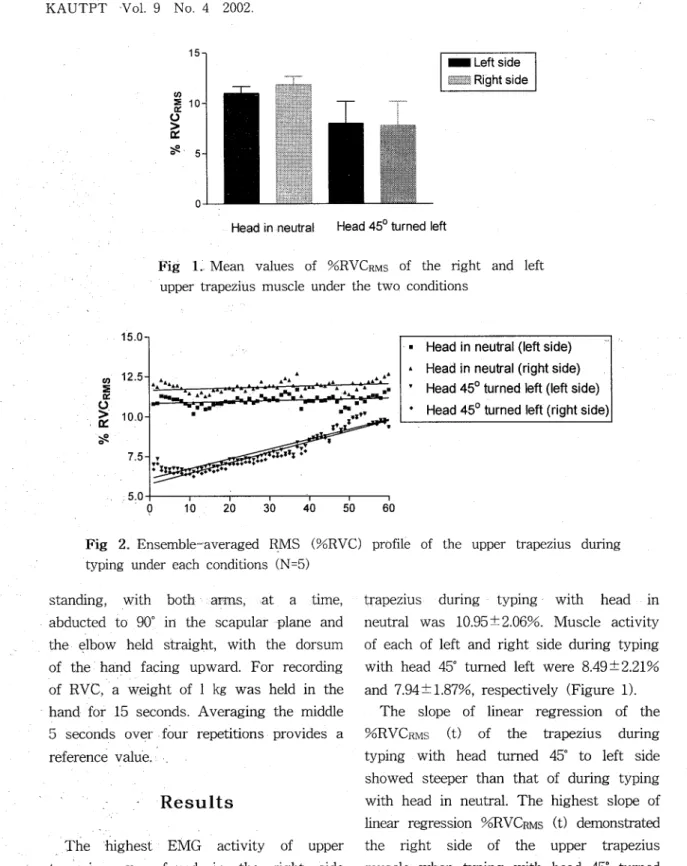
Fig L Mean values of %RVCRMS of the right and left upper trapezius mus c1 e under the two conditions
15.0
Head in neutral (Ieft side)
cn 12.5 -1. ‘ “ “‘ι“ “ “ A “ Head in neutral (right side)
Head 45 0 turned left (Ieft side) Head 45 0 turned left (right side) 졸 1:‘냥L-“‘À"'_.‘- ;-- ‘-.:... ... :“ ‘ζ ‘-ι ••
t
、1.. =-__ _.. F .--.
훌 10.01- ~ .. -..--- 만·
ss ’
Fig 2. Ensemble-averaged RMS (%RVC) profile of the upper trapezius during typing under each conditions (N=5)
standing , with both arms , at a time , abducted to 90
0in the scapular plane and the elbow held straight , with the dorsum of the hand facing upward. For recording of RVC , a weight of 1 kg was held in the hand for 15 seconds. A veraging the middle 5 seconds over four repetitions provides a reference value.
Results
Thehighest EMG activity of upper trapeziuswas found in the right side during typing with head in neutra l(l1. 29 :t 1. 61%). EMG activity of left side of upper
trapezius during typing with head in neutral was 1O .95 :t 2.06%. Muscle activity of each of left and right side during typing with head 45
0tumed left were 8 .4 9 :t 2 .2 1%
and 7.94 :t 1. 87% , respectively (Figure 1), The slope of linear regression of the
%RVCRMS (t) of the trapezius during
typing with head tumed 45
0to left side
showed steeper than that of during typing
with head in neutral. The highest slope of
linear regression %RVCRMS (t) demonstrated
the right side of the upper trapezius
muscle when typing with head 45
0tumed
left (Figure 2)(Table 2).
한국전문물리치료학회지 제 9권 제 4호
KAUTPT Vo l. 9 No. 4 2002.
Table 2. Slope of linear regression of the %RVCRMS (t) for left and right trapezius under each condition
Linear regression %RVCRMS (t)
Head in neutral Head 45
0tumed left Left side
Slope
.0049 :t .0068 a
Right side .0063 :t .0088
Left side .061 :t .0078
Right side .066 :t .0074
Discussion
Recent EMG studies telated to VDT use work have aimed at quantifying the load pattem of the upper extremity muscles to find the mechanisms of musculoskeletal disorders. The experiments of Westgaard and De Luca (1 999) have shown that the motor units with initially higher recruitment thresholds may substitute the motor units with lower thresholds during lQ -minuteduration of trapezius muscle contraction, indicating that continuous firing may temþorarily increase the firing threshold of a motor uni t. In our study, because higher threshold motor units are recruited to replace lower-threshold fatigued motor units that have stopped firing , .a consistent increase of %RVC was foundin the left and right upper trapezius under each condition over the course of working time (Figure 2). Since overexertion of low-threshold motor units is thought to play a role in the pathogenesis of trapezius myalgia (Waersted et al, 1996 ), static load and the frequency of short EMG pauses (gaps) were espetially studied. Hagg and Astrom (1 997) foundthat gap frequency couÌd predict the development of neck/shoulder disorders. Moreover , subjects with neck/shoulder disorders displayed
lower relative duration of muscular rest during work, as compared to subjects without disorders. Both these findings are consistent with the “Cinderella hypothesis".
In our study , as shown in Figure 1 ,
%RVC when typing with head in neutral was higher than it was when typing with head 45
0tumed left. This could be due to the adaptation to position or confidence in computer work tas k. If our study controlled the typing speed , each condition would have %RVC when typing with head in neutral almost equal to it when typing with head 45
0tumed Ieft.
Many previous studies recommended that the copy holder should be positioned on one side of the screen(Bauer and Witting, 1998; Grandjean et al, 1983). Lie and Watten (1 987) found that the activities of the facial and shoulder muscles were sensitive to visual stress experienced by seated subjects reading at eye level under the different visual stress conditions. The authors suggested that increased activity in postural muscles during the VDT work is due to the connection between the extraoccular and smooth eye muscles and the postural muscle through synapses in the midbrain and brain stem.
In typing with head 45
0tumed left , the
right side of muscle activity was higher
한국전문물리치료학회지 제9권 제 4호
KAUTPT- Vo l. 9 No. 4 2002.
than the left side. This means that when working on a computer with head tumed to one side , the opposite side of the upper trapezius muscle predicted as to be more vulnerable to damage.
As shown in Figure 2 , %RVC of the trapezius during typing with head
45。tumed left increased with working than did during typing with head in neutra l. It is suggested that typing with head in neutral is . recommended to prevent musuloskelectal disorder than typing with head tumed position. Further studies are needed to use various methods of surface EMG data reduction , such as amplitude analysis , fatigue analysis , and EEG gaps , to assess the workload during computer work
Conclusion
Purpose of this study was to find the effect of head posture on EMG activity of both sides of upper trapezius during computer work task. The slope of linear regression of the %RVCRMS (t) of the trapezius during typing wìth head tumed 45
0to left sìde showed steeper than that of durìng typìng wìth head in neutra l. The hìghest slope of linear regressìon %RVCRMS (t) demonstrated the right sìde of the upper trapezìus .m uscle when typìng wìth head 45
0tumed lef t. Thìs result suggested that maìntaìnìrig neutral head posìtìon during computer work could be useful to mìnimiie the overuse syndrome and CTDs upper trapezius.
References
Bauer W , Wittig T. Influence of screen and copy holder posìtìons on head posture , muscle actìvity and user judgement. Appl Ergon. 1998;29(3):
185-192.
Grandjean E , Huntìng W , Pidermann M.
VDT workstatìon design: Pr eferred settings and theìr effects. Hum Factors. 1983;25(2):161-175.
Hagg GM , Astrom A. Load pattem and pressure pain threshold in the upper trapezius muscle and psychosocìal factors in medical secretaries with and without shoulder/neck disorders. Int Arch Occup Environ Health. 1997;
69( 6) :423-432.
Hagg GM , Suurkula ]. Zero crossing rate of electromyograms during occupatìonal work and endurance tests as predictors for work related myalgia in the shoulder/neck region. Eur J Appl Ph ysiol
αcupPhysio l. 199 1; 62(6):436-444.
Hamilton N. Source document position as it affects head position and neck muscle tension. Ergonomics. 1996;39(4):593-610.
Ignatius YT , Yee TY , Yan L T. Self reported musculoskeletal problems amongst typist and possible rìsk factors. J Hum Ergol (Tokyo). 1993
;22(2):83-93.
Kl eine BU , Schumann NP , Bradl 1 , et al.
Surface EMG of shoulder and back muscles and posture analysis in secretarìes typìng at vìsual dìsplay units. Int Arch Occup Envìron Health.
1999;72(6):387 - 394.
Lì e 1 , Watten RG. Oculomotor factors ìn the
aetiology of occupatìonal cervicobrachial
한국전문물리치료학회지 제 9권 제4호