Neck dysfunction may be caused by environmental and epidemiological factors such as decreased physi-cal activity and improper posture in the modern pop-ulation,1and persistent neck dysfunction leads to poor
posture, known as the forward head posture (FHP).2-4
In FHP the head position in the sagittal plane moves forward from the gravity line,5and the eyes are fixed
forward, moving the face upward,6 resulting in a
change in neck alignment due to a decrease in the craniovertebral angle (CV angle), which leads to functional impairment of the neck.7 This also causes
imbalance due to excessive muscle tension of the superficial cervical muscles, changes the shoulder bone position, and results in a slumped posture, characterized by thoracic hyperkyphosis due to weakness of the muscles around the shoulder bone.1,8,9
A recent study on patients joint mobilization is not only performed directly on the cervical vertebrae of
The Effects of Maitland Thoracic Mobilization Method on
Cervical Alignment and Muscle Activity in Adult with Forward
Head Posture
INTRODUCTION
Background: Adults with forward head posture (FHP) often suffer from thoracic hyperkyphosis and thoracic dysfunction, and including reduction of the cran-iovertebral angle (CV angle) and tightening of the superficial neck muscles. In order to treat thoracic dysfunction, interventions aimed at improving thoracic mobility are necessary.
Objectives: To examine the effects of maitland manual mobilization therapy on the thoracic spine in adults with FHP.
Design: Single-blind randomized controlled trial.
Methods: Thirty adults with FHP who met the selection criteria were random-ized to the thoracic multiple joint mobilization (TMJM; n=15) group and the tho-racic general joint mobilization (TGJM; n=15) group. Joint mobilizations were performed for 23 minutes a day for 4 weeks continuously, two times per week. Outcome measures were ImageJ, BTS FREE EMG 1000, neck disability Index (NDI).
Results: Although changes in the left sternocleidomastoid muscle activity and NDI scores over time between the two groups differed, other variables were noted only changes observed over time. Muscle activity in the right sternoclei-domastoid increased again in the TGJM group post-intervention and 2 weeks after the end of the experiment, but changes in other variables were retained or improved, confirming the lasting effects of thoracic joint mobilization. Conclusion: Thoracic multiple joint mobilization may be recommended as a more effective intervention for adults with FHP.
Keywords:Forward head posture; Thoracic mobilization; Maitland manual mobilization therapy; Craniovertebral angle; Muscle activity; Neck disability Index
Dajeong Kim, PT, MSa, Hojung An,
PT, Prof., PhDb, Nyeonjun Kim,
PT,Prof., PhDc, Ayeon Kim, PT, MSa,
Geurin Hong, PT, MSa, Soonhee Kim
PT, Prof., PhDa
aDepartment of Physical Therapy, Yongin
University, Yongin, Republic of Korea;
bDepartment of Physical Therapy, Dongnam
Health University, Suwon, Republic of Korea;
cDepartment of Physical Therapy, Pohang
University, Pohang, Republic of Korea
Received : 25 April 2020 Revised : 17 June 2020 Accepted : 23 June 2020
Address for correspondence Soonhee Kim, Prof., PhD
Department of Physical Therapy, Yongin University, 134, Yongindaehak-ro, Cheoin-gu, Yongin-si, Gyeonggi-do, Republic of Korea
Tel: 82-10-5345-2776 E-mail: [email protected]
cervical dysfunction patients, with thoracic dysfunc-tion and hyper kyphosis indicating that both direct and indirect cervical joint mobilization can improve mobility and thereby indirectly reduce cervical pain and increase the range of motion.10,11
However, in the spine, not only the zygapophysial joint that connects the spine, but the hypomobility of the costotransverse joint and costovertebral joints of the same segment that provides stability to the tho-racic can also affect thotho-racic, but in previous studies joint mobilization was performed only centrally to the thoracic.12,13 studies confirming the continuity of the
joint mobilization effects are lacking. The present study aims to examine and compare the effect of thoracic general joint mobilization alone and multiple joint mobilization (including both general joint and thoracic mobilization) in adults with FHP to deter-mine the more effective intervention between the two in treating FHP in adults.
The study was a single-blinded and randomized-controlled clinical trial. All subjects the order was randomly selected using an opaque envelope by the researcher, who has no conflict of interest with the present study. A subject recruitment notice was post-ed for 2 weeks on a campus bulletin board at D University in Suwon-si, South Korea, to recruit 60 adult males and females who agreed to participate in the study. The selection criteria were adult females or males in their 20s who agreed to participate and had 1) a CV angle of <51˚, 2) no known neurological dis-ease or surgery in the cervical or thoracic regions in the previous 3 months,11 and 3) no cerebrovascular
diseases such as headaches, dizziness, or vomiting.14
The study was approved by the Institutional Review Board of Yongin University (approval no. 2-1040966-AB-N-01-20-1910-HSR-150-6), Gyeonggi-do, South Korea.
Craniovertebral angle
A sticker was attached as a reference point on the tragus and the seventh cervical (C7) spinous process of subjects before they were asked to sit in a com-fortable position. A portable camera (Samsung
performed self-balanced postures (SBP) three times.15
The subject's head then stopped in the most comfort-able position, and placed a mirror in front of the subject that could stare at the subject's eyes, limiting the change of posture by vision, and taking pictures from the side. ImageJ (Rasband, 2007) was used to measure the quantified CV angle from the photo-graphs obtained.16,17 this measurement method has
been reported to have a high reliability of .84-.94 in previous studies.18
Muscle activity
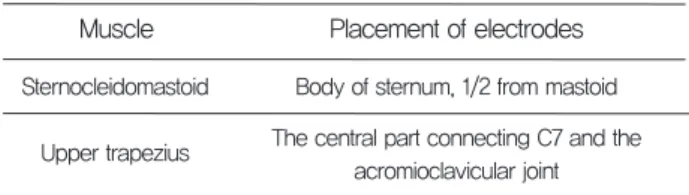
To measure the change in muscle activity, BTS Free EMG 1000 (BTS Bioengineering Corp, Quincy, MA, USA) was used to measure muscle activity in the sternocleidomastoid and both upper trapezius muscles (Table 1). Data were collected using an EMG analyzer software on a computer connected to an EMG device. To increase the objectivity of data due to differences in individual muscle strength of the study subjects, data on contraction of the neck muscles were calcu-lated as root mean square (RMS) and as ratios (%MVC) to compare muscle activity during maximal voluntary contraction (MVC) and while in the position for performing study tasks.19
Both the MVC and manual muscle test were meas-ured by the same experimenter.
To measure cervical muscle activity in the subjects’ posture during task performance, subjects adopted a sitting position and a desk with a medium height was placed between the xiphoid process of the sternum and umbilicus. Subjects were then asked to adopt a comfortable position and look at their smartphones for 1 minute with both elbow joints on the desk to measure muscle contraction data from both the ster-nocleidomastoid and the upper trapezius muscles.
Neck disability index
SUBJECTS AND METHODS
Subjects
Outcome Measures
Muscle Placement of electrodes
Body of sternum, 1/2 from mastoid The central part connecting C7 and the
acromioclavicular joint Sternocleidomastoid
Upper trapezius
Table 1. The placement of surface EMG electrodes %MVC = × 100RMS during task position
daily activities. Each questionnaire item is measured using a 6-point scale (5=unbearable pain or complete dysfunction, 0=no pain or no functional disorder).20 A
total score of 4 points or less indicates no disability; 5-14 points, mild disability; 15-24 points, moderate disability; 25-34 points, severe disability; and 35 points or above, complete disability.21, 22The reliability
of the scale r is .82.23
One set of the following mobilizations was per-formed per segment in the Thoracic multiple joint mobilization (TMJM) group: central PA mobilization for zygapophyseal joint movement, unilateral PA mobilization for costotransverse joint movement, and unilateral costovertebral joint PA mobilization for costovertebral joint movement. For the thoracic gen-eral joint mobilization (TGJM) group, central PA mobilization was performed five times per segment (Table 2).
Subjects were asked to perform passive accessory intervertebral motion to get an end feel for each seg-ment. Grade II vibration technique was used when pain was the main limiting factor; Grade Ⅲ vibration technique was used when the main limiting factor was stiffness.
Using a metronome application, 50 joint mobiliza-tions were performed for 1 minute with the same velocity, which was paused if patients complained of dizziness or headache during the mobilization. There were 30-second breaks between mobilization times and 60-second breaks between segment mobiliza-tions for a total of 23 minutes (Table 2).
All subjects were assessed pre-test, post-test 4 weeks after the intervention, and at follow-up 2
weeks after the end of the experiment. Each session was conducted for 23 minutes per day, twice a week for 4 weeks. We randomized 15 subjects using a ran-dom assignment tool (Research ranran-domizer; http://www.randomizer.org/) to the TMJM and TGJM groups. The pre-test assessment was con-ducted after obtaining written consent, while the post-test assessment took place after the interven-tion had been completed. The follow-up test was conducted 2 weeks after the end of the experiment. All assessments were conducted by one physical therapist who was blinded to the study.
Statistical analyses were performed using SPSS v20 (IBM, Armonk, NY, USA). General characteristics of subjects were assessed using the χ2test and frequency
analysis. To check for the interaction between the time lapses in the two groups, two-way repeated measures analysis of variance was used; if Mauchly’s test indicated that the assumption of data sphericity had not been violated, the Greenhouse-Geisser value was interpreted as being within the subjects’ effect test. If not, Pillai’s trace value was interpreted using the multivariate test. Paired t-test was used to con-firm the change in CV angle, neck muscle activities, and NDI score over time within the two groups. The statistical significance level α was set at .05.
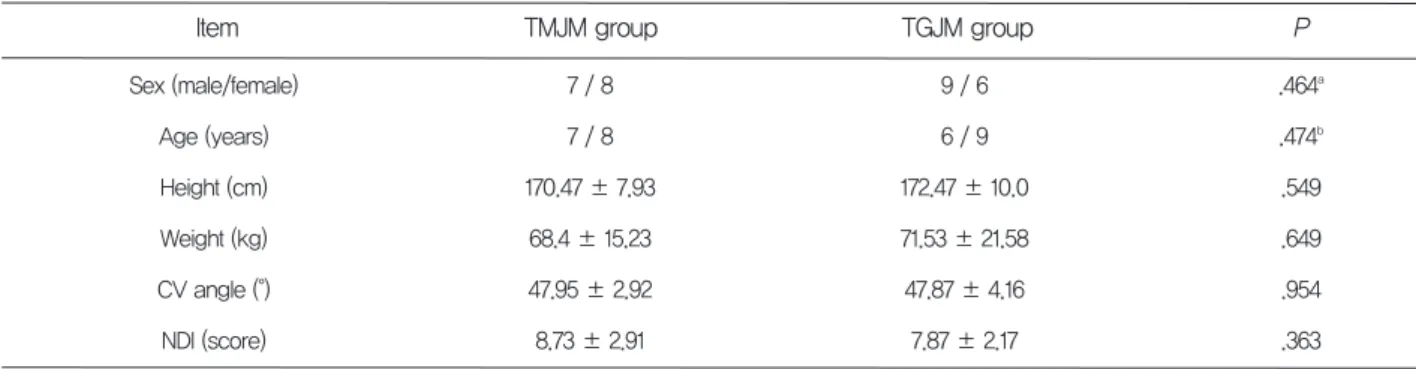
There were no significant differences between the two groups in terms of general characteristics (Table 3).
Experimental Procedures
General characteristics of subjects Data and Statistical Analysis Interventions
MJM: multiple joint mobilization, GJM: general joint mobilization
Segment Group Thoracic MJM Thoracic GJM Techniques Central PA mobilization Unilateral PA mobilization Unilateral costovertebral joint PA mobilization
Central PA mobilization
Set
1 session / 1 time 1 session / 2 times (both) 1 session / 2 times (both)
1 session / 5 times Time 1 min 1 min 1 min 1 min T2–T4
Table 2. Thoracic mobilization techniques used in the intervention
Changes of in the groups before (4 weeks) and after the intervention (2 weeks)
The two groups showed differences in changes over time due to the interaction between the groups and time lapse for left sternocleidomastoid muscle activity (F=4.093, P<.05) and NDI score (F=14.473, P<.05);
however, the difference between the groups was only significant for the CV angle (F=64.689, P<.01), right sternocleidomastoid muscle activity (F=9.980, P<.01), left upper trapezius muscle activity (F=14.052, P< .01), and right upper trapezius muscle activity (F= 16.990, P<.01).
All values are presented as mean and standard deviation
a: Analyzed using the χ2test
b: Analyzed using the independent t-test
TMJM: thoracic multiple joint mobilization TGJM: thoracic general joint mobilization CVA: craniovertebral angle
NDI: neck disability index
Item Sex (male/female) Age (years) Height (cm) Weight (kg) CV angle (°) NDI (score) TGJM group 9 / 6 6 / 9 172.47 ± 10.0 71.53 ± 21.58 47.87 ± 4.16 7.87 ± 2.17 P .464a .474b .549 .649 .954 .363 TMJM group 7 / 8 7 / 8 170.47 ± 7.93 68.4 ± 15.23 47.95 ± 2.92 8.73 ± 2.91 Table 3. General characteristics of subjects
*P<.05, **P<.01. All values are presented as mean and standard deviation
SD: standard deviation, MVC: maximal voluntary contraction, CV angle: craniovertebral angle, NDI: neck disability index, SCM: sternocleidomastoid, MJM:
Classification mean±SDPre-test Post-test (4 weeks) mean±SD Follow-up (after 2 weeks)mean±SD F P-value
Thoracic MJM Thoracic GJM Thoracic MJM Thoracic GJM Thoracic MJM Thoracic GJM Thoracic MJM Thoracic GJM Thoracic MJM Thoracic GJM Thoracic MJM Thoracic GJM CV angle, degree Muscle activities, %MVC NDI score 56.09 ± 3.32bc 53.41 ± 3.67b 2.47 ± 0.92b 2.87 ± 1.57 2.70 ± 0.89b 3.42 ± 1.40c 4.28 ± 2.49b 5.63 ± 4.07 4.62 ± 3.01b 5.70 ± 4.06b 2.93 ± 1.94bc 5.07 ± 1.71bc 52.90 ± 2.78a 53.56 ± 4.18a 2.69 ± 1.05a 2.68 ± 1.17 3.03 ± 1.25a 3.15 ± 1.25 5.13 ± 3.61a 5.30 ± 3.42a 5.51 ± 3.34a 6.27 ± 4.09 3.53 ± 1.73a 6.20 ± 1.32a .189 .012* .075 .112 .184 .000** 1.773 .233 .175 .150 5.372 14.473 47.95 ± 2.25 47.87 ± 4.16 3.49 ± 1.56 2.92 ± 1.26 3.86 ± 1.85 3.37 ± 1.40 6.83 ± 4.44 6.18 ± 3.74 7.04 ± 4.30 6.96 ± 4.66 8.73 ± 2.91 7.87 ± 2.17
In addition, although the right sternocleidomastoid muscle activity increased again in the TGJM group after the intervention and 2 weeks after the end of the experiment, retention of the thoracic joint mobi-lization was confirmed as other variables maintained the same level or even improved (Table 4).
In this study, the effect on cervical alignment, muscle activity and NDI was confirmed by applying different thoracic joint mobilization techniques for 4 weeks to adults with FHP. The TMJM and TGJM groups both showed significant differences in all variables after the 4-week intervention, with signifi-cant intergroup differences in left sternocleidomastoid muscle activity and NDI. However, no significant intergroup difference in other variables was found.
As in the previous works, this study also found that posture alignment effectively improved with an increase in the CV angle and that the application of thoracic joint mobilization in zygapophyseal joint direction reduced thoracic kyphosis,11which indicates
that posture alignment is affected by changes in cer-vical position.
FHP generates excessive muscle tone of the cervical ventral muscle due to abnormal alignment and causes shortening of the cervical extensor, which is the dor-sal muscle, and increases the stress of the neck around muscle. In particular, since abnormal neck around muscle tone reduces the CV angle and trans-forms the ideal posture, it was suggested that an intervention method for muscle tone improvement was necessary.12,24
When analyzing the results of muscle activity after intervention of these muscles, the superficial muscles of the neck and shoulder, which are fatigued due to muscle imbalance, can be seen as a positive result only when the muscle activity is relatively reduced.25
This study examined whether imbalance in the pat-tern of muscle activity was improved in adults with FHP by measuring cervical muscle activity, superficial postural muscle activity, and sternocleidomastoid and upper trapezius muscle activity by analyzing it using the %MVC method. A relative reduction in muscle activity of the superficial muscles of the neck and shoulders following the intervention may thus be regarded as a positive result.
Both groups showed significant differences in the left sternocleidomastoid muscle activity according to
time; both groups also showed an intergroup differ-ence in changes over time. However, there was no intergroup difference in the right sternocleidomastoid and both upper trapezius muscle activities, and only within-groups differences according to time were significant.
This is consistent with the results of a previous study that reported that an increase in the CV angle led to a significant reduction in the sternocleidomas-toid and upper trapezius muscle activity. Therefore, we believe that the increased FHP in this study was improved by thoracic joint mobilization, which in turn significantly reduced the sternocleidomastoid and upper trapezius muscle activity.26
FHP is closely related to neck dysfunction; neck dysfunction was assessed using the NDI question-naire, which has demonstrated reliability. There was a difference in the changing patterns in the time lapse between the two groups. As the thoracic verte-brae are connected to the zygapophyseal, costotrans-verse, and costovertebral joints, effective improve-ment of low mobility in the surrounding joints, rather than in the zygapophyseal joint, may have had a more positive impact on the NDI.
Based on the above results, we conclude that both groups showed significant differences in time lapse and that the maintenance and improvement of all variables, excluding the right sternocleidomastoid muscle activity, 2 weeks after the end of the experi-ment suggest that thoracic joint mobilization can be an effective intervention method for improving FHP.
An assessment of the pain caused by the zygapophyseal, costotransverse and costovertebral joints (joints connected to the thoracic) is difficult.27
Unilateral PA joint mobilization and costovertebral joint PA joint mobilization should, therefore, also be applied around the affected area if the application of central PA joint mobilization in the thoracic zygapophysial joint does not lead to adequate improvement.27 However, as in this study, joint
mobilization was performed on a limited number of thoracic (T2–T4) segments, and, therefore, the results cannot be generalized to apply to segments that are directly involved in the patients’ problems. Hence, it is possible that similar effects could be obtained by applying general joint mobilization with only central PA joint mobilization, and the small difference in intervention effects between the two groups may have been due to the shortness of the experiment (4 weeks).
In addition, while the TMJM group underwent one joint mobilization per thoracic segment, the TGJM
group underwent five joint mobilizations per seg-ment, which may explain changes due to irradiation effects to the surrounding joints with central PA joint mobilization alone.
Therefore, future research should focus on various age groups and a longer study period on segments that are direct sources of pain and low mobility in patients, rather than on a limited number of seg-ments by dividing them into upper thoracic (T1–T4), middle thoracic (T5–T9), and lower thoracic (T10–T12). Using the two different application methods for the same duration, future studies need to investigate in detail differences in effects by confirming changes in posture factors and muscle activities; we hope to confirm these effects in a larger cohort using other assessment tools.
In adults with FHP, the TMJM group showed a more significant difference in time lapse than the TGJM, suggesting that TMJM could be an effective intervention method. However, differences in the interaction between time lapse and groups in several variables were not statistically significant, indicating that the difference in intervention effects is non-sig-nificant. In addition, muscle activity in the right sternocleidomastoid increased again in the TGJM group after the intervention and 2 weeks after the end of experiment; however, retention of the thoracic joint mobilization was confirmed as significant differ-ences were not seen in other variables.
The author declares that there are no conflicts of interest.
CONCLUSION
CONFLICT OF INTERESTS
REFERENCES
1. 2.Szeto GP, Straker L, Raine S. A field comparison of neck and shoulder postures in symptomatic and asymptomatic office workers. Appl Ergon. 2002;33(1):75-84.
Lee CY. Postural patterns of daily life of male
3. 4. 5. 6. 7. 8. 9. 10. 11. 12. 13. 14. National University; 2004.
Silva AG, Punt TD, Sharples P, Vilas-Boas JP, Johnson MI. Head posture and neck pain of chronic nontraumatic origin: a comparison between patients and pain-free persons. Arch Phys Med Rehabil. 2009;90(4):669-674.
Lewis JS, Valentine RE. Clinical measurement of the thoracic kyphosis. A study of the intra-rater reliability in subjects with and without shoulder pain. BMC Musculoskelet Disord. 2010;11(1):39. Fernández-de-Las-Peñas C, Cuadrado M, Pareja J. Myofascial trigger points, neck mobility and forward head posture in unilateral migraine. Cephalalgia. 2006;26(9):1061-1070.
McKenzie R. The cervical and thoracic spine: mechanical diagnosis and therapy. New Zealand: Spinal Publications; 1990.
Kim DH, Kim CJ, Son S-M. Neck pain in adults with forward head posture: effects of craniover-tebral angle and cervical range of motion. Osong Public Health Res Perspect. 2018;9(6):309. Neumann DA. Kinesiology of the musculoskeletal system-e-book: foundations for rehabilitation. Elsevier Health Sciences; 2013.
Kapreli E, Vourazanis E, Strimpakos N. Neck pain causes respiratory dysfunction. Med Hypotheses. 2008;70(5):1009-1013.
Ko T, Jeong U, Lee K. Effects of the inclusion thoracic mobilization into cranio-cervical flexor exercise in patients with chronic neck pain. Eur J Phys Rehabil Med. 2010;22(1):87-91.
Cho J, Lee E, Lee S. Upper thoracic spine mobi-lization and mobility exercise versus upper cervi-cal spine mobilization and stabilization exercise in individuals with forward head posture: a ran-domized clinical trial. BMC Musculoskelet Disord. 2017;18(1):525.
Lee, KS, Lee, JH. Effect of maitland mobilization in cervical and thoracic spine and therapeutic exercise on functional impairment in individuals with chronic neck pain. J Phys Ther Sci. 2017:29(3):531-535.
Krauss J, Creighton D, Ely JD, Podlewska-Ely J. The immediate effects of upper thoracic transla-toric spinal manipulation on cervical pain and range of motion: a randomized clinical trial. J Man Manip Ther. 2008;16(2):93-99.
Lee KS, Lee JH. Effect of maitland mobilization in cervical and thoracic spine and therapeutic exercise on functional impairment in individuals with chronic neck pain. J Phys Ther Sci.
16. 17. 18. 19. 20. 21.
investigation of natural head posture and upper cervical flexor muscle performance. Cephalalgia. 1993;13(4):272-284.
Harman K, Hubley-Kozey CL, Butler H. Effectiveness of an exercise program to improve forward head posture in normal adults: a ran-domized, controlled 10-week trial. J Man Manip Ther. 2005;13(3):163-176.
Diab AA, Moustafa IM. The efficacy of forward head correction on nerve root function and pain in cervical spondylotic radiculopathy: a random-ized trial. Clin Rehabil. 2012;26(4):351-361. Raine S, Twomey LT. Head and shoulder posture variations in 160 asymptomatic women and men. Arch Phys Med Rehabil. 1997;78(11):1215-1223. Weon JH, Oh JS, Cynn HS, Kim YW, Kwon OY, Yi CH. Influence of forward head posture on scapular upward rotators during isometric shoul-der flexion. J Bodyw Mov Ther. 2010;14(4):367-374.
Vernon H, Mior S. The Neck Disability Index: a study of reliability and validity. J Manipulative Physiol Ther.1991;14(7):409-415.
Lee H, Nicholson LL, Adams RD, Maher CG, Halaki M, Bae S-S. Development and psychome-tric testing of Korean language versions of 4 neck pain and disability questionnaires. Spine. 2006;31(16):1841-1845. 22. 23. 24. 25. 26. 27.
Lee EW, Shin WS, Jung KS, Chung YJ. Reliability and validity of the neck disability index in neck pain patients. J Kor Phys Ther. 2007;14(3):97-106.
Song KJ, Choi BW, Kim SJ, Yoon SJ. Cross-cul-tural adaptation and validation of the korean version of the neck disability index. J Korean Orthop Assoc. 2009;44(3):350-359.
Kim DH, Kim SY. Comparison of immediate effects of sling-based manual therapy on specific spine levels in subjects with neck pain and for-ward head posture: a randomized clinical trial. Disabil Rehabil. 2019:1-8.
Kebaetse M, McClure P, Pratt NA. Thoracic posi-tion effect on shoulder range of moposi-tion, strength, and three-dimensional scapular kinematics. Arch Phys Med Rehabil. 1999;80(8):945-950.
Lee KJ, Roh JS, Choi HS, Cynn HS, Choi KH, Kim TH. Effect of active intervention after kaltenborn’s cervical joint mobilization on the cervical spine alignment and muscle activity in patients with forward head posture. J Korean Soc Phys Med. 2015;10(2):17-27.
Maitland GD. Maitland's vertebral manipulation. Elsevier Butterworth-Heinemann;2005.