• 검색 결과가 없습니다.

A Convergence Study on Changes in the Muscle Activity around the Neck of the Operator according to the Patient's Head Angle at the Direct Visual Inspection of the Maxillary Right-side Molar Palatal Surface

N/A
N/A
Protected

Academic year: 2021

Share "A Convergence Study on Changes in the Muscle Activity around the Neck of the Operator according to the Patient's Head Angle at the Direct Visual Inspection of the Maxillary Right-side Molar Palatal Surface"

Copied!
8
0
0

로드 중.... (전체 텍스트 보기)

전체 글

(1)

A Convergence Study on Changes in the Muscle Activity around the Neck of the Operator according to the Patient's Head Angle at the

Direct Visual Inspection of the Maxillary Right-side Molar Palatal Surface

Sook-Jeong Lee

Assistant Professor, Dept. of dental Hygiene, Silla University

상악 우측 대구치 구개면의 직접 시진 시

환자 머리 각도에 따른 술자의 목 주변 근육활성도 변화의 융합적 연구

이숙정

신라대학교 치위생학과 조교수

Abstract This study aimed to investigate the association of the muscle activity around the neck of the operator(dental hygienists’) according to the change in the patient’s neck angle during a direct visual inspection on the maxillary right-side molar palatal surface. The operators were 4

th

year dental hygiene students, who are future dentalhy gienists, having accurate understanding on and awareness of the location of the operation site, hand fixation, and how to use the tools. Data on the change in the muscle activity around the neck were collected by using surface electromyography and neck goniometer. SPSS statistics 20 was used for statistical analyses including Shapiro-wilk test and one-way ANOVA. As a result, the activities of the operator upper trapezius, cervical erector spinae, and levator scapulae muscles significantly decreased when the patient’s head was angled compared to when it was not.

For the angle of the operator head, the head bend significantly decreased when the patient’s head was angled than when it was not. Based on the study results, it is expected that angling the patient’s head when treating his or her teeth will decrease the excessive muscle activity around the neck of the operator, and will reduce muscle fatigue.

Therefore, angling the head of the patient while treating his or her teeth is recommended. This suggests that muscle pain caused by repetitive actions in the wrong posture can be reduced.

Key Words : Convergence, operator, muscle activity, surface EMG, neck goniometer,

요 약 본 연구는 환자 구강내의 상악 우측 대구치 구개면 직접시진 시 환자 머리 각도의 변화에 따른 술자(치과위생사)의 목 주변 근육 활성도의 관련성을 알아보고자 하였다. 술자는 해당부위의 위치와 손고정, 기구 사용에 대한 정확한 이해와 인지를 하고 있는 예비 치과위생사인 치위생학과 4학년 학생들로 표면 근전도, 목 각도계를 이용하여 목 주변 근육 활성도 변화의 자료를 수집하여 SPSS statistics 20을 이용해 Shapiro-wilk 검정, 일원배치 분산분석의 통계처리를 실시하였다.

연구결과 환자 머리의 각도를 주었을 때 각도를 주지 않은 자세 보다 술자의 위등세모근, 목세움근, 어깨올림근 근활성도가 모두 유의하게 감소하였다. 술자의 머리 각도는 환자 머리 각도를 준 자세가 머리 각도를 주지 않은 자세 보다 머리 굽힘은 유의하게 감소하였다. 결과적으로 치아 처치 시 환자 머리 각도의 변화를 주는 것은 술자의 목 주변 근육의 과도한 근활성 도를 줄이고 근육 피로도를 낮출 것으로 예상됨으로 치아 처치 시 환자의 머리 각도 변화의 시행을 추천한다. 이는 잘못된 자세의 반복행위로 인한 근육의 통증도 줄일 수 있을 것이라 사료된다.

주제어 : 융합, 술자, 근활성도, 표면 근전도, 목 각도계

*Corresponding Author : Sook-Jeong Lee ([email protected]) Received September 16, 2018

Accepted November 20, 2018

Revised November 2, 2018 Published November 28, 2018
(2)

1. Introduction

The repetitive use of the dominant hand (the most frequently used hand) in the movements in daily life makes the body continuously move to only one direction, and makes it difficult for the right and left body muscles to be aligned and balanced. This causes muscle imbalance and triggers chronic body pains[1].

In particular, if the repetitive use of the dominant hand continues to repetitive motion in one’s work environment, or there is work overload or when an inappropriate work posture is assumed at the workplace, this will cause musculoskeletal disease of the dominant hand use region[2-4]. Operator(dental hygienists), who are hospital workers, tend to use their dominant hand repetitively when treating their patient’s teeth for long hours; tend to twist their back, neck, and wrist muscles while bending or moving to secure a clear view of the narrow space in the patient’s oral cavity; and tend to participate in treating the patient’s teeth with a repetitive and inappropriate posture.

Therefore, their risk of acquiring the related musculoskeletal diseases can be high[5,6]. Especially, the center of gravity of the operator(dental hygienist’s) head is moved to the front when he or she treats the patient’s teeth in a cervical bending posture for long hours, so the muscle activity of the cervical extensor is increased to balance the head, as a compensating mechanism [7,8]. This causes an increase in the activities of the levator scapulae and upper trapezius muscles, and eventually leads to muscle fatigue and pain if continuous repetition continues. Moreover, the continuing assumption of the aforementioned wrong posture will eventually cause musculoskeletal disease, and if such disease is left untreated and if the pain accompanying it is not managed, it can cause a decline in the quality of the operator(dental hygienist’s) work and in his or her will to work at the workplace due to the pain, and will also require long-term treatment of the disease as well as a longer convalescence time[9,10]. While treating the narrow space in the

patient’s oral cavity, most dental practitioners have no choice but assume an inappropriate posture. This will result in discomfort in the neck, shoulder, and back, which will increase with time. Direct visual inspection of the maxillary right-side molar palatal surface among the other teeth in the oral cavity requires the widest movement of the neck and shoulder, and uses much more inappropriate muscles. Therefore, this study was conducted to find a way of decreasing the occurrence of work-related musculoskeletal disease, which requires long-term treatment, in operator(dental hygienists), through the small effort of angling the patient’s head, without having to make a big change in the work environment. For this, this study identified the changes in the muscle activity in the neck and shoulder region of operator(dental hygienists) treating a patient’s teeth when the patient’s head was angled, and determined the angle of the patient’s head that would allow the least movement of the operator(dental hygienist’s) neck and shoulder.

2. Study Methods

2.1 Subjects and oral cavity regions

The subjects were dental hygiene students who mentioned that they did not have pain in the musculoskeletal or neurological areas based on their subjective judgment. They were 15 students in their fourth year, who were accurately understanding the tooth site in the patient (the mannequin), the position of the operator and the operation procedure. After the explanation of the study procedures and objectives to the subjects, the study was conducted by making the subjects conduct direct visual inspection of the patient’s proximal/distal maxillary right-side molar palatal surface among the other regions in the oral cavity, which requires the widest angle of the dental practitioner’s head and shoulder.

2.2 Study equipment

(3)

2.2.1 Surface electromyography

Surface electromyography (4D-SES, Relive, Korea) was used to measure the activities of the cervical erector spinae and upper trapezius muscles. The sampling rate was set at 1,204 Hz, and the muscle signal was processed with the root-mean-square value.

For data normalization, the reference voluntary contraction (RVC) was used to convert the data to

%RVC, and this was then analyzed. The RVC posture was defined as the participant sitting comfortably with his or her arms flexed to 90° at the shoulder, and with the elbow joints extended while the participant clenches his or her fists for 10 seconds. It was measured three times repetitively, and a 30-second resting time was given after every measurement. After eliminating the values obtained for the first and last 1 second, the mean of 8 seconds was used for data processing, and the mean of the three measurement values obtained was used.

2.2.2 Cervical goniometer

The cervical range of motion (CROM, Performance Attainment Associate, USA) can measure the movement of the head and neck three-dimensionally. It was set on the head of each patient and dental hygienist after aligning the reference line horizontally.

The neck angles of the patients and dental hygienists for each posture were measured three times, and the mean of the three obtained values was used.

2.3 Study procedure

To eliminate the skin resistance, the hair in the applicable region was removed using a razor, and an electrode was attached after disinfecting the region with an alcohol swab. For the upper trapezius muscle, an electrode was attached to the biggest contracting part, at around the middle part of the acromion and C7, while electrodes were attached with 1 cm intervals around the spinous process of C4 for the cervical erector spinae muscles [5]. A 5-minute break was given after measuring the reference isometric

contraction, and then the dental hygienist commenced the treatment from the dental hygienist cervical rotation (DC) position so that he or she would see the patient’s teeth clearly. The patient maintained the supine position, with the sagittal axis at 90°, while the frontal and horizontal axes were kept at 0° when measured with CROM. CROM was used to measure the head angle of the dental hygienist, and EMG was used to measure the muscle activities during the treatment. After a 5-minute break, the dental hygienist resumed the treatment at the patient cervical rotation (PC) position so that he or she could directly inspect the patient’s teeth. CROM was used to measure the head rotation angle after the dental hygienist positioned the patient’s head for a better view while maintaining the sagittal axis at 90° and the frontal axis at 0°. Then the treatment was resumed, and the head angle of the dental hygienist was measured using CROM while the muscle activities were measured using EMG.

One-minute treatment was given three times for each position, and the mean values of the three measured head angles of the patient and dental hygienist and of the dental hygienist’s muscle activities were used.

2.4 Statistical analysis method

SPSS Statistics 20 was used for the analysis of the collected data. The independent variables were DC and PC, and the dependent variables were the patient’s head angle, the dental hygienist’s head angle, and the activities of the dental hygienist’s upper trapezius and cervical erector spinae muscles. All the data were tested for normality using the Shapiro-Wilk test.

Paired t-test was used to compare the head angles and muscle activities at the different postures. The significance level (α) was set at 0.05.

3. Study Results 3.1 Demographics

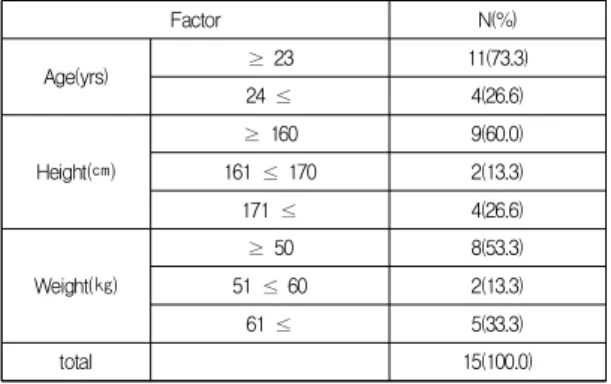
Most of the subjects were 23 years old or younger

(4)

(11, 73.3%), no taller than 160 cm (9, 60.0%), and no heavier than 50 kg (8, 53.3%)[Table 1].

Table 1. General Characteristics of study subjects

Factor N(%)

Age(yrs) ≥ 23 11(73.3)

24 ≤ 4(26.6)

Height(㎝)

≥ 160 9(60.0)

161 ≤ 170 2(13.3)

171 ≤ 4(26.6)

Weight(㎏)

≥ 50 8(53.3)

51 ≤ 60 2(13.3)

61 ≤ 5(33.3)

total 15(100.0)

3.2 Difference in the dental hygienist’s cervical flexion by the change in the patient’s (mannequin’s) head angle

The operator(dental hygienist’s) posture(52.5 ± 8.1) while treating a patient (mannequin) with the latter’s head angled(32.1 ± 9.3) to the right significantly decreased(12.198(p<.000)) the dental hygienist’s cervical flexion(74.4 ± 6.9) compared to the posture with the operator(dental hygienist’s) neck bent and with the patient’s (mannequin’s) head not angled to the right(0.0 ± 0.0)[Table 2].

Table 2. Differences of hygienist cervical flexion angle and model cervical right rotation angle during tooth treatment between hygienist cervical flexion position and model cervical right rotation position

Hygienist cervical flexion

position

Model cervical right

rotation position

t(p)

Hygienist cervical

flexion angle

74.4 ± 6.9 52.5 ± 8.1 12.198(.000)

Model cervical

right rotation

angle

0.0 ± 0.0 32.1 ± 9.3 -13.358(.000)

Unit: %RVC

3.3 Difference in the dental hygienist’s upper trapezius muscle activity by the change in the patient’s (mannequin’s) head angle The operator(dental hygienist’s) posture(37.9 ± 30.4) while treating a patient (mannequin) with the latter’s head angled to the right showed a significant decrease(6.138(p<.000)) in the muscle activity of the right-side upper trapezius compared to the posture(81.1

± 29.8) with the dental hygienist’s neck bent and with the patient’s (mannequin’s) head not angled to the right.

All the other muscles did not show significant differences[Table 3].

Table 3. Differences of upper trapezius and cervical erector spinae muscle activation during tooth treatment between hygienist cervical flexion position and model cervical right rotation position

Hygienist cervical

flexion position

Model cervical right rotation

position

t(p)

Lt. upper

trapezius 23.1 ± 13.2 17.5 ± 6.4 1.755(.101) Lt. cervical

erector spinae

107.9 ±

15.3 109.3 ± 19.1 -.578(.573) Rt. upper

trapezius 81.1 ± 29.8 37.9 ± 30.4 6.138(.000) Rt. cervical

erector spinae

110.3 ±

21.3 108.9 ± 20.9 .825(.423) Unit: %RVC

4. Considerations

Body movement involves moving not only one

muscle but several muscles. The same applies to the

dental hygienist’s movement when treating the

patient’s teeth. The dental hygienist’s assumption of a

posture with a bended neck for a long time while

treating the patient’s teeth shifts the center of gravity

of his or her head to the front and increases the activity

of the cervical extensor muscles to compensate for

such and to balance the head[3]. This causes increased

activity of the levator scapulae and upper trapezius

muscles, and eventually leads to muscle fatigue.

(5)

Further, continuing and repeating such movement and assuming such posture for an extended time can cause pain in the applicable muscles. This is consistent with the study results that have been reported, that the lower height of the monitor in computer work increased the cervical flexion angle and the cervical extensor muscle activity[11]. Dental hygiene textbooks include educational contents regarding the treatment of each part of the teeth in the oral cavity, along with the patient’s proper posture, the practitioner’s appropriate position, the tool holding method to be used and the proper hand fixation, how to secure excellent vision, and precautions. Although there is mention of the proper patient posture (with a 20-30° head angle) for the treatment of each mandibular tooth, there is no mention of the proper patient head angle for the treatment of the maxillary teeth. Direct visual inspection of the maxillary right-side molar palatal surface, which was covered in this study, is very difficult without changing the patient’s head angle, unlike indirect visual inspection. For direct visual inspection, the dental practitioner makes a wide muscle movement, such as excessive neck, shoulder, and back bending, and maintains that posture until the end of the treatment, because the part to be treated is not visible.

This long-term assumption of such inappropriate posture results in accumulated muscle pain during the treatment of the applicable tooth, and in the difficult movement of the musculoskeletal system[12].

Therefore, this study investigated the changes in the dental hygienist’s neck, upper trapezius, and cervical erector spinae muscles while conducting treatment through an experiment on the treatment of the maxillary right-side molar palatal surface region.

As a result, it was found that the right head angle of the patient (mannequin) that allows minimal cervical flexion and easy visual inspection by the dental hygienist was about 32.1°. The dental hygienist’s cervical flexion decreased by about 21.9° compared to when the head of the mannequin was not angled to the right. There was no significant difference in the dental

hygienist’s left-side upper trapezius muscle activity, but the activity of the right-side upper trapezius muscle significantly decreased when the dental hygienist was treating the patient’s (mannequin’s) teeth with the latter’s head angled to the right. This is because all the dental hygienist subjects used their right hands, which resulted in increased activity of the right-side upper trapezius muscle. Angling the patient’s (mannequin’s) head to the right allowed the dental hygienist subjects to treat the patient’s (mannequin’s) teeth with decreased shoulder flexion and elevation on their part, which resulted in decreased activity of their upper trapezius muscle and allowed them to treat the patient’s (mannequin’s) teeth with the movement of only one hand. In the previous studies, the dental hygienists’ mean head flexion during work hours was 46°; the mean activities of the right- and left-wrist extensor muscles were 23 and 18%MVC, respectively;

the mean activities of the right- and left-side upper trapezius muscles were 15 and 14%MVC, respectively;

and the mean shoulder elevation was 83° in the right side and 72° in the left side[13]. In this study, the activity of the right- and left-side upper trapezius muscles were 23 and 81%MVC, respectively, when the head flexion was 74°, but the activity of the right- and left-side upper trapezius muscles decreased to 17 and 37%MVC, respectively, when the head flexion angle decreased to 52°. Therefore, it is suggested that decreased head flexion by dental hygienists will decrease their shoulder and neck pain.

The cervical erector spinae muscle erects the neck

appropriately when a person does computer work, and

keeps the eyesight to the front[14]. Even for people

doing computer work without experiencing neck pain,

there were correlations between the cervical flexion

relaxation phenomenon (FRP) of the right-side cervical

erector spinae muscle and flexion, left lateral flexion,

and left rotation, and left cervical FRP was found to be

strongly correlated with flexion and right lateral

flexion. This study showed that both sides’ cervical

erector spinae muscles affect cervical flexion, and one

(6)

side’s cervical erector spinae muscles affect the other side’s lateral flexion and rotation. Based on this, it can be said that excessive computer work can damage the back or shoulder erector spinae muscles and can cause neck pain even if there is no current pain[15-17]. This study showed the efferent contraction of the cervical erector spinae muscles of a dental hygienist without current neck pain while treating the inside of the patient’s (mannequin’s) oral cavity, while maintaining the cervical flexion or half-flexed position. Fatigue caused by efferent contraction increases the pain and decreases the muscle strength and joint position sensation[18,19]. Moreover, excessive use of the cervical erector spinae muscles to stabilize the neck decreases the muscle strength and endurance[20].

Muscle imbalance between the cervical deep flexor muscle and the cervical extensor muscle causes misalignment of the cervical spine and head posture, and decreases the sagittal plane joint position sensation of the neck[21]. All these phenomena are caused by fatigue from continuous muscle contraction; therefore, the repetitive and continuous cervical flexion by the dental hygienist can cause fatigue of the cervical erector spinae muscles and eventually neck pain, cervical joint instability, and decreased position sense ability. This study, however, did not show a significant difference in the activities of the cervical erector spinae muscles between the two aforementioned postures.

This may have been caused by the fact that the difference between the two postures (about 21.9°

cervical flexion) was not enough to decrease the activity of the cervical erector spinae muscles, although it was able to reduce the external moment arm on the head weight. Dental hygienists perform treatment for more than 7 hours a day while sitting down, which can cause efferent contraction of their cervical erector spinae muscles from continuous cervical flexion moment, and may result in neck pain. Therefore, treating a patient with his or her head angled will allow less cervical flexion and will reduce the neck pain causal factors for dental hygienists. Further studies are

needed to conclusively determine the causal factors of neck pain by measuring the FRP. The limitations of this study are as follows. Due to the small sample size, the results cannot be generalized or applied to all dental hygienists. Also, only the muscle activities of the practitioner’s neck and shoulder region were measured;

the activities of the back muscles were not measured.

5. Limitations of the Study

The limitation of this study is the small sample size of 15, which is insufficient to explain the overall association of the muscle activity around the neck of the operator with the patient’s head angle during a direct visual inspection on the maxillary right-side molar palatal surface.

6. Conclusion

This study measured the muscle activities of 15 healthy dental hygiene senior students without any musculoskeletal or neural damage to the neck and shoulder while conducting a direct visual inspection of the patient’s (mannequin’s) maxillary proximal/distal right-side molar palatal surface.

The demographics showed that most of the study participants were 23 years old or younger (11, 73.3%), no taller than 160 cm (9, 60.0%), and no heavier than 50 kg (8, 53.3%).The right head angle of the mannequin that allowed minimal cervical flexion and easy visual inspection by the dental hygienist was about 32.1°. The dental hygienist’s cervical flexion decreased by about 21.9° compared to when the patient’s head was not angled to the right.

There was no significant difference in the left-side

upper trapezius muscle activity, but the activity of the

right-side upper trapezius muscle significantly

decreased when the dental hygienist was treating the

patient’s (mannequin’s) teeth with the patient’s

(mannequin’s) head angled to the right.

(7)

This study showed efferent contraction of the cervical erector spinae muscles of dental hygienists without current neck pain when conducting treatment while maintaining the cervical flexion or half-flexed position.

Dental hygienists conduct treatment for more than 7 hours a day while sitting down, which can cause efferent contraction of their cervical erector spinae muscles from continuous cervical flexion moment, and may result in neck pain. Therefore, treating a patient with his or her head angled to the right will allow less cervical flexion and will reduce the neck pain causal factors for dental hygienists.

REFERENCES

[1] H. J. Moon. (2007). A Study on Musculoskeletal Pain Management among Dental Hygienists. Journal of The Korean Academy of Dental Hygiene. 9(1), 35-45.

http://www.earticle.net.eproxy.silla.ac.kr:8000/arti cle.aspx?sn=61934

[2] J. H. Park, S. Y. Kang & H. S. Jeon. (2013). The Effect of Using Smart-Phones on Neck and Shoulder Muscle Activities and Fatigue. Physical Therapy Korea . 20(3), 19-26.

[3] J. S. Park, J. Y. Kim. (2008). The Muscle Fatigue Prediction Model for Various Shoulder Postures Ergonomics Society of Korea, .No. 10, 105-110.

http://www.dbpia.co.kr/Article/NODE01598404 [4] SMH. Tsang, BCL. So, RWL. Lau, J. Dai, GPY. Szeto.

(2018). Effects of combining ergonomic interventions and motor control exercises on muscle activity and kinematics in people with work-related neck–shoulder pain. Eur J Appl Physiol. 118(4), 751-765.

[5] J. I. Kang, H. H. Choi, D. K. Jeong, H. Choi, Y. J. Moon, J. S. Park (2018). Effect of scapular stabilization exercise on neck alignment and muscle activity in patients with forward head posture. Journal of Physical Therapy Science. 30(6), 804-808.

[6] M. R. Amar. (2017). Effects of upper trapezius pain and head position on scapular upward rotator activities during shoulder abduction on the scapular plane. Kor J Neuromusc Rehabil, (7), 14-20.

[7] J. H. Kim, H. J. Kim. (2009). A Study on the

Musculoskeletal Pain Experience of Dental Hygienist`s Treatment Postur. Journal of Dental Hygiene Science.

Vol.9 No.4, 413-418

[8] J. S. Park, J. Y. Kim. (2007). Analysis of Local Muscle Fatigue during Various Sustained Shoulder Posture.

Ergonomics Society of Korea, 9-13.

[9] J. Y. Kim. J. S. Park. C. S. Park. H. K. Phyun. (1999).

Measurement of Shoulder Muscle Workload at Various Working Postures, 266-273.

[10] D. H. KwaK. M. C. Jung. Y. K. Kong. Y. W. Song. I. S .Lee. (2010). Evaluation of the effects of hand location and shoulder flexion angle on the grasp strength and subjective discomfort. Ergonomics Society of Korea, No.10, 46-50.

http://www.dbpia.co.kr/Article/NODE01544300 [11] M. B. G. Villanueva, H. Jonai, M. Sotoyama, N.

HISANAGA, Y. TAKEUCHI, S. SAITO. (1997) Sitting posture and neck and shoulder muscle activities at different screen height settings of the visual display terminal. Ind. Health. 35, 330-336.

[12] J. S. Park. S. J. Lee. J. Y. Kim. (2008). Maximum Voluntary Contraction, Muscle Fatigue and Psychophysical Workload Measurement of the Shoulder in Sitting Position. Ergonomics Society of Korea, 62-67.

[13] I. Åkesson, I. Balogh, & G. Å. Hansson.(2012). Physical workload in neck, shoulders and wrists/hands in dental hygienists during a work-day. Applied ergonomics, 43(4), 803-811.

[14] G. P. Szeto, L. M. Straker, P. B. O’Sullivan. (2005). A comparison of symptomatic and asymptomatic office workers performing monotonous keyboard work—1:

neck and shoulder muscle recruitment patterns. Man.

Ther. 10, 270-280.

[15] W. Yoo, S. Park, M. Lee. (2011) Relationship between active cervical range of motion and flexion–relaxation ratio in asymptomatic computer workers. Journal of Physiological Anthropology. 30, 203-207.

[16] R. Larsson, H. Cai, Q. Zhang, P. Öberg, S. Larsson.

(1998). Visualization of chronic neck—shoulder pain:

Impaired microcirculation in the upper trapezius muscle in chronic cervico-brachial pain. Occupational Medicine.

48, 189-194.

[17] M. R. Amar, C. David. (2018). Neck-Shoulder Main Musculature is the Major Cervical Compression Producers during Single-Hand Lifting. Journal of Ergonomics Research, (1).

[18] Ion Lascurain-Aguirrebeñaac Di, J. Newhamb Bernat

Galarraga-Gallasteguid Duncan, J. Critchleya. (2018).

(8)

Differences in neck surface electromyography, kinematics and pain occurrence during physiological neck movements between neck pain and asymptomatic participants. A cross-sectional study. Clinical Biomechanics. (57), 1-9.

[19] I. A. MSc, D. J. Newham, JonIrazusta, JesúsSeco, D. J.

Critchley. (2018). Reliability of a Method to Measure Neck Surface Electromyography, Kinematics, and Pain Occurrence in Participants With Neck Pain. Journal of Manipulative and Physiological Therapeutics. 41(5), 413-424.

[20] K. Jordan, K. Dziedzic, P. Jones, B. Ong, P. (2000).

Dawes. The reliability of the three‐dimensional FASTRAK measurement system in measuring cervical spine and shoulder range of motion in healthy subjects.

Rheumatology. 39, 382-388.

[21] R. S. Reddy, A. G. Maiya, S. K. Rao. (2012). Effect of dorsal neck muscle fatigue on cervicocephalic kinaesthetic sensibility. Hong Kong Physiotherapy Journal. 30, 105-109.

이 숙 정(Lee, Sook Jeong) [정회원]

․2001년 8월 : 인제대학교 보건학 전공 (보건학석사)

․2012년 12월 : 영남대학교 보건학 전공 (보건학박사)

․2007년 3월 ∼ 2014년 2월 : 김천 대학교 치위생학과 전임강사, 조 교수

․2014년 3월 ∼ 현재 : 신라대학교 치위생학과 조교수

․관심분야 : 의료관계법규, 치아형태학

․E-Mail : [email protected]

수치

Table  1.  General  Characteristics  of  study  subjects

참조

관련 문서