RESEARCH ARTICLE
Received: July 6, 2020, Revised: August 28, 2020, Accepted: September 1, 2020 eISSN 2233-7679
†Correspondence to: Sung-Suk Bae, https://orcid.org/00000-0003-4338-0915
Department of Dental Hygiene, Hanseo University, 46, Hanseo 1-ro, Haemi-myun, Seosan 31962, Korea Tel: +82-41-660-1573, Fax: +82-41-660-1579, E-mail: [email protected]
Copyright © The Korean Society of Dental Hygiene Science.
Possibility of a Standardized System for Task-Related Hierarchal Positions of Dental Hygienists
Eun-Ha Jung
1, Sun-Young Han
1,2, Eun-Bi Sim
1,2, and Sung-Suk Bae
3,†1
Department of Dental Hygiene, Wonju College of Medicine, Yonsei University, Wonju 26426,
2
Department of Dental Hygiene, The Graduate School, Yonsei University, Wonju 26426,
3
Department of Dental Hygiene, Hanseo University, Seosan 31962, Korea
Background: Despite the demand for greater competence of dental hygienists in recent times, and the consequent
standardization of systems in the organizations, there is a lack of a proper system for hierarchal positions of dental hygienists.
The aim of this study was to identify the tasks performed by Korean dental hygienists in various work settings and hierarchal positions to suggest a standardized system for task-related hierarchal positions.
Methods: A survey was conducted by sending questionnaires to 966 dental hygienists, and responses from 757 participants were
included in the final analysis. The survey comprised questions regarding participants’ general characteristics, tasks, current positions, and the internal policies or standards of the respective organizations to define these positions. The participants’
positions were analyzed as frequency and cross-sectional analysis with respect to their general characteristics, their place in the organizational charts, the size of their workplaces, and differences in the tasks performed.
Results: Data showed that 82.6% of the hospitals and clinics in Korea have organizational systems to determine the positions, and
there was a significant difference in the systems according to the size of the health facility (p<0.05). The standards or policies used to define positions within general or university hospitals were determined by internal regulations or bylaws, whereas work experience was the major determinant of positions in smaller dental hospitals or clinics. The main tasks performed by dental hygienists in Korea were dental assistance (81.2%), routine dental hygiene tasks (53.4%), and administrative tasks, such as reception and billing (46.1%).
Conclusion:
Most dental hygienists in Korea are actively involved in dental assistance. Therefore, their specific tasks and responsibilities should be standardized more effectively. The data obtained from this study can be used to establish a standardized position system.
Key Words: Dental hygienists, Job description, Job satisfaction, Task performance
Introduction
Systematic organizational management is important because each individual’s role is specialized and specified, and the role of all members determines the quality of medical services in the medical institution. For efficient patient care, hospital staff comprise health and medical personnel in addition to support personnel, and work is divided according to certain rules of conduct
1). In addition, the hospital organization has excessive job value of its
members compared to the general field, and its hierarchy is clearly established
2).
In recent times, the expected roles and responsibilities
of dental hygienists have been increasing with the trend of
expansion and specialization of dental institutions
3,4).
Dental hygienists account for about 60% of all professionals
employed by dental hospitals and clinics, according to
these trends
5). Traditionally, their main tasks involve
providing clinical treatment for prevention of oral disease,
oral health instructions, and dental assistance. More
recently, non-clinical roles, such as participation in the overall management as well as supervision and quality control of the dental care being provided in the facility have been emphasized along with the traditional role
6). As the number and roles of dental hygienists are increasing
7), dental institutions need to have a systematic organizational structure to enable them to perform their duties adequately and to fulfill the role of providing high-quality dental services
8). Currently, dental hygienists do not have standardized designation, and each dental institution uses different designations
9). The absence of a standardized work system can make it difficult to assign appropriate tasks and provide accountability in clinical fields. This can cause conflicts among members of the organization in the clinical field with respect to various tasks and affect the dental institution’s revenue in the long term
10). However, few studies have tried to systematically standardize the dental hygienist’s position according to their tasks. If the task-related positions are specified and adequately compensated according to the dental hygienists’ hierarchical level, it will lead to an overall improvement in job competency and satisfaction level. Moreover, a firm belief in the role of dental hygienists may enhance the com- petitiveness of the organization and minimize conflicts among its members, thereby ensuring the desired effect- iveness of the organization.
Considering this background, the aim of this study was to understand the tasks performed by Korean dental hygienists in various work settings and hierarchal positions, to suggest a standardized system for tasks-related positions.
Materials and Methods
This study was based on the results of a research
11)conducted by the Korea Dental Hygienists Association (KDHA) in 2015, titled “Study on dental hygienist clinical organizational structure standardization,” which investigated the specifications on the hierarchal positions of dental hygienists’, with the ultimate goal of standardizing the roles and responsibilities of dental hygienists in Korea.
1. Participants
The participants of this study were clinical dental
hygienists currently employed at dental healthcare facilities in Korea. A total of 966 dental hygienists working at 47 dental institutions or dental clinics nationwide—as well as dental hygienists attending academic conferences held by the KDHA—were selected for the survey.
2. Questionnaires
The survey questionnaire was sent via mail or handed directly to each participant in person. Although the items in the survey questionnaire were selected based on previous studies and preliminary interviews, the final structure and construction of the questionnaire was confirmed by expert panels. The survey was conducted between January 12 and January 30, 2015.
Participants who expressed their willingness to participate, received a 15-minute-long questionnaire. For managers of dental hygienists, the contents included type of the hospital, number of employees, average number of patients per dentist per day, average number of patients for a dental hygienist per day, number of unit chairs in the hospital, present hierarchal system for dental hygienists, current tasks performed by dental hygienists. For general dental hygienists, the questionnaire required them to specify general characteristics (sex, age, working period, working area), size of the institution, number of dentists, number of dental hygienists, primary task, hierarchal position, salary, present welfare status, job satisfaction, necessity for standardization of the hierarchal system, job stress.
Among the survey questionnaires that were returned, a total of 757 sets were analyzed after eliminating 209 sets with errors. For the purpose of this study, the general characteristics of the participants included were sex, age, types of dental institution, and work experience. The participants’ age range was 21∼57 years, and they were grouped as follows: 21∼25, 26∼30, 31∼35, 36∼40 years of age, and those aged 40 or above. Work experience ranged from 1∼38 years and was divided into quartiles: 1∼
3, 4∼6, 7∼10, and 11 years or more. Dental institution
types were categorized as general hospital, university
dental hospital, dental hospital, or dental clinic to suggest
the organizational system and standards for positional
advancement according to the dental hygienists’ workplace.
Table 1. Positions of Dental Hygienists according to Their General Characteristics (n=757)
Category Variable Manager Member
Sex Female 195 (25.9) 557 (74.1)
Male 1 (20.0) 4 (80.0)
Age (y) 21∼25 10 (4.0) 238 (96.0)
26∼30 82 (30.5) 187 (69.5)
31∼35 37 (30.3) 85 (69.7)
36∼40 35 (58.3) 25 (41.7)
≥40 31 (55.4) 25 (44.6)
Types of dental institution
General hospital 29 (20.3) 114 (79.7) University dental
hospital
31 (14.5) 183 (85.5)
Dental hospital 65 (28.3) 165 (71.7) Dental clinic 71 (42.3) 97 (57.7) Work
experience (y)
1∼3 6 (2.8) 209 (97.2)
4∼6 29 (19.3) 121 (80.7)
7∼10 67 (33.2) 135 (66.8)
≥11 91 (54.5) 76 (45.5)
Total 196 (25.9) 561 (74.1)
Values are presented by number (%).
To categorize the dental hygienist’s tasks, team members and managers from two university hospitals and two dental hospitals were interviewed. All tasks routinely performed by the dental hygienists in current dental care facilities in Korea were categorized into nine areas
11).
The nine general areas of standard work performed by dental hygienists comprised routine dental hygiene, unique tasks included scaling, preventive care, and regular check-ups. Dental assistance included chairside duties, infection control, and management of dental prosthesis.
Reception and billing tasks included all the typical reception duties, such as appointment management, receiving calls, and handling client payments. Patient education and consultation included conducting oral health-related instruction sessions for patients, and outlining the options and details of dental plans. Employee education and medical quality assurance tasks included training new staff members and dental hygiene students, as well as regular quality assurance activities. The office administration and human resource tasks included managing office documents and records, controlling fixed assets, managing basic materials and dental care equipment, and personnel administration tasks. Safety management comprised clinical, patient, and employee safety. Management of the dental hospital or clinic comprised general managerial tasks related to the workplace, marketing, and strategic development of related services. Other tasks included sterilization of equipment and sanitary activities. Although multiple answers were allowed for questions regarding performed tasks, the two most frequently selected tasks were defined as the “main” tasks.
If the participant’s workplace had an organization system with a hierarchy of more than two levels, the individual’s position was categorized as either a team manager or a team member. All higher positions, such as chief, team leader, section leader, and head of the department were categorized as team managers. If the participant’s workplace had no defined organizational chart, the individual was categorized as a team member.
3. Statistical analysis
If no response was provided by a participant to an item in the survey, that questionnaire was excluded from the
analysis. The following were summarized as frequencies and percentages: hierarchal positions of the dental hygienists with respect to the participants’ general characteristics, organizational structure according to the dental institution types, tasks with respect to the position, and the participants’
opinions about the definition of the positions at their place of work. The differences in performed tasks with respect to the defined positions within the dental institutions were analyzed using the chi-square test and Fisher’s exact test.
Statistical analysis was performed using IBM SPSS ver 20.0 (IBM Corp., Armonk, NY, USA) with a level of significance set at 0.05.
Results
1. Current positions with respect to the participants’ general characteristics
Of the participating dental hygienists, 25.9% were team managers and 74.1% identified themselves as team members.
A significant difference was detected in the distribution of team leaders and members according to their age, the size of their workplace, and their work experience (p<0.05).
Individuals in the 36∼40 years age group showed the
largest proportion of those in higher managerial roles as
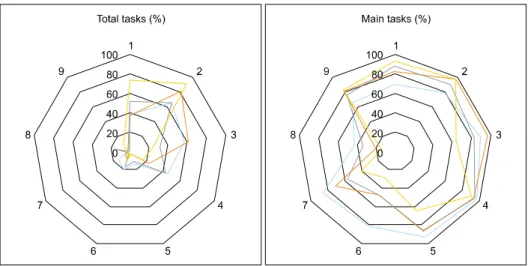
Fig. 1. Performed tasks and main tasks according to position. 1: rou- tine dental hygiene tasks, 2: dental assistance, 3: reception and billing, 4: patient education and consultation, 5: employee education and medical quality assurance, 6: office admin- istration or human resource tasks, 7: safety management, 8: dental hospital/clinic management, 9: oth- er tasks. The blue line is manager and the orange line is member in general or university hospital. The gray line is manager and the yellow line is member in dental hospital or dental clinic.
Table 2. Organization Systems and Standards for Positional Advancement with Respect to the Types of Dental Institution
Category Variable General
hospital
University
dental hospital Dental hospital Dental
clinic Total p
aOrganization system
Yes 107 (74.8) 191 (90.1) 195 (85.5) 133 (80.1) 626 (82.6) <0.001
No 36 (25.2) 21 (9.9) 33 (14.5) 33 (19.9) 123 (16.4)
Position advancement standards
Work experience 28 (30.1) 52 (29.7) 89 (50.6) 57 (46.7) 226 (39.9) <0.001
Contents 3 (3.2) 10 (5.7) 11 (6.3) 13 (10.7) 37 (6.5)
Ability 13 (14.0) 28 (16.0) 24 (13.6) 27 (22.1) 92 (16.3)
Bylaw 45 (48.4) 78 (44.6) 51 (29.0) 23 (18.9) 197 (34.8)
Others 4 (4.3) 7 (4.0) 1 (0.6) 2 (1.6) 14 (2.5)
Values are presented by number (%).
a
By chi-square test.
team leaders (58.3%). Individuals in the 21∼25 years age group were predominantly team members (95.9%). With respect to the reported types of dental institution, the distribution of individuals in higher positions was 42.3%
in dental clinics, 28.3% in dental hospitals, 20.3% in general hospitals, and 14.5% in university dental hospitals.
In terms of work experience, individuals with an experience of 11 or more years comprised a significantly number of those in higher-level positions, with 54.5% of them currently working as team leaders (Table 1).
2. Organization systems according to the size of the dental institutions
It was found that 82.6% of the respondents reported that their workplaces had some type of organizational system for their employees, and a significant difference was seen in terms of the types of dental institution (p<0.05). Of the larger work settings, 90.1% of the university dental
hospitals had organizational systems, and 74.8% of the general hospitals also admitted to having systems to manage their human resources. The most predominant standards and internal policies for defining positions within their hierarchical systems were bylaws in general hospitals (48.4%) and university dental hospitals (44.6%), whereas work experience was the predominant factor in determining positional advancement for individuals working at dental hospitals (50.6%) and dental clinics (46.7%) (Table 2).
3. Performed tasks and main tasks of the
dental hygienists by hierarchal position
Regardless of the types of dental institution, most dental
hygienists in Korea were responsible for dental assistance
(94.7%), patient education and consultation (94.0%), and
routine dental hygiene tasks (53.4%) (Fig. 1). To analyze
the data by workplace size, we grouped the general and
university hospitals together, whereas smaller dental
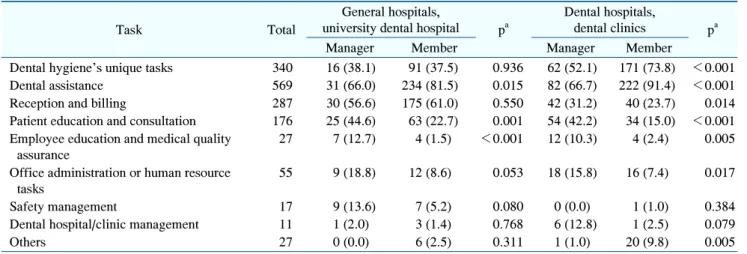
Table 3. Main Tasks according to Current Position in Dental Institution
Task Total
General hospitals,
university dental hospital p
aDental hospitals,
dental clinics p
aManager Member Manager Member
Dental hygiene’s unique tasks 340 16 (38.1) 91 (37.5) 0.936 62 (52.1) 171 (73.8) <0.001
Dental assistance 569 31 (66.0) 234 (81.5) 0.015 82 (66.7) 222 (91.4) <0.001
Reception and billing 287 30 (56.6) 175 (61.0) 0.550 42 (31.2) 40 (23.7) 0.014
Patient education and consultation 176 25 (44.6) 63 (22.7) 0.001 54 (42.2) 34 (15.0) <0.001 Employee education and medical quality
assurance
27 7 (12.7) 4 (1.5) <0.001 12 (10.3) 4 (2.4) 0.005
Office administration or human resource tasks
55 9 (18.8) 12 (8.6) 0.053 18 (15.8) 16 (7.4) 0.017
Safety management 17 9 (13.6) 7 (5.2) 0.080 0 (0.0) 1 (1.0) 0.384
Dental hospital/clinic management 11 1 (2.0) 3 (1.4) 0.768 6 (12.8) 1 (2.5) 0.079
Others 27 0 (0.0) 6 (2.5) 0.311 1 (1.0) 20 (9.8) 0.005
Values are presented by number only or number (%).
a