서 론
메티실린 내성 Staphylococcus aureus (methicillin-resistant S. aureus, MRSA)는 1960년대 말 국내에서 처음 분리된 이후 점점 증가하여S. aureus 중 MRSA의 비율은 1995년 70%에 도 달하였고[1], 최근 보고에서도 66-73%[2-5] 정도로 일정 비율을 유지하고 있다.
118 118
Toxic Shock Syndrome Toxin과 Staphylococcal Enterotoxin C 유전자 양성인 메티실린 내성 Staphylococcus aureus 의 분자생물학적 유형 분석
Molecular Epidemiology of Methicillin-Resistant Staphylococcus aureus Isolates with Toxic Shock Syndrome Toxin and Staphylococcal Enterotoxin C genes
Jae-Seok Kim, M.D.
1, Han-Sung Kim, M.D.
1, Wonkeun Song, M.D.
1, Hyoun Chan Cho, M.D.
1, Kyu Man Lee, M.D.
1, and Eui-Chong Kim, M.D.
2Departments of Laboratory Medicine, Hallym University College of Medicine1, and Seoul National University College of Medicine2, Seoul, Korea 김재석1∙김한성1∙송원근1∙조현찬1∙이규만1∙김의종2
한림대학교 의과대학 진단검사의학교실1, 서울대학교 의과대학 검사의학교실2
118 118
접 수: 2006년 12월 20일 접수번호:KJLM2005 수정본접수: 2007년 3월 5일
게재승인일: 2007년 3월95일 교 신저 자: 김 의 종
우 110-744 서울시 종로구 연건동 28 서울대학교병원 진단검사의학과 전화: 02-2072-3500, Fax: 02-2072-3698
E-mail : [email protected]
*본 연구는 보건복지부의 보건의료기술진흥사업(A050537)의 일부 지원에 의한 결과임.
Background :Many methicillin-resistant Staphylococcus aureus (MRSA) isolates in Korea possess a specific profile of staphylococcal enterotoxins in that the toxic shock syndrome toxin gene (tst) coexists with the staphylococcal enterotoxin C gene (sec). Because the analysis of staphylococcal cassette chromosome mec (SCCmec), a mobile genetic element mecA gene encoding methicillin resistance, showed that majority of these are SCCmec type II, these MRSA isolates with tst and sec may be gene- tically related with each other. This study was performed to investigate the genetic relatedness of tst- and sec-harboring MRSA strains isolated in Korea by using pulsed-field gel electrophoresis (PFGE).
Methods :A total of 59 strains of MRSA isolates of SCCmec type II possessing tst and sec were selected for PFGE and phylogenetic analyses. These isolates were collected from 13 health care facilities during nationwide surveillance of antimicrobial resistance in 2002.
Results :The 59 MRSA isolates were clustered into 11 PFGE types, including one major group of 26 strains (44.1%) isolated from 7 healthcare facilities. Seven PFGE types contained 2 or more iso- lates each, comprising 55 isolates in total.
Conclusions :Most of SCCmec type II MRSA isolates containing tst and sec showed closely relat- ed PFGE patterns. Moreover, MRSA isolates collected from different healthcare facilities showed identical PFGE patterns. These findings suggested a clonal spread of MRSA strains possessing tst and sec in Korean hospitals. (Korean J Lab Med 2007;27:118-23)
Key Words : Staphylococcus aureus, Methicillin resistance, Methicillin-resistant Staphylococcus aureus, SCCmec, Staphylococcal enterotoxin C, Toxic shock syndrome toxin, Pulsed-field gel elec- trophoresis
S. aureus의 메티실린 내성은mecA유전자에 의해서 나타나는 데, mecA 유전자는S. aureus의 유전체 중 staphylococcal cas- sette chromosome mec (SCCmec)이라는 이동성 유전자 부위 에 위치한다[6, 7]. SCCmec은 약 20 kb에서 66 kb 사이의 다 양한 크기를 가진 부위이며, 그 내부의 유전자와 여러 종류의 이 동성 부위(pUB110, pT181, pI254, Tn554)의 유무에 따라 크게 3-5가지 유형(I-IV)으로 분류하고 있다[7]. 또한, MRSA의 클 론성과 SCCmec 유형의 연관성이 알려져 있어, MRSA 균주의 역학분석에 SCCmec 유형 분석이 많이 이용되고 있다[8, 9].
Toxic shock syndrome toxin-1 (TSST-1)은 발열, 혈압저하, 발적 등의 staphylococcal toxic shock syndrome (TSS)을 일으 키는 원인 독소로 알려져 있다. 탐폰 등을 사용한 여성에게 발생 하는 월경성 TSS는 점막을 통과할 수 있는 TSST-1에 의해 주로 발생하나, 화상이나 상처부위의S. aureus감염증 환자에서 발생 하는 비월경성 TSS는 TSST-1외에도 staphylococcal enterotoxin B, C 등이 병독소가 된다[10]. 이러한 staphylococcal enterotoxin 양상도S. aureus의 유전형과 연관이 있으며, 각 균주별 특성을 나 타내므로 이를 분자생물학적 역학 분석에 사용할 수 있다[11-15].
MRSA에 대한 분자생물학적 역학적인 조사는 항균제 내성 균 주의 관리에 필요한 기법으로 이들 내성균주의 전파양상을 파악하 는데 도움이 된다. 특히 pulsed-field gel electrophoresis (PFGE) 는 MRSA에 의한 집단발병의 경우 유용하게 사용되고 있다. 미국 과 유럽의 경우 광범위한 지역에서 분리된 MRSA 균주의 PFGE 유형을 데이터베이스로 만들어 분자생물학적 역학분석이 가능하 며, 병원과 지역사회내 MRSA 감염의 역학분석에도 유용하게 사 용하고 있다[8, 16, 17].
2002년 전국 13개 병원에서 분리된S. aureus균주를 대상으로 SCCmec유전형을 조사한 결과 SCCmec II형이 제일 많은 것으 로 조사되었다. 이 균주들의 포도구균 독소를 분석한 결과 staphy- lococcal enterotoxin C (sec)와 toxic shock syndrome toxin (tst)를 동시에 가지고 있는 균주가 77.3%로 상당히 많이 분리되 었다. 그러나, tst와sec를 가지고 있는S. aureus 균주는 MSSA 나 SCCmecII형 이외의 MRSA에서는 발견되지 않았다[18]. 따 라서, MRSA 균주 중 SCCmec II형으로tst와sec를 동시에 가 지고 있는 균주가 널리 퍼져있을 가능성이 있다. 국내의 병원에서 분리되는S. aureus 균주는 일본의 균주와 유사한 특성이 있다.
일본에서는sec를 가지고 있는 SCCmec II가 많이 분리되고 있으 며 1982년에 분리되어 New York/Japan 클론으로 알려진 N315 도 역시 SCCmecII형으로tst와sec를 가지고 있다[19]. 독소유 전형 또한tst와sec가 동시에 검출되는 균주가 대다수를 차지하 고 있어[20], 일본의 MRSA 균주의 병독성 유전형과 SCCmec 유전형은 국내와 상당히 비슷하다.
본 연구에서는 2002년 국내 여러 의료기관에서 분리된 MRSA 중sec와tst를 동시에 가지고 있는 균주를 대상으로 PFGE 분석 을 통해 이들 균주의 분자생물학적 연관성을 살펴보고자 하였다.
재료 및 방법
1. 대상균주국내에 산재한 13개 의료기관에서 2002년에 수집된S. aureus 균주중 포도구균 독소유전자 PCR과 SCCmecPCR 분석에서[18]
SCCmec II형 균주로서sec와tst 양성이었던 59개 균주를 선택하 였다. 이들의 SCCmec형은 II (n=12), IIA (n=3), IIB (n=44) 로 11개 병원에서 분리된 균주였다.
2. PFGE
면양혈액배지에 전날 배양한S. aureus 균집락을 따서, 생리식 염수에 부유하여 McFarland 5 (1.5×10⁹/mL)의 탁도로 맞추었 다. 부유액 1 mL를 3분간 원심분리한 뒤 10 L의 lysostaphin (500 g/mL)을 가한 세포용해 용액(12 mM Tris-HCl [pH 7.6], 2 M NaCl, 200 mM EDTA, 1% Brij-58, 0.4% sodium deo- xycholate, 1% sodium lauroyl sarcosine) 100 L에 재부유 하 였다. 미리 녹여둔 1.6% Seakem GTG agarose (FMC, Rock- land, ME, USA) 100 L와 혼합한뒤 한천조각틀에 100 L씩 넣고 냉장고에 10분간 두어 굳혔다. 각각의 한천조각은 30 L의 lysozyme (50 mg/mL)과 9 L의 RNase A (10 mg/mL)가 든 3 mL의 세포용해 용액(6 mM Tris-HCl [pH 7.6], 1 M NaCl, 100 mM EDTA, 0.5% Brij-58, 0.2% sodium deoxycholate, 0.5% sodium lauroyl sarcosine)에 넣은 다음 37℃에서 2시간 흔 들어 두었다. 한천조각은 15 L의 proteinase K 용액(20 mg/
mL)과 150 L의 20% sodium dodecyl sulfate가 든 3 mL의 ESP 용액(10 mM Tris HCl [pH7.4], 1 mM EDTA)으로 옮긴 다음 50℃에서 1시간 이상 방치하였다. 한천조각은 10 mL의 세 척용 TE 용액(10 mM Tris HCl [pH 7.4], 0.1 mM EDTA)이 든 용기로 옮긴 다음 50℃에서 1시간 방치한 뒤, 새로운 세척용 TE 용액 10 mL로 교체하는 세척과정을 두 번 더 시행한 뒤에 37℃에서 밤새 흔들어 두었다. 새로운 세척용 TE 용액으로 교체 하고 다음 실험전까지 4℃에 냉장보관하였다.
한천조각은 절반으로 자른 뒤에SmaI (New England Biolabs, Beverly, MA, USA) 20 U를 가한 100 L의 제한효소처리 완 충액에 두어 25℃에서 6시간 반응시켰다. 반응이 끝난 한천조각은 1% Seakem Gold (FMC) gel에 넣어 CHEF Mapper (Bio-Rad, Hercules, CA, USA)로 PFGE를 시행하였다. PFGE 반응조건 은 수조 온도 14℃, 전기장 6 V/cm, 전환 각도 120°, 시간 경사 5-40초, 영동 시간 20시간이었다. Lambda DNA concatamer (New England Biolabs)를 크기표지자로 하였다. 전기영동 후 1.5 g/mL ethidium bromide로 45분간 염색한 뒤 증류수로 1시간 탈염색하였다.
PFGE 결과는 BioNumerics software (Applied Maths, Sint- Martens-Latem, Belgium)를 이용하였다. Dendrogram은 un-
weighted-pair group method using arithmetic averages (UP- GMA)와 Dice coefficients를 설정하여 구하였고, 최적화(opti- mization)와 위치허용(band position tolerance)은 각각 2.0%와 1.5%로 설정하였다. PFGE 분석상 유사한 군으로 분류하는 기 준은 미국과 유럽에서 일반적으로 사용하는 기준[16, 17]을 고려 하여 상동계수(similarity coefficient)가 80% 이상인 균주들로 하였다.
결 과
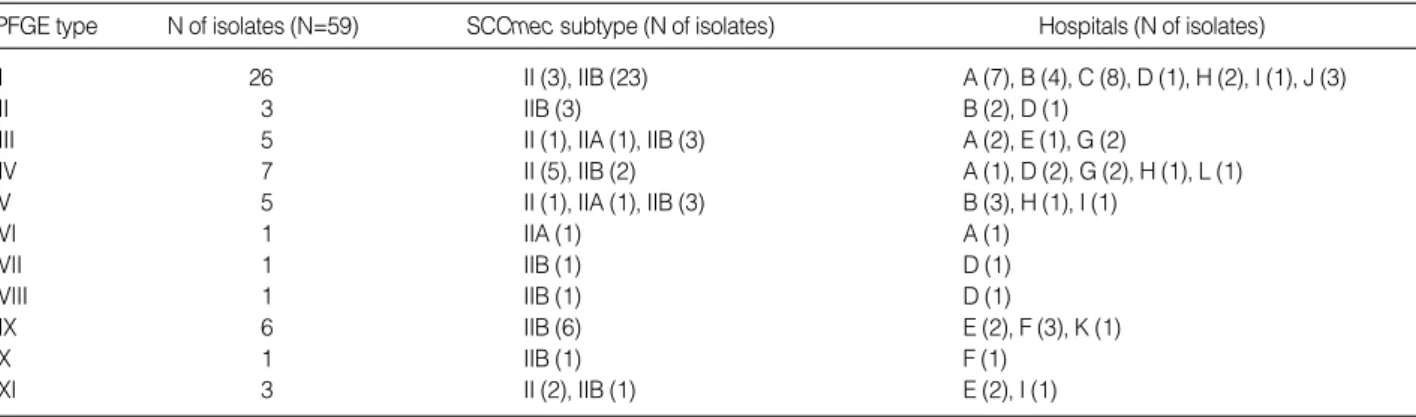
59개의 대상균주를 분석한 결과 모두 11개의 PFGE 유형(puls- ed-field type, PFT)으로 분리되었다(Fig. 1). 가장 균주수가 많은 PFT는 PFT I으로 26균주(44.1%)가 포함되었으며, 나머 지 10개 PFT는 33균주(55.9%)로 각 PFT당 1-7개의 균주가 관 찰되었다(Table 1). 2개 이상의 균주가 포함된 PFT는 모두 7개 로 이들은 각기 다른 의료기관에서 분리된 MRSA 균주들을 포함 하고 있었다.
상동계수 80% 이상인 군을 하나의 유형으로 분류했을 경우 SCCmec II형(N=12)은 PFGE I, III, IV, V, XI 유형으로 분 류되었고, SCCmec IIA형(N=3)은 PFGE IV, V, VI형으로 분류되었으며, SCCmecIIB형(N=44)은 PFGE I, II, III, IV, V, VII, VIII, IX, X, XI로 다양하게 분류되었다.
각 PFGE 유형별로 분류한 결과, 가장 큰 군집을 이룬 PFT I (N=26)의 균주들은 서울, 강원, 경남, 경북, 충남의 7개 병원에서 1-8균주씩 분리되었으며, 대부분 SCCmec IIB형(N=23)이었다.
두번째로 큰 군집인 PFT IV (N=7)의 경우 서울, 강원, 경북, 전남지역 5개 병원에서 1-2균주씩 분리된 균주가 이에 속하였다.
또한, 서울과 부산의 2개 병원에서 분리된 PFT II 3균주와 서울 의 3개 병원에서 분리된 PFT IX 5균주의 경우 서로 다른 의료 기관에서 분리되었으나 PFT가 서로 동일한 결과를 보였다.
고 찰
국내에서 분리된 MRSA 균주의 SCCmec 유형 분석 결과 가 장 흔한 것은 SCCmecII형이라 알려져 있다[9, 18, 21, 22]. 또 한, MRSA의 포도구균 독소를 분석하면tst와sec를 동시에 가지 고 있는 균주가 가장 많으며(43.6%), 이들은 대부분 SCCmecII 형으로 알려져 있다[18]. 반면, 국내의 methicillin-susceptible S.
aureus에서는tst를 가지고 있는 균주는 1.5-6.4%, sec를 가진 균
Abbreviation: PFGE, pulsed-field gel electrophoresis.
PFGE type N of isolates (N=59) SCCmec subtype (N of isolates) Hospitals (N of isolates)
I 26 II (3), IIB (23) A (7), B (4), C (8), D (1), H (2), I (1), J (3)
II 3 IIB (3) B (2), D (1)
III 5 II (1), IIA (1), IIB (3) A (2), E (1), G (2)
IV 7 II (5), IIB (2) A (1), D (2), G (2), H (1), L (1)
V 5 II (1), IIA (1), IIB (3) B (3), H (1), I (1)
VI 1 IIA (1) A (1)
VII 1 IIB (1) D (1)
VIII 1 IIB (1) D (1)
IX 6 IIB (6) E (2), F (3), K (1)
X 1 IIB (1) F (1)
XI 3 II (2), IIB (1) E (2), I (1)
Table 1.Characteristics of PFGE types, SCCmec subtypes, and isolated hospitals of tst- and sec-positive methicillin-resistant Staphylo- coccus aureus isolates. PFGE types were classified by the similarity genetic coefficiency of 80%
Fig. 1.Dendrogram showing the PFGE patterns of SCCmec II iso- lates containing sec and tst. Also shown are the corresponding SCCmec types and 12 hospital origins.
Abbreviations: PFGE, pulsed-field gel electrophoresis; SCCmec, staphylococcal cassette chromosome mec; PFT, pulsed-field type.
SCCmec IIB IIB IIB IIB IIB IIB II
50 55 60 65 70 75 80 85 90 95 100
IIB IIB IIB IIB IIB IIB IIB IIB IIB IIB II II IIB IIB IIB IIB IIB IIB IIB IIB IIB IIB IIB IIB IIB IIB II IIA II II II II IIB II II IIB IIA IIB IIB IIA IIB IIB IIB IIB IIB IIB IIB IIB IIB II IIB II Marker Marker Marker Marker Marker Marker Marker Marker Marker Marker Marker
C C C C C H D A A B B B B C C J C H I A A A A J A J D B B G G A E A G D G L A D H H B I B B A D D E E K F F F F E I E Marker Marker Marker Marker Marker Marker Marker Marker Marker Marker Marker Hospital PFT
I
II III
IV
V
IX X XI VI/VII/
VIII
주는 1.3% 정도로 MRSA에 비해 상대적으로 적다[18, 23].
S. aureus의 포도구균 독소의 양상은 시대적으로, 지역적으로 다 른 것으로 추정된다. 최근에 지역사회와 병원에서 유행하는 MRSA 클론은tst양성인 균주라고 하며, 프랑스와 스위스에서는sec, sed 를 가지고 있는 SCCmecIV형이 많았다고 한다[20, 24-27]. 그 러나, 일본의 균주는sec를 가지고 있는 SCCmecII가 많이 분리 되고 있으며 1982년에 분리되어 New York/Japan 클론으로 알려 진 N315도 역시 SCCmec II형으로tst와sec를 가지고 있다[19].
일본에서 분리된 MRSA의 경우tst와sec가 동시에 검출되는 균 주가 대다수를 차지하고 있어[20], 국내에서 분리되는 MRSA 포도구균 독소 유전형과 SCCmec 유전형은 일본의 연구 결과와 유사한 것으로 생각된다. 우리나라와 일본에서 분리된 MRSA의 SCCmec유전형과 병독성 인자 양상이 유사하다는 결과는, 국내 의 MRSA 균주가 일본에서 분리된 MRSA 균주와 유사한 유전 자 변이를 거쳤거나, 서로 전파가 되었을 가능성을 시사한다. 그리 고, 1982년 분리된 N315 역시tst와sec를 가진 것으로 알려져 있 으므로, tst와sec를 동시에 가지고 있는 MRSA 균주는 오랫동안 병원내 환경에서 적응하면서 지내온 균주일 가능성도 있다.
이 연구결과에서는 거의 발견되지 않았지만, 미국에서는tst와 sea를 동시에 가지고 있는 균주의 보고가 많아서[24], 병원감염을 흔히 일으키는 MRSA인 PFT USA200 균주에서tst가 발견되는 데, 이 균주들은 국내 균주와 달리sec대신에sea를 가지고 있다 [12]. SCCmec II형의 MRSA가 발생하게 된 유전적 변화를 연구 한 논문에서는, 이전에 존재하던 MSSA 균주에 SCCmec II 유전 자와 병독성 인자sea가 삽입되어 영국에서 병원내 감염을 일으킨 MRSA252 균주가 발생하였으며, 그 후에tst가 삽입되어 미국내 의 PFT USA200 균주로 변환되는 과정을 제시하고 있다[12]. 또 한 독일에서 분리된S. aureus 281균주에 대한 연구에서 TSST-1 는 MRSA의 16%, MSSA의 8%에서 생성하였고, enterotoxin C는 MRSA의 0%, MSSA의 20%에서 검출되었지만, TSST-1와 enterotoxin C를 동시에 생성하는 균주는 MSSA 단 1균주였다 [28]. 이런 보고들은 미국과 유럽에서 분리되는 MRSA는 국내에 서 유행하고 있는tst, sec양성인 MRSA 균주와는 다른 과정을 통하여 병독성 유전자를 얻게 되었음을 시사한다.
S. aureus의 유전형이 비슷한 클론에서는 staphylococcal ente- rotoxin 또한 유사한 양상을 보이므로, 독소 양상을 역학 분석에 적용한 연구들도 있다[11-13]. PFGE는 SCCmec 유형과 staphy- lococcal enterotoxin 양상보다는 좀 더 변이가 심하므로, PFGE의 상동계수가 80% 이상일 경우 집단발병과 연관된 균주로 볼 정도 로 가까운 유전형임을 추정할 수 있다. 유럽과 미국에서 분리된S.
aureus균주를 대상으로 PFGE 결과를 상동계수 70 내외로 분석 하면 몇몇의 큰 PFT 양상으로 분류되는데[29, 30], 미국과 유럽 에서 1,069개S. aureus를 대상으로 PFGE를 시행한 결과 10개 정 도의 유형으로 분류되며, 95% 이상이 주요 PFT에 속하므로, 주 요한 몇 개의 MRSA 클론이 지역적으로 다른 여러 병원에 전파되 어 있다는 보고가 있다[30]. 이 연구에서도 MRSA의 PFGE 양
상을 상동계수 기준을 80%으로 분석할 경우 26균주(44.1%), 70%
로 분석할 경우 47개 균주(79.7%)가 동일한 PFT를 보였으르로, 상당수 균주가 유전적 연관성을 가지고 있는 것으로 생각된다.
이 연구에서는tst와sec를 동시에 가진 SCCmecII형의 MRSA 균주에 대해 PFGE 분석한 결과, 국내 여러 병원에서 분리된 MR- SA 균주의 유전적 유사성이 관찰되었고, 국내의 여러 의료기관에 특정한 포도구균 독소를 가지고 있으며 SCCmec 유형이 유사한 MRSA 균종이 산재하고 있음을 알 수 있었다.
요 약
배경 : 국내에서 분리된 메티실린 내성Staphylococcus aureus (methicillin-resistant Staphylococcus aureus, MRSA) 균주 중 상당수가 toxic shock syndrome toxin (tst)와 staphylococcal enterotoxin C (sec)를 동시에 가지고 있다. 이 균주에서는 메티 실린 내성 유전자(mecA)가 위치한 staphylococcal cassette chro- mosome mec (SCCmec) 유형을 분석하면 SCCmec II형이 대 부분이어서, 이러한 MRSA 균주는 역학적으로 밀접한 연관성이 있을 것으로 생각된다. 이 연구에서는 전국에서 수집된 MRSA 중tst와sec를 동시에 가지고 있는 균주를 대상으로 pulsed-field gel electrophoresis (PFGE) 분석을 시행하여 이 균주들의 분자 생물학적 연관성을 알아보고자 하였다.
방법 : 2002년 전국 13개 의료기관에서 수집된 MRSA 중tst와 sec를 가지고 있는 SCCmec II형의 균주 59개를 선택하여 PFGE 분석과 계통수 분석을 시행하였다.
결과 : MRSA 59균주는 크게 11개의 PFGE 유형으로 분류할 수 있었고, 가장 흔한 유형은 7개 의료기관에서 분리된 26균주(44.1
%)였다. 이중 7개 PFGE 유형(N=55)에서는 2개 이상의 균주 를 포함하였으며, 이들은 2개 이상의 의료기관에서 분리되었다.
결론 : 국내의tst와sec 양성이면서 SCCmec II형인 MRSA 균주는 유전적 연관성을 보였다. 특히 다른 의료기관에서 분리된 MRSA라도 동일한 PFGE 양상을 보였으므로, tst와sec를 가진 MRSA 균주는 유사한 유전양상을 가진 MRSA 클론으로서 국 내 여러 기관에 분포하고 있는 것으로 생각된다.
참고문헌
1. Chong Y and Lee K. Present situation of antimicrobial resistance in Korea. J Infect Chemother 2000;6:189-95.
2. Hong SG, Yong DE, Lee KW, Kim EC, Lee WK, Jeong SH, et al. An- timicrobial resistance of clinically important bacteria isolated from hospitals located in representative provinces of Korea. Korean J Clin Microbiol 2003;6:29-36. (홍성근, 용동은, 이경원, 김의종, 이위교, 정석 훈 등. 국내 여러 지역 병원의 임상검체에서 분리된 주요 세균의 항균제
내성률. 대한임상미생물학회지 2003;6:29-36.)
3. Hong SG, Lee JW, Yong DE, Kim EC, Jeong SH, Park YJ, et al. Anti- microbial resistance of clinically important bacteria isolated from 12 hospitals in Korea. Korean J Clin Microbiol 2004;7:171-7. (홍성근, 이 종욱, 용동은, 김의종, 정석훈, 박연준등. 국내 12개병원의임상검체에서 분리된주요세균의항균제내성률. 대한임상미생물학회지2004;7:171-7.) 4. Lee HM, Yong DE, Lee KW, Hong SG, Kim EC, Jeong SH, et al. An- timicrobial resistance of clinically important bacteria isolated from 12 hospitals in Korea in 2004. Korean J Clin Microbiol 2005;8:66-73.
(이혁민, 용동은, 이경원, 홍성근, 김의종, 정석훈등. 2004년도국내 12개 병원에서 분리된 주요 세균의 항균제 내성률. 대한임상미생물학회지 2005; 8:66-73.)
5. Kim JS, Kim HS, Song WK, Cho HC, Lee KM, Kim EC. Antimicro- bial resistance profiles of Staphylococcus aureus isolated in 13 Korean hospitals. Korean J Lab Med 2004;24:223-9. (김재석, 김한성, 송원근, 조현찬, 이규만, 김의종. 국내 13개 의료기관에서 수집된 Staphylococcus aureus의항균제감수성양상. 대한진단검사의학회지2004; 24: 223-9.) 6. Chambers HF. Methicillin resistance in staphylococci: molecular and
biochemical basis and clinical implications. Clin Microbiol Rev 1997;
10:781-91.
7. Oliveira DC, Tomasz A, de Lencastre H. Secrets of success of a human pathogen: molecular evolution of pandemic clones of methicillin- resistant Staphylococcus aureus. Lancet Infect Dis 2002;2:180-9.
8. Kuehnert MJ, Kruszon-Moran D, Hill HA, McQuillan G, McAllister SK, Fosheim G, et al. Prevalence of Staphylococcus aureus nasal colo- nization in the United States, 2001-2002. J Infect Dis 2006;193:172-9.
9. Chongtrakool P, Ito T, Ma XX, Kondo Y, Trakulsomboon S, Tiensa- sitorn C, et al. Staphylococcal cassette chromosome mec (SCCmec) typing of methicillin-resistant Staphylococcus aureus strains isolated in 11 Asian countries: a proposal for a new nomenclature for SCCmec elements. Antimicrob Agents Chemother 2006;50:1001-12.
10. McCormick JK, Yarwood JM, Schlievert PM. Toxic shock syndrome and bacterial superantigens: an update. Annu Rev Microbiol 2001;
55:77-104.
11. Chini V, Dimitracopoulos G, Spiliopoulou I. Occurrence of the ente- rotoxin gene cluster and the toxic shock syndrome toxin 1 gene among clinical isolates of methicillin-resistant Staphylococcus aureus is related to clonal type and agr group. J Clin Microbiol 2006;44:1881-3.
12. Diep BA, Carleton HA, Chang RF, Sensabaugh GF, Perdreau-Rem- ington F. Roles of 34 virulence genes in the evolution of hospital- and community-associated strains of methicillin-resistant Staphylo- coccus aureus. J Infect Dis 2006;193:1495-503.
13. Tsen HY, Yu GK, Hu HH. Comparison of type A enterotoxigenic Staphylococcus aureus strains isolated from geographically far distant locations by pulsed field gel electrophoresis. J Appl Microbiol 1997;
82:485-93.
14. Novick RP, Schlievert P, Ruzin A. Pathogenicity and resistance islands of staphylococci. Microbes Infect 2001;3:585-94.
15. Peacock SJ, Moore CE, Justice A, Kantzanou M, Story L, Mackie K, et al. Virulent combinations of adhesin and toxin genes in natural populations of Staphylococcus aureus. Infect Immun 2002;70:4987-96.
16. Murchan S, Kaufmann ME, Deplano A, de Ryck R, Struelens M, Zinn CE, et al. Harmonization of pulsed-field gel electrophoresis protocols for epidemiological typing of strains of methicillin-resis- tant Staphylococcus aureus: a single approach developed by consen- sus in 10 European laboratories and its application for tracing the spread of related strains. J Clin Microbiol 2003;41:1574-85.
17. McDougal LK, Steward CD, Killgore GE, Chaitram JM, McAllister SK, Tenover FC. Pulsed-field gel electrophoresis typing of oxacillin- resistant Staphylococcus aureus isolates from the United States: es- tablishing a national database. J Clin Microbiol 2003;41:5113-20.
18. Kim JS, Song W, Kim HS, Cho HC, Lee KM, Choi MS, et al. Associ- ation between the methicillin resistance of clinical isolates of Sta- phylococcus aureus, their staphylococcal cassette chromosome mec (SCCmec) subtype classification, and their toxin gene profiles. Diagn Microbiol Infect Dis 2006;56:289-95.
19. Durand G, Bes M, Meugnier H, Enright MC, Forey F, Liassine N, et al. Detection of new methicillin-resistant Staphylococcus aureus clones containing the toxic shock syndrome toxin 1 gene responsible for hospital- and community-acquired infections in france. J Clin Micro- biol 2006;44:847-53.
20. Nishi J, Yoshinaga M, Miyanohara H, Kawahara M, Kawabata M, Motoya T, et al. An epidemiologic survey of methicillin-resistant Staphylococcus aureus by combined use of mec-HVR genotyping and toxin genotyping in a university hospital in Japan. Infect Control Hosp Epidemiol 2002;23:506-10.
21. Soo Ko K, Kim YS, Song JH, Yeom JS, Lee H, Jung SI, et al. Genoty- pic diversity of methicillin-resistant Staphylococcus aureus isolates in Korean hospitals. Antimicrob Agents Chemother 2005;49:3583-5.
22. Soo Ko K, Peck KR, Sup Oh W, Lee NY, Hiramatsu K, Song JH. Ge- netic differentiation of methicillin-resistant Staphylococcus aureus strains from Korea and Japan. Microb Drug Resist 2005;11:279-86.
23. Woo JH, Park KY, Chung DR, Kim EO, Kim YS, Ryu J. Molecular epidemiologic surveillance of TSST-1 strains among pathogenic Staphylococcus aureus. Korean J Infect Dis 1997;29: 463-7. (우준희, 박 기영, 정두련, 김은옥, 김양수, 류지소. 병원성포도상구균의 toxic shock syndrome 생산능력에대한분자역학적탐색. 감염 1997;29: 463-7.) 24. Banks MC, Kamel NS, Zabriskie JB, Larone DH, Ursea D, Posnett
DN. Staphylococcus aureus express unique superantigens depend- ing on the tissue source. J Infect Dis 2003;187:77-86.
25. Fowler VG Jr, Justice A, Moore C, Benjamin DK Jr, Woods CW, Campbell S, et al. Risk factors for hematogenous complications of
intravascular catheter-associated Staphylococcus aureus bacteremia.
Clin Infect Dis 2005;40:695-703.
26. Ferry T, Thomas D, Genestier AL, Bes M, Lina G, Vandenesch F, et al. Comparative prevalence of superantigen genes in Staphylococcus aureus isolates causing sepsis with and without septic shock. Clin Infect Dis 2005;41:771-7.
27. Lehn N, Schaller E, Wagner H, Kronke M. Frequency of toxic shock syndrome toxin- and enterotoxin-producing clinical isolates of Sta- phylococcus aureus. Eur J Clin Microbiol Infect Dis 1995;14:43-6.
28. Schmitz FJ, MacKenzie CR, Geisel R, Wagner S, Idel H, Verhoef J, et al. Enterotoxin and toxic shock syndrome toxin-1 production of
methicillin resistant and methicillin sensitive Staphylococcus aureus strains. Eur J Epidemiol 1997;13:699-708.
29. Shukla SK, Stemper ME, Ramaswamy SV, Conradt JM, Reich R, Graviss EA, et al. Molecular characteristics of nosocomial and native American community-associated methicillin-resistant Staphylococ- cus aureus clones from rural Wisconsin. J Clin Microbiol 2004;42:
3752-7.
30. Wielders CL, Fluit AC, Brisse S, Verhoef J, Schmitz FJ. mecA gene is widely disseminated in Staphylococcus aureus population. J Clin Microbiol 2002;40:3970-5.