Long-term outcome after liver resection and clinicopathological features in patients with small hepatocellular carcinoma
Young Ju Hong, Sung Hoon Kim, Gi Hong Choi, Kyung Sik Kim, and Jin Sub Choi
Department of Surgery, Yonsei University College of Medicine, Seoul, Korea
Backgrounds/Aims: Surveillance programs and imaging modality developments have increased the detection rate of small hepatocellular carcinoma (HCC). In particular, liver transplantation produces good results and is now regarded an alternative to liver resection. However, optimal treatment for small HCC is still debated, and thus, the authors de- signed this study to document clinicopathological characteristics, to identify the prognostic factors of small HCC, and to determine the effectiveness of surgery. Methods: A total of 507 patients underwent curative liver resection for HCC between January 1996 and August 2006 in our institution. One hundred and thirty four of these patients with a single HCC of less than 3 cm and no gross vascular invasion were enrolled. Results: Major resection was performed in 32 (23.9%) patients; there was no postoperative mortality. Fifty-eight (43.3%) patients experienced recurrence, 53 de- veloped intrahepatic recurrence alone, and 50 (94.3%) of 53 had tumors within the Milan criteria. Five-year disease-free and overall survival rates were 51.0% and 77.3%, respectively. Microscopic vascular invasion, positivity for hepatitis B surface antigen or antibody to hepatitis C, and an indocyanine green retention test at 15 minutes of more than 10% were found to be significantly correlated with disease-free overall survival. A platelet count of less than 100,000/mm3 was the only independent prognostic factors of overall survival identified. Conclusions: This study showed favorable outcome comparable to the survival after liver transplantation, thus that liver resection appears to be the primary treatment option for small HCC, even in cases with poor prognostic factors. (Korean J Hepatobiliary Pancreat Surg 2011;15:199-205)
Key Words: Small hepatocellular carcinoma; Liver resection
Received: September 19, 2011; Revised: October 5, 2011; Accepted: October 18, 2011 Corresponding author: Jin Sub Choi
Department of Surgery, Yonsei University College of Medicine, 50, Yonsei-ro, Seodaemun‐gu, Seoul 120‐752, Korea Tel: +82-2‐2228‐2122, Fax: +82-2‐313‐8289, E-mail: [email protected]
Copyright Ⓒ 2011 by The Korean Association of Hepato-Biliary-Pancreatic Surgery Korean Journal of Hepato-Biliary-Pancreatic Surgery ∙ pISSN: 1738-6349
INTRODUCTION
The majority of hepatocellular carcinomas (HCC) arise in the background of chronic hepatitis and cirrhosis, and thus, liver transplantation is the most ideal treatment mo- dality as it corrects the underling liver disease. However, because of the donor shortage situation, liver resection is the preferred treatment. Furthermore, the use of liver re- section in patients with HCC is largely limited by ad- vanced disease and poor liver function.
Recently, a randomized controlled study was performed to determine the merits of HCC screening in China.1 It was found screening confers survival benefits and that de- velopment of imaging modalities and surveillance pro- grams have increased the detection rate of small resect- able HCC.2,3 Several studies have reported the outcomes of treatment modalities for small HCC,4-8 and despite the
different definitions used for small HCC, liver trans- plantation has been proposed as an alternative strategy for small HCC instead of liver resection.8,9 Nevertheless, the optimal treatment for small HCC remains controver- sial.10,11 Small HCC has a favorable prognosis, but its out- come was different according to the prognostic strat- ification and prognostic scoring system for patients treated by liver resection.6,12
In the present study, we investigated the clinicopatho- logical characteristics and prognostic factors of small HCC and attempted to determine the effectiveness of sur- gery with the intention of finding the best approach for its treatment.
METHODS
Definitions
Curative resection was defined as complete tumor re- section with a clear microscopic margin and no residual tumor by imaging at 1 month after surgery. Major liver resection was defined as the resection of ≥3 Couinaud segments. Postoperative mortality was defined as death within 1 month after surgery, and recurrence as typical arterial enhancement with delayed washout on computed tomography (CT) images. Causes of patient death were classified as recurred HCC-related death, complications of liver cirrhosis without recurrence, and unrelated causes.
Patients
Five hundred and seven patients underwent curative liv- er resection for HCC between January 1996 and August 2006 at the Department of Surgery, Yonsei University Health System, Seoul, Korea. Of these 507 patients, 146 had single HCC of ≤3 cm in diameter. Twelve of the 146 patients were also excluded because of gross portal or hepatic vein involvement. Finally, 134 patients were enrolled in this study.
Preoperative evaluation and follow-up methods
A preoperative CT scan, biochemistry testing, and an indocyanine green retention test at 15 minutes (ICG R15) were performed on all patients. The decision whether to perform major or minor resection was made pre- operatively based on tumor location by CT, liver function, Child-Pugh status, ICG R15, and on the likelihood of ach- ieving an adequate resection margin. Alpha-fetoprotein (AFP) levels were determined and underwent ultra- sonography (US) or CT performed on all patients every 3-6 months after surgery.
Outcomes
Prognostic factors for disease-free survival and overall survival were sought from among the following 18 clin- icopathologic variables. Nine were patient factors, namely, age, gender, etiology of liver disease, serum albumin lev- el, serum aspartate aminotransferase (AST) and alanine aminotransferase (ALT) levels, ICG R15, platelet count, and liver cirrhosis grade. Five were surgical factors, that
is, intraoperative bleeding amount, perioperative trans- fusion, surgical tumor-free resection margin, extent of re- section, and type of resection, and four were tumor fac- tors, that is, tumor size, microscopic vascular invasion, Edmondson-Steiner grade, and serum AFP level.
Statistical analysis
Statistical analysis was performed using SPSS v 12.0 software (SPSS Inc., Chicago, IL, USA). Continuous re- sults are presented as medians (ranges) and categorical re- sults are presented as numbers (percentages).
Disease-free and overall survival rates were calculated using the Kaplan-Meier method. Prognostic factors of dis- ease-free and overall survival rates were indentified using the log-rank test and univariate analysis. Multivariate analysis was performed using the Cox proportional hazard model; factors significant by univariate analysis were included. Statistical significance was accepted for p-values of <0.05.
RESULTS
Clinical characteristics
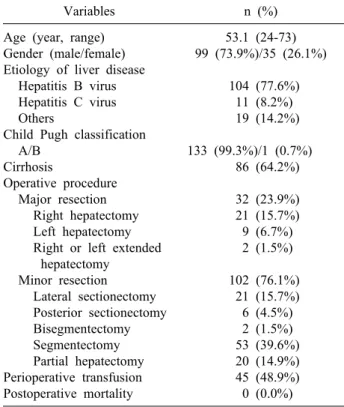
The clinical characteristics are presented in Table 1.
The 134 study subjects had a median age of 53.1 years (range, 24-73 years), and 99 were male. The most com- mon etiology of liver disease was hepatitis B virus (n=104, 77.6%). Liver cirrhosis was proved by pathologic examination in 86 patients (64.2%). All patients except one were of Child–Pugh class A. Major resections were performed in 32 patients (23.8%). Forty-five patients (48.9%) received a perioperative transfusion, and there was no postoperative mortality.
Long-term surgical outcomes after resection During a median follow-up of 43.5 months (4-110 months), 58 (43.3%) patients recurred. Fifty-three patients developed intrahepatic recurrence alone, 4 extrahepatic re- currences alone, and 1 concurrent intrahepatic and extra- hepatic recurrence. Fifty (86.2%) of the intrahepatic re- currence patients had tumors within the Milan criteria, and 17 patients (12.7%) expired due to recurrence (Table 2).
The 1-year, 3-year, and 5-year disease-free and overall survival rates were 82.0%, 62.4%, and 51.0%, and 97.0%, 89.5%, and 77.3%, respectively (Fig. 1).
Table 1. Clinical characteristics
Variables n (%)
Age (year, range) Gender (male/female) Etiology of liver disease
Hepatitis B virus Hepatitis C virus Others
Child Pugh classification A/B
Cirrhosis
Operative procedure Major resection
Right hepatectomy Left hepatectomy Right or left extended
hepatectomy Minor resection
Lateral sectionectomy Posterior sectionectomy Bisegmentectomy Segmentectomy Partial hepatectomy Perioperative transfusion Postoperative mortality
53.1 (24-73) 99 (73.9%)/35 (26.1%)
104 (77.6%)
11 (8.2%) 19 (14.2%)
133 (99.3%)/1 (0.7%)
86 (64.2%) 32 (23.9%) 21 (15.7%) 9 (6.7%) 2 (1.5%)
102 (76.1%) 21 (15.7%) 6 (4.5%) 2 (1.5%) 53 (39.6%) 20 (14.9%) 45 (48.9%) 0 (0.0%)
Table 2. Long-term surgical outcomes after resection
Variables n (%)
Type of recurrence
IH nodular (≤3 nodules) recurrence IH multiple (>3 nodules) recurrence EH recurrence
IH+EH recurrence Cause of death HCC recurrence
Complication of liver cirrhosis without recurrence
Unrelated
58 (43.3%) 50 (86.2%) 3 (5.2%) 4 (6.9%) 1 (1.7%) 27 (20.1%) 17 (63.0%) 7 (25.9%)
3 (11.1%) IH, intrahepatic; EH, extrahepatic; HCC, hepatocellular car- cinoma.
Fig. 1. Survival curves after liver resection for small hepatocellular carcinoma. (A) 1-, 3-, and 5-year disease-free survival rates were 82.0%, 62.4%, and 51.0%, respectively. (B) 1-, 3-, and 5-year overall survival rates were 97.0%, 89.5%, and 77.3%, respectively.
Prognostic factors of disease-free and overall survival
Microscopic vascular invasion (Hazard ratio [HR]=
1.738; 95% confidence interval [CI], 1.015-2.977; p=
0.044), positivity for hepatitis B surface antigen or anti- body to hepatitis C (HR=3.490; 95% CI, 1.258-9.682;
p=0.016), and an ICG R15 of >10% (HR=1.737; 95%
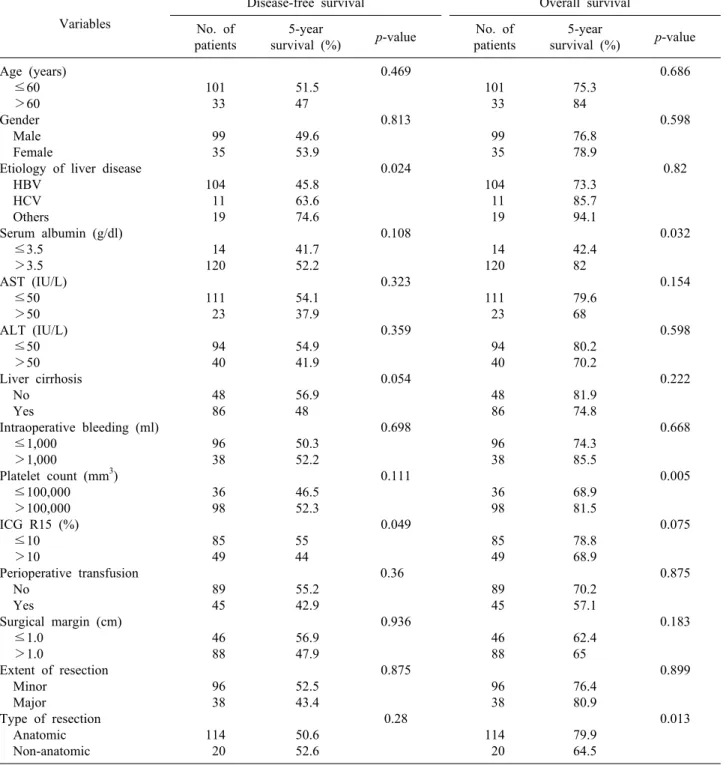
CI, 1.019-2.960; p=0.042) were found to be significantly and negatively correlated with disease-free survival by
both univariate and multivariate analyses (Table 3-5).
A serum albumin of <3.5 g/dl, a serum platelet count of <100,000/mm3 and non-anatomic resection were found to be significantly associated with overall survival by uni- variate analysis (Table 3, 4). However, only a platelet count of <100,000/mm3 (HR=2.907; 95% CI, 1.341- 6.299; p=0.007) was found to be independently associated with prognosis by multivariate analysis (Table 5).
DISCUSSION
Mazzaferro et al.13 first reported good results for liver transplantation in selected patients, and several studies conducted since have concluded that liver transplantation is the better treatment option.9,14-17 Accordingly, liver transplantation is now viewed as the treatment of choice
Table 3. Host and treatment related prognostic factors by univariate analysis Variables
Disease-free survival Overall survival No. of
patients
5-year
survival (%) p-value No. of patients
5-year
survival (%) p-value Age (years)
≤60 >60 Gender Male Female
Etiology of liver disease HBV
HCV Others
Serum albumin (g/dl) ≤3.5
>3.5 AST (IU/L) ≤50 >50 ALT (IU/L) ≤50 >50 Liver cirrhosis No
Yes
Intraoperative bleeding (ml) ≤1,000
>1,000
Platelet count (mm3) ≤100,000 >100,000 ICG R15 (%) ≤10 >10
Perioperative transfusion No
Yes
Surgical margin (cm) ≤1.0
>1.0
Extent of resection Minor
Major
Type of resection Anatomic Non-anatomic
101 33 99 35 104 11 19 14 120 111 23 94 40 48 86 96 38 36 98 85 49 89 45 46 88 96 38 114 20
51.5 47
49.6 53.9 45.8 63.6 74.6 41.7 52.2 54.1 37.9 54.9 41.9 56.9 48
50.3 52.2 46.5 52.3 55 44 55.2 42.9 56.9 47.9 52.5 43.4 50.6 52.6
0.469 0.813
0.024
0.108
0.323
0.359
0.054
0.698
0.111
0.049
0.36 0.936
0.875
0.28
101 33 99 35 104 11 19 14 120 111 23 94 40 48 86 96 38 36 98 85 49 89 45 46 88 96 38 114 20
75.3 84
76.8 78.9 73.3 85.7 94.1 42.4 82
79.6 68
80.2 70.2 81.9 74.8 74.3 85.5 68.9 81.5 78.8 68.9 70.2 57.1 62.4 65
76.4 80.9 79.9 64.5
0.686 0.598
0.82
0.032
0.154
0.598
0.222
0.668
0.005
0.075
0.875
0.183
0.899
0.013
ICG R15=indocyanine green retention test at 15 minutes. HBV, hepatitis B virus; HCV, hepatitis C virus; AST, aspartate amino- transferase; ALT, alanine aminotransferase.
for early HCC in Child-Pugh class B or C cirrhosis.
However, liver resection has also produced good results in patients with small HCC; in fact, the 5-year overall sur- vival rate in the present study was 77.3%. These results show, although the disease-free survival rate for liver re- section is poorer than of liver transplantation, that the
overall survival rates of liver resection and liver trans- plantation are similar for patients with small HCC, and suggest that liver resection is a good treatment option in patients with small HCC.18,19
The merits and demerits of major versus minor resection and anatomical resection versus non-anatomical resection
Table 4. Tumor related prognostic factors by univariate analysis Variables
Disease-free survival Overall survival No. of
patients
5-year
survival (%) p-value No. of patients
5-year
survival (%) p-value Tumor size
≤2 cm >2 cm
Microscopic vascular invasion Absent
Present
Edmondson-Steiner grade I-II
III-IV
Serum AFP (IU/ml) ≤400
>400
52 82 92 42 92 23 107 27
49.1 52.2 57.7 39 49 60.3
48.9 60.8
0.521 0.036
0.801
0.299
52 82 92 42 92 23 107 27
75.9 78.4 80.9 75.2 75 70.9
78.4 72.5
0.786 0.256
0.621
0.201
AFP, alpha-fetoprotein.
Table 5. Independent prognostic factors for disease-free and overall survival by multivariate analysis
Variable Coefficient Standard error p-value Hazard ratio (95% CI) Disease-free survival
Microscopic vascular invasion
Etiology of liver disease (HBV vs. others) Overall survival
Platelet count (≤100,000 vs. >100,000)
0.553 1.031 1.067
0.275 0.524 0.395
0.044 0.049 0.007
1.738 (1.015-2.977) 2.803 (1.003-7.832)
2.907 (1.341-6.299) HBV, hepatitis B virus.
are still debated for small HCC. In the present study, 102 (76.1%) patients underwent minor resection, including non-anatomical resection (n=20, 14.9%), and operation type was not found to be associated with disease-free or overall survival. In a previous report, we reported that non-anatomical resection for small HCC had no adverse effect on disease-free survival,20 and other authors have reported similarly.21,22 In fact, these authors also con- cluded that minor and non-anatomical resection of small HCC (except for deep-seated HCCs or HCCs located alongside a major vessel) is an effective treatment option.
Prognosis after HCC resection has been shown to be affected by tumor invasiveness and underlying liver function.23-25 According to our results, the long-term prog- nosis of patients with a single small HCC is more asso- ciated with underlying liver function than invasiveness.
Microscopic vascular invasion and positivity for hepatitis B surface antigen may develop intrahepatic metastasis and de novo carcinogenesis, respectively, after resection, but in the present study, the majority of recurrences (n=53, 91.4%) were confined to the remaining liver. In addition,
50 patients developed nodular recurrence, which was well controlled by multimodality treatments and had a better prognosis than other recurrence patterns. These ob- servations suggest that long-term prognosis is associated with liver function and the extent to which the liver can resist recurrence given aggressive treatment.
However, according to our data, overall survival rate at 5 years after resection decreased, indicating that liver transplantation was eventually required because of the progression of underlying liver disease or HCC recur- rence. Salvage liver transplantation provides an alternative in patients with recurrence after liver resection. However, the initial experiences with salvage liver transplantation were relatively poor, in which operative mortality was high (23.5%) and survival was unfavorable, but many of the of patients had a tumor beyond the Milan criteria.26 It has been reported that salvage liver transplantation is feasible in 75-80% of patients after liver resection,27 and in the present study, salvage liver transplantation was found to be feasible in 50 of 53 patients (94.3%). It was recently reported that salvage liver transplantation can be
performed with acceptable morbidity and mortality rates and produce results comparable to those of primary liver transplantation.28,29 Furthermore, in one these previous studies, patients that underwent liver resection or liver transplantation showed similar survival rates by in- tention-to-treat analysis.29 However, salvage rates of only up to 20% have been reported by others.29-31 Thus, further studies are needed before salvage liver transplantation can be generally adopted.
Liver resection has been adopted as the primary treat- ment modality for small HCC because its overall survival rate is comparable to that of liver transplantation.
Moreover, because salvage liver transplantation produces attractive results, liver resection, including minor and non-anatomical resection, can be chosen as a primary treatment option for patients with small HCC, even for those with risk factors of a poor prognosis.
REFERENCES
1. Zhang BH, Yang BH, Tang ZY. Randomized controlled trial of screening for hepatocellular carcinoma. J Cancer Res Clin Oncol 2004;130:417-422.
2. Bruix J, Sherman M; Practice Guidelines Committee, American Association for the Study of Liver Diseases. Management of hep- atocellular carcinoma. Hepatology 2005;42:1208-1236.
3. El-Serag HB, Marrero JA, Rudolph L, Reddy KR. Diagnosis and treatment of hepatocellular carcinoma. Gastroenterology 2008;
134:1752-1763.
4. Yamamoto J, Okada S, Shimada K, et al. Treatment strategy for small hepatocellular carcinoma: comparison of long-term results after percutaneous ethanol injection therapy and surgical resec- tion. Hepatology 2001;34:707-713.
5. Jarnagin WR. Management of small hepatocellular carcinoma: a review of transplantation, resection, and ablation. Ann Surg Oncol 2010;17:1226-1233.
6. Nathan H, Schulick RD, Choti MA, Pawlik TM. Predictors of survival after resection of early hepatocellular carcinoma. Ann Surg 2009;249:799-805.
7. Farinati F, Sergio A, Baldan A, et al. Early and very early hep- atocellular carcinoma: when and how much do staging and choice of treatment really matter? A multi-center study. BMC Cancer 2009;9:33.
8. Chen MS, Li JQ, Zheng Y, et al. A prospective randomized trial comparing percutaneous local ablative therapy and partial hep- atectomy for small hepatocellular carcinoma. Ann Surg 2006;
243:321-328.
9. Baccarani U, Isola M, Adani GL, et al. Superiority of trans- plantation versus resection for the treatment of small hepato- cellular carcinoma. Transpl Int 2008;21:247-254.
10. Arii S, Yamaoka Y, Futagawa S, et al. Results of surgical and nonsurgical treatment for small-sized hepatocellular carcinomas:
a retrospective and nationwide survey in Japan. The Liver Cancer Study Group of Japan. Hepatology 2000;32:1224-1229.
11. Llovet JM, Bruix J, Gores GJ. Surgical resection versus trans-
plantation for early hepatocellular carcinoma: clues for the best strategy. Hepatology 2000;31:1019-1021.
12. Minagawa M, Ikai I, Matsuyama Y, Yamaoka Y, Makuuchi M.
Staging of hepatocellular carcinoma: assessment of the Japanese TNM and AJCC/UICC TNM systems in a cohort of 13,772 pa- tients in Japan. Ann Surg 2007;245:909-922.
13. Mazzaferro V, Regalia E, Doci R, et al. Liver transplantation for the treatment of small hepatocellular carcinomas in patients with cirrhosis. N Engl J Med 1996;334:693-699.
14. Figueras J, Ibañez L, Ramos E, et al. Selection criteria for liver transplantation in early-stage hepatocellular carcinoma with cir- rhosis: results of a multicenter study. Liver Transpl 2001;7:877- 883.
15. Hemming AW, Cattral MS, Reed AI, Van Der Werf WJ, Greig PD, Howard RJ. Liver transplantation for hepatocellular carcin- oma. Ann Surg 2001;233:652-659.
16. Jonas S, Herrmann M, Rayes N, et al. Survival after liver trans- plantation for hepatocellular carcinoma in cirrhosis according to the underlying liver disease. Transplant Proc 2001;33:3444-3445.
17. Tamura S, Kato T, Berho M, et al. Impact of histological grade of hepatocellular carcinoma on the outcome of liver transplan- tation. Arch Surg 2001;136:25-30.
18. Margarit C, Escartín A, Castells L, Vargas V, Allende E, Bilbao I. Resection for hepatocellular carcinoma is a good option in Child-Turcotte-Pugh class a patients with cirrhosis who are eligi- ble for liver transplantation. Liver Transpl 2005;11:1242-1251.
19. Zhou J, Wang Z, Qiu SJ, et al. Surgical treatment for early hep- atocellular carcinoma: comparison of resection and liver trans- plantation. J Cancer Res Clin Oncol 2010;136:1453-1460.
20. Kang CM, Choi GH, Kim DH, et al. Revisiting the role of non- anatomic resection of small (< or = 4 cm) and single hep- atocellular carcinoma in patients with well-preserved liver function. J Surg Res 2010;160:81-89.
21. Chen J, Huang K, Wu J, et al. Survival after anatomic resection versus nonanatomic resection for hepatocellular carcinoma: a meta-analysis. Dig Dis Sci 2011;56:1626-1633.
22. Dahiya D, Wu TJ, Lee CF, Chan KM, Lee WC, Chen MF. Minor versus major hepatic resection for small hepatocellular carcinoma (HCC) in cirrhotic patients: a 20-year experience. Surgery 2010;
147:676-685.
23. Chen JY, Chau GY, Lui WY, Tsay SH, King KL, Wu CW.
Clinicopathologic features and factors related to survival of pa- tients with small hepatocellular carcinoma after hepatic resection.
World J Surg 2003;27:294-298.
24. Shimozawa N, Hanazaki K. Longterm prognosis after hepatic re- section for small hepatocellular carcinoma. J Am Coll Surg 2004;
198:356-365.
25. Kim SH, Choi SB, Lee JG, et al. Prognostic factors and 10-year survival in patients with hepatocellular carcinoma after curative hepatectomy. J Gastrointest Surg 2011;15:598-607.
26. Adam R, Azoulay D. Is primary resection and salvage trans- plantation for hepatocellular carcinoma a reasonable strategy?
Ann Surg 2005;241:671-672.
27. Cunningham SC, Tsai S, Marques HP, et al. Management of ear- ly hepatocellular carcinoma in patients with well-compensated cirrhosis. Ann Surg Oncol 2009;16:1820-1831.
28. Belghiti J, Cortes A, Abdalla EK, et al. Resection prior to liver transplantation for hepatocellular carcinoma. Ann Surg 2003;238:
885-892.
29. Del Gaudio M, Ercolani G, Ravaioli M, et al. Liver trans- plantation for recurrent hepatocellular carcinoma on cirrhosis af- ter liver resection: University of Bologna experience. Am J Transplant 2008;8:1177-1185.
30. Poon RT, Fan ST, Lo CM, Liu CL, Wong J. Long-term survival
and pattern of recurrence after resection of small hepatocellular carcinoma in patients with preserved liver function: implications for a strategy of salvage transplantation. Ann Surg 2002;235:
373-382.
31. Facciuto ME, Koneru B, Rocca JP, et al. Surgical treatment of hepatocellular carcinoma beyond Milan criteria. Results of liver resection, salvage transplantation, and primary liver transplan- tation. Ann Surg Oncol 2008;15:1383-1391.