ISSN 2234-3806 • eISSN 2234-3814
Ann Lab Med 2013;33:326-330
http://dx.doi.org/10.3343/alm.2013.33.5.326
Evaluation of Vancomycin Resistance 3 Multiplexed PCR Assay for Detection of Vancomycin-Resistant Enterococci from Rectal Swabs
Yesim Cekin, M.D.1, Aylin Erman Daloğlu, M.D.2, Dilara Öğünç, M.D.2, Betil Özhak Baysan, M.D.2, Duygu Dağlar, M.D.3, Dilara İnan, M.D.4, Derya Mutlu, M.D.2, Gözde Öngüt, M.D.2, and Dilek Çolak, M.D.2
Clinical Microbiology1, Antalya Research and Training Hospital; Department of Medical Microbiology2, Akdeniz University Faculty of Medicine; Clinical Microbiology3, Serik State Hospital; Department of Infectious Diseases and Clinical Microbiology4, Akdeniz University Faculty of Medicine, Antalya, Turkey
Background: Active screening for vancomycin-resistant enterococci (VRE) using rectal specimens is recommended to limit the spread of antimicrobial resistance within certain high-risk populations. We evaluated the diagnostic performance of Vancomycin Resis- tance 3 Multiplexed Tandem PCR assay (AusDiagnostics, Australia), a rapid multiplex real- time PCR assay that detects vanA and/or vanB.
Methods: Two-hundred-and-eleven rectal swabs from Hematology and Oncology unit were submitted for VRE surveillance via direct detection of vanA and/or vanB by culture and by using Vancomycin Resistance 3 Multiplexed Tandem PCR assay. Enterococci were identified to the species level by using standard biochemical tests and BD Phoenix Auto- mated Microbiology System (BD Diagnostic Systems, USA). Vancomycin susceptibility of enterococci was determined using Etest (BioMerieux, France).
Results: Compared to the culture method, Vancomycin Resistance 3 Multiplexed Tandem PCR assay had a sensitivity of 84.0%, specificity of 98.8%, positive predictive value (PPV) of 91.3%, and negative predictive value (NPV) of 97.6%. The assay failed to detect 18 (8.5%) specimens because of the presence of PCR inhibitors; of the remaining 193 speci- mens, 25 (12.9%) were positive, 23 for vanA, and 2 for vanB. Although both sensitivity and specificity for vanA VRE was 100% compared to the culture method, all vanB-positive specimens tested negative by VRE culture.
Conclusions: Vancomycin Resistance 3 Multiplexed Tandem PCR assay is a rapid and la- borsaving option for VRE surveillance for direct use on rectal swabs. However, the high rate of PCR failure owing to the inhibitors in the specimens and the low specificity for vanB should be considered when interpreting the results.
Key Words: Vancomycin resistance, Enterococcus faecium, PCR
Received: January 17, 2013 Revision received: March 18, 2013 Accepted: June 4, 2013
Corresponding author: Betil Özhak Baysan Department of Medical Microbiology, Akdeniz University Faculty of Medicine, Antalya 07058, Turkey
Tel: + 90-0505-7406887 Fax: +90-0505-2496903 E-mail: [email protected]
© The Korean Society for Laboratory Medicine.
This is an Open Access article distributed under the terms of the Creative Commons Attribution Non-Commercial License (http://creativecom- mons.org/licenses/by-nc/3.0) which permits unrestricted non-commercial use, distribution, and reproduction in any medium, provided the original work is properly cited.
INTRODUCTION
The emerging resistance to glycopeptide antibiotics (vancomycin and teicoplanin) observed in enterococci is soon becoming one of the most serious issues related to infection control. The first outbreak of vancomycin-resistant Enterococcus (VRE) in Turkey
was reported in 1998 [1], and the increase in its prevalence since then has been associated with higher healthcare costs and mortality rates [2]. Vancomycin resistance in enterococci is mainly due to the acquisition of vanA and vanB genes, which have been primarily detected in Enterococcus faecium [3].
Asymptomatic intestinal colonization with VRE is widely re-
ported, and it can act as a reservoir for dissemination and sub- sequent infection [4-6]. Effective infection control and preven- tion measures can reduce the colonization and transmission rates, thus reducing the infection rate. Early diagnosis of VRE colonization is, therefore, critical to reduce the incidence of VRE infections and outbreaks. Culture-based methods are typically used for the detection of VRE, which requires 24-72 hr for isola- tion, identification, and susceptibility testing [7, 8]. However, a screening assay that could detect VRE colonization in < 24 hr would prevent the spread of VRE by allowing earlier implemen- tation of appropriate barrier precautions. Several nucleic acid amplification tests have been developed and evaluated for the detection of VRE, but quite a few of these require complex regi- mens for extraction and detection [9-12] or an enrichment step involving the use of a selective enrichment broth [13, 14] or iso- lates recovered from solid medium [15, 16]. The Vancomycin Resistance 3 Multiplexed Tandem PCR kit (AusDiagnostics, Al- exandria, Australia) is designed for direct use on rectal swabs for active VRE surveillance. In this study, we aimed to evaluate this kit for early detection of VRE colonization.
METHODS
1. SpecimensA total of 211 non-duplicate rectal swabs collected at the Hema- tology and Oncology unit at Akdeniz University Faculty of Medi- cine during an outbreak and submitted to the Clinical Microbiol- ogy laboratory were used in this study. This study was per- formed in April 2012 in accordance with the institutional VRE surveillance program.
2. Culture method
Two rectal swab specimens were collected from all patients, and one was inoculated into Enterococcosel broth containing 6 µg/
mL vancomycin (BD Diagnostic Systems, Sparks, MD, USA) and incubated in 5-10% CO2 at 35˚C for 24-72 hr. Black discol- oration or cloudiness in the broth was considered positive; the culture was then subcultured on Enterococcosel agar contain- ing 6 µg/mL vancomycin (BD Diagnostic Systems). Cultures were considered negative, if no growth was observed on the third day. Black colonies on Enterococcosel agar were identified as potential VREvancomycin-resistant enterococci; these were then subcultured to sheep blood agar plates and incubated at 35˚C for 24 hr. Catalase-negative, gram-positive cocci positive for leucine aminopeptidase (LAP; Remel, Lenexa, KS, USA) and L- pyrolidonyl-β-naphthylamide (PYR; Remel) were further identi-
fied using colony morphology, methyl-α-D-glucopyranoside (MDG; Sigma, Taufkirchen, Germany) test, and motility. Species identification and antimicrobial susceptibility testing was per- formed by using BD Phoenix System (BD Diagnostic Systems).
Enterococcus faecalis strain (ATCC 29212) was used as a the control strain in the identification assays. The minimum inhibi- tory concentrations (MICs) of vancomycin and teicoplanin were determined by the E-test method according to the manufac- turer’s recommendations. The van gene was typed using the BD GeneOhm™ VanR Assay (BD Diagnostic Systems).
3. Vancomycin resistance 3 multiplex tandem PCR assay All the specimens were studied with the PCR assay according to the manufacturer’s instructions. Vancomycin Resistance 3 Mul- tiplex Tandem PCR assay was configured to screen for VRE col- onization in hospital patients by testing perianal and/or rectal swabs for the presence of vanA and vanB genes. The assay uses the principle of Multiplexed Tandem PCR employing 2 se- quential PCR steps. Step 1 is multiplex amplification using prim- ers homologous to all targets in the panel. The product from Step 1 is then diluted into individual wells for real-time PCR (Step 2) using primers “nested inside” the primers used for Step 1. This process is automated by the Easy-Plex system (AusDiagnostics). The Rotor-Gene Q thermal cycler (Qiagen, Hilden, Germany) was used for DNA amplification, which was measured by the increase in fluorescence when Eva-GreenTM dye is incorporated into the DNA being formed. The 3 targets (vanA, vanB, and an internal control) were amplified together in Step 1 by using 3 tube strips for 24 samples. Step 2 is per- formed in individual wells fused together into a 72-position Gene-Disc. The assay could be completed in approximately 90 min for every 24 samples.
RESULTS
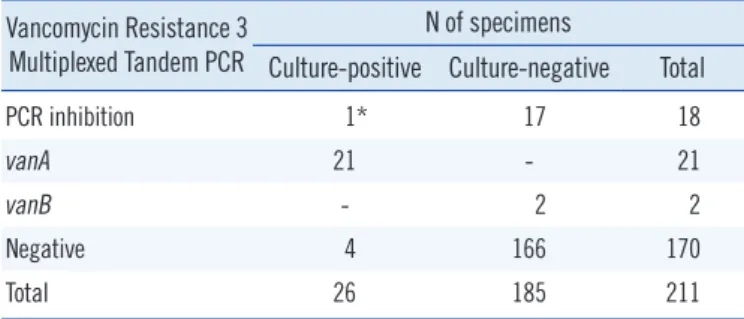
Of the 211 rectal swab samples, 18 (8.5%) were not effectively amplified by the PCR–presumably because of the presence of PCR inhibitors in the samples; one of them tested positive for VRE by using the enrichment culture method. Samples showing PCR inhibition were excluded from the study, leaving 193 sam- ples for consideration. Comparative results for the culture-based method and PCR are listed in Table 1 and described in detail in the following results section. The PCR assay was assessed us- ing the results obtained with the enrichment culture method as the gold standard. Of the 25 positive PCR results, 21 were posi- tive for vanA, and 2, for vanB. All the 21 vanA-positive results
tested positive for VRE by culture method; we confirmed vanA genotype by using BD GeneOhm™ VanR Assay. None of the vanB-positive PCR results confirmed with those obtained with the culture method. Four of the samples that tested positive in the culture method tested negative in the PCR assay. Compared to the culture method, the Vancomycin Resistance 3 Multi- plexed Tandem PCR assay yielded a sensitivity of 84.0%, speci- ficity of 98.8%, positive predictive value (PPV) of 91.3%, and negative predictive value (NPV) of 97.6%.
DISCUSSION
The increasing global prevalence of VRE [17-22] has led to in- creased interest in screening of patients for colonization and in development of methods for rapid, sensitive, and reliable detec- tion of VRE [23]. Various commercial phenotypic and genotypic assays with different sensitivity and specificity are available for VRE screening [12, 24-30]; however, genotypic assays are gener- ally more rapid and sensitive [28, 31, 32]. The Cepheid GeneX- pert vanA/vanB assay, BD GeneOhm VanR assay, and other commercially available assays have high sensitivity and specific- ity for detecting vanA-positive specimens [24, 28-30], but a low specificity due to the comparably high rates of apparent false- positive vanB-positive specimens [12, 28]. The low specificity of detection of the vanB gene by various assays has been ex- plained by the presence of commensal bacteria of the fecal flora carrying the vanB gene [8, 12, 13, 25, 28, 33]. Consistent with these findings, the 2 vanB genes we detected by PCR were not confirmed using the culture method. To the best of our knowl- edge, this is the first study involving Vancomycin Resistance 3 Multiplexed Tandem PCR assay, and like all other methods stud- ied for the active surveillance and detection of VRE, it produced false-positive results due to vanB. Therefore, it has been sug- gested that follow-up culture should be performed on all vanB-
positive specimens [12, 27]. The vanB genotype has never been detected in this hospital until date [1, 34]. In our sample set, vanB was present in 8.0% (2/25) of the total number of speci- mens, and in this setting, confirmation with the culture method has prevented unnecessary precautions during isolation of strains.
In our study, 18 (8.5%) of the 211 rectal swab samples con- tained PCR inhibitors. Because one of these samples tested positive for VRE using the culture method, this finding highlights a disadvantage of the assay. PCR inhibitors are often present in stool samples, and may originate from dietary components, polysaccharides, or chlorophyll from herbs and vegetables, bile salts, urea, glycolipids, hemoglobin, and heparin [35]. Although automated nucleic acid extraction systems improve the consis- tency and throughput of PCR tests, these systems may prove insufficient for removal of PCR inhibitors [36]. Although various protocols have been developed to remove PCR inhibitors (e.g., heat treatment before PCR, chloroform extraction, treatment with activated carbon, sample dilution), they may affect the sen- sitivity of the assay or lead to false-negative results [35].
In our study, 12.9% of the specimens tested positive for VRE, and all the strains were found to display vanA phenotype. This is not an unexpected result, considering that there has been only 1 report describing the isolation of vanB-positive E. faecium in Turkey [37]. As a part of our study, we collected samples dur- ing an outbreak period from the Hematology and Oncology unit and from pediatric and adult patients. Many of them could have been treated with antibiotics, which might increase the selective pressure for VRE. However, as the antibiotic therapy received by the patients was not documented for the present study, the ef- fects of antibiotics could not be compared.
The Vancomycin Resistance 3 Multiplexed Tandem PCR kit had an excellent NPV and PPV for the detection of vanA. Be- cause the kit can rapidly identify patients not carrying vancomy- cin-resistance genes and those who have acquired the vanA and vanB genes, healthcare professionals can, within 3 hr of patient admission, determine appropriate infection control poli- cies to prevent cross infections. Strains testing positive for vanA can be rapidly identified as VRE, but strains testing positive for vanB need to be confirmed by the culture method.
In conclusion, direct application of Vancomycin Resistance 3 Multiplexed Tandem PCR assay on rectal swabs is a reliable op- tion to give rapid and accurate results for vanA-VRE surveil- lance.
Table 1. Performance of Vancomycin Resistance 3 Multiplexed Tandem PCR compared to enrichment cultures for vancomycin-re- sistant enterococci
Vancomycin Resistance 3 Multiplexed Tandem PCR
N of specimens
Culture-positive Culture-negative Total
PCR inhibition 1* 17 18
vanA 21 - 21
vanB - 2 2
Negative 4 166 170
Total 26 185 211
*vanA positive.
Authors’ Disclosures of Potential Conflicts of Interest
No potential conflicts of interest relevant to this article were re- ported.
Acknowledgements
The authors would like to thank infection control committee of Akdeniz University Faculty of Medicine.
REFERENCES
1. Colak D, Naas T, Gunseren F, Fortineau N, Ogunc D, Gultekin M, et al.
First outbreak of vancomycin-resistant enterococci in a tertiary hospital in Turkey. J Antimicrob Chemother 2002;50:397-401.
2. Top J, Willems R, Bonten M. Emergence of CC17 Enterococcus faeci- um: from commensal to hospital-adapted pathogen. FEMS Immunol Med Microbiol 2008;52:297-308.
3. Courvalin P. Vancomycin resistance in gram-positive cocci. Clin Infect Dis 2006;42(S1):S25-S34.
4. Matar MJ, Safdar A, Rolston KV. Relationship of colonization with van- comycin-resistant enterococci and risk of systemic infection in patients with cancer. Clin Infect Dis 2006;42:1506-7.
5. Werner G, Serr A, Schütt S, Schneider C, Klare I, Witte W, et al. Com- parison of direct cultivation on a selective solid medium, polymerase chain reaction from an enrichment broth, and the BD GeneOhm™
VanR Assay for identification of vancomycin-resistant enterococci in screening specimens. Diagn Microbiol Infect Dis 2011;70:512-21. 6. Olivier CN, Blake RK, Steed LL, Salgado CD. Risk of vancomycin-resis-
tant Enterococcus (VRE) bloodstream infection among patients colo- nized with VRE. Infect Control Hosp Epidemiol 2008;29:404-9.
7. Novicki TJ, Schapiro JM, Ulness BK, Sebeste A, Busse-Johnston L, Swanson KM, et al. Convenient selective differential broth for isolation of vancomycin-resistant enterococcus from fecal material. J Clin Micro- biol 2004;42:1637-40.
8. Van Horn KG, Gedris CA, Rodney KM, Mitchell JB. Evaluation of com- mercial vancomycin agar screen plates for detection of vancomycin-re- sistant enterococci. J Clin Microbiol 1996;34:2042-4.
9. Domingo MC, Huletsky A, Giroux R, Boissinot K, Picard FJ, Lebel P, et al. High prevalence of glycopeptide resistance genes vanB, vanD, and vanG not associated with enterococci in human fecal flora. Antimicrob Agents Chemother 2005;49:4784-6.
10. Palladino S, Kay ID, Flexman JP, Boehm I, Costa AM, Lambert EJ, et al.
Rapid detection of vanA and vanB genes directly from clinical speci- mens and enrichment broths by real-time multiplex PCR assay. J Clin Microbiol 2003;41:2483-6.
11. Paule SM, Trick WE, Tenover FC, Lankford M, Cunningham S, Stosor V, et al. Comparison of PCR assay to culture for surveillance detection of vancomycin-resistant enterococci. J Clin Microbiol 2003;41:4805-7. 12. Sloan LM, Uhl JR, Vetter EA, Schleck CD, Harmsen WS, Manahan J, et
al. Comparison of the Roche LightCycler vanA/vanB detection assay and culture for detection of vancomycin-resistant enterococci from perianal swabs. J Clin Microbiol 2004;42:2636-43.
13. Ballard SA, Grabsch EA, Johnson PD, Grayson ML. Comparison of three PCR primer sets for identification of vanB gene carriage in feces and correlation with carriage of vancomycin-resistant enterococci: inter-
ference by vanB-containing anaerobic bacilli. Antimicrob Agents Che- mother 2005;49:77-81.
14. Drews SJ, Johnson G, Gharabaghi F, Roscoe M, Matlow A, Tellier R, et al. A 24-hour screening protocol for identification of vancomycin-resis- tant Enterococcus faecium. J Clin Microbiol 2006;44:1578-80.
15. Petrich, A, Luinstra K, Page B, Callery S, Stevens D, Gafni A, et al. Ef- fect of routine use of a multiplex PCR for detection of vanA- and vanB- mediated enterococcal resistance on accuracy, costs and earlier report- ing. Diagn Microbiol Infect Dis 2001;41:215-20.
16. Sahm DF, Free L, Smith C, Eveland M, Mundy LM. Rapid characteriza- tion schemes for surveillance isolates of vancomycin-resistant entero- cocci. J Clin Microbiol 1997;35:2026-30.
17. Brown DF, Hope R, Livermore DM, Brick G, Brougthon K, George RC, et al. Non-susceptibility trends among enterococci and non-pneumo- coccal streptococci from bacteraemias in the UK and Ireland, 2001 to 2006. J Antimicrob Chemother 2008;62(S2):ii75-85.
18. Henard S, Lozniewski A, Aissa N, Jouzeau N, Rabaud C. Evaluation of the duration of vanA vancomycin-resistant Enterococcus faecium car- riage and clearance during a large-scale outbreak in a region of eastern France. Am J Infect Control 2011;39:169-71.
19. Sagel U, Schulte B, Heeg P, Borgmann S. Vancomycin-resistant entero- cocci outbreak, Germany, and calculation of outbreak start. Emerg In- fect Dis 2008;14:317-9.
20. Ergani-Ozcan A, Naas T, Baysan BO, Ogunc D, Inan D, Colak D, et al.
Nosocomial outbreak of vancomycin-resistant Enterococcus faecium in a paediatric unit at a Turkish university hospital. J Antimicrob Chemother 2008;61:1033-9.
21. Theilacker C, Jonas D, Huebner J, Bertz H, Kern WV. Outcomes of in- vasive infection due to vancomycin-resistant Enterococcus faecium during a recent outbreak. Infection 2009;37:540-3.
22. Werner G, Coque TM, Hammerum AM, Hope R, Hryniewicz W, John- son A, et al. Emergence and spread of vancomycin resistance among enterococci in Europe. Euro Surveill 2008;13:pii:19046
23. Vonberg RP, Chaberny IF, Kola A, Mattner F, Borgmann S, Dettenkofer M, et al. Prevention and control of the spread of vancomycin-resistant enterococci: results of a workshop held by the German Society for Hy- giene and Microbiology. Anaesthesist 2007;56:151-7.
24. Bourdon N, Bérenger R, Lepoultier R, Mouet A, Lesteven C, Borgey F, et al. Rapid detection of vancomycin-resistant enterococci from rectal swabs by the Cepheid Xpert vanA/vanB assay. Diagn Microbiol Infect Dis 2010;67:291-3.
25. Grabsch EA, Ghaly-Derias S, Gao W, Howden BP. Comparative study of selective chromogenic (chromID VRE) and bile esculin agars for isola- tion and identification of vanB-containing vancomycin-resistant entero- cocci from feces and rectal swabs. J Clin Microbiol 2008;46:4034-6. 26. Ledeboer NA, Das K, Eveland M, Roger-Dalbert C, Mailler S, Chatellier S,
et al. Evaluation of a novel chromogenic agar medium for isolation and differentiation of vancomycin-resistant Enterococcus faecium and En- terococcus faecalis isolates. J Clin Microbiol 2007;45:1556-60.
27. Stamper PD, Shulder S, Bekalo P, Manandhar D, Ross TL, Speser S, et al. Evaluation of BBL CHROMagar VanRE for detection of vancomycin- resistant Enterococci in rectal swab specimens. J Clin Microbiol 2010; 48:4294-7.
28. Stamper PD, Cai M, Lema C, Eskey K, Carroll KC. Comparison of the BD GeneOhm VanR assay to culture for identification of vancomycin-re- sistant enterococci in rectal and stool specimens. J Clin Microbiol 2007; 45:3360-5.
29. Babady NE, Gilhuley K, Cianciminio-Bordelon D, Tang YW. Perfor- mance characteristics of the Cepheid Xpert vanA assay for rapid identi- fication of patients at high risk for carriage of vancomycin-resistant En- terococci. J Clin Microbiol 2012;50:3659-63.
30. Usacheva EA, Ginocchio CC, Morgan M, Maglanoc G, Mehta MS, Tremblay S, et al. Prospective, multicenter evaluation of the BD Ge- neOhm VanR assay for direct, rapid detection of vancomycin-resistant Enterococcus species in perianal and rectal specimens. Am J Clin Pathol 2010;134:219-26.
31. Naas T, Fortineau N, Snanoudj R, Spicq C, Durrbach A, Nordmann P.
First nosocomial outbreak of vancomycin-resistant Enterococcus faeci- um expressing a VanD-like phenotype associated with a vanA genotype.
J Clin Microbiol 2005;43:3642-9.
32. Song JH, Ko KS, Suh JY, Oh WS, Kang CI, Chung DR, et al. Clinical im- plications of vancomycin-resistant Enterococcus faecium (VRE) with VanD phenotype and vanA genotype. J Antimicrob Chemother 2008;61: 838-44.
33. Graham M, Ballard SA, Grabsch EA, Johnson PD, Grayson ML. High rates of fecal carriage of nonenterococcal vanB in both children and
adults. Antimicrob Agents Chemother 2008;52:1195-7.
34. Ongut G, Kilinckaya H, Baysan BO, Ogunc D, Colak D, Inan D, et al.
Evaluation of Brilliance VRE agar for the detection of vancomycin-resis- tant enterococci in rectal swab specimens. J Med Microbiol 2013;62: 661-2.
35. Schrader C, Schielke A, Ellerbroek L, Johne R. PCR inhibitors-occur- rence, properties and removal. J Appl Microbiol 2012;113:1014-26. 36. Verheyen J, Kaiser R, Bozic M, Timmen-Wego M, Maier BK, Kessler
HH. Extraction of viral nucleic acids: comparison of five automated nu- cleic acid extraction platforms. J Clin Virol 2012;54:255-9.
37. Coşkun FA, Mumcuoğlu I, Aksu N, Karahan ZC, Us E, Tekeli FA, et al.
Phenotypic and genotypic traits of vancomycin-resistant enterococci in a public hospital: the first vanB-positive Enterococcus faecium isolates.
Mikrobiyol Bul 2012;46:276-82.