1
In Vivo Kinematics of a Mobile-bearing Total Knee Prosthesis
Yeon Soo Lee†, Sang Jin Park*, Eun Kyoo Song*,**
이동베어링형 인공무릎전치환관절의 생체내의 운동 이연수†, 박상진*, 송은규*,**
knee(무릎), kinematics(운동형태), mobile-bearing(이동형베어링), total knee arthroplasty(무릎전치환술)
Abstract
In the total knee arthroplasty (TKA), kinematic benefic of a mobile-bearing total knee prosthesis is still arguing. Main reasons for implant failure are loosening and polyethylene wear and should be solved with new designs with mob ile bearings. The kinematics of the knee prosthesis also affects the implant failure. Recently, a second generation of p rostheses with a mobile-bearing was developed. The current study aimed to assess the kinematic path of the 2nd generation mobile knee prosthesis compared to the normal knees. Using 3D/2D registration method, CT-derived 3D knee models were fitted to sequential 2D X-ray images during knee flexion. 3D kinematics of the femur and the tibia were analyzed. The 2nd generation mobile-bearing TKA prosthesis (e.motion, Aesculap, Germany) knees showed less external rotation and knee flexion range compared to the normal knee, but the trend of external rotation was similar each other.
1. INTRODUCTION
In the total knee arthroplasty (TKA), kinematic benefic of a mobile-bearing total knee prosthesis is still arguing. Main reasons for implant failure are loosening and polyethylene wear which are linked to the incongruence between the tibial inlay and the femoral component. They should be solved with new designs with mobile bearings [1]. Former mobile bearings devices like the Low Contact Stress Prosthesis with two separated meniscal bearings failed to show an improvement in long-term follow ups. Now the second generation of prostheses with mobile bearings, mainly with one-piece floating platforms, allows an additional sagittal movement and enhance congruency in flexion [2].
Altered design factors will bring about different kinematics so that consequently it will affect patient’s knee range of motion and survivorship.
The current study aimed to assess kinematic difference between the 2nd generation mobile-bearing knee prosthesis and the normal knee.
2. MATERIALS AND METHOD
2.1 Specimens
2.2 Five normal knee patients and 5 TKA knee patients treated with a 2nd generation TKA prosthesis (e.motion, Aesculap, Germany) participated at the current study. During knee flexion from full extension to deep flexion, 3D kinematics of the femur and the tibia were analyzed.
The TKA prosthesis used were Aesculap e.motion 2nd generation TKA prosthesis. The sizes of the femoral component were F3, F4, F6, while those of the tibial component were T2, T3, T4.
2.2 Acquisition of 3D models
For the normal knees, each patient in the supine
† KSME Member, Gwangju Institute of Science and Technology
E-mail : [email protected] TEL : (602)970-3259 FAX : (062)970-2384
* Chonnam National University Hospital
** Chonnam National University
1473 대한기계학회 2008년도 추계학술대회 논문집
2 posture took computerized tommographic (CT) images with 512 x 512 resolution and 1.25 slice thickness. The 3-dimensional (3D) knee bone models were reconstructed from the CT images using Mimics 10.1 (Materialise, Belgium).
For TKA knees, the femoral and tibial components were scanned using a laser scanner. The scanned volumetric points were converted to 3D polygonal CAD models (Fig.1).
Fig. 1. Local coordinate systems of a femoral component and a tibial component.
2.3 Acquistion of 2D X-ray images
Using a distortion-free X-ray scanner, sequential knee motion images were taken during each patient’s voluntary active knee flexion. The X-ray images were taken with the resolution 1900*2991.
2.4 3D/2D registration
In vivo kinematics were analyzed using a 3D/2D registration method by which CT-derived 3D knee models were fitted to sequential 2D X-ray images.
3D/2D registrations were performed with the Model- based RSA (Medis Specials, Netherald).
Fig. 2. 3D/2D registration of 3D TKA prostheses to a 2D x-ray image.
3. RESULTS
3.1 Range of motion in the knee flexion
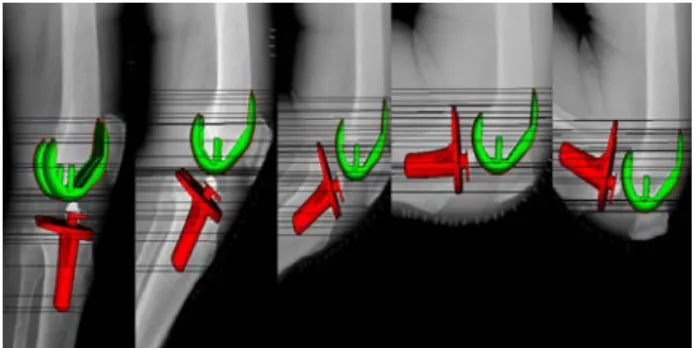
Normal intact knee showed up to 140 degrees of maximum knee flexion. In contrast, TKA patients showed 108 degrees of maximum knee flexion (Fig. 3)
Fig. 3. 3D TKA prosthesis motion during knee flexion
3.2 External rotation
With respect to the tibial coordinate system, the axial rotation of the femur was analyzed. TKA knees showed less external rotation compared to the normal knee, but the trend was similar each other (Fig. 4).
Femoral rotation with respect to the tibia
-10 -5 0 5 10 15 20 25
0 20 40 60 80 100 120 140 160
Knee fexion (degree)
Int rot.(-) <--> Ext. rot. (+), (degree)
Normal knee LeeKK LF5T4 GongYY RF4T3 GongYY LF5T4 MoonOR RF3T2 LeeGJ LF5T4 Average TKR
Fig. 4. External rotation of the femur with respect to the tibia
4. CONCLUSION
The 2nd generation mobile-bearing TKA prosthesis (e.motion, Aesculap, Germany) knees showed less external rotation and knee flexion range compared to the normal knee, but the trend of external rotation was similar each other.
REFERENCES
[1]Zurcher, A. W., Wolterbeek, N., Harlaar, J., and Poll, R. G., 2008, "Knee rotation during a weight bearing activity: Influence of turning," Gait & posture, 28(3), pp.
472-477.
[2]Geiger, F., Mau, H., Kruger, M., and Thomsen, M., 2008, "Comparison of a new mobile-bearing total knee prosthesis with a fixed-bearing prosthesis: a matched pair analysis," Archives of orthopaedic and trauma surgery, 128(3), pp. 285-291.
1474