• 검색 결과가 없습니다.

Development of a Thermal Model for Discharge Behavior of MH Hydrogen Storage Vessels

N/A
N/A
Protected

Academic year: 2021

Share "Development of a Thermal Model for Discharge Behavior of MH Hydrogen Storage Vessels"

Copied!
6
0
0

로드 중.... (전체 텍스트 보기)

전체 글

(1)

MH 수소저장 장치의 방출시 열거동 모사 수치 모델 개발

오상근*, 조성욱**, 이경우*

*서울대학교 재료공학부, **한국 지질자원 연구원

Development of a Thermal Model for Discharge Behavior of MH Hydrogen Storage Vessels

SANGKUN O*, SUNGWOOK CHO**, KYUNGWOO YI*

*Department of Materials Science and Engineering, Seoul National University, 1 Gwanak-ro, Gwanak-gu, Seoul, Korea

**Korea Institute of Geoscience and Mineral Resouces, 92 Gwahang-no, Yuseong-gu, Daejeon, Korea

ABSTRACT

Metal hydride alloys are a promising type of material in hydrogen storage applications, allowing for low-pressure, high-density storage. However, while many studies are being performed on enhancing the hydrogen storage properties of such alloys, there has been little research on large-scale storage vessels which make use of the alloys. In particular, large-scale, high-density storage devices must make allowances for the inevitable generation or absorption of heat during use, which may negatively impact functioning properties of the alloys. In this study, we develop a numerical model of the discharge properties of a high-density MH hydrogen storage device. Discharge behavior for a pilot system is observed in terms of temperature and hydrogen flow rates. These results are then used to build a numerical model and verify its calculated predictions. The proposed model may be applied to scaled-up applications of the device, as well as for analyses to enhance future device designs.

KEY WORDS : Numerical analysis(전산 모사), Metal hydrides(수소화 합금), Hydrogen storage(수소 저장), Thermal model(열 해석 모델)

† Corresponding author : [email protected]

[

접수일

: 2011.4.1

수정일

: 2011.4.15

게재확정일

: 2011.4.22 ]

1. Introduction

Hydrogen storage is a major issue which must be resolved for development of a viable, efficient

hydrogen economy 1) . Many storage technologies including high pressure gas or liquid-state storage are hindered by issues such as low volumetric storage density, systemic instability and cost.

Certain metal alloys have been shown to be a

promising alternative, with many numerous

(2)

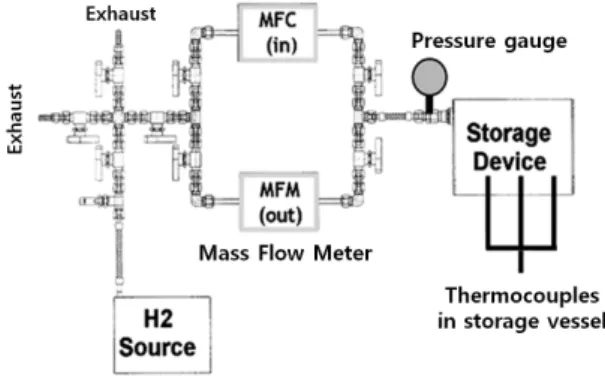
Fig. 1 Pilot system for bulk-scale data acquisition.

previous studies demonstrating their ability to absorb and release hydrogen in significant quantities.

Moreover, hydrogen storage in metal hydrides offers potential benefits such as high volumetric density and stable, low pressure utilization 1) . One type of alloy with promising hydrogen storage properties is the TiCrV alloy 2,3) and TiCrV-Fe alloy 4) . These alloys have been shown to demonstrate high reversible storage capacities and resiliency through multiple cycles.

However, utilization of these alloys in practical applications has been hindered by the comparatively low volume of research being performed on their bulk behavior or storage device designs for such materials in large-scale applications. Moreover, high costs and low practicality make it difficult to perform experimentation on large-scale devices or systems. This is particularly true in a climate with domestic investment in hydrogen research being more heavily focused on production than on storage or distribution 5) .

In this study, we address this issue by developing a numerical analysis model of the discharge pro- perties of an MH storage system based on measured properties from a pilot system using TiCrV-Fe alloy. The numerical modeling takes into account key parameters such as the inevitable absorption of heat during hydrogen release, which may nega- tively impact the storage properties of the alloy 1,6,7) . The model allows for prediction of the thermal behavior of an MH vessel during hydrogen release, and may be applied to different configurations of MH systems, and in further studies to enhance future device designs.

2. Experimental Method 2.1 Pilot System

In order to obtain bulk-scale data of the TiCrV-

Fe alloy used in the present study, we built a pilot system with a simple hydrogen storage device based on prior simulations intended to optimize both reaction rates and temperature control. The system, as illustrated in Figure 1, makes it possible to obtain temperature readings from various loca- tions within the hydride beds by employing stra- tegically placed thermocouples, as well as gas flow rates for both absorption and desorption through a mass flow controller .

2.2 Numerical Modeling

Because of limitations arising from high cost and practicality, production of large amounts of alloys and direct experimentation on multiple devices utilizing them is prohibitively difficult. As a result, studies regarding the impact of certain variables on device efficiency are often limited to a single design 7) .

A convenient and effective alternative to direct experimentation is to predict the behavior of systems in question using numerical simulation.

Several studies adopting this method have been

reported in the literature 8-11) . Unfortunately, most

of these studies are not performed in tandem with

direct analysis of real alloy samples. In this study,

bulk material properties are first obtained from a

(3)

0 1 2 3 4 5 1E-3

0.01 0.1 1 10

P

H2

(MP a )

wt%

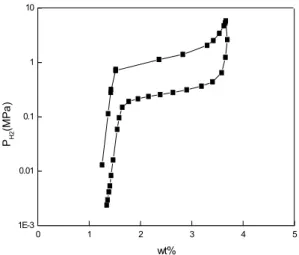
Fig. 2 PCT curve for Ti

0.32

Cr

0.35

V

0.25

-Fe

0.08

alloy at 293K.

pilot system to create an accurate and reliable numerical model.

The simulations are based on measurements taken from Ti 0.32 Cr 0.35 V 0.25 -Fe 0.08 alloy. The PCT characteristics of the alloy at 293K are given in Figure 2. The alloy demonstrates a relatively high reversible storage capacity within a reasonable pressure range.

The reaction heat value used in this study was measured in alloy samples to be 42 kJ for each mol of hydrogen gas. Temperature for the system is calculated by multiplying this value by the flow rate, which is assumed to be equal to the reacted amount of hydrogen.

The effective thermal conductivity of the device is of particular importance in determining the efficiency of a device 1,6,7,12) , especially given the unpredictable conductivity of porous materials 12,13) . We have determined the conductivity of a porous bed of the MH alloy to be approximately 0.2 W/m-K.

A number of assumptions are made in order to simplify the model and improve calculation effi- ciency:

(i) As pointed out in earlier studies 14) , metal

hydride materials will generally reach a uniform particle size following several cycles of hydroge- nation and dehydrogenation, and therefore the powder bed is assumed to be a homogeneous volume of uniform porosity.

(ii) Because of the extremely high diffusivity of hydrogen gas and the high porosity of metal hydride beds, the entire metal hydride bed region is assumed to undergo reaction simultaneously.

This simplification is applicable in this study as we deal mostly with relatively small mobile application- scale devices, but may not be suitable for scaled- up applications.

(iv) In order to simplify the model, reaction kinetics are not directly calculated. Instead, we base our modeling and design on considerations of heat, given the measured reaction heat of 42 kJ for each mol of hydrogen gas.

Heat transfer is calculated through an energy conservation equation. Such an equation may be defined in numerous ways, but the calculations performed in the present study make use of the total enthalpy equation.

Flow-related calculations are carried out using the Navier-Stokes Equation. Flow analysis is based on mass conservation and momentum conservation.

Because of mass conservation, any change in a given volume’s mass over time must be balanced by the flow of an equivalent mass to a corres- ponding volume. Newton’s 2nd law gives that the variation of momentum over time must be equal to the total sum of the forces acting upon the fluid. These two components are combined in the Navier-Stokes Equation.

The calculations were performed using the general

purpose commercial numerical analysis software

package CFD-ACE.

(4)

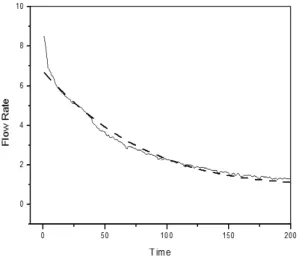
Fig. 3 Average measured flow rate from MH vessel (solid) and 4th-order fit of data (dotted).

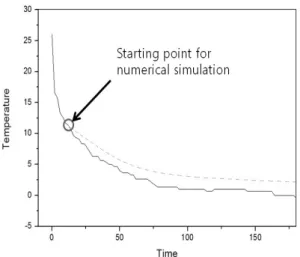
Fig. 4 Measured temperature drop from different intial internal tank pressures.

3. Results and Discussion 3.1 Measured Results

The average measured flow rates upon exposure of the MH device to the atmosphere at 1 atm for 3 minutes (180 seconds) is given as the solid line in Figure 3. The average value is taken from 10 trials.

In the early stages of hydrogen release, the flow rate is relatively high, for three reasons:

First, the high concentration of absorbed hydrogen in the alloy results in a greater release of gas.

Second, the system's temperature has not yet dropped significantly from the endothermic reaction, which yields a higher flow rate. And third, a significant amount of hydrogen exists within the tank in gaseous form, not reacted with the alloy, and readily escapes the vessel upon opening of the valve.

As the hydrogen release process proceeds, the system's temperature drops and the concentration of hydrogen in the alloy likewise diminishes, resulting in a lower flow rate, which eventually reaches a steady plateau.

3.2 Numerical Model Results

To calculate temperature in the thermal numerical model, the measured flow rate was multiplied by the measured reaction heat value of the alloy, 42 kJ for each mol of hydrogen gas. In the interests of calculation simplicity, a 4th order fit of the average flow data, shown as the dotted line in Figure 3, was used in place of the actual average data. As the figure shows, the deviation between the data fit and the actual data is negligibly small.

A major factor which must be figured into the calculations is the cooling by gas expansion in the experimental system. A significant amount of hy- drogen remains in its gaseous form within the vessel, without reacting with the MH alloy. When the vessel is opened to atmospheric pressure, this gas expands rapidly from a compressed state, resulting in a marked decrease of temperature. As the calculations are based on the reaction heat alone, the cooling by gas expansion must be re- flected separately in the results.

Figure 4 shows measured temperature changes

(5)

Fig. 5 Measured average temperature (solid) and calculated tem- perature in MH vessel during hydrogen desorption.

in the center of the vessel for trials beginning from various internal pressure values. While there is some minor deviation between the trials, it appears that the initial steep temperature drop occurs within the first 10 seconds, and for the purposes of this study, this period is assumed to be a period of cooling by gas expansion. Cooling by reaction heat is considered for the period after the initial 10 seconds.

The measured temperature change within the MH hydrogen storage vessel versus the calculated change over the same period is given in Figure 5 as solid and dotted lines, respectively. The initial period of cooling by gas expansion is not reflected in the calculated results. Overall, the trend of decreasing temperature as the endothermic gas desorption reaction progresses is very similar for the measured and calculated results. The minor discrepancies between the values is expected to be an issue caused by assumptions made in the calculations regarding the transition from cooling by gas expansion to cooling by reaction heat.

The calculated results are similar enough to measured values that the numerical model may be

considered reasonably accurate, and may be applied to later studies regarding new system configurations.

In particular, the accuracy of temperature prediction from measured reaction rates, or flow rates, will prove useful in the development of a compre- hensive numerical reaction model, given further investigation into the relationship between tem- perature and reaction rates.

4. Conclusions

In this study, we propose a numerical model of the thermal behavior of MH hydrogen storage devices during the discharge of hydrogen gas. An experimental system utilizing kilogram-scale amounts of an alloy with a composition of Ti 0.32 Cr 0.35 V 0.25 -Fe 0.08

was constructed to obtain bulk-scale data which might be applied to the numerical model. Results show good agreement between the measured and calculated values. The model allows for accurate temperature prediction given reaction rates, and may be further utilized in other systems, and for the development of a comprehensive chemical reaction model.

Acknowledgements

This study was performed as part of the 21st Century Frontier R&D Program for Hydrogen Energy, supported by the Ministry of Science and Technology of Korea.

References

1) Sandrock S. A. panoramic overview of hydrogen storage alloys from a gas reaction point of view. J Alloys and Compounds 1999; 293-295:

pp. 877-888.

2) Lin H. C., Lin K. M., Wu K. C., Hsiung H. H.,

Tsai H. K. Cyclic hydrogen absorption-desorption

(6)

characteristics of TiCrV and Ti0.8Cr1.2V alloys.

Int J Hydrogen Energy 2007; 32: pp. 4966-4972.

3) Cho S.-W., Shim G., Choi G.-S., Park C.-N., Yoo J.-H., Choi J. Hydrogen absorption-desorption properties of Ti0.32Cr0.43V0.25 alloy. J Alloys and Compounds 2007; 430: pp. 136-141.

4) Yoo J.-H., Shim G., Cho S.-W., Park C.-N.

Effects of desorption temperature and substitution of Fe for Cr on the hydrogen storage properties of Ti0.32Cr0.43V0.25 alloy. Int J Hydrogen Energy 2007; 32: pp. 2977-2981.

5) 박노언, 김형욱 “수소-연료전지 연구개발 투 자현황 분석”, 한국 수소 및 신에너지 학회논 문집, Vol. 21, No. 2, 2010, pp. 143-148.

6) Zhang J., Fisher T., Ramachandran P. V., Gore J. P., Mudawar I. A review of heat transfer issues in hydrogen storage technologies. J Heat Transfer 2005; 127: pp. 1391-1399.

7) Muthukumar P., Maiya M. P., Murthy S. S.

Experiments on a metal hydride-based hydrogen storage device. Int J Hydrogen Energy 2005;

30: pp. 1569-1581.

8) Gambini M., Manno M., Vellini M. Numerical analysis and performance assessment of metal hydride-based hydrogen storage systems. Int J

Hydrogen Energy 2008; 33: pp. 6178-6187 9) MacDonald B. D., Rowe A. M. Impacts of

external heat transfer enhancements on metal hydride storage tanks. Int J Hydrogen Energy 2006; 31: pp. 1721-1731.

10) MacDonald B. D., Rowe A. M. A thermally coupled metal hydride hydrogen storage and fuel cell system. J Power Sources 2006; 161:

346-355.

11) Oi T., Maki K., Sakaki Y. Heat transfer cha- racteristics of the metal hydride vessel based on the plate-fin type heat exchanger. J Power Sources 2004; 125: pp. 52-61.

12) Nagel M., Komazaki Y., Suda S. Effective thermal conductivity of a metal hydride bed augmented with a copper wire matrix. J of Less-Common Metals 1986; 120: pp. 35-43.

13) Kurt A., Ates H. Effect of porosity on thermal conductivity of powder metal materials. Materials and Design 2007; 28: pp. 230-233.

14) Mohan G., Prakash Maiia M., Srinivasa Murthy

S. Performance simulation of metal hydride

hydrogen storage device with embedded filters

and heat exchanger tubes. Int J Hydrogen Energy

2007; 32: pp. 4978-4987.

수치

Fig. 1 Pilot system for bulk-scale data acquisition.
Fig. 2 PCT curve for Ti 0.32 Cr 0.35 V 0.25 -Fe 0.08  alloy at 293K.
Fig. 4 Measured temperature drop from different intial internal  tank pressures.
Fig. 5 Measured average temperature (solid) and calculated tem- tem-perature in MH vessel during hydrogen desorption.

참조

관련 문서

The experimental data were adopted for this analysis on the base of cold storage technology of modified atmosphere package(MAP) for seven months from March

Ejectors is a fluid transportation device for which a principle is used that high-pressure fluid are spouted through driving pipe and the pressure

Schmidt, The Next Generation of Seasonal Thermal Energy Storage in Germany, 2007, p.2 (원전 Steinfurt : ITW University of Stuttgart, Attenkirchen : ZAE Bayern) / PlanEnergi,

FPSO (Floating Production Storage & Offloading) FSO(floating storage and offloading).. FSRU (Floating Storage Regasification

However syn elimination does occur in rigid molecules when the living group and the hydrogen are held in an when the living group and the hydrogen are held in an

J., “Hydrogen production from partial oxidation of dimethyl ether using corona discharge plasma”, International Journal of Hydrogen Energy , Vol.. Liu C.,

In this study, a fine Ce 3 Al 11 phase catalyst was synthesized by mechanochemical reaction and the influence of the catalyst on the NaAlH 4 hydrogen storage properties

Microbubbles are created in copious quantities in the wakes of ocean vessels and, because of their large acoustical cross sections, are responsible for