The Evaluation of UV-induced Mutation of the Microalgae, Chlorella vulgaris in Mass Production Systems
Tae-O Choi1,2, Kyong-Ho Kim1, Gun-Do Kim1, Tae-Jin Choi1 and Young Jae Jeon1*
1Department of Microbiology, Pukyong National University, Busan 48513, Korea
2Chloland Co.. Ltd., Gabae-ri, Dongbu-myeon, Geoje, Gyeongsangnam-do 53330, Korea Received July 11, 2017 /Revised September 21, 2017 /Accepted September 29, 2017
The microalgae Chlorella vulgaris has been considered an important alternative resource for biodiesel production. However, its industrial-scale production has been constrained by the low productivity of the biomass and lipid. To overcome this problem, we isolated and characterized a potentially econom- ical oleaginous strain of C. vulgaris via the random mutagenesis technique using UV irradiation. Two types of mass production systems were compared for their yield of biomass and lipid content. Among the several putatively oleaginous strains that were isolated, the particular mutant strain designated as UBM1-10 in the laboratory showed an approximately 1.5-fold higher cell yield and lipid content than those from the wild type. Based on these results, UBM1-10 was selected and cultivated under outdoor conditions using two different types of reactors, a tubular-type photobioreactor (TBPR) and an open pond-type reactor (OPR). The results indicated that the mutant strain cultivated in the TBPR showed more than 5 times higher cell concentrations (2.6 g l-1) as compared to that from the strain cultured in the OPR (0.5 g l-1). After the mass cultivation, the cells of UBM1-10 and the parental strain were further investigated for crude lipid content and composition. The results indicate a 3-fold higher crude lipid content from UBM1-10 (0.3%, w/w) as compared to that from the parent strain (0.1% w/w).
Therefore, this study demonstrated that the economic potential of C. vulgaris as a biodiesel production resource can be increased with the use of a photoreactor type as well as the strategic mutant isolation technique.
Key words : Biodiesel resource, Chlorella vulgaris, mass-scale production, microalgae, mutagenesis
*Corresponding author
*Tel : +82-53-629-5612, Fax : +82-53-629-5619
*E-mail : [email protected]
This is an Open-Access article distributed under the terms of the Creative Commons Attribution Non-Commercial License (http://creativecommons.org/licenses/by-nc/3.0) which permits unrestricted non-commercial use, distribution, and reproduction in any medium, provided the original work is properly cited.
ISSN (Online) 2287-3406 Journal of Life Science 2017 Vol. 27. No. 10. 1137~1144 DOI : https://doi.org/10.5352/JLS.2017.27.10.1137
Introduction
Prolonged anthropogenic activities relying on fossil fuels has created one of the most urgent global environmental is- sues such as climate change [2]. The search for suitable alter- natives which are renewable and cleaner energy sources to mitigate carbon dioxide and greenhouse gas emissions has been one of important missions for future sustainability of our society [1]. Various types of biomass as organic matters produced by plants, microorganisms and animals have been considered as promising candidates. In particular lipid feed- stock biomass derived from agricultural crops has been the main use for such an alternative [19]. However, such oil feedstocks derived from palm, corn and soybean have been
created another public concerns such as ethical dilemma, competing land use issue and generating more greenhouse gas during these crops production processes [1]. Microalgae can be emphasized as one of promising alternatives since biofuels derived from the microbial biomass show relatively higher productivities based on culture area, and were also considerably less problematic to the land use issue for food and feed productions. Many researches related to the appli- cation of various microalga species to mass scale cultivation technology for biofuel production have been reported [5, 8, 12, 21, 23]. Among the microalgae, Chlorella sp. is considered as one of the most promising candidates due to its relatively simple and fast growth characteristics, high lipid contents, the availability of mass culture technologies, and its non- competing culturable land use for food resources [12].
However, despite of several advantages over the conven- tional biodiesel feedstocks, the technologies used in the mi- croalga biomass production have been hampered by low yields of biomass and lipids. With these reasons, many re- search efforts have been paid to improve biomass and lipid productivities via strain developments and culturing tech-
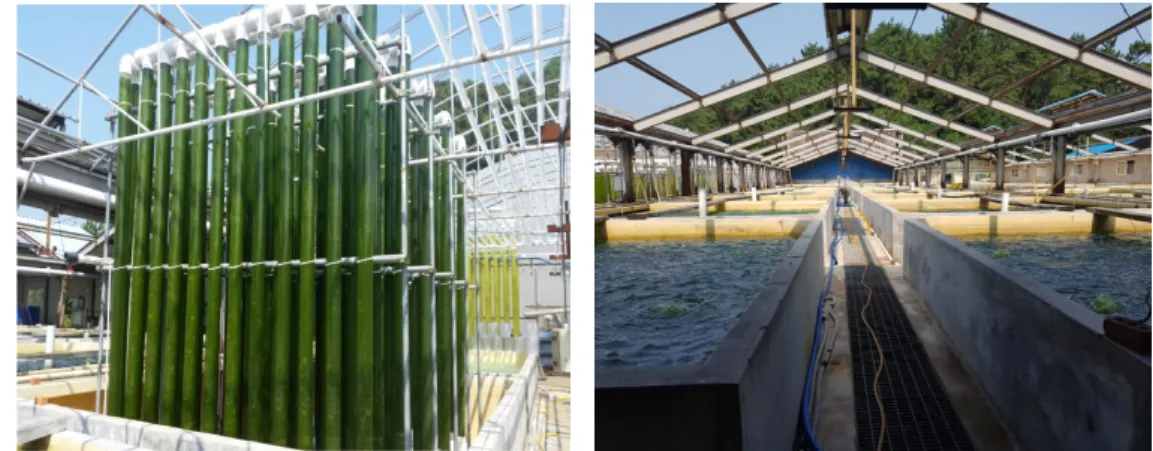
Fig 1. The outdoor microalgae cultivation systems used in this study for mass cultivation. Left, tubular-type photobioreactor (TBPR);
Right, open pond type reactor (OPR)
nology with various medium compositions, environmental conditions and photoreactors [15, 16, 18, 20]. Although hard to compare their biomass and lipid productivities from vari- ous Chlorella sp. so far reported due to the various important parameters considered, the highest biomass and lipid pro- ductivities ever reported were in a range of 0.17~0.23 g l-1 day-1 and 32~44 mg l-1 day-1respectively [21]. In addition, many strain developmental strategies via various random mutagenesis techniques such as UV mutagenesis or metabol- ic engineering have been reported to increase both pro- ductivities [3, 4, 24, 27].
Thus, in this study, we also attempted to isolate econom- ically potential high oleaginous strain of C. vulgaris for the comparison of two types of mass production via the random mutagenesis technique using UV irradiation.
Materials and Methods
Strain and Growth medium
The microalgae Chlorella vulgaris (KMMCC 191) used in this study was purchased from the Korean Marine Microal- gae Culture Center, Busan, Korea. The lab scale cultivation was carried out in 250 ml conical flasks with a working vol- ume of 100 ml volume using F/2 medium [25]. The culture was maintained at 25℃ with a light intensity of 74 μmol m-2 s-1 in 12:12 circadian cycles.
Growth analysis
The absorbance of Chlorella vulgaris was measured for cell growth at 680 nm using a UV/visible spectrophotometer (Optizen 2120UV, Mecacys Ltd, Korea). For the determi- nation of dry cell weight (DCW), a 10 ml cell culture was
filtered using a pre-weighted filter paper (Waterman No. 2), and the filtered cells were dried in a dry oven at 105℃ for 24 hr and weighed. For mass scale cultivations, the cell growth monitoring was achieved via cell number counting using Hemocytometer (Thermo Fisher Scientific, USA) un- der a microscope. The cell numbers was converted to dry cell weight using a conversion factor (2.24×10⁻¹¹ g cell-1) pre- viously reported by Hu [14] for the comparison of biomass productivities.
Experimental set up for Random Mutagenesis To achieve physical mutagenesis, UV-B (312 nm) light from a UV lamp stand (15 W, 76 μM / cm 2, VILBER Lour- mat, France) was used with the irradiation distance at 15 cm (Fig. 1). The ultraviolet light was irradiated to a 60-mm Petri-dish containing a 5 ml of cell culture adjusted to the initial cell absorbance (OD 680 nm = 0.5) with the time intervals of 1~5 min. After UV irradiation, the cells were serially di- luted with F/2 medium and were spread on F/2 agar plates.
The UV-irradiated plates were kept in dark for 16 hr to pre- vent light-induced repair. The plates were then maintained under a light intensity of 74 μmol m-2 s-1 for 3 weeks at 20℃
until colonies were formed. The resulting colonies were in- oculated into 250 ml conical flasks containing 100 ml F/2 liquid media for further growth characteristic analysis.
Lipid quantification analysis
The intracellular neutral lipid content of C. vulgaris was determined using the method previously reported by Chen et al. [7]. For efficient staining of nile red, the cell absorbance was adjusted to the optical density of 0.5 at 680 nm, and then the 10 μl cell culture with a mixture of 138 μl sterile
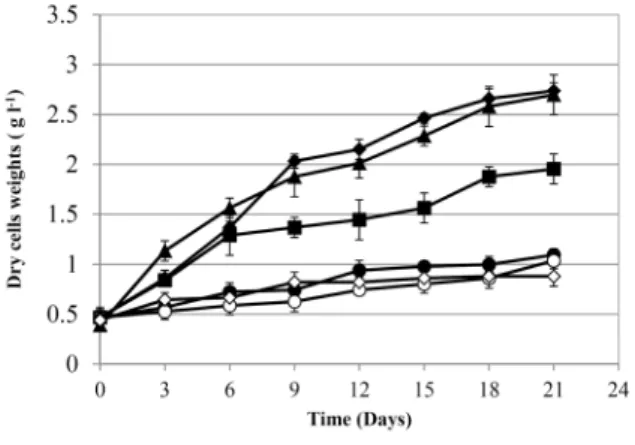
Fig. 2. Cell growth evaluation of UV-B induced mutants. The experiments were carried out at 250 ml conical flasks containing 100 ml f/2 media with a light intensity of 74 μmol m-2 s-1 in 12:12 circadian cycles at 25°C without air supply. Symbols: The wild type strain of C. vulgaris (■), the mutant strain of C. vulgaris UBM1-2 (●), UBM1- 3 (◯), UBM1-10 (◆), UBM1-15 (▲), UBM1-18 (◇). Error bars from triplicates.
distilled water, 2 μl nile red, and 50 μl DMSO added to a 96-well plate (Costar 3790, Corning Inc., USA). The culture was incubated at 40℃ for 10 min. After the incubation, the fluorescence intensity was measured at the wavelength of excitation at 490 nm and emission at 620 nm. The fluo- rescence intensity values were obtained by subtracting the auto-fluorescence values of the microalgae using a fluo- rescence spectrophotometer FS-2 (SCINCO, USA). The lipid content of the parental strain and the mutant strain was measured after preparing a calibration curve with Triolein (Sigma-Aldrich, USA) for lipid quantification.
Mass scale cultivation
To evaluate UV-B induced mutant for biomass productiv- ities and lipid contents, a tubular type photobioreactor (TBPR) with 20 ton capacity and an open pond reactor (OPR) with 30 ton capacity were used, which was previously re- ported [9, 17] as shown in the Fig. 1. Before the cultivation started, the culture broth with the addition of a 5 g ton-1 of calcium hypochlorite (Nippon Soda, Japan) as a dis- infectant was sterilized by aeration for 24 hr. Afterward, a 10 g ton-1 of sodium thiosulfate (Kukdong Chemical, China) was used for neutralization. In the TBPR, an approximately 700 liter of inoculum with a cell concentration of about 3×10⁷ cells ml-1 was added to the neutralized seawater to 1.3 tons of seawater to achieve the initial concentration of 1×10 7 cells ml-1. In the open pond experiments, a 3 liter of 100×108 cell ml-1 inoculum was added to 30 tone media to achieve the same initial concentration of the experiments used in TBPR.
The microalgae cultivation medium prepared with filtered natural seawater with supplements of 100 g of urea (Dongbu Farm Hannong, Korea) per ton of seawater and 30 g of com- pounds fertilizer (Dongbu Farm Hannong, Korea) per ton of seawater containing 21 g nitrogen, 5 g phosphate and 8 g potassium source. Both reactors were maintained at 20
±2oC and pH 8. 0 under a greenhouse conditions with natu- ral light source from April 10 to 22 for 2 weeks at Geoje Gyeonsangnam-do, South Korea (34°47'13.0"N 128°32'40.7"E).
The CO2 gas (Ssangyong Synthesis Gas, Korea) was supplied into both systems at 0.2 l min-1 during cultivation using air-blowers with one horse power.
Statistical analysis
The results of this study were expressed as mean values from 3 replicates. The statistical significance between the control and experimental groups was tested using Student's
t-test at standard deviation (p-value <0.05)
Results and Discussion
Mutant selection
After the UV mutagenesis, each of the irradiated samples was spread onto F/2 agar medium by the plate dilution method. Single colonies were appeared after 3 weeks. The colony morphology, in particular showing large and dark green color colonies were peaked and these colonies were once again streaked on the F/2 agar plates. The isolated sin- gle colonies were transferred to 250 ml conical flasks con- taining 100 ml F/2 liquid media and cultured for 21 days to analyze mutagenicity characteristics. Among those mu- tant strains, in particular five mutant strains with excellent cell growth in the liquid medium were identified as UV-B mutants (UBM) designated as UBM 1-2, UBM1-3, UBM1-10, UBM1-15 and UBM1-18. The growth characteristics of each strain lipid contents were determined.
Cell growth characteristics of UV-induced mutant strains
Cell growth from the 5 selected mutant strains obtained from UV mutagenesis was measured with 3-day intervals for 21 days as shown in Fig. 2. Among the mutant strains tested, the cell growth rates from the mutants UBM1-10 and UBM1-15 were higher than that of the wild-type strain.
Maximum biomass concentrations from UBM1-10 (2.8±0.2 g
Table 1. The comparison of maximal biomass concentrations and lipid contents from UV induced mutants of C. vulgaris and other microalgae strains cultivated in 250-ml flasks under the lab conditions
Chlorella sp. Biomass
(g l-1)
Lipid content (%, w/w)
Biomass productivities (g l-1 day -1)
Lipid productivity
( mg l-1 day-1) Ref.
C. vulgaris (KMMCC 191) C. vulgaris UBM1-2 UBM1-3
UBM1-10 UBM1-15 UBM1-18
C. sorokiniana IAM-212 Chlorella sp. F&M-M48 C. vulgaris F&M-M49 C. vulgaris CCAP 211/11b
1.8 1.075
0.93 2.8 2.8 0.86
- - - -
4.5 8.9 5.4 6.8 5.6 6.0 19.3 18.7 18.4 19.2
0.09 0.05 0.04 0.13 0.13 0.04 0.23 0.23 0.20 0.17
2.1 4.2 2.6 3.2 2.7 2.8 44.7 42.1 36.9 32.6
In this study In this study In this study In this study In this study In this study
[21]
[21]
[21]
[21]
l-1) and UBM1-15, (2.8±.03 g l-1) strains were reached at 21th days which were about 1.5 times higher than that of the control strain (1.8 g l-1). However, the maximum biomass concentrations from other mutants such as UBM1-2, UBM1-3 and UBM1-18 were lower than that from the parental strain.
Lipid contents were measured using nile red fluorescence method mentioned in the early section on the 21st day of cultures. The results are highlighted in Table 1. Among the mutant strains, in particular the lipid content from UBM1-2 showed the highest content at 8.9%(w/w) followed by UBM1-10 (6.8%) and UBM1-18 (6.0%). The lipid contents from UBM1-2 and UBM1-10 were approximately a 2- and 1.5-fold higher than that from the wild type strain (4.5%).
In particular UBM1-10 strain showed interesting character- istics. According to its growth characteristics as shown in Fig. 2, the strain showed higher biomass yield and faster growth rate as compared to those from the wild type stain whereas its lipid contents was also a 1.5 fold higher than that from the wild type strain. Rodolfi et al. reported [21]
that the biomass and lipid contents productivities from vari- ous strains of Chlorella sp.. The biomass and lipid productiv- ities from their report were in a range of 0.17~0.23 g l-1 day-1 and 32~44 mg l-1 day-1 respectively as shown in Table 1.
However, the mutant strains isolated from this study were in a range of 0.04~0.13 g l-1 day-1 in biomass productivity and 2.6~4.2 mg l-1 day-1 in lipid content productivity. Such reduction in these parameters could possibly be derived from different culture conditions and strains of Chlorella sp.
such as light intensity, CO2 supply and different circadian cycles used.
Many research previously reported that microalgae can accumulate large amounts of intracellular triglycerides trig-
ged by various environmental stresses such as nutrient star- vation, UV irradiation and high concentration of salts [11, 13, 20, 22, 27]. Our research was also agreeable to the pre- vious reports, since most of mutants isolated after UV muta- genesis showed higher lipid contents than that from the wild type strain. Zayadan et al. [26] reported the UV mutant iso- lation strategy with enhanced lipid accumulation using ni- trogen source starvation. The author found the UV induced strain from C. pyrenoidosa C-2 showed 2-fold higher biomass yield and lipid contents as compared to those from the wild type strain. In addition, other authors [3] also reported that a UV induced mutant of C. vulgaris with a gene mutation involved in CO2 fixation such a gene coding for acetyl CoA carboxylase showed enhanced the lipid accumulation.
Although what genetic mutation caused the increased lipid content in our mutant strains remained to be further eluci- dated, the results indicated that the mutant strain obtained by ultraviolet irradiation can increase intracellular lipid con- tents under the normal cell growth conditions without nitro- gen starvation, which would be economical benefits for the lipid production as a feedstocks for biodiesel production.
With the economical consideration, the strain UBM1-10 showing higher cell biomass yield and lipid content was se- lected for mass scale production experiments.
Outdoor experiments using TBPR and OPR In the open pond reactors, both mutant and the wild type strains showed a similar growth rate. After 10 days of culti- vation, both strains reached highest cell concentrations at 0.48 g l-1 and 0.5 g l-1 respectively. This indicated that both wild type and mutant strains did not show a significant dif- ference in terms of the growth rates and biomass yields (Fig.
Fig. 3. Cell growth evaluation of the UV induced mutant of C. vulgaris UBM1-10. The experiments were carried out at either tubular type phothoreactor (TBPR) with 20 ton capacity or open pond type reactor (OPR) with 30 ton capacity under outdoor conditions. Symbols: (◆), the wild type strain of C. vulgaris from TBPR ; (■), the mutant stain of C. vulgaris UBM1-10 from TBPR; (◇), the wild type strain of C. vulgaris from OPR; (□), the mutant stain of C. vulgaris UBM1-10 from OPR.
3). However, in the TBPR system, both wild-type and the mutant strains after 9th days had reached to a highest con- centration at 2.7 g l-1 and 2.5 g l-1 respectively, which were about 5 times higher than those from both strains as cultured in the OPR system. This result indicated that the TBPR sys- tem is much more efficient to yield higher biomass concen- trations than those from using the OPR system. In particular, the results from TBPR were comparable to those results per- formed under small scale lab culture conditions as shown in the Table 1. This would be caused by higher light pene- tration rates in the TBPR than those in the OPR. The diame- ter of the tubular type reactor used in our system was 140mm diameter, whereas the depth of OPR was 0.8 m height, which indicates that the sunlight transmittance in the TBPR would be higher than that from OPR. Therefore, the microorganism could have more sufficiently received the sunlight required for photosynthesis as the TBPR system was used. In comparison with a simple unit productivity per area basis, the TBPR as a large-scale cultivation system has been shown to be much higher. However, industrial ap- plication for microbial biomass mass production requires an approach through various economic analyses including not only the productivity per unit area, but also other parame- ters such as initial facility installation and operation costs [19]. Therefore, it was difficult to conclude which method would be the best method as a suitable system for industrial application. This would require a further investigation on life cycle assessment with these economical parameters.
However, as compared to the strain-wise, the maximal biomass concentrations and growth rates from the mutant strains cultured using either TBPR or OPR were similar to those from the wild type strain. The reason for this result is that, under the lab conditions the strain can be cultured under optimized conditions such as temperature, light in- tensity and medium composition. However, in the case of outdoor cultures, these cannot be controlled. In particular, under outdoor conditions, both culture systems were totally relied on the natural environments such local temperature and light source. In addition, F/2 media have been broadly used to culture marine microalgae under lab conditions [21, 25]. However this can be quite expensive due to the many trace elements such as biotin and vitamin B12 required in the medium compositions. With the reason, many researches have been search for efficient and cheap alternatives with additional benefits for the water quality controls [10, 18].
However, in this study the plant compound fertilizer as in- dustrial medium was applied to these purposes. Although the plant compound fertilizer as an alternative to the F/2 medium showed quite excellent industrial medium for mi- croalgae cultivation as shown in Fig. 2 and Table 2, such an industrial medium may provide nutritional deficiency of trace elements contained in F/2 medium used for the labo- ratory culture experiments as mentioned by previous reports [6, 15] . This could be one of reasons leading to such poor growth of the UV-induced mutant. Therefore, it would be necessary to carry out an experiment to search for another economical culture medium that can promote cell growth in future for industrial mass culture. Many intensive review articles highlighted current status of industrial media devel- opments of biomass feedstock production and microalgae with suitable candidates [6]. However, the information re- lated to more than a ton unit scale was quite limited and most of results were from small lab scale productions em- phasizing the importance of this study.
Biomass composition analysis from mass culture The mass cultivated cells of the mutant strain UBM1-10 from TBPR were harvested for the biomass composition analysis. The analysis results indicated that UBM1-10 strain showed a roughly threefold increase in crude fat content compared to that from the wild-type strain (Table 3).
Interestingly, the results from the lipid analysis indicate that the concentration of docosahexaenoic acid (DHA, 0.052%) from the mutant strain cultured from TBBR showed about
Table 2. Comparison of maximal biomass yields and biomass productivities of UV induced mutant strain C. vulgaris using various types of photoreactors
Reactor type Stains Maximal biomass yield
(g l-1)
Biomass productivities (g l-1 day -1)
OPRa C. vulgaris (KMMCC 191)
C. vulgaris UBM1-10
0.48 0.50
0.05 0.05
TBPRa C. vulgaris (KMMCC 191)
C. vulgaris UBM1-10
2.7 2.6
0.37 0.29 250 ml conical flask C. vulgaris (KMMCC 191)
C. vulgaris UBM1-10
1.8 2.8
0.09 0.13
a: Both strains cultured using open pond reactor (OPR) with 30 ton capacity under outdoor conditions.
b: Both strains cultured using tubular type reactor with 20 ton capacity under outdoor conditions.
c: Both strains cultured using F/2 media under lab conditons without CO2 supply.
Table 3. The biomass composition anaylsis of C. vulgaris UBM1- 10 and its parental strains drived from mass cultures using the TBPR system
Contents
Chlorellar vulgaris UBM1-10
(% w/w)
Parental strain (%) Crude lipid
Crude protein Ash
Docosahexaenoic acid Eicosapentaedecanoic acid
0.3 0.7 3.2 0.052
ND
0.1 0.7 2.1 0.018 0.026
a 3-fold higher concentration than that from the wild type (0.018%), although its concentration was relatively small. In addition, the mutant strain did not produce eicosapentaede- canoic acid (EPA) whereas the wild produced such an un- saturated fatty acid at 0.021%. This result indicated that the UV induced mutagenesis could have affected the metabolic pathway of lipid biosynthesis. However, what genetic muta- tion in such metabolic pathway could led to such results remained to be answered. In addition, such low productivity from the mutant cultured in the TBPR system indicates cur- rent stage of mass culture production system used in this study. Many review articles highlight various reactor types can be used for the production of biofuel feedstocks and their possible limitation parameters to improve biomass and lipid content productivities have been emphasized [15]. The limitation from our results was also agreeable to those pre- vious reports.
In this study, the mutant strains of Chlorella vulgaris in- duced by UV irradiation were isolated with the industrial application purpose. Among the mutants isolated, in partic- ular, the mutant strain UBM1-10 isolated showed excellent growth characteristics under the lab conditions with an in-
crease in biomass yield (35% increase) and lipid contents (34% increase) as compared to those from the wild type strain. In addition, as this strain was applied to two types of photoreactors for the production of biodiesel feedstock, our study clearly demonstrated that the biomass productiv- ities under outdoor conditions can be significantly increased with the choice of type of cultivation technologies. In partic- ular, the biomass composition analysis indicated that the UV-induced C. vulgaris mutant UBM1-10 as an excellent mu- tant showing about 3 times increase in the lipid contents as compared that from the wild type strain. Although their biomass and lipid productivities were quite low as com- pared to others that previously reported. This indicated that further researches are required to improve such important parameters for biofuel feedstock production such as in- dustrial medium development and more sophisticated mass- scale production systems. In this respect, this study will pos- sibly contribute to useful data for the industrial production of biofuel feedstock using microalgae with a consideration for mass culturing technologies.
Acknowledgement
This work was supported by the Pukyong National University Research fund in 2016(C-D-2016-1279).
References
1. Ahmad, A., Yasin, N. M., Derek, C. and Lim, J. 2011.
Microalgae as a sustainable energy source for biodiesel pro- duction: A review. Renew. Sustainable Energy Rev. 15, 584- 593.
2. Amin, S. 2009. Review on biofuel oil and gas production processes from microalgae. Energy Convers. Manage. 50,
1834-1840.
3. Anthony, J., Rangamaran, V. R., Gopal, D., Shivasankar- asubbiah, K. T., Thilagam, M. L., Peter Dhassiah, M., Padinjattayil, D. S., Valsalan, V. N., Manambrakat, V., Dak- shinamurthy, S., Thirunavukkarasu, S. and Ramalingam, K.
2015. Ultraviolet and 5'fluorodeoxyuridine induced random mutagenesis in Chlorella vulgaris and its impact on fatty acid profile: A new insight on lipid-metabolizing genes and structural characterization of related proteins. Mar. Biotech- nol. 17, 66-80.
4. Banerjee, C., Dubey, K. K. and Shukla, P. 2016. Metabolic engineering of microalgal based biofuel production:
Prospects and challenges. Front. Microbiol. 7, 432.
5. Brennan, L. and Owende, P. 2010. Biofuels from microalgae
—a review of technologies for production, processing, and extractions of biofuels and co-products. Renew. Sustainable Energy Rev. 14, 557-577.
6. Carvalho, A. P., Meireles, L. A. and Malcata, F. X. 2006.
Microalgal reactors: A review of enclosed system designs and performances. Biotechnol. Prog. 22, 1490-1506.
7. Chen, W., Sommerfeld, M. and Hu, Q. 2011. Microwave-as- sisted nile red method for in vivo quantification of neutral lipids in microalgae. Bioresour. Technol. 102, 135-141.
8. Chisti, Y. 2007. Biodiesel from microalgae. Biotechnol. Adv.
25, 294-306.
9. Choi, T. O. 2015. High-density culturing apparatus of micro- algae of air exchange type. K. Chloland Co. Ltd (ed.), Republic of Korea (Patent No: 10-2015-0018351).
10. Dianursanti Rizkytata, B. T., Gumelar, M. T. and Abdullah, T. H. 2014. Industrial tofu wastewater as a cultivation me- dium of microalgae Chlorella vulgaris. Energy Procedia 47, 56- 61.
11. El-Kassas, H. Y. 2013. Growth and fatty acid profile of the marine microalga Picochlorum sp. Grown under nutrient stress conditions. Egypt. J. Aquat. Res. 39, 233-239.
12. Guccione, A., Biondi, N., Sampietro, G., Rodolfi, L., Bassi, N. and Tredici, M. R. 2014. Chlorella for protein and biofuels:
From strain selection to outdoor cultivation in a green wall panel photobioreactor. Biotechnol. Biofuels 7, 84-84.
13. Hounslow, E., Kapoore, R. V., Vaidyanathan, S., Gilmour, D. J. and Wright, P. C. 2016. The search for a lipid trigger:
The effect of salt stress on the lipid profile of the model microalgal species Chlamydomonas reinhardtii for biofuels production. Curr. Biotechnol. 5, 305-313.
14. Hu, W. 2014. Dry weight and cell density of individual algal and cyanobacterial cells for algae research and develop- ment, University of Missouri--Columbia.
15. Huntley, M. E., Johnson, Z. I., Brown, S. L., Sills, D. L., Gerber, L., Archibald, I., Machesky, S. C., Granados, J., Beal,
C. and Greene, C. H. 2015. Demonstrated large-scale pro- duction of marine microalgae for fuels and feed. Algal Res.
10, 249-265.
16. Katsuda, T., Shimahara, K., Shiraishi, H., Yamagami, K., Ranjbar, R. and Katoh, S. 2006. Effect of flashing light from blue light emitting diodes on cell growth and astaxanthin production of Haematococcus pluvialis. J. Biosci. Bioeng. 102, 442-446.
17. Kim, J., Jung, J. M., Lee, J., Kim, K. H., Choi, T. O., Kim, J. K., Jeon, Y. J. and Kwon, E. E. 2016. Pyrogenic trans- formation of Nannochloropsis oceanica into fatty acid methyl esters without oil extraction for estimating total lipid content. Bioresour. Technol. 212, 55-61.
18. Lau, K. Y., Pleissner, D. and Lin, C. S. K. 2014. Recycling of food waste as nutrients in Chlorella vulgaris cultivation.
Bioresour. Technol. 170, 144-151.
19. Mata, T. M., Martins, A. A. and Caetano, N. S. 2010.
Microalgae for biodiesel production and other applications:
A review. Renew. Sustainable Energy Rev. 14, 217-232.
20. Rios, L., Klein, B., Luz, L., Maciel Filho, R. and Maciel, M.
W. 2015. Nitrogen starvation for lipid accumulation in the microalga species desmodesmus sp. Appl. Biochem. Biotech- nol. 175, 469-476.
21. Rodolfi, L., Chini Zittelli, G., Bassi, N., Padovani, G., Biondi, N., Bonini, G. and Tredici, M. R. 2009. Microalgae for oil:
Strain selection, induction of lipid synthesis and outdoor mass cultivation in a low‐cost photobioreactor. Biotechnol.
Bioeng. 102, 100-112.
22. Sharma, K. K., Schuhmann, H. and Schenk, P. M. 2012. High lipid induction in microalgae for biodiesel production.
Energies 5, 1532-1553.
23. Slade, R. and Bauen, A. 2013. Micro-algae cultivation for biofuels: Cost, energy balance, environmental impacts and future prospects. Biomass Bioenergy 53, 29-38.
24. Trentacoste, E. M., Shrestha, R. P., Smith, S. R., Glé, C., Hartmann, A. C., Hildebrand, M. and Gerwick, W. H. 2013.
Metabolic engineering of lipid catabolism increases micro- algal lipid accumulation without compromising growth.
Proc. Natl. Acad. Sci. USA. 110, 19748-19753.
25. Watanabe, A. 1960. List of algal strains in collection at the institute of applied microbiology, university of tokyo. J. Gen.
Appl. Microbiol. 6, 283-292.
26. Zayadan, B. K., Purton, S., Sadvakasova, A. K., Userbaeva, A. A. and Bolatkhan, K. 2014. Isolation, mutagenesis, and optimization of cultivation conditions of microalgal strains for biodiesel production. Russ. J. Plant Physiol. 61, 124-130.
27. Zhu, L. D., Li, Z. H. and Hiltunen, E. 2016. Strategies for lipid production improvement in microalgae as a biodiesel feedstock. Biomed. Res. Int. 2016, 8792548.
초록:자외선에 의해 유도된 Chlorella vulgaris 돌연변이 균주의 대량 생산 시스템에서의 평가
최태오1,2․김경호1․김군도1․최태진1․전용재1*
(1부경대학교 미생물학과, 2㈜클로랜드)
미세조류 Chlorella vulgaris는 바이오 디젤 생산을 위한 중요한 대체원료 중 하나로 간주되어 왔으나, 이러한 미생물의 산업적 적용은 낮은 바이오 매스와 지질 생산성에 의해 제약을 받아왔다. 따라서 이러한 문제를 극복하 기 위해 본 연구는 자외선을 이용한 무작위 돌연변이 유발 기술을 통해 높은 지질 및 바이오 매스 생산성을 가지 는 C. vulgaris 균주를 분리하고 그 특성을 규명하였으며, 두 가지 유형의 대량 생산 시스템을 이용하여 바이오 매스 및 지질 함량의 산출량을 비교하였다. 분리된 돌연변이 균주 중, 특히 실험실 조건에서 UBM1-10으로 명명 된 돌연변이 균주는 야생형 균주에 비해 약 1.5배 높은 세포 수율 및 지질 함량을 보였다. 이러한 결과를 바탕으로 UBM1-10을 선택하여 TBPR (tubular photobioreactor)과 OPR (open pond type reactor)의 두 가지 유형의 반응기
를 사용하여 실외 배양 조건에서 배양하였다. 그 결과 TBPR에서 재배된 돌연변이 균주의 세포 수율은(2.6 g l-1)
OPR에서 배양된 균주의 세포 수율(0.5 g l-1)과 비교하였을 때 약 5배 이상의 높은 세포 수율을 나타내었으며, 대량
배양 후, UBM1-10 및 모 균주의 조 지방 함량 및 조성 등에 대해 추가로 조사를 실시하였다. 그 결과 C. vulagris UBM1-10균주의 지질함량(0.3% w/w)이 모 균주의 지질함량(0.1%)에 비해 약 3배 이상의 조 지방 함량을 보유함 을 확인하였다. 따라서 이 연구는 바이오 디젤 생산 자원으로서 C. vulgaris의 경제적 잠재성이 photoreactor type 의 선택 및 전략적 돌연변이 분리 기술을 통해 증가 될 수 있음을 보여 주었다.