− 342 −
사회인지론 모델을 적용한 나트륨 섭취 줄이기 소비자 영양교육 프로그램 개발 - 포커스그룹 인터뷰에 기초하여-
안소현1)·김혜경1)·김경민2)·윤진숙3)·권종숙4)†
1)
가톨릭대학교 식품영양학과,
2)배화여자대학교 식품영양과,
3)계명대학교 식품영양학과,
4)신구대학교 식품영양과
Development of Nutrition Education Program for Consumers to Reduce Sodium Intake Applying the Social Cognitive Theory
- Based on Focus Group Interviews -
So-Hyun Ahn
1), Hye-Kyeong Kim
1), Kyung Min Kim
2), Jin-sook Yoon
3), Jong Sook Kwon
4)†1)
Department of Food Science and Nutrition, Catholic University, Bucheon, Korea
2)
Department of Food and Nutrition, Baewha Women's University, Seoul, Korea
3)
Department of Food and Nutrition, Keimyung University, Taegu, Korea
4)
Department of Food and Nutrition, Shingu College, Songnam, Korea
†
Corresponding author Jong Sook Kwon Department of Food and Nutrition, Shingu College, 377 Gwangmyeong-ro, Seongnam, Gyeonggi-do 462-743, Korea
Tel: (031) 740-1642 Fax: (031) 740-1590 E-mail: [email protected]
This research was supported by grants from Korea Food and Drug Administration fund.
(11162Sobiyeon165).
Received: July 15, 2014 Revised: August 11, 2014 Accepted: August 26, 2014
ABSTRACT
Objectives: This study aimed to develop nutrition education program for consumers to reduce sodium intake based on social cognitive theory (SCT).
Methods: The main factors of SCT related to low sodium diet were investigated by using focus group interview (FGI) with 30 women who participated in consumer organizations.
Results: The main target groups for the education program were housewives (H), parents (P), and the office workers (OW), for which we considered their influences on other people and the surroundings. According to the results of FGI, in carrying out low sodium diet, ‘positive outcome expectation’ were prevention of chronic disease and healthy dietary habit, and ‘negative outcome expectation’ were low palatability of foods, difficulty in cooking meals, and limited choice of foods. The contents of the program and education materials were individualized by each group to raise self- efficacy and behavioral capability, which reflected the results of the FGI. The program included ‘salt intake and health’ to raise positive outcome expectation. For improving the ability to practice low-sodium diet, the program contained the contents that focused on ‘cooking’ and ‘food purchasing’ for H, on ‘purchasing and selection of low-sodium food with the children’ for P, and on ‘way of selecting restaurant menu’ for OW. Also the program included ‘way of choosing the low-sodium foods when eating out’ with suggestions on sodium content of the dishes and snacks. Further, ‘dietary guidelines to reduce sodium intake’ was also suggested to help self-regulation.
Conclusions: This nutrition education program and education materials could be utilized for the community education and provide the basis for further consumer targeted education program for reducing sodium intake.
Korean J Community Nutr 19(4): 342~360, 2014
KEY WORDS reducing sodium intake, nutrition education program, focus group inter- view, social cognitive theory, consumer
This is an Open-Access article distributed under the terms of the Creative Commons Attribution Non-Commercial License (http://
creativecommons.org/licenses/by-nc/3.0) which permits unrestricted non-commercial use, distribution, and reproduction in any medium, provided the original work is properly cited.
RESEARCH ARTICLE
—————————————————————————
서 론
—————————————————————————
우리나라의 나트륨 섭취 현황을 살펴보면 2011년 평균 4,831.2 mg으로, 1998년부터 계속적으로 4,500 mg~
5,200 mg 수준을 유지하고 있다. 이는 한국인영양섭취 기준 에서 제시한 충분섭취량의 3배 수준이며, 목표섭취량인 2,000 mg 이상 섭취자의 비율도 87.1%로(Ministry of Health
& Welfare, Korea Centers for Diseases Control &
Prevention 2012) 높게 나타나 국민들의 나트륨 섭취 과 다가 우려되고 있다. 나트륨의 과다 섭취는 혈액의 부피를 증 가시키고 혈관 수축에 관여하는 노르에피네프린의 분비를 증 가시켜 혈관의 말초 저항을 상승시킴으로써 고혈압을 유발 할 뿐만 아니라(Blaustein & Hamlyn 1983), 심혈관질환, 뇌혈관질환, 신장 질환, 골다공증 발병 위험을 높이고, 위암 을 유발하거나 악화시키는 등(Chobanian & Hill 2000) 여 러 질병과의 연관성이 높은 것으로 알려져 있다.
현대사회는 매스컴의 홍보나 광고에 민감하게 반응하고 급 식·외식 문화의 확대, 그리고 가공식품이나 간편 조리식품 의 이용이 증가하였으며, 식사를 직장 동료나 친구 등과 같 이 외식을 하는 경우가 많으므로(Jung 등 2012), 환경요인 이 식생활에 영향을 미치는 주요 요인이 되었다. 또한 소금 섭취량 감소는 자신의 태도 뿐 아니라 친구나 이웃의 권유 등 주변인의 영향이 크다는 보고가 있다(Yoon 등 2008). 그 러므로 개인의 영양지식 향상이 태도와 행동변화로 이어진 다는 근거 하에 지식과 정보 전달에 중점을 두는 KAB 교육 모델(Knowledge-Attitude-Behavior model)에만 국 한하여 영양교육을 실시하는 것은 더 이상 적합하지 않을 수 있으므로 현대인의 식생활 환경을 고려한 체계적인 영양교 육 프로그램 설계가 필요한 시점이 되었다. 단순히 영양지식 을 높이는 프로그램보다는 바람직한 식행동으로의 변화를 통 해 생활습관을 확립하여 영양교육 후에도 교육 효과가 지속 될 수 있도록 하는 것이 중요하고(Sheahan & Fields 2008), 개인적 요인 뿐 만 아니라, 행동적, 환경적 요인을 동 시에 고려하여 이들의 상호작용을 중요시하는 사회인지론이 영양교육 프로그램 개발에 효과적일 수 있겠다.
사회인지론은 개인의 인지적 요인과 환경적 요인, 행동적 요인의 끊임없는 상호작용이 개인의 행동에 영향을 미친다 는 것을 주요 개념으로 하는 교육이론이다(Boyle & Morris 1999; Glanz 등 2008). 인지적 요인에는 특정행동 수행에 따른 ‘결과 기대’(긍정적 결과기대, 부정적 결과기대)와 특 정행동 수행 결과에 부여하는 ‘가치 기대’, 그리고 행동수행 에 대한 자신감을 나타내는 ‘자아효능감’이 포함되고, 행동
적 요인에는 행동변화에 필요한 지식과 기술인 ‘행동수행력’
이 포함되어 있다. 다른 이론 모델과의 차별적 요소인 환경 적 요인에는 공간, 시설 등의 ‘물리적 환경’ 및 가족, 친구, 영 양사 등 주변인을 포함한 ‘사회적 환경’과, 이들에 의한 ‘사 회적 지원’, 환경에 대한 개인의 인식을 의미하는 ‘상황’, 그 리고 다른 사람의 행동을 관찰하고 따라하면서 배우게 되는
‘관찰학습’ 등이 포함된다(Glanz 등 2008). 사회인지론을 적용한 초등학생 대상의 당 섭취에 관한 영양교육 연구에서 영양지식과 식태도, 식행동 등이 교육 후 향상되었으며(Kim
& Lee 2011), 일반인 대상 대규모 건강증진 연구에서도 건 강한 식품 선택을 할 때 가족의 지지, 자아 효능감의 증가, 부 정적인 결과 기대에 대한 극복 등이 행동 조절에 주요 역할 을 한 것으로 보고되어(Eileen 등 2007) 사회인지론의 적 용이 영양교육에 유효한 수단이 될 수 있음을 알 수 있다.
나트륨과 관련된 선행연구를 살펴보면 나트륨의 주요 급 원 식품과 식습관 조사 등의 섭취 실태 파악 조사와(Jung &
Shin 2008) 현황 보고에 국한된 경우가 많고, 영양교육으 로는 고혈압환자와 보건소 방문주민, 초등학생 대상 영양교 육 사례가 보고되었다(Huh 2003; Yim 2008; Jung 등 2009; Kim 등 2009; Moon & Kim 2011). 그러나 영양 교육 프로그램이 이론모델에 근거하지 않은 경우가 많고 나 트륨 저감화 교육에 사회인지론을 적용한 사례는 보고된 바 없으며 일반인 소비자 대상의 나트륨 섭취 줄이기 영양교육 은 활성화되지 않았다. 일반 소비자를 대상으로 한 나트륨 저 감화 영양교육은 만성질환을 예방함으로써 치료에 드는 막 대한 의료비용을 줄일 수 있고(Glanz 등 1997) 질병 발생 후에도 식사와 질병 관리가 용이하므로 효율성이 크다. 한편 식품과 음식의 선택 및 구매는 ‘나트륨 섭취 줄이기’의 중요 한 부분이므로 소비자 영양교육의 관점에서의 나트륨 저감 화 교육은 접근이 가능하다.
소비자교육은 소비자가 개인적, 사회적 존재로서 바람직한 소비생활 방법을 추구하고 새로운 소비문화를 형성하는데 필 요한 소비자능력을 개발할 수 있도록 도와주는 것으로, 현명 하고 효율적인 소비자 역할 수행을 위한 지식 배양, 태도 변 화, 기술 증진을 통해 소비자의 행동변화에 긍정적인 영향을 줄 수 있다(Kim 2004; Park & Sohn 2010). ‘능력 있는 소비자’는 올바른 가치 판단으로 사회 흐름을 주도할 수 있 고, 주변에 영향력을 행사하여 사회 변화를 주도할 수 있으므 로 소비자를 대상으로 한 교육 설계는 중요한 의미를 가진다.
특히 주부들은 직접 가정의 식품의 구매와 조리를 담당하는
주요 인물인 동시에 가정과 소비시장의 중간 고리 역할, ‘가
족 소비자경제’에 중요한 역할을 하며, 차세대 소비자인 자녀
들의 가치관 형성에 중요한 영향을 미칠 수 있다(Kim 2004).
질적 연구 조사 방법인 포커스그룹인터뷰(Focus Group Interview: FGI)는 심층 면접 조사 방법으로 관심 대상 집 단을 포커스집단으로 만들어 그 집단의 특정 문제에 대한 경 험, 서비스에 대한 의견, 문제 관련 환경 등에 대한 정보를 얻 는 방법으로(Yoo & Yoo 2009), 개방형 질문을 통해 교육 요구도와 식습관이나 생활습관 등의 기본적인 정보를 얻고 집단의 특성을 이해할 수 있다.
본 연구에서는 주부 소비자를 대상으로 하여 포커스그룹 인터뷰를 통해 나트륨 섭취 줄이기와 관련된 인지적 요인, 환 경적 요인, 행동적 요인에 대한 조사와 전반적인 교육 요구 도, 영양교육 프로그램 개발에 대한 의견을 조사한 결과를 기 반으로 하여, 사회인지론 모델을 적용한 일반 소비자 대상의 나트륨 섭취 줄이기 영양교육 프로그램 및 교육 자료를 개발 하고자 하였다.
—————————————————————————
연구대상 및 방법
—————————————————————————
1. 포커스그룹 인터뷰 1) 조사대상 및 조사일시
소비자 단체협의회에 소속되어있는 소비자단체회원들을 대상으로 희망자를 모집하여 서울 소재의 소비자단체 협의 회 회의실에서 소비자 대상의 나트륨 섭취 줄이기 교육 프로 그램 개발을 위한 사전조사를 목적으로 두 차례의 포커스그 룹 인터뷰(Focus group interview, FGI)를 실시하였다.
학령기 자녀가 있는 경우 관심 영역이 달라질 수 있으므로 대 상자들을 자녀가 고등학교 졸업이상의 연령인 중년 주부군 과 그 이하 연령층인 학부모군으로 분류하여 인터뷰를 진행 하였다. 1차 FGI는 2011년 3월 중년 주부 6명, 학부모 8명 을 대상으로 실시하였고, 2차 FGI는 2011년 4월 중년 주부 9명, 학부모 7명을 대상으로 실시하였다.
2) 조사 방법 및 조사 내용
조사에 사용한 설문 문항은 선행 연구 결과를 참고하여 (Huh 2003; Son 등 2007a; Jung 등 2012) 선정하였고, 중년 주부와 학부모 각 군별로 교수 1명, 연구조사원 2명씩 을 배당하여 개방형 질문 형식으로 자유롭게 의견을 제시할 수 있는 분위기에서 조사를 실시하였다. 직장인군은 별도 팀 을 구성하지 않고, 중년 주부군과 학부모군 대상자들에게 직 장인 대상 교육 프로그램을 실시하는 경우를 상고하도록 하 여 도출한 것을 직장인 교육프로그램 개발에 적용하였다. 각 항목에 대하여 먼저 각 군(중년 주부군이나 학부모군)의 자 체 의견을 조사한 후에, 이어서 같은 질문에 대하여 직장에 다니는 남편이나 자녀 또는 본인의 경우를 고려하여 의견을
말하도록 하였다. 그리고 남편과 자녀의 건강을 위하여 직장 인 교육에 포함되기를 원하는 내용을 제시하도록 하였다.
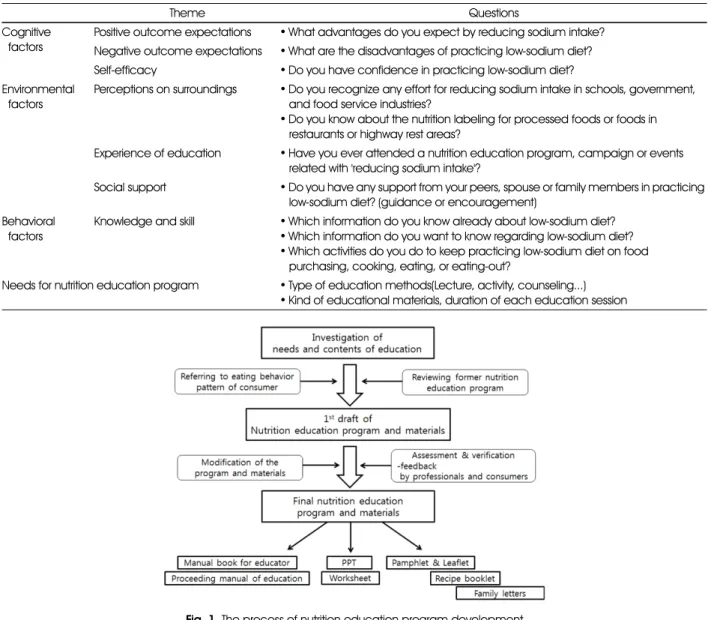
인지적 요인과 관련한 내용으로는 나트륨 섭취 줄이기에 대 한 ‘긍정적 결과기대’와 ‘부정적 결과기대’, 행동결과에 대한 가치, 나트륨 섭취 줄이기 실천에 대한 ‘자아효능감’을 조사 하였고, 환경적 요인으로는 나트륨 섭취 줄이기 관련 주변 환 경에 대한 인식(나트륨 관련 정부 캠페인이나 행사, 광고 등 에 대한 인식 정도 및 참여 여부, 가공식품의 신호등표시제도 와 외식 음식의 영양표시 실시에 관한 인식 정도)과 영양교육 을 받은 경험(캠페인, 관련 행사 등 참여 여부), 사회적 지원 (주변인의 호응도, 지원 정도)에 대해 조사하였다. 행동적 요 인으로는 ‘행동수행력’과 관련된 영양지식과 기술정도를 조 사하기 위해 평소의 식품 구매유형(구매 시 영양표시제 활용 여부, 나트륨섭취를 줄이기 위한 식품 구매 법)이나 소금섭취 와 관련된 식행동(저나트륨식 조리 팁, 가정에서 식사 시와 외식 시에 나트륨 섭취를 줄이기 위한 행동) 등의 소금 섭취 줄이기를 위한 구체적인 실천 방법을 조사하였다(Table 1).
3) 자료 수집 및 분석 방법
연구조사원은 인터뷰 내용을 녹음, 기록하였고, 인터뷰 직 후 브리핑을 통해 녹취한 자료를 수집, 분류하여 분석에 활 용하였다. 전체 인터뷰 내용은 진술한 내용 그대로 컴퓨터에 입력하였고, 연구자의 메모 내용 등을 참고하여 재해석하였 다. 반복된 표현은 하나로 통합하고, 그 중에서 의미 있는 내 용을 추출하여 도출된 진술을 토대로 집단군별과 주제별로 모아 정리하였다(Silverman 2010). FGI 참가자 일반사항 에 대한 자료 분석은 SAS 9.2 package program을 사용 하였고, 평균, 표준편차, 백분율 및 빈도수로 표시하였다. 연 속변수들에 대하여 참가자의 군별 차이는 Student's t-test 를 이용하여 비교하였고, 빈도변수에 대해서는 Chi-square test를 이용하여 비교였다.
2. 영양교육 프로그램 및 교육 자료 개발
영양교육 프로그램 및 교육 자료는 사회인지론에 근거하
여 실시한 FGI를 통해 도출한 내용과 선행 영양교육 프로그
램(Jung 등 2009; Jung 등 2012; Park 등 2012)에서
도출된 나트륨 섭취 줄이기 실천을 위한 영양교육 내용을 참
고하여 개발하였다(Fig. 1). 나트륨 줄이기와 관련된 기대
효과, 저나트륨식 실행과 관련된 지식수준, 환경요인에 대한
인지정도, 나트륨 섭취 줄이기에 대한 소비자 인식과 교육 요
구도는 주로 FGI에서 도출한 내용을 참고하여 대상자 특성
에 맞게 대상자별로 차별화한 프로그램을 개발 하였다. 행동
수행력을 높이기 위한 방안으로 소비자를 대상으로 실시한
선행 연구의 결과에서 도출한 행동양식 자료(Ahn 등 2012) 를 프로그램 개발 시에 반영하여, 나트륨 섭취 줄이기에 중 요한 행동임에도 실천 용이도에서 대상자들이 실천하기 어 렵다고 생각하는 항목들을 모든 대상자의 프로그램 내용에 포함하였다. 포커스 그룹 인터뷰에서 대상자들의 행동결과 에 대한 부정적 기대나 낮은 자아효능감의 원인으로 언급되 었던 요소들에 대한 해결책을 교육내용에 포함하였고, 대상 자들에게 구체적인 정보 제시를 통해 환경적 요인을 바로 인 식할 수 있도록 하는데 초점을 두어 프로그램 내용과 교육 자 료를 개발하였다.
3. 교육 자료에 대한 평가 및 검증
교육 자료에 대한 평가 및 검증을 3단계로 실시하여 각 평
가 결과에서 나온 수정, 보완사항 및 의견을 수렴하여 최종 교육자료 및 프로그램 개발에 반영하였다. 1차 평가는 전문 가 집단(영양교육 전문 교수, 소비자 단체 소속 영양교육 및 교육매체 자문진)과 교육대상자 집단을 대상으로 하여 연구 진이 프로그램 내용을 직접 강의하고 교육 자료를 제시하여, 교육프로그램과 자료에 대한 만족도와 자료의 효용성, 교재 의 난이도 및 이해도 등에 대한 평가를 실시하였다. 1차 평 가 결과를 반영하여 수정된 교육 자료에 대하여 소비자단체 협의회의 교육자료 평가회의 2회와 직접 현장에서 영양교육 을 실시할 강사 집단을 대상으로 하여 실시한 강사교육 워크 샵에서의 평가회의 1 회를 통한 총 세 번에 걸친 2차 평가를 실시하였다. 2차 평가에서는 교육 프로그램 및 교육 자료의 난이도와 구성이 소비자 교육 현장에 적합한지 여부와 교육
Table 1. The questions used for focus group interview based on social cognitive theory
Theme Questions
Cognitive factors
Positive outcome expectations
•
What advantages do you expect by reducing sodium intake?Negative outcome expectations
•
What are the disadvantages of practicing low-sodium diet?Self-efficacy
•
Do you have confidence in practicing low-sodium diet?Environmental factors
Perceptions on surroundings
•
Do you recognize any effort for reducing sodium intake in schools, government, and food service industries?•
Do you know about the nutrition labeling for processed foods or foods in restaurants or highway rest areas?Experience of education
•
Have you ever attended a nutrition education program, campaign or events related with 'reducing sodium intake'?Social support
•
Do you have any support from your peers, spouse or family members in practicing low-sodium diet? (guidance or encouragement)Behavioral factors
Knowledge and skill
•
Which information do you know already about low-sodium diet?•
Which information do you want to know regarding low-sodium diet?•
Which activities do you do to keep practicing low-sodium diet on food purchasing, cooking, eating, or eating-out?Needs for nutrition education program
•
Type of education methods(Lecture, activity, counseling...)•
Kind of educational materials, duration of each education sessionFig. 1. The process of nutrition education program development
자료의 효용성에 대한 평가와 검증을 실시하였다. 영양전문 학회의 자문위원회의에서의 3차 평가를 통하여 전반적인 교 육프로그램의 구성, 내용의 적절성, 교육이론 반영의 적절 성, 교육 매체의 효용성 등에 대한 평가와 검증을 실시하였다.
—————————————————————————
결 과
—————————————————————————
1. 포커스그룹 인터뷰 조사 대상자들의 일반적 특성
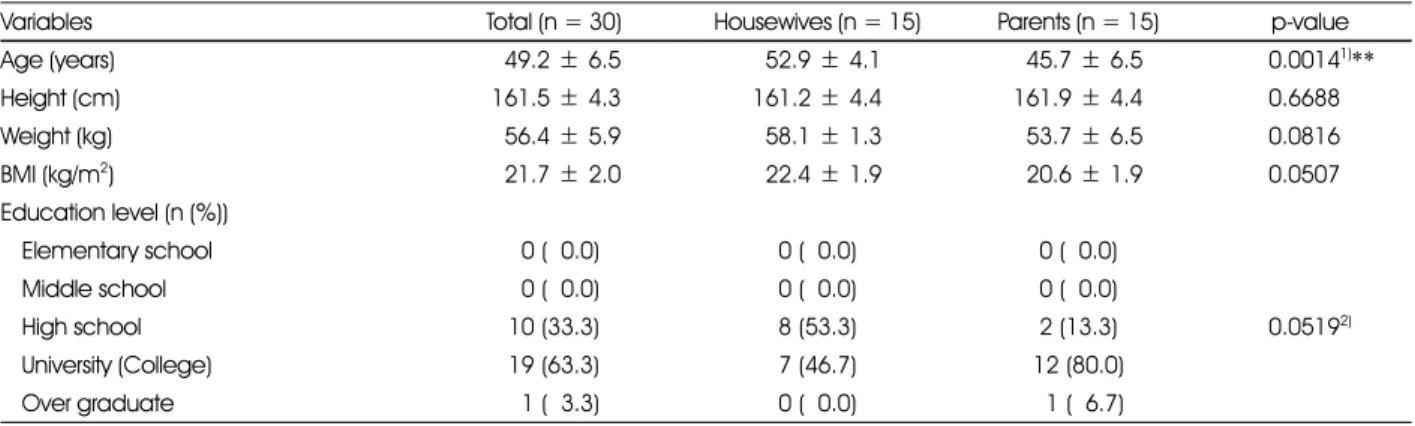
포커스그룹 인터뷰에 참여한 조사 대상자들의 군별 특성 은 Table 2와 같다. 조사 대상자의 평균 연령은 49.2세였 고, 중년 주부군과 학부모군의 평균은 각각 52.9세, 45.7세 로 중년 주부군이 학부모군에 비해 연령이 높았다(p < 0.01).
중년 주부군과 학부모군 간에 신장과 체중, 그리고 BMI 는 차이가 없었다. 교육수준은 전체 대상자의 63.3 %가 전문대 학 이상 졸업자였는데, 중년 주부군은 고졸이 53.3 %,, 학부 모군은 전문대학 이상 졸업이 80 %로 가장 많았다.
2. 포커스그룹 인터뷰 조사 결과
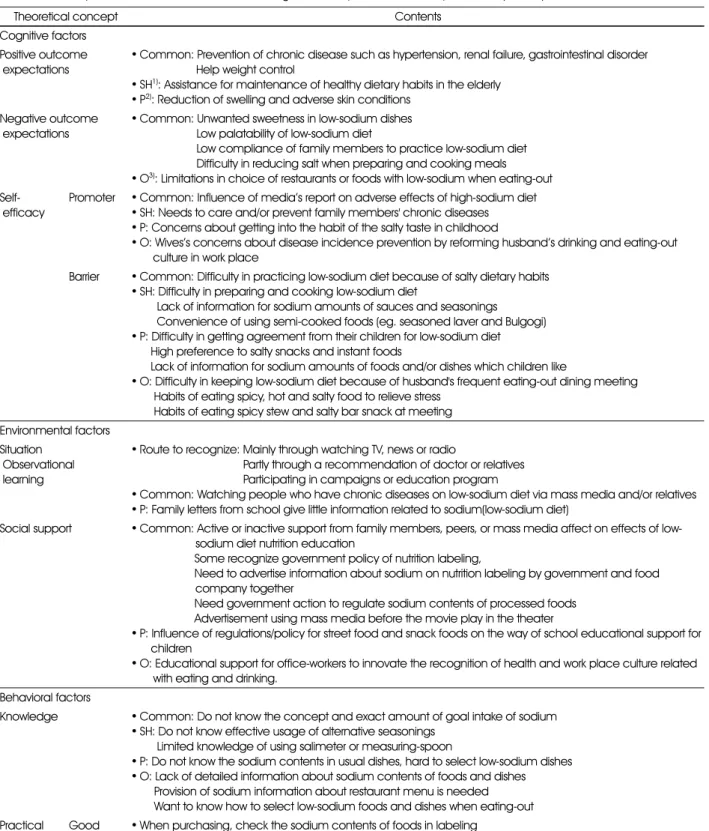
나트륨 섭취 줄이기 교육프로그램 개발을 위해 실시한 포 커스그룹 인터뷰 조사 결과는 Table 3에 제시하였다.
1) 나트륨 섭취 줄이기에 대한 인지적 요인
인지적요인은 나트륨 섭취 줄이기에 대한 긍정적 결과 기 대와 부정적 결과 기대, 그리고 자아 효능감에 대하여 조사 하였다.
(1) 긍정적 결과기대 및 행동결과의 가치
대상자들은 대부분 나트륨 섭취를 줄여야 하는 필요성에 대해서 공감을 하여 짜게 먹으면 좋지 않고, 싱겁게 먹어야 건강에 도움이 된다고 생각하고 있었다. 나트륨 섭취 줄이기
에 대한 긍정적 결과기대로 혈압 감소, 신장병이나 위장관 질 환 등 만성질환의 개선과 체중조절에 도움이 될 수 있을 것 이라고 공통적으로 응답하였다. 중년 주부군은 남편이나 가 족이 만성질환을 이미 앓고 있는 경우가 있었으며 이미 저나 트륨식을 실천하고 있는 경우도 있었는데, 저나트륨식을 통 해 질병이 호전될 것이라는 기대감을 가지고 있다고 응답하 였다. 또한 저나트륨식이 성인병 예방이나 노년기의 건강한 식습관 유지에 도움이 될 것으로 기대하고 있다고 하였다. 학 부모군은 나트륨 섭취 줄이기가 피부 개선이나 다이어트 효 과 등 외적인 부분에 긍정적인 효과를 줄 것으로 기대하였다.
(2) 부정적 결과기대
대상자들은 나트륨 섭취 줄이기에 대한 부정적 결과기대 로 저나트륨식을 실시하는 경우에 원하지 않는 단맛이 강해 지고 맛이 없어 거부감이 있을 수 있다는 반응을 보였다. 장 아찌나 장류 등 전통음식으로 인해 길들여진 짜게 먹던 식습 관, 기존의 짠 입맛, 남편이나 아이들의 선호도를 바꾸기가 어려워 실효성이 낮고 가족들의 호응도가 낮으리라 기대하 였다. 또한 저나트륨식의 준비나 조리과정이 어려울 것 같 고, 조리방법이 다양하지 못하리라 생각하고 있었고, 직장인 의 경우 외식 시에는 저나트륨식을 위한 식당이나 메뉴 선택 이 제한적일 것이라고 기대하였다.
(3) 자아효능감
자아효능감은 나트륨 섭취 줄이기의 실천을 촉진하는 ‘촉 진적 자아효능감’과 실천의 장애요인으로 작용하는 ‘장애적 자아효능감’으로 나누어 조사하였다.
공통적으로 짜게 먹는 식습관의 부정적 효과에 대해 대중 매체에서 보도된 경우가 대상자들의 자아효능감을 높이는 요 인으로 작용하였다. 중년 주부군은 가족 구성원의 만성질병
Table 2. The general characteristics of the participants in focus group interview
Variables Total (n = 30) Housewives (n = 15) Parents (n = 15) p-value
Age (years) 49.2± 6.5 52.9± 4.1 45.7± 6.5 0.00141)**
Height (cm) 161.5± 4.3 161.2± 4.4 161.9± 4.4 0.6688
Weight (kg) 56.4± 5.9 58.1± 1.3 53.7± 6.5 0.0816
BMI (kg/m2) 21.7± 2.0 22.4± 1.9 20.6± 1.9 0.0507
Education level (n (%))
Elementary school 80 (80.0) 0 (80.0) 0 (80.0)
Middle school 80 (80.0) 0 (80.0) 0 (80.0)
High school 10 (33.3) 8 (53.3) 2 (13.3) 0.05192)
University (College) 19 (63.3) 7 (46.7) 12 (80.0)
Over graduate 81 (83.3) 0 (80.0) 81 (86.7)
1) Student's t-test 2) Chi-square test
**: p < 0.01.
Table 3. THe major themes and contents for social cognitive theory from Focus Group Interview (n = 30)
Theoretical concept Contents
Cognitive factors Positive outcome expectations
•
Common: Prevention of chronic disease such as hypertension, renal failure, gastrointestinal disorder Help weight control•
SH1): Assistance for maintenance of healthy dietary habits in the elderly•
P2): Reduction of swelling and adverse skin conditions Negative outcomeexpectations
•
Common: Unwanted sweetness in low-sodium dishes Low palatability of low-sodium dietLow compliance of family members to practice low-sodium diet Difficulty in reducing salt when preparing and cooking meals
•
O3): Limitations in choice of restaurants or foods with low-sodium when eating-out Self-efficacy
Promoter
•
Common: Influence of media’s report on adverse effects of high-sodium diet•
SH: Needs to care and/or prevent family members' chronic diseases•
P: Concerns about getting into the habit of the salty taste in childhood•
O: Wives’s concerns about disease incidence prevention by reforming husband’s drinking and eating-out culture in work placeBarrier
•
Common: Difficulty in practicing low-sodium diet because of salty dietary habits•
SH: Difficulty in preparing and cooking low-sodium dietLack of information for sodium amounts of sauces and seasonings Convenience of using semi-cooked foods (eg. seasoned laver and Bulgogi)
•
P: Difficulty in getting agreement from their children for low-sodium diet High preference to salty snacks and instant foodsLack of information for sodium amounts of foods and/or dishes which children like
•
O: Difficulty in keeping low-sodium diet because of husband's frequent eating-out dining meeting Habits of eating spicy, hot and salty food to relieve stressHabits of eating spicy stew and salty bar snack at meeting Environmental factors
Situation Observational learning
•
Route to recognize: Mainly through watching TV, news or radioPartly through a recommendation of doctor or relatives Participating in campaigns or education program
•
Common: Watching people who have chronic diseases on low-sodium diet via mass media and/or relatives•
P: Family letters from school give little information related to sodium(low-sodium diet)Social support
•
Common: Active or inactive support from family members, peers, or mass media affect on effects of low- sodium diet nutrition educationSome recognize government policy of nutrition labeling,
Need to advertise information about sodium on nutrition labeling by government and food company together
Need government action to regulate sodium contents of processed foods Advertisement using mass media before the movie play in the theater
•
P: Influence of regulations/policy for street food and snack foods on the way of school educational support for children•
O: Educational support for office-workers to innovate the recognition of health and work place culture related with eating and drinking.Behavioral factors
Knowledge
•
Common: Do not know the concept and exact amount of goal intake of sodium•
SH: Do not know effective usage of alternative seasonings Limited knowledge of using salimeter or measuring-spoon•
P: Do not know the sodium contents in usual dishes, hard to select low-sodium dishes•
O: Lack of detailed information about sodium contents of foods and dishes Provision of sodium information about restaurant menu is needed Want to know how to select low-sodium foods and dishes when eating-out Practicalskills
Good examples
•
When purchasing, check the sodium contents of foods in labeling•
When cooking, blanching processed foods (ham, fried tofu) before use•
When eating salty dishes like spaghetti or soup, dilute source with milk or water Limitations•
Common: Difficult to order for ‘less salt on dishes’, especially in restaurants•
SH: Hard to read nutrition labeling because of the small size of letters Limitations of recipe of low-sodium diet•
P: Do not know various cooking methods of vegetables for children 1) SH: senior housewives 2) P: parents 3) O: office-workers관리를 위한 식사관리의 필요성을 크게 인식하고 있었고, 학 부모군은 자녀들이 학령기부터 짠 음식에 일찍 노출되어 습 관화될 것을 걱정하여 나트륨 섭취 줄이기 실행 의지가 높아 진다고 하였다. 직장에서 남편들의 잦은 음주와 직장 회식문 화 등으로 만성질환 발병에 대한 높은 우려가 실행의지를 높 이므로, 직장인을 대상으로 한 식사문화 개선에 대한 별도의 교육 프로그램이 마련되었으면 좋겠다는 의견을 제시하였다.
자아효능감을 낮추는 요인으로는 공통적으로 기존의 짜게 먹던 식습관 때문에 저나트륨식 실천이 어려울 것 같다는 인 식을 하고 있었다. 중년 주부군은 저나트륨식 요리나 준비를 하기가 어려운 점, 소스나 양념류의 나트륨 함량에 대한 정 보가 제대로 제시되어 있지 않은 점, 기존의 반조리 식품, 조 미김이나 양념불고기 등 파는 반찬류 이용의 편리성 등의 의 견을 제시하였다. 학부모군은 저나트륨식에 대한 자녀의 호 응도가 낮다는 점, 짭짤한 과자나 가공식품에 대한 아이들의 높은 선호, 아이들이 좋아하는 음식들에 함유된 나트륨 양에 대한 정보가 없다는 점 등이 자아효능감을 낮추는 요인으로 작용한다고 하였다. 직장인의 경우 잦은 저녁 약속, 회식, 부 서 모임 등이 저나트륨식 실천에 걸림돌이며 스트레스 해소 를 위해 맵고 짠 자극적인 음식을 먹던 식습관이나 회식자리 에서의 얼큰한 국물요리나 맛이 강한 안주류의 유혹 등이 장 애요인이라고 응답하였다.
2) 나트륨 섭취 줄이기에 대한 환경적 요인
사회인지론의 특징적인 부분인 환경요인으로는 자신이 처 한 공간이나 환경에 대한 인식과 학교나 정부의 캠페인 및 영 양교육 경험 등의 보고 듣고 접하는 관찰학습, 그리고 주변 사람의 영향에 의한 사회적 지원이 미치는 효과에 대하여 조 사 하였다.
(1) 주변 환경 상황에 대한 인식과 관찰학습
대상자들은 저나트륨식에 대해 텔레비전이나 뉴스 보도, 라디오 방송 등을 통해 간접적으로 접한 경우가 많았다. 일 부는 주변의 권유, 의사의 추천, 영양교육 프로그램이나 캠 페인에 참여했던 경험이 있었는데, 중년 주부군 보다는 연령 대가 젊은 학부모군에서 교육 참여 경험이 더 많았다. 대상 자들의 대부분은 이벤트 마케팅, 캠페인에 대해 긍정적인 반 응을 보였다. 뉴스나 방송에서 나트륨 과다 섭취 현황과 문 제점, 직장인의 짜게 먹는 식습관이 장기화되어 만성질병에 걸린 환자 사례 등의 시청을 통해 저나트륨식에 대한 관심이 증가하였으며, 주위에서 만성질병으로 저나트륨식을 실천하 고 있는 사람이 있거나 저나트륨식의 실천으로 효과를 본 사 례를 접한 경우 등도 대상자들에게 영향을 미친 것으로 조사
되었다. 학부모군은 아이들의 먹거리에 대한 관심이 높았는 데, 이에 비해 학교에서 보내주는 가정통신문에 나트륨과 관 련된 내용은 매우 적다고 하였다.
(2) 사회적 지원
대상자들은 가족 구성원, 직장 동료 등의 주변 사람들이나 대중 매체의 영향을 많이 받고 있었는데, 나트륨 줄이기에 대 해 주변의 호응도가 높은 경우에는 지속적으로 실천하기가 용이하지만 호응도가 낮고 협조가 잘 이루어지지 않을 경우 에는 실천이 어렵다고 하였다. 나트륨 저감화를 위해 정부에 서 시행하고 있는 정책이나 영양표시 제도의 확대에 대해서 는 일부 대상자들만이 인식하고 있었고, 영양표시에 대해 알 고 있는 경우에도 나트륨 양을 확인하는 경우는 적었고 주로 열량을 확인하는 용도로 이용하는 경우가 많아, 나트륨에 대 한 적극적인 교육과 홍보의 필요성을 시사하였다. 한편, 식 품회사와 정부가 함께 나트륨 섭취 줄이기를 위해 노력한다 면 성과가 더욱 높을 것이라는 점에 대부분 공감을 하였고, 영화관람 전 광고상영 시간이나 교통방송 출퇴근 시간대에 나트륨 섭취 줄이기에 대한 공익광고를 하면 효과적일 것이 라는 의견도 있었다.
학부모군에서는 아이들의 올바른 식습관 형성을 위한 교 육 지원 및 등하교 길의 길거리 음식이나 학교 급식과 주변 환경에 대한 규제가 필요하다고 하였는데, 일일이 간섭할 수 는 없으므로 좋지 않은 먹거리 자체를 줄여야 하고, 매점에 서 파는 음식들에 대한 규제나 단속을 강화하는 것이 필요하 다는 의견이 제시되었다. 또한 TV에서 짜고 맵고 자극적인 음식들을 맛집으로 소개하는 경우 이에 대한 영향력을 무시 할 수 없으므로 프로그램 심의를 강화해야 한다는 등의 의견 도 있었다.
회식문화나 모임에 대한 인식 전환을 위해 직장인 단체교 육의 필요성을 제시하였으며, 직장 구내식당에서와 매점에 서 파는 음식에 대한 규제도 필요하다고 하였다.
3) 나트륨 섭취 줄이기에 대한 행동적 요인
대상자들의 행동적 요인을 지식적 측면과 기술적 측면으 로 나누어 조사하였다.
지식적 측면에서 대부분은 나트륨 목표섭취량에 대한 개
념이 없이 막연하게 나트륨 줄이기는 싱겁게 먹으면 될 것이
라고 생각하고 있었다. 중년 주부군은 소금을 대체할 양념 조
미료의 효과적인 사용법이나 계량스푼, 염도계의 사용법에
대한 교육을 필요로 하였고, 학부모군은 자주 접하는 음식의
나트륨 함량에 대한 정보, 직장인들이 자주 먹게 되는 외식
음식의 나트륨 함량이나 효과적인 메뉴 선택 방법 등에 대한
교육이 필요하다고 하였다.
기술적 측면에서 보면, 나트륨 섭취 줄이기를 실천하고 있 다고 응답한 대상자들 중에는 치즈, 햄 등을 살 때 영양표시 를 확인하고 향신료, 조미료 등을 구입할 때 성분 표시를 확 인하거나, 조리 시에 가공식품을 데쳐서 사용하여 나트륨 양 을 줄이기 위해 노력하고, 짠 음식은 물을 넣어 희석하거나 스파게티 소스에 우유를 넣어 희석하여 먹는 경우도 있었다.
기술적 측면에서의 제한점으로는, 중년 주부군에서 영양표 시의 글자 크기가 너무 작아 읽기에 어려워 주로 원산지표시 만 확인하게 된다고 하였고, 저나트륨식 조리방법이 제한적 이라고 응답하였다. 학부모군에서는 아이들이 좋아할만한 채 소 조리법 등을 잘 알지 못하고 저나트륨 조리방법이 제한적 이라고 하였다. 공통적으로 외식을 할 때 음식점에서 파는 음 식이 가정식에 비해 짜다고 생각하지만, 음식점에서 ‘싱겁게 해 달라’고 따로 요청하기에 어려움이 많다고 응답하며 직장 인들에게도 그 부분이 중요하다고 하였다.
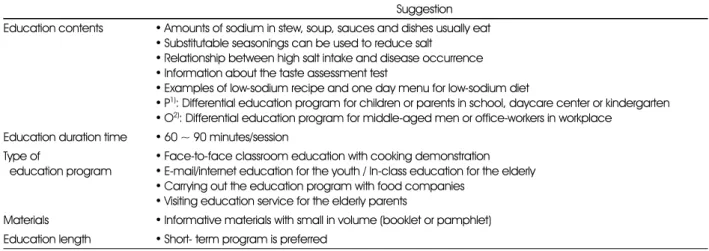
3. 나트륨 섭취 줄이기 영양교육 프로그램에 대한 요구 대상자들의 나트륨 섭취 줄이기 영양교육 프로그램에 대 한 요구도 조사 결과는 Table 4와 같다. 공통적으로 원하는 교육 내용으로 국이나 소스류, 나물 반찬 등 자주 먹는 음식 의 나트륨 함량, 소금 대체 양념, 소금 섭취와 질병과의 관 계, 미각검사(자신의 짠 맛에 대한 미각 적절성)에 대한 정 보, 다양한 저나트륨 요리법, 저나트륨 하루 식단 예시 등의 구체적인 정보 제시를 원하였다. 학부모군에서는 학령기 자 녀들이 어린 시절부터 바람직한 식생활에 대한 중요성을 인 식할 수 있도록 하고, 부모들이 이를 잘 지도할 수 있도록 학 교, 보육센터, 유치원에서 아이들과 학부모를 위한 차별화된 교육 프로그램을 원하였다. 또한 직장에서 만성질병 위험이
높은 중년 남성, 직장인을 위한 별도의 교육 프로그램이 필 요할 것 같다는 의견이 있었다. 교육 시간은 1시간에서 최대 90분 내외를 원하였고, 팸플릿 등 작은 소책자에 교육내용을 포함한 정보를 나누어주어 참고할 수 있는 것이 좋다고 하였 다. 공통적으로 대상자들이 직접 참여할 수 있는 교육, 시연, 조리실습 등 실제적인 교육을 원하였는데, 젊은 층이나 바쁜 직장인의 경우 이메일이나 인터넷 동영상 교육 등을 활용하 는 것이 제안되었으며 연령대가 높은 경우에는 대면 교육을 원하였다. 교육이나 캠페인 프로그램을 기획할 때 식품회사 와 함께 할 수 있는 프로그램이었으면 좋겠다는 의견과 노인 층 부모를 위한 방문 서비스 교육에 대한 의견도 있었다.
장기적인 프로그램은 일정시간을 지속적으로 필요로 하므 로 실행이 어려울 수 있으므로 단기적인 프로그램을 기획하 여 동시에 많은 대상자에게 실시한다면 파급효과가 더욱 클 것이라는 의견이 있었다.
4. 나트륨 섭취 줄이기 영양교육 프로그램 및 교육자료 개발 1) 나트륨 섭취 줄이기 영양교육 자료 개발
소비자단체를 통해 교육하는 것을 원칙으로 하여 1회 교 육용 자료를 개발하였다. FGI 결과에서 교육시간이 1시간에 서 90분 사이가 적절한 것으로 나타났으므로 총교육시간이 60분이 되도록 계획하여, 교육 전후 설문조사와 평가시간을 각각 10분으로 하고 본 교육 시간은 40분으로 하도록 하였 다. 교육 도입부에 짧은 동영상을 통해 주위를 환기시키고 집 중할 수 있도록 하고, 나머지 부분은 파워포인트를 활용하도 록 하였다.
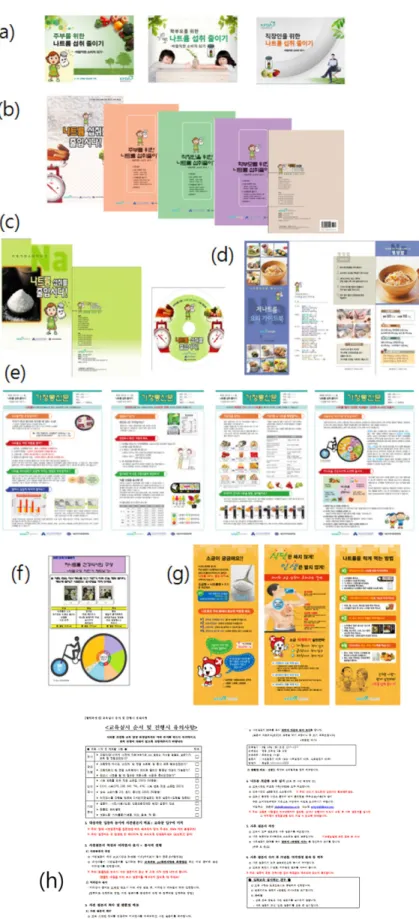
개발한 교육 자료는 교육용 파워포인트, 강사용 강의 운영 매뉴얼, 팸플릿, 저나트륨식 요리책자, 가정통신문, 활동지, 리플릿과 교육 진행 매뉴얼(Fig. 2)이었다. 팸플릿과 리플
Table 4. Needs on nutrition education programs for reducing sodium intake (n = 30) Suggestion Education contents
•
Amounts of sodium in stew, soup, sauces and dishes usually eat•
Substitutable seasonings can be used to reduce salt•
Relationship between high salt intake and disease occurrence•
Information about the taste assessment test•
Examples of low-sodium recipe and one day menu for low-sodium diet•
P1): Differential education program for children or parents in school, daycare center or kindergarten•
O2): Differential education program for middle-aged men or office-workers in workplace Education duration time•
60 ~ 90 minutes/sessionType of
education program
•
Face-to-face classroom education with cooking demonstration•
E-mail/internet education for the youth / In-class education for the elderly•
Carrying out the education program with food companies•
Visiting education service for the elderly parentsMaterials
•
Informative materials with small in volume (booklet or pamphlet) Education length•
Short- term program is preferred1) P: parents 2) O: office-workers
Fig. 2. The nutrition education material for reducing sodium intake
(a) Power-points for housewives, parents, office-workers (b) Manual book for educator (c) Pamphlet (d) Booklet of low-sodium recipe (e) Family letters of school nutrition education (f) Work-sheet, (g) Leaflet (h) Proceeding manual of nutrition education for educator
릿은 피교육자들의 교육내용 이해를 돕고 구체적인 정보 제 공을 목적으로 제작하였고, 활동지는 교육시간 내에 피교육 자들의 참여를 유도하기 위해 개발하였다. 식약처 홈페이지 의 저나트륨 요리를 참고하여(Korea Food and Drug Administration 2014a) 실생활에서 활용할 수 있도록 저 나트륨 음식 레시피와 저나트륨 소스가 소개되어 있는 요리 책자(Table 5)를 별도로 제작하여 교육 시 제공하도록 하 였다. 학교교육에 활용될 수 있도록 가정통신문 4종도 개발 하였다. 강사들에 대한 사전 교육을 목적으로 개발한 교육 진 행 매뉴얼로 교육자 교육을 실시하도록 하였다. 교육 진행 매 뉴얼의 내용은 효율적인 강의 방법 및 강사용 강의 운영 매 뉴얼에 대한 설명, 교육매체(팸플릿, 요리별책, 동영상 구동, 활동지 등)의 활용방법, 관련 활동의 시연 등으로 구성하였다.
2) 나트륨 섭취 줄이기 영양교육 프로그램의 구성
영양교육 프로그램은 사회적인 파급효과를 고려하여 주변 에 대한 영향력이 큰 집단을 대상으로 실시하도록 하였다.
FGI에서 도출된 의견을 참고로 하여 생활 패턴과 주요 관심 사 등이 다른 학령기 자녀가 없는 중년 이후 주부, 학령기 아 동 자녀를 둔 학부모, 그리고 회식과 외식 빈도가 잦은 직장 인을 대상으로 하여 세군에 대한 별도의 교육 프로그램을 구 성하였다.
교육내용 구성은 사회인지론의 요인들을 바탕으로 하였 다. 초반부는 인지적 요인에 해당되는 부분인 행동변화에 대 한 긍정적인 기대 자극을 높이고 환경적 요인에 해당되는 부 분인 나트륨 관련 영양지식 습득 및 상황에 대한 인식을 할 수 있도록 ‘소금과 나트륨’, ‘나트륨과 건강’에 대한 주제로 구성하였다. 본론은 행동적 요인에 해당되는 부분인 영양지
식 및 기술 능력 향상과 환경적 요인에 해당되는 부분인 사 회적 환경의 영향 및 환경에 대한 인식 개선에 중점을 두어 대상자들의 행동수행력을 높이는 것을 목표로 하였다. 각 대 상별 교육 프로그램의 세부 내용을 ‘식품구매’, ‘조리’, ‘식 사’, ‘외식’의 카테고리로 나누어 대상자 특성에 맞추어 선별 하여 구성하였다. 영양전문가들이 제안한 나트륨 섭취 줄이 기 실천방법과 FGI에서 도출한 결과에서 나타난 항목 중 실 천하기 쉽고 보편적인 항목보다는 실천하기 어려운 부분을 교육내용에 포함하여 행동수행 능력을 높이도록 하였다. 그 결과, 실천 용이도에서 대상자들이 가장 실천하기 어렵다고 생각하는 ‘영양표시 확인하여 식품 선택하기’에 대해 모든 대상자 프로그램에서 공통적으로 다루었다. 대상에 따라 별 도로 제작한 활동지 등을 활용하여 영양표시 확인 및 나트륨 함량 비교하는 방법을 제시하였다. 교육 후반부에는 교육 내 용 요약 및 ‘행동수정’, ‘자기서약서’, ‘저나트륨 식생활 실천 지침’을 제시하여 인지적 요인인 자아 효능감을 상승시키고, 행동적 요인에 해당되는 변화된 행동실천을 유지하는데 필 요한 자기 관리 기술을 교육하는데 초점을 두었다. ‘자기서 약서’ 부분에서는 행동수정 예시를 통해 스스로의 문제점을 파악하고 개선할 식생활을 위한 서약서를 작성하도록 하였 는데, 학부모용 프로그램의 경우에는 가정에서도 자녀들과 함께 ‘자기서약서’를 작성해볼 수 있도록 구성하였다.
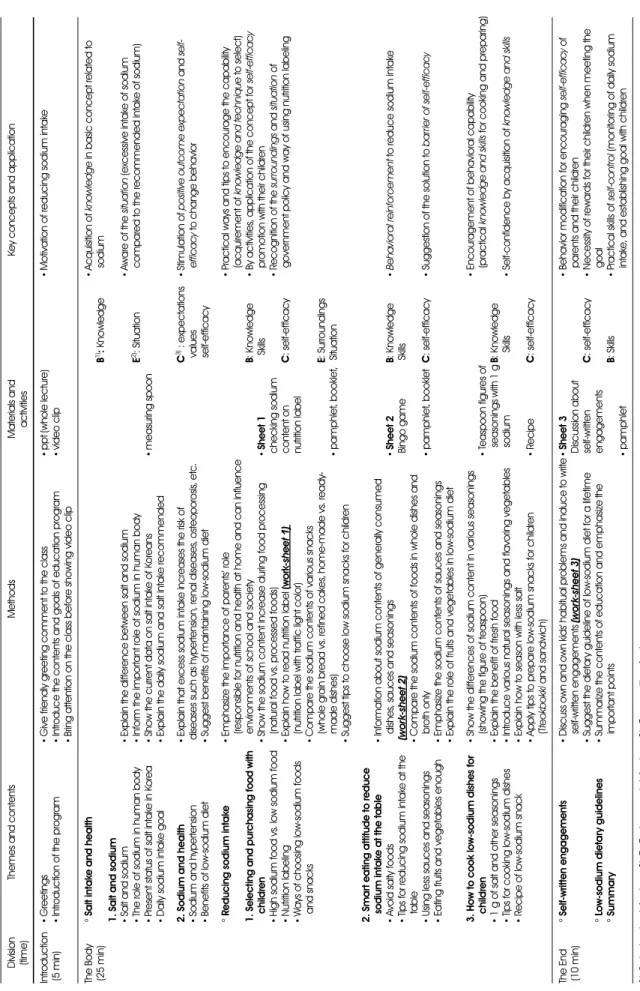
(1) 중년 주부를 위한 나트륨 섭취 줄이기 영양교육 프로그램 중년 주부를 위한 나트륨 섭취 줄이기 영양교육 프로그램 의 내용 구성은 Table 6과 같다. 교육의 본론에서는 식품 구 매와 조리, 식사, 외식의 카테고리 중 ‘구매’와 ‘조리’에 초점 을 맞추었다. ‘구매’ 부분에서 식품을 식품군별로 분류하여
Table 5. The contents of recipe booklet for nutrition education
Group Contents
Grains
•
Nutritious rice•
Sweet potato porridgeVegetables
•
Salt-free kimchi made with cabbage and perilla leaf•
Seasoned winter plowing•
Vegetable dishes seasoned with balsamic vinegarMeats
•
Chicken wrapped with cooked cabbage•
Roasted chicken with yoghurt and parsley sauce•
Sirloin steak with mushroom sauceFish
⋅
seafood•
Boiled-down bean-curd dregs with seasoned chives and clam•
Roasted mackerel with salt-free seasoning•
Seafood Shabu-ShabuSnacks
•
Autumn squash and rice ball cake covered with crushed sponge cake flakesDressing
•
Soybean milk dressing mixed with bean curd•
Yoghurt dressing•
Low-sodium Ssamjang/ processed soybean paste•
Low-sodium mustard sauce/ soy sauce/ and lemon soy sauceTable 6. The nutrition education program for senior housewives to reduce sodium intake Division (time)Themes and contentsMethodsMaterials and activitiesKey concepts and application Introduction (5min)•Greetings •Introduction of the program •Give friendly greeting comment to the class •Introduce the contents and goals of education program •Bring attention on the class before showing video clip
•ppt (whole lecture) •video clip•Motivation of reducing sodium intake The body (25min)°Salt intake and health 1. Salt and sodium •Salt and sodium •The role of sodium in human body •Present status of salt intake in Korea •Daily sodium intake goal
•Explain the difference between salt and sodium •Inform the important role of sodium in human body •Show the current data on salt intake of Koreans •Explain the daily sodium and salt intake recommended
•Measuring spoon
B1): Knowledge E2): Situation
•Acquisition of knowledge in basic concept related to sodium •Aware of the situation (excessive intake of sodium compared to the recommended intake of sodium) 2. Sodium and health •Sodium and hypertension •Benefits of low-sodium diet
•Explain that excess sodium intake increases the risk of diseases such as hypertension, renal diseases, osteoporosis, etc. •Suggest benefits of maintaining low-sodium diet C3) : expectations values self-efficacy
•Stimulation of positive outcome expectation and self-efficacy to change behavior °Reducing sodium intake 1. Selecting and purchasing of food •Sodium content of foods in each food group Nutrition labeling
•Show sodium contents of several foods in each food group and compare the sodium contents of natural food vs. processed food (work-sheet 1) •Compare the sodium contents of home-made dishes vs. ready- made dishes •Educate how to read nutrition labeling (work-sheet 2) •Explain the traffic light color nutrition labeling
•Sheet 1 Bingo game : high vs. low sodium food • Sheet 2 checking sodium content on nutrition label •pamphlet, booklet, B: Knowledge Skills C: self-efficacy E: Surroundings Situation
•Improvement of one's ability for practice (acquirement of knowledge and technique) •By activities, application of the concept for self-efficacy promotion •Recognition of the surroundings and situation of government policy and way of using nutrition labeling 2. Smart cooking for low-sodium diet •1g of salt and other seasonings •Tips for cooking low-sodium dishes •Summary of subsections
•Show the differences of sodium content in various seasonings (showing the figure of teaspoon) •Explain the benefit of fresh food •Show how to use natural seasonings and flavoring vegetables •Show how to season with less salt •Introduce how to monitor salt use while cooking •Review cooking methods of low-sodium dishes (work-sheet 3)
•Sheet 3 : Sodium Reducing cooking method (Example of a meal of low-sodium diet) •pamphlet, booklet (Low-sodium dish recipe) B: Knowledge Skills C: self-efficacy
•Behavioral reinforcement by suggesting practical way of cooking dishes for low-sodium diet •Suggestion of the solution to barrier of self-efficacy, soothing the negative outcomes 3. Smart eating attitude to reduce sodium intake at the table •Avoid salty foods •Eating solid ingredients rather than broth of soup •Reducing sauces and seasonings to the half •Eating fruits and vegetables enough
•Compare the sodium contents of foods in whole dishes and broth only •Emphasize the sodium contents of sauces and seasonings •Explain the role of fruits and vegetables in low-sodium diet B: Knowledge Skills C: self-efficacy
•Practical ways and tips to encourage the capability •Self-confidence by acquisition of knowledge and skills The End (10min)°Self-written engagements °Low-sodium dietary guidelines °Summary
•Discuss own habitual problems and induce to write self-written engagements (work-sheet 4) •Suggest the dietary guideline of low-sodium diet for a lifetime •Summarize the contents of education and emphasize the important points
•Sheet 4 : Discussion about self-written engagements •pamphlet C: self-efficacy B: Skills•Behavioral modification for encouraging self-efficacy •Focus on monitoring of daily sodium intake 1) B: behavioral factors, 2) E: Environmental factors, 3) C: cognitive factors
Table 7. The nutrition education program for parents to reduce sodium intake Division (time)Themes and contentsMethodsMaterials and activitiesKey concepts and application Introduction (5min)•Greetings •Introduction of the program•Give friendly greeting comment to the class •Introduce the contents and goals of education program •Bring attention on the class before showing video clip
•ppt (whole lecture) •video clip•Motivation of reducing sodium intake The Body (25min)°Salt intake and health 1. Salt and sodium •Salt and sodium •The role of sodium in human body •Present status of salt intake in Korea •Daily sodium intake goal
•Explain the difference between salt and sodium •Inform the important role of sodium in human body •Show the current data on salt intake of Koreans •Explain the daily sodium and salt intake recommended•measuring spoon B1): Knowledge E2): Situation
•Acquisition of knowledge in basic concept related to sodium •Aware of the situation (excessive intake of sodium compared to the recommended intake of sodium) 2. Sodium and health •Sodium and hypertension •Benefits of low-sodium diet
•Explain that excess sodium intake increases the risk of diseases such as hypertension, renal diseases, osteoporosis, etc. •Suggest benefits of maintaining low-sodium diet C3) : expectations values self-efficacy
•Stimulation of positive outcome expectation and self- efficacy to change behavior °Reducing sodium intake 1. Selecting and purchasing food with children •High sodium food vs. low sodium food •Nutrition labeling •Ways of choosing low-sodium foods and snacks
•Emphasize the importance of parents’ role (responsible for nutrition and health at home and can influence environments of school and society •Show the sodium content increase during food processing (natural food vs. processed foods) •Explain how to read nutrition label (work-sheet 1) (nutrition label with traffic light color) •Compare the sodium contents of various snacks (whole grain bread vs. refined cakes, home-made vs. ready- made dishes) •Suggest tips to choose low sodium snacks for children
•Sheet 1 checking sodium content on nutrition label •pamphlet, booklet, B: Knowledge Skills C: self-efficacy E: Surroundings Situation
•Practical ways and tips to encourage the capability (acquirement of knowledge and technique to select) •By activities, application of the concept for self-efficacy promotion with their children •Recognition of the surroundings and situation of government policy and way of using nutrition labeling 2. Smart eating attitude to reduce sodium intake at the table •Avoid salty foods •Tips for reducing sodium intake at the table •Using less sauces and seasonings •Eating fruits and vegetables enough
•Information about sodium contents of generally consumed dishes, sauces and seasonings (work-sheet 2) •Compare the sodium contents of foods in whole dishes and broth only •Emphasize the sodium contents of sauces and seasonings •Explain the role of fruits and vegetables in low-sodium diet
•Sheet 2 Bingo game •pamphlet, booklet B: Knowledge Skills C: self-efficacy
•Behavioral reinforcement to reduce sodium intake •Suggestion of the solution to barrier of self-efficacy 3. How to cook low-sodium dishes for children •1g of salt and other seasonings •Tips for cooking low-sodium dishes •Recipe of low-sodium snack
•Show the differences of sodium content in various seasonings (showing the figure of teaspoon) •Explain the benefit of fresh food •Introduce various natural seasonings and flavoring vegetables •Explain how to season with less salt •Apply tips to prepare low-sodium snacks for children (Tteokbokki and sandwich)
•Teaspoon figures of seasonings with 1g sodium •Recipe B: Knowledge Skills C: self-efficacy
•Encouragement of behavioral capability (practical knowledge and skills for cooking and preparing) •Self-confidence by acquisition of knowledge and skills The End (10min)°Self-written engagements °Low-sodium dietary guidelines °Summary
•Discuss own and own kids' habitual problems and induce to write self-written engagements (work-sheet 3) •Suggest the dietary guideline of low-sodium diet for a lifetime •Summarize the contents of education and emphasize the important points
•Sheet 3 Discussion about self-written engagements •pamphlet C: self-efficacy B: Skills
•Behavior modification for encouraging self-efficacy of parents and their children •Necessity of rewards for their children when meeting the goal •Practical skills of self-control (monitoring of daily sodium intake, and establishing goal with children 1) B: behavioral factors, 2) E: Environmental factors, 3) C: cognitive factors
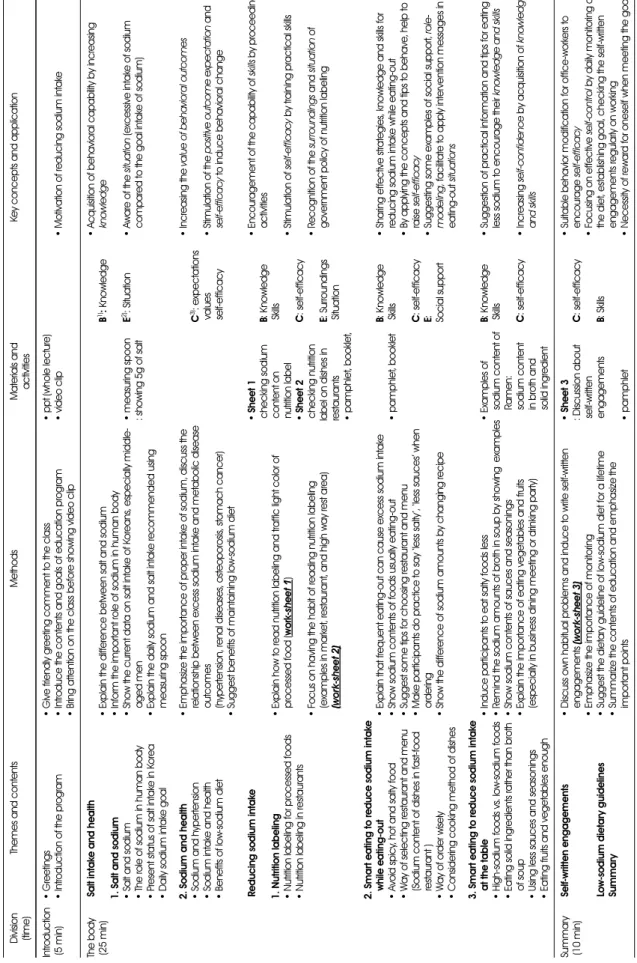
Table 8. The nutrition education program for office-workers to reduce sodium intake Division (time)Themes and contentsMethodsMaterials and activitiesKey concepts and application Introduction (5min)•Greetings •Introduction of the program•Give friendly greeting comment to the class •Introduce the contents and goals of education program •Bring attention on the class before showing video clip
•ppt (whole lecture) •video clip•Motivation of reducing sodium intake The body (25min) Salt intake and health 1. Salt and sodium •Salt and sodium •The role of sodium in human body •Present status of salt intake in Korea •Daily sodium intake goal
•Explain the difference between salt and sodium •Inform the important role of sodium in human body •Show the current data on salt intake of Koreans, especially middle- aged men •Explain the daily sodium and salt intake recommended using measuring spoon
•measuring spoon : showing 5g of salt B1): Knowledge E2): Situation
•Acquisition of behavioral capability by increasing knowledge •Aware of the situation (excessive intake of sodium compared to the goal intake of sodium) 2. Sodium and health •Sodium and hypertension •Sodium intake and health •Benefits of low-sodium diet
•Emphasize the importance of proper intake of sodium, discuss the relationship between excess sodium intake and metabolic disease outcomes (hypertension, renal diseases, osteoporosis, stomach cancer) •Suggest benefits of maintaining low-sodium diet C3): expectations values self-efficacy
•Increasing the value of behavioral outcomes •Stimulation of the positive outcome expectation and self-efficacy to induce behavioral change Reducing sodium intake 1. Nutrition labeling •Nutrition labeling for processed foods •Nutrition labeling in restaurants
•Explain how to read nutrition labeling and traffic light color of processed food (work-sheet 1) •Focus on having the habit of reading nutrition labeling (examples in market, restaurant, and high way rest area) (work-sheet 2)
•Sheet 1 checking sodium content on nutrition label •Sheet 2 checking nutrition label on dishes in restaurants •pamphlet, booklet, B: Knowledge Skills C: self-efficacy E: Surroundings Situation
•Encouragement of the capability of skills by proceeding activities •Stimulation of self-efficacy by training practical skills •Recognition of the surroundings and situation of government policy of nutrition labeling 2. Smart eating to reduce sodium intake while eating-out •Avoid spicy, hot and salty food •Way of selecting restaurant and menu (Sodium content of dishes in fast-food restaurant ) •Way of order wisely •Considering cooking method of dishes
•Explain that frequent eating-out can cause excess sodium intake •Show sodium contents of foods usually eating-out •Suggest some tips for choosing restaurant and menu •Make participants do practice to say ‘less salty’, ‘less sauces’ when ordering •Show the difference of sodium amounts by changing recipe
•pamphlet, bookletB: Knowledge Skills C: self-efficacy E: Social support
•Sharing effective strategies, knowledge and skills for reducing sodium intake while eating-out •By applying the concepts and tips to behave, help to raise self-efficacy •Suggesting some examples of social support, role- modeling, facilitate to apply intervention messages in eating-out situations 3. Smart eating to reduce sodium intake at the table •High-sodium foods vs. low-sodium foods •Eating solid ingredients rather than broth of soup •Using less sauces and seasonings •Eating fruits and vegetables enough
•Induce participants to eat salty foods less •Remind the sodium amounts of broth in soup by showing examples •Show sodium contents of sauces and seasonings •Explain the importance of eating vegetables and fruits (especially in business dining meeting or drinking party)
•Examples of sodium content of Ramen: sodium content in broth and solid ingredient B: Knowledge Skills C: self-efficacy
•Suggestion of practical information and tips for eating less sodium to encourage their knowledge and skills •Increasing self-confidence by acquisition of knowledge and skills Summary (10min) Self-written engagements Low-sodium dietary guidelines Summary
•Discuss own habitual problems and induce to write self-written engagements (work-sheet 3) •Emphasize the importance of monitoring •Suggest the dietary guideline of low-sodium diet for a lifetime •Summarize the contents of education and emphasize the important points
•Sheet 3 : Discussion about self-written engagements •pamphlet C: self-efficacy B: Skills
•Suitable behavior modification for office-workers to encourage self-efficacy •Focusing on effective self-control by daily monitoring of the diet, establishing goal, checking the self-written engagements regularly on working •Necessity of reward for oneself when meeting the goal 1) B: behavioral factors, 2) E: Environmental factors, 3) C: cognitive factors