Analysis of Community Structure of Metabolically Active Bacteria in a Rice Field Subjected to Long-Term Fertilization Practices
Jae-Hyung Ahn, Min-Young Choi, Hye-Won Lee, Byung-Yong Kim, Jaekyeong Song, Myung-Sook Kim1, and Hang-Yeon Weon*
Agricultural Microbiology Division, National Academy of Agricultural Science, Rural Development Administration, Suwon 441-853, Korea
1Soil & Ferilization Division, National Academy of Agricultural Science, Rural Development Administration, Suwon 441-853, Korea
(Received: October 28 2013, Accepted: November 29 2013)
To estimate the effect of long-term fertilization on metabolically active bacterial communities in a rice field, RNA was extracted from endosphere (rice root), rhizosphere, and bulk soil that had been subjected to different fertilization regimes for 59 years, and the 16S rRNAs were analyzed using the pyrosequencing method. The richness and diversity of metabolically active bacteria were higher in bulk soil than in the endosphere and rhizosphere, and showed no significant difference between non-fertilized and fertilized plots. Weighted UniFrac analysis showed that each compartment had characteristic bacterial communities and that the effect of long-term fertilization on the structure of bacterial community was more pronounced in bulk soil than in the endosphere and rhizosphere. The 16S rRNAs affiliated with Alphaproteobacteria and Firmicutes were more abundant in the endosphere than in bulk soil while those affiliated with Chloroflexi and Acidobacteria were more abundant in bulk soil than in the endosphere. Several dominant operational taxonomic units (clustered at a 97% similarity cut-off) showed different frequencies between non-fertilized and fertilized plots, suggesting that the fertilization affected their activities in the rice field.
Key words: RNA, Bacterial community, Rice field, Fertilization
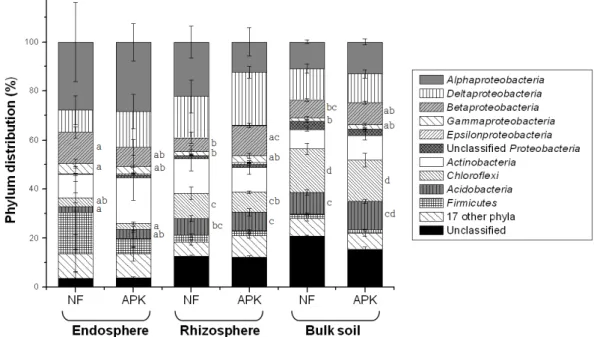
Phyla distributions of endophytic bacteria, rhizospheric bacteria, and bulk soil bacteria in a rice field.
1)
*Corresponding author : Phone: +82312908478, Fax: +82312908488, E-mail: [email protected]
§Acknowledgement: This study was made possible by the support of “Research Program for Agricultural Science & Technology Development (Project No. PJ90712703)” from the National Academy of Agricultural Science, Rural Development Administration, Republic of Korea.
Introduction
토양미생물은 토양의 물질 순환에 관여하고, 식물 다양성 과 생산성에 영향을 미치기 때문에 농업 시스템의 가장 중요한 요인 중 하나이다. 벼의 생장 역시 논에 존재하는 다양한 미생 물의 영향을 받을 것으로 추정되며, 논토양에 어떤 미생물이 존재하는지, 이들의 역할이 무엇인지 파악하는 것은 벼의 생 산성을 향상시키기 위한 중요한 수단이 될 것이다.
논토양의 미생물 다양성을 분석하는 방법은 배양에 의한 방법과 배양에 의존하지 않는 방법으로 구분할 수 있다. 배양 에 의한 방법의 경우 분리된 균의 생리적 성질을 연구하고 토 양에서의 기능을 추정할 수 있다는 장점이 있으나 많은 토양 세균은 배양법으로 쉽게 분리되지 않는다는 것이 알려져 있다 (Kim et al., 2005; Nakayama et al., 2006). 특히 논토양의 경우 대부분 혐기성 상태로 존재하기 때문에 (Kögel-Knabner et al., 2010) 토양 내 우점 세균을 분리하기 위해서는 혐기성 배양 방법이 요구된다 (Liesack et al., 2000). Hengstmann et al. (1999)은 배양법과 비배양법 모두 토양 내 우점 세균을 분석하는데 사용할 수 있음을 보였으나, 배양법은 많은 시료 를 분석하기에는 작업량이 많아 적당하지 않다. 따라서 토양 에서 DNA를 추출한 후 16S rRNA 유전자를 PCR하거나 shotgun 시퀀싱을 통해 토양에 존재하는 세균의 다양성을 파 악하는 비배양 방법에 의한 연구가 많이 수행되었다 (Ahn et al., 2012; Cui et al., 2012; Hardoim et al., 2011; Sessitsch et al., 2011).
토양에서 DNA 상태로 존재하는 세균이 반드시 대사적으로 활발한 상태임을 의미하지는 않는다. 포자 등의 휴면상태로 존재하는 세균이라도 DNA는 검출될 수 있다. 따라서 최근에 는 DNA 뿐만 아니라 RNA를 기반으로 한 연구도 활발히 이루 어지고 있다 (Lu et al., 2006; Ma et al., 2012). RNA는 단백질 합성에 직접 관여하기 때문에 RNA 양의 증가는 대사 활동의 증가를 반영한다. 본 연구진도 논토양의 미생물 다양성이 DNA를 기반으로 조사했을 때와 RNA를 기반으로 조사했을 때 달라지는 것을 관찰하였다 (Ahn et al., 2013). 예를 들면 Proteobacteria 문에 속하는 염기서열들의 비율이 DNA 보다 RNA에서 유의하게 높았으며, Chloroflexi 문에 속하는 염기서열들 의 비율은 그와는 반대 경향을 나타내었다. 이는 Proteobacteria에 속하는 세균들이 Chloroflexi에 속하는 세균들보다 대사 활성 이 높기 때문인 것으로 추정된다. 이러한 연구결과는 DNA를 기반으로 분석된 미생물 다양성이 반드시 실제로 활동 중인 세균의 다양성과 일치하지 않을 수 있다는 것을 의미한다.
본 연구에서는 RNA를 기반으로 논토양의 세균 다양성을 조사하였다. 대상 논토양은 59년간 동일 비료를 시비한 시험 포장에서 비료를 시용하지 않은 처리구 (무비구)와 질소-인- 칼륨을 시비한 처리구 (3요소구)를 선택하였다. 시료는 벼뿌 리 (내생), 근권 토양, 비근권 토양으로 세분하여 각 영역에
어떤 세균이 대사적으로 활발한 지를 조사하였다.
Materials and Methods
시료 채취 시료는 경기도 수원시 국립식량과학원 시험
포장 내에 1954년 조성된 동일 비료 장기 연용 시험포장을 이용하였다. 공시토양의 특성, 공시품종, 경종 개요 등은 기존 연구에 자세히 기술되어 있다 (Kim et al., 2012; Yeon et al., 2007). 분석용 시료는 2013년 8월 14일에 무비구와 3요소구에 서 각각 3개의 토양시료와 3개의 벼 시료를 채취하였다. 토양 시료와 벼 뿌리는 채취 후 30분 이내에 실험실로 이송하였다.
벼 뿌리는 멸균수로 세척하면서 뿌리의 영향을 받지 않는 부분 을 제거하고 뿌리에 근접한 토양을 멸균수로 세척하면서 그 용액을 50 ml falcon tube에 수집하였다. 수집된 용액은 8,000 rpm에서 원심분리하여 상등액은 버린 후 남은 시료를 근권시 료로 하였다. 내생시료는 근권시료를 채취한 벼 뿌리를 수 차 례 멸균수로 세척하여 남아 있는 토양을 완전히 제거 하였다.
뿌리 표면은 Qin et al. (2009)의 방법에 따라 3 단계의 표면 살균을 하였고 (5% NaOCl 5분, 2.5% Na2S2O3 10분, 75%
ethanol 5분), 살균 후에는 멸균수와 NaHCO3로 세척하였다.
채취된 시료는 -70°C 에 보존하면서 RNA 추출에 사용하였다.
RNA 추출 및 cDNA 합성 내생 시료 분석을 위해서 벼 뿌리 4 g에 액체 질소를 가하고 분쇄한 후 RNA 추출에 사용하였다. 근권 토양과 비근권 토양의 경우에는 토양 2 g을 RNA 추출에 사용하였다. 토양 RNA 추출은 RNA PowerSoil Total RNA Isolation Kit (MO BIO Laboratories Inc., USA)를 이용하였다. 추출된 RNA는 RQ1 RNase-Free DNase (Promega, USA)를 처리하여 남아있는 DNA를 제거한 후, RNeasy MinElute Cleanup Kit (Qiagen, Germany)를 이용하여 정제하였다. cDNA 합성은 GoScript reverse transcription system과 random hexamer (Promega, USA)를 이용하였다.
파이로시퀀싱 분석 세균의 16S rRNA는 각 시료로부터 얻은 cDNA를 주형으로 하여 PCR을 이용하여 증폭하였다.
PCR 반응액은 총 50 μL였으며 1 x PCR buffer (Roche, Germany), 4종의 dNTP 각각 0.2 mM, 정방향 및 역방향 프라 이머 0.4 μM, bovine serum albumin 1 mg mL-1, Taq DNA polymerase 1.25 units (Roche, Germany), cDNA 1 μL로 구성 되었다. PCR은 touch-down 방식으로 수행되었으며 초기 denaturation (94°C 5분) 후, denaturation (94°C 30초)- annealing (60°C 45초)-extension (72°C 90초)을 10회 반복하 였다. 이 때 1회 반복 시마다 annealing 온도를 0.5°C씩 낮추었 다. 다음 단계에서 denaturation (94°C 30초)-annealing (55°C 45초)-extension (72°C 90초)을 20회 반복하였다. 정방향 프 라이머로는 V1-9F (5’-X-AC-GAGTTTGATCMTGGCTCAG-3’),
Table. 1. Summary of the pyrosequencing data obtained from a rice fields.
Sample† Number of reads
Number of OTUs‡
Good’s coverage‡
Richness estimator‡ Diversity index‡
Chao1 ACE Shannon Inverse Simpson
Endosphere
NF 989 280±77a§ 0.85±0.05a 499±139a 688±233a 4.8±0.5a 65.0±54.6a APK 989 348±21a 0.79±0.01a 662±55ac 984±264a 4.9±0.3a 45.3±33.2a Rhizosphere
NF 989 547±82b 0.63±0.09b 1,261±398b 2,018±717ab 6.0±0.2b 347±134b APK 989 577±41bd 0.62±0.05b 1,184±193bc 1,761±599ab 6.1±0.1b 455±78b Bulk soil
NF 989 692±21cd 0.45±0.03c 2,062±204d 3,737±250c 6.3±0.1b 530±104b APK 989 677±14bc 0.47±0.02c 2,016±97d 2,739±634bc 6.3±0.0b 507±44b
†Symbols: NF, non-fertilized; APK, fertilized with ammonium sulfate, fused and superphosphate, and potassium chloride.
‡Calculated at a 97% 16S rRNA similarity cut-off, average ± standard deviation (n=3).
§The values sharing the same letter in the same column indicate no significant difference (P < 0.05).
Fig. 1. Rarefaction curves for OTUs (97% similarity cut-off) obtained from the endosphere, rhizosphere, and bulk soil in a rice field. The curves were generated using 1,000-random sampling without replacement. Values are means ± standard deviation, n = 3. NF, non-fertilized; APK, fertilized with ammonium sulfate, fused and superphosphate, and potassium chloride.
역방향 프라이머는 V3-541R (5’-X-AC-WTTACCGCGGCTGCTGG-3’) 을 사용하였다 (Chun et al., 2010). 여기서 X는 7~11개의 뉴클 레오타이드로 구성된 바코드로 시료를 구별하기 위해 사용되 었다. 증폭된 PCR 산물은 QIAquick Gel Extraction Kit (QIAGEN, Germany)로 정제한 후 서울대학교 농생명과학공 동기기원에 의뢰하여 454 GS FLX Titanium Sequencing System (Roche, Germany)을 이용하여 파이로시퀀싱을 수행 하였다.
파이로시퀀싱 결과 분석 파이로시퀀싱 결과는 Mothur (version 1.27.0) (Schloss et al., 2009) 프로그램을 이용하였 다. 즉, 파이로시퀀싱 데이터는 예비 여과과정을 통해 길이가 짧거나 프라이머의 불일치가 있는 시퀀스를 제거한 후 PyroNoise 알고리즘 (Quince et al., 2011)을 이용하여 파이로시퀀싱 에러 를 수정하고 UCHIME 프로그램 (Edgar et al., 2011)을 이용하여 키메라 시퀀스를 제거하였다. 다음으로 RDP database (version 9) (Cole et al., 2009)를 이용하여 진핵생물, 고세균, 클로로플 라스트, 미토콘드리아, 계 (kingdom) 수준에서 분류가 안된 염기서열들을 제거한 후, 각 시료의 염기서열을 989개로 표준 화하였다. 표준화된 염기서열을 SINA Aligner (version 1.1) (Pruesse et al., 2012)를 이용하여 정렬한 후 average-neighbor 알고리즘을 이용하여 97% 유사도를 기준으로 operational taxonomic unit (OTU)으로 분류하였다. Good의 coverage, 종 풍부도지수 및 다양성지수 계산을 위해서는 Mothur 프로그램 을 이용하였다. 시료간 유사성 기반의 베타다양성 분석은 FastTree 프로그램 (Price et al., 2009)과 Weighted UniFrac 분석 (Lozupone and Knight, 2005)을 이용하였다. 시료간의 유사성 기반의 군집분석은 Morisita-Horn distance index를 이용하였다. 각 시료별 우점세균 (내생은 2% 이상, 근권과 비 근권은 1% 이상을 차지하는 OTU)의 염기서열과 GenBank에
서 유사도가 높은 염기서열을 이용하여 계통수를 작성하였다.
계통수는 ARB 프로그램 (Ludwig et al., 2004)으로 1,300 bp 이상의 염기서열만을 이용하여 maximum-likelihood (phylip) tree를 작성한 후, ARB parsimony tool를 이용하여 짧은 염기 서열을 삽입하였다. 각 시료 당 우점 OTU의 비율을 heatmap 으로 작성하기 위해서 iTOL tool (http://itol.embl.de) (Letunic and Bork, 2011)을 이용하였다.
Results and Discussion
파이로시퀀싱 결과 요약 파이로시퀀싱 결과를 Table 1에 요약하였다. 각 시료로부터 선발된 고품질의 염기서열 중
Fig. 2. Phyla distributions of endophytic bacteria, rhizospheric bacteria, and bulk soil bacteria in a rice field. For Proteobacteria, class distribution is indicated. Error bars indicate standard deviation (n = 3). Different letters beside the bars indicate significant difference (p < 0.05) for the corresponding taxon among the samples. Symbols, NF, non-fertilized; APK, fertilized with ammonium sulfate, fused and superphosphate, and potassium chloride.
무작위로 선택된 989개의 염기서열 (총 17,802개)을 분석에 사용하였다. 97% 유사도를 기준으로 OTU를 정의했을 때, 관 찰된 OTU수 및 종풍부도 지수 (Chao1와 ACE)는 내생 < 근권 토양 < 비근권 토양 순으로 증가하였고, 다양성지수 (Shannon 과 Inverse Simpson)는 근권과 비근권 토양이 내생에 비해 유 의하게 높았다. 이는 근권과 비근권 토양이 내생에 비해 서식 환경이 보다 다양하기 때문으로 생각된다. 그러나 모든 영역 에서 무비구와 3요소구 간에는 차이가 없는 것으로 나타나 비료의 시용이 세균의 종풍부도 및 다양성에는 영향을 미치지 않는 것으로 판단된다.
Rarefaction 분석 (Fig. 1) 결과 역시 내생 < 근권 토양 <
비근권 토양 순으로 OTU 풍부도가 증가하였다. 벼 뿌리 내생 세균의 경우 1,000개의 염기서열을 분석할 경우 곡선이 완만 해지나, 근권 토양과 비근권 토양은 OTU 수가 계속 증가하는 경향이었으며, 존재하는 총 OTUs 수에 근접하기 위해서는 더 많은 염기서열을 분석할 필요가 있을 것으로 판단된다.
Rarefaction 분석에서도 무비구와 3요소구 간 차이는 없었다.
문 다양성 비교 Fig. 2에 파이로시퀀싱으로 분석한 세균 의 문 분포를 나타내었다. 내생, 근권 토양, 비근권 토양 모두 Proteobacteria의 비율이 가장 높았고 (36~55%), 그 외에 Actinobacteria, Chloroflexi, Acidobacteria, Firmicutes에 속하 는 세균이 우점하였다. 이러한 결과는 논에서 대사적으로 가장 활발한 세균은 Proteobacteria임을 의미하며, 이는 이전 연구 결 과 (Ahn et al., 2013; Lu et al., 2006)와 일치한다. 영역 별로 분포 비율을 보면, 벼 뿌리에 존재하는 내생 세균은 Alphaproteobacteria
와 Firmicutes의 비율이 각각 28%, 6~17%로 비근권 토양에 비해 (각각 11~13%, 2%) 높았으며, 비근권 토양의 경우 Chloroflexi와 Acidobacteria의 비율이 각각 17~18%, 9~12%로 내생 세균에 비해 (각각 2~3%, 1~2%) 높았다. 근권 토양의 경우 Alphaproteobacteria, Firmicutes, Chloroflexi, Acidobacteria의 비율이 대략 내생 세균과 비근권 토양의 중간에 위치하는 것으로 나타났다 (각각 12~22%, 2~3%, 8~10%, 7~8%). 논토양에서 발견된 Chloroflexi 는 대부분 Anaerolineae 강에 속하였고, Anaerolineae 강에 속하는 모든 표준균주들은 절대혐기성균으로 다당류를 분해 하는 것으로 알려져 있다 (Podosokorskaya et al., 2013). 비근 권 토양에서 Chloroflexi의 비율이 높았던 것은 비근권 토양이 근권 토양과 뿌리에 비해 상대적으로 혐기성이기 때문으로 추정된다. Acidobacteria는 일반적으로 빈영양세균으로 알려 져 있다 (Fierer et al., 2007). 벼 뿌리에 비해 비근권 토양이 영양분이 부족하기 때문에 비근권 토양에서 Acidobacteria의 비 율이 높았던 것으로 생각된다. 근권 토양의 Betaproteobacteria 의 비율만이 비료 시용에 따른 차이가 유의한 것으로 나타나 (무비, 6%; 3요소, 12%) 비료의 장기 연용이 대사적으로 활발 한 세균의 문 분포에 큰 영향을 미치지 않은 것으로 판단된다.
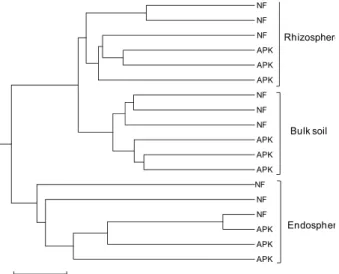
전체 군집 구조 비교 내생, 근권, 비근권 세균의 전체 군집구조간의 비교는 16S rRNA 염기서열간의 계통분류학적 유사도를 고려한 방법인 Weighted UniFrac 분석 (Fig. 3)과 공유 또는 비공유되는 OTU의 풍부도에 근거한 Morisita-horn distance index (Fig. 4)를 이용하였다. Weighted UniFrac 분 석에서 내생, 근권, 비근권은 세 개의 그룹으로 뚜렷하게 분리
Fig. 3. Principal coordinates analysis (PCoA) of the py- rosequencing reads obtained from the endosphere, rhizo- sphere, and bulk soil in a rice field based on the Weighted UniFrac metric. Filled symbols, non-fertilized; closed sym- bols, fertilized with ammonium sulfate, fused and super- phosphate, and potassium chloride.
NF NF NF APK APK APK NF NF NF APK APK APK NF
NF NF APK APK APK
Rhizosphere
Bulk soil
Endospher
Fig. 4. UPGMA dendrogram constructed using Morisita-Horn distance indices showing similarities among the bacterial community structures in the endosphere, rhizosphere, and bulk soil in a rice field. Symbols, NF, non-fertilized; APK, fertilized with ammonium sulfate, fused and superphosphate, and potassium chloride.
되었으며, 이러한 결과는 각 영역의 세균 군집 구조가 독특하 다는 것을 나타낸다. 군집 구조의 유사도 측면에서 벼뿌리 내 생 세균이 반복간 변이가 가장 컸으며, 근권, 비근권 순으로 반복간 상대적인 유사도가 높았다. Morisita-Horn distance index를 이용한 클러스터링 분석에서도 내생, 근권, 비근권 별로 클러스터가 형성되었으며, 벼 뿌리 내생 세균의 군집구 조는 근권과 비근권의 세균 군집구조와 차이가 있는 것으로 나타나 벼 뿌리에는 토양 세균과는 다른 종류의 세균이 서식하 고 있다는 것을 재확인하였다. 비근권 토양은 무처리구와 3요 소처리구 간의 차이가 뚜렷하였으며, 근권 토양에서는 이러한
경향이 약하고, 뿌리 내생 세균의 경우는 무처리구와 3요소처 리구 간의 구분이 명확하지가 않았다. 이러한 결과는 비근권, 근권, 내생으로 갈수록 세균 군집이 비료 처리보다는 식물에 의한 영향을 더 많이 받기 때문으로 생각된다.
우점세균 비교 Fig. 5에 각 토양 시료에서 우점하는 OTU들의 (내생은 2%, 근권과 비근권은 1% 이상) 계통분류학 적 위치 및 점유 비율을 나타내었다. 가장 우점하는 OTU는 시료의 종류에 따라 다른 경향을 나타내었다. 내생에서는 Alphaproteobacteria 강 Bradyrhizobium 속으로 분류된 otu0001 이 무처리구와 3요소처리구에서 평균 8.1%와 10.0%로 가장 높았지만 통계적인 유의성은 없었다. 반면 Chloroflexi 문 Anaerolineaceae 과로 분류된 otu0004는 비근권의 무처리구 와 3요소처리구에서 각각 평균 2.2%, 1.7%로 그 비율이 가장 높았으며, 같은 그룹에 속하는 otu0007, otu0010과 함께 그 비율이 내생에 비해 비근권에서 유의하게 (P < 0.05) 높았다.
이는 내생, 근권, 비근권으로 가면서 나타나는 산소 농도와 산화환원전위의 감소 (Flessa and Fischer, 1992; Frenzel et al., 1992; Revsbech et al., 1999)와 관련이 있을 것으로 추정 된다. Bradyrhizobium 속은 대표적인 뿌리혹 세균으로서 콩과 식물의 뿌리에 침입하여 뿌리혹을 만들고 질소를 고정하는 호기성 세균이다 (Kuykendall, 2005). 반면 Chloroflexi 문 Anaerolilneacea 과의 배양, 분리된 균주들은 모두 절대혐기 성균으로서 혐기 조건에서 다당류를 발효하는 것으로 알려져 있다 (Podosokorskaya et al., 2013). Alphaproteobacteria 강 Methylocystis 속의 otu0002는 근권 무처리구에서 1.6%, Deltaproteobacteria 강 Anaeromyxobacter 속의 otu0005는 근 권 3요소 처리에서 1.6%로 그 비율이 가장 높았다. Methylocystis 는 특히 논에서 많이 관찰되는 메탄산화균으로 알려져 있다 (Ahn et al., 2013; Ma and Lu, 2011). 따라서 위의 결과는 이 속에 속하는 세균들이 근권에서 매우 활발히 메탄을 산화하 고 있다는 것을 의미한다. Anaeromyxobacter 속은 염화페놀, 산소, 질산, 철이온 (III) 등 다양한 전자 수용체를 이용할 수 있는 것으로 알려져 있으며 (He and Sanford, 2003; Sanford et al., 2002) 호기 및 혐기 영역이 혼재하는 근권에서 다양한 전자 수용체를 이용하여 증식하고 있을 것으로 추정된다.
Betaproteobacteria 강 Thiobacillus 속의 otu0008은 내생에서 검출되지 않았지만 근권과 비근권 토양에서는 0.3%에서 1.7%
까지 점유하였다. Thiobacillus 속은 환원된 황을 전자 공여체 로, 산소 및 질산을 전자 수용체로 이용하여 살아가는 세균으 로 (Kelly et al., 2005) 주로 혐기와 호기의 경계면에서 증식하 는 것으로 추정된다.
비료 처리에 따른 출현빈도의 차이도 관찰되었는데 Delta- proteobacteria 강 Anaeromyxobacter 속의 otu0005와 Actino- bacteria 문 Actinomycetales 목의 otu0026은 무처리구보다 3요소처리구에서 그 비율이 높았다. Alphaproteobacteria 문
Fig. 5. Phylogenetic positions of predominant operational taxonomic units (OTUs, in bold) in the endosphere, rhizosphere, and bulk soil in a rice field with related sequences. Known isolation sources are indicated for the reference sequences. Symbols, NF, non-fertilized; APK, fertilized with ammonium sulfate, fused and superphosphate, and potassium chloride. Black spots on tree nodes indicate bootstrap support >90%. The scale bar indicates an estimated change per nucleotide of 0.1. The average relative abundances of OTUs in each sample are represented by a color gradient (heatmap). Letters indicates the significant difference (P <
0.05) in abundance among the samples.
Rhodospirillaceae 과의 otu0028, otu0039, otu0044는 근권 무처리구에서만 높은 비율로 출현하였다. Actinobacteria 문 Streptomyces 속의 otu0006과 Kineococcus 속의 otu0009는 내생 특히 3요소처리구에서 그 비율이 높았지만 (각각 3.7, 2.4%), 근권과 비근권에서는 발견되지 않았다. Alphapro- teobacteria 문 Hyphomicrobiaceae 과의 otu0003은 내생 3요 소처리구에서 6.1%를 점유하였지만 다른 시료에서는 거의 검 출되지 않았다. Firmicutes 문 Sporotalea 속의 otu0018은 내
생 무처리구에서 2.5%의 비율을 차지하였으나 다른 시료에서 는 검출되지 않았다. 3요소처리구는 토양에 부족한 질소, 인, 칼륨을 공급할 뿐만 아니라 장기간 3요소를 시용하면 토양 pH가 낮아진다 (Yeon et al., 1997). 따라서 pH의 차이가 세균 군집의 조성에 영향을 미칠 것으로 예상되며, 향후 순수 배양 을 통한 생리적 연구를 통해 특정 세균이 특정한 처리에서 우 세한 이유를 밝힐 수 있을 것으로 기대한다.
Conclusion
화학비료의 장기 시용이 대사적으로 활발한 세균 군집에 미치는 영향을 평가하기 위해 국립농업과학원의 장기 비료 연용 논포장에서 벼 뿌리 (내생), 근권 토양, 비근권 토양을 채취하고 토양 RNA를 추출한 후 16S rRNA 염기서열을 파이로 시퀀싱 기법으로 분석하였다. 세균의 종풍부도 및 종다양성은 내생, 근권, 비근권 순으로 증가하였으며, 무비구와 3요소구 간에는 유의한 차이는 없었다. 세균 군집 구조는 영역 (내생, 근권, 비근권)에 따라 뚜렷이 구분되었고, 내생에서는 Alphap- roteobacteria와 Firmicutes의 비율이 높았으나, 비근권 토양 에서는 Chloroflexi와 Acidobacteria의 비율이 상대적으로 높 았다. 이는 내생, 근권, 비근권으로 가면서 산소 농도와 기질 의 종류에 차이가 있기 때문으로 추정된다. 비근권 토양의 세 균 군집구조는 무비구와 3요소구로 확연히 구분된 반면, 내생 과 근권에서는 그 차이가 명확하지 않았다. 이는 비근권, 근권, 내생으로 갈수록 비료 처리보다는 식물의 영향을 더 받기 때문 으로 추정된다. 종 수준에서도 비료 시용 유무에 따른 점유 비율의 차이가 있었으며, 이는 비료 시용에 따른 토양의 화학 성의 변화에 기인한 것으로 추정된다.
References
Ahn, J.H., J. Song, B.Y. Kim, M.S. Kim, J.H. Joa, and H.Y.
Weon. 2012. Characterization of the bacterial and archaeal communities in rice field soils subjected to long-term fertilization practices. J. Microbiol. 50:754-765.
Ahn, J.H., M.Y. Choi, B.Y. Kim, J.S. Lee, J. Song, G.Y. Kim, and H.Y. Weon. 2013. Effects of water-saving irrigation on the emission of greenhouse gases and the prokaryotic communities in rice paddy soils. Microb. Ecol. in press.
Chun, J., K. Kim, J.H. Lee, and Y. Choi. 2010. The analysis of oral microbial communities of wild-type and toll-like receptor 2-deficient mice using a 454 GS FLX Titanium pyrosequencer.
BMC Microbiol. 10:101.
Cole, J.R., Q. Wang, E. Cardenas, J. Fish, B. Chai, R.J. Farris, A.S. Kulam-Syed-Mohideen, D.M. McGarrell, T. Marsh, G.M. Garrity, and J.M. Tiedje. 2009. The Ribosomal Database Project: improved alignments and new tools for rRNA analysis. Nucleic Acids Res. 37:D141-D145.
Cui, J., H. Meng, M. Nie, X. Chen, Z. Li, N. Bu, B. Li, J. Chen, Z. Quan, and C. Fang. 2012. Bacterial succession during 500 years of soil development under agricultural use. Ecol. Res.
27:793-807.
Edgar, R.C., B.J. Haas, J.C. Clemente, C. Quince, and R. Knight.
2011. UCHIME improves sensitivity and speed of chimera detection. Bioinformatics. 27:2194-2200.
Fierer, N., M.A. Bradford, and R.B. Jackson. 2007. Toward an ecological classification of soil bacteria. Ecology. 88:1354-1364.
Flessa, H. and W.R. Fischer. 1992. Plant-induced changes in the redox potentials of rice rhizospheres. Plant Soil. 143:55-60.
Frenzel, P., F. Rothfuss, and R. Conrad. 1992. Oxygen profiles and methane turnover in a flooded rice microcosm. Biol. Fert.
Soils. 14:84-89.
Hardoim, P.R., F.D. Andreote, B. Reinhold-Hurek, A. Sessitsch, L.S. van Overbeek, and J.D. van Elsas. 2011. Rice root- associated bacteria: Insights into community structures across 10 cultivars. FEMS Microbiol. Ecol. 77:154-164.
He, Q. and R.A. Sanford. 2003. Characterization of Fe(III) reduction by chlororespiring Anaeromxyobacter dehalogenans.
Appl. Environ. Microbiol. 69:2712-2718.
Hengstmann, U., K.-J. Chin, P.H. Janssen, and W. Liesack. 1999.
Comparative phylogenetic assignment of environmental sequences of genes encoding 16S rRNA and numerically abundant culturable bacteria from an anoxic rice paddy soil.
Appl. Environ. Microbiol. 65:5050-5058.
Kögel-Knabner, I., W. Amelung, Z. Cao, S. Fiedler, P. Frenzel, R. Jahn, K. Kalbitz, A. Kölbl, and M. Schloter. 2010.
Biogeochemistry of paddy soils. Geoderma. 157:1-14.
Kelly, D., A. Wood, and E. Stackebrandt. 2005. Genus II.
Thiobacillus, p. 764-769. In D. J. Brenner, N. R. Krieg, G. M.
Garrity, J. T. Staley, D. R. Boone, P. Vos, M. Goodfellow, F. A.
Rainey and K. H. Schleifer (eds.), Bergey’s manual of systematic bacteriology, Springer, USA.
Kim, M.S., J.H. Ahn, M.K. Jung, J.H. Yu, D. Joo, M.C. Kim, H.Y. Shin, T. Kim, T.H. Ryu, S.J. Kweon, D.H. Kim, and J.O.
Ka. 2005. Molecular and cultivation-based characterization of bacterial community structure in rice field soil. J. Microbiol.
Biotechn. 15:1087-1093.
Kim, M.S., Y.H. Kim, S.S. Kang, H.B. Yun, and B.K. Hyun.
2012. Long-term application effects of fertilizers and amendments on changes of soil organic carbon in paddy soil. Korean J. Soil.
Sci. Fert. 45:1108-1113.
Kuykendall, L.D. 2005. Genus I. Bradyrhizobium, p. 438-443. In D. J. Brenner, N. R. Krieg, G. M. Garrity, J. T. Staley, D. R.
Boone, P. Vos, M. Goodfellow, F. A. Rainey and K. H.
Schleifer (eds.), Bergey’s manual of systematic bacteriology, Springer US, New York, USA.
Letunic, I. and P. Bork. 2011. Interactive Tree Of Life v2: online annotation and display of phylogenetic trees made easy.
Nucleic Acids Res. 39:W475-W478.
Liesack, W., S. Schnell, and N.P. Revsbech. 2000. Microbiology of flooded rice paddies. FEMS Microbiol. Rev. 24:625-645.
Lozupone, C. and R. Knight. 2005. UniFrac: a new phylogenetic method for comparing microbial communities. Appl. Environ.
Microbiol. 71:8228-8235.
Lu, Y., D. Rosencrantz, W. Liesack, and R. Conrad. 2006.
Structure and activity of bacterial community inhabiting rice roots and the rhizosphere. Environ. Microbiol. 8:1351-1360.
Ludwig, W., O. Strunk, R. Westram, L. Richter, H. Meier, Yadhukumar, A. Buchner, T. Lai, S. Steppi, G. Jobb, W.
Förster, I. Brettske, S. Gerber, A.W. Ginhart, O. Gross, S.
Grumann, S. Hermann, R. Jost, A. König, T. Liss, R. Lüßmann, M. May, B. Nonhoff, B. Reichel, R. Strehlow, A. Stamatakis, N. Stuckmann, A. Vilbig, M. Lenke, T. Ludwig, A. Bode, and K.H. Schleifer. 2004. ARB: a software environment for sequence data. Nucleic Acids Res. 32:1363-1371.
Ma, K. and Y. Lu. 2011. Regulation of microbial methane production and oxidation by intermittent drainage in rice field soil. FEMS Microbiol. Ecol. 75:446-456.
Ma, K., R. Conrad, and Y. Lu. 2012. Responses of methanogen mcrA genes and their transcripts to an alternate dry/wet cycle of paddy field soil. Appl. Environ. Microbiol. 78:445-454.
Nakayama, N., A. Okabe, K. Toyota, M. Kimura, and S.
Asakawa. 2006. Phylogenetic distribution of bacteria isolated from the floodwater of a Japanese paddy field. Soil Sci. Plant Nutr. 52:305-312.
Podosokorskaya, O.A., E.A. Bonch-Osmolovskaya, A.A. Novikov, T.V. Kolganova, and I.V. Kublanov. 2013. Ornatilinea apprima gen. nov., sp. nov., a novel cellulolytic representative of class Anaerolineae. Int. J. Syst. Evol. Microbiol. 63:86-92.
Price, M.N., P.S. Dehal, and A.P. Arkin. 2009. FastTree:
computing large minimum evolution trees with profiles instead of a distance matrix. Mol. Biol. Evol. 26:1641-1650.
Pruesse, E., J. Peplies, and F.O. Glöckner. 2012. SINA: accurate high throughput multiple sequence alignment of ribosomal RNA genes. Bioinformatics. 28:1823-1829.
Qin, S., J. Li, H.-H. Chen, G.-Z. Zhao, W.-Y. Zhu, C.-L. Jiang, L.-H. Xu, and W.-J. Li. 2009. Isolation, diversity, and antimicrobial activity of rare actinobacteria from medicinal plants of tropical rain forests in Xishuangbanna, China. Appl.
Environ. Microbiol. 75:6176-6186.
Quince, C., A. Lanzen, R. Davenport, and P. Turnbaugh. 2011.
Removing noise from pyrosequenced amplicons. BMC Bioinformatics. 12:38.
Revsbech, N.P., O. Pedersen, W. Reichardt, and A. Briones.
1999. Microsensor analysis of oxygen and pH in the rice rhizosphere under field and laboratory conditions. Biol. Fert.
Soils. 29:379-385.
Sanford, R.A., J.R. Cole, and J.M. Tiedje. 2002. Characterization and description of Anaeromyxobacter dehalogenans gen. nov., sp. nov., an aryl-halorespiring facultative anaerobic Myxo- bacterium. Appl. Environ. Microbiol. 68:893-900.
Schloss, P.D., S.L. Westcott, T. Ryabin, J.R. Hall, M. Hartmann, E.B. Hollister, R.A. Lesniewski, B.B. Oakley, D.H. Parks, C.J.
Robinson, J.W. Sahl, B. Stres, G.G. Thallinger, D.J. Van Horn, and C.F. Weber. 2009. Introducing mothur: open-source, platform-independent, community-supported software for describing and comparing microbial communities. Appl.
Environ. Microbiol. 75:7537-7541.
Sessitsch, A., P. Hardoim, J. Döring, A. Weilharter, A. Krause, T.
Woyke, B. Mitter, L. Hauberg-Lotte, F. Friedrich, M.
Rahalkar, T. Hurek, A. Sarkar, L. Bodrossy, L. van Overbeek, D. Brar, J.D. van Elsas, and B. Reinhold-Hurek. 2011.
Functional characteristics of an endophyte community colonizing rice roots as revealed by metagenomic analysis. Mol. Plant Microbe In. 25:28-36.
Yeon, B.Y., H.K. Kwak, B.L. Huh, C.W. Hong, and J.H. Lee.
1997. Influence of long term application of compost, lime and silicate fertilizer on some properties of paddy soil. RDA. J.
Agro-Envir. Sci. 39:9-15.
Yeon, B.Y., H.K. Kwak, Y.S. Song, H.J. Jun, H.J. Cho, and C.H.
Kim. 2007. Changes in rice yield and soil organic matter content under continued application of rice straw compost for 50 years in paddy soil. Korean J. Soil. Sci. Fert. 40:454-459.