Introduction
Use of saline water for irrigation is interesting subject because increasing of the water requirements for irrigation for the drought periods, temporarily. Rapid growth in the demand for high quality water coupled with natural shortage and continuous restrictions in supply have accelerated the alternative sources.
In the Mediterranean area, Tunisia is an example, where the fresh water resources for agricultural use are rather limited, and extension of irrigated agriculture is mainly possible by using saline water. For the above reason
extensive field research was already carried out in the 1960's, within the framework of a UNESCO project (1970). In 1989, the Mediterranean Agronomic Institute at Bari, southern Italy, started a long term lysimeter experiment to plant growth under soil salinity conditions as may be encountered in practice. Van Hoorn et al.(1993) describes the long term salinity development from 1989 to 1995, after those years no changes occurred in salinity and adsorption complex. Most importantly, effluent application for irrigation simultaneously solves water shortage and wastewater disposal problems.
Wastewater treatment and improvement are required both to minimize the health and environmental risks and to evaluate the utilization of wastewater as a solution to
Received : 17 January 2007 Accepted : 8 February 2007*Corresponding author: Phone : +82312900210, E-mail : [email protected]
Influences of Chinese Cabbage Growth and Soil Salinity to Alternative Irrigation Waters
Joung-Du Shin,
*Sang-Won Park, Won-Il Kim, Jong-Sik Lee, Sun-Gang Yun, and Ki-Cheol Eom National Institute of Agricultural Science and Technology, Rural Development Administration, Suwon 441-707, Korea
Objective of this experiment was to investigate the growth effects of Chinese cabbage and soil salinity to alternative irrigation waters for drought periods. The treatments were consisted of the discharge water from industrial wastewater treatment plant (DIWT), the discharge water from municipal wastewater treatment plant (DMWT) and ground water as the control.
For the chemical compositions of alternative water, it appeared that concentrations of the Ni
+and SAR values in DIWT were over the reuse criteria of other countries for irrigation, but CODcr concentration in DMWT was higher than the reuse criteria for agricultural irrigation. According to classification of water by EC
ivalue, DIWT and DMWT are ranged from 0.7 to 2.0 dS m
-1, slight salinity.
Average harvest indexes were 0.64 for DIWT and 0.63 for DMWT as compared to 0.61 of the control regardless of irrigation periods. SAR value in soil was increased with prolonging the irrigation periods at head forming stage, but not much difference except for 30 days of irrigation period at harvesting time for DIWT. However, it was not much difference along with irrigation periods through the growth stages for DMWT as compared with the groundwater. At harvesting time, average EC
efor the soil irrigated with alternative agricultural waters was 0.017 dS m
-1for its DIMT and 0.036 dS m
-1for its DMWT as compared to 0.013 dS m
-1of its groundwater as the control. For NH
4-N concentrations, it observed that there were no differences among the treatments with different irrigation periods at head forming stage in soil after irrigation. Also, NO
3-N concentration in soil was increased up to 20 days after irrigation, and then decreased at 30 days after irrigation with DMWT at head forming stage. The Ni
+concentration in upper layer soil (0-15 cm) irrigated with DIWT was increased with prolonging the irrigation period at head forming stage, but it was dramatically decreased and almost constant in all the treatments at harvesting time.
Therefore, it might be concluded that there was potentially safe to irrigate the discharge water from municipal wastewater treatment plant for 20 days after transplanting to drought periods with cultivating the Chinese cabbage.
Key words : Alternative irrigation waters, Drought periods, and Soil salinity
water shortage problems. Furthermore, Shin et al. (2003) might be considered that there was limited possibility to irrigate the discharge water from municipal wastewater treatment plant to overcome drought injury of rice transplanting season in paddy field.
In the status of wastewater reuse in United State, 18 states have adopted some form of regulations regarding the reuse of reclaimed water, 18 states had full fledged guidelines or design standards, and 14 states had nothing (U.S. EPA, 1992). However, the total discharge water from the municipal wastewater treatment plant is about 646,000 Mm
3yr
-1, and only 2.5% of reused water for agricultural irrigation in Korea (Environmental Management Corporation, 2001).
Therefore, for utilizing the potential water resources of agricultural irrigation, objectives of this experiment were to investigate the growth effects of Chinese cabbage and soil salinity to alternative irrigation waters for drought periods.
Materials and Methods
The variety used in the greenhouse experiment was Chinese cabbage (Noranja-Baechu), and the soil texture was clay loam. The 20-day-old seedlings of Chinese cabbage were transplanted with 45-70 cm of planting distances on vinyl mulching in the greenhouse at Sept. 5, 2002.
Amount of fertilizer was based on soil test for chemical properties to the soil before experiment. Chemical properties of soil used were presented in table 1.
Fertilizers were applied with 33-30-16 kg ha
-1(N-P
2O
5- K
2O) in clay loam soil as the basal application amount of fertilizer at 3 days before transplanting.
The setup consisted of 2 tanks that a pipe serving as drainage outlet connected at the bottom of tank with mortar pump. Especially, the pipe serving the groundwater was connected with cock through 2 tanks for irrigation periods. The tanks were fulfilled with the discharge water from industrial wastewater treatment plant (DIWT) and the discharge water from municipal wastewater treatment plant (DMWT). Irrigation system
with vinyl mulching was drip irrigation, and Chinese cabbage was grown with irrigation of ground water until 30 days after transplanting. For inducing the initial wilting points, there is stopped to irrigate the ground water until 77 kPa of soil moisture content in clay loam soil.
The irrigation period were 10, 20 and 30 days, and continuous irrigation during cabbage cultivation period after transplanting, and then there was irrigated with groundwater after designated periods.
For the effect of yield, harvest index was calculated by the following equation.
Soil samples at each plot were collected at 10, 20, 30 and 60 days after irrigation of alternative water, and dried and passed through 2 mm sieve for soil chemical properties.
The chemical characteristics of different irrigation waters were analyzed by standard methods (K.EPA, 2000). The pH was determined by using pH meter (model-162, Orion Research Ltd.), electric conductivity by the model EA-940 (Orion Research Ltd.), COD
Crby K
2Cr
2O
7method, NH
4-N by Indol-phenol method, NO
3- N, PO
4-P, Cl
-and SO
42-by IC(Ion Chromatography, Dionex-300), cations as Na
+, Ca
2+and Mg
2+, Al, Mn, Ni, and Zn by using ICP-AES (Inductively Coupled Plasme- Atomic Emission Spectrometry, GBC INTERGRA XMP).
For chemical characteristics of each soil, the pH was determined by using pH meter (model-162, Orion), electric conductivity with an Orion EA-940. Extracts with 2 M KCl (1:5, soil: extractant ratio) were analyzed for NH
4-N and NO
3-N by using Semi micro Kjeldahl apparatus, and extracts with 1N NH
4OAc for cations by using ICP-AES.
Sodium adsorption ratio (SAR) was calculated by the following equation using concentrations of the cations as Na
+, Ca
2+and Mg
2+and Ni in mmol
cL
-1;
Soils
Na K
Mg Av.P2O5 Ca
O.M
g kg-1 mg kg-1 --- cmol kg-1---
Clay loam 4.9 21.5 951 2.93 0.29 0.23 0.09
Ext. Cation pH
Table 1. Chemical properties of upland soil used.
Edible biomass Harvest Index =
Total biomass
SAR = C
Na/ (C
Ca+C
Mg)/2
This experiment was conducted with randomized complete design with 5 replications. Data were subjected to an analysis of variance and standard deviation is calculated to compare the treatments.
Results and Discussion
Chemical compositions of alternative irrigation water Alternative water quality used in this study and reused criteria for agricultural irrigation were shown in Table 2. For the chemical compositions of alternative water, it appeared that concentrations of Ni
+and SAR in DIWT were over the reuse criteria of other countries for irrigation, but the CODcr concentration in DMWT was higher than the reuse criteria for agricultural irrigation.
According to classification of water by EC
ivalue, DIWT and DMWT are ranged from 0.7 to 2.0 dS m
-1, slight salinity (Rhoades et al., 1992) but they were not proper for the irrigation water quality owing to the high values of SAR.
However, it may not suitable for irrigation water quality by considering some of chemical components, but it is necessary for alternative irrigation water to consider the irrigation water for cultivation of Chinese cabbage in upland during drought periods, limitedly.
Influence of Chinese cabbage yield to alternative irrigation waters The alternative irrigation water may influence the harvest index that is dependent on the
irrigation water resources and periods. Influences of harvest index to alternative irrigation waters and irrigation were presented in Figure 1. Average harvest indexes were 0.64 for DIWT and 0.63 for DMWT as compared to 0.61 of the control regardless of irrigation periods. It appeared that there were not significantly differences among the alternative irrigation waters with irrigation periods at the harvest index.
Soil salinity Influences of SAR values in upper layer soil (0-15 cm) over 60 days after irrigation to alternative
Parameters
aSAR = CNa/ (CCa+CMg)/2 ; bDischarge water from industrial wastewater treatment plant; cDischarge water from municipal wastewater treatment plant;
N.D. was not detected
dAngelakis et al., 1999
Nations Tunisia(1975)
〃
U.S.EPA(1992), Israel(1978) Tunisia(1999)
- - - Tunsia(1999)
- - Tunsia(1999)
〃
〃 Italy(1977) 6.5-8.5
<3.0 5, 15 90.0 - - - 2,000
- - 0.5 0.2 5
<10 8.1
0.84 0.02 90.13
0.82 17.76 N.D.
13.38 386.21
0.06 0.010 0.037 0.016 3.86 8.4
2.92 0.01 81.39 25.76 0.44 N.D.
468.12 158.24 0.03 0.222 0.576 0.012 189.5 7.0
0.14 0.03 49.17 16.74 8.27 N.D.
8.18 0.89 0.03 0.004 0.005 0.517 4.63 -
dS m-1 mg L-1
〃
〃
〃
〃
〃
〃
〃
〃
〃
〃
〃 pH
ECi SS CODcr NH4+-N NO3-N PO4-P Cl- SO42-
Al Mn2+
Ni+ Zn2+
SARa
Criteria
Referencesd DMWTc
DIWTb Ground water
Units
Table 2. Chemical characteristics of discharge waters from industrial and municipal wastewater treatment plant, and groundwater, and reused criteria for agricultural irrigation.
Fig. 1. Influences of harvest index to alternative irrigation waters with different irrigation periods. DAT, days after treatment, DIWT, discharge water from industrial wastewater treatment plant, DMWT, discharge water from municipal wastewater treatment plant; Error bar(I), represents the standard deviation of each variable.
irrigation waters and irrigation periods were presented in Figure 2. For DIWT, SAR value was increased with prolonging the irrigation periods at head forming stage, but not much difference except for 30 days of irrigation period at harvesting time. However, it was not much difference along with irrigation periods through the growth stages for its DMWT as compared with the groundwater. Especially, SAR value of 10 and 20 days of irrigation periods at head forming stage was close to 13, a value that separates sodic soils from non sodic soils (Soil Science Society of America, 1997)
Electrical conductivity of the irrigated soil with DITW was higher at upper layer (0-15 cm) depth than that of soil with DMWT at 10 and 20 days of irrigation periods except for 20 days of irrigation periods at head forming stage (Fig. 2). However, it was observed the reverse pattern in soil with DMWT at harvesting stage. At harvesting time, average EC
efor alternative irrigation waters was 0.017 dS m
-1for its DIMT and 0.036 dS m
-1for its DMWT as compared to 0.013 dS m
-1of groundwater as the control (Fig. 3).
Influences of NH
4-N and NO
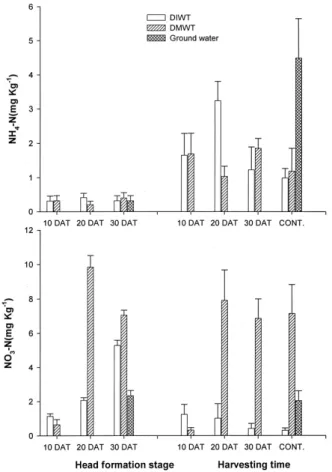
3-N concentrations in upper layer soil (0-15 cm) over 60 days after irrigation of alternative waters with different irrigation periods were shown in Figure 4. For NH
4-N concentrations, it observed that there were no differences among the alternative irrigation waters with different irrigation periods at head forming stage in soil after irrigation. But it was higher at head forming stage than that of harvesting stage regardless of alternative irrigation waters and irrigation periods. Also, NO
3-N concentration in soil
Fig. 3. Changes of ECe in upper layer soil (0-15cm) over 60days after irrigation to alternative irrigation waters with different irrigation periods. DAT, days after treatment;
DIWT; discharge water from industrial wastewater treatment plant; DMWT, discharge water from municipal wastewater treatment plant; Error bar(I); represent the standard deviation of each variable.
Fig. 2. Changes of SAR values in upper layer soil (0-15cm) over 60days after irrigation to alternative irrigation waters with different irrigation periods. DAT, days after treatment;
DIWT, discharge water from industrial wastewater treatment plant; DMWT, discharge water from municipal wastewater treatment plant; Error bar(I) represents the standard deviation of each variable.
Fig. 4. Influences of NH4-N and NO3-N concentrations in upper layer soil (0-15 cm) over 60 days after irrigation to alternative irrigation waters with different irrigation periods.
DAT, days after treatment; DIWT, discharge water from industrial wastewater treatment plant; DMWT, discharge water from municipal wastewater treatment plant; Error bar(I) represents the standard deviation of each variable.
was increased up to 20 days after irrigation and then decreased at 30 days after irrigation with DMWT at head forming stage. But it was not difference among the irrigation periods except for 10 days of irrigation period at harvesting time. However, it was increased with prolonging the irrigation periods with DIWT at head forming stage, and then radically decreased below than that of the groundwater irrigation plot at harvesting time.
Nickel concentrations in soil The Ni
+concentration in upper layer soil (0-15 cm) irrigated with DIWT was increased with prolonging the irrigation period at head forming stage, but it was dramatically decreased and almost constant in all the treatments at harvesting time (Fig. 5). This tendency might be attributed to the rapidly uptake of Ni
+with Chinese cabbage growth. However, it was observed that there was almost constant at the Ni concentration in the soil irrigated with DMWT from head forming stage to harvesting time regardless of irrigation periods. This might be due to irrigation water properties which is not contained Ni
+in the DMWT.
Overall, it might be concluded that there was potentially safe to irrigate the discharge water from municipal wastewater treatment plant for 20 days after transplanting to drought periods with cultivating the Chinese cabbage relative to harvest index, SAR value, and Ni
+concentration in soil.
Conclusion
This experiment was conducted to investigate the growth effects of Chinese cabbage and soil salinity to alternative irrigation waters for drought periods. The treatments were consisted of the discharge water from industrial wastewater treatment plant (DIWT), the discharge water from municipal wastewater treatment plant (DMWT) and ground water as the control.
According to classification of alternative irrigation water by EC
ivalue, DIWT and DMWT are ranged from 0.7 to 2.0 dS m
-1, slight salinity.
Average harvest indexes were 0.64 for DIWT and 0.63 for DMWT as compared to 0.61 of the control regardless of irrigation periods. SAR value in soil was increased with prolonging the irrigation periods at head forming stage, but not much difference except for 30 days of irrigation period at harvesting time for DIWT. At harvesting time, average EC
efor the soil irrigated with alternative agricultural waters was 0.017 dS m
-1for its DIMT and 0.036 dS m
-1for its DMWT as compared to 0.013 dS m
-1of its groundwater as the control. For NH
4- N concentrations, it observed that there were no differences among the treatments with different irrigation periods at head forming stage in soil after irrigation. Also, NO
3-N concentration in soil was increased up to 20 days after irrigation, and then decreased at 30 days after irrigation with DMWT at head forming stage. The Ni concentration in upper layer soil (0-15 cm) irrigated with DIWT was increased with prolonging the irrigation period at head forming stage, but it was dramatically decreased and almost constant in all the treatments at harvesting time.
Therefore, it might be concluded that there was potentially safe to irrigate the discharge water from municipal wastewater treatment plant for 20days after transplanting to drought periods with cultivating the Chinese cabbage.
References
Angelakis, A.N., Do Monte M. Marecos, H. F., L. Bontoux, and T.
Asano, 1999. The status of wastewater reuse practice in the Mediterranean basin: Need for guidelines. Wat. Res. Vol. 33, No.
10: 2201-2217.
Environmental Management Corporation. 2001. Study on reuse technology of discharge water from municipal wastewater treatment plant(Ed.): 11
Korea Environmental Protection Agency. 2000. Standard methods Fig. 5. Influences of Ni concentration in upper layer soil (0-15
cm) over 60days after irrigation to alternative irrigation waters with different irrigation periods. DAT, days after treatment; DIWT, discharge water from industrial wastewater treatment plant, DMWT, discharge water from municipal wastewater treatment plant; Error bar(I) represents the standard deviation of each variable.
for the examination of water contamination.(Ed.): 141-347.
Rhoades, J.D., A. Kandiah, and A.M. Mashali, 1992. The use of saline waters for crop production. FAO Irrigation and Drainage Paper No. 48, Rome: 133.
Shin, J.D., J.S. Lee, W.II. Kim, C.E. Lee, S.G. Yun and K.C. Eom,.
2003. Influences of Discharge waters from wastewater Treatment Plants on Rice(Oryza sativa L.) Growth and Percolation Water Salinity. Korean J. Soil Sci. Fert. 36(1): 24-31.
Soil Science society of America(Terminology committee). 1997.
Glossary of Soil Science Terms. SSSA. Madison, WI, USA.
U.S. EPA.1992. Guidelines for water Reuse: Manual. U.S. EPA and U.S. agency for Int. Development. EPA/625/R-92/004, Cincinnati, OH.
UNESCO. 1970. Research and training on irrigation with saline water. Techn. Report UNDP project, Tunisia 5. UNESCO, Paris:
256
Van Hoorn, J.W., N. Kateriji, and M. Mastrorilli, 1993. Effect of saline water on soil salinity and on water stress, growth and yield of wheat and potatoes. Agric. Water Manage. 23: 247-265.
갈수기에 관개한 대체용수가 배추 생육 및 토양 염류도에 미치는 영향을 구명하기 위해 대체관개용수로 산업 공장 폐수처리장 방류수, 하수종말처리장 방류수와 대조구로서 지하수를 관개하여 본 실험을 수행하였다. 관개 한 대체용수에 대한 화학구성 성분은 산업공장 폐수처리장 방류수의 Ni+ 농도와 SAR 값은 관개수로서 다른 국가의 재활용 기준치를 상회하였다. 또한 하수종말처리장 방류수의 CODcr 농도는 농업관개용수 재활용 기준 을 초과하는 것으로 나타났다. ECi 값은 산업공장 폐수처리장 및 하수종말처리장 방류수가 0.7에서 2.0 dS m-1 로서 약한 염류도에 속하였다. 산업공장 폐수처리장 및 하수종말처리장 방류수 관개구의 평균 수확지수는 관개 기간에 관계없이 대조구 0.61에 비교하여, 각각 0.64과 0.63으로 나타났다. 토양중의 SAR값은 결구기에 관개기 간이 지연됨에 따라 증가하였지만, 산업공장 폐수처리장 방류수 관개구에 대해서는 수확기에 30일간 관개한 것 을 제외하고는 큰 차이를 보이지 않았다. 그러나, 하수종말처리장 방류수를 관개한 경우 대조구와 비교하여 전 생육기간을 통해 관개기간에 따른 큰 차이는 없었다. 수확기에 산업공장 폐수처리장 및 하수종말처리장 방류수 관개구의 평균 ECe는 대조구 0.013 dS m-1에 비교하여 각각 0.017 dS m-1 과 0.036dS m-1이었다. 대체용수를 관 개한 후 수확기의 토양 중 NH4-N 농도는 관개기간에 따른 대체용수원 별로는 큰 차이가 없는 것으로 관측되 었다. 또한, 토양 중의 NO3-N 농도는 관개 후 20일까지는 증가하였지만, 결구기에 하수종말처리장 방류수 관개 후 30일에는 감소하였다. 하수종말 처리장 방류수를 관개한 표토층(0 15 cm)의 Ni+ 함량은 결구기에 관개기간 이 지연됨에 따라 증가하였지만, 수확기에 급격히 감소하여 모든 처리구에서 일정 수준을 유지하였다. 그러므 로, 배추경작 시 갈수기에 배추정식 후 20일간 하수종말 처리장 방류수를 20일간 관개하여도 안전한 것으로 사 료된다.
대체관개 용수에 의한 배추생육 및 토양 염류도에 미치는 영향
신중두*·박상원·김원일·이종식·윤순강·엄기철 농업과학기술원