희석 방법에 따른 나노에멀젼 형성 연구
조 완 구†⋅한 상 길*
전주대학교 대체의학대학 기초의과학과, *순천향대학교 산학협력단 (2012년 5월 16일 접수, 2012년 8월 10일 수정, 2012년 8월 20일 채택)
Study of Nano-emulsion Formation by Different Dilution Method
Wan Goo Cho† and Sang Gil Han*
College of Alternative Medicine, Jeonju University, Hyoja 3ga, Wansan-gu, Jeonju 560-759, Korea,
*Industry Academy Cooperation Foundation, Soonchunhyang University (Received May 16, 2012; Revised August 10, 2012; Accepted August 20, 2012)
요 약: Oil-in-ethanol (O/E) 마이크로에멀젼을 물에 희석하여 얻은 O/W 나노에멀젼의 성질에 대하여 다른 희석 과정 의 영향을 연구하였다. 물/에탄올/비이온성계면활성제/실리콘 오일 계를 모델 계로 선택하였다. 희석과정은 물(또는 마이크로에멀젼)을 마이크로에멀젼(또는 물)에 단계별로 첨가하는 방법으로 구성되었다. O/E 마이크로에멀젼을 물에 첨가하여 혼합하면 30 nm 정도의 입경을 가진 나노에멀젼을 얻을 수 있었다. 반면에 물을 O/E 마이크로에멀젼에 첨가 하면 400 nm의 입경을 가진 에멀젼을 얻을 수 있다. 희석 방법이 얻어지는 에멀젼의 성질에 중요한 역할을 하였다.
시간에 따른 나노에멀젼의 입자 변화는 관찰되지 않았으나 입자가 큰 에멀젼은 시간에 따라 입경이 증가하였으며 불안 정화 기작은 오스트왈드 라이퍼닝으로 추정되었다.
Abstract: The influence of different dilution procedures on the properties of oil-in-water (O/W) nano-emulsions ob- tained by dilution of oil-in-ethanol (O/E) microemulsions with water has been studied. The system water/etha- nol/nonionic surfactant/silicone oil with ethanol was chosen as model system. The dilution procedures consisted of add- ing water (or microemulsion) stepwise. By mixing O/E microemulsions into water, nano-emulsions with droplet diam- eters of 30 nm were obtained. In contrast, by mixing water into O/E microemulsion, emulsions with diameter of 400 nm were obtained The dilution methods were shown to be a key factor determining the properties of the emulsions. There were no change in diameters of nanoemulsion droplets against time, however sizes of droplets in the emulsion with larger droplets were increased with time and the mechanism of unstability was thought to be Ostwald ripening.
Keywords: nanoemulsions, microemulsions, self-emulsification, dilution
1. 서 론
1)
나노에멀젼은 입경이 20 ∼ 200 nm 정도의 크기를 갖 으며 입경이 작기 때문에 반투명한 외관을 갖는다[1-3].
마이크로에멀젼과는 다르게 나노에멀젼은 열역학적으로 안정하지 않지만 장시간 물리적으로 안정할 수 있으며 산업적으로 중요한 의미가 있는 계면활성제의 함량이 적
† 주 저자 (e-mail: [email protected])
기 때문에 의약품, 화장품 및 농업 분야에서 다양하게 응 용되고 있다[4-10]. 일반적으로 나노에멀젼은 전단력을 가진 믹서를 이용하여 계에 기계적인 에너지를 가하거나 고압 유화기 또는 초음파 등과 같이 높은 에너지를 사용 하는 방법으로 제조된다[11-13]. 그러나 저 에너지를 이 용한 유화 방법이 최근 관심의 대상이 되고 있는데 이는 상전이 방법, 직접 또는 자발적 유화 방법 등이며 이들 방법은 미세한 입경의 나노에멀젼 제조는 물론 입경 분 포의 폭이 적은 에멀젼을 얻을 수 있다[14-19].
상전이 방법은 유화과정 중에 발산되는 에너지를 이용 하는 방법으로 이는 계면활성제 분자의 곡률이 음에서 양으로 또는 양에서 음으로의 변화를 의미한다. 이러한 변화는 일정 온도에서는 조성의 변화로 달성할 수 있으 며 이러한 유화법을 상반전 조성 유화법(phase-inver- sion composition method, PIC)이라 칭한다[20-26]. 이 와는 다르게 일정 조성에서는 온도의 변화에 의해 달성 될 수 있으며 이는 상전이 온도 유화법이라 칭한다 (phase inversion temperature method, PIT)[27-31].
PIC 유화방법에서 핵심적인 사항은 작은 입경의 에멀젼 을 얻기 위해서는 유화과정에서 라멜라 액정상 또는 이 중 연속상 마이크로에멀젼이 생성되어야하며 이는 계면 활성제 집합체의 평균 곡률이 영이 됨을 의미한다 [20-31]. 더욱이 PIT 방법을 이용한 유화에서는 작은 입 경을 가진 에멀젼의 생성은 모든 오일과 계면활성제가 하나의 상에 존재하기만 한다면 초기의 평형 상에 의존 적이지 않다는 것이다[28,31]. 여기서 입자의 형성은 주 로 이중 연속상의 마이크로에멀젼의 구조에 의해서 좌우 되고 잉여의 물은 희석제로서 작용한다. 이는 최근 유사 한 계의 PIC 방법에서도 확인되었다[26].
일반적으로 자발적 유화라고 불리는 방법에서 유화는 희석과정으로 이루어지는데 일반적으로 일정온도에서 유화과정 중에 어떤 상전이도 일어나지 않는다. O/W 나 노에멀젼을 자발적 유화방법에 의해 제조하는 방법은 O/W 마이크로에멀젼을 희석하는 방법이다[32-35]. 나 노에멀젼의 입자는 물로 희석함에 따라 계면활성제의 농 도가 감소하여 열역학적으로 안정한 계면장력 유지(γ <
10-2 Nm-1)가 충분하지 않기 때문에 일어나는 현상이다.
희석에 의한 나노에멀젼의 형성과 안정성에 대한 체계적 인 연구가 물/SDS/n-알칸올/탄화수소의 계에서 수행되 었다[32,33]. 안정성은 떨어졌지만 입경이 20 ∼ 80 nm 정도의 나노에멀젼을 얻을 수 있음을 보고하였다. 안정 성은 오스트왈드 라이퍼닝 현상이 주요인이었다. 마이크 로에멀젼에서 물의 함량과 희석에 의해 얻어지는 나노에 멀젼의 관계를 탄화수소를 제외하고는 같은 계에서 연구 되었다[34]. 물이 연속상인 마이크로에멀젼(전기전도도 가 높은)은 희석함에 따라 낮은 전도도를 지닌 마이크로 에멀젼(W/O 마이크로에멀젼)보다 작은 나노에멀젼을 얻을 수 있었다. 이 연구에 사용된 한 단계의 희석은 마 이크로에멀젼에 물을 혼입시키는 것과 같은 방법임을 주 목할 필요가 있다[32,34].
많은 연구나 실제 응용에서 나노에멀젼은 상전이나 자 발적 유화에 의해 제조된다는 점은 주목할 필요가 있다.
이는 2단계 또는 3단계의 단계별 유화 과정을 참조할 필 요가 있다[37-40]. 화장품에서 흥미가 있는 약 100 nm 정도의 미세 분산 나노에멀젼을 2단계 과정으로 제조할 수 있음이 보고되었다[37]. 첫 번째 단계는 유화온도 (85 ℃)에 PIT 계를 조절하는 단계로 적절한 유화제와 보조유화제를 사용하여 이중 연속상 마이크로에멀젼 상 을 만든다. 두 번째 단계는 찬물로 희석하는 단계이다.
이 두 번째 단계는 온도와 조성의 변화가 수반되고 계면 활성제의 곡률이 영(bicontinuous microemulsion)에서 양의 곡률(O/W nano-emulsion)로 전환된다. 최근 두 단계 희석 유화법은 일정온도에서 두 단계 유화법으로 소개되었다[38]. 첫 번째 단계에서 계는 조성이 고정되 고 평형 상태에 존재하며 연속 이중 마이크로에멀젼 또 는 라멜라 액정 상으로 존재한다. 두 번째 단계는 물로 희석함에 따라 나노에멀젼이 형성되고 곡률이 영에서 양 으로 전환된다. 흥미 있는 것은 SANS에 의해서 수행되 어 보고된 나노에멀젼의 안정성은 불안정화 요인이 주로 응집 현상에 의한 것이라는 것이다. 이 결과는 합일과 오 스트왈드 라이퍼닝에 의한 불안정화 요인의 다른 계의 결과와는 모순이다[32,33]. W/O 나노에멀젼을 얻기 위 한 3단계 유화 방법이 보고되었다[40]. 첫 번째 단계는 고정된 유화제/오일/물로 농축 용액을 제조하고 두 번째 단계에서는 나머지 물을 첨가하고 마지막 3단계에서는 오일로 희석하여 W/O 나노에멀젼을 제조하는 방법이 다. 이렇게 제조된 나노에멀젼은 아주 우수한 안정성을 보였다.
Pm3n 구조를 가진 큐빅 액정상에 직접 희석하여 O/W 나노에멀젼을 제조하는 새로운 유화 방법이 최근 보고되었다[35,36]. 물을 큐빅상에 첨가하면 마이셀이 분리되고 큐빅 구조가 깨지며 계면활성제/보조계면활성 제가 물로 이동하는 부분이 생기고 궁극적으로는 미세 입경을 가진 에멀젼이 유도됨을 보였다. 희석과정에서는 계면활성제 곡률의 변화가 일어나지 않음을 주목할 필요 가 있다. 이와 관련해서 마지막 단계에서 곡률의 변화 없 이 O/W 나노에멀젼을 얻기 위한 유화 기작은 온도의 변 화를 의미하는 즉 sub-PIT 유화법에 의해서 얻을 수 있 다[41,42]. 이 방법에서 계는 우선 PIT 이하로 온도를 조 정하고 모든 오일을 팽윤된 마이셀(O/W microemulsions) 에 가용화시키고 온도를 변화하여 입자가 준 안정화 상 태인 나노에멀젼을 제조한다.
본 논문에서는 일정한 온도에서 저 에너지 유화법에 의해 형성되는 나노에멀젼 기작을 연구하기 위해 비온성 계면활성제를 이용한 O/E (Oil/Ethanol) 마이크로에멀
Table 1. Materials for Experiments
INCI* name Trade name Company
Octyldodeceth-16 Emalex OD 16 Nihon Emulsion (Japan)
Polyoxyethylene (40) hydrogenated castor oil Nikkol HCO 40 Nikko Chem. (Japan)
Methyl phenyl polysiloxane Silicone 556 Dow Corning (USA)
Ethyl alcohol Ethyl alcohol Sigma-Aldrich (USA)
*INCI : International Cosmetic Ingredient
Figure 1. Scheme showing the emulsification procedures used to form nanoemulsions : (a) addition of O/E micro- emulsion into water in one step, (b) stepwise addition of water into O/E ME. O/E ME refers to Oil/Ethanol microemulsions.
Figure 2. Visual aspects of Nano-emulsions obtained in system water/nonionic surfactant/ethanol/silicone 556 (a) addition of O/E ME (A) into water (B) in one step, (b) stepwise addition of water (B) into O/E ME (A).
젼의 희석을 통하여 나노에멀젼을 제조하는 연구에 대한 보고를 하고자 한다. 연구의 초점은 서로 다른 희석 과정 이다.
2. 실험 및 재료
2.1. 재료
Table 1에 본 실험에 사용한 원료를 정리하였다. 화장 품용 원료는 각 생산업체로부터 받아 그대로 사용하였으 며 물은 Milli Q (Millepore Co., Milford, MA, USA)에서 18 MW-cm로 통과시킨 것을 사용하였다.
2.2. O/W 나노에멀젼의 제조
비이온성 계면활성제 Emalex OD-16 0.5 g, Nikkol HCO 40 0.5 g을 에탄올 7.0 g에 실온에서 용해하고 Silicone 556 0.1 g을 첨가하여 O/E ME, A를 제조하였다.
나노에멀젼은 제조한 O/E ME를 물(B)에 첨가하는 방법과 물을 O/E ME에 첨가하는 방법을 선택하였다.
물의 첨가량은 91.9 g으로 총량을 100 g으로 제조하였다.
희석은 열판 자석 교반기를 사용하고 실온에서 진행하였 으며 혼합은 400 rpm으로 하였다. 첨가시간은 A를 B에 첨가할 때는 1 min 간에 걸쳐서 첨가하였으며 B를 A에 첨가할 때는 20 min 간에 걸쳐서 서서히 첨가하였다. 제 조된 나노에멀젼은 안정성을 평가하기 위하여 마개 있는 시험관으로 옮겨 평가하였다.
2.3. 입자 크기, 다분산도 및 안정성 실험
평균 입경과 분포도는 Dynamic light scattering 방법 을 활용한 입자측정기(DLS, ESLZ, Photal, Japan)를 사 용하여 에멀젼을 희석 없이 실온에서 측정하였다. 측정 할 때의 산란각은 90도에서 진행하였다.
3. 결과 및 고찰
3.1. 나노에멀젼의 제조
나노에멀젼 형성을 연구하기 위하여 Figure 1과 같이 두 가지 다른 희석 방법을 시험하였다. 첫 번째 방법은 단계별로 마이크로에멀젼을 물에 희석하였고 두 번째는
(a) (b)
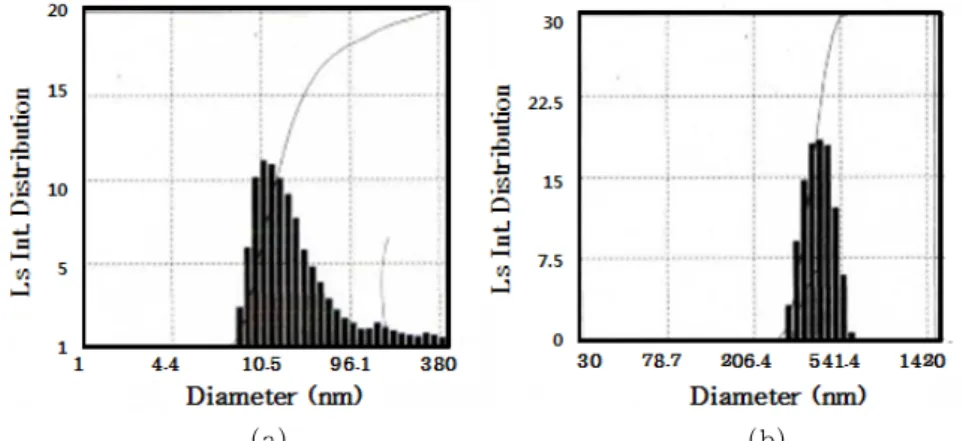
Figure 3. Droplet size distributions of emulsions obtained in the system water/nonionic surfactant/ethanol/silicone 556, (a) method of A to B, (b) method of B to A.
Figure 4. Droplet size versus time of emulsions obtained in the system water/nonionic surfactant/ethanol/silicone 556, using method of A to B (◆) or B to A (■).
마이크로에멀젼에 물을 단계별로 첨가하였다. 2절에서 언급한 바와 같이 유화과정에서 물의 조성은 항상 91.9 % 로 하였다. 희석하는 동안 혼합 속도는 일정하게 유지하 였으나 나노에멀젼을 얻기 위한 필수 조건은 아니었고 최근 보고된 나노에멀젼을 얻기 위한 큐빅 액정상의 물 에 대한 희석과정과는 다르게 점도가 높은 액정상은 존 재하지 않았다[35,36]. 큐빅상 희석 연구에서는 계의 점 도가 높아 희석속도가 나노에멀젼의 성질에 아주 큰 영 향을 미침을 보고하고 있다.
Figure 2에는 제조 직후의 나노에멀젼의 외관을 나타냈 다. 외관상으로 보아도 제조 희석 방법의 차이에 따른 차 이가 뚜렷하여 O/E 마이크로에멀젼을 물에 첨가하여 제 조한 나노에멀젼은 거의 투명성을 유지하고 있으나 그 반 대의 희석과정으로 제조한 나노에멀젼은 현탁 정도에서 큰 차이를 보였다. 이는 나노에멀젼의 입도 분포가 다름을 의미하며 이를 확인하고자 입도 분석을 측정하였다.
3.2. 나노에멀젼의 안정성
나노에멀젼 불안정화 기작을 평가하기 위하여 나노에 멀젼의 입경을 시간에 따라 측정하였다. Figure 3에 DLS 에 의해 측정된 나노에멀젼의 입경을 나타냈다. Figure 3 (a) 은 O/E ME를 물에 첨가하여 희석한 에멀젼으로 30 nm 정도의 나노에멀젼을 얻을 수 있었다. 입자의 분포도는 폭이 넓었으며 Figure 3 (b)은 반대로 물을 O/E ME에 첨가하여 희석하는 방법으로 제조한 에멀젼으로 400 nm 정도의 에멀젼으로 분포도는 유사한 결과를 얻을 수 있 었다.
에멀젼의 안정성을 검토하고자 시간에 따른 입경의 변 화를 측정하였다. O/E ME를 물에 첨가하여 희석한 제 조된 나노에멀젼은 시간 변화에 대하여 입경의 변화를 보이지 않았으나 반대의 방법으로 희석한 경우는 시간에 따라 점차 입경이 증가하는 경향을 보였다. 나노에멀젼 의 안정성은 오스트왈드 라이퍼닝이 지배한다고 알려져
Figure 5. r3 versus time of emulsions obtained in the sys- tem water/nonionic surfactant/ethanol/silicone 556, using method of A to B (◆) or B to A (■).
있다[32-34,43]. 그러나 복합 비이온 계면활성제를 사용 한 본 계에서는 주어진 시간 동안 입도의 변화가 없었다.
나노에멀젼의 주요한 불안정화 기작은 오스트왈드 라 이퍼닝으로 알려져 있다[32-34]. 물을 O/E ME에 첨가 하여 제조한 에멀젼은 입경이 400 nm 전후로 나노에멀 젼으로 분류하기에는 큰 입경을 보이고 있어 오스트왈드 라이퍼닝이 안정성을 지배한다고 단언할 수 없으나 가능 성 여부를 평가하기 위하여 입자 반경의 세제곱을 시간 에 따라 Figure 5와 같이 나타냈다. LSW 이론에 따르면 Figure 5와 같이 r3과 시간이 직선의 관계를 가지면 주요 한 불안정화 기작은 오스트왈드 라이퍼닝이며 이는 이전 에 발표된 결과와도 일치한다[32-34]. 실리콘 오일의 물 에 대한 용해도는 낮아 오스트왈드 라이퍼닝의 가능성 낮은 것으로 보고되고 있음은 O/E ME을 물에 희석하여 제조한 나노에멀젼에서는 입도의 변화를 보이지 않으나 저자들의 단일 비이온계면활성제를 사용한 이전의 결과 와는 차이를 보였다[43]. 일반적인 에멀젼의 안정화에서 복합 계면활성제의 사용은 에멀젼을 안정화함이 널리 알 려져 있다[44,45]. 본 실험의 결과와 이전의 안정성의 차 이는 향후 좀 더 추가 연구가 필요한 것으로 생각된다.
그러나 물을 O/E ME에 첨가하여 희석한 에멀젼의 경우 는 입자가 크고 용해도를 증가시키는 에탄올의 첨가 등 으로 인하여 오스트왈드 라이퍼닝이 주요한 요인으로 생 각된다.
4. 결 론
물/비이온성계면활성제/에탄올/실리콘 오일 계에서 O/E 마이크로에멀젼을 서로 다른 희석 방법에 따른 영 향을 관찰하였다. 희석과정은 물을 O/E 마이크로에멀젼
에 첨가하는 방법과 반대로 물을 O/E 마이크로에멀젼에 첨가하는 방법으로 하였다. O/E 마이크로에멀젼을 물에 희석하여 제조한 미세 나노에멀젼은 30 nm 정도의 입경을 보였으나 반대로 물을 O/E 마이크로에멀젼에 첨가한 경 우에는 물을 단계별로 서서히 첨가하였음에도 불구하고 400 nm 정도의 입경을 가진 에멀젼을 얻을 수 있었다.
안정성 시험에서 나노에멀젼은 주어진 기간 동안 안정 성을 유지하였다. 일반적으로 나노에멀젼의 주요한 불안 정화 기작은 오스트왈드 라이퍼닝이라고 알려져 있으나 본 실험에서는 에탄올이 첨가됨에도 실리콘 오일의 용해 도가 낮아 오스트왈드 라이퍼닝 현상을 보이지 않고 안 정하였다. 그러나 제조된 에멀젼은 불안정하였고 불안 정화 기작은 오스트왈드 라이퍼닝 현상으로 설명할 수 있었고 이는 유사한 다른 계에서의 결과와 일치하였다 [32,34].
이러한 일련의 일은 O/E 마이크로에멀젼을 희석하여 입경과 다분산성이 작은 나노에멀젼을 얻기 위해서는 희 석 방법이 중요한 역할을 하며 나노에멀젼 형성 기작의 이해에 도움을 준다. 더욱이 도입한 방법은 실제적인 응 용에 사용가능할 것으로 생각된다. O/E 마이크로에멀젼 을 물에 첨가하여 희석하면 미세 나노에멀젼을 얻을 수 있다. 더욱이 이 과정은 scale-up이 쉽고 에너지 절감이 가능하며 온도의 변화나 과정 중에 점도가 높은 상의 생 성이 없어 높은 회전수의 믹싱이 필요하지 않다.
참 고 문 헌
1. C. Solans, I. Sole, A. Fernandez-Arteaga, J. Nolla, N. Azemar, J. M. Gutierrez, A. Maestro, C.
Gonzalez, and C. M. Pey, Surfactant Science Series 146, ed. H. A. Roque, 457, CRC Press, New York (2010).
2. Solans, P. Izquierdo, J. Nolla, N. Azemar, and M. J.
Garcia-Celma, Nano-emulsions, Curr. Opin. Colloid Inter. Sci., 10, 102 (2005).
3. J. M. Gutierrez, C. Gonzalez, A. Maestro, I. Sole, C.
M. Pey, and J. Nolla, Nano-emulsions: New appli- cations and optimization of their preparation, Curr.
Opin. Colloid Inter. Sci., 13, 245 (2008).
4. J. M. Asua, Miniemulsion polymerization, Prog.
Polym. Sci., 27, 1283 (2002).
5. M. Antonietti and K. Landfester, Polyreactions in miniemulsions, Prog. Polym. Sci., 27, 689 (2002).
6. G. Caldero, M. J. Garcia-Celma, and C. Solans, Formation of polymeric nano-emulsions by a low- energy method and their use for nanoparticle prep- aration, J. Colloid Inter. Sci., 353, 406 (2011).
7. L. Wang, J. Dong, J. Chen, J. Eastoe, and X. Li, Design and optimization of a new self-nano- emulsifying drug delivery system, J. Colloid Inter.
Sci., 330, 443 (2009).
8. N. Sadurni, C. Solans, N. Azemar, and M. J.
Garcia-Celma, Studies on the formation of O/W nano-emulsions, by low-energy emulsification methods, suitable for pharmaceutical applications, Eur. J. Pharm. Sci., 26, 438 (2005).
9. L. Wang, X. Li, G. Zhang, J. Dong, and J. Eastoe, Oil-in-water nanoemulsions for pesticide formula- tions, J. Colloid Inter. Sci., 314, 230 (2007).
10. O. Sonneville-Aubrun, J. T. Simonnet, and F.
L'Alloret, Nanoemulsions: a new vehicle for skin- care products, Adv. Colloid Inter. Sci., 108–9, 145 (2004).
11. J. Floury, A. Desrumaux, M. A. V. Axelos, and J.
Legrand, Effect of high pressure homogenisation on methylcellulose as food emulsifier, J. Food Eng., 58, 227 (2003).
12. K. Landfester, J. Eisenblatter, and R. Rothe, Pre- paration of polymerizable miniemulsions by ultra- sonication, J. Coat. Technol. Res., 1, 65 (2004).
13. T. Delmas, H. Piraux, A. C. Couffin, I. Texier, F.
Vinet, P. Poulin, M. E. Cates, and J. Bibette, How to prepare and stabilize very small nanoemulsions, Langmuir, 27, 1683 (2011).
14. Th. F. Tadros, P. Izquierdo, J. Esquena, and C.
Solans, Formation and stability of nano-emulsions, Adv. Colloid Inter. Sci., 108–09, 303 (2004).
15. K. Shinoda and H. Kunieda, Encyclopedia of Em- ulsion Technology 1, ed. P. Becher, 337, Marcel Dekker, New York, (1983).
16. S. A. Vitale and J. L. Katz, Liquid droplet dis- persions formed by homogeneous liquid-liquid nu- cleation: The Ouzo effect, Langmuir, 19, 4105 (2003).
17. S. Sajjadi, Formation of fine emulsions by emulsifi- cation at high viscosity or low interfacial tension; A
comparative study, Langmuir, 22, 5597 (2006).
18. K. Bouchemal, S. Briancon, E. Perrier, and H. Fessi, Nano-emulsion formulation using spontaneous emul- sification: solvent, oil and surfactant optimisation, Int. J. Pharm., 280, 241 (2004).
19. F. Ganachaud and J. L. Katz, Nanoparticles and nanocapsules created using the Ouzo effect: spon- taneous emulsification as an alternative to ultra- sonic and high-shear devices, Chem, Phys, Chem., 6, 209 (2005).
20. A. Forgiarini, J. Esquena, C. Gonzalez, and C.
Solans, Formation of nano-emulsions by low-en- ergy emulsification methods at constant temper- ature, Langmuir, 17, 2076 (2001).
21. P. Fernandez, V. Andre, J. Rieger, and A. Kuhnle, Nano-emulsion formation by emulsion phase in- version, Colloids Surf., A251, 53 (2004).
22. W. Liu, D. Sun, C. Li, Q. Liu, and J. Xu, Formation and stability of paraffin oil-in-water nano-emul- sions prepared by the emulsion inversion point method, J. Colloid Inter. Sci., 303, 557 (2006).
23. O. Sonneville-Aubrun, D. Babayan, D. Bordeaux, P.
Lindner, G. Rata, and B. Cabane, Phase transition pathways for the production of 100 nm oil-in-water emulsions, Phys. Chem. Chem. Phys., 11, 101 (2009).
24. P. Heunemann, S. Prevost, I. Grillo, C. M. Marino, J. Meyer, and M. Gradzielski, Formation and struc- ture of slightly anionically charged nanoemulsions obtained by the phase inversion concentration (PIC) method, Soft Mater, 7, 5697 (2011).
25. M. Hessien, N. Singh, C. Kim, and E. Prouzet, Surfactant concentration regime in miniemulsion polymerization for the formation of MMA nano- droplets by high-pressure homogenization, Lang- muir, 27, 2299 (2011).
26. K. Roger and B. Cabane, Emulsification through surfactant hydration: The PIC process revisited, Langmuir, 27(2), 604 (2011).
27. P. Izquierdo, J. Esquena, Th. F. Tadros, C. Dederen, M. J. Garcia, N. Azemar, and C. Solans, Formation and stability of nano-emulsions prepared using the phase inversion temperature method, Langmuir, 18,
26 (2002).
28. D. Morales, J. M. Gutierrez, M. J. Garcia-Celma, and C. Solans, A study of the relation between bi- continuous microemulsions and oil/water nano- emulsion formation, Langmuir, 19, 7196 (2003).
29. P. Izquierdo, J. Esquena, Th. F. Tadros, C. Dederen, J. Feng, M. J. Garcia-Celma, N. Azemar, and C.
Solans, Phase behavior and nano-emulsion for- mation by the phase inversion temperature method, Langmuir, 20(16), 6594 (2004).
30. P. Izquierdo, J. Feng, J. Esquena, Th. F. Tadros, C.
Dederen, M. J. Garcia-Celma, N. Azemar, and C.
Solans, The influence of surfactant mixing ratio on nanoemulsion formation and stability, J. Colloid Inter. Sci., 285(1), 388 (2005).
31. D. Morales, C. Solans, J. M. Gutierrez, M. J.
Garcia-Celma, and U. Olsson, Oil/water droplet for- mation by temperature change in the water/C16E6/
mineral oil system, Langmuir, 22, 3014 (2006).
32. P. Taylor and R. H. Ottewill, The formation and ageing rates of oil-in-water miniemulsions, Colloids Surf., A88, 303 (1994).
33. P. Taylor, Ostwald ripening in emulsions, Adv.
Colloid Inter. Sci., 75, 107 (1998).
34. R. Pons, I. Carrera, J. Caelles, J. Rouch, and P.
Panizza, Formation and properties of miniemulsions formed by microemulsions dilution, Adv. Colloid Inter. Sci., 106, 129 (2003).
35. I. Sole, A. Maestro, C. Gonzalez, C. Solans, and J.
M. Gutierrez, Optimization of nano-emulsion prepa- ration by low energy methods in an ionic surfactant system, Langmuir, 22, 8326 (2006).
36. I. Sole, A. Maestro, C. Gonzalez, C. Solans, and J.
M. Gutierrez, Influence of the phase behavior on the properties of ionic nanoemulsions prepared by the phase inversion composition method, J. Colloid Inter. Sci., 327, 433 (2008).
37. A. Wadle, Th. Forster, and W. von Rybinski, Influence of the microemulsion phase structure on the phase inversion temperature emulsification of polar oils, Colloids Surf., A76, 51 (1993).
38. L. Wang, K. J. Mutch, J. Eastoe, R. K. Heenan, and J. Dong, Nanoemulsions prepared by a two-step low-energy process, Langmuir, 24, 6092 (2008).
39. L. Wang, R. Tabor, J. Eastoe, X. Li, R. K. Heenan, and J. Dong, Formation and stability of nano- emulsions with mixed ionic–nonionic surfactants, Chem. Phys. Chem., 11, 9772 (2009).
40. J. L. Salager, A. Forgiarini, J. C. Lopez-Momtilla, and L. Marquez, Low-energy emulsification by phase inversion techniques: Trends and Tricks, 4th World Congress on Emulsion, Lyon France, 222 (2006).
41. K. Roger, B. Cabane, and U. Olsson, Formation of 10-100 nm size-controlled emulsions through a sub-PIT cycle, Langmuir, 26(6), 3860 (2010).
42. Z. Mei, S. Liu, L. Wang, J. Jiang, J. Xu, and D.
Sun, Preparation of positively charged oil/water nano-emulsions with a sub-PIT method, J. Colloid Inter. Sci., 361, 565 (2011).
43. H. J. Yang, W. G. Cho, and S. N. Park, Stability of oil-in-water nano-emulsions prepared using the phase inversion composition method, J. Ind. Eng.
Chem., 15, 331 (2009).
44. F. O. Opawale and D. J. Burgess, Influence of inter- facial rheological properties of mixed emulsifier films on the stability of water-in-oil-in-water emulsions, J. Pharm. Pharmacol., 50(9), 965 (1998).
45. R. Pichot, F. Spyropoulos, and I. T. Norton, Mixed-emulsifier stabilised emulsions: Investigation of the effect of monoolein and hydrophilic silica particle mixtures on the stability against coa- lescence, J. Colloid Inter. Sci., 329, 284 (2009).