• 검색 결과가 없습니다.

Preliminary Research on the Effect of Cosmetic Containing Ginseng Extract on Quality of Life of Healthy Women Based on Skindex-16

N/A
N/A
Protected

Academic year: 2021

Share "Preliminary Research on the Effect of Cosmetic Containing Ginseng Extract on Quality of Life of Healthy Women Based on Skindex-16"

Copied!
8
0
0

로드 중.... (전체 텍스트 보기)

전체 글

(1)

Vol. 41, No. 4, December 2015, 333-340 http://dx.doi.org/10.15230/SCSK.2015.41.4.333

1)

† 주 저자(e-mail: [email protected]) call: 031)280-5842

인삼 추출물 함유 한방화장품이 건강한 성인 여성의 삶의 질에 미치는 영향에 관한 예비 연구; Skindex-16을 중심으로

조 가 영 ⋅박 효 민⋅권 이 경⋅조 성 아⋅강 병 영⋅김 윤 범 *

아모레퍼시픽 기술연구원, *경희대학교 안이비인후피부과 교실

(2015년 10월 28일 접수, 2015년 11월 18일 채택)

Preliminary Research on the Effect of Cosmetic Containing Ginseng Extract on Quality of Life of Healthy Women Based on Skindex-16

Ga Young Cho , Hyo Min Park, Lee Kyung Kwon, Sung A Cho, Byung Young Kang, and Yoon Bum Kim

* Amore Pacific R&D Center, 1920 Yonggu-daero, Giheung-gu, Yongin, Gyeonggi-do 17074, Korea

*Department of Ophthalmology, Otolaryngology and Dermatology of Korean Medicine, College of Korean Medicine, Seoul 02447, Korea

(Received October 28, 2015; Accepted November 18, 2015)

요 약: 본 연구에서는 건강한 성인 여성을 대상으로 인삼 추출물을 함유한 스킨케어 제품의 시료 제시 방법과

여성들의 삶의 질 개선 효과 간의 상관 관계를 분석하였다. 삶의 질이란 질병이나 건강 상태가 일상생활에 미치 는 신체적, 정신적 그리고 사회적 영향에 대한 개인적인 반응을 나타내는 개념이다. 이에 저자들은 45명의 건강 한 성인 여성을 두 그룹으로 나누어 한 그룹(Group A)에는 브랜드 고유의 패키지를 유지한 인삼 크림 시료를 제공하였고, 다른 그룹(Group B)은 브랜드와 제품명을 알 수 없는 하얀색 통에 담은 동일한 시료를 제공하여 8주간 사용하게 하였다. 피부 관련 삶의 질 평가는 Skindex-16 설문지를 사용하여 시험 초기와 4주 후, 8주 후에 걸쳐 시행되었다. 시험 참여를 중지한 2명의 피험자를 제외한 43명의 Skindex-16 초기값의 평균은 22.70 ± 4.82점이었다. 8주 후, 그룹 A의 Skindex-16 지표는 초기값 23.30 ± 5.14에서 20.20 ± 4.83으 로, 그룹 B는 22.17 ± 4.58에서 20.52 ± 3.60로 통계적으로 유의한 정도로 개선되었다. 세부 항목에서는 그룹 A의 ‘증상’ 항목이 4주 후, ‘감정’ 항목이 8주 후에 통계적으로 유의하게 개선되었으며, ‘기능’ 항목은 어 느 그룹에서도 통계적으로 유의한 변화가 관찰되지 않았다. 또한, 총합과 세부 항목 모두 측정 시기 및 그룹에 따른 교호작용은 통계적으로 유의한 차이가 확인되지 않았다. 본 실험을 통해 인삼 크림이 포함된 스킨케어가 건강한 성인 여성의 삶의 질에 긍정적인 영향을 줄 수 있음을 확인하였으며, 스킨케어 행위 자체가 패키지에 대한 영향보다 삶의 질의 개선에 주는 영향이 큼을 추측할 수 있다. 장기적으로 ‘삶의 질’이란 기존의 피부과학 지표의 개선과 주관적 만족도의 개념을 넘어 신규한 화장품 효능 영역으로 추가적인 연구가 필요할 것으로 생 각된다.

Abstract: This study is designed to analyze the effect of skincare using cosmetic containing ginseng extract, on improv-

ing quality of life (QOL) of healthy women, with blind testing. QOL is a concept that represents how one’s disease

or health condition can physically, psychologically, and socially influence his or her daily life. The study was conducted

to assess the effect of a ginseng cosmetic preparation on quality of life (QOL) using the Skindex-16 score, stratified

by blind versus non-blinded option. 45 healthy women aged between 30 and 49 years with no skin disease were

recruited for this study. Volunteers were divided into two groups. Group A (n = 22) received anti-aging cream with

ginseng extract in the original packaging, which included the brand name and logo. Group B (n = 23) received the

(2)

1. Introduction

The World Health Organization (WHO) defines quality of life (QOL) as an individuals’ perception of their position in life, in the context of the culture and value systems in which they live, and in relation to their goals, expectations, standards, and concerns. It is a multifaceted concept that includes physical health, mental state, level of independence, social relationships, personal beliefs, and relationship to salient features of the environment[1].

Health-related QOL includes physical and mental health perceptions and their corollaries, including health risks and conditions, functional status, social support, and soci- oeconomic status[2]. Over 660 standardized methods to assess QOL have been developed worldwide since the 1980s. These various methods are designed to measure not only biological changes related to disease but also subjective or perceived change[3].

QOL instruments can be largely classified into two groups. One group includes general health-related QOL assessments, and the other group is more specific for dis- eased states. These tools are regularly updated, expanded, or amended for precision. For example, the Short Form Health Survey (SF-36) and the World Health Organization quality of life assessment instrument (WHOQOL) have been evolved to include several previously neglected as- pects that contribute to a persons’ health, and includes emotional, social, and physical dimensions. Disease-spe- cific QOL measures are often employed to evaluate the

effect of a particular intervention or determine the course of a treatment. ProQolid, the Clinical Outcome Assessment (COA) Instruments Database lists 559 differ- ent disease-specific QOL instruments[4]. For instance, dermatology-specific QOL instruments include the follow- ing : Dermatology Life Quality Index (DLQI), Skindex, Dermatology Quality of Life Scales (DQOLS) and Dermatology Specific Quality of Life (DSQL). There are instruments even more specific for certain diseases, such as the Psoriasis Disability Index (PDI), Psoriasis Life Stress Inventory (PLSI), Acne Disability Index (ADI), and Assessment of the Psychological and Social Effects of Acne (APSEA)[5].

QOL scales are particularly applicable in dermatology.

Many skin diseases are detrimental to social interactions, and thus it is important to evaluate their psychosocial ef- fect as an aspect of the efficacy of treatment. Patients per- ceive a personal “disability” in different ways, which are not necessarily proportional to the clinical severity of disease[6-8]. Some reports claim that physical attractive- ness influences an individual’s QOL related to self-esteem and depression. Patients suffering from acne often have social, mental, and emotional statuses similar to those seen in patients with asthma, epilepsy and diabetes, owing to their perception of QOL[9,10]. For patients with acne who do not wish to undergo surgical or physical inter- ventions (i.e. laser treatments, injection, and plastic sur- gery), simple cosmetic cover on the acne scars, oily skin, or discoloration can improve the reported QOL[11-14].

same cream in a plain white jar without any package decoration or logo. Both groups used the cream for 8 weeks.

For the skin-related QOL assessment, Skindex-16 was used at baseline, forth, and eighth week. All volunteers except two dropouts in Group A completed the dermatology-specific QOL measure, Skindex-16, at baseline, after 4 weeks, and after 8 weeks of treatment with the provided samples. As a result, the mean score of 43 participants at baseline was 22.70 ± 4.82. There was a significant difference between the baseline score and the score after 8 weeks in both groups: The scores changed from 23.30 ± 5.14 to 20.20 ± 4.83 in Group A, from 22.17 ± 4.58 to 20.52 ± 3.60 in Group B. The “Symptom” subscale of Skindex-16 improved after 4 weeks and the “Emotion” subscale improved after 8 weeks in Group A. The “Function” subscale did not show improvement in either groups. Both groups showed no interaction effect between follow up time and groups in Skindex-16 and subscale. This research opens up the possibility of skincare using ginseng cream having a positive effect on QOL in healthy women. Moreover, one can predict that skincare ritual itself may have greater impact on the improvement of QOL, compared to the product packaging.

Keywords: skincare, cosmetic, quality of life, Skindex-16, ginseng

(3)

Despite growing interest in the influence of cosmetic and non-surgical intervention on one’s QOL, little progress has been made. Some studies are limited to color makeup applications, so our team designed a clinical study to evaluate the effect of skincare cosmetics on QOL in healthy women.

2. Materials and Methods

The study was conducted from April 2013 to July 2013 in Seoul (Kyunghee University Medical Center).

Environmental temperature was typically between 10.0 ~ 25.5 ℃ throughout the course of the study.

2.1. Subject

The study was approved by the Kyunghee University Medical Center Ethics Committee (IRB approval no.

KOMCIRB-2013-03). The aim and method of the study were clearly explained, and all subjects voluntarily participated in this study.

2.1.1. Inclusion Criteria

∙ 30 to 49-year-old female

∙ In good health without any physical disease

∙ Able to understand the methods of the study and sign a consent form

∙ Available for long-term follow-up 2.1.2. Exclusion Criteria

∙ Had any cosmetic procedure in the past 6 months, including chemical peel, IPL, and botox injection

∙ Has systemic disease that may affect judgment

∙ Unable to comply with the study protocol

2.2. Methods

2.2.1. Materials

The product sample provided to the participants of the study is a commonly recognizable brand in Korea. This product has been commercially available for over 10 years, and is therefore regarded as safe for long-term use.

The recognizability of the brand may influence subjective satisfaction, so two groups were formed in order to ad- dress this potential bias. The main active ingredients of the product were ginseng extract and ginsenosides.

2.2.2. Study Design

All subjects were assigned randomly to two groups.

Group A (n = 22) received cosmetic samples with the commercially marketed packaging that includes the brand name and logos. Group B (n = 23) received the same for- mulation but in a white jar without any brand name or logo. During the trial period, basic moisturizers (toner and emulsion) were provided and the use of other functional cosmetics (except sunscreen) was restricted. Volunteers used these samples twice a day for 8 weeks. There was no restriction on color-makeup cosmetics. The Skindex-16 QOL questionnaire and clinical observation were con- ducted at baseline, at 4 weeks, and at 8 weeks.

2.2.3. Quality of Life Questionnaire

The Skindex-16, one of the standardized QOL ques- tionnaires for dermatology, is utilized in this study. The original Skindex, designed in 1996, had 61 items to meas-

Group A Group B

One Skin Moisturizing Toner One Skin Moisturizing Emulsion

One Skin Moisturizing Toner One Skin Moisturizing Emulsion One Rejuvenation Cream

- Formulation with ginseng extract and ginsenosides - Ginseng fragrance, light yellow color, and creamy texture - Commercial jar printed with brand name and well-recognized

brand logo

One Rejuvenation Cream

- Formulation with ginseng extract and ginsenosides

- Ginseng fragrance, light yellow color, and creamy texture

- Plain white jar without any logo, or brand name

Table 1. Cosmetic Samples Used for Test

(4)

ure the effects of skin disease on QOL. The Skindex-16 was developed as an abbreviated version, which retained the reproducibility, reliability, and validity of the original version. It is designed to evaluate QOL based on sympto- matic, functional, and emotional factors[15]. Each section has 5 symptom items, 6 emotional items, and 5 functional items. Each item is given a numeric grade to express the level of impairment from “never” (score 1) to “always”

(score 5). The score for each dimension corresponds to the sum of scores of related items. A lower score corre- lates to higher QOL[15]. In this study, we used a Korean version of Skindex-16 with agreement of the copyright holding author.

2.3. Statistical Analysis

Statistical analysis was performed using SPSS 22 Korea (SPSS Inc., Chicago, IL, USA). Repeated measured analysis of variance (ANOVA) and paired t-tests were used to compare the Skindex-16 score between groups at baseline, 4 and 8 weeks. Independent t-test was performed to assess difference at baseline between groups. Statistical significance is p-value < 0.05.

3. Results

3.1. Participants

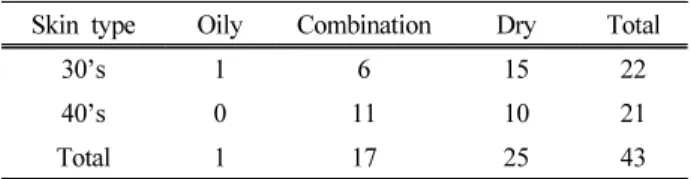
The subjects of the study were healthy females aged 30 to 49 years, without any skin disease. Forty-five fe- males volunteered to participate in this study but two vol- unteers in Group A had dropped out of this project. Basic characteristics, including age and skin type are below in Table 2.

3.2. Skindex-16 Score

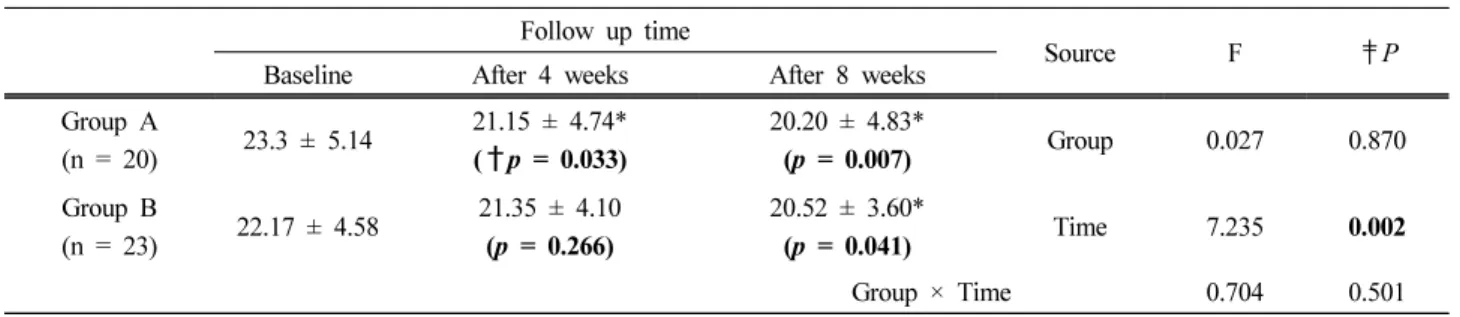
At baseline, there was no statistical difference in Skindex-16 total score between Group A (23.30 ± 5.14) and Group B (22.17 ± 4.58). After 4 weeks, Skindex-16 score in both groups decreased, but statistically significant differences were observed only in Group A at this point.

After 8 weeks, the Skindex-16 scores of both Group A and B were significantly decreased (p < 0.05). The

change in Skindex-16 score and interaction by the time and groups (F = 0.704, p = 0.501) was analyzed by Repeated ANOVA, and was not significantly different (Table 3).

3.3. Sub-score of Skindex-16 by Items

The highest score of 16 items in Skindex-16 was “the appearance of your skin condition” at 0 weeks (2.35 ± 1.02), 4 weeks (2.19 ± 1.05), and 8 weeks (1.91 ± 1.09).

The lowest score at baseline was “being annoyed about your skin condition” (1.05 ± 0.21). At 4 weeks, the low- est scores were “being annoyed about your skin con- dition”, “embarrassment about your skin condition, “the effects of your skin condition on your desire to be with people”, and “the effects of your skin condition on your daily activities” (1.09 ± 0.29). “The effects of your skin condition on your desire to be with people” was the lowest scoring item at week 8 (1.00 ± 0.00).

The subscale parts of Skindex-16 include “Symptoms”

(5 items), “Emotions” (6 items), and “Functions” (5 items). In Group A, the “Symptoms” subscale sig- nificantly improved by week 4 and 8. The “Emotions”

subscale in Group A was significantly improved at 8 weeks. In Group B, all of subscale of Skindex-16 had tendency to decrease but there was no significantly

Skin type Oily Combination Dry Total

30’s 1 6 15 22

40’s 0 11 10 21

Total 1 17 25 43

χ 2 p-value : 0.178

Table 2.1. General Characteristics of Participants

Group 30’s 40’s Total

N Age N Age N Age

Group A 8 37.6 ± 2.0 12 41.8 ± 1.4 20 40.1 ± 2.7 Group B 14 37.1 ± 2.1 9 41.8 ± 1.9 23 39.0 ± 3.0 Total 22 37.3 ± 2.0 21 41.8 ± 1.6 43 39.5 ± 2.9

P-value * 0.609 0.971 0.196

Mean ± SD

* : P-value is for Independent t-test

Table 2.2. General Characteristics of Participants

(5)

difference between the base line scores and scores after 4 and 8 weeks. The change of Skindex-16 subscale and interaction by the time and groups (F = 0.704, p = 0.501) analyzed by Repeated ANOVA was not sig- nificantly different (Table 4).

4. Discussion

Quality of life is a broad concept, encompassing healthcare, social, and political aspects as they affect the overall well-being of the individual. Since 1980, the Follow up time

Source F ‡P

Baseline After 4 weeks After 8 weeks Group A

(n = 20) 23.3 ± 5.14 21.15 ± 4.74*

(†p = 0.033)

20.20 ± 4.83*

(p = 0.007) Group 0.027 0.870

Group B

(n = 23) 22.17 ± 4.58 21.35 ± 4.10 (p = 0.266)

20.52 ± 3.60*

(p = 0.041) Time 7.235 0.002

Group × Time 0.704 0.501

† P-value is for Paired T-Test

‡ P-value is for Repeated ANOVA

* : Statistical significance was set at p < 0.05

Table 3. Repeated ANOVA Mean Response of the Sum of Skindex-16 According to Follow Up Time by Groups

Follow up time

Source F ‡P

Baseline After 4 weeks After 8 weeks Symptom

Group A

(n = 20) 6.75 ± 1.41 5.70 ± 0.92*

(†p = 0.002)

5.95 ± 1.19*

(p = 0.008) Group 3.301 0.077

Group B

(n = 23) 7.04 ± 1.43 6.57 ± 1.56 ( p = 0.164)

6.57 ± 1.34

( p = 0.205) Time 7.388 0.001

Group × Time 0.903 0.409

Emotion Group A

(n = 20) 10.50 ± 2.95 9.60 ± 2.93 ( †p = 0.095)

8.80 ± 3.22*

(p = 0.010) Group 0.829 0.368

Group B

(n = 23) 9.30 ± 2.90 9.09 ± 2.27 ( p = 0.662)

8.47 ± 2.17

( p = 0.103) Time 6.190 0.005

Group × Time 0.659 0.523

Function Group A

(n = 20) 6.05 ± 1.57 5.85 ± 1.60 ( †p = 0.551)

5.45 ± 1.15

( p = 0.144) Group 0.133 0.717 Group B

(n = 23) 5.83 ± 1.27 5.70 ± 1.15 ( †p = 0.650)

5.48 ± 0.90

( p = 0.103) Time 3.205 0.051

Group × Time 0.250 0.780

† P-value is for Paired T -Test

‡ P-value is for Repeated ANOVA

* : Statistical significance was set at p < 0.05

Table 4. Repeated ANOVA Mean Response of the Subscale of Skindex-16 According to Follow Up Time by Groups

(6)

concept of health-related QOL and its determinants has expanded to include several aspects of health, such as emotional, social, and physical dimensions[16]. Since social well-being is a key aspect of QOL, cosmetic products can be said to contribute to general health.

Cosmetic products are used worldwide, so this study involves objective descriptions of their effects on differ- ent dimensions contributing to QOL[17]. Cosmetic prod- ucts are intended to enhance appearance, and thereby improve self-perception, the way we relate to others, and ultimately QOL[16]. Under both normal physiological conditions and pathological states, cosmetic care can improve well-being, self-esteem, and social relations[18].

However, data on the effects of nonsurgical cosmetic interventions on well-being are rather scarce.

In Korea, beauty related QOL studies are very limited, except in the case of melasma. Using a melasma-specific QOL index, the Melasma Quality of Life scale (MELASQOL), several reports have addressed the corre- lation between severity of melasma and QOL degrada- tion[19], improvement of QOL after melasma treat- ment[20], and the correlation between MELASQOL and DLQI[21]. Beauty-related QOL fields are varied, and the effect of cosmetic surgery as well as nonsurgical cosmetic procedures on QOL may be a source for much broader studies. Nonsurgical cosmetic procedures include botox, HA filler, make-up, and skin correction[22]. According to Boehncke’s study in women with acne or rosacea, the DLQI score improved significantly from 9.2 to 5.5, 2 weeks after using a skin tone correction emulsion[23].

Similar results were reported for skin tone correction and eye and lip make-up in patients with melasma and rosacea. DLQI score improved significantly from 9.9 to 3.49 after 4 weeks. However, these studies are also lim- ited to cosmetic make-up[24].

The general function of many cosmetics is to cleanse, beautify, increase attractiveness, or alter the appearance.

Unlike medicine prescribed for skin conditions, cosmetics are used commercially, by people with or without skin disease. This clinical study was therefore designed to target healthy females without any skin disease and to

analyze the effect of skin care intervention on QOL and correlation factors.

All volunteers in this study were randomly assigned to two groups. The test sample was chosen because it had been marketed commercially for over 10 years, leading to brand awareness and product preference by many women.

In order to evaluate how brand awareness influenced sub- jective valuation, one group (n = 22) was offered cos- metic samples with the publicly marketed brand name and, logos, while the other group (n = 23) was offered the same formulation in a neutral white jar without any logo or brand name.

The Skindex-16 was used to assess QOL in this study.

The mean score in healthy females were 22.70 ± 4.82 at baseline, 21.26 ± 4.35 at 4 weeks, and 20.37 ± 4.17 at 8 weeks. The sum of Skindex-16 scores in Group A (with original package) significantly improved at 4 weeks and 8 weeks. The same scale in Group B with brand blinded showed significant improvement at 8 weeks. Group A tended toward faster improvement than Group B, but the ratio of improvement of both groups was similar after 8 weeks. No significant difference was found between groups. The symptoms and emotions subscales of the Skindex-16 improved in Group A but functional factors remained unchanged. There are some limitations to this study. First, the small sample size means the results can- not easily be generalized to this age group. Next, the as- sessment scale Skindex-16 is a specialized questionnaire for patients with skin diseases, which may decrease the extent of the change in QOL in healthy females. Despite these limits, this study is the first significant trial inves- tigating the effect of skincare on QOL.

In the cosmetic field, personal perception and sat- isfaction is as important as the products’ functions.

These factors need to be addressed at the QOL level.

Further research in the cosmetic field is needed, as the

field can expand to include harmony and balance of

body and mind when QOL is a factor in cosmetic

development.

(7)

5. Conclusion

In order to study the effect of ginseng cosmetics on QOL in healthy women, we analyzed Skindex-16 scores in 45 healthy Korean women aged 30 - 49 years. The results are shown below.

1. The baseline mean score in healthy females aged 30 - 49 years was 22.70 ± 4.82. There was a significant difference in Skindex-16 scores between baseline scores and scores after 8 weeks in both groups.

Group A changed from 23.30 ± 5.14 to 20.20 ± 4.83 and Group B from 22.17 ± 4.58 to 20.52 ± 3.60.

2. Skindex-16 score of Group A had statistical sig- nificance after 4 weeks and 8 weeks. Group B’s score was statistically significant after 8 weeks.

Both groups showed no interaction effect between follow up time and groups in Skindex-16 scores.

3. In Group A, the “Symptom” score improved after 4 weeks and “Emotion” score showed improvement after 8 weeks. In Group B, there was no significant difference in any subscale of Skindex-16 after 4 weeks and 8 weeks.

Our study suggests that skincare using ginseng cos- metics may have a positive effect on QOL. There are few studies along these lines to compare our work herein.

Further studies are necessary to assess the effect of cos- metics on QOL in healthy female subjects. Ideally, this research could be expanded to patients with specific skin conditions for the purpose of improving QOL.

Acknowledgement

SKINDEX-16 The Regents of the University of California, 2001. All rights reserved. SKINDEX-16 con- tact information and permission to use: MAPI Research Trust, Lyon, France. Internet: www.mapi-trust.org

Reference

1. The WHOQOL Group, The world health organization quality of life assessment (WHOQOL): development and general psychometric properties, Soc. Sci. Med., 46, 1569 (1998).

2. H. C. Shin, The definition of health-related quality of life, J. Korean Acad. Fam. Med., 19(11), 1008 (1998).

3. T. Y. Jeong, J. H. Cho, and C. G. Son, An overview of HRQOL (health related quality of life) instrument and application in oriental medicine, J. Korean Oriental Med., 31(2), 64 (2010).

4. B. Gandek, S. J. Sinclair, M. Kosinski, and J. E.

Ware, Psychometric evaluation of the SF-36 health survey in medicare managed care, Health Care Financ Rev., 25, 5 (2004).

5. E. J. Bae, S. H. Seo, Y. C. Kye, and H. H. Ahn, Use of quality of life instruments in original articles of the Korean journal of dermatology, Korean J.

Dermatol., 48(3), 179 (2010).

6. E. Seqot-Chicq and C. Fanchon, Quality of life in postmenopausal women: translation and validation of MSkinQOL questionnaire to measure the effect of a skincare product in USA, J. Cosmet. Dermatol., 12(4), 267(2013).

7. G. B. Jemec and H. C. Wulf, Patient-physician con- sensus on quality of life in dermatology, Clin. Exp.

Dermatol., 21, 177 (1996).

8. A. Jayaprakasam, A. Darvay, G. Osborne, and D.

McGibbon, Comparison of assessments of severity and quality of life in cutaneous disease, Clin. Exp.

Dermatol., 27(4), 306 (2002).

9. G. L. Patzer, Improving self-esteem by improving physical attractiveness, Eur. J. Esthet. Dent., 9(1), 44 (1997).

10. C. Zip, The impact of acne on quality of life, Skin Therapy Lett., 12(10), 7 (2007).

11. N. Hayashi, M, Imori, M. Yanagisawa, and Y. Seto,

Make up improves the quality of life of acne patients

without aggravating acne eruptions during treatment,

(8)

Eur. J. Dermatol., 15(4), 284 (2005).

12. S. A. Holme, P. E. Beatti, and C. J. Fleming, Cosmetic camouflage advice improves quality of life, Br. J. Dermatol., 147(5), 946 (2002).

13. P. Deshayes, Cosmetic camouflage for a better qual- ity of life, Ann. Dermatol. Venereol., 136(6), 372 (2009).

14. E. Segot-Chicq, D. Compan-Zaouati, P. Wolkenstein, S. Consoli, C. Rodary, V. Delvigne, V. Guillou, and F. Poli, Development and validation of a ques- tionnaire to evaluate how a cosmetic product for oily skin is able to improve well-being in women, J. Eur.

Acad. Dermatol. Venereol., 21(9), 1181 (2007).

15. M-M. Chren, R. J. Lasek, L. M. Quinn, E. N.

Mostow, and S. J. Zyzanski, Skindex, a quality of-life measure for patients with skin disease: reliability, val- idity, and responsiveness, J. Invest. Dermatol., 107, 707 (1996).

16. A. Beresniak, J-P. Auray, G. Duru, S. Aractingi, G.

G. Krueger, S. Talarico, K. Tsutani, D. Dupont, and Y. D. Linares, Quality of life assessment in cos- metics: specificity and interest of the international BeautyQOL instrument, J. Cosmet. Dermatol., 14(6), 260 (2015).

17. C. Battie, M. Verschoore, Dermatology, cosmetic and wellbeing, Ann. Dermatol. Venereol., 138(4), 294 (2011).

18. B. G. An, S. J. Lee, G. G. Nam, Y. L. Jeong, and S. H. Lee, The Korean version of Skindex-29, Korean J. Dermatol., 42(1), 9 (2004).

19. T. H. Cho, S. B. Hong, J. H. Ryou, and M. H. Lee, Quality of life in melasma, Korean J. Dermatol., 45(3), 232 (2007).

20. H. K. Kang, J. O. Baek, J. Y. Roh, and J. R. Lee, Change of quality of life after melasma treatment, Korean J. Dermatol., 50(7), 579 (2012).

21. H. Y. Kim, G. H. Park, E. J. Park, I. H. Kwon, K.

H. Kim, and K. J. Kim, Usefulness of melasma qual- ity of life scale (MELASQOL) when evaluating the quality of life in Korean melasma patients, Korean J.

Dermatol., 51(6), 422 (2013).

22. N. S. Sadick, The impact of cosmetic interventions on quality of life, Dermatol. Online J., 14(8), 2 (2008).

23. W. H. Boehncke, F. Ochsendorf, I. Paeslack, R.

Kaufmann, and T. M. Zollner, Decorative cosmetics improve the quality of life in patients with disfiguring skin diseases, Eur. J. Dermatol., 12(6), 577 (2002).

24. S. Seite, P. Deshayes, B. Dreno, L. Misery, P.

Reygagne, P, Saiag, F. Stengel, A. Roguedas-Contios, and A. Rougier, Interest of corrective makeup in the management of patients in dermatology, Clin.

Cosmet. Investig. Dermatol., 5, 123 (2012).

수치

Table 2.1. General Characteristics of Participants
Table 3. Repeated ANOVA Mean Response of the Sum of Skindex-16 According to Follow Up Time by Groups

참조

관련 문서

This study examines the effect of previous work experience on the long-lived venture firm called 'Good Quality startup'. The research explores entrepreneurs of

This study investigates the effect of complex exercise program activities using Motion-based games on high school students with developmental disabilities on

Thirdly, it appeared that social support had meaningful effect on self-efficacy and the quality of life, and in the case of the difference analysis by

The purpose of this study is to analyze the effects of service quality on customer satisfaction and revisit intention perceived by Chinese golf range

Consequently, the present study was designed to investigate the effect of adding 60 mg of raloxifene hydrochloride daily to women treated with GnRH-a for severe endometriosis

In the present study we investigated the proliferation effect of human oral cancer KB cell treated with pulsatilla koreana extract.. We analyzed the effects of this

Following the spirit of Mehlum et al.(2006), we hypothesize that the effect of an abundance of natural resources on a country’s level of corruption depends on the quality of

The study on the clinical efficacy of korean red ginseng extract on postmenopausal syndrome..