*Corresponding author: Soon-Kun Choi Phone: +82-63-238-2504; Fax: +82-63-238-3823;
E-mail: [email protected]
Korean J Environ Agric. 2018;37(3):189-196. Korean Online ISSN: 2233-4173
Published online 2018 September 22. https://doi.org/10.5338/KJEA.2018.37.3.22 Print ISSN: 1225-3537
비점오염모델 적용을 위한 우리나라 행정구역별 강수 중 질소농도 비교분석
최동호1, 김민경2, 허승오1, 홍성창1, 최순군1*
1농촌진흥청 국립농업과학원 농업환경부 기후변화생태과, 2농촌진흥청 기술협력국 국제기술협력과
Comparative Analysis of Nitrogen Concentration of Rainfall in South Korea for Nonpoint Source Pollution Model Application
Dong Ho Choi1, Min-Kyeong Kim2, Seung-Oh Hur1, Sung-Chang Hong1 and Soon-Kun Choi1* (1Climate Change
& Agroecology Division, Department of Agricultural Environment, National Institute of Agricultural Sciences, Rural Development Administration, Wanju 55365, Korea, 2International Technology Cooperation Center (ITCC), Technical Cooperation Bureau, Rural Development Administration, Jeonju 54875, Korea)
Received: 10 July 2018/ Revised: 27 July 2018/ Accepted: 15 September 2018 Copyright ⓒ 2018 The Korean Society of Environmental Agriculture
This is an Open-Access article distributed under the terms of the Creative Commons Attribution Non-Commercial License (http://creativecommons.org/licenses/by-nc/3.0) which permits unrestricted non-commercial use, distribution, and reproduction in any medium, provided the original work is properly cited.
ORCID DongHo Choi
http://orcid.org/0000-0001-7327-0624 Soon-Kun Choi
http://orcid.org/0000-0003-3494-5371
189
Abstract
BACKGROUND: Water quality management of river requires quantification of pollutant loads and implementation of measures through monitoring study, but it requires labour and costs. Therefore, many researchers are performing nonpoint source pollution analysis using computer models.
However, calibration of model parameters needs observed data. Nitrogen concentration in rainfall is one of the factors to be considered when estimating the pollutant loads through application of the nonpoint source pollution model, but the default value provided by the model is used when there are no observed data. Therefore, this study aims to provide the representative nitrogen concentration of the rainfall for the administrative district ensuring rational modeling and reliable results.
METHODS AND RESULTS: In this study, rainfall monitoring data from June 2015 to December 2017 were used to determine the nitrogen concentration in rainfall for each administrative district. Range of the NO3- and NH4+ concentrations were 0.41~6.05 mg/L, 0.39~2.27 mg/L,
respectively, and T-N concentration was 0.80~7.71 mg/L.
Furthermore, the national average of T-N concentration in this study was 2.84±1.42 mg/L, which was similar to the national average of T-N 3.03 mg/L presented by the Ministry of Environment in 2015. Therefore, the nitrogen concentrations suggested in this study can be considered to be resonable values.
CONCLUSION: The nitrogen concentrations estimated in this study showed regional differences. Therefore, when estimating the pollutant loads through application of the nonpoint source pollution model, resonable parameter estimation of nitrogen concentration in rainfall is possible by reflecting the regional characteristics.
Key words: Administrative district, Nitrogen, Nonpoint source model, Rainfall
서 론
국내에서는 점오염의 저감을 위한 다양한 정책과 시설 설 치를 통한 수질을 개선하고자 하였지만, 점오염원 관리만을 통한 수질개선은 한계점을 보였다. 따라서 수질개선을 위해서 는 오염원의 발생위치 및 발생량 파악이 가능하고 처리가 가 능한 점오염원 관리와 더불어 강우시에 다양한 토지이용에서 광범위하고 다량으로 유출되는 비점오염원의 관리의 중요함
Research Article Open Access
이 대두되었다. 비점오염원은 6개의 오염원(생활계, 축산계, 토지계, 산업계, 매립계 및 양식계)으로 구분되며, 이 중 토지 계(대지, 논, 밭, 산림, 기타)의 오염부하량은 전체 오염부하량 의 평균 63.5%를 차지하는 것으로 보고되었다(Relevant Ministerial Consortium, 2012).
하천으로 유입되는 비점오염물질의 저감을 위해서는 토지 이용별 발생하는 오염부하량 파악 및 유출경로 파악이 중요 하다. 2014년 새롭게 발표된 토지피복별 발생 원단위는 대지 의 원단위는 감소하고 논, 밭 등 농경지의 원단위는 증가하는 것으로 분석되었다. 토지피복별 오염부하량은 자연현상의 변 화(강우량, 강우강도, 무강우일수), 사회적변화(불투수면적 증 가, 영농활동의 변화), 토양특성 등 다양한 요인에 의해 변화 화기 때문에 합리적인 하천의 수질관리를 위해서는 토지피복 별 다양한 강우사상에서 배출되는 오염물질량 파악과 저감하 기 위한 방안이 요구된다.
최근 오염물질의 정량화와 저감방안에 따른 저감량 평가 등 현장 중심의 연구가 수행되고 있지만, 유역의 특성별로 오 염원의 배출경로가 다양하고 복합적으로 발생하기 때문에 모 든 유역에 공통적으로 적용하여 평가하기에는 현실적으로 부 적절하다(Shin, 2007; Oh et al., 2004; Lee et al., 2011;
Jung et al., 2009). 따라서, 많은 연구자들은 모니터링을 통 한 오염물질의 정량화에 대한 한계점을 극복하기 위해 강우 시 및 비강우시 오염물질의 유출특성 모의가 가능한 모델을 이용하고 있다.
비점오염 유출 모의의 대표적인 모델로 EPIC (Environmental Policy Integrated Climate), CREAMS (Chemicals, Runoff and Erosion from Agricultural Systems), APEX (Agricultural Policy & Environmental eXtender Model), SWAT (Soil and Water Association Tool), HSPF (Hydrological Simulation Program-Fortran) 및 SWMM (Storm Water Management Model) 등 다양한 모델이 있으며(Jung et al., 2012; National Academy of Agricultural Science, 2014), 모델을 이용한 비점오염물 질의 평가를 위해서는 적용지역의 오염원현황의 반영과 평가 목적에 부합하는 모델의 선정이 필요하며, 관측자료를 이용한 매개변수의 보정을 통한 모델 결과의 신뢰성을 확보가 필요 하다(Kang et al., 2012; Lee et al,. 2016). 특히, 비점오 염모델은 강우의 특성을 반영하여 수문학적 변화와 오염물질 의 이동을 분석하기 때문에 강우의 특성 반영은 필요하다.
따라서, 본 연구에서는 비점오염 모델의 적용을 통한 신뢰 성 있는 오염부하량 산정을 위해 국내 실정에 맞는 강우 내 질소 농도를 제시하고자 한다. 이를 위해 국내에서 강우량의 질소농도 조사가 수행된 논문과 보고서, 그리고 국립농업과학 원(완주)에서 2015년 6월부터 2017년 12월까지 강우 채취 및 분석된 질소 농도를 이용하여 16개 행정구역별(1개시, 6개 광 역시, 9개도)로 강우시 질소의 대표 농도를 산정하고 제시하 였다.
재료 및 방법 선행 연구결과 수집 및 분석
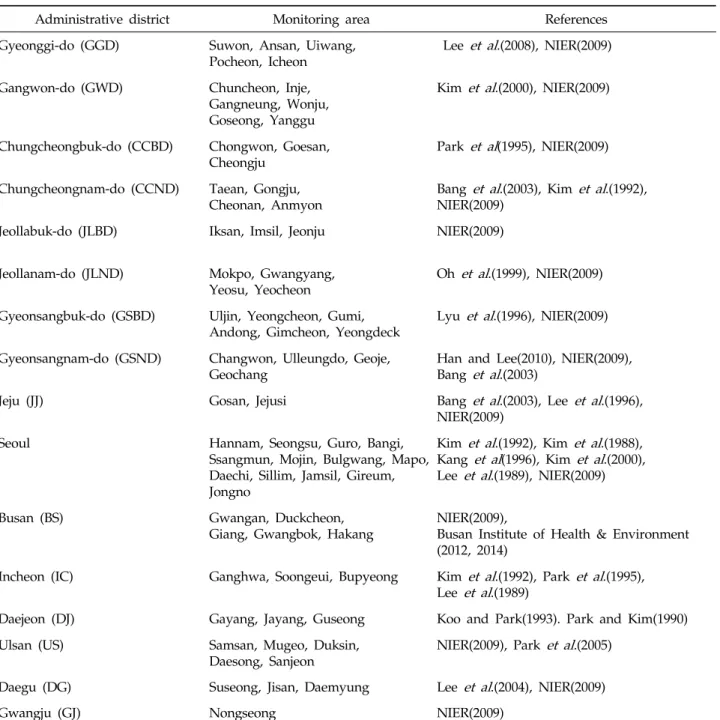
선행 연구는 국내 빗물농도의 산성도 평가 및 원인규명, 각 지역의 시기별 강우 이온농도 특성 분석 등의 목적으로 수 행되었다. 본 연구에서는 선행 연구결과에서 제시하고 있는 강우시의 NO3- 및 NH4+ 농도를 수집하고 지역별 농도를 분 석하였다. 또한, 문헌에서 제시하고 있는 단위의 표시가 상이 한 부분이 있어 수질농도에 적합하도록 mg/L 로 통일하였다 (Table 1).
강우량 수집 및 수질분석
본 연구에서 강우량 관측은 전라북도 완주군 이서면 국립 농업과학원(35°49′45″ N, 127°02′27″E) 내에 위치한 자동강 우채취기를 이용하여 2015년 6월부터 2017년 6월까지 총 74 회 수집하였다. 빗물의 채취는 bulk sampling 방식으로 매 강우마다 채수하였으며, 센서에 강우가 감지되면 자동으로 뚜 껑이 열려 빗물을 채수하는 wet sampling 방식의 강우자동 채취기(SL12021, Shinill Scicnce Co., Korea)를 사용하였다.
강우의 NH4+와 NO3- 농도는 국립농업과학원 농업용용수 수 질분석 실무 매뉴얼(NAS, 2016) 준하여 UV-spectrophotometer 를 이용하여 분석하였다(UV/Vis spectrophotometer, Varian Cary 300, USA). NH4+는 차아염소산 이온의 공존하에서 페놀과 반응하여 생성되는 청색의 Indophenol을 640 nm에서 측정하는 Indophenol법, NO3-는 1N‐HCl로 hydroxide 와 carbonate에 의한 영향을 제거하고 220 nm에서 흡광도를 측 정하는 자외선 흡광광도법으로 측정하였다(NAS, 2016). 대기 중의 질소산화물은 강우와 반응하여 NO3-와 NH4+ 이온으로 형태가 변화되는 것으로 보고되고 있다. 따라서 본 연구에서 T-N 농도는 NH4+ 농도와 NO3- 농도의 합으로 산정하였다.
통계분석
본 연구에서 적용된 강우농도는 각 지역별로 분포가 다양 하게 발생하기 때문에 변동계수를 산정하였다. 변동계수는 표 준편차에 대한 평균값으로서 자료의 표준편차와 분포가 다른 대상을 상호 비교 때 활용이 되며, 10% 미만일 경우 큰 변화 가 없음을 의미하며, 30%를 초과하면 자료의 변화가 큰 것을 의미한다.
CV=(Standard deviation/average) * 100(%)
결과 및 고찰
지역별 NH4+, NO3- 및 T-N 대표 농도 산정
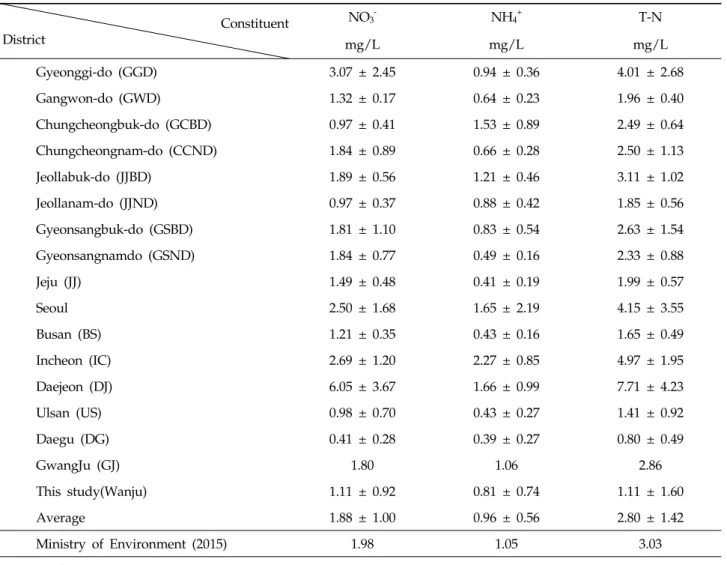
본 연구에서 수집된 선행 연구결과를 종합하여 분석된 지 역별 NO3-의 농도를 살펴보면, 대구광역시에서 0.41±0.28 mg/L로 가장 낮은 값을 보인 반면, 대전광역시에서 6.05±
3.67 mg/L 로 가장 높은 수치를 보였다. NH4+의 경우 제주 도에서 0.41±0.19 mg/L로 가장 낮았으며, 인천광역시에서
Administrative district Monitoring area References Gyeonggi-do (GGD) Suwon, Ansan, Uiwang,
Pocheon, Icheon
Lee et al.(2008), NIER(2009)
Gangwon-do (GWD) Chuncheon, Inje, Gangneung, Wonju, Goseong, Yanggu
Kim et al.(2000), NIER(2009)
Chungcheongbuk-do (CCBD) Chongwon, Goesan, Cheongju
Park et al(1995), NIER(2009) Chungcheongnam-do (CCND) Taean, Gongju,
Cheonan, Anmyon
Bang et al.(2003), Kim et al.(1992), NIER(2009)
Jeollabuk-do (JLBD) Iksan, Imsil, Jeonju NIER(2009)
Jeollanam-do (JLND) Mokpo, Gwangyang, Yeosu, Yeocheon
Oh et al.(1999), NIER(2009) Gyeonsangbuk-do (GSBD) Uljin, Yeongcheon, Gumi,
Andong, Gimcheon, Yeongdeck
Lyu et al.(1996), NIER(2009) Gyeonsangnam-do (GSND) Changwon, Ulleungdo, Geoje,
Geochang
Han and Lee(2010), NIER(2009), Bang et al.(2003)
Jeju (JJ) Gosan, Jejusi Bang et al.(2003), Lee et al.(1996),
NIER(2009)
Seoul Hannam, Seongsu, Guro, Bangi,
Ssangmun, Mojin, Bulgwang, Mapo, Daechi, Sillim, Jamsil, Gireum, Jongno
Kim et al.(1992), Kim et al.(1988), Kang et al(1996), Kim et al.(2000), Lee et al.(1989), NIER(2009)
Busan (BS) Gwangan, Duckcheon,
Giang, Gwangbok, Hakang
NIER(2009),
Busan Institute of Health & Environment (2012, 2014)
Incheon (IC) Ganghwa, Soongeui, Bupyeong Kim et al.(1992), Park et al.(1995), Lee et al.(1989)
Daejeon (DJ) Gayang, Jayang, Guseong Koo and Park(1993). Park and Kim(1990)
Ulsan (US) Samsan, Mugeo, Duksin,
Daesong, Sanjeon
NIER(2009), Park et al.(2005)
Daegu (DG) Suseong, Jisan, Daemyung Lee et al.(2004), NIER(2009)
Gwangju (GJ) Nongseong NIER(2009)
Table 1. Previous study on the classification of nitrogen concentration in rainfall by the administrative district
2.27±0.85 mg/L로 가장 높은 농도를 보였다.
각 지역의 NO3-농도와 NH4+를 평균하여 산정된 평균 농 도는 각각 1.88±1.00 mg/L와 0.96±0.56 mg/L였으며, 이는 환경부에서 제시하고 있는 2015년 전국 NO3-와 NH4+
의 평균 농도 1.98 mg/L와 1.05 mg/L와 비슷하였다.
NO3- 농도와 NH4+ 농도의 합으로 구성된 T-N은 대구광역 시에서 0.80±0.49 mg/L로 가장 낮았고, 대전광역시에서 7.71±4.23 mg/L로 가장 높았다. NH4+의 농도는 서에서 동 으로 갈수록 상대적으로 감소하는 지형적 특성을 보였지만 NO3-농도는 큰 차이를 보이지 않았다(Fig 2). 이와 같은 이 유는 지형적 차이와 지역별 공업의 발달, 교통량, 난방 등 다 양한 요인에 의한 영향으로 보고되고 있다(Bu et al., 2016).
본 연구 지역인 완주군에서 측정된 NO3-와 NH4+ 농도는 각각 1.11±0.92 mg/L와 0.81±0.74 mg/L 였다. 완주군의 차량등록수(30,290대 → 51,072대), 주택(27,391호 → 35,971 호), 산업체수(4,241개 → 6,475개)로 지속적으로 증가하는 것 으로 나타났다. 따라서, 향후 지속적인 강우모니터링을 통한 수질자료 구축과 사회적변화(인구수, 차량등록대수, 산업체수, 토지이용면적)에 따른 강우 농도변화 요인분석을 위한 연구 가 필요하다.
강우에 의한 하천의 수질의 영향을 분석하기 위해서는 강 우의 질적 ․ 양적 변화에 대한 분석이 중요하다(Seo와 Fang.
2012). SWAT 모델과 APEX 모델에서 제시되고 있는 강우 의 질소 농도는 각각 1.0 mg/L와 0.77 mg/L로 본 연구결
(a) (b)
Fig. 1. Rainfall measurement and collection equipment located in national academy of agricultural science in wanju, Korea.
(a) NH4+
(b) NO3-
(c) T-N Fig. 2. The NO3-
, NH4+
, T-N concentrations by administrative district in Korea.
과에서 산정된 농도값과 큰 차이를 보였다. 국내의 10년 평균 강수량이 1446.3 mm 이고(Choi et al., 2015), 평균 T-N 농도 가 2.84 mg/L이면 강우에서 지면으로 공급되는 질소부하량 은 41.1 kg/ha가 공급되고 T-N 농도가 1.15 mg/L 이면 16.6 kg/ha가 공급이 된다. 따라서, 강우량과 T-N 농도의 차이로 인해 수계로 유입되는 T-N 부하량은 변화되므로 모델링 통한 강우 유출수의 T-N 부하량 평가시 관측 강우 농도 반영이 요 구된다.
지역별 NH4+, NO3- 및 T-N 농도의 변동성 분석 NO3-
, NH4+와 T-N 농도의 변동계수를 살펴보면, NO3-는 강원도에서 12.9%로 안정적인 변화를 보인 반면, 본 연구지
역인 전라북도 완주군의 변동계수가 83.3%로 가장 크게 나타 났다. NH4+의 경우 서울에서 133.1%로 변동계수가 가장 크 게 나타났으며, 다른 행정구역에서는 30%이상의 변동계수를 보였다. T-N은 강원도가 20.1%, 충청북도 25.6%, 전라남도 29.9%, 부산 29.6%로 변동계수가 30% 이하로 안정적인 변화 를 보였지만, 서울과 전라북도 완주군에서 80% 이상의 큰 변 동을 보였다(Fig. 3). 일반적으로 변동계수가 10이하이면 안정 적인 변화를 보이는 것으로 판단하며, 30 이상일 경우 국내/
외의 다양한 원인으로 질소농도의 변화가 큰 것으로 판단할 수 있다. 국내의 질소농도 변화의 원인으로는 전라북도의 경 우 NO3-농도가 변동성이 큰 이유는 7개 시군에서 관측된 강 우시 질소농도 자료로써 공장과 인구밀도가 높은 전주와 완
Constituent District
NO3-
NH4+
T-N
mg/L mg/L mg/L
Gyeonggi-do (GGD) 3.07 ± 2.45 0.94 ± 0.36 4.01 ± 2.68
Gangwon-do (GWD) 1.32 ± 0.17 0.64 ± 0.23 1.96 ± 0.40
Chungcheongbuk-do (GCBD) 0.97 ± 0.41 1.53 ± 0.89 2.49 ± 0.64
Chungcheongnam-do (CCND) 1.84 ± 0.89 0.66 ± 0.28 2.50 ± 1.13
Jeollabuk-do (JJBD) 1.89 ± 0.56 1.21 ± 0.46 3.11 ± 1.02
Jeollanam-do (JJND) 0.97 ± 0.37 0.88 ± 0.42 1.85 ± 0.56
Gyeonsangbuk-do (GSBD) 1.81 ± 1.10 0.83 ± 0.54 2.63 ± 1.54
Gyeonsangnamdo (GSND) 1.84 ± 0.77 0.49 ± 0.16 2.33 ± 0.88
Jeju (JJ) 1.49 ± 0.48 0.41 ± 0.19 1.99 ± 0.57
Seoul 2.50 ± 1.68 1.65 ± 2.19 4.15 ± 3.55
Busan (BS) 1.21 ± 0.35 0.43 ± 0.16 1.65 ± 0.49
Incheon (IC) 2.69 ± 1.20 2.27 ± 0.85 4.97 ± 1.95
Daejeon (DJ) 6.05 ± 3.67 1.66 ± 0.99 7.71 ± 4.23
Ulsan (US) 0.98 ± 0.70 0.43 ± 0.27 1.41 ± 0.92
Daegu (DG) 0.41 ± 0.28 0.39 ± 0.27 0.80 ± 0.49
GwangJu (GJ) 1.80 1.06 2.86
This study(Wanju) 1.11 ± 0.92 0.81 ± 0.74 1.11 ± 1.60
Average 1.88 ± 1.00 0.96 ± 0.56 2.80 ± 1.42
Ministry of Environment (2015) 1.98 1.05 3.03
※ mean±SD
(a) NH4+
(b) NO3-
(c) T-N Fig 3. The coefficient of variation by administrative district in Korea.
Table 2. Representative nitrogen concentration in Korea for nonpoint source model application
주지역에서 농도가 높게 나타나며, 상대적으로 오염원이 적은 무주, 장수 등은 낮게 나타나기 때문으로 사료된다. 또한, 서 울과 경기도의 경우 타 행정구역에 비해 자동차 등록 대수 및 통행량이 많기 때문에 대기 중의 NO2의 농도가 시기별로 다 르게 나타나며(NIER, 2016) 대구광역시의 경우 고정배출원인 주거지역의 질소산화물 배출의 꾸준한 증가와 차량증가로 인 한 교통량의 증가로 인한 이동 배출원이 증가했기 때문에 질 소농도의 변동이 큰 것으로 사료된다(NIER, 2016). 또한, 국 내의 대기 중 질소산화물은 중국 고비와 내몽골에서 유입되 는 연무와 황사의 영향을 받는다. 황사 발생시에는 토양기원 염기성 물질과 질소산화물이 반응하여 NH4+는 낮아지는 현 상을 보이는 반면, 연무 발생시에는 NO3-와 NH4+ 농도 모두 증가하는 것으로 나타났다(Ko et al., 2016).
적 요
본 연구에서는 비점오염 모델에 강우의 질소 농도를 현실 적으로 반영하기 위하여 국내 문헌과 3년 동안 관측한 강우 질소 농도를 분석하여 1개시(서울시), 9개도(경기도, 강원도, 충청남/북도, 전북남/북도, 경상남/북도, 제주도) 6개 광역시 (부산, 인천, 대전, 울산, 대구, 광주)의 강우시 NO3-, NH4+ 및 T-N의 대표 농도를 제시하였다. NO3-와 NH4+의 평균 농도는 각각 1.88 mg/L와 0.96 mg/L 였으며, T-N은 2.84 mg/L 였 다. 이는 환경부에서 제시하고 있는 2015년 전국 NO3-와 NH4+의 평균 농도인 1.98 mg/L와 1.05 mg/L와 비슷한 것 으로 나타나 본 연구에서 제시된 각 행정구역별 농도는 타당 한 수치로 사료된다. 본 연구결과 행정구역별로 질소농도의 차이가 있는 것으로 나타나 해당지역에 적합한 질소농도의 적용이 필요한 것으로 나타났다. 따라서 비점오염 모델 적용 시 다양한 구축자료(수문인자, 지형인자 및 영농활동 인자 등) 와 더불어 모델 적용지역의 강우 특성을 적절히 반영하여 오 염부하량을 추정하는데 활용이 가능할 것으로 판단된다.
Note
The authors declare no conflict of interest.
Acknowledgement
This study was carried out with the support of
“Research Program for Agricultural Science & Technology Development (Project No. PJ012549)”, National Institute of Agricultural Sciences, Rural Development Adminstration, Republic of Korea.
References
Back, J. H., Jang, B. K., & Kim, D. H. (1993). Rain acidity (pH) by air pollutants and meteorological factors in Taegu and Kumi Area. Environmental Science &
Technology Institute, 7, 209-219.
Bang, S. Y., Choi, J. C., Park, S. S., Cho, K. S., & Oh, S. N.
(2003). A study on the properties of ionic components in precipitation at background area of the Korean peninsula. Journal of Korean Meteorological Society, 39(1), 29-41.
Bu, J. O., Song, J. M., Shin, S. H., Kim, W. H., & Kang, C.
H. (2016). Ionic composition and pollution characteristics of precipitation in Jeju Island during 2009-2014.
Analytical Science and Technology, 29(1), 19-28.
Choi, D. H., Jung, J .W., Yoon, K. S., Choi, W. J., Cho, S.
H., Beom, J. A., & Yoo, S. W. (2015). Comparison of unit load from paddy field by various estimation methods. Journal of Environmental Impact Assessment, 24(5), 407-419.
Han, C. B., & Lee, T. S. (2010). Seasonal variation and storage period rainwater quality in Changwon. Journal of Korean Society of Environmental Engineers, 32(5), 461-468.
Jung, J. W., Cho, S. H., Lim, B. J., Oh, T. Y., Ham, S. I.,
& Kim, K. S. (2012). Evaluation of the possibility of daily flow data generation from 8-day interval measured flow data using SWAT-CUP. Journal of Korean Society on Water Environment, 28(4), 595-600.
Jung, J. W., Yoon, K. S., Joo, S. H., Choi, W. Y., Lee, Y.
W., Rhew, D. H., Lee, S. W., & Chang, N. I. (2009).
Estimation of pollutant loads delivery ratio by flow duration using regression equation in Hwangryong A Watershed. Journal of the Korean Society of Agricultural Engineers, 51(6), 25-31.
Kang, C. H., Hong, S. B., Kim, W. H., Ko, H. J., Lee, S.
B., & Song, J. M. (2006). Study on acidification and neutralization characteristics of precipitation in Jeju city between 1997 and 2005. Journal of Korean Society for Atmospheric Environment, 22(4), 487-498.
Kang, G. U., Chun, C. N., & Kim, H. K. (1996). Interpretation of chemistry analytical data in precipitation. Korean Journal of Environmental Health Sciences, 22(4), 62-68.
Kang, H. S., Ryu, J. C., Kang, H. S., Choi, J. W., Moon, J.
P., Choi, J. D., & Lim, K. J. (2012). Enhancement and application of SWAT auto-calibration using Korean Ministry of Environment 8-day interval flow/water quality data. Journal of Korean Society on Water Environment, 28(2), 247-254.
Kim, J. H., Yu, M. J., & Park, S. B. (1988). The ionic composition of rainwater to implicate acidification.
Journal of Korean Society of Environmental Engineers, 10(3), 3019-3027.
Kim, J. S., Kang, I. G., & Chang, S. K. (1992). Evaluation
of acid rain through the scavenging theory and application of trajectory model. Journal of Korean Society for Atmospheric Environment, 8(2), 121-127.
Kim, J. Y., Chun, Y. S., Cho, H. M., Choi, J. C., Nam, J.
C., & Kim, S. (2000). Neutralization of precipitation by alkaline ions in urban and rural area. Journal of Korean Meterological Society, 36(1), 15-24.
Kim, M. K., Kwon, S. I., Jung, G. B., Hong, S. C., Chae, M. J., Yun, S. G., & So, K. H. (2013a). Small-scale pond effects on reducing pollutants load from a paddy field.
Korean Journal of Environmental Agriculture, 32(4), 355-358.
Kim, M. K., Hong, S. C., Lee, J. S., Jung, G. B., Kwon, S.
I., Chae, M. J., Yun, S. G., & So, K. H. (2013b).
Chemical properties and nutrient loading of rainwater during farming season. Korean Journal of Soil Science and Fertilizer, 46(5), 386-390.
Ko, B. G., Kim, M. K., Lee, J. S., Kim, G. Y., Park, S. J., Kwon, S. I., Jung, G. B., & Lee, D. B. (2010). Chemical properties and nutrient loadings of rainwater during farming season. Korean Journal of Soil Science and Fertilizer, 43(5), 578-583.
Ko, H. J., Song, J. M., Cha, J. W., Kim, J. E., Ryoo, S. B., &
Kang, C. H. (2016). Chemical composition characteristics of atmospheric aerosols in relation to haze, asian dust and mixed haze-asian Dust episodes at gosan site in 2013. Journal of Korean Society for Atmospheric Environment, 32(3), 289-304.
Koo, J. K. & Park, K. L. (1993). A study on the chemical caracteristics of acid rain in Taejon City. Journal of Korean Society for Atmospheric Environment, 9(2), 147-153.
Kwon, Y. S., & Huh, W. B. (1993). Studies on the present state of acid precipitation in Wonju area. Journal of the Korean Meteorology Society, 29(2), 127- 132.
Lee, H. W., Choi, N. H., Lee, Y. S., & Choi, J. H. (2011).
Estimation of pollutants loading from non-point sources based on rainfall event and land use characteristics.
Journal of Korean Society of Environmental Engineers, 33(8), 572-577.
Lee, J. S., Kim, J. H., Jung, G. B., Kim, M. K., Yun, S. G.,
& Kwon, S. I. (2008). Chemical Characteristics of Rainwater in Suwon. Korean Journal of Environmental Agriculture, 27(3), 239-244.
Lee, K. H., & Hu, C. G. (1996). Chemical characterization of rainwater sampled in Cheju City. Journal of the Korean Environmental Sciences Society, 5(6), 739-748.
Lee, M. H., Han, J. S., Han, E. J., & Shim, C. K. (1989). A Study on the chemical composition of precipitation
during the period of sandy dust phenomena. Journal of Korean Society for Atmospheric Environment, 5(2), 1-11.
Lee, W. H., Lee, J. H., Park, J. H., & Choi, H. S. (2016).
The relationship between parameters of the SWAT model and the geomorphological characteristics of a watershed. Ecology and Resilient Infrastructure, 3(1), 35-45.
Lee, S. H., Song, H. B., & Jung, D. S. (2004). The Chemical and microbiological characteristics of rainfall in Daegu area. Journal of Korean Society of Environmental Engineers, 26(8), 853-860.
Lyu, S. G., Kwon, O. I., Bae, K. S., & Sur, G. S. (1996). A study on the chemical characteristics of acid rain at Youngchun and Kumi Area in Kyongbuk Province.
Journal of Korean Society of Environmental Engineers, 18(9), 1115-1124.
Oh, G. Y., Yang, S. I., & Lee, W. J. (1999). A Study on ion distribution and behavior of acid rain in Mokpo and Yeochon area. Journal of Korean Society for Atmospheric Environment, 15(4), 385-392.
Oh, G. Y., Yang, S. I., & Lee, W. J. (1999). A study on ion distribution and behavior of acid rain in Mokpo and Yeochon Area. Journal of Korean Society for Atmospheric Environment, 15(4), 385-392.
Oh, Y. T., Park, J. C., Kim, D. S., & Rhyu, J. K. (2004).
Pollutant characteristics of nonpoint source runoff in Okcheon stream. Journal of Korean Society on Water Environment, 20(6), 657-663.
Park, J. K., & Hwang, Y. S. (1997). The characteristics of chemical components and acidity in the precipitation at Kimhae area. Journal of the Korean Environmental Sciences Society, 6(5), 461-472.
Park, K. L., & Kim, D. S. (1990). A Study on ion concentration change of acid rain by the succeeding rainfall. Korean Journal of Environmental Health Society, 16(2), 11-20.
Park, K. T., Moon, G. E., Heo, J. G., & Hong, H. B. (1995).
A Comparative Study on the Chemical Compositions of Precipitations in Sungnam City of Kyunggi Province, Inchon City, Kangneung City of Kangwon Province, and Chongwon-gun of Chungbuk Province. Journal of Environmental Science International, 4(3), 133-133.
Roh, S. D., Kim, J. H., Lee, D. K., Kim, S. J., Sohn, B. Y.,
& Chun, Y. K. (2006). Characteristics of pollutants discharge from Hoengseong watershed during the dry and rainy seasons. Journal of Korean Society on Water Quality, 22(4), 67-77.
Seo, D. I., & Fang, T. H. (2012). Application of Automatic
Stormwater Monitoring System and SWMM Model for Estimation of Urban Pollutant Loading During Storm Events. Journal of Korean Society of Environmental Engineers, 34(6), 373-381.
Shin, D. S. (2007). Basic monitoring concept for revised unit-load on NPS. Journal of Korean Society on Water
Quality, 23(4), 429-433.
Yang, S. I., Gang, G. S., Park, C. O., Hong, S. S., Yang, J.
K., & Oh, G. Y. (1996). Studies on the acidity and the distribution of inorganic ions of precipitation in Chonnam area (II). Korean Society for Atmospheric Environment, 39-40.