Print ISSN: 2288-4637 / Online ISSN 2288-4645 doi:10.13106/jafeb.2020.vol7.no10.591
The Effect of Exchange Rates and Interest Rates of Four Large Economies on the Health of Banks in ASEAN-3
Rudi PURWONO
1, Jopie TAMTELAHITU
2, M. Khoerul MUBIN
3Received: July 30, 2020 Revised: August 23, 2020 Accepted: September 10, 2020
Abstract
This study examines how the health of the banks in ASEAN-3 countries namely Indonesia, Malaysia and Thailand respond to the change in exchange rates and foreign interest rates in four large economies. The transmissions of the two external factors through domestic factors in each ASEAN-3 countries eventually affects Non-Performing Loan (NPL) of commercial banks. This study uses the monthly time series data and the renowned Structural Vector Autoregressive (VAR) model comprising five variables, namely exchange rate, foreign interest rate, domestic interest rate, money supply, and non-performing loan (NPL). The results indicate that there are different effects between ASEAN-3 countries, which can be classified as short-run effect and long-run effect. In the long run effect, external factors have a dominant role in determining NPL in ASEAN-3 countries. Yuan has the biggest effect on Malaysia’s NPL, while Indonesia is more affected by European interest rates rather than the fluctuation of the US currency and China’s interest rates. Among ASEAN-3 countries, Malaysia is the one that is the most vulnerable to external factors. While Thailand’s NPL is affected dominantly by domestic factors. This study shows that the Fed Funds Rate (US official interest rate) is not always the dominant factor affecting the health of domestic banks in ASEAN-3.
Keywords: Exchange Rates, Interest Rates, Non-Performing Loan, ASEAN, Structural VAR JEL Classification Code: E42, E43, E51, E52, G21
one of which is the Non-Performing Loan (NPL) indicator.
The ratio of bad loans (NPL) is very important, not only for banks but also for the country’s economy. The existence of a banking crisis that can cause a country’s economic crisis can be detected from the development of bank NPLs in that country (Castro, 2013; Reinhart & Rogoff, 2011).
Performance of NPLs (both decreasing and increasing) is influenced by many external factors beyond the ability of the bank itself. NPL is also influenced by the macroeconomic development of a country such as GDP growth, exchange rates, and loan interest rates (Beck et al. 2013). Zaidi et al.
(2013) in their research states that there is an influence of macroeconomic variables abroad (US and Japan) and also macroeconomic variables in the country on the NPL. The world economy is currently running within the framework of globalization, everything goes beyond the border. A country’s economy is interrelated with the economy of another country If there is one economic variable changes in a country, it will have an impact also in other countries’
economies, which can therefore, affect the world economy as a whole. Trade and capital flows are the transmissions that can change a country’s economy due to the policies in other countries.
1. Introduction
The flow of funds in the financial system and the economy must be ensured to run smoothly and efficiently (Mishkin, 2015). Banks play an important role in a country’s economy.
Banks have the main task of channeling funds in the form of loans to the public to make investments. If banks in a country are unstable, they can affect the distribution of income and ultimately increase inequality (Agnello & Sousa, 2012).
Bank stability can be assessed from the level of bank health,
1
First Author and Corresponding Author. Associate Professor, Department of Economics, Faculty of Economics and Business, Universitas Airlangga, Indonesia [Postal Address: Jalan Airlangga Nomor 4, Gubeng, Surabaya, 60286, Indonesia]
Email: [email protected]
2
Department of Economics, Universitas Airlangga, Indonesia.
Email: [email protected]
3
Department of Economics, Universitas Airlangga, Indonesia.
Email: [email protected]
© Copyright: The Author(s)
This is an Open Access article distributed under the terms of the Creative Commons Attribution Non-Commercial License (https://creativecommons.org/licenses/by-nc/4.0/) which permits unrestricted non-commercial use, distribution, and reproduction in any medium, provided the original work is properly cited.
In 2015, Rupiah weakened sharply to Rp 13,850 per US dollar. This value is considered to have exceeded the psychological limit of the Rupiah’s exchange rate, which should have been the highest value of only Rp. 13,500 per US dollar. Pressure on the Rupiah against the US Dollar is influenced by many things such as Indonesia’s trade policy, the Fed’s policy of raising the Fed Fund Rate in the US, and economic policies taken by big economy countries such as China, Japan and the European Union.
The weakening of the Rupiah had an impact on the performance of the banking industry at that time. The banking sector performance report in the second quarter of 2015 showed an increase in the ratio of bad loans or NPL.
The weakening condition of the rupiah was exacerbated by the high interest rates and high inflation, causing one of them to increase the NPL at that time (Chavez, 2020).
This study aims to analyze the effect of exchange rates and interest rates on the 4 developed countries (US, EU, Japan and China) on the ratio of bad credit in ASEAN-3 (Indonesia, Malaysia, and Thailand). The effect of changes in exchange rates and interest rates in developed countries is transmitted on domestic macroeconomic variables, which in turn affect the level of bank NPLs in ASEAN-3. This study contributes to the existing literature in two aspects. First this study covers 3 countries in ASEAN (Indonesia, Malaysia, and Thailand) so we can compare different responses from each country. Second, because of the interconnectedness of the world economy, it is important to analyze the extent of the linkages of economic activities with the 4 developed countries which are the engine of the world economy, namely the US, European Union (EU), Japan and China on banking activities in ASEAN countries. Currently, the world economy is becoming increasingly dynamic, where the exchange rate is one of the instruments that become the advantage in trading.
By using the Structural VAR model, analysis can be done by looking at the short-term and long-term results.
2. Literature Review
There are several studies on the relationship between macroeconomic variables, namely, interest rates and changes in exchange rates, to that of the health of banks in terms of the ratio of bad loans. Taiwo and Adesola (2013) in their research on banks in Nigeria found that exchange rate fluctuations can affect the ability of the public to establish or increase the ratio of bad credit. Vogiazas and Nikolaidou (2011) found that macroeconomic variables namely construction and investment expenditure, inflation, unemployment, and foreign debt are related to the development of GDP and the money supply (M2) influences credit risk in Romanian banks. In addition, his research also found that the crisis experienced by neighboring Romania, especially Greece, also affected increasing credit risk in Romania.
Louzis et al. (2012) conducted a study using the dynamic panel data method to determine the determinants of NPL in the Greek banking sector. The results of the study show that for all control variables in the form of macroeconomic variables namely GDP growth, unemployment rates, interest rates, public debt affect the NPL ratio for all loan categories.
In addition, the bank’s quality management variable also influences the Greek banking NPL ratio.
Research on the relationship between the development of macroeconomic variables and NPL ratios was also conducted in Malaysia (Alizadeh Janvisloo et al., 2013; Lee
& Wang, 2018). In Malaysia, demand and supply shocks have negatively affected NPLs while changes in monetary policy instruments have a positive effect on NPLs (Alizadeh Janvisloo et al., 2013). Rachman et al. (2018) studied the effect of bank-specific factors on NPLs in developing countries.
The results show that Indonesian Bank’s profitability and credit growth negatively influenced the number of NPLs.
Beck et al. (2013) used panel data to examine the determinants of bad loans in 75 countries. Real GDP, exchange rates, and loan interest rates are variables that significantly affect NPLs. For the exchange rate variable, the direction of the impact depends on whether foreign currency loans in the country have a hedging scheme or not, as well as several other matters relating to the regulation of the use of currency systems in the country. Skarica (2014) analyzes the determinants of increasing NPL ratios in European countries. The results show that the NPL increase was significantly caused by slowing economic growth in the region, as well as high unemployment and inflation. Nkusu (2011) also examined the macroeconomic development in relation to NPLs in developing countries. The results also show the same thing that the performance of macroeconomic variables is a determinant of the banking NPL ratio in the country. The research also concluded that the friction found in the credit market caused the country in macroeconomic research to be vulnerable. An increase in NPL in the long run, can hamper economic growth. Banna et al. (2017) examined the effect of the global financial crisis on the efficiency of Bangladesh commercial banks. The study revealed that the crisis period in conjunction with real interest rate has significantly affected the efficiency of commercial banks in Bangladesh.
3. Methodology
This study uses secondary data obtained from various sources. Data was obtained from each of the websites of the central banks of the countries that were the subjects of the study (Bank Indonesia, Bank Negara Malaysia, and Bank of Thailand). And also using data from US Forex (www.usforex.com), the Fed (https://fred.stlouisfed.org), and Quandl (www.quandl.com). The observation period starts from 2003 to 2014 each month. Therefore, the total number of observations in this study is 144 observations.
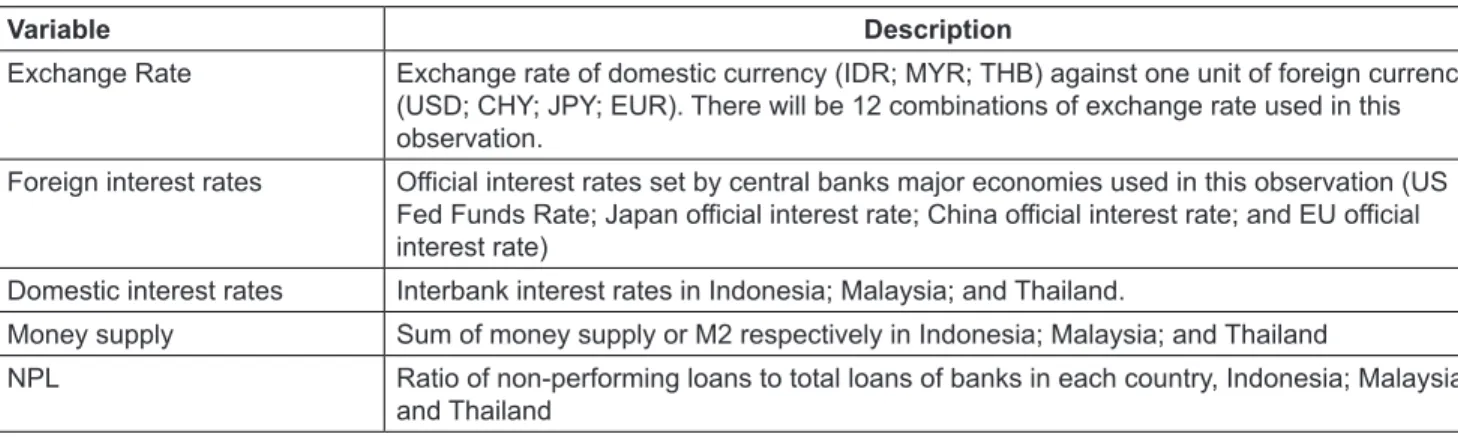
The following variables used in this study (see Table 1).
This research uses a structural VAR mode to be able to do the analysis. Changes in interest rates in a country is related to the country’s efforts to maintain economic balance through its monetary policy in the country. The simultaneous equations of the model can be written as equation (1) below.
10 11 12 13
1 1 1
14 15 1,
1 1
. . .
. .
p p p
ij ij j i
t t n t n t n
n n n
p p
i i
t n t n t
n n
le a a le a r a lm
a r a npl e
− − −
= = =
− −
= =
= + + +
+ + +
∑ ∑ ∑
∑ ∑
20 21 22 23 24
1 1 1
25 26 2,
1 1
. . . .
. .
− − −
= = =
− −
= =
= + + + +
+ + +
∑ ∑ ∑
∑ ∑
p p p
j ij ij j i
t t t n t n t n
n n n
p p
i i
t n t n t
n n
r a a le a le a r a lm
a r a npl e
30 31 32 33 34
1 1
35 36 37 3,
1 1 1
. . . .
. . .
− −
= =
− − −
= = =
= + + + +
+ + + +
∑ ∑
∑ ∑ ∑
p p
i ij j ij j
t t t t n t n
n n
p p p
i i i
t n t n t n t
n n n
lm a a le a r a le a r
a lm a r a npl e
40 41 42 43 44
1
45 46 47
1 1 1
48 4,
1
. . . .
. . .
.
−
=
− − −
= = =
−
=
= + + + +
+ + +
+ +
∑
∑ ∑ ∑
∑
i ij j i p ij
t t t t t n
n
p p p
j i i
t n t n t n
n n n
p i
t n t
n
r a a le a r a lm a le
a r a lm a r
a npl e
50 51 52 53 54
1 1
55 56 57 5,
1 1 1
. . . .
. . .
− −
= =
− − −
= = =
= + + + +
+ + + +
∑ ∑
∑ ∑ ∑
p p
i i i ij j
t t t t n t n
n n
p p p
i i i
t n t n t n t
n n n