Korean J. Breed. Sci. 53(1):60-68(2021. 3) https://doi.org/10.9787/KJBS.2021.53.1.60
고단백 내탈립 장류용 콩 품종 ‘하이프로’
김지민
1
⋅신일섭1
⋅박수권2
⋅최만수2
⋅이정동3
⋅하보근4
⋅이주석5
⋅강양제6
⋅정순천5
⋅문중경2
⋅강성택1*
1
단국대학교 생명공학대학 생명자원학부,2
국립식량과학원,3
경북대학교 농업생명과학대학 응용생명과학부,4
전남대학교 농업생명과학대학 응용식물학과,5
한국생명공학연구원 바이오평가센터,6
경상대학교 자연과학대학 생명과학부Soybean Cultivar ‘Hipro’ for Tofu and Soymilk with High Seed Protein Content and Pod Shattering Resistance
Ji-Min Kim
1
, Ilseob Shin1
, Soo-Kwon Park2
, Man Soo Choi2
, Jeong-Dong Lee3
, Bo-Keun Ha4
, Juseok Lee5
, Yang Jae Kang6
, Soon-Chun Jeong5
, Jung-Kyung Moon2
, and Sungteag Kang1*
1 Department of Crop Science and Biotechnology, Dankook University, Cheonan, 31116, Republic of Korea
2 National Institute of Crop Science, Rural Development Administration, Wanju, 55365, Republic of Korea
3 School of Applied Biosciences, Kyungpook National University, Daegu, 41566, Republic of Korea
4 Department of Applied Plant Science, Chonnam National University, Gwangju, 61186, Republic of Korea
5 Bio-Evaluation Center, Korea Research Institute of Bioscience and Biotechnology, Cheongju, 28116, Republic of Korea
6 Division of Life Science Department at Gyeongsang National University, Jinju, 52828, Republic of Korea
Abstract A yellow soybean cultivar called ‘Hipro’ was developed using the single seed descent (SSD) method by crossing ‘Saedanbaek’
(SS92414 × MD87L) and ‘Daepung’ (Baekwon × Sinpaldal2). A preliminary yield trial (PYT), advanced yield trial (AYT), and regional yield trial (RYT) were conducted in three regions. ‘Hipro’ has a determinate growth habit, white flowers, and a spherical seed shape. In the regional yield trial, the flowering and maturity dates of ‘Hipro’ were August 4 and October 17, respectively, and the 100-seed weight was 22.2 g, which was lower than that of Daewon (26 g). Additionally, ‘Hipro’ showed resistance to lodging, soybean mosaic virus (SMV), bacterial blight, and pod shattering. The seed protein content of ‘Hipro’, which was of particular interest in this study, was 53.9%, which was higher than that of ‘Daepung’ (41.5%), and the total amino acid content without tryptophan was 43.6%, 19% higher than that of ‘Daepung’. The mean yield of ‘Hipro’ in RYT was 2.23 ton/ha, which was 91.3% of the yield of ‘Daewon’. However, ‘Hipro’ showed an 11% higher yield than Daewon in Paju. As a result of the tofu characteristic test, 'Hipro' is suitable for making soy milk and tofu due to its high solid content (12.67 Brix) and protein content (13.68%) and high yield (325%) of tofu. Overall, ‘Hipro’ had high protein content, excellent processing quality for tofu and soy milk, and strong resistance to disease and pod shattering that will greatly contribute to the consumption of soybeans in Korea. (Registration No. 7735).
Keywords soybean, soymilk, tofu, cultivar
Received on February 9, 2021. Revised on February 11, 2021. Accepted on February 19, 2021.
* Corresponding Author (E-mail: [email protected], Tel: +82-41-550-3621, Fax: +82-41-569-7881)
서 언
콩[Glycine max. (L.) Merr]은 한반도 북부가 원산지인 작물로 전세계적으로 식용, 사료용, 산업용 원료 등 여러가지 용도로 이용되고 있는 주요 두과작물 중 하나이다. 우리나라에서는 과거 부터 주로 두부, 장류, 콩나물 등 전통가공식품의 원료곡으로 소비되어 왔으며, 주식인 쌀의 부족한 영양분을 채워주는 역할을 해왔다(Medic et al. 2014). 간장, 된장, 고추장, 두부, 콩나물, 두유 등 다양한 식품의 원료로 이용하고 있는데 이러한 다양한
용도는 사람들의 일상 생활에서 조미료로 중요한 위치를 차지하 며 많은 반찬에 사용되고 있다. 또한 임상 연구를 통해 이러한 제품들이 암 및 당뇨병 치료에 효과가 있고 비만 및 변비를 예방하는 능력과 같은 많은 건강상의 이점이 있음이 입증되었다(Shin &
Jeong 2015).
콩의 국내 재배면적과 생산량은 2013년 8만ha, 15만 4천톤에 서 2019년 5만 8천 ha, 10만 5천톤으로 감소하였으나 2017년 이후 논 타작물 재배지원사업 영향으로 다시 증가하는 추세이며, 자급률 또한 2008년 29.6%에서 2019년 26.7%으로 비슷한 변화
를 보이는 실정이다(MAFRA 2020). 농업관측본부 소비자 패널 조사에 따르면 국내 콩 소비자들은 수입산 콩의 안정성에 대한 우려로 국산콩에 대한 선호도는 높은 반면 국산콩의 비싼 가격으 로 인해 구매율이 저조한 것으로 조사되었다(KREI 2019). 콩의 생산량과 자급률 향상을 위해 수입콩과 비교해 높은 품질 경쟁력 과 더불어 재배 안정성이 확보된 품종 개발이 필요하다.
농촌진흥청에서 개발된 장류콩들을 살펴보면 1990년대 후반 에 고단백 계통인 ‘단백콩’(Kim et al. 1996)이 있었으며, 이후 현재까지 국가보급종으로 가장 많이 사용되는 ‘대원콩’(Kim et al. 1998)이 개발되었다. 2000년대 초반에는 조숙종 대립종인
‘다올’(Baek et al. 2003)과 모자이크 바이러스 저항성인 ‘진미’
(Suh et al. 2003)를 비롯한 ‘장원’(Lee et al. 2003), ‘대망’(Yun et al. 2005), ‘선유’(Baek et al. 2005), ‘대망2호’(Yun et al. 2006),
‘만수’(Kim et al. 2007) 등이 개발되었다. 특히 2005년에 내도복 성, 콩 모자이크바이러스병, 불마름병에 내성을 가지며 다수성인
‘대풍’(Park et al. 2005)콩이 개발되었으며 이 품종은 2009년 대한민국 우수품종상에서 대통령상에 선정되었다. 2000년대 후 반 분자표지선발(Marker assisted selection)을 이용해 콩모자이 크병 저항성 품종 ‘신강’(Lee et al. 2009)이 개발되었으며, 노동 력 절감을 위한 기계화 적응성 품종인 ‘남풍’(Kim et al. 2010b)이 있었고 2010년대 초반에는 ‘대양’(Kim et al. 2010a), ‘천상’(Kim et al. 2012) 등이 개발되었다. 2014년 단백질함량이 높은 계통인
‘새단백’(Kim et al. 2014)이 개발되었으며, 이후에는 이모작을 위한 조숙종인 ‘황금올’(Ko et al. 2016a), ‘한올’(Ko et al. 2016b),
‘참올’(Ko et al. 2018)과 품종과 기계화 적응성 높은 ‘우람’(Ko et al. 2016c), ‘새금’(Kim et al. 2019a)과 재배안정성과 수량이 높은 ‘선풍’(Kim et al. 2017)과 ‘늘찬’(Kim et al. 2019b)이 개발되었다.
다양한 국산콩과 수입콩이 유통되면서 품종판별은 육종가의 권리 보호를 위해 중요한 요소가 되었다. DUS (Distinctiveness, Uniformity, Stability) 검정은 전통적으로 품종의 경장, 엽형, 화색, 성숙기 등 형태학적 기준으로 실시하였으나 이러한 방법은 시간과 비용이 많이 들고 많은 토지와 숙련된 인력이 필요하며 결정적으로 주관적인 판단이 필요하다(Cooke 1995). 현재까지 연구자들은 이러한 단점을 보완하기 위해 분자 마커를 적용한 DUS 검정법을 개발하는데 노력해왔다(Jamali et al. 2019). 최근 새로운 NGS (Next Generation Sequencing) 플랫폼의 출현으로 Simple Sequence Repeat (SSR), Single Nucleotide Polymorphism (SNP) 및 Insetion/Delection (InDels)마커를 품종판별마커로 활발하게 사용하고 있다(Sohn et al. 2017, Achard et al. 2020,
Zhang et al. 2020).
단국대학교 작물분자육종실험실에서는 현재 개발된 품종 중 가장 단백질 함량이 높은 새단백과 재배안정성 우수한 대풍을 교배하여 재배안정성이 높은 고단백 계통을 개발하였다. 개발된 계통의 두부 가공특성을 평가하여 매우 우수한 결과를 확인하고
‘하이프로’라는 이름으로 품종 출원하였고, SNP 마커를 활용한 유전체 정보를 확보하여 품종판별(DUS) 마커를 확보하였다.
본 논문에서는 ‘하이프로’ 품종의 고유특성 및 재배특성 및 가공 특성 등에 대해 소개하고자 한다.
재료 및 방법
품종육성과정
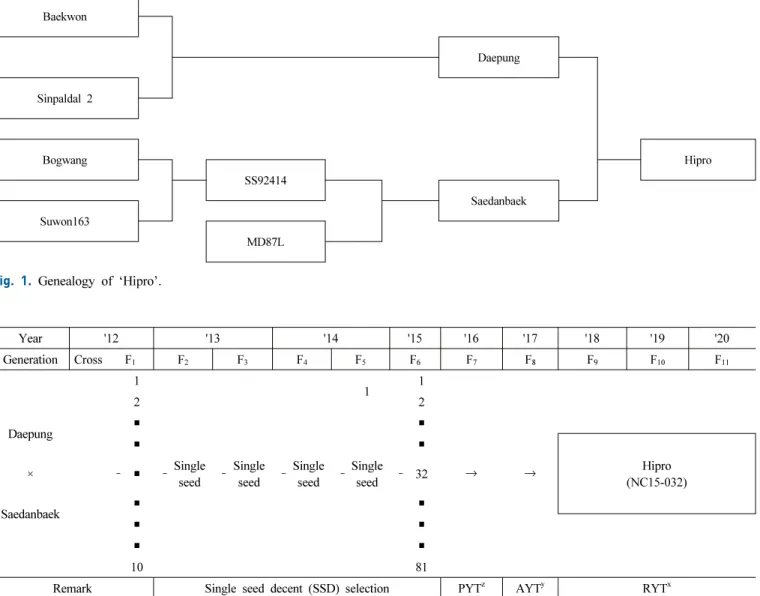
‘하이프로’는 단백질 함량이 높고 내탈립성을 갖춘 콩 품종 개발을 목적으로 병에 강하고 내탈립성이며 수량성이 높은 ‘대 풍’콩을 모본으로 단백질함량이 높은 새단백을 부본으로 2012년 에 단국대학교 시험포장에서 인공교배 하였다(Fig. 1). 생산된 F
1
종자는 2012-2013 동계기간 동안 온실에 심어져 F2
종자를 획득하였다. 이후 F2
에서 F5
까지 1개체 1개통법(SSD)으로 세대 를 진전시킨 후 2014년 하계에 개체별 전량의 F6
종자를 채종하고 2015년 하계에 개체별로 계통재배를 통해 F6
세대 81계통을 양성하였다. 2015년 포장에 전개된 계통의 생육특성을 조사하고 아울러 계통별 단백질 함량을 측정하여 단백질 함량이 높은 계통을 선발하였다. 2016년 천안, 전주에서 포장 생육특성검정 과 종실의 단백질 등 성분함량을 평가결과 NC15-032 계통이 단백질함량이 높고 생육특성이 우수하여 ‘하이프로’라 명명하고 (Fig. 2), 2016년 국립종자원에 품종보호권을 출원하였으며 2019 년 품종보호권이 등록되었다(품종보호 제7735호).생산력 검정시험 및 지역적응성 검정시험
2016년 생산력검정예비시험(PYT, Preliminary Yield Trial), 2017년 생산력검정본시험(AYT, Advanced Yield Trial)을 충청 남도 천안시 단국대학교 시험포장에서 실시하였다. 생산력검정 예비시험은 재식거리 70 × 15 cm, 1주 2본으로 재배되고 난괴법 2반복으로 배치하였다. 생산력검정본시험은 같은 방법으로 난괴 법 3반복으로 배치하였다. 생육특성 및 수량성은 농업과학기술 연구조사분석기준에 따라 조사하였다(RDA 2012).
지역적응시험(RYT, Regional Yield Trial)은 시험지역 2019 년 경북 군위에 소재한 경북대학교 실험포장, 전남 광주소재 전남대학교 실습포장 및 경기 파주 농가포장에서 실시하였고,
Baekwon
Daepung Sinpaldal 2
Bogwang Hipro
SS92414
Saedanbaek Suwon163
MD87L Fig. 1. Genealogy of ‘Hipro’.
Year '12 '13 '14 '15 '16 '17 '18 '19 '20
Generation Cross F
1F
2F
3F
4F
5F
6F
7F
8F
9F
10F
111 1 1
2 2
Daepung ▪ ▪
▪ ▪
Hipro (NC15-032)
× → ▪ →Single seed →Single seed →Single seed →Single seed → 32 → →
Saedanbaek ▪ ▪
▪ ▪
▪ ▪
10 81
Remark Single seed decent (SSD) selection PYT
zAYT
yRYT
xz
Preliminary yield trial
yAdvanced yield trial
xRegional yield trial.
Fig. 2. Pedigree diagram of ‘Hipro’.
2020년에는 경기 파주 농가포장에서만 수행하였다. 파종기는 경북 군위가 2019년 6월 1일, 전남 광주는 2019년 6월 19일, 경기 파주는 2019년 6월 16일과 2020년 6월 20일이며, 재식방법 은 대구 및 광주는 70 cm × 15 cm, 파주는 72 cm × 20 cm로 세 지역 모두 점파, 1주 2본으로 재배하였으며 난괴법 3반복으로 수행하였다. 기타 재배법은 농촌진흥청 표준재배법 기준에 의거 하여 재배하였고(https://www.nongsaro.go.kr/), 농촌진흥청 농 업과학기술 연구조사분석 기준에 따라 생육특성 및 수량성을 조사하였으며 표준품종인 ‘대원콩’과 비교하였다(RDA 2012).
내탈립성, 내병성, 내도복성 검정
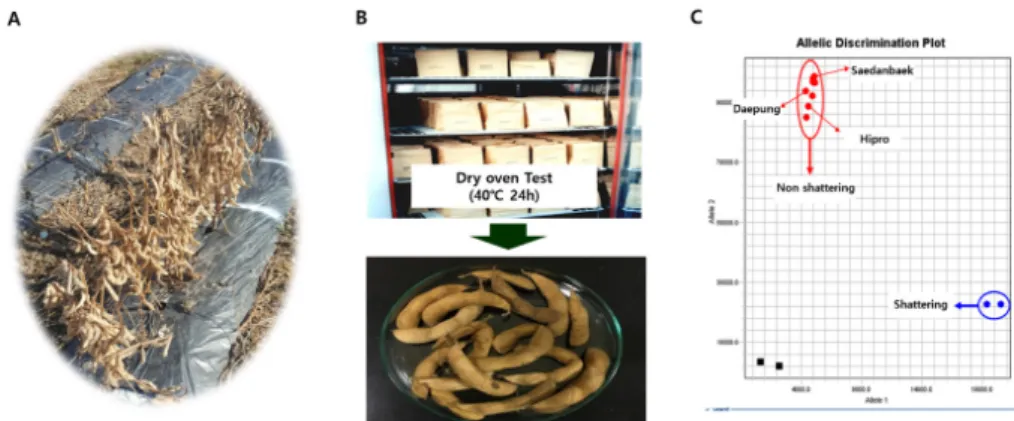
개발된 ‘하이프로’의 내탈립성 검정을 위해 3가지 방법을 사용 하였는데(Fig. 3). 포장검정을 위해 시험포장에서 수확기(R8) 이후 30일 간 식물체를 수확하지 않고 포장에서 탈립 정도를 확인하였고, 실내검정은 성숙한 꼬투리 20개를 채취하여 40℃
건조기에 48시간 건조 후 꼬투리의 개열정도를 조사하였다(Kang et al. 2005). 또한 탈립성 연관 SNP 마커인 KSS-SNP5를 사용하 여 ‘하이프로’의 내탈립성 유전자 보유 여부를 검정하였다(Kim et al. 2020).
콩모자이크바이러스병 저항성 검정은 포장상태에서 콩 재배 기간 중에 자연감염된 정도를 조사하였는데 모자이크반응은
Fig. 3. Pod shattering test of ‘Hipro’ using three different method. A : Field test of ‘Hipro’ to evaluate for pod shattering after maturation, not showing seed dispersal of ‘Hipro’, B : Dry oven test of ‘Hipro’ to evaluate for pod shattering, not showing pod dehiscence of ‘Hipro’, C : DNA marker test of ‘Hipro’, ‘Daepung’ and ‘Saedanbaek’ to evaluate for pod shattering, showing non shattering allele clearly against shattering allele.
등급화하고 괴저반응은 감염개체 비율로 조사하였으며, 도복정 도는 성숙시에 45° 이상 기울어진 개체의 비율을 등급화(1: 5%
이하, 3: 6~10%, 5:11~50%, 7:51~75%, 9: 76% 이상)하여 조사 하였다. 기타 특성은 농촌진흥청 농업과학기술 연구조사분석 기준에 따라 조사하였다(RDA 2012).
종실의 성분분석(조단백, 조지방, 이소플라본, 아미노산) 종실의 조단백질 함량분석은 두가지 방법으로 분석하였다.
첫번째는 분쇄된 시료 0.2 g을 듀마스 방법으로 원소 분석기 (Elementary, vario MAX cube, GmbH, Germany)를 이용하여 질소 농도를 측정하였다(Jung et al. 2003). 두번째는 킬달법으로 분쇄 시료를 0.5 g씩 칭량 후 습식분해 법으로 분해용액(HNO3:
H2SO4: HClO4 = 10: 1: 4)을 첨가하여 질소 농도에 콩 단백질 환산 계수 6.25를 곱하여 계산하였다(Jung et al. 2003). 조지방분 석은 식품공전에 따라 뢰제⋅고트리브(Roese-Gottlieb)법으로 추출하여 정량하였고(www.foodsafetykorea.go.kr/foodcode/01 _03.jsp?idx=11025), 모든 처리는 3반복 시험을 하여 평균값으로 구하였다. 이소플라본 분석은 초음파 처리를 이용하여 메탄올로 시료 중 이소플라본을 추출하여 액체크로마토그래프 / 자외부 흡광 광도검출기를 이용하여 분석하는 방법으로 최대 흡수파장 인 260 nm 에서 정량 분석하였다.
종실의 구성 아미노산의 조성 및 함량은 아미노산 분석기 (S433-H, SYKAM, Germany)를 사용하였다. Column은 cation separation column(LCA K06/Na, 4.6 × 150 mm)을 사용하였고, buffer 용액(pH 3.45~10.85)의 flow rate는 0.45 mL/min, reagent 의 flow rate는 0.25 mL/min, column 온도는 57~74℃, fluorescence
detector(Ex=440 nm, Em=570 nm)로 검출하였다.
두부 제조 및 가공특성
두유는 선별한 원료콩 100 g으로 정선하여 12시간 실온에서 수침시킨 후 900 ml 정제수를 가하여 소형두부제조기(AFC-100A, Soylove, Ronic, Korea)로 30분간 마쇄 및 가열하여 수용성 물질을 추출하였다. 마쇄한 두미를 스테인리스 체망과 면포 (30 × 30 cm)를 이용하여 두유와 비지를 분리하였고 여과하여 얻은 두유는 스테인리스 용기에 담아 90℃까지 가열한 후 두부 응고용 비커에 담아 80℃에서 응고제인 혼합응고제(맛순2100, TaejinGnS) 용액을 3%로 조정하여 회전 교반하여 넣은 뒤 15분 동안 응고 반응을 주었다. 그리고 응고물을 두부 성형틀(12 ×
10 × 10 cm)에 넣고 2.5 kg(24 × 3 cm)의 누름돌로 25분 동안 압착하여 두부를 제조하였다.
두유 및 두부의 수율은 원료콩 100 g으로 제조한 완성품의 무게로 표시하였으며, 원료 콩과 두유 및 두부의 색상은 색차계 (Chroma meter CR-400, Minolta, Japan)를 이용하여 L value (lightness ranging from 0 = black to 100 = white), a value (redness), b value (yellowness) 값으로 각각 3회 반복 측정하여 평균값으로 표기하였다. 원료 콩과 두부의 수분 함량은 시료 약 20 g을 계량한 후, 60℃로 설정한 incubator (IB-05G, JEIO TECH Co., Ltd., Korea)에 보관하면서 감소한 무게를 2-3일간 측정하여 무게 변화가 없을 시 종료하여 수분 함량 비율로 환산하 였다. Soluble solid 함량은 digital refractometer (PAL-1, Atago Co., Ltd., Tokyo, Japan)를 사용하여 측정하였고, pH는 pH meter (Starter300, Ohaus Co., Ltd., USA)를 이용하여 측정하였다.
Cultivar Growth habit Leaflet shape Flower color Pubescence color Pod color Seed coat color Hilum color Seed shape
Hipro Determinate Ovate White Grey Light brown Yellow Light brown Spherical
Daepung Determinate Ovate White Brown Dark brown Yellow Light brown Spherical
Table 1. Morphological characteristics of ‘Hipro’.
Cultivar Flowering date Maturity date
Plant height (cm)
No. of nods No. of
branches Pod number per plant
Seed number
pod per 100 seed weight
(g)
Lodging
z(1~9)
Soybean Mosaic
Virus Bacterial
zPustule
(1~9)
Shattering Mosaic
y(0~9)
Necrosis
(%) Field
(1~9)
zDry oven test (%)
marker DNA test
xHipro 8.4 10.17 75.5 13.0 3.7 50.3 1.9 22.2 1.8 0.5 0.3 1 1 0.3 R
Daewon 8.3 10.19 80.5 15.0 2.9 53.0 2.0 26.6 3.0 0.5 0 1 1 0.3 R
t-test
wns ns ns ** ns ns ns * ns ns ns ns ns ns -
z
(1) Tolerant~(9) Susceptible
y
(0) Tolerant~(9) Susceptible
x
R: resistance allele for pod shattering, S : susceptible allele for pod shattering
w
(ns) non-significant; * and ** were significantly different between Hipro and Daewon at 0.05 and 0.01 level of probability, respectively, by student t-test
Table 2. Quantitative characteristic of ‘Hipro’ in regional yield trial from 2019 to 2020 in three regions.
‘하이프로’의 공장규모 두부생산성 및 특성 분석을 위해 10 kg의 원료콩 ‘하이프로’와 표준품종으로 ‘대원콩’을 사용하여 중규모 가공시설에서 온비지 방식으로 두부를 제조하였다.
품종판별마커 개발
‘하이프로’가 국내 콩 시장에 유통되면서 기존의 장류콩들과 혼용 되었을 경우 ‘하이프로’를 구분할 수 있는 DUS 마커를 유전체 정보 기반으로 개발하였다. Axiom 180K SNP array기반으로 유전 형 분석이 완료된 국내 재배콩 및 야생콩 4,237점의 데이터를 비교하여 다른 자원들로부터 ‘하이프로’를 판별할 수 있는 분자 마커를 선발하였다(Jeong et al. 2018).
결과 및 고찰
고유특성 및 생육특성
‘하이프로’는 유한신육형 초형으로 꽃색은 백색, 엽형은 난형, 모용색은 회색, 협색은 담갈색, 종실은 구형이며 종피색은 황색으 로, 표준품종인 ‘대풍’과 유사하다(Table 1). 지역적응시험에서 나타난 ‘하이프로’의 개화기는 8월 4일로 ‘대원콩’에 비해 하루 늦고, 성숙기는 10월 17일로 ‘대원콩’ 대비 2일 빠른 중생종이며, 경장, 마디수, 협수는 각각 75.5 cm, 13개, 3.7개로 표준품종인
‘대원콩’과 비슷한 생육특성을 갖고 있으며, 100립중은 22.2 g으 로 ‘대원콩’에 비해 유의하게 작았다(Table 2).
내탈립성, 내병성, 내도복성
‘하이프로’의 내탈립성은 포장검정에서 대부분 내탈립성이 확인되었고(Fig. 3A, Table 2), 40℃, 48시간 Dry oven 검정에서 도 탈립비율이 0%로 탈립에 매우 강하였으며(Fig. 3B, Table 2), 내탈립마커인 KSS-SNP5 마커를 활용한 내탈립성 검정 결과에 서도 내탈립 allele을 가지고 있는 것으로 나타났다(Fig. 3C, Table 2). 지역적응성 시험에서 조사한 콩모자이크 바이러스와 불마름병의 내병성 검정 결과 모든 지역의 시험포장에서 ‘0’
또는 ‘1’ 평가되어 표준품종인 ‘대원콩’ 보다 강하거나 비슷하여 내도복성 품종으로 평가되었다(Table 2).
수량성
‘하이프로’는 2015년~2016년에 실시한 생산력검정시험에서 평 균수량 2.5 ton/ha로 대풍 대비 6~7% 유의하게 낮았고(Table 3), 2019년~2020년 3개지역에서 실시한 지역적응시험 결과, 평균 2.23 ton/ha로 표준품종인 ‘대원콩’에 비해 9% 감소하는 경향이 었으나 통계적 유의성은 없었고(Table 3), 남부지방인 군위, 광주 지역에 비해 북부지방인 파주에서의 수량성은 ‘하이프로’가 ‘대 원콩’에 비해 10% 유의하게 높아 ‘하이프로’는 북부지방에 적응 성이 다소 높은 것으로 판단된다(Table 3).
종실특성 및 성분(조단백, 조지방, 이소플라본, 아미노산)
‘하이프로’의 종실의 조단백질 함량은 2가지 방법으로 다년간 여러 지역에서 측정한 결과 ‘대풍’에 비해 유의하게 높았고,
Yield trial PYT
zAYT
yRYT
xLocation (Year)
Cheonan
('16) Cheonan
('17) Gunwi
('19) Gwangju ('19) Paju
('19) Paju
('20) Total Means Adapted Region (Paju) Means Yield
(ton/ha) Index
(%) Yield
(ton/ha) Index
(%) Yield
(ton/ha) Yield
(ton/ha) Index
(%) Yield
(ton/ha) Index (%)
Hipro 2.46 94 2.55 94 1.70 2.80 2.37 2.03 2.23 91.3 2.20 111
Check variety
w2.63 100 2.70 100 2.15 4.43 2.20 1.77 2.63 100 1.99 100
t-test
v* - * - - - - - ns - ** -
z
Preliminary yield trial
y
Advanced yield trial
x
Regional yield trial
w
Daepung in PYT, AYT, Daewon in RYT
v
(ns) non-significant; * and ** were significantly different between Hipro and check variety at 0.05 and 0.01 level of probability, respectively, by student t-test Table 3. Yield trial of ‘Hipro’ in PYT, AYT, RYT from multiple year and location.
Cultivar
Crude Protein (%) Amino acid (%) w/o tryptophan Crude (%) Oil
Total Flavonoid (mg/100g)
Isoflavone (mg/100g) Dumas
zIndex
yKjeldahl
xIndex Total Index Essential for adults
wIndex Essential for kids
vIndex Daidzein Genistein
Hipro 53.9 130 43.6 117 43.62 119 14.12 113 19.8 120 5.73 75.88 0.191 0.631
Daepung 41.5 100 35.9 100 36.61 100 12.53 100 16.52 100 8.10 66.50 0.711 0.772
t-test
u** - ** - ** - ** - ** - ** * * ns
z
Dumas (Jung et al. 2003)
y
Mean of Hipro/mean of Daepung × 100
x
Kjeldahl (Jung et al. 2003)
w
Thr, Val, Met, Ile, Leu, Phe, Lys
v
Thr, Val, Met, Ile, Leu, Phe, Lys, His, Arg
u
(ns) non-significant; * and ** were significantly different between Hipro and Daepung at 0.05 and 0.01 level of probability, respectively, by student t-test Table 4. Characteristics of seed composition of ‘Hipro’.
Cultivar Yield (%) Color value Total solids contents
(Brix) pH Crude Protein (%) Crude Oil Fresh (Index) Dry (Index) Fresh
z(Index) L a b (%)
Hipro 244(107) 54(120) 325(115) 95.29 -2.83 15.63 12.67 6.84 13.68 4.19
Daepung 228(100) 45(100) 283(100) 81.92 -3.18 19.74 6.00 6.64 12.58 6.82
t-value
y* ** ** - - - ** ns ns *
z
Daewon used for check variety and 10 kg was used for pilot scale
y
ns is not significantly different between Hipro and Daepung at 0.05 by student t-test Table 5. Characteristics of tofu of ‘Hipro’.
조지방의 함량은 낮게 측정되었다(Table 4). 종실 구성 아미노산 함량에서도 유의적인 차이를 보였는데, 종 아미노산함량, 생체내 에서 합성이 불가능한 필수아미노산함량 및 어린아이들에게 추가로 중요한 필수아미노산인 histidine과 arginine의 함량을 포함한 유아용 필수아미노산의 함량에서도 ‘하이프로’가 ‘대풍’
에 비해 유의하게 높게 나타났다(Table 4). 종실의 플라보이드 함량은 ‘하이프로’가 ‘대풍’에 비해 다소 높았으나 이소플라본 중 주요 성분인 daidzein과 genistein의 함량은 ‘하이프로’가 ‘대
풍’에 비해 다소 낮게 존재하는 것으로 나타났다(Table 4).
두부의 품질, 가공특성
‘하이프로’의 두부수율을 실험실수준에서 측정한 결과, ‘하이 프로’는 244%로 표준품종인 ‘대풍’의 228%에 비하여 7% 높았 고. 건물중 수율도 ‘하이프로’가 20% 유의하게 높은 것으로 나타났으며(Table 5), 두부 업체의 두부 제조방식으로 측정한 결과에서도 ‘하이프로’는 325% 생산되어 ‘대원콩’의 283% 대비
Cultivar Coagulation Stirring the curd The broken curd Tofu
Hipro
Daewon
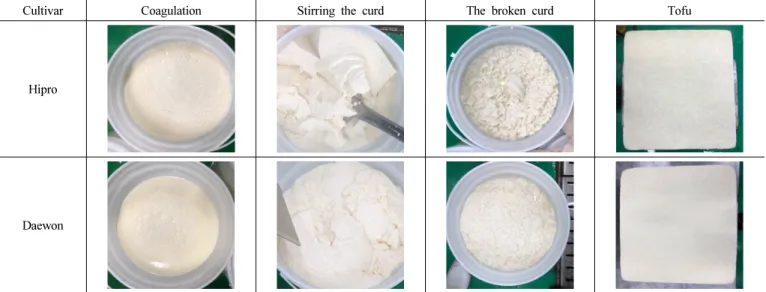
Fig. 4. Photo comparison between ‘Hipro’ and ‘Daewon’ in the process of making tofu in pilot scale.
15%가 더 많이 생산되었다(Table 5). 두부의 전체 가용성고형분 함량은 ‘하이프로’가 12.67 Brix로 ‘대풍’(6.00 Brix) 보다 2배정 도 유의하게 높은 것으로 나타났으며, 두부의 pH는 두 품종 모두 비슷했다(Table 5). 두부의 조단백질, 조지방 함량은 ‘하이 프로’는 각각 13.68%, 4.19%이고, ‘대풍’은 12.58%, 6.82%로 하이프로가 조단백질 함량이 높고 조지방 함량은 다소 낮았으며 두부색도는 ‘하이프로’의 두부가 ‘대풍’의 두부에 비해 색이 더 진하게 나타나 외관상 우수하였다(Table 5). 종합적으로 두부의 응고정도 및 생산성이 우수하고 대부분의 품질면에서 큰 차이가 없거나 우수한 것으로 평가되어 산업화 가능성이 높을 것으로 판단된다(Fig. 4).
품종판별(DUS) 마커 개발
국내 콩 재배종 및 야생종 4,237점의 유전체 데이터를 기반으 로 ‘하이프로’의 품종판별(DUS) 마커를 유전체 전반에서 74개 선발하였다(Data not shown). 구체적으로 살펴보면, 9번 염색체 에서 23개로 가장 많은 수의 마커가 존재하였고 8번, 12번, 14번, 17번 염색체에서는 품종판별 마커가 존재하지 않았다. 개발된 마커를 활용하면 추후에 ‘하이프로’ 품종의 품종보호권 강화에 기여할 것으로 판단된다.
적 요
‘하이프로’는 고단백질함량을 가지며 재배안정성이 우수한 품종육성을 목표로 2012년에 ‘대풍’(백운 × 신팔달2호)를 모본
으로 ‘새단백’(SS92414 × MD87L)을 부본으로 교배하여 1개체 1계통육종법에 의해 선발되었다. 2016년, 2017년도에 실시한 생산력검정시험에서는 고단백인 계통으로 ‘NC05-032’을 선발 하였고, 2019년, 2020년에 수행한 지역적응시험 결과 종실특성 이 ‘대원콩’과 비슷하며 도복과 탈립에 강하며 고단백, 특히 필수 아미노산 함량이 높고 두부의 가공특성이 우수하여 ‘하이프로’로 명명되었다. ‘하이프로’는 유한신육형, 화색이 백색, 종피는 황색 이면서 구형인 장류콩 품종이다. 개화기는 8월 4일, 성숙기는 10월 17일, 100립중이 22.2 g으로 ‘대풍’과 생육특성이 유사하지만, 종실의 단백질함량이 53.9%로 43.6%인 ‘대풍’에 비해 매우 높았 으며, 필수아미노산 함량은 19% 높았다. 도복 정도는 시험포장 에서 ‘대원콩’와 비슷하게 강하였고, 협개열성 정도는 포장검정, 실내 검정, 분자표지 검정에서 모두 탈립에 강하였다. 불마름병, 콩모자이크바이러스 등 병해에 ‘대원콩’과 대등하였다. 수량성은 전국 평균 2.23 ton/ha로 ‘대원콩’의 91.3% 수준으로 다소 낮았으나 적응지역인 파주에서는 ‘하이프로’의 수량이 ‘대원콩’보다 11%
높았다. 유전체 정보를 기반으로 74개의 품종판별마커를 개발하여
‘하이프로’의 품종보호권 강화에 기여하였다.
사 사
본 연구는 농촌진흥청 연구사업(과제명: 거대유전분석집단을 활용한 콩 유전체선발 기반구축, 과제번호: PJ0132132020)의 지원에 의해 수행되었다.
REFERENCES