• 검색 결과가 없습니다.

Stem Fixation in Revision Total Knee Arthroplasty: Indications, Stem Dimensions, and Fixation Methods

N/A
N/A
Protected

Academic year: 2021

Share "Stem Fixation in Revision Total Knee Arthroplasty: Indications, Stem Dimensions, and Fixation Methods"

Copied!
6
0
0

로드 중.... (전체 텍스트 보기)

전체 글

(1)

Introduction

One of the primary goals of total knee arthroplasty (TKA) is to recreate a stable joint with accurate position and orientation of prostheses, mimicking the normal knee kinematics. However, it would be a more difficult task in the revision setting due to com­

bined severe bone defects and soft tissue insufficiency. Stems are required in most revision TKAs to help transfer loads from the compromised articular and metaphyseal bone to the remaining tibial cortical rim and to widely distribute the increased stress of a constrained articulation.

They improve the mechanical stability at the cost of stress

shielding. Mechanical stability can be improved by resistance to shear, reduced lift­off, and decreased micromotion

1)

. However, long stems may have disadvantages including end­of­stem pain and stress shielding along their length with associated reduction in bone density, a theoretical risk of subsidence, loosening, and periprosthetic fracture

1,2)

. It is known that the axial load can be reduced by 23% to 39% when a stem length reaches 70 mm

3)

. With a stem up to 150 mm in length, marked stress shielding of the proximal tibial cortex and doubling of the strain are noted at the stem tip

3)

.

Although the need for stem to improve initial mechanical sta­

bility and ultimate component survival is well accepted, the ideal indications, proper lengths and diameters, and fixation methods remain controversial. No evidence­based guidelines are available to help determine when to use a stem, which length and diam­

eter are ideal, and whether or not to use cement fixation

4)

. Such decisions should be based on a great store of knowledge rather than on presumption. In this review article, we will discuss the indications, selection of stem lengths and diameters, and fixation methods in revision TKA.

1. Indications

Stems should be used in revision TKA when the remaining

Stem Fixation in Revision Total Knee Arthroplasty:

Indications, Stem Dimensions, and Fixation Methods

Se Gu Kang, MD 1 , Cheol Hee Park, MD 2 , and Sang Jun Song, MD, PhD 1

1
Department of Orthopedic Surgery, College of Medicine, Kyung Hee University, Seoul;

2

Department of Medicine, Graduate School, Kyung Hee University, Seoul, Korea

Although stems improve initial mechanical stability in revision total knee arthroplasty (TKA), ideal indications, proper lengths and diameters, and appropriate fixation methods remain controversial. The topics of the present article include the indications, selection of lengths and diameters, and fixation methods of stems in revision TKA. The use of a stem in revision TKA can protect the juxta­articular bone. A stem cannot be a substitute for optimal component fixation; it plays an adjunctive role in transferring the loads from the compromised metaphysis to the stronger diaphysis. Proper bone surface preparation and appropriate use of the stem based on a great store of knowledge are required to support the stemmed components effectively in revision TKA. The balance between overshielding and overloading the juxta­articular bone would provide excellent structural protection. The stem length and diameter should be tailored according to patients’ anatomical characteristics and determined fixation strategy. There are two traditional methods of stem fixation including the total cementation technique and the hybrid technique with a cementless press­fit stem.

Selection of a cementation technique should be based on thorough consideration of advantages and disadvantages of each technique.

Keywords: Knee, Arthroplasty, Revision, Stem pISSN 2234-0726 · eISSN 2234-2451

Knee Surgery & Related Research

Received February 16, 2018; Revised April 10, 2018;

Accepted April 28, 2018

Correspondence to: Cheol Hee Park, MD

Department of Medicine, Graduate School, Kyung Hee University, 23 Kyungheedae­ro, Dongdaemun­gu, Seoul 02447, Korea

Tel: +82­2­958­9489, Fax: +82­2­964­3865 E­mail: [email protected]

187

This is an Open Access article distributed under the terms of the Creative Commons Attribution Non­Commercial License (http://creativecommons.org/licenses/by­nc/4.0/) which permits unrestricted non­commercial use, distribution, and reproduction in any medium, provided the original work is properly cited.

Copyright © 2018 KOREAN KNEE SOCIETY www.jksrr.org

(2)

bone stock is insufficient to support the prosthesis. Bone grafting for large volume defects may require the use of a stem to protect the graft from excessive load. The knee joint bears loads that are several times the body weight. If a stem fails to transfer the load, then the remaining cancellous bone will experience load beyond its ultimate strength, which will lead to a loss in component fixa­

tion in the initial phase

5)

. Modular metal augments (blocks or wedges), cones, or sleeves can be used when the cortical rim or either the distal femur or proximal tibia is breached. The selec­

tion of metal augments typically mandates the use of a stem.

Brand et al.

6)

reported the results of 22 TKAs with modular metal wedges and small tibial cemented stems: no tibial tray was con­

sidered loose at an average of 37 months of follow­up.

Wolff’s Law states that bone remodels in response to applied stress and strain in the chronic phase. The strain for normal re­

modeling of the proximal tibia should be within a physiological range of 50 to 1,500 με

1)

. Below 50 με, stress shielding is likely to occur and bone resorption takes place

1)

. On the contrary, the risk of damage within the cancellous bone with microfractures increase above 1,500 με, and the risk of collapse with pathological overloading increases above 3,000 με

1)

. The stiffer the material, the greater the stress shielding effect. Also, the greater the differ­

ence in Young’s modulus of elasticity between the material and surrounding bone, the greater the stress shielding. Greater shield­

ing is therefore expected in cobalt­chrome components than in titanium components. Accordingly, factors affecting the selection of a stem include not only bone stock and the type of bone defect but also component material. However, recent studies with finite element analysis have shown no difference in stress shielding be­

tween long stems made of titanium and cobalt­chrome

1)

. The de­

velopment of metaphyseal cones or sleeves and porous trabecular metals have provided an alternative to stems although biome­

chanical studies are warranted

7)

. More research on various stem lengths, surface finishes, and different stem fixation techniques are needed under different circumstances to optimize the strain environment.

The increased constraint of polyethylene insert in patients with soft tissue insufficiency can result in increased stress between the components and cement or between cement and host bone.

Therefore, more stable fixation of components would be required in patients with severe soft tissue insufficiency and constrained prostheses

8)

. Anderson et al.

9)

reported good results of 55 TKAs using a constrained condylar prosthesis without stem extension:

there were one case of femoral loosening and one case of tibial fracture at 44.5 months of follow­up. Sabatini et al.

10)

reported favorable clinical and radiographic results with use of the second

generation semi­constrained prosthesis with stem extension. Al­

though the use of the stem remains controversial in constrained TKA, the stem should be used routinely if there is inadequate bony surface.

The stem can also be used for the treatment of periprosthetic fractures after TKA. Fractures around a loose prosthesis are clas­

sified as Rorabeck type III

11)

; the exchange for a prosthesis with a longer stem for diaphyseal fixation is the treatment of choice in this type of periprosthetic fractures. As in the case of fractures around the femoral component, the stability of the prosthesis is important in the treatment of periprosthetic tibial fractures. In fractures with subtype B according to Felix classification, a loose prosthesis has to be exchanged for a revision prosthesis with di­

aphyseal stem fixation

12)

.

Stems can be used depending on the extent of offset. Hicks et al.

13)

noted significant variability in the location of the tibial canal relative to the tibial plateau. They found that the intramedullary canal center was usually anterior and medial to the tibial plateau.

Tang et al.

14)

described that the axis of the tibial shaft is located anterolateral to the center of the tibial plateau in Asian popula­

tion. These studies highlighted the feasibility of offset stems of the tibial component in revision TKA.

2. Dimensions (Length and Diameter)

Micromotion of knee prostheses can be significantly reduced by increasing the stem length, diameter, and canal filling ratio (CFR) in revision TKA using press­fit stems

1)

. Biomechanical studies also demonstrated significant improvement in joint stability with use of a press­fit stem with an increased length and diameter

15,16)

.

When a short stem (25 to 30 mm in length) is used, it should be cemented for stability. However, the use of long modular stem extensions, which are canal filling and diaphyseal engaging, can provide the stability in a press­fit method without the use of ce­

ment. Wood et al.

17)

reported the results of 135 revision TKAs using press­fit diaphyseal fixation and cemented metaphyseal fixation: the 12­year survival analysis showed 98% probability of survival free of revision for aseptic loosening.

However, the literature review failed to identify the “ideal”

length

18)

. It is unlikely that an ideal length can be determined be­

cause of the heterogeneity of patients’ anatomical characteristics and revision circumstances. Patient­specific tailoring of recon­

struction strategy will be needed to match the patient’s anatomy, bone loss, and constraint requirements.

Although some authors have recommended at least 4 cm of

diaphyseal engagement for press­fit stems

19)

, longer stems that

approach the confined diaphyseal isthmus may need to be nar­

(3)

rower

20)

. The length of a diaphyseal engaging stem must be determined concurrently with the stem diameter

20)

. No clinical evidence has effectively reconciled this relative influence of stem length and diameter. The ideal composite of stem length and diameter may be better expressed as the CFR, which is defined as the width of the stem divided by the width of the intramedul­

lary canal. The canal filling stems permit considerable diaphyseal cortical contact, which may enhance component stability and improve mechanical alignment

20,21)

. Fleischman et al.

22)

reported that the risk for mechanical failure was reduced by 41.2% for ev­

ery 10% increase in CFR. Parsley et al.

23)

recommended a CFR of

>0.85 to achieve stable intramedullary fit.

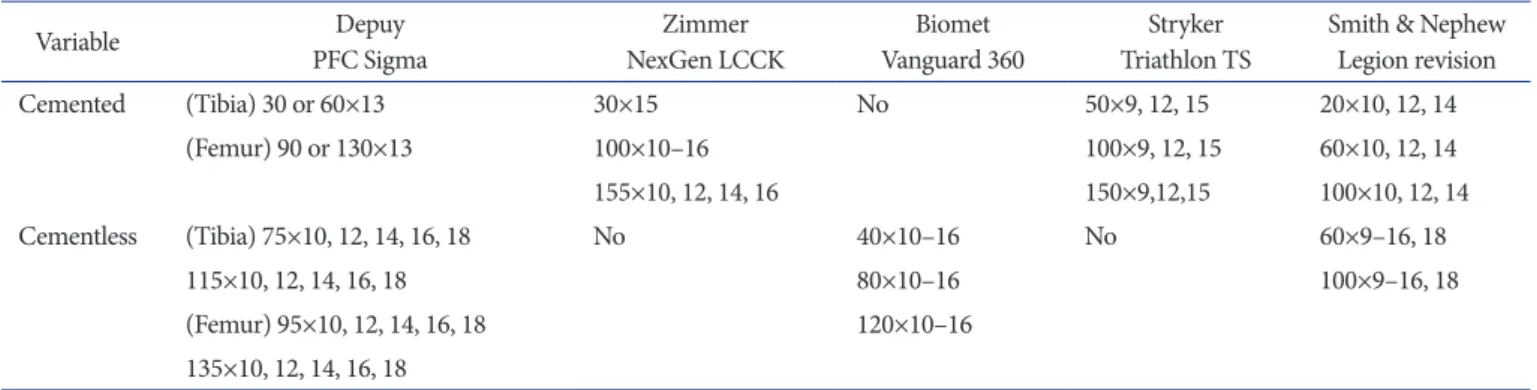
A long stem can force articular components into suboptimal position (Table 1). Gobba et al.

24)

demonstrated that a 120 mm tibial stem will force the tibial component into an excessively val­

gus position, and a 200 mm tibial stem will often force the tibial component into a posteromedial position above the tibial surface.

Therefore, proper surgical strategies are required to prepare a cut surface that facilitates the entry of the long stem. We will describe such strategies in the next section.

A preoperative estimate along with the intraoperative assess­

ment of stem length and diameter is required to determine the extent of press­fit. The preoperatively templated stem diameter has to be confirmed intraoperatively to the point at which cortical chatter is felt or heard with a reamer at the preset stem length. A greater degree of press­fit is required when there are severe bone defect and soft tissue insufficiency

3)

. Reaming to a greater diam­

eter and removal of more endosteal bone induce more robust support for the stemmed component; it facilitates the insertion of a stem of larger diameter and provides an enlarged stem­to­bone contact associated with positive effects on stability

25)

. The press­

fit stem length and diameter have to be tailored to optimize the canal filling with the consideration of patients’ anatomical char­

acteristics and degree of bone defect and prosthesis constraint.

Manufacturers provide various press­fit or cemented stems with different lengths and diameters (Table 1), which need to be pre­

pared to match various patients’ anatomical characteristics (Fig.

1).

3. Fixation Methods

Two traditional methods of stem fixation have been used: total cementation technique and hybrid technique with a cementless press­fit stem. Both techniques have their own advantages and disadvantages (Table 2)

20,26)

. Based on the available literature, no superiority of any type of stem fixation has been found

26)

. Due to the inhomogeneity of failure mechanism, bone stock, implant design, and comorbidities, a strictly randomized controlled trial (RCT) for revision TKA is nearly impossible to compare the outcomes according to the cementation technique

26)

. A recent RCT

27)

performed radiostereometric analysis with (1) constructs of the same length, (2) the same Anderson Orthopaedic Research Institute type of bone defect, (3) implants with the same level of constraint, and (4) exclusion of re­revision TKAs. No difference was reported in median migration or the number of migrating components between total and hybrid cementation techniques in revision TKAs. However, another study

28)

showed that cemented stems were significantly more likely to have radiographic loosen­

ing compared to uncemented stems (4.9% vs. 1.6%, p=0.02). It suggested that the reamed diaphysis was a poor surface for ce­

ment interdigitation, leading to higher rates of radiolucency (32%

vs. 17%, p=0.006).

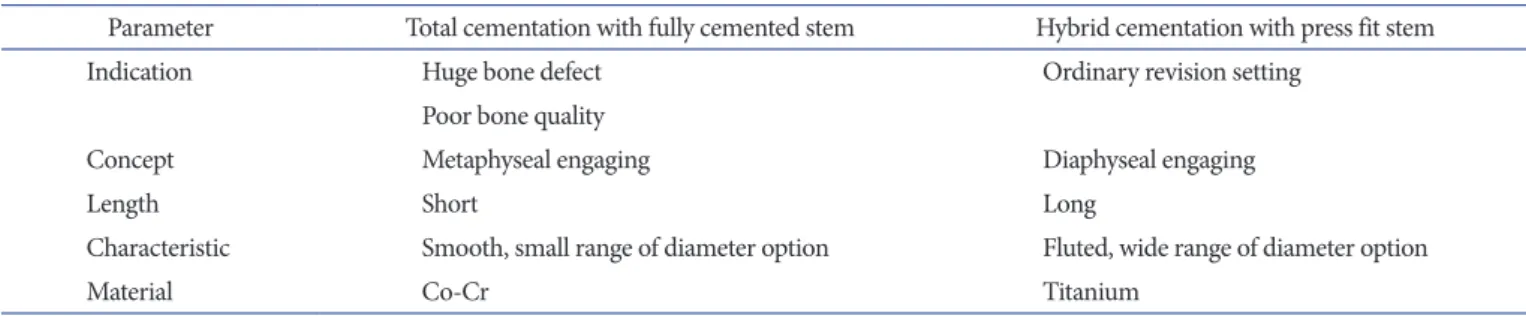
Some surgeons favor the use of a specific technique, but others select them on an ad hoc basis. Most surgeons prefer the hybrid technique with a press­fit stem in ordinary revision TKA (Table 3)

20)

. However, the total cementation technique is occasionally required when the metaphyseal bone is severely destructed and the inner cortex is too poor in patients with severe osteoporosis.

We will describe the hybrid cementation technique first and then

Table 1. Length and Diameter of Stem according to Providers in Korea

Variable Depuy

PFC Sigma Zimmer

NexGen LCCK Biomet

Vanguard 360 Stryker

Triathlon TS Smith & Nephew Legion revision

Cemented (Tibia) 30 or 60×13 30×15 No 50×9, 12, 15 20×10, 12, 14

(Femur) 90 or 130×13 100×10–16 100×9, 12, 15 60×10, 12, 14

155×10, 12, 14, 16 150×9,12,15 100×10, 12, 14

Cementless (Tibia) 75×10, 12, 14, 16, 18 No 40×10–16 No 60×9–16, 18

115×10, 12, 14, 16, 18 80×10–16 100×9–16, 18

(Femur) 95×10, 12, 14, 16, 18 120×10–16

135×10, 12, 14, 16, 18

Values are presented as length×diameter (mm).

(4)

introduce the use of cement plugs in the total cementation tech­

nique.

Preoperative radiographic planning includes assessment of the

intramedullary canal to ensure that stem insertion is possible without ipsilateral hardware and deformity or that the intramed­

ullary canal axis conforms to the mechanical axis orientation.

Fig. 1. Preoperative planning on the diameter and length of a stem. (A) Tibial component loosening required stable fixation of the tibial component using a stem in revision total knee arthroplasty, but the narrow intramedullary canal made the use of a stem difficult (double­headed arrow). (B) The 75×10 mm press­fit stem was altered to be 45×10 mm to prevent an insertion failure. (C) Fortunately, the ordinary 75×10 mm stem could be inserted with modification of the stem insertion point.

A B C

Table 2. Advantages and Disadvantages of Total Cementation versus Hybrid Cementation Techniques in Revision Total Knee Arthroplasty Variable Total cementation with fully cemented stem Hybrid cementation with press fit stem

Advantage Easy to implant Potential for bone stock preservation

Better initial stability Less stress shielding

Potential benefit of intramedullary elution of antibiotics Optimizing mechanical alignment by diaphyseal referencing More variability in component positioning and sizing Easy to remove

Useful especially in diaphyseal bowing Applicable in patients with previous DFO or HTO

Disadvantage Difficult to remove Potential for end­of­stem pain

Decreased references for proper alignment Potential forcing of component into suboptimal position without offset stem Risk of periprosthetic fractures with canal preparation

DFO: distal femoral osteotomy, HTO: high tibial osteotomy.

Table 3. Comparison of Indication and Concept between Total Cementation and Hybrid Cementation Techniques in Revision Total Knee Arthroplasty

Parameter Total cementation with fully cemented stem Hybrid cementation with press fit stem

Indication Huge bone defect Ordinary revision setting

Poor bone quality

Concept Metaphyseal engaging Diaphyseal engaging

Length Short Long

Characteristic Smooth, small range of diameter option Fluted, wide range of diameter option

Material Co­Cr Titanium

(5)

Eccentric joint surfaces may require the use of offset stems

29)

. The stem length and diameter are estimated to obtain adequate end­

osteal press­fit. Preparation of at least two possible stem lengths with correspondingly different stem diameters would allow opti­

mal application and prevent cortical impingement.

Intraoperatively, technical efforts should be focused on expos­

ing the good inner cortex to achieve a sufficient press­fit and matching the cut surface and stem orientation, when using an extramedullary alignment guide. Alternatively, preparation of the cut surface can be easily performed using a broad intramedullary guide rod or a reamer. The initial reaming removes ectatic and sclerotic inner cortex which can lever the reamers away from the true intramedullary canal axis

3)

. Then, the intramedullary canal is sequentially reamed to the appropriate length and diameter to accept the press­fit stems. Traditionally, reaming is performed approximately 1 cm past the tip of the stem to ensure that there is no tip impingement with the possibility of cortical erosion. It is continued in millimeter increments until minimal endosteal cor­

tical contact is felt at the preoperatively determined stem length.

For structural­bulk allografts, reaming should be continued at least 1mm wider beyond the point at which cortical chatter is felt and heard to improve initial stability.

The position of components is dictated by the position of the press­fit stem. If the canal is eccentric, an offset stem should be considered. In particular, the femoral component position in the sagittal plane with a straight stem is also dictated by the stem and therefore determines the flexion gap. Because posterior shifting of the femoral component’s position or addition of posterior fem­

oral augments to alter the flexion gap cannot be accomplished with a straight stem, a posterior offset stem or a femoral compo­

nent with a different housing junction point can be a good viable option

3)

.

When components are easily seated without a stem but failure of seating occurs with the stem, the surgeon should consider the following causes: (1) improper stem size; (2) occurrence of endosteal impingement; and (3) mismatch between the prepared bone surface and the intramedullary position of the stem. The use of an offset stem and adjustment of stem position with intra­

medullary widening should be considered as a solution.

After sufficient reaming and confirmation of the match be­

tween the canal and prepared bone surface, cement is mixed and packed along the cut surfaces with component undersurface and metaphyseal keel, but not around the stem tip.

For the total cementation technique with a fully­cemented stem, impingement of stem or mismatch between the prepared bone surface and stem orientation is uncommon (Table 2). However,

optimization of mechanical alignment by diaphyseal referenc­

ing cannot be expected. Care should be taken to achieve accu­

rate positioning of components and alignment during the bone preparation and cementation. With a cement plug placed above the expected level of the stem tip, cement is pressure injected into the intramedullary canal. Additional cement is mixed and packed along the prepared bone surfaces with undersurface of the articu­

lar components, surfaces of the metaphyseal keel, and around the stem.

Conclusions

Use of a stem in revision TKA can protect the juxta­articular bone and transfer the load to the stronger diaphyseal bone. The balance between overshielding and overloading of the juxta­ar­

ticular bone is crucial for excellent structural protection. Proper bone surface preparation and appropriate use of stems based on a great store of knowledge are required to support the stemmed components effectively in revision TKA. The stem length and diameter should be tailored according to the patients’ anatomi­

cal characteristics and selected fixation strategy. Two traditional methods of stem fixation (total cementation technique and hy­

brid technique with cementless press­fit stem) have their own advantages and disadvantages, which should be carefully taken into consideration in the selection of a cementation technique.

Conflict of Interest

No potential conflict of interest relevant to this article was re­

ported.

References

1. Scott CE, Biant LC. The role of the design of tibial compo­

nents and stems in knee replacement. J Bone Joint Surg Br.

2012;94:1009­15.

2. Murray PB, Rand JA, Hanssen AD. Cemented long­stem re­

vision total knee arthroplasty. Clin Orthop Relat Res. 1994;

(309):116­23.

3. Weeden SH, Poprosky WG, Sekundiak TD. Use of stems in revision total knee arthroplasty. In: Callaghan JJ, Rosen­

berg AG, Rubash HE, Simonian PT, Wickiewicz TL, eds.

The adult knee. Philadelphia, PA: Lippincott Williams and Wilkins; 2003. p1439­45.

4. Bottner F, Laskin R, Windsor RE, Haas SB. Hybrid compo­

nent fixation in revision total knee arthroplasty. Clin Orthop

(6)

Relat Res. 2006;446:127­31.

5. Crawford DA, Berend KR, Morris MJ, Adams JB, Lombardi AV Jr. Results of a modular revision system in total knee ar­

throplasty. J Arthroplasty. 2017;32:2792­8.

6. Brand MG, Daley RJ, Ewald FC, Scott RD. Tibial tray aug­

mentation with modular metal wedges for tibial bone stock deficiency. Clin Orthop Relat Res. 1989;(248):71­9.

7. Daines BK, Dennis DA. Management of bone defects in revi­

sion total knee arthroplasty. Instr Course Lect. 2013;62:341­

8.

8. Engh GA, Ammeen DJ. Bone loss with revision total knee arthroplasty: defect classification and alternatives for recon­

struction. Instr Course Lect. 1999;48:167­75.

9. Anderson JA, Baldini A, MacDonald JH, Tomek I, Pellicci PM, Sculco TP. Constrained condylar knee without stem ex­

tensions for difficult primary total knee arthroplasty. J Knee Surg. 2007;20:195­8.

10. Sabatini L, Risitano S, Rissolio L, Bonani A, Atzori F, Masse A.

Condylar constrained system in primary total knee replace­

ment: our experience and literature review. Ann Transl Med.

2017;5:135.

11. Rorabeck CH, Taylor JW. Classification of periprosthetic fractures complicating total knee arthroplasty. Orthop Clin North Am. 1999;30:209­14.

12. Felix NA, Stuart MJ, Hanssen AD. Periprosthetic fractures of the tibia associated with total knee arthroplasty. Clin Orthop Relat Res. 1997;(345):113­24.

13. Hicks CA, Noble P, Tullos H. The anatomy of the tibial intra­

medullary canal. Clin Orthop Relat Res. 1995;(321):111­6.

14. Tang Q, Zhou Y, Yang D, Xu H, Liu Q. The offset of the tibial shaft from the tibial plateau in Chinese people. J Bone Joint Surg Am. 2010;92:1981­7.

15. Conlisk N, Gray H, Pankaj P, Howie CR. The influence of stem length and fixation on initial femoral component stability in revision total knee replacement. Bone Joint Res.

2012;1:281­8.

16. Jazrawi LM, Bai B, Kummer FJ, Hiebert R, Stuchin SA. The effect of stem modularity and mode of fixation on tibial component stability in revision total knee arthroplasty. J Ar­

throplasty. 2001;16:759­67.

17. Wood GC, Naudie DD, MacDonald SJ, McCalden RW, Bourne RB. Results of press­fit stems in revision knee ar­

throplasties. Clin Orthop Relat Res. 2009;467:810­7.

18. El­Zayat BF, Heyse TJ, Fanciullacci N, Labey L, Fuchs­Win­

kelmann S, Innocenti B. Fixation techniques and stem di­

mensions in hinged total knee arthroplasty: a finite element study. Arch Orthop Trauma Surg. 2016;136:1741­52.

19. Gililland JM, Gaffney CJ, Odum SM, Fehring TK, Peters CL, Beaver WB. Clinical & radiographic outcomes of cemented vs. diaphyseal engaging cementless stems in aseptic revision TKA. J Arthroplasty. 2014;29(9 Suppl):224­8.

20. Patel AR, Barlow B, Ranawat AS. Stem length in revision to­

tal knee arthroplasty. Curr Rev Musculoskelet Med. 2015;8:

407­12.

21. Fleischman AN, Azboy I, Restrepo C, Maltenfort MG, Parvizi J. Optimizing mechanical alignment with modular stems in revision TKA. J Arthroplasty. 2017;32(9S):S209­13.

22. Fleischman AN, Azboy I, Fuery M, Restrepo C, Shao H, Par­

vizi J. Effect of stem size and fixation method on mechanical failure after revision total knee arthroplasty. J Arthroplasty.

2017;32(9S):S202­8.

23. Parsley BS, Sugano N, Bertolusso R, Conditt MA. Mechani­

cal alignment of tibial stems in revision total knee arthro­

plasty. J Arthroplasty. 2003;18(7 Suppl 1):33­6.

24. Gobba MS, Chan N, Patel R, Noble PC, Incavo SJ. Tibial stems in revision total knee arthroplasty: is there an ana­

tomic conflict? J Arthroplasty. 2015;30(9 Suppl):86­9.

25. Pfeifer R, Sellei R, Pape HC. The biology of intramedullary reaming. Injury. 2010;41 Suppl 2:S4­8.

26. Wang C, Pfitzner T, von Roth P, Mayr HO, Sostheim M, Hube R. Fixation of stem in revision of total knee arthro­

plasty: cemented versus cementless­a meta­analysis. Knee Surg Sports Traumatol Arthrosc. 2016;24:3200­11.

27. Heesterbeek PJ, Wymenga AB, van Hellemondt GG. No Difference in implant micromotion between hybrid fixation and fully cemented revision total knee arthroplasty: a ran­

domized controlled trial with radiostereometric analysis of patients with mild­to­moderate bone loss. J Bone Joint Surg Am. 2016;98:1359­69.

28. Edwards PK, Fehring TK, Hamilton WG, Perricelli B, Beaver WB, Odum SM. Are cementless stems more durable than cemented stems in two­stage revisions of infected total knee arthroplasties? Clin Orthop Relat Res. 2014;472:206­11.

29. Foruria X, Schmidt­Braekling T, Nabarte DA, Fasching­

bauer M, Kasparek M, Boettner F. Does the tibia component

design affect the need for offset stems in revision total knee

arthroplasty? Arch Orthop Trauma Surg. 2017;137:853­60.

수치

Table 1. Length and Diameter of Stem according to Providers in Korea
Table 3. Comparison of Indication and Concept between Total Cementation and Hybrid Cementation Techniques in Revision Total Knee  Arthroplasty

참조

관련 문서

The definitive fixation using Steinmann pin & 4.0, 6.5 cannulated screws was performed(A-D), Postoperative X-ray (A : ankle lateral view, B : Calcaneal axial view, C

Injury is a burden on athletes, but the rehabilitation exercise of this study suggests that the improvement of knee muscle function and knee function

This modifier is attached to the stem of action verbs and follows a premodifying clause and modifies a following noun.. When verbs with ‘ㄹ’ meet the ending starting with

High complication rate in locking plate fixation of lower periprosthetic distal femur fractures in patients with total knee arthroplasties.. Management and

Approved clinical use of bone marrow stem cells for myocardial infarction treatment... Cardiac

Figure 6-15 shows a distribution for the typical cost components of OPEX for a deepwater development. The percentage of each cost component of the total OPEX varies from

- quadriceps tendon 이 슬개골 하연에서 tibial tuberocity에 부착.

1 John Owen, Justification by Faith Alone, in The Works of John Owen, ed. John Bolt, trans. Scott Clark, "Do This and Live: Christ's Active Obedience as the