Vol. 10, No. 3, p. 305−320, September 2006
A Cretaceous supra-subduction oceanic basin source for Central Philippine ophiolitic basement complexes: Geological and geophysical constraints
ABSTRACT: The Central Philippines is made up of several Cre- taceous oceanic lithospheres that were generated and emplaced in a variety of geologic setting and manner. The Antique Ophiolite Complex exposed along the western side of Central Philippines is associated with blueschists, which suggests tectonic erosion accom- panied subduction during its emplacement. Mélanges are associ- ated with the Southeast Bohol Ophiolite Complex and the Cebu ophiolitic rocks suggesting that subduction kneading was a major process during the emplacement of these oceanic fragments. The geology and geochemistry of the Tacloban Ophiolite Complex in Northern Leyte, the Malitbog Ophiolite Complex in Southern Leyte and the dismembered ophiolitic sequence in southern Samar imply that subduction played a role in the generation and emplacement of these Cretaceous oceanic lithospheres. Whole rock major and trace element, along with spinel mineral chemistry, favor a supra- subduction zone origin for these ophiolites. The ophiolites become younger towards the east (present-day geographic setting) indicat- ing that convergence was accentuated by trench jumping. The similarities in the petrologic features, geochemical signatures and ages displayed by these oceanic lithosphere fragments in Central Philippines indicate that they were probably derived from a single Cretaceous oceanic basin which could have been a part of the proto-Philippine Sea Plate.
Key words: oceanic lithospheres, subduction, Cretaceous, Philippines
1. INTRODUCTION
Recent studies involving field mapping coupled with geochemical and geophysical surveys resulted into a pleth- ora of new information about the Philippines as a whole and Central Philippines, in particular. From an earlier model by Rangin et al. (1989) which proposed that the Neogene evolution of Central Philippines involved a progressive col- lision with the Mindanao block to the south, several models have been forwarded that deal with the details of the geologic evolution of several of these islands (Yumul et al., 2000;
Tamayo et al., 2001; De Jesus et al., 2000; Yumul et al., 2001; Dimalanta and Yumul, 2003; 2004). Majority of the oldest rocks in these islands represent fragments of oceanic crust – upper mantle sequences or ophiolites (e.g., Yumul et al., 1997; Tamayo et al., 2004). Plate tectonic reconstruc- tions carried out by Pubellier et al. (2004) suggest that most of the ophiolites in Southeast Asia were related to conver- gent margins. Possible sources of these ophiolites include the proto-Philippine Sea Plate and the northern Australian margin (e.g., Pubellier et al., 2003; Suerte et al., 2005). As new data on these different oceanic basement complexes become available, the early history of Central Philippines becomes better constrained. This paper presents a synthesis of the geological, geochemical and geophysical data of the different exposed oceanic lithospheric fragments in the Central Philippines. The information aids in understanding the geodynamic evolution of this part of the Philippine island arc system. In addition, it has practical implications for mineral resource inventory, hazard assessment and land use planning.
2. GEOLOGIC OUTLINE OF CENTRAL PHILIP- PINES
2.1. Major Tectonic Elements
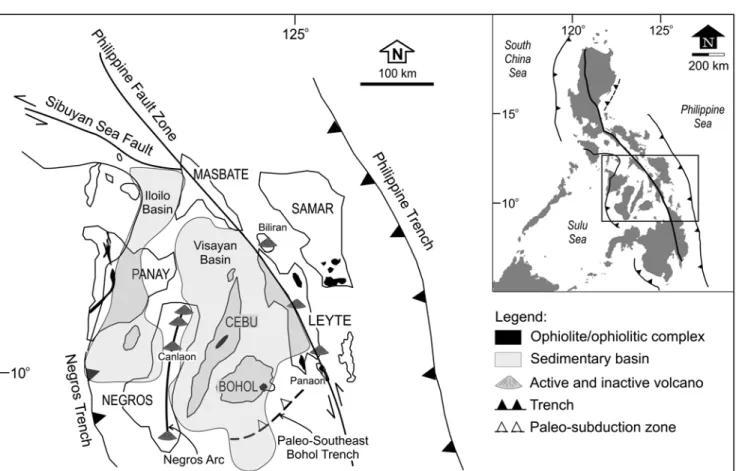
Central Philippines is made up of the islands of Panay, Negros, Cebu, Bohol, Leyte and Samar (Fig. 1). It is bounded by the east-dipping Negros Trench in the west and the west- dipping Philippine Trench in the east. The left-lateral strike- slip Philippine Fault Zone and the Sibuyan Sea Fault traverse Central Philippines in Leyte, and offshore north of Panay, respectively. The latter was recently determined to have a slip rate of 2.3±0.2 cm/yr (Bacolcol et al., 2004).
The subduction of the Sulu Sea basin along the Negros C.B. Dimalanta*
L.O. Suerte G.P. Yumul Jr.
R.A. Tamayo Jr.
E.G.L. Ramos }
Tectonics and Geodynamics Group, National Institute of Geological Sciences, College of Science, University of the Philippines, Diliman, Quezon City, Philippines 1101
Now with the Department of Earth Resources Engineering, Kyushu University, Fukuoka, 812-8581 Japan and the Mines and Geosciences Bureau Regional Office No. 6, Department of Environment and Natural Resources, Iloilo City, Philippines
Also with the Philippine Council for Industry and Energy Research and Development and the Philippine Atmospheric, Geophysical and Astronomical Services Administration, Department of Science and Technology, Bicutan, Taguig, Philippines
Tectonics and Geodynamics Group, National Institute of Geological Sciences, College of Science, University of the Philippines, Diliman, Quezon City, Philippines 1101
*Corresponding author: [email protected]; [email protected]
306 C.B. Dimalanta, L.O. Suerte, G.P. Yumul Jr., R.A. Tamayo Jr. and E.G.L. Ramos
Trench on the western side of the region produced the Negros Arc, which includes the active Canlaon volcano. To the east, westward subduction along the Philippine Trench at ca. 4-5 Ma triggered the volcanism in Leyte. This is seen as a 250-km long volcanic belt extending from Biliran to Panaon islands (Sajona et al., 1997) (Fig. 1). Sedimentary basins, which have been targets of petroleum and energy resource exploration, are also found in Central Philippines.
The Iloilo basin is an asymmetric basin with a 5000-m thick fill composed of Oligocene to Recent sedimentary rocks (Japan International Cooperation Agency, 1982). The Visayan Basin is approximately 4000 meters thick and consists of a Middle Oligocene to Pleistocene sedimentary sequence (Aurelio and Pena, 2002) (Fig. 1). In addition to being an exploration ground for petroleum and energy resources, some of the ophiolites and ophiolitic complexes in Central Philippines host metallic mineral deposits such as chromite, nickel, platinum-group minerals and massive sulfides.
2.2. Geophysical Characteristics
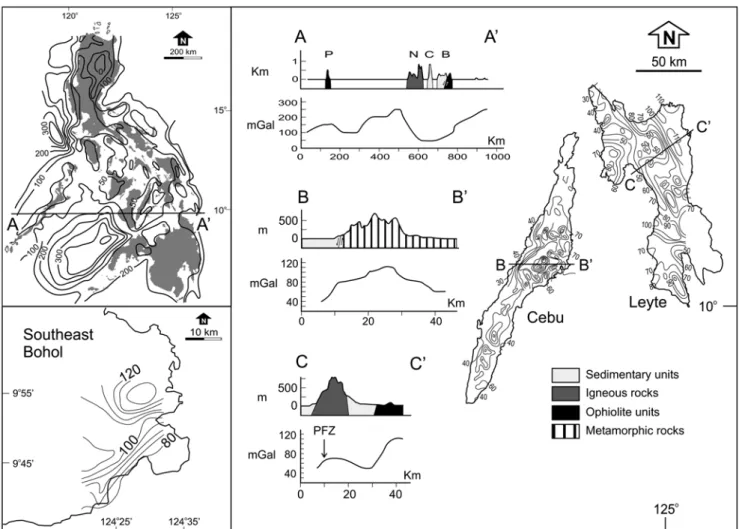
Recent anomaly maps produced using the marine gravity data of Sandwell and Smith (1997) show a distinct gravity low southeast of Bohol island. This feature is interpreted to correspond to the proto-Southeast Bohol Trench (Yumul et
al., 2001). The trace of the Philippine Fault Zone in Leyte island can be clearly traced from the linearity of the Bou- guer anomalies and the linear distribution of aeromagnetic anomalies (Japan International Cooperation Agency–Metal Mining Agency of Japan, 1990) (Figs. 2 and 3). On the free-air and Bouguer anomaly maps of the Philippines, a nearly north-south trending gravity low between Negros and Cebu can be seen (Sonido, 1981) (Inset A in Fig. 2). This anom- aly seems to coincide roughly with the Visayan Basin. A tomographic image drawn across the Visayas in central Philippines reveals the horseshoe-shaped slabs correspond- ing to Sangihe and Halmahera. A 250-km long west-dip- ping feature is interpreted to correspond to the slab which has been consumed along the Philippine Trench (Rangin et al., 1999).
2.3. Geochronological Information on Ancient Arcs Some of the oldest arc rocks in the Philippine archipelago are found in Central Philippines. A diorite from Cebu yielded a crystallization age of 109+2 Ma using the U-Pb isotopic dating method (Kerntke et al., 1992). Arc rocks, which are mostly calc-alkaline in chemistry, are found in Negros. A batholith sample from southwestern Negros yielded ages of 38.4±2.0 Ma and 34.4±2.0 Ma using the K-Ar iso-
Fig. 1. Tectonic elements of Central Philippines. The majority of the islands comprising Central Philippines is underlain by Cretaceous ophiolite complexes. See text for details.
topic dating method (Mitchell and Leach, 1991). In Panay, the basalts, andesites and volcaniclastic rocks comprising the volcanic arc gave K-Ar isotopic ages ranging from 30 to 21.5 Ma (Bellon and Rangin, 1991). Finally, an age of 20.9±2.3 Ma using the K-Ar method was obtained from a gabbro sample collected from northern Leyte (Sajona et al., 1997).
2.4. Cretaceous Scenarios
Various workers who attempted to come up with a syn- thesized tectonic reconstruction model for the Southeast Asian region often encounter difficulties when it comes to the Philippine island arc system. The insufficient data about the western boundary of the Philippine Sea plate is further complicated by the interactions between the oppositely-dip- ping subduction systems surrounding the Philippine archi-
pelago. Thus, paleogeographic reconstructions of the region prior to the Late Cretaceous are not well-constrained (Pubellier et al., 2003). Nevertheless, recent data from Southeast Asia suggest the following scenarios. The Huatung Basin, which was determined by Deschamps et al. (2000) to have opened on the northern hemisphere during the Cretaceous age, could have been part of the proto-South China Sea Basin (Hall, 2002). At about the same period, the Zamboanga- North Sulawesi-Luzon Arc, thought to be an extension of the West Sulawesi – North Borneo continental margin, could have corresponded to an Andean-type margin at the periph- ery of the western Pacific. The Mesozoic also saw the break off of microcontinental blocks from the northern Australian margin (Pubellier et al. 2003). These northwesterly drifting terranes eventually collided with the Sundaland block in the early Miocene. The Philippine island arc system itself is made up of island arc and ophiolite materials, which are
Fig. 2. Airborne gravity maps for the islands of Cebu and Leyte (modified from JICA-MMAJ, 1990) show that relatively high values characterize the central part of Cebu and the northeastern and southwestern tips of Leyte. The segment of the Philippine Fault Zone in Leyte can be traced from the linear configuration of the gravity anomalies. Inset A shows the Bouguer anomaly map of the Philippines (modified from Sonido, 1981) where a prominent gravity low is interpreted to correspond to the Visayan Basin. Inset B shows the ground gravity anomalies for Southeast Bohol (from Barretto et al., 2000). Linear gravity anomalies accompanied by steep gradients have been reported in areas underlain by ophiolitic units. Contours are in mgals. Gravity profiles are also drawn across Central Philippines (P = Palawan; N = Negros; C = Cebu and B = Bohol) (A-A’), Cebu (B-B’) and Leyte (C-C’).
308 C.B. Dimalanta, L.O. Suerte, G.P. Yumul Jr., R.A. Tamayo Jr. and E.G.L. Ramos
dominantly Cenozoic in age (Bureau of Mines and Geo- sciences, 1982; Hall, 2002). Although Cretaceous arc rocks and ophiolitic rocks have also been reported, these occur mostly in the eastern part of the archipelago (Pubellier et al., 2004; Tamayo et al., 2004).
3. CRETACEOUS CENTRAL PHILIPPINE OPHIO- LITES
Most of what we know now about the Central Philippine region is the outcome of the various investigations which have been conducted recently in this part of the archipelago.
Regional geologic mapping on a 1:50,000 scale have been carried out in Western Panay-Antique, Central Cebu, South- east Bohol, northern and southern Leyte and southern Samar.
Geochemical analyses of samples collected during the geo-
logic mapping of these areas were also undertaken. Ground gravity and magnetic surveys at 1 kilometer station inter- vals were also conducted in Southeast Bohol. Cretaceous ophiolites and dismembered ophiolitic rocks underlie the islands in Central Philippines (Table 1). These emplaced oceanic lithospheric fragments are covered by sedimentary carapace that indicates deep marine environment (e.g., chert, pelagic limestone) or relatively shallow, land-bound marine setting (e.g., tuffaceous sandstone). Associated metamorphic rocks of varying origin (e.g., metamorphic soles of amphib- olite, serpentinite, regionally metamorphosed rocks and ocean floor metamorphosed rocks) have also been mapped. Mélanges, ranging from tectonic to sedimentary, are associated with some of the ophiolite and ophiolitic complexes. A description of the different ophiolite and ophiolitic complexes in Central Philippines that we have mapped follows.
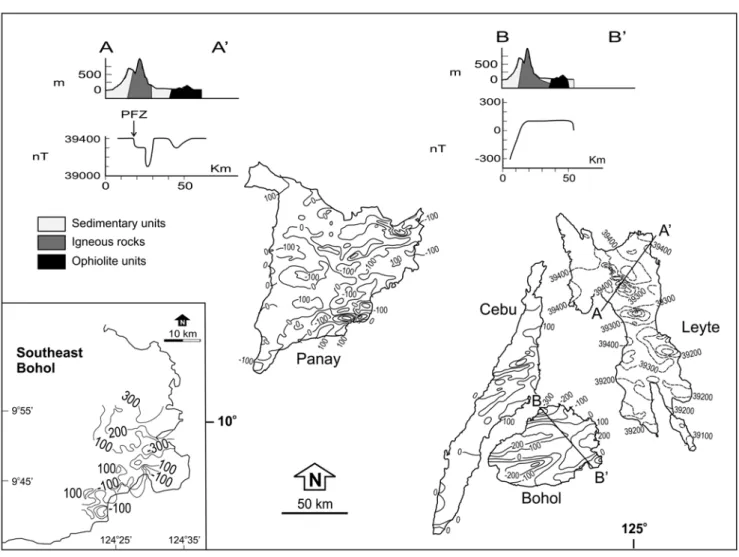
Fig. 3. Aeromagnetic anomalies for the islands of Panay, Cebu, Bohol and Leyte (modified from JICA-MMAJ, 1990) (dashed line = total magnetic intensity values; solid line = International Geomagnetic Reference Field-reduced magnetic anomalies). Generally high magnetic anomaly values (100 nT; 39300-39400 nT) characterize areas underlain by the ophiolite units. In Leyte, the trace of the Phil- ippine Fault Zone is defined by the linear distribution of the magnetic anomalies. Inset A shows the Central Philippine islands in the gray boxed area. Inset B shows the ground magnetic anomalies for Southeast Bohol (from Barretto, 1998). The positive anomalies coin- cide with the schist, melange and ophiolite units. Magnetic profiles across northern Leyte (A-A’) and northeastern Bohol (B-B’) are also shown. Contours are in nT.
3.1. Antique Ophiolite Complex
The Antique Ophiolite Complex is exposed along the west- ern part of Panay Island as dismembered fragments of harzburgites, serpentinites, minor dunites, isotropic gabbros and mostly pillow basalts (United Nations Development Programme, 1986; Tamayo et al., 2001). Sheeted dike expo- sures are sparse. The ophiolite units are separated from each other by northwest-striking thrust faults, which are over- printed by the northeast-trending thrust contacts between the ophiolite and younger formations. Exposures of the ophi- olite units are best observed in Bongbongan and Sibalom River in southwestern Panay. The pelagic sedimentary rocks consist of red chert, mudstone, green siltstone, man- ganiferous shale, calcarenite and thin tuffaceous sediments.
Rangin et al. (1991) collected Early Cretaceous (Barremian – Aptian) radiolarian-bearing chert from this sedimentary cover. Serpentinite bodies containing blocks of ultramafic rocks, gabbros, pillow basalts and sedimentary rocks intruded the ophiolite. Younger volcaniclastic and sedimentary rocks are in thrust contact with or unconformably overlie the iso- lated elongate ophiolitic bodies. Ophiolitic clasts in the overly- ing sedimentary sequence dated to Middle Miocene indicate that the ophiolite was exposed by then. A Middle Miocene mélange outcrops east of the ophiolite but the contact between
the two units is not known (Fig. 4) (Tamayo et al., 2001).
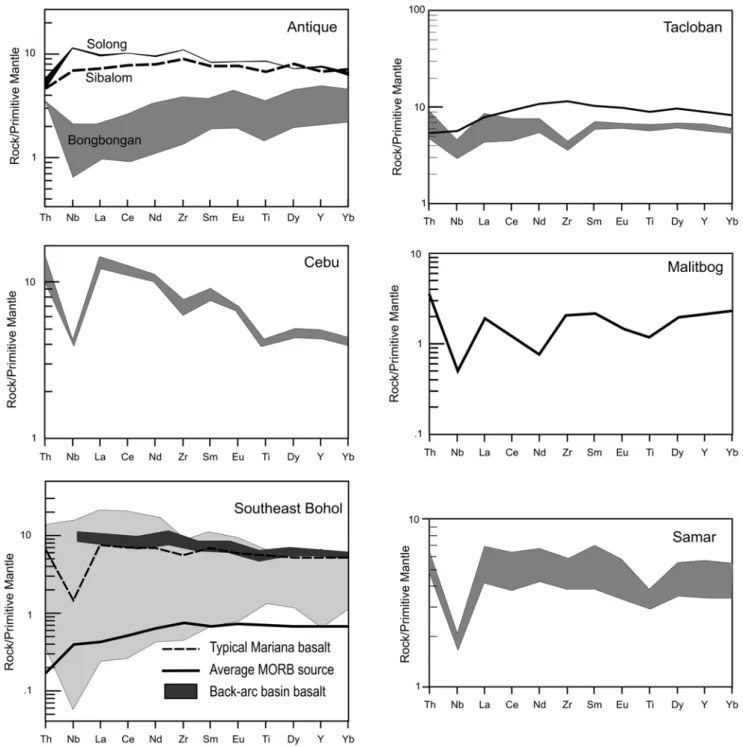
The basalt and diabase collected from Solong, Bongbon- gan and Sibalom are mostly olivine tholeiites. XMg values vary from 0.51 (Solong) to 0.73 (Bongbongan) and the Cr and Ni contents increase from the Solong group to the Bongbongan group (Cr > 400 ppm, Ni > 150 ppm) (Tamayo et al., 2001). The Bongbongan rocks display negative Nb and Ti anomalies, whereas the Sibalom group exhibits slight negative Ti anomaly in multi-element diagrams normalized to primitive mantle values of Sun and McDonough (1989) (Fig. 5). Mineral chemistry data of the ultramafic rocks reveal that their olivine is highly magnesian (XMg = 0.901 –0.916) and their spinel is characterized by a wide range of XCr [Cr/(Cr+Al)] values (0.23-0.66). The chemistry of the volcanic rocks also shows varying geodynamic affinities.
The Solong group exhibits transitional mid-oceanic ridge basalt (nearly flat multi-element patterns from Yb to Nb) signature, whereas the Sibalom group displays normal mid- oceanic ridge basalt signatures (relatively flat patterns from Yb to Nd that decrease towards Th). On the other hand, the Bongbongan rocks exhibit affinity with transitional island arc – mid oceanic ridge basalts (U-shaped multi-element spectra) (Tamayo et al., 2001). All of these geochemical signatures, as will be expounded later, are consistent with a subduction zone-related oceanic basin origin for the rocks.
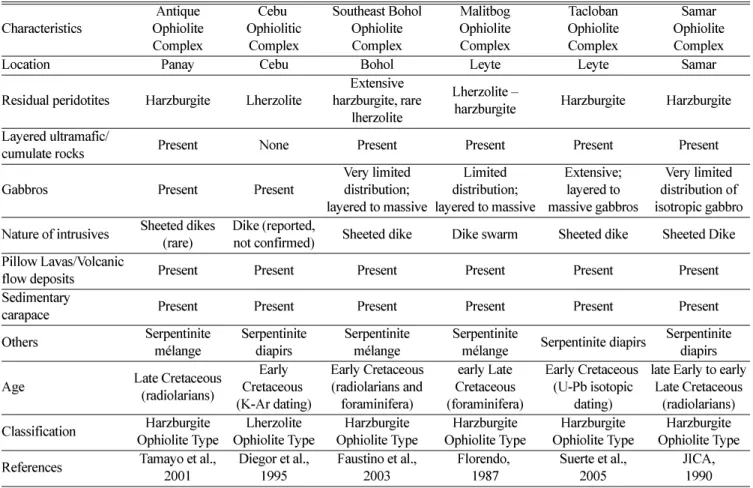
Table 1. Summary of the lithologic units and the different characteristics of the Central Philippine ophiolite and ophiolitic complexes.
Characteristics Antique Ophiolite Complex
Cebu Ophiolitic
Complex
Southeast Bohol Ophiolite Complex
Malitbog Ophiolite Complex
Tacloban Ophiolite Complex
Samar Ophiolite Complex
Location Panay Cebu Bohol Leyte Leyte Samar
Residual peridotites Harzburgite Lherzolite Extensive harzburgite, rare
lherzolite
Lherzolite –
harzburgite Harzburgite Harzburgite Layered ultramafic/
cumulate rocks Present None Present Present Present Present
Gabbros Present Present Very limited
distribution;
layered to massive
Limited distribution;
layered to massive
Extensive;
layered to massive gabbros
Very limited distribution of isotropic gabbro Nature of intrusives Sheeted dikes
(rare) Dike (reported,
not confirmed) Sheeted dike Dike swarm Sheeted dike Sheeted Dike Pillow Lavas/Volcanic
flow deposits Present Present Present Present Present Present
Sedimentary
carapace Present Present Present Present Present Present
Others Serpentinite
mélange Serpentinite
diapirs Serpentinite
mélange Serpentinite
mélange Serpentinite diapirs Serpentinitediapirs
Age Late Cretaceous
(radiolarians)
Early Cretaceous (K-Ar dating)
Early Cretaceous (radiolarians and
foraminifera)
early Late Cretaceous (foraminifera)
Early Cretaceous (U-Pb isotopic
dating)
late Early to early Late Cretaceous
(radiolarians) Classification Harzburgite
Ophiolite Type Lherzolite
Ophiolite Type Harzburgite
Ophiolite Type Harzburgite
Ophiolite Type Harzburgite
Ophiolite Type Harzburgite Ophiolite Type References Tamayo et al.,
2001 Diegor et al.,
1995 Faustino et al.,
2003 Florendo,
1987 Suerte et al.,
2005 JICA,
1990
310 C.B. Dimalanta, L.O. Suerte, G.P. Yumul Jr., R.A. Tamayo Jr. and E.G.L. Ramos
3.2. Cebu Ophiolitic Complex
Lherzolites and harzburgites, metamorphic and volcanic rocks as well as a Cretaceous sedimentary unit compose the basement complex of Cebu. These are exposed mostly in the central portion of the island. The chlorite orthoschists and micaceous paraschists are believed to be the metamor- phosed mafic cumulate sequence of the ophiolite complex (Diegor et al., 1995). Pillow lavas of basalt to pyroxene andesite composition are seen intercalated with thin layers of chert (Aurelio and Peña, 2002). Serpentinite diapirs occur along major fault systems. Some of these diapiric bodies are associated with lherzolites and layered mafic sequences (Diegor et al., 1995). A Late Cretaceous sedimentary unit unconformably overlies the pillow lavas. This is still believed to be part of the dismembered ophiolitic complex due to the reported presence of bedded chert and pillow basalt intercalations within the limestone and clastic sequence (Aurelio and Peña, 2002) (Fig. 6).
On the FeO/MgO versus TiO2 (wt%) diagram, the vol-
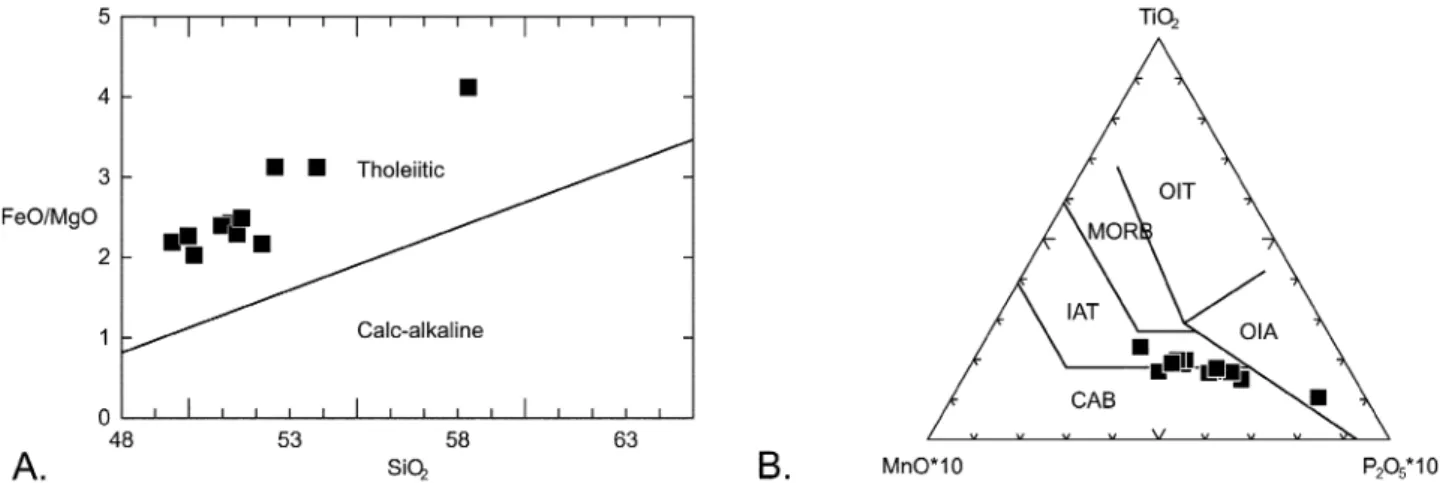
canic rock samples display increasing TiO2 with increasing FeO/MgO. The tholeiitic character of the samples is also evident when the samples are plotted on the FeO/MgO ver- sus SiO2 (wt%) diagram (Fig. 7a). In the MnO-TiO2-P205 discrimination diagram of Mullen (1983), the samples plot mostly within the CAB and IAT fields (Fig. 7b). Further- more, the basalts display distinct negative Nb, Zr and Ti anomalies with respect to their adjacent elements in multi- element spectra normalized to the primitive mantle values of Sun and McDonough (1989) (Fig. 5). The geochemical signatures displayed by the Cebu samples are typical of island arc volcanic rocks.
3.3. Southeast Bohol Ophiolite Complex
A striking feature in the basement complex of Southeast- ern Bohol is the presence of metamorphic rocks, tectonic mélange (Cansiwang Mélange) and a complete ophiolite sequence (Southeast Bohol Ophiolite Complex) (e.g., Barretto et al., 2000; De Jesus et al., 2000). These different units are
Fig. 4. Geologic map of Panay island showing the distribution of the ophiolite units, metamorphic rocks and mélange (from Tamayo et al., 2001). The stratigraphic column for western Panay is also shown (from Aurelio and Peña, 2002). The Antique Ophiolite Complex is found in the western portion of Panay island. The ophiolite units are separated from each other by northwest-verging thrust faults.
separated from each other by thrust faults that are generally north-oriented and dipping to the west (Yumul et al., 2001) (Fig. 8). The metamorphic rock unit consists of chlorite schist, quartz-sericite schist and amphibolite schist. The mélange consists of ophiolitic clasts and chert set in a ser- pentinite matrix. Harzburgites with occasional lherzolites, massive to layered gabbros and norites, sheeted dike com-
plex, basaltic to andesitic sheet flows and pillow lavas com- prise the ophiolite complex. This is overlain by pelagic chert and manganiferous umber. The ophiolite complex was dated Early Cretaceous based on the radiolarian and fora- miniferal assemblage found in the chert unit (Faustino et al., 2003). On the total alkalis diagram of Irvine and Baragar (1971), the Southeast Bohol Ophiolite Complex volcanic
Fig. 5. Multi-element spectra for the Central Philippine ophiolites. The back-arc basin basalt field is from East Scotia Sea samples (Saun- ders and Tarney, 1979 in Wilson, 1989). The dashed line defines typical Mariana basalts whereas the solid line corresponds to the average MORB (from Elliott in http://www.margins.wustl.edu/Eugene_PDF/ SubFac_abstract_Elliot.pdf). The negative Nb, Zr and Ti anomalies displayed by most samples are indicative of generation in a marginal basin. Sources: Antique = Tamayo et al., 2001; Southeast Bohol
= Faustino et al., 2003; Tacloban = Suerte et al., 2005; Cebu, Malitbog and Samar = J. Cotten (analyst).
312 C.B. Dimalanta, L.O. Suerte, G.P. Yumul Jr., R.A. Tamayo Jr. and E.G.L. Ramos
rocks display a calc-alkaline to tholeiitic character. Whole rock geochemical analysis of the volcanic and hypabyssal rocks comprising the SEBOC indicates the presence of four types of lavas: boninitic rocks, mid-oceanic ridge basalt- like lavas, calc-alkaline basalts and high magnesian andes-
ites (Yumul et al., 2001; Faustino et al., this volume). Min- eral chemistry data of some mafic cumulate rocks show XMg values of 0.65–0.85 for the clinopyroxenes and 0.74–
0.82 for the orthopyroxenes. The XCr values in the spinels decrease from the harzburgites (XCr = 0.24-0.49) to the
Fig. 6. Geologic map (modified from Diegor et al., 1995) and stratigraphic column of Cebu island (modified from Aurelio and Peña, 2002). The basement complex consists of a dismembered ophiolite complex, metamorphic rocks and volcanic rocks. Lherzolites, harzburgites, pillow basalts intercalated with thin layers of chert comprise the dismembered ophiolite complex.
Fig. 7. A. The Cebu volcanic rock samples plot within the tholeiitic field of the FeO/MgO versus SiO2 (wt%) diagram. B. In the MnO- TiO2-P205 discrimination diagram of Mullen (1983), the samples plot mostly within the CAB and IAT fields.
lherzolites and wehrlites (XCr = 0.16-0.18) (Faustino, 2000;
Yumul et al., 2001) (Table 2). The geochemical signatures observed from the whole rock, trace and rare earth element data of the Southeast Bohol rocks imply their generation in a supra-subduction zone setting (Faustino et al., this volume).
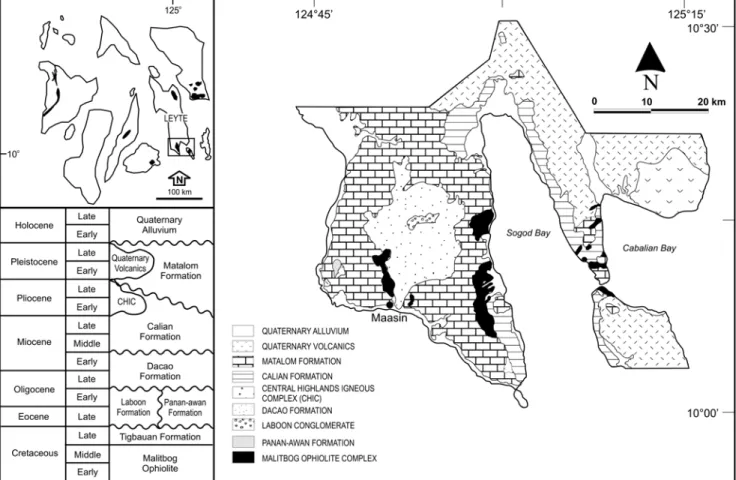
3.4. Malitbog Ophiolite Complex
The Malitbog Ophiolite Complex outcrops in the south- ern portion of Leyte (Fig. 9). Its mantle sequence includes both harzburgites and lherzolites along with occasional dunites.
The layered ultramafic sequence consists of dunite, pyrox- enite, harzburgite. Gabbros to anorthosites, isotropic gabbros, diabase dike swarms and pillow lava deposits complete this ophiolite sequence. Northeast-trending thrust faults bound the different units of the ophiolite. A sedimentary carapace
consisting of interbedded chert, mudstone, sandstone and limestone overlies the ophiolite complex. The Malitbog Ophi- olite Complex was assigned a Late Cretaceous age based on the foraminifera (Globotruncana helvetica) found in the micritic limestones overlying the pillow lava deposit (Flo- rendo, 1987).
The XMg and XCr of olivine and spinel, respectively, increase from the lherzolites (0.90−0.91 and 0.11−0.14) to harzburgites (0.90−0.91 and 0.20−0.45) (Tamayo, 2001).
These values are typical of oceanic mantle rocks that have undergone different degrees of partial melting (Dick and Bullen, 1984; Arai, 1987; Dick, 1989). Whole rock geochemical data for a diabase collected from this ophiolite displays rel- atively primitive characteristics (Cr=450 ppm; Ni=252 ppm).
Its multi-element pattern normalized to the Primitive Man- tle values of Sun and McDonough (1989) is U-shaped, with
Fig. 8. Geologic map and stratigraphic column of Southeast Bohol island (modified from Yumul et al., 2001). A complete ophiolite com- plex, tectonic mélange and metamorphic rocks comprise the basement of Southeast Bohol. These rock units are in thrust contact with each other.
314 C.B. Dimalanta, L.O. Suerte, G.P. Yumul Jr., R.A. Tamayo Jr. and E.G.L. Ramos
prominent negative peaks in Ti and Nb similar to that observed in some supra-subduction related magmas (e.g., Kurth-Velz et al., 2004; Beccaluva et al., 2005) (Fig. 5). The geochemical signatures of both the mantle and crustal rocks suggest their derivation from a supra-subduction related geodynamic setting.
3.5. Tacloban Ophiolite Complex
This ophiolite complex exposed in Northeastern Leyte outcrops as a northwest-southeast trending massif com- posed of harzburgites, layered to isotropic gabbros, sheeted diabase and basalt dike complex, and pillowed and massive basaltic lava flow deposits. The most predominant unit of the Tacloban Ophiolite Complex is the isotropic gabbro sec- tion (Fig. 10). Several serpentinite diapirs, which contain ophiolitic clasts, intrude the ophiolite complex. Red and green siliceous metasedimentary rocks with subordinate red chert cap the ophiolite. Sensitive High Resolution Ion Micro- probe (SHRIMP) U-Pb isotopic dating of zircons from a gabbro gave this ophiolite an Early Cretaceous age (145.1
±3.2 Ma) (Suerte et al., 2005). On the Harker-type diagrams, the increasing whole rock Fe2O3 and TiO2 indicate the tholeiitic character of the volcanic and hypabyssal rocks. When plotted on the MnO-TiO2-P205 diagram of Mullen (1983), the rocks exhibit affinities with both mid-oceanic ridge and supra-subduction zone-related lavas. The multi-element spectra normalized to the Primitive Mantle values of Sun and McDonough (1989) of the basalts exhibit two general trends: a generally flat pattern with distinct negative Nb and Zr anomalies, with or without negative Ti spikes, and another relatively flat pattern but with noticeable depletion in Th (Suerte, 2005; Suerte et al., 2005) (Fig. 5). These spectra are similar to those exhibited by arc and N-MORB lavas, respectively.
3.6. Samar Ophiolite Complex
The Japan International Cooperation Agency – Metal Min- ing Agency of Japan (JICA-MMAJ) (1990) reports the pres- ence of a complete ophiolite sequence in southern Samar. It is made up of harzburgites and dunites, isotropic gabbro,
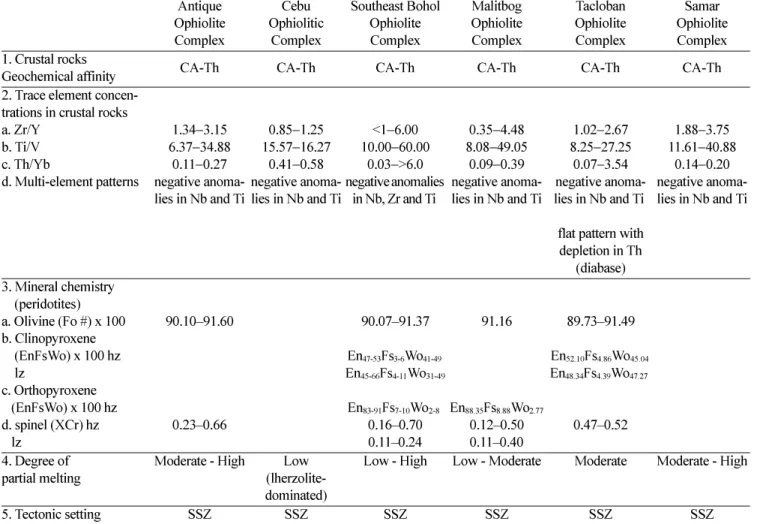
Table 2. Comparison of the geochemistry of ophiolites and ophiolitic complexes in Central Philippines. Data were taken from Tamayo et al. (2001), Yumul et al.(2001), Faustino et al. (2003) and Suerte et al. (2005).
Antique Ophiolite Complex
Cebu Ophiolitic
Complex
Southeast Bohol Ophiolite Complex
Malitbog Ophiolite Complex
Tacloban Ophiolite Complex
Samar Ophiolite Complex 1. Crustal rocks
Geochemical affinity CA-Th CA-Th CA-Th CA-Th CA-Th CA-Th
2. Trace element concen- trations in crustal rocks a. Zr/Y
b. Ti/V c. Th/Yb
d. Multi-element patterns
1.34−3.15 6.37−34.88
0.11−0.27 negative anoma- lies in Nb and Ti
0.85−1.25 15.57−16.27
0.41−0.58 negative anoma- lies in Nb and Ti
<1−6.00 10.00−60.00
0.03−>6.0 negative anomalies
in Nb, Zr and Ti
0.35−4.48 8.08−49.05
0.09−0.39 negative anoma- lies in Nb and Ti
1.02−2.67 8.25−27.25
0.07−3.54 negative anoma- lies in Nb and Ti flat pattern with depletion in Th
(diabase)
1.88−3.75 11.61−40.88
0.14−0.20 negative anoma- lies in Nb and Ti
3. Mineral chemistry (peridotites) a. Olivine (Fo #) x 100 b. Clinopyroxene (EnFsWo) x 100 hz lz
c. Orthopyroxene (EnFsWo) x 100 hz d. spinel (XCr) hz lz
90.10–91.60
0.23–0.66
90.07–91.37 En47-53Fs3-6Wo41-49 En45-66Fs4-11Wo31-49
En83-91Fs7-10Wo2-8 0.16–0.70 0.11–0.24
91.16
En88.35Fs8.88Wo2.77 0.12–0.50 0.11–0.40
89.73–91.49 En52.10Fs4.86Wo45.04 En48.34Fs4.39Wo47.27
0.47–0.52 4. Degree of
partial melting Moderate - High Low (lherzolite- dominated)
Low - High Low - Moderate Moderate Moderate - High
5. Tectonic setting SSZ SSZ SSZ SSZ SSZ SSZ
sheeted diabase dike/sill complex and basaltic pillow and sheet flow deposits (Fig. 11). Chert is intercalated with the pillow basalts. Radiolarians (Vitorfus campbelli pessagno and Sciadiocapsa sp)were extracted from cherts collected along the National Highway in Pinamitinan, Marabut, Western Samar (approximately at 11º05’N, 125º25’E) giving an Early to Late Cretaceous age for the ophiolite (Marquez, pers. comm., 2003). Available geochemical data for some samples col- lected from the Samar Ophiolite Complex show an increas- ing TiO2 with increasing FeO/MgO. The tholeiitic character of the samples is also evident when plotted on the FeO/MgO versus SiO2 (wt.%). Distinct negative Nb and Ti anomalies and a slight Zr anomaly can be noted on the multi-element spectra normalized to the Primitive Mantle values of Sun and McDonough (1989) of the rocks (Fig. 5). This geochemical signature is typical of supra-subduction zone-related lavas.
4. MORPHOLOGY, STRUCTURE AND GEOCHEM- ISTRY OF THE OCEANIC LITHOSPHERES
The lithologic characteristics of the Cretaceous ophiolites in Central Philippines are summarized in Table 1. Except
for the Cebu and Malitbog Ophiolite Complexes, all of the ophiolites have harzburgitic mantle sections typical of the oceanic mantle related to intermediate- to fast-spreading centers (e.g. Boudier and Nicolas, 1985; Yumul, 2003). Exposures of the gabbroic section in these ophiolites range from lim- ited to extensive. In slow spreading-centers, the gabbros occur as pods hosted by the peridotites suggestive of inter- mittent magmatism (e.g., Lagabrielle et al., 1998). Most of the ophiolites have well-developed dike complex and vol- canic sequence. Extensive normal faulting which is typical in slow-spreading centers are seldom observed in these sequences. As a whole, these features suggest that the majority of the exposed oceanic lithospheric fragments in Central Philippines were generated in intermediate- to fast- spreading centers. The representative geochemical charac- teristics of the Central Philippine ophiolite and ophiolitic complexes as summarized in Table 2 show that the associ- ated volcanic rock sequences are mostly basaltic and exhibit calc-alkaline to tholeiitic chemical characteristics. The rocks display a wide range of Ti/V (8.08–49.05), which falls within the values typical of island arc tholeiites as well as mid-ocean ridge and back-arc basin basalts. However, the
Fig. 9. Geologic map and stratigraphic column of southern Leyte island (modified from 2003 Geology 170 and 215 classes). Units that make up the Malitbog Ophiolite Complex are distributed throughout the southern portion of Leyte island and in Panaon island. Northeast- trending thrust faults separate the ophiolite units.
316 C.B. Dimalanta, L.O. Suerte, G.P. Yumul Jr., R.A. Tamayo Jr. and E.G.L. Ramos
majority of the samples show strong negative anomalies in Nb and Ti in multi-element spectra normalized to Primitive Mantle values. This set of information suggests that the var- ious lithologies of the Central Philippine oceanic lithos- pheric fragments were generated in a supra-subduction zone environment. The mineral chemistry values of olivine Fo#
and spinel XCr range, respectively, from 0.90−0.92 and 0.12−0.70. The latter is mostly < 0.60 implying that the mantle rocks have undergone relatively low degrees of par- tial melting as compared to most island arc-related peridot- ites (Arai and Matsukage, 1998; Andal et al., 2005). As a whole, the geochemistry of Cretaceous Central Philippine crustal and mantle rocks suggest their derivation from a supra subduction zone-related oceanic basin. Rocks associ- ated with supra-subduction zone complexes are generally depleted in high field strength elements (such as Nb, Ta, Hf,
Ti and Zr) (e.g. Hawkins and Florendo, 1992). Pearce et al.
(1984) introduced the term supra-subduction zone ophiolite for ophiolites formed above a subduction zone during the early stages of arc development.
5. GEOPHYSICAL CHARACTERISTICS ASSOCIATED WITH THE OCEANIC LITHOSPHERES
Cebu island displays Bouguer anomalies ranging from 30 to ~120 mgals (Fig. 2). Closed positive gravity anomalies (80 to 120 mgals) are observed in the central portion of the island coinciding with the location of mapped ophiolitic units. The gravity signatures of Cebu island are typical of extensively fragmented terranes such as ophiolitic com- plexes (Milsom et al., 1996). Aeromagnetic anomaly data for the island show anomalies varying from 100 to 200
Fig. 10. Geologic map and stratigraphic column of northeastern Leyte island (modified from Suerte et al., 2005). The ophiolite complex is seen as a northwest-trending massif that is dominated by gabbro. The ophiolite complex is intruded in some portions by serpentinite diapirs.
gammas (equivalent to nT) (JICA-MMAJ, 1990). Similar to the gravity anomalies, the relatively high magnetic anom- alies occur over the central portion of Cebu island where the ophiolitic complex has been mapped.
The adjacent island of Bohol was also covered by air- borne magnetic surveys (JICA-MMAJ, 1990). In addition to the airborne geophysical surveys, ground magnetic and gravity surveys were also carried out specifically in the southeastern portion of the island where the Southeast Bohol Ophiolite Complex is exposed (Barretto et al., 2000).
The aeromagnetic map shows anomaly values ranging from –200 to 200 gammas (equivalent to nT). The anomalies generally trend east-west and a large northeast-southwest trending linear feature in the eastern part of the island seems to be defined by the distribution of highs and lows. No prom- inent aeromagnetic anomalies can be observed in southeast- ern Bohol. The ground geophysical surveys produced more distinct gravity and magnetic signatures. The linear distri- bution of the gravity anomalies which trends northeast- southwest coincides with the distribution of the schists, andesites and the lithologic units of the ophiolite complex.
The linearity of the gravity anomalies accompanied by steep gradients has also been reported for other areas under- lain by ophiolitic units (Milsom, 1973; Dimalanta, 1994).
Total magnetic intensities measure from 39250 to 40040 nT and the resulting magnetic anomalies after correcting for
the International Geomagnetic Reference Field (IGRF) vary from –766 to 466 nT. The positive magnetic anomalies are found to coincide with the schists, mélange and harzburgite units.
Airborne geophysical data for Leyte island were also obtained by the surveys done by the JICA-MMAJ in 1990.
Bouguer anomalies range from 30 to 110 mgals with the relatively high anomalies occurring in northeastern Leyte.
High gravity anomalies (80–100 mgals) are also observed in southern Leyte. These high gravity values correspond to the location of the ophiolite units in northeastern and south- ern Leyte. The igneous bodies in central Leyte also display high gravity values. The trace of the Philippine Fault Zone in Leyte can be clearly discerned from the linearity of the gravity anomalies. In terms of the aeromagnetic anomalies, Leyte island exhibits values from 39000 to 39500 gammas (equivalent to nT) (Fig. 3). Because of the relatively widely- spaced contour intervals, no distinct magnetic anomalies are noted over southern Leyte where the Malitbog Ophiolite Complex was mapped. In the general vicinity of northeast- ern Leyte, magnetic anomalies from 39300–39400 gammas are noted. Similar to the gravity anomalies, the linear dis- tribution of the magnetic anomalies serves to delineate the trace of the Philippine Fault Zone in Leyte island. Magnetic and gravity anomalies are not available for Samar island.
Anomalies coinciding with the distribution of units com-
Fig. 11. Geologic map and stratigraphic column of Southern Samar island. Ophiolite units were encountered during a recent mapping in Southern Samar. Radiolarians extracted from a chert intercalated with the pillow basalts yielded an Early to Late Cretaceous age.
318 C.B. Dimalanta, L.O. Suerte, G.P. Yumul Jr., R.A. Tamayo Jr. and E.G.L. Ramos
prising ophiolite sequences can be seen on available regional gravity and magnetic anomaly maps. The Cretaceous ophi- olite and ophiolitic complexes in Central Philippines gen- erally exhibit the same range of gravity and magnetic anomaly values. High magnetic anomalies are found to coincide with the Cretaceous ophiolite complexes similar to what has been observed in the Mineoka ophiolite belt, Japan (Fuji- wara et al., 1999). The wavelengths displayed on the mag- netic anomaly maps and profiles can be used to estimate depth-to-magnetic source. As a “rule of thumb”, deep sources are generally seen as long wavelengths whereas shallow sources are depicted as short wavelengths. Modelling of a ground magnetic profile from Southeast Bohol reveals that the short wavelength magnetic anomalies indicate basement at shallow depth. However, the aeromagnetic anomalies for the other islands are not of sufficient resolution to allow a discussion of the magnetic structure of the ophiolite bodies.
In terms of gravity anomalies, relatively high values (> 150 mgal) are typically associated with large ophiolite com- plexes such as the Troodos ophiolite in Cyprus and the Pap- uan ophiolite in New Guinea (Milsom, 1973; Milsom et al., 1996). The gravity anomalies observed for the Central Phil- ippine ophiolites are not as high as those exhibited by other large ophiolite complexes. This is taken to be indicative of the dismembered nature of these sequences. The ophiolite units were not emplaced as coherent blocks but are mostly seen as tectonic slices which have been emplaced by thrust faults.
6. GEODYNAMIC EVOLUTION OF CENTRAL PHILIPPINES
The recognition of around twenty complete and dismem- bered ophiolite sequences in various parts of the Philippine island arc system has allowed their classification into var- ious zonations or belts. With the scant data previously avail- able for these ophiolitic units, the zonations were initially based on geographic distribution. The geological, geochem- ical, geophysical and geochronological data that are cur- rently available for these oceanic lithospheric fragments have allowed modifications in the zonations in terms of identifying their possible sources. Tamayo et al. (2004) came up with four belts of ophiolites on the basis of their geochemical signatures and ages of formation. Their model suggests that most of the Philippine ophiolites and ophi- olitic complexes originated from supra-subduction environ- ments with only a few having formed at normal mid- oceanic ridges. Previous models for the evolution of Central Philippines involve an Early Cretaceous subduction which was followed by back-arc spreading in the eastern part of the region (Florendo, 1987). Another model suggested the existence of a subduction zone along the eastern side of the Philippines during the Late Cretaceous. An eastward migra- tion of the trench accounts for the spatial distribution of
ophiolites in Cebu, Bohol, Leyte and Samar (Yumul et al., 2001). Recent isotopic ages and geochemical data reinforce an earlier idea which proposes that the ophiolites along the eastern and central portions of the Philippines were gener- ated within a single oceanic basin. The oceanic basin which is most likely the source of the Cretaceous oceanic lithos- pheric fragments in central Philippines is the proto-Philip- pine Sea Plate. The differences in the geochemical signatures of the rocks can be attributed to the possible existence of several sub-basins in the proto-Philippine Sea Plate. As an example, the Philippine Sea Plate is made up of several basins that include the West Philippine Basin, Shikoku Basin and Parece Vela Basin. These sub-basins expose rocks that are characterized by varying geochemistry that ranges from MOR-like through back-arc to within-plate and island arc setting. The Shikoku and Parece Vela basins are inactive backarc basins and basalts collected from these basins reveal MORB characteristics (Okino et al., 1999). Samples obtained from ODP drilling in the West Philippine Basin show basalts that are transitional between island arc tholei- ites and MORB (de Bari et al., 1999). In the northern por- tion of the West Philippine Basin, basalts and tonalites from the Amami Plateau reveal intraoceanic island arc signatures (Hickey-Vargas, 2005).
7. CONCLUSIONS
Geologic mapping carried out in the different islands in Central Philippines - Panay, Cebu, Bohol, Leyte and Samar – show that most of the oldest rocks there represent either complete or dismembered fragments of oceanic lithosphere.
Recent age determinations using paleontological and/or iso- topic dating techniques yielded Early to Late Cretaceous ages for these ophiolites. The geochemical signatures of these Cretaceous ophiolite sequences show basaltic rocks with calc-alkaline to tholeiitic affinities. Pronounced negative Nb and Ti anomalies in the multi-element spectra normalized to primitive mantle values are displayed by most of the crustal sequence rocks. This is indicative of generation in a sub- duction-related oceanic basin. The Central Philippine ophi- olites generally coincide with high magnetic and gravity anomalies. The wavelengths of the magnetic anomalies indicate that the ophiolite units are not deeply rooted in the mantle. The low amplitude gravity anomalies are inter- preted to correspond to the dismembered nature of the ophi- olite units. The morphology and lithological characteristics of these ophiolite complexes are compatible with sequences generated in intermediate- to fast-spreading centers. Simi- larities in the age and geochemical signatures suggest that the ophiolites and ophiolitic complexes in Central Philip- pines were derived from a single oceanic basin. The Cre- taceous age of the crust-mantle sequences and their geochemical signatures make the proto-Philippine Sea Plate the most likely candidate for this oceanic basin.
ACKNOWLEDGEMENTS: Our geological, geochemical and geo- physical investigations were partly funded by the University of the Philippines – National Institute of Geological Sciences, Department of Science and Technology – Philippine Council for Industry and Energy Research and Development and the National Research Council of the Philippines. Laboratory analyses were conducted at the Geological Institute, University of Tokyo; Domaines Océaniques, Université de Bretagne Occidentale – Brest; Université Paul Sabatier; Department of Earth Sciences – University of Hong Kong. Field mapping was done together with the UP-NIGS 1997, 2002 and 2003 Geology 170 and Geology 215 classes. Logistic support provided by the Mines and Geo- sciences regional offices is acknowledged. Comments by Dr. T. Mor- ishita and an anonymous reviewer helped improve the manuscript.
REFERENCES
Andal, E.S., Arai, S. and Yumul, G.P. Jr., 2005, Complete mantle sec- tion of a slow-spreading ridge-derived ophiolite: An example from the Isabela ophiolite in the Philippines. The Island Arc, 14, 272−294.
Arai, S., 1987, An estimation of the least depleted spinel peridotite on the basis of olivine-spinel mantle array. Neues Jahrbuch für Min- eralogie Monatshefte, 347−354.
Arai, S. and Matsukage, K., 1998, Petrology of a chromitite micro- pod from Hess Deep, equatorial Pacific: A comparison between abyssal and alpine-type podiform chromitites. Lithos, 43, 1−14.
Aurelio, M.A. and Peña, R.E., 2002, Geology and Mineral Resources of the Philippines – Volume 1: Geology. Department of Environ- ment and Natural Resources – Mines and Geosciences Bureau, 391pp.
Bacolcol, T., Barrier, E. and Duquesnoy, T., 2004, Study of the Phil- ippine Fault in the Visayas through spatial geodesy. Eos, Trans.
AGU, 85(28), Western Pacific Geophysics Meeting Suppl., Abstract G32A-06.
Barretto, J.A.L., 1998, Magnetic and gravity variations along the Southeast Bohol Ophiolite Complex (SEBOC): Implications on its emplacement history. M.Sc. Thesis, University of the Philip- pines, 136pp.
Barretto, J.A.L., Dimalanta, C.B. and Yumul, G.P.Jr., 2000, Gravity variations along the Southeast Bohol Ophiolite Complex (SEBOC), Central Philippines: Implications on ophiolite emplacement. The Island Arc, 9, 575−583.
Beccaluva, L., Coltorti, M., Saccani, E. and Siena, F., 2005, Magma generation and crustal accretion as evidenced by supra-subduc- tion ophiolites of the Albanide-Hellenide Subpelagonian zone.
The Island Arc, 14, 551−563.
Bellon, H. and Rangin, C., 1991, Geochemistry and isotopic dating of Cenozoic volcanic arc sequences around the Celebes and Sulu seas. In: Silver, E.A., Rangin, C. and von Breymann, M.T. (eds.), Proceedings of the Ocean Drilling Program, Scientific Report, 124, 321−338.
Boudier, F. and Nicolas, A., 1985, Harzburgite and lherzolite sub- types in ophiolitic and oceanic environments. Earth and Plane- tary Science Letters, 76, 84−92.
Bureau of Mines and Geosciences, 1982, Geology and Mineral Resources of the Philippines – Volume 1. Manila, 175pp.
De Bari, S., Taylor, B., Spencer, K. and Fujioka, K., 1999, A trapped Philippine Sea plate origin for MORB from the inner slope of the Izu-Bonin trench. Earth and Planetary Science Letters, 174, 183−197.
De Jesus, J.V., Yumul, G.P.Jr. and Faustino, D.V., 2000, The Cansi-
wang Mélange of Southeast Bohol (Central Philippines): Origin and tectonic implications. The Island Arc, 9, 566−575.
Deschamps, A., Monie, P., Lallemand, S., Hsu, S.-K. and Yeh, K.Y., 2000, Evidence for Early Cretaceous oceanic crust trapped in the Philippine Sea Plate. Earth and Planetary Science Letters, 179, 503−516.
Dick, H.J.B., 1989, Abyssal peridotites, very slow spreading ridges and ocean ridge magmatism. In: Saunders, A.D. and Norry, M.J.
(eds.), Magmatism in the Ocean Basins. Geological Society Spe- cial Publication, 42, 71−105.
Dick, H.J.B. and Bullen, T., 1984, Chromian spinel as a petrogenetic indicator in abyssal and alpine-type peridotites and spatially asso- ciated lavas. Contributions to Mineralogy and Petrology, 86, 54−76.
Diegor, W.G., Momongan, P.C. and Diegor, E.J.M., 1995, The ophi- olitic basement complex of Cebu. Field Symposium on Ophio- lites and Related Mineralizations Proceedings, 13−16.
Dimalanta, C.B., 1994, Interpretation of geophysical anomalies over the southern Zambales area: Evidence for the Subic Bay Fault Zone. Journal of the Geological Society of the Philippines, 49, 1−13.
Dimalanta, C.B. and Yumul, G.P.Jr., 2003, Magmatic and amagmatic contributions to crustal growth of an island arc system: The Phil- ippine example. International Geology Review, 45, 922−935.
Dimalanta, C.B. and Yumul, G.P.Jr., 2004, Crustal thickening in an active margin setting (Philippines): The whys and the hows. Epi- sodes, 27, 260−264.
Faustino, D.V., 2000, Geochemical and petrological characterization of the Southeast Bohol Ophiolite Complex (SEBOC): implications on the tectonic evolution of Southeast Bohol. Unpublished MSc Thesis, University of the Philippines.
Faustino, D.V., Yumul, G.P.Jr., de Jesus, J.V., Dimalanta, C.B., Aitch- ison, J.C., Zhou, M.-F., Tamayo, R.A.Jr. and de Leon, M.M., 2003, Geology of Southeast Bohol, Central Philippines: accretion and sedimentation in a marginal basin. Australian Journal of Earth Sciences, 50, 571−583.
Faustino, D.V., Yumul, G.P.Jr., Dimalanta, C.B., de Jesus, J.V., Zhou, M.-F., Aitchison, J.C. and Tamayo, R.A.Jr., 200x, Volcanic-hypabyssal rock geochemistry of a subduction-related marginal basin ophi- olite: Southeast Bohol Ophiolite – Cansiwang Mélange Complex, Central Philippines. Geosciences Journal, this volume.
Florendo, F.F., 1987, The tectonic framework and the Cretaceous to Cenozoic evolution of the East-Central Philippines. M.Sc. thesis, University of Tulsa, Oklahoma, USA, 103pp.
Fujiwara, T., Kinoshita, H. and Morijiri, R., 1999, Magnetic structure of the southern Boso Peninsula, Honshu, Japan, and its implica- tions for the formation of the Mineoka Ophiolite Belt. Earth Planets Space, 51, 413−424.
Hall, R., 2002, Cenozoic geological and plate tectonic evolution of SE Asia and the SW Pacific: computer-based reconstructions, model and animations. Journal Asian Earth Sciences, 20, 353−431.
Hawkins, J.W. and Florendo, F., 1992, Supra-subduction zone mag- matism: Implications for the origin of Philippine ophiolites. Acta Geologica Taiwanica, 30, 163−171.
Hickey-Vargas, R., 2005, Basalt and tonalite from the Amami Pla- teau, northern West Philippine Basin: New Early Cretaceous ages and geochemical results, and their petrologic and tectonic impli- cations. The Island Arc, 14, 653−665.
Irvine, T.N. and Baragar, W.R.A., 1971, A guide to the chemical clas- sification of the common volcanic rocks. Canadian Journal of Earth Sciences, 8, 523−548.
Japan International Cooperation Agency (JICA), 1982, Basic survey report of Kyosui-Sei-Gasu Development Project in Iloilo Basin,