R E S E A R C H A R T I C L E Open Access
Comparison of the effects of adjuvant concurrent chemoradiotherapy and chemotherapy for resected biliary tract cancer
Hyera Kim * , Mi Hwa Heo and Jin Young Kim
Abstract
Background: Biliary tract cancers (BTC) have a poor prognosis even after curative resection because of frequent local and distant recurrences. Therefore, the importance of adjuvant therapy in BTC has been advocated to improve outcomes. However, the choice of adjuvant therapy is still controversial. The aim of this study was to compare the effects of adjuvant concurrent chemoradiotherapy (CCRT) and chemotherapy on resected BTC.
Methods: We analyzed 92 patients who had curatively resected BTC and had received adjuvant CCRT or chemotherapy from January 2000 to December 2017 at Keimyung University Dongsan Medical Center.
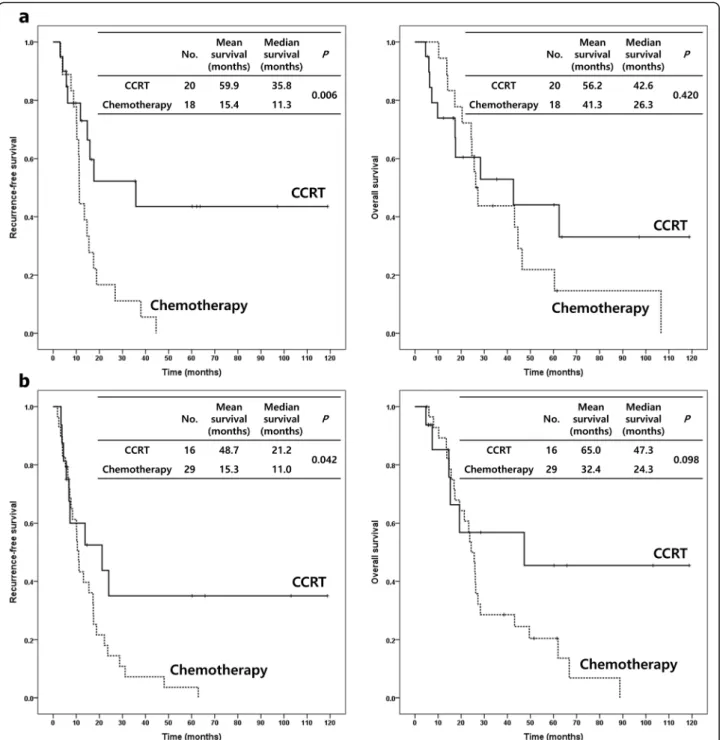
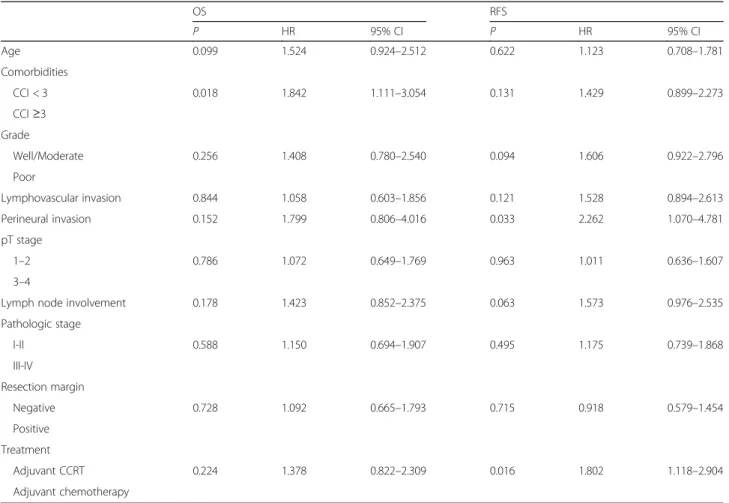
Results: Of the patients, 46 received adjuvant CCRT and 46 received adjuvant chemotherapy. The median recurrence-free survival (RFS) for the adjuvant CCRT and chemotherapy groups were 13.8 and 11.2 months (p = 0.014), respectively. The median overall survival (OS) for the adjuvant CCRT and chemotherapy groups were 30.1 and 26.0 months (p = 0.222), respectively. Adjuvant CCRT had significantly better RFS and numerically higher OS than did chemotherapy. For subgroups with no lymph node (LN) involvement (RFS p = 0.006, OS p = 0.420) or negative resection margins (RFS p = 0.042, OS p = 0.098), adjuvant CCRT led to significantly longer RFS and numerically higher OS than did chemotherapy. For multivariate analysis, the pattern of adjuvant treatment (chemotherapy vs. CCRT, p = 0.004, HR 2.351), histologic grade (poor vs. well, p = 0.023, HR 4.793), and LN involvement (p = 0.028, HR 1.912) were the significant prognostic factors for RFS.
Conclusions: Our study demonstrated the superiority of adjuvant CCRT over chemotherapy for improving RFS in curatively resected BTC.
Keywords: Biliary tract neoplasms, Adjuvant chemoradiotherapy, Adjuvant chemotherapy
Background
Biliary tract cancers (BTC) are a heterogeneous group of neoplasms that includes cholangiocarcinoma and gall- bladder cancer [1]. These cancers have a poor prognosis of low five-year survival rates in the range of 5 to 15%
[2]. R0 resection has been the most important factor for the successful treatment of patients with BTC [3, 4].
However, less than 30% are resectable diseases at pres- entation because BTC are close to the complex anatomy
of the porta hepatis [5 – 7]. Even after satisfactory curative resection, resectable diseases have five-year survival rates between 20 and 50% [8] due to frequent local and distant recurrences [5, 6]. Furthermore, the frequency of positive resection margins has been reported to be anywhere from 9 to 74% after curative-intent surgery [9]. Therefore, the importance of adjuvant therapy in BTC has been advo- cated to improve survival outcomes [10, 11].
Adjuvant treatments, including chemotherapy, radiother- apy, and chemoradiotherapy, may decrease the recurrence rate and improve overall survival (OS). Several single-center retrospective studies have demonstrated a survival benefit of adjuvant therapy in resected BTC [10 – 12]. Horgan et al.
© The Author(s). 2020 Open Access This article is distributed under the terms of the Creative Commons Attribution 4.0 International License (http://creativecommons.org/licenses/by/4.0/), which permits unrestricted use, distribution, and reproduction in any medium, provided you give appropriate credit to the original author(s) and the source, provide a link to the Creative Commons license, and indicate if changes were made. The Creative Commons Public Domain Dedication waiver (http://creativecommons.org/publicdomain/zero/1.0/) applies to the data made available in this article, unless otherwise stated.
* Correspondence: [email protected]
Division of Hematology and Oncology, Department of Internal Medicine,
Keimyung University, Dongsan Medical Center, 56 Dalseong-ro, Jung-gu,
Daegu 41931, South Korea
reported a systemic review and meta-analysis of published studies that showed the greatest OS improvement being achieved, especially in patients with node-positive and margin-positive diseases, when adjuvant chemotherapy or chemoradiotherapy was administered [13].
Despite the better outcomes of adjuvant chemotherapy and chemoradiotherapy following radical resection, the choice of adjuvant therapy, whether it be chemotherapy or chemoradiotherapy, is still controversial [7]. The current National Comprehensive Cancer Network (NCCN) guide- lines recommend all options, including observation, chemo- therapy, and chemoradiotherapy, for resected BTC and state that more data are necessary to make firm conclusions [14]. Therefore, the aim of this study was to compare the effects of adjuvant CCRT and chemotherapy in order to in- vestigate the possible recurrence-free survival (RFS) or OS benefit after radical resection for BTC.
Methods
Patients and treatments
Of the patients who had undergone radical resection for BTC from January 2000 to December 2017 at Keimyung University Dongsan Medical Center, we collected 92 patients treated with adjuvant CCRT or chemotherapy.
The patients met the following inclusion criterion of having histologically confirmed, non-metastatic BTC, which was defined as tumors of the gallbladder and the intrahepatic, perihilar, and distal extrahepatic bile ducts but excluding the ampulla of Vater. We reviewed the medical records retrospectively for the following charac- teristics: age, gender, date of death or the last follow-up visit, date of recurrence, the Karnofsky performance sta- tus (KPS), the Charlson comorbidity index (CCI), tumor location, histologic features (e.g. histology, grade, lym- phovascular invasion, and perineural invasion), patho- logic stage based on criteria from the American Joint Committee on Cancer (AJCC), 7th edition, LN status, resection margin status, the preoperative carbohydrate antigen 19–9 (CA19–9) levels as tumor markers, pattern of recurrence, and adjuvant treatment including chemo- therapeutic agents. The cut-off value of serum CA 19–9 level was defined as 37 U/ml. RFS was defined as the time from the date of pathologic diagnosis to the date of recurrence, or death. OS was measured from the date of pathologic diagnosis to the date of death.
Curative-intent surgery was performed on all patients in this study. The adjuvant CCRT or chemotherapy plans and schedules depended on the clinicians’ deci- sions. Of the 92 patients, 46 received adjuvant concur- rent chemotherapy and external beam radiotherapy. Of these 46 patients, 21 received CCRT followed by chemo- therapy. The concurrent chemotherapy regimens in- cluded oral 5-fluorouracil (5-FU), such as uracil-tegafur (1 patient, 2.2%), intravenous 5-FU (7 patients, 15.2%),
5-FU/leucovorin (21 patients, 45.7%), 5-FU/cisplatin (12 patients, 26.1%), gemcitabine (4 patients, 8.7%), and other (1 patient, 2.2%). The patients received 4000–5400 cGy of external beam radiation in 28–30 fractions over 5–6 weeks. The radiation fields were tumor beds and regional LN. Of the patients, 2 received delayed adjuvant therapy after 4 months but the others had started treatment within at least 3 months. CCRT was begun at a mean of 7.3 weeks after surgery. All patients completed the whole course of CCRT. Of the 92 patients, 46 received only adjuvant chemotherapy. The chemotherapy regimens included oral 5-FU, such as uracil-tegafur (21 patients, 45.7%), intraven- ous 5-FU/leucovorin (18 patients, 39.1%), 5-FU/cisplatin (4 patients, 8.7%), gemcitabine/cisplatin (2 patients, 4.3%), and gemcitabine (1 patient, 2.2%). Recurrence was classi- fied into three patterns: locoregional recurrence, distant recurrence, and both. Locoregional recurrence was de- fined as recurrence in the tumor bed, anastomosis sites, or regional LN area. Distant recurrence was defined as recur- rence in the non-regional LN area or in other organs.
Most recurrences were clinically diagnosed by imaging studies, such as computed tomography or positron emission tomography, without pathologic confirmation.
Patient follow-up was completed by March 2018.
This study was approved by the Institutional Review Board of the Keimyung University Dongsan Medical Center (DSMC 2018–08–045-001), which waived the re- quirement for written informed consent because of the retrospective nature of the study.
Statistical analysis
The RFS and OS were calculated using the Kaplan- Meier method and were compared using the log-rank test. The Cox proportional hazard model was used for multivariate analyses to adjust for potential confounding factors. The results are presented as hazard ratios (HR) and 95% confidence intervals (CI). The chi-square test and Fisher’s exact test were used to compare the baseline characteristics among patients grouped by categorical variables. Continuous variables were compared using Student’s t-test. The level of critical significance was assigned at p-value < 0.05. Statistical data were analyzed with the IBM SPSS Statistics for Windows, version 20.0 (IBM Corp., Armonk, N.Y., USA).
Results
Patient characteristics
Table 1 describes the characteristics of the patients. All
92 patients met the inclusion criteria. The median age
was 64.5 years (range, 34–81 years). There were 58 men
(63%). KPS was ≥70 in 83 (90.2%) patients. The CCI,
except for the malignancy score, was ≥3 in 42 (45.7%)
patients. The tumor locations were the intrahepatic bile
duct in 13 (14.1%), perihilar bile duct in 17 (18.5%), distal
Table 1 Characteristics of biliary tract cancer patients
Characteristic Total (n = 92) Adjuvant CCRT (n = 46) Adjuvant chemotherapy (n = 46) P value
Median age, years (range) 64.5 (34 –81) 65.5 (44 –81) 61.0 (34 –80) 0.134
Men (%) 58 (63.0) 26 (56.5) 32 (69.6) 0.195
Performance (%)
KPS ≥70 83 (90.2) 41 (89.1) 42 (91.3) 1.000
KPS < 70 9 (9.8) 5 (10.9) 4 (8.7)
Comorbidities (%)
CCI < 3 50 (54.3) 24 (52.2) 26 (56.5) 0.675
CCI ≥3 42 (45.7) 22 (47.8) 20 (43.5)
Tumor location (%)
Intrahepatic bile duct 13 (14.1) 6 (13.0) 7 (15.2) 0.756
Perihilar bile duct 17 (18.5) 10 (21.7) 7 (15.2)
Distal bile duct 42 (45.7) 19 (41.3) 23 (50.0)
Gallbladder 20 (21.7) 11 (23.9) 9 (19.6)
Histology (%)
Adenocarcinoma 86 (93.5) 43 (93.5) 43 (93.5) 1.000
Others 6 (6.5) 3 (6.5) 3 (6.5)
Grade (%)
Well 4 (4.3) 1 (2.2) 3 (6.5) 0.590
Moderate 63 (68.5) 32 (69.6) 31 (67.4)
Poor 21 (22.8) 12 (26.1) 9 (19.6)
NA 4 (4.3) 1 (2.2) 3 (6.5)
LV invasion (%)
Yes 64 (69.6) 29 (63.0) 35 (76.1) 0.213
No 25 (27.2) 15 (32.6) 10 (21.7)
NA 3 (3.3) 2 (4.3) 1 (2.2)
Perineural invasion (%)
Yes 65 (70.7) 34 (73.9) 31 (67.4) 0.414
No 14 (15.2) 9 (19.6) 5 (10.9)
NA 13 (14.1) 3 (6.5) 10 (21.7)
pT stage (%)
1 10 (10.9) 3 (6.5) 7 (15.2) 0.279
2 39 (42.4) 21 (45.7) 18 (39.1)
3 41 (44.6) 22 (47.8) 19 (41.3)
4 2 (2.2) 0 (0.0) 2 (4.3)
LN involvement (%)
Yes 54 (58.7) 26 (56.5) 28 (60.9) 0.672
No 38 (41.3) 20 (43.5) 18 (39.1)
Pathologic stage (%)
bile duct in 42 (45.7%), and gallbladder in 20 (21.7%) pa- tients. The histology was adenocarcinoma in 86 (93.5%) pa- tients. Four (4.3%) patients had well-differentiated tumors, 21 (22.8%) had poorly differentiated tumors, and the remaining (63%) patients had moderately differentiated tumors. The LN involvement was found in 54 (58.7%) pa- tients. Forty-six (50.0%) patients had positive resection mar- gins. According to the 2010 AJCC staging system, 14 (15.2%) patients were at Stage I, 37 (40.2%) were at Stage II, 28 (30.4%) were at Stage III, and 13 (14.1%) were at Stage IV. All Stage IV patients had M0 status, 10 patients had TxN1M0 (IVA) intrahepatic bile duct cancer, and 3 pa- tients had TxN2M0 (IVB) GB cancer. Ten (10.9%) patients were pT1, 39 (42.4%) were pT2, 41 (44.6%) were pT3, and 2 (2.2%) were pT4. Sixty-four (69.6%) patients had lympho- vascular invasion and 65 (70.7%) had perineural invasion.
The preoperative CA19–9 levels were ≥ 37 U/ml in 50 (54.3%) patients.
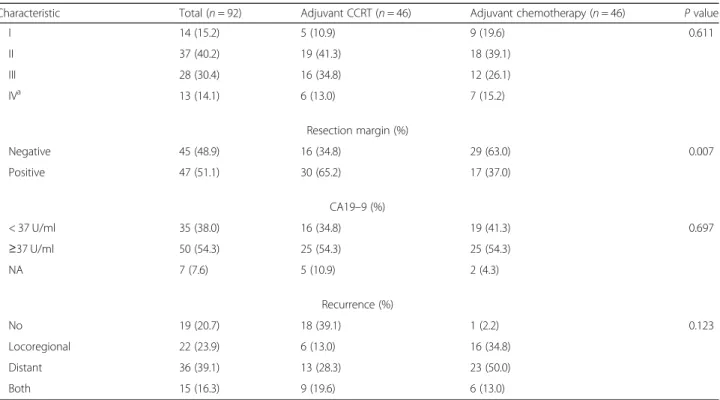
Out of 92 patients, 46 received adjuvant CCRT and 46 received adjuvant chemotherapy. Median follow-up pe- riods for both groups were 17.0 and 25.8 months, respect- ively. There was no significant difference between both groups except for the resection margins. The patients in the adjuvant CCRT group tended to have more positive resection margins (p = 0.007). The baseline characteristics, including age, gender, performance status, comorbidity, tumor location, histologic features (e.g. histology, grade,
lymphovascular invasion, and perineural invasion), patho- logic stage, LN status, and the preoperative CA19–9 levels, of the two groups were similar (Table 1).
The patterns of recurrence were evaluated for all pa- tients. A total of 73 recurrences (79.3%) were observed.
Locoregional recurrence occurred in 22 patients (23.9%), and distant recurrence occurred in 36 patients (39.1%).
Local and distant recurrence occurred simultaneously in 15 patients (16.3%). There was no difference in the recur- rence patterns of both the adjuvant CCRT and chemo- therapy groups (p = 0.123) (Table 1).
The median follow-up duration was 20.7 months.
Death had occurred in 63 of 92 patients (68.5%) during the follow-up period. The median and mean RFS were 12.8 and 25.9 months, whilst the median and mean OS were 26.1 and 39.2 months.
Adjuvant concurrent chemoradiotherapy versus chemotherapy
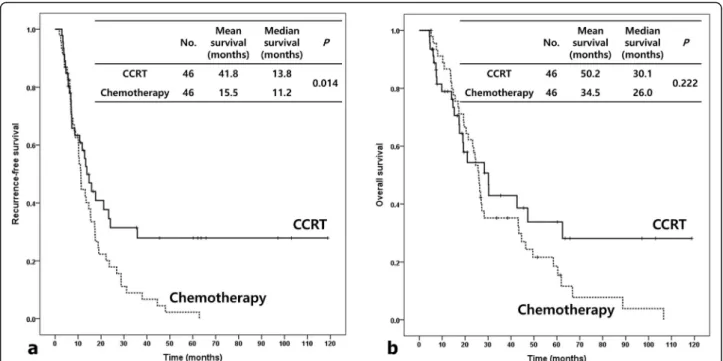
The median RFS for the adjuvant CCRT and chemother- apy groups were 13.8 and 11.2 months (p = 0.014), re- spectively (Fig. 1a). The median OS were 30.1 and 26.0 months (p = 0.222), respectively (Fig. 1b). Adjuvant CCRT had significantly better RFS and numerically higher OS than did chemotherapy. The median locoregional RFS for the adjuvant CCRT and chemotherapy groups were 20.8 and 15.2 months (p = 0.085), respectively (Fig. 2).
Table 1 Characteristics of biliary tract cancer patients (Continued)
Characteristic Total (n = 92) Adjuvant CCRT (n = 46) Adjuvant chemotherapy (n = 46) P value
I 14 (15.2) 5 (10.9) 9 (19.6) 0.611
II 37 (40.2) 19 (41.3) 18 (39.1)
III 28 (30.4) 16 (34.8) 12 (26.1)
IV
a13 (14.1) 6 (13.0) 7 (15.2)
Resection margin (%)
Negative 45 (48.9) 16 (34.8) 29 (63.0) 0.007
Positive 47 (51.1) 30 (65.2) 17 (37.0)
CA19 –9 (%)
< 37 U/ml 35 (38.0) 16 (34.8) 19 (41.3) 0.697
≥37 U/ml 50 (54.3) 25 (54.3) 25 (54.3)
NA 7 (7.6) 5 (10.9) 2 (4.3)
Recurrence (%)
No 19 (20.7) 18 (39.1) 1 (2.2) 0.123
Locoregional 22 (23.9) 6 (13.0) 16 (34.8)
Distant 36 (39.1) 13 (28.3) 23 (50.0)
Both 15 (16.3) 9 (19.6) 6 (13.0)
CCRT Concurrent chemoradiotherapy, KPS Karnofsky performance score, CCI Charlson comorbidity index, LV Lymphovascular, LN Lymph node
a