Introduction
Tuberculosis remains a public health threat with significant annual impacts on morbidity and mortality. Brazil is ranked 16th among the 22 high-burden countries that collectively ac- count for 80% of tuberculosis (TB) cases globally, with an in- cidence of 33.5 cases/100,000 inhabitants/yr in 2014. The city of Porto Alegre has the highest incidence of TB in the country (99.3 cases/100,000 inhabitants/yr in 2014)
1.
At present, much of the attention of TB programs is focused on outcomes of microbiological cure and mortality, and health related quality of life (HRQL) is undervalued. HRQL may be fundamental in influencing treatment outcome. Studies showed that as compared with the general population, TB pa-
Health-Related Quality of Life, Depression and Anxiety in Hospitalized Patients with Tuberculosis
Ana Paula Ceré dos Santos, M.Sc.
1, Tássia Kirchmann Lazzari, M.Sc.
1and Denise Rossato Silva, M.D., Ph.D.
1,2,31
Graduate Program in Pneumological Sciences, Universidade Federal do Rio Grande do Sul, Porto Alegre,
2Medical School, Universidade Federal do Rio Grande do Sul, Porto Alegre,
3Pulmonology Division, Hospital de Clínicas de Porto Alegre, Porto Alegre, Brazil
Background: Much of the attention of tuberculosis (TB) programs is focused on outcomes of microbiological cure and mortality, and health related quality of life (HRQL) is undervalued. Also, TB patients have a significantly higher risk of developing depression and anxiety compared with those in the general population. We intend to evaluate the HRQL and the prevalence of symptoms of depression and anxiety in hospitalized patients with TB.
Methods: Cross-sectional study in a tertiary care hospital in Brazil. Adult patients with pulmonary TB that were hospitalized during the study period were identified and invited to participate. HRQL was measured using the Medical Outcomes Study Short Form-36 (SF-36) version 2. Hospital Anxiety and Depression Scale (HADS) was used to record symptoms of anxiety and depression.
Results: Eighty-six patients were included in the analysis. The mean age of all patients was 44.6±15.4 years, 69.8% were male, and 53.5% were white. Thirty-two patients (37.2%) were human immunodeficiency virus positive. Twenty-seven patients (31.4%) met study criteria for depression (HADS depression score ≥11) and 33 (38.4%) had anxiety (HADS anxiety score ≥11). Scores on all domains of SF-36 were significantly lower than the Brazilian norm scores (p<0.001).
Conclusion: The present study shows that TB patients may have a poor HRQL. Additionally, we found a possible high prevalence of depression and anxiety in this population. Health care workers should be aware of these psychological disorders to enable a better management of these patients. The treatment of these comorbidities may be associated with better TB outcomes.
Keywords: Tuberculosis; Mycobacterium tuberculosis ; Mental Disorders; Depression; Anxiety; Comorbidity; Quality of Life
Address for correspondence: Denise Rossato Silva, M.D., Ph.D.
Pulmonology Division, Hospital de Clínicas de Porto Alegre, 2350 Ramiro Barcelos Street, 2nd floor, Porto Alegre 90035-003, Brazil
Phone: 55-51-33598241, Fax: 55-51-33598000 E-mail: [email protected] Received: Jun. 14, 2016
Revised: Jul. 21, 2016 Accepted: Sep. 19, 2016
cc It is identical to the Creative Commons Attribution Non-Commercial License (http://creativecommons.org/licenses/by-nc/4.0/).
Copyright © 2017
The Korean Academy of Tuberculosis and Respiratory Diseases.
All rights reserved.
tients reported reductions in their physical health, psychologi- cal health, and social functioning
2,3. There are several aspects of TB that may lead to deficits in HRQL, like social stigma, prolonged therapy, potentially toxic drugs, lack of knowledge regarding the disease and its treatment, anxiety, and depres- sion
4-7.
TB patients have a significantly higher risk of developing depression compared with those in the general population
8. Depression in individuals with TB is associated with delays in seeking health care and poor treatment compliance, that can lead to drug resistance, morbidity and mortality
9. Rates of mental illness of up to 70% have been identified in TB pa- tients
10. In a study that evaluated hospitalized TB patients, de- pression was present in about 80%
11. Anxiety disorder is also high among patients with TB
12.
The evaluation of HRQL and the identification of psychiatric comorbidities, such as depression and anxiety, in patients with TB are important for characterizing the physical and mental health of these patients. It is possible that these factors have an influence on treatment adherence, and their knowledge can enable a better understanding of the attitudes of these patients regarding their disease. Therefore, the aim of this study is to evaluate the HRQL, the prevalence of symptoms of depression and anxiety in hospitalized patients with TB, and to compare the characteristics of patients with and without depression, and with or without anxiety.
Materials and Methods
We conducted a cross-sectional study in a general, tertiary care, university-affiliated hospital with 750 beds, located in the city of Porto Alegre, Rio Grande do Sul State, in southern Bra- zil. The study was approved by the Ethics Committee at Hos- pital de Clínicas de Porto Alegre in January 22, 2013 (number 13-0022).
Adult patients (≥18 years old) with pulmonary TB that were hospitalized during the study period (January 2013–June 2015) were identified and invited to participate. We included only the patients who began treatment for TB after hospital- ization. Patients who were already receiving treatment at ad- mission, who are unable to comply with study procedures and those who refused signing the consent form were excluded from this study. Pulmonary TB was diagnosed according to the Brazilian Guidelines for Tuberculosis
13.
The following data were collected from patient records us- ing a standardized data extraction tool: demographic data (sex, age, race, and years of schooling), behavioral data (smoking status, alcohol abuse, and injection drug use), and medical history (clinical form of TB, symptoms at admission, methods of diagnostic, presence of comorbidities, prior TB treatment, drug regimen, interval from hospital admission until diagno- sis, length of hospital stay, intensive care unit [ICU] admission,
length of mechanical ventilation, and hospitalization outcome [death or discharge]). A current smoker was defined as report- ing smoking at least 100 cigarettes in their lifetime, and at the time of the survey were smoking at least one day a week. A former smoker was defined as reporting smoking at least 100 cigarettes in their lifetime but who, at the time of the survey, did not smoke at all. Never smoked reported having smoked
<100 cigarettes in their lifetime. Alcohol abuse was defined as daily consumption of at least 30 g (equivalent to a pint and a half of 4% beer) for men and 24 g (equivalent to a 175 mL glass of wine) for women. An independent physician analyzed the chest X-rays and classified them as typical or compatible with active TB, according to previously described guidelines
14.
HRQL was measured using the Medical Outcomes Study Short Form-36 (SF-36) version 2, which is a reliable, validated questionnaire
15,16. This questionnaire contains eight domains assessing diverse aspects of health including physical func- tioning, role physical, bodily pain, general health, vitality, so- cial functioning, role emotional, and mental health, and two summary measures, physical and mental components. For all the SF-36 domains, higher scores indicate better health.
Brazilian normative data for the SF-36 version 2 were used for comparative purposes
17. Scores of Brazilian men and women ranged according to age and gender were included as a Sup- plementary Tables 1 and 2.
Human immunodeficiency virus (HIV) positive patients also completed the World Health Organization Quality of Life instrument for HIV clients (WHOQOL-HIV). Several specific instruments for individuals with HIV are found in the inter- national literature, but only the WHOQOL-HIV was validated for use in Brazil
18,19. This questionnaire will be administered by the possibility of change in HRQL be related to HIV (and not tuberculosis, or even due to the two diseases). This instru- ment contains 31 items and for each item there is a fivepoint Likert scale where 1 indicates low or negative perceptions and 5 high or positive perceptions. These items contain six domains: physical health (4 items), psychological well being (5 items), social relationship (4 items), environmental health (8 items), level of independence (4 items), and spiritual health (4 items). There were two general questions about general QOL and perceived general health. The physical domain contained information regarding presence of pain, energy, and sleep.
The psychological domain consisted of negative and positive feelings, self esteem, and thinking. The social domain covered social support, personal relationships and sexual activity. Mo- bility, work capacity, and activities were included in the level of dependence. Financial issues; home and physical environ- ment; availability of transport; physical safety and security, and participation in leisure activities were included under the environmental domain. The spirituality domain did contain questions about death and dying; forgiveness and blame and concern about the future.
The Hospital Anxiety and Depression Scale (HADS)
20, pre-
viously validated in Brazil
21, was used to record symptoms of anxiety and depression. This questionnaire was developed to identify caseness (possible and probable) of anxiety disorders and depression among patients in nonpsychiatric hospital clinics, not with the diagnostic purpose, but as screening. It avoids recording details of the biological symptoms of depres- sion that might arise as a result of the physical complaints. It is divided into an anxiety subscale (HADS-A) and a depression subscale (HADS-D) both containing seven questions. The overall score for each subscale goes from 0 to 21. Scores of 11 or above on the anxiety or depression subscale are taken as indicative of probable for either disorder.
Also, self-esteem was evaluated by Rosenberg’s Self-Esteem Scale, validated in Brazil
22. This is a one-dimensional mea- sure, and consists of 10 statements related to a set of feeling of self-esteem and of self-acceptance that assesses global self-esteem. The items are answered in a Likert scale of four points: strongly agree, agree, disagree, and strongly disagree.
The overall score goes from 10 to 40. Scores ≤15 indicate low self-esteem.
Data analysis was performed using SPSS version 18.0 (SPSS Inc., Chicago, IL, USA). Data were presented as number of cases, mean±standard deviation, or median with interquar- tile range. Categorical comparisons were performed by chi- square test using Yates’s correction if indicated or by Fisher ex- act test. Continuous variables were compared using the t test or Wilcoxon test. SF-36 results were compared with Brazilian normative data using a paired t test. A two-sided p-value <0.05 was considered significant for all analyses.
Sample size calculation was based on a previous study
23. Considering an expected proportion of 0.70 (prevalence of symptoms of depression and anxiety, 70%), an amplitude of the confidence interval of 0.20 and a 95% confidence level, we estimated a sample size of 81 patients.
Results
One hundred nineteen patients met the inclusion criteria.
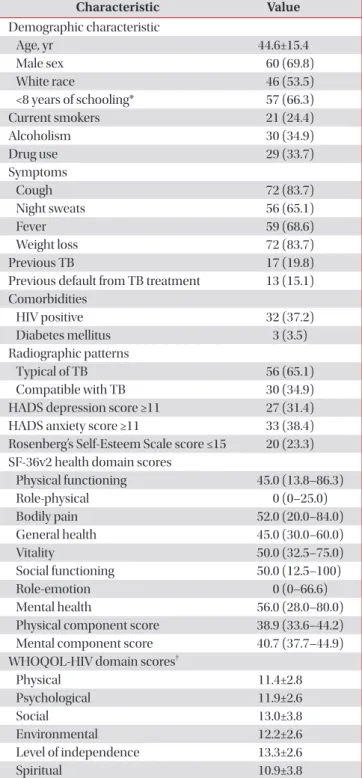
Seventeen patients refused to participate and 16 were unable to comply with study procedures (all were ICU patients), then 86 patients were included in the analysis. The characteristics of participants are summarized in Table 1. The mean age of all patients was 44.6±15.4 years, 69.8% were male, and 53.5%
were white. Thirty-two patients (37.2%) were HIV positive.
Twenty-seven patients (31.4%) met study criteria for de- pression (HADS depression score ≥11) and 33 (38.4%) had anxiety (HADS anxiety score ≥11). Scores on all domains of SF-36 were significantly lower than the Brazilian norm scores (p<0.001) (Table 2). Patients with probable depression were more frequently current smokers (44.4%) than patients with no probable depression (15.3%) (p=0.008) (Table 3). Low self-esteem was more common in patients with probable de-
Table 1. Characteristics of study patients (n=86)
Characteristic Value
Demographic characteristic
Age, yr 44.6±15.4
Male sex 60 (69.8)
White race 46 (53.5)
<8 years of schooling* 57 (66.3)
Current smokers 21 (24.4)
Alcoholism 30 (34.9)
Drug use 29 (33.7)
Symptoms
Cough 72 (83.7)
Night sweats 56 (65.1)
Fever 59 (68.6)
Weight loss 72 (83.7)
Previous TB 17 (19.8)
Previous default from TB treatment 13 (15.1) Comorbidities
HIV positive 32 (37.2)
Diabetes mellitus 3 (3.5)
Radiographic patterns
Typical of TB 56 (65.1)
Compatible with TB 30 (34.9)
HADS depression score ≥11 27 (31.4)
HADS anxiety score ≥11 33 (38.4)
Rosenberg’s Self-Esteem Scale score ≤15 20 (23.3) SF-36v2 health domain scores
Physical functioning 45.0 (13.8–86.3)
Role-physical 0 (0–25.0)
Bodily pain 52.0 (20.0–84.0)
General health 45.0 (30.0–60.0)
Vitality 50.0 (32.5–75.0)
Social functioning 50.0 (12.5–100)
Role-emotion 0 (0–66.6)
Mental health 56.0 (28.0–80.0)
Physical component score 38.9 (33.6–44.2) Mental component score 40.7 (37.7–44.9) WHOQOL-HIV domain scores
†Physical 11.4±2.8
Psychological 11.9±2.6
Social 13.0±3.8
Environmental 12.2±2.6
Level of independence 13.3±2.6
Spiritual 10.9±3.8
Values are presented as n (%), mean±standard deviation, or me- dian (interquartile range).
*In Brazil, the primary (or elementary) school cycle is 8 years long.
†