• 검색 결과가 없습니다.

Health-Related Quality of Life, Depression and Anxiety in Hospitalized Patients with Tuberculosis

N/A
N/A
Protected

Academic year: 2022

Share "Health-Related Quality of Life, Depression and Anxiety in Hospitalized Patients with Tuberculosis"

Copied!
12
0
0

로드 중.... (전체 텍스트 보기)

전체 글

(1)

Introduction

Tuberculosis remains a public health threat with significant annual impacts on morbidity and mortality. Brazil is ranked 16th among the 22 high-burden countries that collectively ac- count for 80% of tuberculosis (TB) cases globally, with an in- cidence of 33.5 cases/100,000 inhabitants/yr in 2014. The city of Porto Alegre has the highest incidence of TB in the country (99.3 cases/100,000 inhabitants/yr in 2014)

1

.

At present, much of the attention of TB programs is focused on outcomes of microbiological cure and mortality, and health related quality of life (HRQL) is undervalued. HRQL may be fundamental in influencing treatment outcome. Studies showed that as compared with the general population, TB pa-

Health-Related Quality of Life, Depression and Anxiety in Hospitalized Patients with Tuberculosis

Ana Paula Ceré dos Santos, M.Sc.

1

, Tássia Kirchmann Lazzari, M.Sc.

1

and Denise Rossato Silva, M.D., Ph.D.

1,2,3

1

Graduate Program in Pneumological Sciences, Universidade Federal do Rio Grande do Sul, Porto Alegre,

2

Medical School, Universidade Federal do Rio Grande do Sul, Porto Alegre,

3

Pulmonology Division, Hospital de Clínicas de Porto Alegre, Porto Alegre, Brazil

Background: Much of the attention of tuberculosis (TB) programs is focused on outcomes of microbiological cure and mortality, and health related quality of life (HRQL) is undervalued. Also, TB patients have a significantly higher risk of developing depression and anxiety compared with those in the general population. We intend to evaluate the HRQL and the prevalence of symptoms of depression and anxiety in hospitalized patients with TB.

Methods: Cross-sectional study in a tertiary care hospital in Brazil. Adult patients with pulmonary TB that were hospitalized during the study period were identified and invited to participate. HRQL was measured using the Medical Outcomes Study Short Form-36 (SF-36) version 2. Hospital Anxiety and Depression Scale (HADS) was used to record symptoms of anxiety and depression.

Results: Eighty-six patients were included in the analysis. The mean age of all patients was 44.6±15.4 years, 69.8% were male, and 53.5% were white. Thirty-two patients (37.2%) were human immunodeficiency virus positive. Twenty-seven patients (31.4%) met study criteria for depression (HADS depression score ≥11) and 33 (38.4%) had anxiety (HADS anxiety score ≥11). Scores on all domains of SF-36 were significantly lower than the Brazilian norm scores (p<0.001).

Conclusion: The present study shows that TB patients may have a poor HRQL. Additionally, we found a possible high prevalence of depression and anxiety in this population. Health care workers should be aware of these psychological disorders to enable a better management of these patients. The treatment of these comorbidities may be associated with better TB outcomes.

Keywords: Tuberculosis; Mycobacterium tuberculosis ; Mental Disorders; Depression; Anxiety; Comorbidity; Quality of Life

Address for correspondence: Denise Rossato Silva, M.D., Ph.D.

Pulmonology Division, Hospital de Clínicas de Porto Alegre, 2350 Ramiro Barcelos Street, 2nd floor, Porto Alegre 90035-003, Brazil

Phone: 55-51-33598241, Fax: 55-51-33598000 E-mail: [email protected] Received: Jun. 14, 2016

Revised: Jul. 21, 2016 Accepted: Sep. 19, 2016

cc It is identical to the Creative Commons Attribution Non-Commercial License (http://creativecommons.org/licenses/by-nc/4.0/).

Copyright © 2017

The Korean Academy of Tuberculosis and Respiratory Diseases.

All rights reserved.

(2)

tients reported reductions in their physical health, psychologi- cal health, and social functioning

2,3

. There are several aspects of TB that may lead to deficits in HRQL, like social stigma, prolonged therapy, potentially toxic drugs, lack of knowledge regarding the disease and its treatment, anxiety, and depres- sion

4-7

.

TB patients have a significantly higher risk of developing depression compared with those in the general population

8

. Depression in individuals with TB is associated with delays in seeking health care and poor treatment compliance, that can lead to drug resistance, morbidity and mortality

9

. Rates of mental illness of up to 70% have been identified in TB pa- tients

10

. In a study that evaluated hospitalized TB patients, de- pression was present in about 80%

11

. Anxiety disorder is also high among patients with TB

12

.

The evaluation of HRQL and the identification of psychiatric comorbidities, such as depression and anxiety, in patients with TB are important for characterizing the physical and mental health of these patients. It is possible that these factors have an influence on treatment adherence, and their knowledge can enable a better understanding of the attitudes of these patients regarding their disease. Therefore, the aim of this study is to evaluate the HRQL, the prevalence of symptoms of depression and anxiety in hospitalized patients with TB, and to compare the characteristics of patients with and without depression, and with or without anxiety.

Materials and Methods

We conducted a cross-sectional study in a general, tertiary care, university-affiliated hospital with 750 beds, located in the city of Porto Alegre, Rio Grande do Sul State, in southern Bra- zil. The study was approved by the Ethics Committee at Hos- pital de Clínicas de Porto Alegre in January 22, 2013 (number 13-0022).

Adult patients (≥18 years old) with pulmonary TB that were hospitalized during the study period (January 2013–June 2015) were identified and invited to participate. We included only the patients who began treatment for TB after hospital- ization. Patients who were already receiving treatment at ad- mission, who are unable to comply with study procedures and those who refused signing the consent form were excluded from this study. Pulmonary TB was diagnosed according to the Brazilian Guidelines for Tuberculosis

13

.

The following data were collected from patient records us- ing a standardized data extraction tool: demographic data (sex, age, race, and years of schooling), behavioral data (smoking status, alcohol abuse, and injection drug use), and medical history (clinical form of TB, symptoms at admission, methods of diagnostic, presence of comorbidities, prior TB treatment, drug regimen, interval from hospital admission until diagno- sis, length of hospital stay, intensive care unit [ICU] admission,

length of mechanical ventilation, and hospitalization outcome [death or discharge]). A current smoker was defined as report- ing smoking at least 100 cigarettes in their lifetime, and at the time of the survey were smoking at least one day a week. A former smoker was defined as reporting smoking at least 100 cigarettes in their lifetime but who, at the time of the survey, did not smoke at all. Never smoked reported having smoked

<100 cigarettes in their lifetime. Alcohol abuse was defined as daily consumption of at least 30 g (equivalent to a pint and a half of 4% beer) for men and 24 g (equivalent to a 175 mL glass of wine) for women. An independent physician analyzed the chest X-rays and classified them as typical or compatible with active TB, according to previously described guidelines

14

.

HRQL was measured using the Medical Outcomes Study Short Form-36 (SF-36) version 2, which is a reliable, validated questionnaire

15,16

. This questionnaire contains eight domains assessing diverse aspects of health including physical func- tioning, role physical, bodily pain, general health, vitality, so- cial functioning, role emotional, and mental health, and two summary measures, physical and mental components. For all the SF-36 domains, higher scores indicate better health.

Brazilian normative data for the SF-36 version 2 were used for comparative purposes

17

. Scores of Brazilian men and women ranged according to age and gender were included as a Sup- plementary Tables 1 and 2.

Human immunodeficiency virus (HIV) positive patients also completed the World Health Organization Quality of Life instrument for HIV clients (WHOQOL-HIV). Several specific instruments for individuals with HIV are found in the inter- national literature, but only the WHOQOL-HIV was validated for use in Brazil

18,19

. This questionnaire will be administered by the possibility of change in HRQL be related to HIV (and not tuberculosis, or even due to the two diseases). This instru- ment contains 31 items and for each item there is a fivepoint Likert scale where 1 indicates low or negative perceptions and 5 high or positive perceptions. These items contain six domains: physical health (4 items), psychological well being (5 items), social relationship (4 items), environmental health (8 items), level of independence (4 items), and spiritual health (4 items). There were two general questions about general QOL and perceived general health. The physical domain contained information regarding presence of pain, energy, and sleep.

The psychological domain consisted of negative and positive feelings, self esteem, and thinking. The social domain covered social support, personal relationships and sexual activity. Mo- bility, work capacity, and activities were included in the level of dependence. Financial issues; home and physical environ- ment; availability of transport; physical safety and security, and participation in leisure activities were included under the environmental domain. The spirituality domain did contain questions about death and dying; forgiveness and blame and concern about the future.

The Hospital Anxiety and Depression Scale (HADS)

20

, pre-

(3)

viously validated in Brazil

21

, was used to record symptoms of anxiety and depression. This questionnaire was developed to identify caseness (possible and probable) of anxiety disorders and depression among patients in nonpsychiatric hospital clinics, not with the diagnostic purpose, but as screening. It avoids recording details of the biological symptoms of depres- sion that might arise as a result of the physical complaints. It is divided into an anxiety subscale (HADS-A) and a depression subscale (HADS-D) both containing seven questions. The overall score for each subscale goes from 0 to 21. Scores of 11 or above on the anxiety or depression subscale are taken as indicative of probable for either disorder.

Also, self-esteem was evaluated by Rosenberg’s Self-Esteem Scale, validated in Brazil

22

. This is a one-dimensional mea- sure, and consists of 10 statements related to a set of feeling of self-esteem and of self-acceptance that assesses global self-esteem. The items are answered in a Likert scale of four points: strongly agree, agree, disagree, and strongly disagree.

The overall score goes from 10 to 40. Scores ≤15 indicate low self-esteem.

Data analysis was performed using SPSS version 18.0 (SPSS Inc., Chicago, IL, USA). Data were presented as number of cases, mean±standard deviation, or median with interquar- tile range. Categorical comparisons were performed by chi- square test using Yates’s correction if indicated or by Fisher ex- act test. Continuous variables were compared using the t test or Wilcoxon test. SF-36 results were compared with Brazilian normative data using a paired t test. A two-sided p-value <0.05 was considered significant for all analyses.

Sample size calculation was based on a previous study

23

. Considering an expected proportion of 0.70 (prevalence of symptoms of depression and anxiety, 70%), an amplitude of the confidence interval of 0.20 and a 95% confidence level, we estimated a sample size of 81 patients.

Results

One hundred nineteen patients met the inclusion criteria.

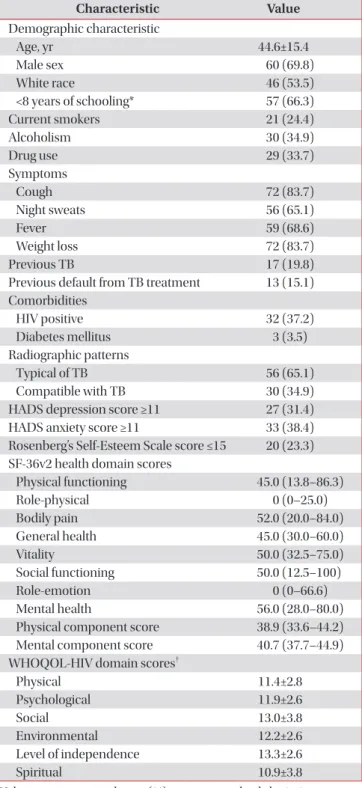
Seventeen patients refused to participate and 16 were unable to comply with study procedures (all were ICU patients), then 86 patients were included in the analysis. The characteristics of participants are summarized in Table 1. The mean age of all patients was 44.6±15.4 years, 69.8% were male, and 53.5%

were white. Thirty-two patients (37.2%) were HIV positive.

Twenty-seven patients (31.4%) met study criteria for de- pression (HADS depression score ≥11) and 33 (38.4%) had anxiety (HADS anxiety score ≥11). Scores on all domains of SF-36 were significantly lower than the Brazilian norm scores (p<0.001) (Table 2). Patients with probable depression were more frequently current smokers (44.4%) than patients with no probable depression (15.3%) (p=0.008) (Table 3). Low self-esteem was more common in patients with probable de-

Table 1. Characteristics of study patients (n=86)

Characteristic Value

Demographic characteristic

Age, yr 44.6±15.4

Male sex 60 (69.8)

White race 46 (53.5)

<8 years of schooling* 57 (66.3)

Current smokers 21 (24.4)

Alcoholism 30 (34.9)

Drug use 29 (33.7)

Symptoms

Cough 72 (83.7)

Night sweats 56 (65.1)

Fever 59 (68.6)

Weight loss 72 (83.7)

Previous TB 17 (19.8)

Previous default from TB treatment 13 (15.1) Comorbidities

HIV positive 32 (37.2)

Diabetes mellitus 3 (3.5)

Radiographic patterns

Typical of TB 56 (65.1)

Compatible with TB 30 (34.9)

HADS depression score ≥11 27 (31.4)

HADS anxiety score ≥11 33 (38.4)

Rosenberg’s Self-Esteem Scale score ≤15 20 (23.3) SF-36v2 health domain scores

Physical functioning 45.0 (13.8–86.3)

Role-physical 0 (0–25.0)

Bodily pain 52.0 (20.0–84.0)

General health 45.0 (30.0–60.0)

Vitality 50.0 (32.5–75.0)

Social functioning 50.0 (12.5–100)

Role-emotion 0 (0–66.6)

Mental health 56.0 (28.0–80.0)

Physical component score 38.9 (33.6–44.2) Mental component score 40.7 (37.7–44.9) WHOQOL-HIV domain scores

Physical 11.4±2.8

Psychological 11.9±2.6

Social 13.0±3.8

Environmental 12.2±2.6

Level of independence 13.3±2.6

Spiritual 10.9±3.8

Values are presented as n (%), mean±standard deviation, or me- dian (interquartile range).

*In Brazil, the primary (or elementary) school cycle is 8 years long.

The scores range between 4 and 20, where higher scores denote higher quality of life.

TB: tuberculosis; HIV: human immunodeficiency virus; HADS:

Hospital Anxiety and Depression Scale; SF-36v2: Medical

Outcomes Study Short Form-36 version 2; WHOQOL-HIV: World

Health Organization Quality of Life instrument for HIV clients.

(4)

pression (55.6% vs. 8.5%, p<0.001). Probable depression was significantly associated with six of the SF-36 domain scores (physical functioning, general health, vitality, social function- ing, role emotional, and mental health). In addition, HIV pa- tients with probable depression had a lower quality of life in all but one domain (physical) of WHOQOL-HIV as compared with HIV patients with no probable depression.

Patients with probable anxiety had more frequently a his- tory of default from TB treatment (69.2%) than patients with no probable anxiety (30.8%) (p=0.016) (Table 4). HIV diagno- sis was significantly more common in patients with probable anxiety (57.6% vs. 24.5%, p=0.004). Six of the SF-36 domain scores (bodily pain, general health, vitality, social functioning, role emotional, and mental health) were significantly reduced in patients with probable anxiety as compared with patients with no probable anxiety. Significantly lower median social, environmental, and level of independence domains were re- ported by patients with probable anxiety.

Discussion

The present study was an attempt to evaluate the HRQL and the prevalence of symptoms of depression and anxiety in hospitalized patients with TB. We found that the scores on all domains of SF-36 were significantly lower than the Brazilian norm scores. In addition, more than one third of patients had a diagnosis of depression (31.4%) or anxiety (38.4%), accord- ing to HADS.

According to the World Health Organization (WHO), health is defined as a state of complete physical, mental, and social well-being and not a mere absence of disease

24

. Therefore, we have to consider that any disease will impact not only on physical health but also on all other aspects of an individual’s health. Thus, TB has a substantial and encompassing impact

on patients’ quality of life. Median domain scores of SF-36 reported by participants in this study were significantly lower than the Brazilian norm scores. Several studies have showed that TB patients reported deficits in their physical and mental well-being in comparison with the general population

2,3

. Also, one study

3

demonstrated that even after treatment comple- tion and microbiological cure, TB patients may still have sig- nificantly lower HRQL when compared to U.S. norms.

HRQL was even lower among patients who met depression or anxiety criteria in our study. This is an important finding once we also demonstrated that more than one third of pa- tients met the study criteria for depression or anxiety. Studies have shown that the prevalence of depression and other psy- chiatric disorders, like generalized anxiety disorder, adjust- ment disorder and organic brain disorders, is high among patients with TB

12,25

. Although rates of major depression are expected to be higher in those individuals with medical illness than in the general population, they may be still higher in TB patients

26

. In a previous investigation

11

, depression was pres- ent in about 80% of the TB patients, using Beck’s Depression Inventory. In this study, it was more common in males, and young and elderly patients. In addition, they found that the main factors associated with depression were altered social relationships, among male TB patients, and TB stigma among females. One study also conducted with hospitalized TB patients, the authors demonstrated that 68% of patients met the criteria for depression

27

. These different prevalence rates might possibly be due to the differences in the sensitivity of the depression screening instruments used.

Depressive disorder in TB patients has been recognized as a cause of poor treatment compliance and poor disease outcomes, like treatment default or death

28

. A retrospective cohort analysis of 440 TB patients has revealed a high rate of relapse due to poor medication compliance, and psychiatric disorders have been implicated

29

. Several factors were signifi- Table 2. Comparison between SF-36 scores and Brazilian norm scores

Scores Study group score Brazilian norm score p-value

Physical functioning 48.4±36.5 80.5±10.4 <0.001

Role-physical 15.99±29.7 81.4±7.9 <0.001

Bodily pain 52.0±35.3 80.5±6.8 <0.001

General health 46.2±19.7 73.2±7.0 <0.001

Vitality 51.6±27.8 74.6±4.6 <0.001

Social functioning 52.3±38.8 86.7±5.1 <0.001

Role-emotion 29.8±42.5 84.7±5.7 <0.001

Mental health 53.7±31.3 76.6±3.7 <0.001

Physical component score 38.9±7.9 51.1±3.9 <0.001

Mental component score 40.7±4.5 52.3±2.6 <0.001

Values are presented as mean±standard deviation.

SF-36: Medical Outcomes Study Short Form-36.

(5)

cantly associated with depression in persons with a TB diag- nosis, like personal, socio-demographic (age and financial sta- tus), environmental, and clinical (persistent cough)

28

. In our study, low self-esteem and current smoking were significantly associated depression.

We found that patients with probable depression were sig- nificantly more likely to have low self-esteem. Also, approxi- mately 20% of our sample had criteria for low self-esteem ac- cording to Rosenberg scale. Another study with hospitalized patients with TB showed that self-esteem scores dropped in Table 3. Factors associated with a HADS depression score ≥11 (probable depression)

Variable HADS depression score ≥11 (n=27)

HADS depression score <11

(n=59) p-value

Age, yr 43.6±13.4 45.1±16.3 0.686

Male sex 17 (63.0) 43 (72.9) 0.499

White race 13 (48.1) 33 (55.9) 0.661

< 8 years of schooling 19 (70.4) 38 (64.4) 0.766

Current smokers 12 (44.4) 9 (15.3) 0.008

Cough 24 (88.9) 48 (81.4) 0.534

Weight loss 22 (81.5) 50 (84.7) 0.947

Previous TB 4 (14.8) 13 (22.0) 0.625

Previous default from TB treatment 4 (30.8) 9 (69.2) 0.617

HIV 14 (51.9) 18 (30.5) 0.097

Smear positive 17 (63.0) 41 (69.5) 0.549

Cavity 10 (37.0) 17 (28.8) 0.446

Low self-esteem 15 (55.6) 5 (8.5) <0.001

Probable anxiety 19 (57.6) 14 (42.4) <0.001

SF-36v2 domain

Physical functioning 25.0 (5.0–45.0) 65.0 (20.0–95.0) 0.002

Role-physical 0 (0–0) 0 (0–25.0) 0.091

Bodily pain 41.0 (10.0–64.0) 52.0 (20.0–100) 0.157

General health 35.0 (25.0–40.0) 50.0 (40.0–67.0) <0.001

Vitality 25.0 (5.0–45.0) 65.0 (50.0–80.0) <0.001

Social functioning 25.0 (12.5–62.5) 62.5 (25.0–100) 0.028

Role-emotion 0 (0–0) 0 (0–100) 0.049

Mental health 24.0 (4.0–40.0) 76.0 (44.0–88.0) <0.001

Physical component score 38.9 (32.2–44.2) 38.9 (33.6–44.2) 0.837

Mental component score 40.8 (35.6–44.9) 41.3 (37.7–44.9) 0.670

WHOQOL-HIV domain*

Physical 10.9±2.8 11.8±2.8 0.402

Psychological 10.7±2.3 12.7±2.6 0.033

Social 10.4±3.4 15.1±2.7 <0.001

Environmental 10.7±2.1 13.3±2.4 0.003

Level of independence 12.1±2.3 14.2±2.5 0.023

Spiritual 9.4±3.9 12.1±3.3 0.038

Values are presented as mean±standard deviation, number (%), or median (percentile 25–percentile 75).

*n=32.

HADS: Hospital Anxiety and Depression Scale; TB: tuberculosis; HIV: human immunodeficiency virus; SF-36v2: Medical Outcomes Study

Short Form-36 version 2; WHOQOL-HIV: World Health Organization Quality of Life instrument for HIV clients.

(6)

accordance with category of depression, revealing that low self-esteem is a characteristic of depression

25

. Stigmatization, negative emotions, social rejection, and isolation were report- ed by TB patients and could contribute to low self-esteem and impairment of psychosocial well-being

2,3

.

In our study, individuals with TB who screened positive for

depression were more likely to be current smokers. The high prevalence of cigarette smoking among people with chronic mental illness is well known

30

. Smoking was associated with a nearly two-fold increased risk of depression relative to both never smokers and former smokers

31

. This finding is especially important since previous investigations have emphasized the Table 4. Factors associated with a HADS anxiety score ≥11 (probable anxiety)

Variable HADS anxiety score ≥11

(n=33)

HADS anxiety score <11

(n=53) p-value

Age, yr 42.1±10.4 46.2±17.7 0.184

Male sex 20 (60.6) 40 (75.5) 0.223

White race 13 (39.4) 33 (62.3) 0.065

<8 years of schooling 24 (72.7) 33 (62.3) 0.445

Current smokers 11 (33.3) 10 (18.9) 0.208

Cough 31 (93.9) 41 (77.4) 0.085

Weight loss 27 (81.8) 45 (84.9) 0.706

Previous TB 10 (30.3) 7 (13.2) 0.097

Previous default from TB treatment 9 (69.2) 4 (30.8) 0.016

HIV 19 (57.6) 13 (24.5) 0.004

Smear positive 18 (54.5) 40 (75.5) 0.050

Cavity 12 (36.4) 15 (28.3) 0.433

Probable depression 19 (57.6) 8 (15.1) <0.001

Low self-esteem 15 (45.5) 5 (9.4) <0.001

SF-36v2 domain

Physical functioning 35.0 (20.0–85.0) 50.0 (7.5–90.0) 0.765

Role-physical 0 (0–12.5) 0 (0–37.5) 0.324

Bodily pain 31.0 (10.0–63.0) 62.0 (31.0–100) 0.004

General health 40.0 (25.0–54.5) 47.0 (36.0–63.5) 0.049

Vitality 40.0 (15.0–52.5) 65.0 (45.0–80.0) <0.001

Social functioning 25.0 (12.5–62.5) 75.0 (25.0–100) 0.001

Role-emotion 0 (0–0) 0 (0–100) 0.001

Mental health 28.0 (12.0–40.0) 76.0 (56.0–88.0) <0.001

Physical component score 38.9 (35.9–44.2) 38.9 (33.6–44.3) 0.971

Mental component score 40.8 (37.7–44.9) 41.3 (37.7–44.9) 0.724

WHOQOL-HIV domain (n=32)

Physical 11.1±3.1 11.9±2.4 0.470

Psychological 11.3±2.7 12.7±2.3 0.144

Social 11.9±3.9 14.7±3.1 <0.001

Environmental 10.9±2.2 14.1±1.9 <0.001

Level of independence 12.0±2.3 15.1±2.0 <0.001

Spiritual 10.6±4.0 11.4±3.5 0.561

Values are presented as mean±standard deviation, number (%), or median (interquartile range).

HADS: Hospital Anxiety and Depression Scale; TB: tuberculosis; HIV: human immunodeficiency virus; SF-36v2: Medical Outcomes Study

Short Form-36 version 2; WHOQOL-HIV: World Health Organization Quality of Life instrument for HIV clients.

(7)

impact of smoking on many aspects of TB, such as TB infec- tion, TB disease, and mortality

32,33

. Indeed, mortality from TB is four times greater among smokers than among nonsmok- ers

32

.

We also found a significantly association between HIV infec- tion and anxiety. Mental health problems such as anxiety and depression in patients infected with HIV is well documented

34

. In a study

35

that evaluated 649 adult patients with HIV, TB or both, the frequency of any anxiety disorder was 30.8%, and the rates of generalized anxiety disorder were highest for the HIV group. Previous default from TB treatment was also statisti- cally associated with symptoms of anxiety in our study. It is possible that these patients were afraid of the consequences of having abandoned treatment, and this thought is reflected in a higher prevalence of anxiety.

The study has certain limitations. One of the limitations of the study is that it is cross-sectional in design thus casual re- lationships cannot be inferred. In addition, we evaluated only TB patients and did not compare HRQL scores with a control group. We used the SF-36, and then we compared results to the Brazilian population norms, which could neutralize this limitation. However, the Brazilian norm scores (SF-36) were obtained from a dataset of general population, which can be biased because hospitalization itself and not TB can make pa- tients’ HRQL scores lower, and depression and anxiety scores higher. Comparisons between hospitalized TB patients and patients hospitalized with other diseases, and comparisons between hospitalized TB patients and TB patients treated only in outpatient clinics are needed to get reliable conclu- sions. In spite of these restrictions, knowing patients’ HRQL is important to understand the well being of TB patients and to plan actions to improve their health outcomes. Also, the iden- tification and prompt treatment of depression and anxiety in patients with TB may be helpful increasing treatment compli- ance and reducing relapse.

In conclusion, the present study shows that TB patients may have a poor HRQL. Additionally, we found a possible high prevalence of depression and anxiety in this population.

Health care workers should be aware of these psychological disorders to enable a better management of these patients.

The treatment of these comorbidities may be associated with better TB outcomes.

Supplementary Material

Supplementary material can be found in the journal homepage (http://www.e-trd/org).

Supplementary Table S1. Descriptive measures of the stan- dardized scores for the eight domains of the 36-item Short Form and for the two summary measures (physical and mental component) of the Brazilian male population by age groups.

Supplementary Table S2. Descriptive measures of the stan- dardized scores for the eight domains of the 36-item Short Form and for the two summary measures (physical and mental component) of the Brazilian female population by age groups.

Conflicts of Interest

No potential conflict of interest relevant to this article was reported.

Acknowledgments

We would like to acknowledge the support from the Inter- national Clinical Operational Health Services Research Train- ing Award (ICOHRTA/Fogarty International Center/National Institutes for Health-NIH) and Johns Hopkins University (Johns Hopkins Bloomberg School of Public Health). Funding source: FIPE-HCPA (Fundo de Incentivo à Pesquisa – Hospi- tal de Clínicas de Porto Alegre).

References

1. Secretaria de Vigilância em Saúde, Ministério da Saúde. Bo- letim Epidemiológico [Internet]. Brasilia: Portal de Saúde, Ministério da Saúde; 2015 [cited 2016 Oct 1]. Available from:

http://www.saude.gov.br.

2. Guo N, Marra CA, Marra F, Moadebi S, Elwood RK, Fitzgerald JM. Health state utilities in latent and active tuberculosis.

Value Health 2008;11:1154-61.

3. Marra CA, Marra F, Colley L, Moadebi S, Elwood RK, Fitzger- ald JM. Health-related quality of life trajectories among adults with tuberculosis: differences between latent and active in- fection. Chest 2008;133:396-403.

4. Keshavjee S, Gelmanova IY, Farmer PE, Mishustin SP, Strelis AK, Andreev YG, et al. Treatment of extensively drug-resistant tuberculosis in Tomsk, Russia: a retrospective cohort study.

Lancet 2008;372:1403-9.

5. Long NH, Johansson E, Diwan VK, Winkvist A. Fear and so- cial isolation as consequences of tuberculosis in VietNam: a gender analysis. Health Policy 2001;58:69-81.

6. Miller TL, McNabb SJ, Hilsenrath P, Pasipanodya J, Weis SE.

Personal and societal health quality lost to tuberculosis. PLoS One 2009;4:e5080.

7. Yee D, Valiquette C, Pelletier M, Parisien I, Rocher I, Menzies D. Incidence of serious side effects from first-line antitubercu- losis drugs among patients treated for active tuberculosis. Am J Respir Crit Care Med 2003;167:1472-7.

8. Shen TC, Wang CY, Lin CL, Liao WC, Chen CH, Tu CY, et al.

People with tuberculosis are associated with a subsequent

(8)

risk of depression. Eur J Intern Med 2014;25:936-40.

9. Pachi A, Bratis D, Moussas G, Tselebis A. Psychiatric mor- bidity and other factors affecting treatment adherence in pulmonary tuberculosis patients. Tuberc Res Treat 2013;2013:489865.

10. Doherty AM, Kelly J, McDonald C, O’Dywer AM, Keane J, Cooney J. A review of the interplay between tuberculosis and mental health. Gen Hosp Psychiatry 2013;35:398-406.

11. Sulehri MA, Dogar IA, Sohail H, Mehdi Z, Azam M, Niaz O, et al. Prevalence of depression among tuberculosis patients.

APMC 2010;4:133-7.

12. Aghanwa HS, Erhabor GE. Demographic/socioeconomic factors in mental disorders associated with tuberculosis in southwest Nigeria. J Psychosom Res 1998;45:353-60.

13. Conde MB, Melo FA, Marques AM, Cardoso NC, Pinheiro VG, Dalcin Pde T, et al. III Brazilian Thoracic Association guide- lines on tuberculosis. J Bras Pneumol 2009;35:1018-48.

14. Diagnostic Standards and Classification of Tuberculosis in Adults and Children. This official statement of the American Thoracic Society and the Centers for Disease Control and Prevention was adopted by the ATS Board of Directors, July 1999. This statement was endorsed by the Council of the In- fectious Disease Society of America, September 1999. Am J Respir Crit Care Med 2000;161(4 Pt 1):1376-95.

15. Ciconelli RM, Ferraz MB, Santos W, Meinão I, Quaresma MR. Brazilian-Portuguese version of the SF-36: a reliable and valid quality of life outcome measure. Rev Bras Reumatol 1999;39:143-50.

16. Ware JE, Snow KK, Kosinski M, Gandek B. SF-36 health sur- vey: manual and interpretation guide. Lincoln: Quality Metric;

2005. p. 1-38.

17. Laguardia J, Campos MR, Travassos C, Najar AL, Anjos LA, Vasconcellos MM. Brazilian normative data for the Short Form 36 questionnaire, version 2. Rev Bras Epidemiol 2013;16:889-97.

18. Fang CT, Hsiung PC, Yu CF, Chen MY, Wang JD. Validation of the World Health Organization quality of life instrument in patients with HIV infection. Qual Life Res 2002;11:753-62.

19. Fleck MP, Louzada S, Xavier M, Chachamovich E, Vieira G, Santos L, et al. Application of the Portuguese version of the abbreviated instrument of quality life WHOQOL-bref. Rev Saude Publica 2000;34:178-83.

20. Zigmond AS, Snaith RP. The hospital anxiety and depression scale. Acta Psychiatr Scand 1983;67:361-70.

21. Botega NJ, Bio MR, Zomignani MA, Garcia C Jr, Pereira WA.

Mood disorders among inpatients in ambulatory and valida- tion of the anxiety and depression scale HAD. Rev Saude Pu- blica 1995;29:355-63.

22. Hutz CS, Zanon C. Revision of the adaptation, validation, and

normatization of the Roserberg self-esteem scale. Aval Psicol 2011;10:41-9.

23. Aamir S, Aisha. Co-morbid anxiety and depression among pulmonary tuberculosis patients. J Coll Physicians Surg Pak 2010;20:703-4.

24. World Health Organization. WHO definition of health [Inter- net]. Geneva: World Health Organization; 2015 [cited 2016 Oct 1]. Available from: http://www.who.int.

25. Westaway MS, Wolmarans L. Depression and self-esteem:

rapid screening for depression in black, low literacy, hospital- ized tuberculosis patients. Soc Sci Med 1992;35:1311-5.

26. vonAmmon Cavanaugh S. The prevalence of emotional and cognitive dysfunction in a general medical population: using the MMSE, GHQ, and BDI. Gen Hosp Psychiatry 1983;5:15- 24.

27. Schechter M, Zajdenverg R, Falco G, Barnes GL, Faulhaber JC, Coberly JS, et al. Weekly rifapentine/isoniazid or daily rifampin/pyrazinamide for latent tuberculosis in household contacts. Am J Respir Crit Care Med 2006;173:922-6.

28. Ugarte-Gil C, Ruiz P, Zamudio C, Canaza L, Otero L, Kru- ger H, et al. Association of major depressive episode with negative outcomes of tuberculosis treatment. PLoS One 2013;8:e69514.

29. Rose N, Shang H, Pfyffer GE, Brandli O. Tuberculosis therapy in canton Zurich 1991-1993: what are the causes for re- currence and therapy failure? Schweiz Med Wochenschr 1996;126:2059-67.

30. Tidey JW, Miller ME. Smoking cessation and reduction in people with chronic mental illness. BMJ 2015;351:h4065.

31. Luger TM, Suls J, Vander Weg MW. How robust is the asso- ciation between smoking and depression in adults? A meta- analysis using linear mixed-effects models. Addict Behav 2014;39:1418-29.

32. Gajalakshmi V, Peto R, Kanaka TS, Jha P. Smoking and mortal- ity from tuberculosis and other diseases in India: retrospec- tive study of 43000 adult male deaths and 35000 controls.

Lancet 2003;362:507-15.

33. Slama K, Chiang CY, Enarson DA, Hassmiller K, Fanning A, Gupta P, et al. Tobacco and tuberculosis: a qualitative systematic review and meta-analysis. Int J Tuberc Lung Dis 2007;11:1049-61.

34. Adejumo O, Oladeji B, Akpa O, Malee K, Baiyewu O, Ogunniyi A, et al. Psychiatric disorders and adherence to antiretroviral therapy among a population of HIV-infected adults in Nigeria.

Int J STD AIDS 2016;27:938-49.

35. van den Heuvel L, Chishinga N, Kinyanda E, Weiss H, Patel V,

Ayles H, et al. Frequency and correlates of anxiety and mood

disorders among TB- and HIV-infected Zambians. AIDS Care

2013;25:1527-35.

(9)

Age group PH RF BP GH VT SF RE MH Physical Mental Up to 24 years

old (n = 645)

Mean 95.3 89.8 90.6 83.7 80.4 93.1 90 80.9 56.6 53.4

95% CI 93.1–97.5 87.0–92.6 88.3–92.8 81.5–85.9 77.8–83.1 91.1–95.1 87.0–93.0 78.6–83.2 55.9–57.2 52.2–54.6

% Ground 1.9 0.0 0.0 0.0 0.0 0.0 1.9 0.0 0.0 0.0

% Ceiling 85.4 70.1 66.0 14.6 25.8 78.0 76.9 22.5 49 14.4

25–34 years old (n = 2,100)

Mean 92.0 90.6 89.8 83.2 81.3 92.8 90.0 82.1 55.7 54.4

95% CI 90.6–93.5 89.2–92.0 88.5–91.1 82.1–84.3 80.2–82.4 91.7–93.8 87.0–93.0 81.0–83.2 55.2–56.1 53.8–54.9

% Ground 2.2 1.2 0.8 0.0 0.1 0.4 1.2 0.0 0.0 0.1

% Ceiling 78.2 76.3 69.2 14.2 19.2 77 78.8 21.4 50.7 12.4

35–44 years old (n = 2,685)

Mean 86.5 87.1 85.4 77.7 78.6 91.5 89.9 79.8 53.4 53.9

95% CI 84.9–88.1 85.8–88.5 84.1–86.7 76.5–78.9 77.6–79.7 90.5–92.5 88.7–91.1 78.8–80.8 52.8–53.9 53.4–54.4

% Ground 4 2.3 0.6 0.1 0.0 0.4 1.4 0.1 0.9 0.6

% Ceiling 67.2 67.8 58.4 8.0 17.4 72.2 73.8 18.1 37.7 11.9

45–54 years old (n = 2,555)

Mean 80.8 82.4 80.5 72.1 75.4 86.4 86.0 77.4 51.0 52.5

95% CI 79.1–82.6 80.8–84.0 79.0–82.1 70.7–73.4 74.2–76.6 85.1–87.8 84.5–87.5 76.2–78.7 50.4–51.6 51.9–53.1

% Ground 4.0 2.6 1.5 0.3 0.0 0.6 2.3 0.1 0.7 0.3

% Ceiling 52.3 60.4 49.4 5.0 17.1 63.1 67.4 17.4 29.0 16.2

55–64 years old (n = 2,120)

Mean 74.3 75.9 76.8 67.2 74.0 84.3 81.2 77.1 48.3 52.2

95% CI 72.2–76.3 73.8–78.0 75.0–78.6 65.5–68.8 72.5–75.4 82.7–85.8 79.3–83.1 75.7–78.5 47.6–49.0 51.4–52.9

% Ground 3.8 4.5 1.4 1.0 0.5 0.8 2.9 0.5 1.2 0.6

% Ceiling 39 52.6 41.3 3.9 17.2 59.3 60.2 19.1 19.1 15.9

65–74 years old (n = 1,565)

Mean 64.1 67.8 73.6 62.2 70.1 79.5 75.8 74.9 45.1 51.0

(10)

≥ 75 years old (n

= 754)

Mean 48.0 56.0 67.6 56.5 68.0 73.8 68.3 76.8 39.5 51.5

95% CI 44.5–51.5 52.2–59.8 64.4–70.9 53.9–59.1 65.5–70.5 70.8–76.8 64.7–72.0 74.7–79.0 38.3–40.7 50.3–52.8

% Ground 9.3 10.2 2.7 1.5 0.3 0.6 6.3 0.0 5.1 0.6

% Ceiling 9.0 28.8 31.0 1.5 12.1 39.9 41.7 20.2 5.7 19.3

Total (n = 12,423)

Mean 79.4 80.7 81.4 72.7 76.0 86.9 84.8 78.5 50.7 52.9

95% CI 78.6–80.3 79.9–81.4 80.7–82.1 72.1–73.4 75.4–76.6 86.3–87.5 84.1–85.5 78.0–79.0 50.4–51.0 52.6–53.1

% Ground 4 3.4 1.2 0.5 0.2 0.6 2.5 0.1 0.9 0.4

% Ceiling 52.6 59.2 51.9 6.9 17.1 64.6 66.3 18.5 30.3 14.7

PH: physical functioning; RF: role-physical; GH: general health; VT: vitality; SF: social functioning; AE: role-emotional; RE: role-emotional; MH: mental health; CI:

confidence interval.

Source: Adapted from Laguardia J et al. Rev Bras Epidemiol 2013;16:889-97 according to Creative Commons license.

(11)

Age group PH RF BP GH VT SF RE MH Physical Mental Up to 24

years old (n=645)

Mean 89.4 86.8 83.5 77.9 75.8 88.3 87.2 74.3 54.5 50.9

95% CI 87.3–91.5 84.5–89.0 81.3–85.6 75.9–79.9 74.0–77.7 86.3–90.3 85.0–89.4 72.5–76.2 53.8–55.2 49.9–51.9

% Ground 2.1 0.7 0.2 0.0 0.0 0.9 1.2 0.2 0.2 1.2

% Ceiling 66.7 66.4 51.7 9.7 14.7 67.7 68.4 12.0 39.2 8.6

25–34 years old (n=2,100)

Mean 87.8 86.6 83.3 77.7 73.4 88.9 87.9 72.9 54.2 50.7

95% CI 86.5–89.2 85.2–87.9 82.0–84.6 76.5–78.9 72.2–74.5 87.7–90.0 86.6–89.2 71.7–74.1 53.8–54.6 50.1–51.2

% Ground 2 1.2 0.7 0.3 0.3 0.5 1.4 0.3 0.2 1.4

% Ceiling 64.6 65.9 50.5 8.6 11.0 67.8 70.1 12.2 37.9 9.2

35–44 years old (n=2,685)

Mean 81.2 81.5 78.6 72.4 69.7 85.4 83.8 71.7 51.5 49.8

95% CI 79.8–82.6 80.1–82.9 77.3–79.9 71.3–73.6 68.6–70.8 84.3–86.5 82.5–85.1 70.6–72.8 51.1–52.0 49.2–50.3

% Ground 3.3 2.6 0.9 0.5 0.3 0.3 2.7 0.1 0.5 1.1

% Ceiling 51.5 58.7 42.5 4.7 9.8 60.0 63.0 11.0 30.2 8.9

45–54 years old (n=2,555)

Mean 73.3 76.2 71.9 67.2 69.1 82.2 79.4 71.6 48.3 49.7

95% CI 71.7–74.8 74.6–77.7 70.4–73.3 66.0–68.4 67.9–70.2 81.0–83.5 77.9–80.8 70.4–72.7 47.7–48.8 49.1–50.3

% Ground 2.8 3.3 1.6 0.5 0.5 0.6 3.8 0.3 0.8 1.4

% Ceiling 36.6 48.9 36.0 4.0 11.1 54.5 56.4 12.3 19.8 11.4

55–64 years old (n=2,120)

Mean 64.5 67.9 66.2 63.4 66.0 77.2 74.6 69.5 45.0 48.8

95% CI 62.8–66.2 66.2–69.7 64.5–67.9 62.1–64.8 64.7–67.3 75.7–78.6 72.9–76.3 68.2–70.8 44.4–45.6 48.1–49.5

% Ground 3.7 4.3 2.2 1.0 1.0 0.8 4.0. 0.2 1.7 1.2

% Ceiling 23.1 37 27.4 1.7 10.4 45.3 47.2 10.7 11.8 12.3

65–74 years

old (n=1,565)

(12)

% Ceiling 13.9 31.7 24.9 1.5 9.1 39.6 42.5 14.7 6.3 14.4

≥ 75 years old (n=754)

Mean 43.3 53.0 61.9 55.3 62.1 68.6 65.6 70.3 38.3 48.7

95%CI 40.0–46.6 49.6–56.4 59.0–64.9 52.7–57.8 59.7–64.5 65.7–71.6 62.3–68.9 68.0–72.6 37.2–39.5 47.4–50.0

% Ground 12.4 14.0 3.6 2.1 1.7 2.9 7.8 1.4 3.6 1.9

% Ceiling 9.3 24.5 24.3 2.9 11.8 35.9 39.9 16.2 4.8 19.7

Total (n=12,423)

Mean 72.5 75.2 73.4 68.3 68.9 81.7 79.5 71.6 48.3 49.7

95%CI 71.8–73.3 74.5–75.9 72.7–74.0 67.8–68.9 68.3–69.4 81.1–82.3 78.8–80.1 71.1–72.1 48.1–48.6 49.5–50

% Ground 3.9 4.1 1.6 0.8 0.6 0.8 3.5 0.3 1.1 1.2

% Ceiling 39.3 49.1 37.1 4.5 10.7 54.1 56.4 12.2 22.1 11.4

PH: physical functioning; RF: role-physical; GH: general health; VT: vitality; SF: social functioning; RE: role-emotional; MH: mental health; physical: physical component summary; mental: mental component summary; CI: confidence interval.

Source: Adapted from Laguardia J et al. Rev Bras Epidemiol 2013;16:889-97 according to Creative Commons license.

수치

Table 1. Characteristics of study patients (n=86)

참조

관련 문서

Objective: This study examined the current status of depression and related factors affecting children's depression among children using Community child center.. Methods:

The hospital anxiety and depression scale (HADS) and the 9-item patient health questionnaire (PHQ-9) as screening instruments for depression in patients with cancer.. Age

The Relationship between Physical Activities and Health-related Quality of Life in Korean Adults with Diabetes

quality of life and improved standard of living, and as reflected in this popular desire, kiosks provide various forms of food-related information and have

In this study, a family of middle school students the health, self-resilience, recreation and leisure satisfaction and satisfaction with school life were

Conclusions: This study suggests that psychological health factors such as stress perception, depression and suicidal ideation are related to the quality of sleep

Beck Depression Inventory(BDI), Satisfaction with Life Scale(SLS), health behavior including smoking(Fagerstrom Test for Nicotine Dependence), sleep(Pittsburgh

The investigator examined the mediating effects of depression and family conflict on relations between problem drinking and life satisfaction according to the life cycle and