Journal of Trauma and Injury Vol. 27, No. 4, December, 2014
� Address for Correspondence : Kyu-Hyouck Kyoung, M.D.
Trauma Center, Department of Emergency Medicine, Ulsan University Hospital, University of Ulsan College of Medicine, Ulsan, 877, Bangeojinsunhwando-ro, Dong-gu, Ulsan, Korea
Tel : 82-52-250-7118, Fax : 82-52-250-8082, E-mail : [email protected]
Submitted : September 14, 2014 Revised : October 21, 2014 Accepted : October 22, 2014
고도 중증외상 환자에서 급성 혈액응고장애가 초기 및 조기 사망에 미치는 영향
울산대학교 의과대학 울산대학교병원 외과학교실, 1권역외상센터, 2응급의학교실 노민수, 양성수, 경규혁1,2
- Abstract -
The Effect of Acute Coagulopathy in Profoundly Traumatic Patients on Acute and Early Deaths
Minsu Noh, M.D., Song-Soo Yang, M.D., Ph.D., Kyu-Hyouck Kyoung, M.D.
1,2Department of Surgery, 1Trauma Center, 2Department of Emergency Medicine, Ulsan University Hospital, University of Ulsan College of Medicine, Ulsan, Korea
Purpose: Numerous studies have investigated the pattern of traumatic death with a focus on the injury mechanism, the severity of the injury and the presence of hemorrhage. Acute coagulopathy has been treated as only one of many complications. The purpose of this study was to investigate the influence of acute coagulopathy on acute and early death due to trauma.
Methods: A retrospective analysis of trauma patients with injury severity score (ISS)≥25 who had been treated between January 2011 and December 2012 was conducted. Based on the time of injury, traumatic death was catego- rized into acute (within 48 hours) and early (from 3 to 7 days). The correlations between various parameters within 24 hours after injury and time of death were analyzed.
Results: A total of 124 patients were enrolled. Of them, 8.1% (n=10) of the patients experienced acute mortality. For those patients, significant differences in initial systolic blood pressure, coagulopathy score, amount of transfusion, abbreviated injury scale of the head and neck, the abdomen and the extremities were noted. Early mortality was experi- enced by 7.0% (n=8) of the patients, only coagulopathy score was found to be a significant independent risk factor for acute (odds ratio: 3.127; 95% confidence interval: 1.185-8.252; p=0.021) and early mortality (odds ratio: 2.470; 95%
confidence interval: 1.029-5.929; p=0.043).
Conclusion: Acute traumatic coagulopathy has an important role in the mortality, even after the acute phase. Early man- agement and prevention of acute coagulopathy may improve survival of trauma patients. [ J Trauma Inj 2014; 27: 158-64 ]
Key Words: Trauma, Coagulopathy, Mortality
I. 서 론
전세계적으로 외상은 전체 사망의 3위를 차지하는 주요 사 망 원인으로,(1) 외상으로 인한 사망의 원인은 외상 후 시간 의 경과에 따라 다른 분포를 보인다. 과거에는 삼정곡선의 (trimodal curve) 사망률을 보여 왔으나,(2,3) 외상 치료의 발전으로 최근에는 이정곡선의(bimodal curve) 분포로 변 화하여 왔다.(4,5) 외상 사망의 시기적 분류는 다양하게 제시 되어 왔으며 Cothren 등(6)은 초기(48시간 이내), 조기(2~7 일) 및 후기의(7일 이상) 분류를 제시하였다. 시기에 따른 사 망 원인의 분포는 초기에는 뇌손상 및 출혈, 조기 이후에는 전신성염증반응, 감염, 다장기 부전 및 감염 등으로 주요 사 망 원인이 변화되는 양상을 보인다.(7,8) 이는 외상 환자의 사망 원인이 초기의 직접적인 외상에서 후유증 및 초기 치료 에 의한 합병증으로 이행하는 것을 나타낸다.
Brohi 등(9)은 중증외상 환자에서 내원시 24.4% 에서 이 미 혈액응고장애가 발생하였으며 이 환자군에서는 46% 의 사망률을 보이는 것으로 보고하였으며,대량 출혈과 이에 대 한 치료 과정에서 발생하는 혈액응고장애는 저체온, 산증과 더불어 중증외상의 치명적인 합병증으로 이 자체로 중요한 사망 원인이 된다.(10-12) 특히 Injury Severity Score (ISS) 25점 이상의 고도중증외상 환자에서는 급성 혈액응고 장애가 사망에 미치는 영향이 급격히 증가하며 혈액응고장애 의 정도와 사망률이 비례하여 증가하는 양상을 보인다.(11)
그러나, 외상 환자의 사망에서 혈액응고장애가 미치는 다 른 요인들과의 상대적 영향과 사망 시기에 따른 기여도에 대 한 연구는 미미한 실정으로 본 연구에서는 외상의 형태 및 정도와 급성 혈액응고장애를 포함한 초기 경과가 시기별 사 망에 미치는 영향을 연구하고자 하였다.
II. 대상 및 방법 1. 연구 대상
2011년 1월부터 2012년 12월까지 본원 응급실에 내원한 16세 이상의 고도중증외상을 대상으로 후향적으로 분석하였 다. ISS 25점 이상을 고도중증외상으로 정의하였으며 수상 후 3시간을 초과하여 내원하였거나 7일 이내에 전원되어 7 일 생존여부의 확인이 불가능한 환자들을 제외하였다.
2. 연구 방법
외상의 형태와 정도 및 수상 후 24시간 동안의 경과가 시 기별 사망에 미치는 영향을 분석하기 위하여 내원 시 생체 징후, ISS, 수상 후 24시간 이내 수술 및 중재적 시술, 혈액 검사 결과 및 수혈량을 조사하였다. 대량 수혈은 내원 후 24 시간 이내에 10단위 이상의 농축적혈구를 수혈한 것으로 정 의하였다. 사망의 시기는 수상 48시간 이내의 초기 사망 및 7일 이내의 조기 사망으로 정의하여 분류하였다. 혈액응고장 애의 평가는 범발성혈액응고장애지수(disseminated intravascular coagulation score)의(13) 혈소판과 프로트 롬빈 시간을 적용하여 평가하였으며 D-dimer 와 섬유소원 을 적용하지 않아 혈액응고장애지수라는 용어로 정의하였다 (Table 1).
3. 통계 분석
통계 분석은 SPSS 21 (SPSS Inc., Chicago, IL)을 이용 하였으며, 연속 변수에 대해서는 평균값±표준편차, 또는 중 간값과 사분위수로 나타내고 Mann-Whitney U test 를 이 용하였으며, 범주형 변수는 카이 제곱 검정 및 피셔의 정확 한 검정을 시행하였다. 사망 요인 분석을 위해 초기 사망의 단변량 분석에서 유의한 차이를 보인 변수들로 다변량 회귀 분석을 시행하였다. 유의 수준은p값이 0.05 미만인 경우로 정의하였다.
III. 결 과
1. 대상 환자의 일반적 특성
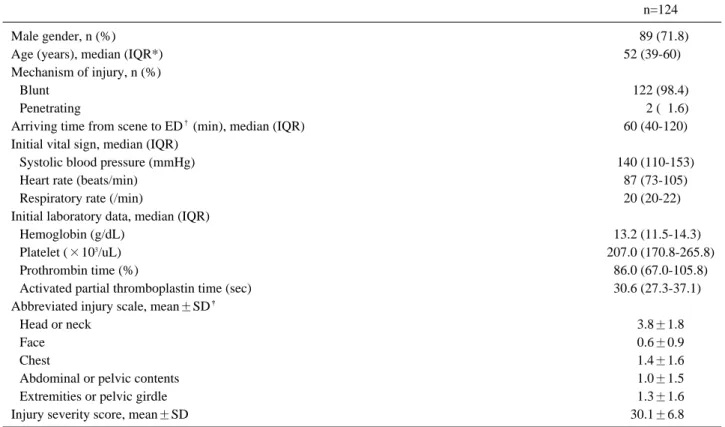
총 124명의 환자 중 남자는 89명(71.8%), 여자는 35명 (28.2%) 이었고, 나이는 평균 50.7세 였다. 122명(98.4%)이 둔상으로 수상하였고 사고 후 응급실 내원까지의 시간은 86 분이었다.내원 당시 혈압은 129.7 mmHg 였고 ISS는 30점 이었다(Table 2).
수상 후 24시간 이내에수술 또는 동맥색전술을시행받은 환자는 53명(42.7%) 이었고, 혈액응고장애지수는 0.7 이었 으며 농축적혈구 5.5단위를 수혈하였다(Table 3).
Table 1. The scoring of coagulopathy.
Points 0 1 2
Platelet (×103/uL) >100 ≥50 <50
Prothrombin time (%) >700 40~70 <40
2. 시기별 사망 요인의 분석
7일 이내에 사망한 환자는 18명으로 14.5%의 사망률을 보 였다. 초기 사망은 10명(8.1%)이었으며 나이, 성별 및 수상 후 내원까지 시간의 차이는 없었으며 내원시 수축기 혈압이 사망군에서 낮았으며(p=0.028) 수상 후 24시간 동안의 혈색
소는 차이가 없었고 혈액응고장애지수는 사망군에서 유의하 게 높은 결과를 보였다(p=0.006). 24시간 동안의 농축적혈 구 수혈량(p=0.001) 및 대량수혈의 발생(p=0.023) 또한 사 망군에서 높았으며 수상 부위에 따라서는 두경부 손상 (p=0.032), 복부(p=0.05), 사지 및 골반 손상에서(p=0.008) 의미있는 차이를 보였다.
Table 2. Baseline characteristics.
n=124
Male gender, n (%) 089 (71.8)
Age (years), median (IQR*) 52 (39-60)00.
Mechanism of injury, n (%)
Blunt 122 (98.4)
Penetrating 002 (01.6)
Arriving time from scene to ED�(min), median (IQR) 60 (40-120)0.
Initial vital sign, median (IQR)
Systolic blood pressure (mmHg) 140 (110-153)0.
Heart rate (beats/min) 87 (73-105)0.
Respiratory rate (/min) 20 (20-22)00.
Initial laboratory data, median (IQR)
Hemoglobin (g/dL) 13.2 (11.5-14.3)0
Platelet (×103/uL) 207.0 (170.8-265.8)
Prothrombin time (%) 86.0 (67.0-105.8)
Activated partial thromboplastin time (sec) 30.6 (27.3-37.1)0
Abbreviated injury scale, mean±SD�
Head or neck 3.8±1.8
Face 0.6±0.9
Chest 1.4±1.6
Abdominal or pelvic contents 1.0±1.5
Extremities or pelvic girdle 1.3±1.6
Injury severity score, mean±SD 30.1±6.80
* IQR: interquartile range
�ED: emergency department
�SD: standard deviation
Table 3. Clinical courses within first 24 hours.
n=124
Operation or angio-embolization, n (%) 53 (42.7)
Laboratory data, median (IQR*)
Hemoglobin (g/dL) 10.7 (8.5-12.5)0
Platelet (×103/uL) 144.5 (87.5-199.5)
Prothrombin time (%) 086.0 (67.0-105.8)
Activated partial thromboplastin time (sec) 30.6 (27.3-37.1)
Coagulopathy score, mean±SD� 0.7±1.1
Amount of transfusion (units), mean±SD
Red blood cell 05.5±10.7
Fresh frozen plasma 3.0±5.8
Platelet concentration 4.2±7.9
* IQR: interquartile range
�SD: standard deviation
Table 4.Acute and early mortality and 24-hour characteristics of patients. 2-day (n=124)7-day (n=114) SurvivorNon-survivorp-valueSurvivorNon-survivop-value Number, n (%)114 (91.9)10 (8.1)106 (93.0)8 (07.0) Age (years), median (IQR*)52 (40-60)00.47 (36-67)00.<0.86951 (39-60)00.56 (53-70)00.214 Male gender, n (%)083 (72.8)6 (60)<0.466078 (68.4)5 (04.4)0.681 Injury to hospital interval (min), median (IQR)60 (60-120)0.50 (27-75)00.<0.06260 (60-120)0.95 (34-151)0.812 Initial vital sign, median (IQR) Systolic blood pressure (mmHg)140 (111-153)0.74 (41-155)0.<0.028140 (111-152)0.154 (97-177)00.451 Heart rate (beats/min)87 (73-101)0.124 (83-142)00.<0.01487 (73-100)0.87 (71-127)0.673 Respiratory rate (/min)20 (20-22)00.20 (14-26)00.<0.75220 (20-22)00.20 (17-25)00.581 Laboratory data, median (IQR) Hemoglobin (g/dL)10.8 (8.6-12.5)0010.3 (7.1-12.0)00<0.53010.9 (8.6-12.5)00.8.8 (7.5-10.8)0.137 Platelet (×103/uL)149.0 (93.0-200.5)084.5 (51.5-158.3)<0.050149.5 (109.0-200.5)0.94.0 (38.8-201.5)0.129 Prothrombin time (%)87.5 (68.8-106.0)54.5 (7.0-85.3)00<0.01493.5 (71.8-107.0).69.5 (53.5-82.8)0.011 Activated partial thromboplastin time (sec)30.0 (27.2-35.9)074.4 (36.0-120.0)<0.00129.5 (26.9-34.9)0.42.8 (32.7-66.9)0.002 Coagulopathy score, mean±SD� 0.6±1.01.8±1.5<0.0060.6±0.91.4±1.30.048 Amount of transfusion (units), mean±SD Red blood cell4.3±8.618.6±20.7<0.0014.2±8.85.4±5.40.170 Fresh frozen plasma2.4±4.609.8±12.0<0.0012.3±4.63.8±4.40.129 Platelet concentration4.0±7.606.0±10.8<0.7523.6±6.909.8±13.50.106 Massive Transfusion, n (%)019 (16.7)5 (50)<0.023017 (16.0)2 (25.0)0.619 Abbreviated injury scale, mean±SD Head or neck3.9±1.72.7±2.2<0.0323.9±1.84.9±0.40.100 Face0.6±0.90.6±1.1<0.9560.6±0.90.3±0.70.246 Chest1.4±1.61.0±1.5<0.5081.4±1.61.4±1.50.957 Abdominal or pelvic contents1.0±1.52.0±1.9<0.0501.0±1.50.3±0.70.159 Extremities or pelvic girdle1.2±1.52.8±2.0<0.0081.2±1.51.3±1.50.869 Injury Severity Score, mean±SD29.9±6.7032.5±7.10<0.24329.8±6.7031.8±7.900.799 * IQR: interquartile range �SD: standard deviation
조기 사망은 8명(7.0%)이었으며 초기 사망군에서 차이를 보였던 내원시수축기 혈압, 수혈량, 두경부 손상과 사지 및 골반 손상에서는 통계적 유의성을 보이지 않았고, 혈액응고 장애지수에서만(p=0.048) 유의한 차이를 보였다(Table 4).
3. 조기 사망의 다변량 분석
외상 후 24시간 이내의 경과와 외상의 중증도가 초기 및 조기 사망에 미치는 영향을 분석하기 위해 시행한 다변량 분 석에서 초기 사망에는 혈액응고장애지수(p=0.021), 저혈압 (p=0.001) 및 빈맥이(p=0.027) 독립적 위험 인자로 나타났 다. 그러나 조기 사망에서는 저혈압 및 빈맥이 통계적 유의 성을 보이지 않았으며 혈액응고장애지수 만이 유의한 차이를 (odd ratio=2.470, 95% confidence interval 1.029- 5.929, p=0.043) 보여 외상 후 24시간 이내에 발생한 혈액 응고장애가 유일하게 초기 및 조기 사망에 공통되는 독립적 위험인자로 평가되었다(Table 5).
IV. 고 찰
외상 환자의 초기 사망의 주요 원인은 중추신경계 손상 및 출혈이며,(14) 초기 이후의 사망은 폐렴, 패혈증 및 다장기부 전이 주요 원인이 된다.(15) 외상 초기에 생존한 환자에서는 전신성 염증반응은 수일간 지속되며 다장기 부전을 유발하게 되며, 특히 3일 이후에 발생한 다장기 부전은 초기부터 발생 한 다장기 부전보다 더 치명적인 영향을 미친다.(16) 혈액응 고장애는 지속적인 출혈을 유발하여 이로 인한 합병증을 발 생시키는 정도로 생각되어 왔으나, Cohen 등(17)의최근 연 구에서는 외상 초기의 혈액응고장애가 폐렴, 급성호흡부전, 다장기 부전 및 사망률 증가의 원인임을 보였다. 외상 후 3- 7일에 원내 사망의 빈도가 가장 높은 것으로 보고되어 있으 며,(15) 본 연구의 결과는 급성 혈액응고장애가 이 시기의 사 망에 기여하는 독립적 요인임보여 준다.
급성 혈액응고장애의 발생 기전은 복합적이며 대량의 수액 투여에 의한 응고인자의 희석과 출혈로 인한 응고인자의 소 실, 저체온에 의한 혈액 응고의 지연, 저관류에 의한 항응고 인자의 활성화 등이 동시에 작용하게 된다.(17-19) 급성 혈 액응고장애에 의한 사망률의 증가는 국내에서도 보고되어 있 으며(20) 출혈을 동반한 외상 환자의 수혈 전략은 혈색소의 유지를 위한 농축적혈구 수혈이 중심이었으나 현재는 혈색소 의 유지와 함께 혈액응고장애의 예방으로 그 목표가 옮겨 가 고 있다. 이를 위해 다양한 연구들이 시행되었으며 공통적으 로 농축 적혈구 대비 혈장 및 혈소판의 수혈 비율을 높일 것 을 권장하고 있으며 수혈량의 감소와 생존률 증가를 보고하 고 있다.(21-23) 이는 급성 혈액응고장애의 예방과 조기 치 료가 출혈량의 감소뿐만 아니라 혈액응고장애 자체의 장기적 Table 5.Logistic regression analysis associated with acute and early mortality. 2-day (n=124)7-day (n=114) OR*95% CI�p-valueOR95% CIp-value Coagulopathy score03.1271.185~8.2520.0212.4701.029~5.92900.043 Initial systolic blood pressure <90 mmHg39.522004.208~371.2290.0015.6730.388~82.9900.205 Initial heart rate >100 beat/min09.43301.289~69.0450.0273.3380.490~22.7510.218 Massive transfusion00.2930.022~3.9780.3570.8570.064~11.5580.908 AIS�head or neck01.1400.664~1.9580.6343.0310.784~11.7220.108 AIS abdominal or pelvic contents01.2750.708~2.2970.4190.4130.119~1.42900.163 AIS extremities or pelvic girdle01.0580.618~1.8120.8371.2970.657~2.56200.454 * OR: odds ratio �CI: confidence interval �AIS: abbreviated injury scale
합병증을 예방하는 결과로도 볼 수 있어 급성혈액응고장애의 중요성을 더욱 강조하고 있다.
외상 환자 생존률과 관련된 지금까지의 연구들이 초기 사 망과 원내 사망에 초점을 맞추었던 반면에 본 연구는 외상 환자의 7일 이내의 조기 사망 원인을 밝히는 것에 중점을 두 었다. 본 연구에서도 알려진 바와 같이(15) 두경부 손상, 복 부 손상, 골반 골절을 포함한 사지 손상 및 출혈이 초기 사망 의 주요 원인이었다. 그러나 조기 사망에서는 초기 사망의 주요 원인들의 기여도가 감소하고 급성 혈액응고 장애가 주 요 사망 원인으로 나타나 초기 이후의 사망에는 수상 기전, 수상 부위 및 외상의 정도보다도 그 합병증이 주로 기여함을 나타내며 외상 초기 손상통제소생술(damage control resuscitation) 이 초기 이후 사망에도 중요한 영향을 미친 다는 것을 보였다.
외상의 정도와 초기 치료 및 급성 혈액응고장애의 영향에 초점을 맞추기 위해 감염 등의 보다 복합적인 원인이 주로 작용하게 되는(7,23) 7일 이후의 후기 사망을 배제한 것은 본 연구의 한계점이 된다. 또한 외상 환자의 초기 진단과 치 료 과정이 수상 부위와 수상의 정도, 출혈에 초점이 맞추어 져 있어 때문에 D-dimer와 섬유소원은 그 중요성에 비해 초기 적용이 미흡한 실정으로, 일상적으로 측정되지 않아 범 발성혈액응고장애지수라는 용어를 사용하지 못하고 혈액응 고장애지수라는 지표로 대체한 것은 후향적 연구에서 오는 본 연구의 제한점으로 보인다. 급성 혈액응고장애의 사망에 대한 영향이 급격하게 증가하는 ISS 25점 이상의 고도 중증 외상 환자들만을 대상으로 하여 ISS 25점 미만의 중증외상 환자들이 배제되었으며 이로 인해 ISS 점수에 따른 결과의 차이가 나타나지 않은 것으로 보이며 이 점도 역시 제한점으 로 생각될 수 있으나 고도 위험군 내에서의 임상경과에 대한 연구라는 점에 중요한 의미가 있다.
V. 결 론
급성 혈액응고장애의 발생은 출혈량의 증가 뿐만 아니라 직접적인 사망 원인으로 작용하며, 특히 고도 중증외상환자 의 생존률 증가를 위해 급성 혈액응고장애의 예방과 빠른 치 료는 외상 환자의 초기 치료에서 중요한 목표가 되어야 한다.
RERERENCES
01) World Health Organization (2001) The world health report 2001: mental health: new understanding, new hope. Geneva, World Health Organization. http://www.who.int/whr/2001/en/
whr01_en. pdf Accessed 22 Dec 2013.
02) Baker CC, Oppenheimer L, Stephens B, Lewis FR, Trunkey DD. Epidemiology of trauma deaths. Am J Surg 1980; 140:
144-50.
03) Trunkey DD. Trauma. Accidental and intentional injuries account for more years of life lost in the U.S. than cancer and heart disease. Among the prescribed remedies are improved preventive efforts, speedier surgery and further research. Sci Am 1983: 249: 28-35.
04) Gunst M, Ghaemmaghami V, Gruszecki A, Urban J, Frankel H, Shafi S. Changing epidemiology of trauma deaths leads to a bimodal distribution. Proc (BaylUniv Med Cent) 2010; 23:
349-54.
05) Clark DE, Qian J, Sihler KC, Hallagan LD, Betensky RA. The distribution of survival times after injury. World J Surg 2012;
36: 1562-70.
06) Sauaia A, Moore FA, Moore EE, Moser KS, Brennan R, Read RA, et al. Epidemiology of trauma deaths: a reassessment. J Trauma 1995; 38: 185-93.
07) Pang JM, Civil I, Ng A, Adams D, Koelmeyer T. Is the tri- modal pattern of death after trauma a dated concept in the 21st century? Trauma deaths in Auckland 2004. Injury 2008;39:
102-6.
08) Acosta JA, Yang JC, Winchell RJ, Simons RK, Fortlage DA, Hollingsworth-Fridlund P, et al. Lethal injuries and time to death in a level I trauma center. J Am CollSurg 1998; 186:
528-33.
09) Brohi K, Singh J, Heron M, Coats T. Acute traumatic coagu- lopathy. J Trauma 2003; 54: 1127-30.
10) MacLeod JB, Winkler AM, McCoy CC, Hillyer CD, Shaz BH. Early trauma induced coagulopathy (ETIC): prevalence across the injury spectrum. Injury 2014; 45: 910-5.
11) Niles SE, McLaughlin DF, Perkins JG, Wade CE, Li Y, Spinella PC, et al. Increased mortality associated with the early coagulopathy of trauma in combat casualties. J Trauma 2008; 64: 1459-65.
12) Mitra B, Cameron PA, Mori A, Fitzgerald M. Acute coagu- lopathy and early deaths post major trauma. Injury 2012; 43:
22-5.
13) Angstwurm MW, Dempfle CE, Spannagl M. New dissemi- nated intravascular coagulation score: A useful tool to predict mortality in comparison with Acute Physiology and Chronic Health Evaluation II and Logistic Organ Dysfunction scores.Crit Care Med 2006; 34: 314-2.
14) Evans JA, van Wessem KJ, McDougall D, Lee KA, Lyons T, Balogh ZJ. Epidemiology of traumatic deaths: comprehensive population-based assessment. World J Surg 2010; 34: 158-63.
15) Abdelrahman H, El-Menyar A, Al-Thani H, Consunji R, Zarour A, Peralta R, et al. Time-Based Trauma-Related Mortality Patterns in a Newly Created Trauma System. World J Surg 2014; 38: 2804-12.
16) Maier B, Lefering R, Lehnert M, Laurer HL, Steudel WI, Neugebauer EA, et al. Early versus late onset of multiple organ failure is associated with differing patterns of plasma cytokine biomarker expression and outcome after severe trau- ma. Shock 2007; 28: 668-74.
17) Cohen MJ, Call M, Nelson M, Calfee CS, Esmon CT, Brohi K, et al. Critical role of activated protein C in early coagulopa- thy and later organ failure, infection and death in trauma
patients. Ann Surg 2012; 255: 379-85.
18) Brohi K, Cohen MJ, Ganter MT, Matthay MA, Mackersie RC, Pittet JF. Acute traumatic coagulopathy: initiated by hypoperfusion: modulated through the protein C pathway?
Ann Surg 2007; 245: 812-8.
19) Deras P, Villiet M, Manzanera J, Latry P, Schved JF, Capdevila X, et al. Early coagulopathy at hospital admission predicts initial or delayed fibrinogen deficit in severe trauma patients. J Trauma Acute Care Surg 2014; 77: 433-40.
20) Dong Eun Lee, Kang Suk Seo, MiJin Lee, Su Jeong Shin, Hyun WookRyoo, Jong Kun Kim, et al. Acute Traumatic Coagulopathy in Severe Trauma Patients. J Trauma Inj 2012;
25: 72-8.
21) Gonzalez EA, Moore FA, Holcomb JB, Miller CC, Kozar RA, Todd SR, et al. Fresh frozen plasma should be given ear- lier to patients requiring massive transfusion. J Trauma 2007;
62: 112-9.
22) Zink KA, Sambasivan CN, Holcomb JB, Chisholm G, Schreiber MA. A high ratio of plasma and platelets to packed red blood cells in the first 6 hours of massive transfusion improves outcomes in a large multicenter study. Am J Surg 2009; 197: 565-70.
23) Pfeifer R, Tarkin IS, Rocos B, Pape HC. Patterns of mortality and causes of death in polytrauma patients--has anything changed? Injury 2009; 40: 907-11.