45(4) : 315∼ 319 (2014)
315
피부백삼의 추출 조건에 따른 프로사포게닌 함량 변화
임병옥1·조순현2·고성권3*
1세명대학교 자연약재과학과, 2대원대학교 제약식품계열, 3세명대학교 한방식품영양학부
Changes in the Contents of Prosapogenin in the
Skin White ginseng(Panax ginseng) Depending on Extracting Batches
Byung Ok Im1, Soon Hyun Cho2, and Sung Kwon Ko3
*
1Department of Natural Medicine Resources, Semyung University, Jecheon 390-711, Korea
2Department of Pharmacy & Food, Daewon University College, Jecheon 390-702, Korea
3Department of Oriental Medical Food & Nutrition, Semyung University, Jecheon 390-711, Korea
Abstract − This study compared the contents of ginseng prosapogenin depending on the extracting conditions of Skin White ginseng(Panax ginseng) to provide basic information for developing Skin White ginseng-based functional foods. Our findings show that the content of crude saponin peaked at 4 hours of extraction(SWG-4) and when extracted at 100oC. However, the content of total saponin reached its height at 8 hours of extraction at 100oC(SWG-8). On the other hand, the content of pro- sapogenin reached their heights at 60 hours of extraction(SWG-60), followed by 60 hours of extraction at 100oC. And at 100oC the main prosapogenin of the content of Red and Black ginseng ginsenoside Rg3, Rg5 and Rk1 reached their heights at 60 hours of extraction(SWG-60), followed by 60 hours of extraction.
Keywords: Skin White ginseng, Prosapogenin, Ginsenoside, Rg3, Rg5, Rk1
인삼(Panax ginseng)은 한반도가 원산인 생약으로 4500 여 년 전부터 보원기제로 사용되어온 중요한 한방약재 중 의 하나이다. 동양에서 가장 오래된 본초서인 신농본초경에 인삼은 오장을 보하고, 정신을 안정시키고, 혼백을 바르게 하고, 가슴 두근거림을 멈추게 하고, 눈을 밝게하며, 지혜롭 게 하고, 심장 순환을 좋게 하며, 장복하면 몸이 가벼워지 고 장수 한다고 기록되어 있다.1)
인삼류 생약으로는 생삼을 수삼이라 하고, 수삼을 죽도로 껍질을 벗겨서 말린 것을 백삼, 껍질을 벗기지 않고 말린 것 을 피부백삼이라고 한다. 또한, 수증기로 쪄서 말린 것을 홍 삼이라 하고, 아홉 번 찌고 말린 것을 흑삼이라고 한다.1)
인삼의 생리활성은 체계적인 약리학적 접근으로 심혈관 계,2) 면역계,3) 신경계4)에 대한 효능과 간 기능 개선작용,5) 항암작용6) 그리고 항당뇨작용7) 등이 보고되었으며, 최근에 는 AIDS에 대한 억제작용,8)방사선 방어 작용 등이 보고되 고 있다.9-11)
인삼의 주요한 생리활성물질은 인삼사포닌(ginsenosides), polyacetylenes, 산성다당체, 인삼단백질, 페놀성 및 리그난 계 물질 등이 알려져 있다.12-14) 그 중에서 인삼사포닌은 Shibata 등13)의 연구에 의해서 그 화학구조가 명확히 확인 되었고, 항당뇨 활성11)을 비롯하여 항암작용, 항산화작용, 동맥경화 및 고혈압의 예방, 간 기능 촉진 및 숙취제거효과, 항 피로 및 항 스트레스 작용, 노화방지 작용, 두뇌활동 촉 진작용, 항염활성, 알레르기성 질환치료, 단백질합성능력의 촉진 등이 보고12)되었다.
특히, 수삼을 쪄서 건조한 홍삼은 열에 의해서 생성되는 홍삼 특유 성분인 ginsenoside Rg2, Rg3, Rh1, Rh2 등이 암 예방 작용, 암세포성장 억제작용,15, 16)혈압강하 작용,17)뇌 신경세포 보호작용,18) 항혈전작용,19) 항산화작용15)이 있다고 하여 홍삼만의 특·장점으로 주목받고 있다.
한편, 구증구폭한 홍삼을 흑삼이라고 하는데, 흑삼에는 ginsenoside Rg3, Rg5, Rk1을 주성분으로 함유한다고 Lee 등 이 보고하였고,20) 이와 같은 흑삼 특유성분도 백미삼의 추 출 조건을 최적화하여 고농도로 함유한 조성물을 개발할 수 있다고 보고하였다.21)또한, 홍삼 특유 성분은 인삼사포닌
*교신저자(E-mail):[email protected] (Tel): +82-43-649-1433
배당체가 열에 의해서 가수 분해 되어 생성되는 prosapogenin 형태의 인공물인데, 열, 압력, 산(acid)과 같은 물리화학적인
방법22-25)과 효소를 이용한 생화학적인 방법26,27)에 의해서 고
농도 인삼 prosapogenin 조성물이 개발되고 있다.
본 연구는 피부백삼의 추출 시간(100oC)에 따른 인삼 사 포닌의 함량을 비교분석함으로서 생리활성성분(ginsenoside Rg3, Rg5, Rk1) 고농도 함유 조성물과 전문화된 피부백삼 기 능성 식품의 개발에 필요한 기초 자료를 제공하고자 한다.
재료 및 방법
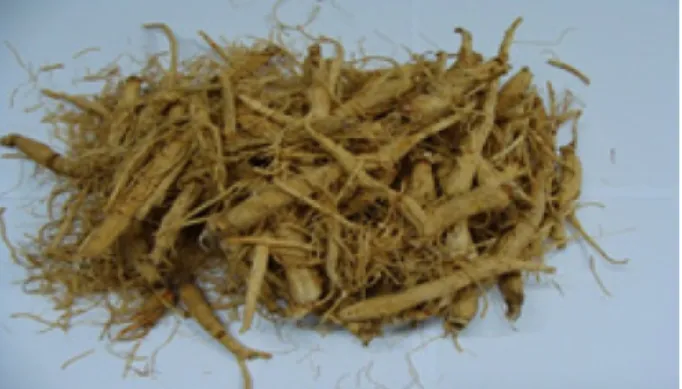
실험재료 − 본 연구에 사용한 피부백삼(Panax ginseng)은 2012년 10월에 (주)대동고려삼(대표: 최성근)에서 4년 근을 구입하였고, 제품표본은 세명대학교 한방식품연구실에 보관 하고 있다(Fig. 1.).
엑스의 조제 − 피부백삼를 세말하고, 시료 각각 200 g씩 에 증류수 2 l를 넣고, 100oC에서 4, 8, 12, 16, 20, 36, 48, 60 그리고 72시간씩 1회 추출하여 여과 후, 동결건조 하여 피부백삼 엑스를 얻었다.
조 사포닌(Crude Saponin) 조제25)− 피부백삼 엑스 각
2 g에 디에틸에테르(diethylether) 50 ml를 가하여 1시간씩 3 회 초음파 세정기(고도기업, 4020P, 한국)로 추출한 후, 원 심분리 하여 상등액을 제거한다. 얻은 잔사에 수포화 부탄 올(butanol) 50 ml를 가하여 2시간씩 3회 추출하고, 원심분 리 하여 상등 액을 취하여 여과하고, 감압 농축을 하여 조 사포닌(조사포닌량 Table I 참조)을 얻는다.
HPLC-ginsenoside의 분석 − 위에서 얻은 엑스를 고 등28) 의 조건을 응용하여 HPLC를 실시하고, 상법에 따라 표품 Fig. 1. Figure of Skin White ginseng.
Table I. Ginsenoside contents in Skin White ginseng extracted under various conditions (%,w/w)
Ginsenosides Skin White ginseng
SWG-4c) SWG-8c) SWG-12c) SWG-16c) SWG-20c) SWG-36c) SWG-48c) SWG-60c) SWG-72c) Rb1 1.017±0.03 1.275±0.037 1.057±0.189 0.893±0.011 0.789±0.042 0.186±0.006 0.099±0.003 0.022±0.002 - Rb2 0.584±0.071 0.721±0.068 0.528±0.099 0.567±0.014 0.479±0.040 0.158±0.005 0.188±0.005 0.176±0.022 0.172±0.034
Rc - - 0.072±0.017 0.136±0.016 0.164±0.023 0.158±0.004 0.205±0.006 0.2000±0.004 0.171±0.038 Rd 0.203±0.002 0.263±0.006 0.219±0.040 0.196±0.005 0.188±0.024 0.061±0.003 0.041±0.002 0.022±0.001 0.010±0.002 Re 0.931±0.032 0.797±0.022 0.542±0.099 0.445±0.009 0.389±0.016 0.068±0.005 0.031±0.004 0.009±0.007 - Rf 0.103±0.011 0.153±0.004 0.139±0.026 0.140±0.003 0.150±0.013 0.086±0.003 0.099±0.001 0.091±0.004 0.074±0.010 Rg1 0.268±0.026 0.405±0.010 0.341±0.063 0.301±0.011 0.272±0.012 0.059±0.003 0.028±0.001 0.007±0.001 - Rg2 0.080±0.013 0.117±0.005 0.124±0.022 0.145±0.002 0.176±0.008 0.148±0.004 0.186±0.006 0.172±0.01 0.137±0.022 20S-Rg3 0.106±0.005 0.296±0.009 0.447±0.079 0.590±0.011 0.823±0.066 0.770±0.026 0.991±0.035 0.996±0.007 0.857±0.134 20R-Rg3 0.082±0.02 0.377±0.009 0.335±0.198 0.269±0.011 0.307±0.028 0.147±0.002 0.551±0.016 0.540±0.008 0.211±0.016 Rg5 0.048±0.001 0.205±0.014 0.343±0.059 0.461±0.009 0.640±0.056 0.629±0.020 0.807±0.027 0.840±0.005 0.763±0.131 Rg6 0.001±0.001 0.004±0.001 0.008±0.002 0.011±0.001 0.016±0.003 0.017±0.001 0.025±0.001 0.030±0.002 0.024±0.012 Rh1 0.675±0.019 0.802±0.028 0.664±0.109 0.611±0.020 0.539±0.021 0.237±0.011 0.207±0.008 0.174±0.004 0.144±0.026 Rh4 0.003±0.001 0.009±0.001 0.017±0.003 0.026±0.001 0.040±0.004 0.043±0.002 0.059±0.002 0.065±0.001 0.061±0.011 Rk1 0.008±0.001 0.045±0.004 0.076±0.014 0.269±0.011 0.142±0.017 0.143±0.005 0.194±0.007 0.203±0.001 0.182±0.031 Rk3 0.002±0.001 0.004±0.001 0.011±0.005 0.017±0.003 0.025±0.003 0.022±0.001 0.028±0.001 0.031±0.002 0.029±0.005 F4 0.009±0.001 0.022±0.003 0.039±0.002 0.051±0.001 0.069±0.005 0.073±0.003 0.088±0.007 0.096±0.004 0.090±0.017
Crude saponin 26.316 24.965 24.040 24.024 18.545 18.545 19.207 18.557 19.686
Total ginsenosidesa)
4.117 5.492 4.960 4.961 5.205 3.002 4.101 3.672 2.923
Prospogeninb) 1.003 1.857 2.025 2.399 2.708 2.154 3.047 3.051 2.407
Values represent the mean±S.E. (n=3), a) Sum total of individual ginsenoside contents. b) Ginsenosides Rg2+Rg3+Rg5+Rg6+Rh1+ Rh4+Rk1+Rk3+F4, c) hours, SWG-4: Skin White ginseng extracted 4 hours at 100oC
과 직접 비교하여 인삼사포닌의 함량 및 조성을 각 시료당 3회 반복 실험하여 결과의 재현성을 확인하여 분석하였다.
표품은 Chromadex(USA)와 엠보연구소(Korea)로부터 구입 한 순도 99% 이상의 ginsenoside를 사용하였다.
사용한 HPLC 장치는 Waters 1525 binary HPLC system(Waters, Milford, MA, USA)이며, 컬럼은 Eurospher 100-5 C18(3×250 mm; Knauer, Germany)을 사용하였다. 이 동상은 acetonitrile(HPLC grade; Sigma-Aldrich Chem Co., USA)과 증류수(HPLC급, B&J, USA)이며, acetonitrile의 비 율을 17%(0 min)에서 25%(25 min), 40%(50 min), 60%
(105 min) 그리고 100%(110 min)로 순차적으로 늘려주고 마지막으로 다시 17%로 조절하였다. 전개온도는 실온, 유 속은 분당 0.8 ml, 크로마토그램은 uv/vis Waters 2487 Dual λ Absorbance Detector(Waters, U.S.A.) 검출기를 이용하여 203 nm에서 검출하였다.
결과 및 고찰
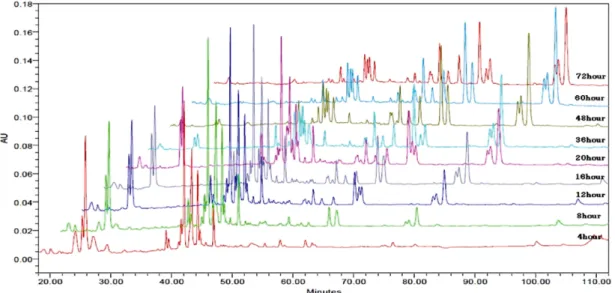
인삼을 가공하는 데는 추출농축을 통하여 진행되고, 열 에 의한 가수분해에 의해서 홍삼 및 흑삼 제조시 생성되는 prosapogenin 성분(ginsenoside Rg3, Rg5, Rk1)이 산생20, 29) 된다고 하는 점에 착안하여, 본 연구는 피부백삼의 추출 시 간에 따른 인삼 사포닌의 함량을 HPLC 법으로 비교분석하 였다(Fig. 2, 3).
피부백삼 증류수 추출(100oC) 시간별 인삼사포닌 함량 비 교 분석을 실시한 결과, 조 사포닌의 양에 있어서는 Table I에서 보는바와 같이 SWG-4가 26.316%로 가장 높은 함량 을 나타내었으며, SWG-8이 24.965%, SWG-12는 24.024%
순서로 높은 함량을 나타내므로서, 100oC 4시간 추출 피부 백삼 추출물의 조 사포닌 함량이 높게 확인되었다. 각 ginsenoside의 총합인 총 사포닌(total saponin) 함량에 있어
Fig. 2. HPLC chromatogram of ginsenosides detected from the processed Skin White ginseng.
Fig. 3. HPLC profiles of ginsenosides detected from the processed Skin White ginseng(SWG-60)
서는 SWG-8이 5.492%이었으며 SWG-20은 5.205%이었으 며, SWG-16은 4.961%로서 100oC 8시간 추출 피부백삼 추 출물의 총 사포닌이 높은 함량을 보여주었다. Prosapogenin 성분(Rg2, Rg3, Rg5, Rg6, Rh1, Rh4, Rk1, Rk3, F4)의 총량은 SWG-60이 3.051%이었으며 SWG-48은 3.047%이었으며, SWG-20은 2.708%로서 100oC 60시간 추출 피부백삼 추출 물의 총 사포닌이 높은 함량을 보여주었다.
Protopanaxadiol group prosapogenin의 경우는 4시간 추출 (SWG-4)시 ginsenoside Rg3의 함량이 0.188%을 나타내었 으나, 추출 시간이 늘어날수록 함량이 증가하다가, 48시간 추출했을 때, 1.542%(SWG-48)의 가장 높은 함량을 나타내 었고, 60시간 추출시 1.536%(SWG-60)의 순이었고, 72시간 추출(SWG-72)시에는 1.068%로 줄어 들었다. 이와 같은 SWG-48의 ginsenoside Rg3의 함량은 고 등30)이 보고한 홍 삼 엑스보다 약 2,7배 높은 함량을 나타내었다.
또한, ginsenoside Rg5, Rk1의 함량에 있어서는 60시간 추 출했을 때, 1.043%(SWG-60)의 가장 높은 함량을 나타내었 고, 48시간 추출시 1.001%(SWG-48)의 순이었다. 특히, SWG-60의 ginsenoside Rg5, Rk1의 함량에 있어서는 Lee 등20)이 보고한 구증구폭한 홍삼(흑삼) 엑스보다도 약 2.4배 높은 함량을 나타내었다.
따라서, protopanaxadiol group 홍삼특유성분으로 알려진 ginsenoside Rg3는 48시간 추출했을 때, protopanaxadiol group 흑삼특유성분으로 알려진 ginsenoside Rg5 과 Rk1은 60시간 추출했을 때 가장 고농도 인삼 prosapogenin 성분 함유 추출 엑스를 얻을 수 있음을 확인할 수 있었다.
한편, Protopanaxatriol group prosapogenin의 경우는 4시 간 추출시 ginsenoside Rg2의 함량이 0.080%을 나타내었으 나, 추출 시간이 늘어날수록 함량이 증가하다가, 48시간 추 출했을 때, 0.186%의 가장 높은 함량을 나타내었고, 20시간 추출시 0.176%의 순이었다.
또한, ginsenoside Rh1의 함량에 있어서는 8시간 추출했 을 때, 0.802%의 가장 높은 함량을 나타내었고, 4시간 추출 시 0.675%의 순이었고, 추출시간이 길어질수록 함유량이 적 어졌다. 따라서, Protopanaxatriol group 홍삼특유성분으로 알려진 ginsenoside Rg2는 48시간 추출했을 때, ginsenoside Rh1은 8시간 추출했을때 가장 고농도 인삼 prosapogenin 성 분 함유 추출 엑스를 얻을 수 있음을 확인할 수 있었다.
결 론
기능성 성분 강화 피부백삼 조성물 개발의 일환으로 피부 백삼 증류수 추출(100oC) 시간별 인삼사포닌 함량을 비교분 석한 결과, 홍삼 및 흑삼 특유성분으로 알려진 ginsenoside Rg3는 48시간 추출했을 때, ginsenoside Rg5 과 Rk1은 60시 간 추출했을 때 가장 고농도 인삼 prosapogenin 성분 함유
추출 엑스를 얻을 수 있음을 확인할 수 있었고, ginsenoside Rg2는 48시간 추출했을때, ginsenoside Rh1은 8시간 추출했 을때 가장 고농도 인삼 prosapogenin 성분 함유 추출 엑스 를 얻을 수 있음을 확인할 수 있었다.
사 사
“본 연구는 농림부 고부가가치식품기술개발사업의 지원에
의해 이루어진 것임”
인용문헌
1. Ko, S. K. and Im, B. O. (2009) The science of Korean gin- seng, 47-52, Yakupsinmunsa, Seoul.
2. Lee, D. C., Lee, M. O., Kim, C. Y. and Clifford, D. H. (1981) Effect of ether, ethanol and aqueous extracts of ginseng on cardiovascular function in dogs. Can. J. Comp. Med. 45: 182- 187.
3. Jie, Y. H., Cammisuli, S. and Baggiolini, M. (1984) Immu- nomodulatory effects of Panax ginseng C.A. Meyer in the mouse. Agents Actions 15: 386-391.
4. Kim, Y. C., Kim, S. R., Markelonis, G. J. and Oh, T. H.
(1998) Ginsenosides Rb1 and Rg3 protect cultured rat cortical cells from glutamate-induced neurodegeneration. J. Neurosci.
Res. 53: 426-432.
5. Joo, C. N., Koo, J. D., Kim, D. S. and Lee, S. J. (1977) Bio- chemical studies of ginseng saponins. XI. The effects of gin- seng saponins on alcohol dehydrogenase. Hanguk Saenghwa Hakhoe Chi 10: 109-120.
6. Tahara, M., Kono, H., Mune, S. and Odashima, S. (1985) Action of ginsenosides on tumor cells. Growth inhibition and redifferentiation of neoplasia. Wakan Yaku Gakkaishi 2: 170- 171.
7. Yokozawa, T., Kobayashi, T., Oura, H. and Kawashima, Y.
(1985) Studies on the mechanism of the hypoglycemic activ- ity of ginsenoside-Rb2 in streptozotocin-diabetic rats. Chem.
Pharm. Bull. 33: 869-872.
8. See, D. M., Broumand, N., Sahl, L. and Tilles, J. G. (1997) In vitro effects of echinacea and ginseng on natural killer and antibody-dependent cell cytotoxicity in healthy subjects and chronic fatigue syndrome or acquired immunodeficiency syn- drome patients. Immunopharmacology 35: 229-235.
9. Kim, H. J., Kim, M. H., Byon, Y. Y., Park, J. W., Jee, Y. and Joo, H. G. (2007) Radioprotective effects of an acidic polysaccharide of Panax ginseng on bone marrow cells. J.
Vet. Sci. 8: 39-44.
10. Lee, T. K., Johnke, R. M., Allison, R. R., O'Brien, K. F. and Dobbs, L. J. Jr. (2005) Radioprotective potential of ginseng.
Mutagenesis 20: 237-43.
11. Lee, H. J., Kim, S. R., Kim, J. C., Kang, C. M., Lee, Y. S., Jo, S. K., Kim, T. H., Jang, J. S., Nah, S. Y. and Kim, S. H.
(2006) In Vivo radioprotective effect of Panax ginseng C.A.
Meyer and identification of active ginsenosides. Phytother.
Res. 20: 392-395.
12. Park, J. D. (1996) Recent studies on the chemical constituents of Korean ginseng. Korean J. Ginseng Sci. 20: 389-415.
13. Sanata, S., Kondo, N., Shoji, J., Tanaka, O. and Shibata, S.
(1974) Studies on the saponins of ginseng. I. Structure of gin- seng-R0, Rb1, Rb2, Rc and Rd. Chem. Pharm. Bull. 22: 421- 428.
14. Kitagawa, I., Taniyama, T., Shibuya, H., Nota, T. and Yoshikawa, M. (1987) Chemical studies on crude drug pro- cessing. V. On the constituents of ginseng radix rubra (2) ; Comparison of the constituents of White ginseng and Red ginseng prepared from the same Panax ginseng root.
Yakugaku Zasshi 107: 495-505.
15. Keum, Y. S., Park, K. K., Lee, J. M., Chun, K. S., Park, J. H., Lee, S. K., Kwon, H. and Surh, Y. J. (2000) Antioxidant and anti-tumor promoting activities of the methanol extract of heat-processed ginseng. Cancer Lett. 150: 41-48.
16. Kim, S. E., Lee, Y. H., Park, J. H. and Lee, S. K. (1999) Gin- senoside-Rs3, a new diol-type ginseng saponin, selectively elevates protein levels of p53 and p21WAF1 leading to induction of apoptosis in SK-HEP-1 cells. Anticancer Res.
19: 487-491.
17. Kim, W. Y., Kim, J. M., Han, S. B., Lee, S. K., Kim, N. D., Park, M. K., Kim, C. K. and Park, J. H. (2000) Steaming of ginseng at high temperature enhances biological activity. J.
Nat. Prod. 63: 1702-1704.
18. Bao, H. Y., Zhang, J., Yeo, S. J., Myung, C. S., Kim, H. M., Kim, J. M., Park, J. H., Cho, J. S. and Kang, J. S. (2005) Memory enhancing and neuroprotective effects of selected ginsenosides. Arch. Pharm. Res. 28: 335-342.
19. Jung, K. Y., Kim, D. S., Oh, S. R., Lee, I. S., Lee, J. J., Park, J. D., Kim, S. I. and Lee, H. K. (1998) Platelet activating fac- tor antagonist activity of ginsenosides. Biol. Pharm. Bull. 21:
79-80.
20. Lee, S. A., Jo, H. K., Im, B. O., Kim, S. G., Whang, W. K.
and Ko, S. K. (2012) Changes in the contents of prosa- pogenin in the Red ginseng(Panax ginseng) depending on steaming batches. J. Ginseng Res. 36: 102-106.
21. Lee, S. A., Jo, H. K., Sung, M. C., Cho, S. H., Song, Y. C., Im, B. O. and Ko, S. K. (2012) Changes in the Contents of Prosapogenin in Ginseng Radix palva(Panax ginseng) Depending on the Extracting Conditions. Kor. J. Pharma- cogn. 43: 152-156.
22. Kwon, S. W., Han, S. B., Park, I. H., Kim, J. M., Park, M. K.
and Park, J. H. (2001) Liquid chromatographic determination of less polar ginsenosides in processed ginseng. J. Chro- matogr. 921: 335-339.
23. Kim, S. J., Kim, J. D. and Ko, S. K. (2013) The change of ginsenoside composition in ginseng leaf and stem extract by the microwave and vinegar process. Kor. J. Pharmacogn. 44:
149-153.
24. Kim, S. J., Kim, J. D. and Ko, S. K. (2013) Changes in gin- senoside composition of ginseng berry extracts after a micro- wave and vinegar process. J. Ginseng Res. 37: 269-272.
25. Jo, H. K., Im, B. O. and Ko, S. K.(2014)The change of gin- senoside composition in White ginseng and Fine White gin- seng extract by the microwave and vinegar process. Kor. J.
Pharmacogn. 45: 77-83.
26. Hasegawa, H., Sung, J. H., Matsumiya, S. and Uchiyama, M.
(1996) Main ginseng saponin metabolites formed by intes- tinal bacteria. Planta Med. 62: 453-457.
27. Hasegawa, H., Sung, J. H. and Benno, Y. (1997) Role of human intestinal Prevotella oris in hydrolyzing ginseng saponins. Planta Med. 63: 436-440.
28. Ko, S. K., Bae, H. M., Cho, O. S., Im, B. O., Chung, S. H.
and Lee, B. Y. (2008) Analysis of ginsenoside composition of ginseng berry and seed. Food Sci. Biotechnol. 17: 1379-1382.
29. Ha, Y. W., Lim, S. S., Ha, I. J., Na, Y. C., Seo, J. J., Shin, H.
S., Son, S. H. and Kim, Y. S. (2007) Preparative isolation of four ginsenosides from Korean Red ginseng (steam-treated Panax ginseng C. A. Meyer), by high-speed counter-current chromatography coupled with evaporative light scattering detection. Journal of Chromatography A. 1151: 37-44.
30. Ko, S. K., Lee, C. R., Choi, Y. E., Im, B. O., Sung, J. H. and Yoon, K. R. (2003) Analysis of ginsenosides of white and Red ginseng concentrates. Korean J. Food Sci. Technol. 35:
536-539.
(2014. 10. 5 접수; 2014. 11. 17 심사; 2014. 12. 5 게재확정)