Convergent Influence of Self Efficacy, Academic Control and School Resilience on TOEIC Learning Flow among Health College Students
Soomi Hong, Sang-Yun Bae
*Professor, Dept. of Health Administration, Vision University of Jeonju
보건계열 대학생의 자기효능감, 학업통제감 및
학교적응유연성이 TOEIC 학습몰입에 미치는 융복합적인 영향
홍수미, 배상윤*
전주비전대학교 보건행정학과 교수
Abstract This study investigates convergent influence on TOEIC learning flow and its association with self efficacy, academic control and school resilience among health college students. Data collection was carried out using a self-administered questionnaire from May 1 to May 29, 2018 and the target was randomly selected 255 health college students in TOEIC class from college located in J city. TOEIC learning flow was positively correlated with self efficacy, academic control and school resilience. With the analysis of covariance structure, we could confirm relationship among self efficacy, academic control, school resilience and TOEIC learning flow. School resilience was more influential on TOEIC learning flow than self efficacy and academic control. The results of the study indicate that the efforts to manage these factors are required to increase TOEIC learning flow of health college students in TOEIC class. The results are expected to be used to develop TOEIC learning curriculum increasing the TOEIC learning flow among health college students in TOEIC class. In the following study, the survey about additional factors of influence on TOEIC learning flow will be needed.
Key Words : Convergent influence, Health college students, TOEIC study, TOEIC learning flow, SEM
요 약 본 연구는 보건계열 대학생의 토익학습에서 자기효능감, 학업통제감 및 학교적응유연성과 TOEIC 학습몰입의 관련 성을 파악하고 TOEIC 학습몰입에 미치는 융복합적 영향을 분석하였다. 자료수집은 2018년 5월 1일부터 5월 29일까지 자기 기입식 설문지를 사용하였으며, 조사대상은 임의로 선정된 J시 소재 대학의 토익학습반에 참여하는 보건계열 대학생 255명 으로 하였다. TOEIC 학습몰입은 자기효능감, 학업통제감 및 학교적응유연성과 양의 상관관계를 보였다. 공분산 구조분석 결과, 자기효능감, 학업통제감 학교적응유연성 및 TOEIC 학습몰입의 인과관계가 확인되었다. 학교적응유연성은 자기효능 감 및 학업통제감보다는 TOEIC 학습몰입에 더 큰 영향을 미쳤다. 이상의 연구결과를 볼 때, 보건계열 대학생의 TOEIC 학습몰입을 높이기 위해서는 이들 요인들을 관리하는 노력이 필요하다. 이러한 결과는 보건계열 대학생의 토익 학습몰입을 높이는 토익학습 교육과정 개발에 활용이 기대된다. 향후연구에서는 TOEIC 학습몰입에 영향을 미치는 추가요인에 대한 조사가 필요하다.
주제어 : 융복합적 영향, 보건계열 대학생, 토익학습, 토익학습몰입, 구조방정식
*Corresponding Author : Sang-Yun Bae([email protected]) Received September 18, 2018
Accepted December 20, 2018
Revised October 26, 2018 Published December 28, 2018
1. Introduction
Hospitals in Korea have repeated quantitative expansion such as population growth, economic growth and development of medical technology, but they encounter requests for qualitative innovation on management and administration of hospital by facing problems of increase of necessity on efficient management of facility, equipment and manpower, increase of importance of primary prevention and efficient operation of medical care delivery system[1,2].
These quantitative and qualitative social requests are increasing necessity on high qualitative improvement of medical service for medical personnel and high quantitative growth of medical administration of hospital administration personnel[1,3].
External environment changes of hospitals have developed medical service by applying as opportunity and strength of medical system, but diversity of medical-related duty, dualistic structure of medical service and administration and spreaded supply of high price medical equipments have caused complex problems such as increase of congestion inside hospital's internal environment and increase of high necessity of innovation on hospital management and have influence as threat and weakness of medical system[3,4].
Thus, the environment of Korea's hospitals is creating difficult situation for maintaining competitiveness with medical service limited to medical treatment to local society patients[4]. Also, increase of multi-cultural families, foreigner and international students residing in Korea caused by acceleration of globalization and continuous development of Korean economy is generating new and internationalized duties on medical service[1]. As an effort of coping with request for internationalization of medical service, the government and private area is carrying forward expansion of various resources and certificates regarding international medical service.
These request for internationalization of medical service is also raising necessity on strengthening
foreign language communication ability of manpower who conducts medical service, medical support and hospital administration duty in the hospital[5]. In addition, in medical-related duty that has labor-intensive characteristic, communication ability is accepted as basic grounding in order to conduct internationalization medical service duty[6]. For health college students, who are required to enter the hospital and perform their major field duties after graduation[5,6], English communication ability is becoming important besides studying major field of study[7]. During conducting international medical service, hospitals may utilize expert interpreter but absence of expert knowledge on medical and hospital administration shall generate medical error, so English communication ability of manpower of medical service, medical support and hospital administration is considered as occupational basic ability[5].
Health college departments are operating occupational basic ability on English communication as various subjects in regular and special curriculum[6]. In order to strengthen English communication ability of health college students, they are utilizing TOEIC score as credit recognition and graduation certification system besides general English and major English subjects and also they are opening TOEIC training school and TOEIC special class[5]. TOEIC is for non-native speakers and it tests their English communication ability. It was developed in the United States in 1979 and has been used in various fields of society such as colleges and businesses since it was introduced in Korea in 1982[5]. Health college students have English communication ability and develop their practical skill to conduct internationalized medical service through TOEIC study[7].
As it is reported that TOEIC studying works as new
opportunity and academic burden to health college
students and generates stress such as burnout and
anxiety[5,7], support plan is necessary for students to
overcome negative stress related to TOEIC and be
immersed in studying. Learning flow is a status of
participating and being immersed in learning for doing one’s best and it is comprised of combination of challenges and skills for study subject, integration of behavior and consciousness for study activity, clear goal on one’s study activity, evaluation and specific feedback of activity process, focusing on task, sense of control for activity process, loss of consciousness that is sense of unity on activity, distorted sense of time due to immersion in activity and purposeful self-experience on compensation for activity process[8].
From the former researches, self efficacy was reported as influencing to English study strategy[9], English communication ability[10] and learning flow[11]
academic control is relevant to school resilience and learning flow[5], and school resilience is being suggested to influence to learning flow[6]. As such, existing research studies investigate and report the association or relation between self-efficacy, academic control, and school resilience to TOEIC learning flow.
TOEIC learning flow seems to be increased by controlling proper activity for learning situation and making oneself adapt to belonged school environment resiliently. Existing researches on learning flow reported of relevance of individual factors, but study on convergent influence on mutual relevance and relative importance of self efficacy, academic control, school resilience and learning flow is uncommon. This study would like to investigate relevance between self efficacy, academic control and school resilience and TOEIC learning flow of health college students, comprehend mutual relevance and relative importance of these factors and analyze convergent influence of self efficacy, academic control and school resilience to TOEIC learning flow. The purpose of this analysis result is to enhance TOEIC learning flow by utilizing as baseline data for TOEIC education and learning support for health college students.
2. Study method 2.1 Subject of survey
The survey was conducted aimed at health college students in TOEIC study class in randomly selected college located in J region from May 1
st, 2018 to May 29
th, 2018. In order to determine appropriate sample number, the minimum required sample number was calculated as 238, at F rejection region 1.57 when analyzing test power at significance level .05, test power .95 and effect size .15 for t-test, ANOVA, correlation analysis and multiple regression analysis with G*power 3.1 program[12], and this study determined the number as 300 people considering poor response. From the result of questionnaire survey, 272 questionnaires were collected(collection rate 90.1%) and this study analyzed 255 questionnaires excluding 17 questionnaires having poor response. In order to observe study ethics, researchers personally visited TOEIC the university and explained the purpose and contents of survey, the right to refuse and method to protect and complete the questionnaire, and then asked students who consented to participate in the study to complete self-administered questionnaire and then collected it on the spot.
2.2 Survey tool
The questionnaire is consisted of self efficacy, academic control, school resilience and TOEIC learning flow. Self-efficacy is the criterion of R. M. Tipton & E.
L. Worthington’s measurement tool[13] reorganized and validated by S. M. Yang[14] and the higher the score is, self-efficacy is high. Academic control is the criterion of R. Karasek et al’s measurement tool[15]
revised and supplemented by Y. B. Lee et al.[16] and the higher the score is, academic control is high. School resilience is the criterion of A. S. Masten’s measurement tool[17] revised and supplemented by H.
S. Park[18] and the higher the score is, school
resilience is high. Subarea is consisted of interest in
school life, attitudes to study and grades and
compliance with school regulations. Learning flow is
the criterion of M. Cskiszentmihalyi’s measurement
tool[8] validated by A. Y. Kim et al.[19] and the higher
the score is, learning flow is high. Subarea is consisted of combination of challenges and skills, integration of behavior and consciousness, clear goals, specific feedback, focus on task, sense of control, loss of consciousness, distorted time and sense and purposeful self-experience.
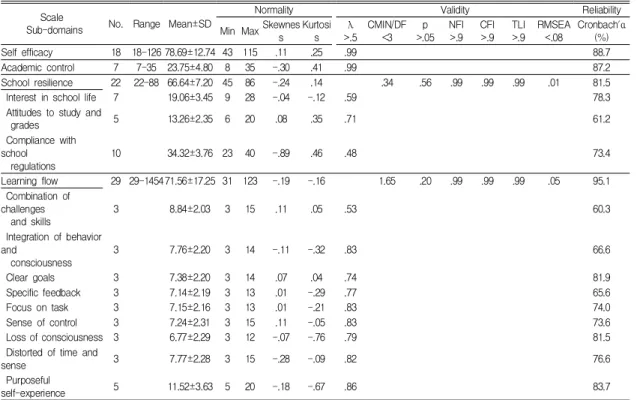
Table 1 shows the number of questions, range of score, average, standard deviation, normality, validity and reliability of criteria measuring self efficacy, academic control, school resilience and learning flow.
As the value of skewness and kurtosis of measured criteria does not exceed absolute value 2, it satisfied normality assumption. From the result of confirmatory factor analysis in order for verification of validity of measured criteria, the value of standard factor loadings(λ), χ
2/df, p, NFI(Normed Fit Index), CFI(Comparative Fit Index), TLI(Tucker-Lewis Index) and RMSEA(Root Mean Square Error of Approximation) corresponded to the criteria, so the validity was verified as appropriate. Cronbach’s α value, internal reliability of used criteria, showed good level.
2.3 Data treatment
This study calculated Pearson correlation coefficient of self efficacy, academic control, school resilience and learning flow. For structural equation model, this study estimated parameter in maximum-likelihood method and selected each model composition elements as latent variable and variables applicant to each composition elements as observation variable. For selection of variables, this study selected variables which have significant relevance in individual simple analysis, support theoretical model and compose proper model in model fit. For exogenous latent variables, this study included self-efficacy and academic control into structural equation model and this study included endogenous latent variables as school resilience and learning flow into structural equation model. For path coefficient, this study marked only significant factors on path diagram. Significance level of all statistics was p<.05.
Scale
Sub-domains No. Range Mean±SD
Normality Validity Reliability
Min MaxSkewnes s
Kurtosi s
λ
>.5 CMIN/DF
<3 p
>.05 NFI
>.9 CFI
>.9 TLI
>.9 RMSEA
<.08
Cronbach'α (%)
Self efficacy 18 18-126 78.69±12.74 43 115 .11 .25 .99 88.7
Academic control 7 7-35 23.75±4.80 8 35 -.30 .41 .99 87.2
School resilience 22 22-88 66.64±7.20 45 86 -.24 .14 .34 .56 .99 .99 .99 .01 81.5
Interest in school life 7 19.06±3.45 9 28 -.04 -.12 .59 78.3
Attitudes to study and
grades 5 13.26±2.35 6 20 .08 .35 .71 61.2
Compliance with school
regulations
10 34.32±3.76 23 40 -.89 .46 .48 73.4
Learning flow 29 29-1454 71.56±17.25 31 123 -.19 -.16 1.65 .20 .99 .99 .99 .05 95.1
Combination of challenges
and skills
3 8.84±2.03 3 15 .11 .05 .53 60.3
Integration of behavior and
consciousness
3 7.76±2.20 3 14 -.11 -.32 .83 66.6
Clear goals 3 7.38±2.20 3 14 .07 .04 .74 81.9
Specific feedback 3 7.14±2.19 3 13 .01 -.29 .77 65.6
Focus on task 3 7.15±2.16 3 13 .01 -.21 .83 74.0
Sense of control 3 7.24±2.31 3 15 .11 -.05 .83 73.6
Loss of consciousness 3 6.77±2.29 3 12 -.07 -.76 .79 81.5
Distorted of time and
sense 3 7.77±2.28 3 15 -.28 -.09 .82 76.6
Purposeful
self-experience 5 11.52±3.63 5 20 -.18 -.67 .86 83.7
Table 1. The normality, validity and reliability of used scale
3. Study result
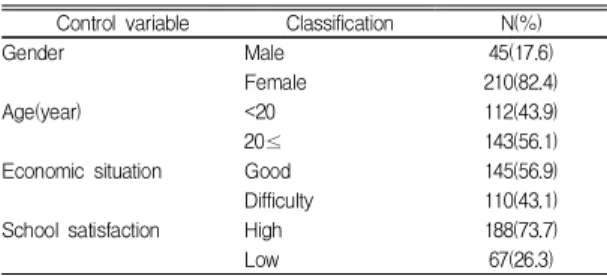
3.1 Demographic factors of subject of survey Table 2 shows gender and age of respondents.
Female students were 82.4%, male students were 17.6% and ‘over 20 years old’ was 56.1% and ‘under 20 years old’ was 43.9%. The economic situation was good 56.9%, and the economic difficulty was 43.1%. The high school satisfaction rate was 73.7%, and the low school satisfaction rate was 26.3%.
Control variable Classification N(%)
Gender Male 45(17.6)
Female 210(82.4)
Age(year) <20 112(43.9)
20≤ 143(56.1)
Economic situation Good 145(56.9)
Difficulty 110(43.1)
School satisfaction High 188(73.7)
Low 67(26.3)
Table 2. Demographic factor of subject
(n=255)3.2 Correlation between learning flow and relevant variables
For correlation between learning flow and relevant factors in Table 3, learning flow showed significant positive correlation with interest in school life and attitudes to study and grades which is the subarea of self efficacy, academic control and school resilience.
Var. 1 2 3 4 5
1. Learning flow 1
2. Self efficacy .517** 1
3. Academic control .450** .369** 1
School resilienc e
4. Interest in school life .469** .550** .336** 1 5. Attitudes to study
and grades .462** .441** .431** .421** 1 6. Compliance with
school regulations .079 .209** .222** .287** .342**
* : p<.05, ** : p<.01.
Table 3. Correlation coefficients between model factors
3.3 Result of covariance structure analysis This study set up model with 2 exogenous concepts(self efficacy, academic control) and 2
endogenous concepts(school resilience, learning flow) as theoretical variable. Observation variable of theoretical variable is 3 subareas of learning flow, 9 subareas of school resilience, academic control and self efficacy.
Model fit value is below 3 in absolute fit index with result χ
2=465.630(df=59), χ
2/df=1.112, and its significance probability is bigger than .05 with the result p=.258, root mean square residual(RMR) is smaller than .05 with the result .033, goodness of fit index(GFI) is bigger than .9 with the result .963, adjusted goodness of fit index(AGFI) is bigger than .9 with the result of .934 and the value of root mean square error of approximation(RMSEA) is smaller than .08 with the result of .021. However, for Incremental Fit Index, normed fit index(NFI) is bigger than .9 with the result of .971, Tucker-Lewis Index(TLI) is bigger than .9 with the result of .995 and Comparative Fit Index(CFI) is bigger than .9 with the result of .997, therefore it can be considered as good model.
Model Fit
Absolute fit index
χ2= 65.630(df = 59), χ2/df = 1.112, p = .258 RMR(Root Mean square Residual) = .033 GFI(Goodness of Fit Index) = .963 AGFI(Adjusted Goodness of Fit Index) = .934 RMSEA(Root Mean Square Error of Approximation) = .021
Incremental fit index
NFI(Normed Fit Index) = .971 TLI(Tucker-Lewis Index) = .995 CFI(Comparative Fit Index) = .997
Table 4. Model identification
Reviewing effect of exogenous latent variable for
endogenous latent variable in Table 5 and figure 1, self
efficacy showed positive(+) direct effect to learning
flow with standard path coefficient .200 and showed
positive(+) direct effect to school resilience with value
of .561. And academic control showed positive(+) direct
effect to learning flow with the value of .156 and
showed positive(+) direct effect to school resilience
with value of .358. Considering effects between
endogenous variables, school resilience showed
positive(+) direct effect to learning flow with standard
path coefficient .368. In addition, considering the rate of explaining dependent variable by independent variable(SMC), self efficacy and academic control explained school resilience 59.2% and self efficacy, academic control and school resilience explained learning flow 39.1%. Path coefficients showed 5% level of self efficacy and academic control for learning flow and other path coefficients academic burnout for test anxiety and the coefficients were significant showing 1% level for all the rest variables.
Endogenous variable Exogenous variable Coefficient of determination School
resilience Self Efficacy Academic
control SMC¶ School
resilience
.093**
(.561)
.136**
(.358) .592
Learning flow
.112* (.368)
.009* (.200)
.018*
(.156) .391
*: p<.05 , **: p<.01
∥ : Regression Weights(Standardized Regression Weights)
¶ : SMC(Squared Multiple Correlations)
Table 5. Structural model of subjects
4. Consideration
This study was conducted in order to comprehend convergent influence of self efficacy, academic control and school resilience to TOEIC learning flow for health college students.
Reviewing correlation between TOEIC learning flow and its relevant factors, TOEIC learning flow showed significant positive correlation with 3 subarea factors of self efficacy, academic control and school resilience, interest in school life and attitudes to study and grades, and self efficacy[11], academic control[5] and school resilience[6] showing correlation with TOEIC learning flow showed similar result in this study. It was judged that the self efficacy, the belief that one can behave properly in context, has close relevance with TOEIC learning flow. Academic control, self-directed learning and self-regulation on learning, seems to have relevance with TOEIC learning flow. For school resilience, interest in school life and attitudes to study and grades are related to TOEIC learning flow, but the relevance with compliance with school regulations was not confirmed. This was judged that active activity such as independence, spontaneity and control for
Academic control Self efficacy
d1 V1
1.00 e1
V10 V11 .78
V9 V12V13
V8 V7
.81 .77 .73
.72 .60
e8
e7 e9 e13
Learning flow d2 V4
e4
V3
V2
e3
e2
.69 .72
School resilience
.083(.561)
.112(.368) .136(.358)
.88
.99
V5 .67
e5
V6 V14
e6
.36 .84
.009(.200)
.018(.156) .371
e10 e11 e12 e14
V1 Self efficacy V5 Compliance with school regulations V9 Specific feedback V13 Distorted of time and sense V2 Academic control V6 Combination of challenges and skills V10 Focus on task V14 Purposeful self-experience V3 Interest in school life V7 Integration of behavior and consciousness V11 Sense of control
V4 Attitudes to study and grades V8 Clear goals V12 Loss of consciousness