서 론
지구상에 존재하는 미생물은 지구 생태계의 전 생물 종의 약60%를 차지하고 있는 것으로 알려져 있으며, 이
러한 미생물은 지구 생태계를 유지하는데 없어서는 안될 중요한 역할을 담당하고 있다. 그들의 종과 기능의 다양 성은 지구 생태계 내에서 생산자와 소비자로 이어지는 물 질흐름에 있어서 분해자의 역할을 수행함으로써 물질의 순환을 극대화 시킬 뿐만 아니라 생태계 내의 한정적인
─
─ 137 ──
대청호로부터 제작한 메타지놈 라이브러리에서
1, 2-dichloroethane
의 분해에 관여하는dhlA
유전자의 분리강철희∙문미숙∙송지숙∙이상만1∙김치경*
(충북대학교 미생물학, 1청주대학교 생명과학과)
Isolation of dhlA Gene Responsible for Degradation of 1, 2--dichloroethane from Metagenomic Library Derived from Daecheong Reservoir. Kang, Cheol--Hee, Mi--Sook Moon, Ji--Sook Song, Sang--Mhan Lee1and Chi--Kyung Kim*(Department of Microbiology, Chungbuk National University, Cheongju 361--763, Korea; 1Department of Life Science, Chongju University, Cheongju 360--764, Korea )
Traditional screening techniques have missed up to 99% of microbial resources existing in the nature. Strategies of direct cloning of environmental DNAs comprising the genetic blueprints of entire microbial metagenomes provide vastly more genetic information than is contained in the culturable. Therefore, one way to screening the useful gene in a variety of environments is the construction of metagenomic DNA library. In this study, the water samples were collected from Daecheong Reservoir in the mid Korea, and analyzed by T-RFLP to examine the diversity of the microbial communities. The crude DNAs were extracted by SDS- based freezing-thawing method and then further purified using an UltraCleanTMkit (MoBio, USA). The metagenomic libraries were constructed with the DNAs partially digested with EcoRI, BamHI, and SacII in Escherichia coli DH10B using the pBACe3.6 vector. About 14.0 Mb of metagenomic libraries were obtained with average inserts 13~15 kb in size. The genes responsible for degradation of 1, 2- dichloroethane (1, 2-DCE) via hydrolytic dehalogenation were identified from the metagenomic libraries by colony hybridization. The 1, 2-dichloroethane dehalo- genase gene (dhlA) was cloned and its nucleotide sequence was analyzed. The acti- vity of the 1, 2-DCE dehalogenase was highly expressed to the substrate. These results indicated that the dhlA gene identified from the metagenomes derived from Deacheong Reservoir might be useful to develop a potent strain for degradation of 1, 2-DCE.
Key words : metagenomic libraries, dhlA, 1, 2-dichloroethane dehalogenase, T-RFLP
* Corresponding author: Tel) 043) 261-2300, Fax: 043) 264-9600, E-mail: [email protected]
자원을 이용하거나 새로운 유기물질을 합성하는데 있어서 도 아주 중요한 역할을 한다(Weisse, 1992; Pernthaler et al., 1998). 또한 상이한 환경 조건에서 적응하여 살아가 는 수많은 종류의 미생물들은 서로 다른 다양한 유용한 유전자를 지닌다고 보고되어 있다(Lee, 2002).
최근까지 미생물을 다양한 자연 환경으로부터 순수 분 리하여 배양하거나 배양된 균체로부터 유용한 각종 물질 을 추출하는 연구가 진행되었다. 그러나 자연 생태계에 존 재하는 모든 미생물을 순수 분리하여 배양하는 것은 불가 능하다. 현재 다양한 미생물 종이 발견되거나 이용되고 있 으나, 많은 학자들은 지금까지 알려진 자연 생태계에 존재 할 것으로 예상되는 미생물 종에 대하여 Amann et al.
(1995)이 보고한 바에 의하면 Table 1과 같이 전통적인 방법으로 배양 가능한 미생물은1% 미만이며, 99% 이상은 배양하기 어려우며, 또는 배양할 수 없다고 보고되었다.
최근에는 미지의 유용한 미생물 자원을 이용하기 위한 방법으로 다양한 환경에 분포되어 있는 상당수의 미생물 을 체계적으로 이용하고자 하는 연구가 본격적으로 이루 어지고 있는데, 그 중의 하나가 배양이 어렵거나, 배양할 수 없는 이들의 유전체를 직접 추출하여 벡터에 삽입하 여 클로닝하는 방법으로 메타게놈 연구가 활발하게 진행 되고 있다. 이때 사용하는 벡터는 큰 크기의 유전자 또는 유전자 클러스터를 클로닝할 수 있는 BAC (Bacterial Artificial Chromosome), YAC (Yeast Artificial Chromo- some), Fosmid, 그리고 Cosmid가 많이 사용되고 있다. 이와 같이 메타지놈 라이브러리를 제작하여 신규 유용 유전자를 탐색하고자 하는 연구가 선진국을 중심으로 활 발히 진행되고 있다(Kim et al., 1992; Bintrim et al.,
1997; Rondon et al., 2000; Moon et al., 2004).
Halogenated hydrocarbons는 유기용매, 농약과 제초제 의 성분 그리고 여러 유기화학 합성 원료물질로 널리 사 용되어 왔다. 특히, Trichloroethylene (TCE)와Perchloro- ethylene (PCE), 그리고 그들의 분해 중간 대사 산물인 1, 2-dichloroethane (1, 2-DCE)은 세척제 및 탈지제로 쓰이거나 다른 화학합성의 원료물질로 쓰이고 있다. 이 물질들은 토양계나 수계환경에 노출되면 독성과 발암성 이 있기 때문에 생명체에 유해하고, 특히 사람의 건강을 위협하는 요인이 되어 환경부에서 그 사용을 제한하고 있 다. 따라서 이러한 환경오염 물질들을 분해할 수 있는 미 생물의 분리 및 분해에 관여하는 효소, 유전자 그리고 분 해경로 등에 관한 많은 연구들이 진행되고 있다(Fetzner and Lingens, 1994; Janssen et al., 2001).
미생물들이 halogenated hydrocarbons를 분해하는 과 정 가운데 가장 중요한 단계는dehalogenation으로 탄소 와 할로겐의 강한 공유결합(C-H)이 dehalogenase의 작 용으로 끊어지게 된다. Janssen et al. (2001)은 dehalo- genation이 일어남으로서 halogenated hydrocarbons의 독성이 약해진다고 보고하였다.
Haloalkane의 분해에 관여하는 haloalkane dehalo- genase 중 hydrolytic haloalkane dehalogenase로는 Xanthobacter autotrophicus GJ10 (Janssen et al., 1989) 와 Xanthobacter flavus UE15 (Song et al., 2004)의 hydrolytic 1, 2-DCE dehalogenase (dhlA)이며, Mycobac- terium sp. GP1 (Poelarends et al., 1999)와Pseudomonas pavonaceae (Poelarends et al., 2000), 그리고 Rhodoco- ccus rhodochrous (Kulakova et al., 1979)에서 보고된 hydrolytic 1, 2-dibromoethane dehalogenase (dhaA)가 대표적인데, 이 두 효소는 아미노산 서열에 있어서 30%
정도의 낮은 유사성을 보이지만 효소의 전체적인 구조는 매우 유사하고 효소활성 부위에 보존적인 아미노산이 존 재한다는 것이 특징이다(Newman et al., 1999).
1, 2-DCE은 Xanthobacter autotrophicus GJ10 (Janssen et al., 1989)와 Xanthobacter flavus UE15 (Song et al., 2004)의 haloalkane dehalogenase인 dhlA 와haloacid dehalogenase인dhlB에 의하여 염소이온 두 개가 순차적으로 떨어지며 분해된다고 보고되었다.
본 연구에서는 대청호 시료로부터 핵산을 추출하여 BAC벡터를 이용한 메타지놈 라이브러리를 구축하였고, 그 중에서 hydrolytic dehalogenation 작용으로 1, 2- dichloroethane (1, 2-DCE)를 분해하는pDC20을 분리하 였다. 메타지놈 라이브러리로부터 분리한 pDC20로부터 haloalkane dehalogenase gene, dhlA을 클로닝하고, 염기 Table 1. Culturability determined as a percentage of cul-
turable bacteria in comparison with total cell counts.
Habitat Culturability
References (%)a
Seawater 0.001~0.1 Kogure et al. (1979; 1980), Ferguson et al. (1984) Freshwater 0.25 Jones (1977)
Sediments 0.25 Jones (1977)
Soil 0.30 Tosvik et al. (1990)
Mesotrophic
0.1~1 Staley and Konopka (1985) lake
Unpolluted estu-
1~3 Ferguson et al. (1984) arine waters
Activated sludge 1~15 Wagner et al. (1993; 1994)
aCulturable bacteria are measured as CFU formation.
서열을 분석하였으며, 또한 효소 활성을 다른 미생물과 비교 검정하였다.
재료 및 방법
1. 시료 채취 및 핵산 추출
국내 중부권에 위치한 대청호로부터 시료 채취와 동시 에 수온 및 pH를 현장에서 측정하였으며, 그 외에 측정 항목에 따라 전처리를 실시한 후 4�C 상태로 실험실로 운반하여 분석하였다.
대청호 시료로부터 핵산을 추출하기 위하여Rhochelle et al. (1992)의 방법을 변형하여 사용하였다. 대청호의 시 료를 원심분리기(14,000×g, 15분, 4�C)를 사용하여 농축 하였으며, 농축된 균이 들어있는 tube에 lysozyme buffer (0.15 M NaCl, 0.1 M EDTA, pH 8.0, lysozyme 15 mg mL-1) 300µL를 넣고, 37�C 항온 중탕기 속에서 1시간 방치하 는 동안에15분마다 혼합액을 섞어 주었다. SDS solution (0.1 M NaCl, 0.5 M Tris-HCl, pH 8.0, SDS 4%) 300µL 를 첨가하여 65�C에서 15분 동안 반응시킨 후, -70�C에 서 얼리고, 65�C에서 녹이는 과정을 3회 반복한 후에 동 량의 phenol (Tris-buffered, pH 7.4)을 처리한 후, phenol: chloroform: isoamylalcohol (25 : 24 : 1)의 혼합액 과chloroform: isoamylalcohol (24 : 1)의 혼합액을 순서대 로 각 1회씩 처리하였다. 상층액을 취하여 동량의 냉 isopropanol과 sodium acetate (최종 농도 0.3 M)를 첨가 하고-20�C에서12시간 이상 방치하여 핵산을 침전시켰 다. 원심분리(14,000×g, 30분, 4�C)한 후, 에탄올로 세척 하고, 건조시켜 DNA pellet을 얻었다. 추출된 핵산은 UltraCleanTMDNA Purification kit (Mo Bio, Solana Beach, USA)로 정제하였다. 정제된 핵산은 TE 완충용액 (100 mM Tris-HCl, 1 mM EDTA, pH 8.0)으로 녹인 후 -20�C에서 보관하였다.
2. 16S rDNA T-RFLP 분석
16S rDNA의 증폭에 이용된eubacterial primer는27F (E. coli numbering 8-27 : 5′-AGAGTTTGATCMTGG- CTCAG-3′)와 785R (E. coli numbering 785-804 : 5′- ACTACCRGGGTATCTAATCC-3′)을 사용하였다. T-RF 분리를 위하여27F는 biotinylated primer (27FB)를 사용 하였다(Lee et al., 2000). PCR 반응물의 조성은 1×반응 용액(100 mM Tris-HCl, 400 mM KCl, 1.5 mM MgCl2, 500µg mL-1BSA, pH 8.3), 160µM dNTPs, 0.3µM pri-
mer, 정제된 DNA (10~15 ng µL-1)와 1.5 unit의 Taq DNA polymerase를 첨가하여 총 50µL의 혼합물을 만들 었다. PCR 반응조건은 95�C에서 3분간 열 처리한 후, 95�C에서30초, 58�C에서 30초, 72�C에서1분씩 30회 반 복하고, 마지막에는 72�C에서 10분간 처리한 후 반응을 중단시켰다. PCR product는 0.8% agarose gel에서 전기 영동하여 확인하였으며, UltraCleanTM kit (MO BIO)로 정제 후-20�C에서 보관하였다.
PCR 산물에 제한 효소 HaeIII (TaKaRa, Otsu, Shiga, Japan) 5 unit을 첨가하여 37�C에서 5시간 동안 반응시 켰다. 제한 효소에 의해 절단된DNA에0.5×SSC 완충용 액(75 mM NaCl, 7.5 mM sodium citrate, pH 7.3)으로 3 회 세척한 후 streptavidin paramagnetic particle (Pro- mega, Madison, Wisconsin, USA)과 1×SSC를 첨가하여 실온에서10분 동안 반응시켰다. Magnetic stand로 분리 된streptavidin paramagnetic particle은 0.1×SSC 완충 용액으로 4회 세척 후, 0.2 N NaOH를 첨가하여 5분간 반응시키고, 다시 0.2 N NaOH를 첨가하여 2분간 반응시 킴으로써 biotin이 붙은 single-stranded DNA (ssDNA) T-RF만을 회수하였다. 25% NH4OH를 넣고 65�C에서 10분간 반응시켜서streptavidin으로부터DNA를 분리시 켰다. 원심분리(14,000×g, 4분, 4�C)하여 상층액만 취한 후, 20분 동안 진공 건조하여 암모니아를 제거하였다.
T-RF profile은 6% polyacrylamide gel (acrylamide:
bisacrylamide = 19 : 1, 0.7 M urea, 1×TBE)에서 전기영 동하여 확인하였다. 시료 3µL와 loading dye buffer (95%
formamide, 10 mM NaOH, 20 mM EDTA, 0.02% bromo- phenol blue, 0.02% xylene cyanol FF) 1.5µL를 섞어 3분 동안 95�C에서 변성시킨 후, 얼음에 식혔다. 1×TBE 완 충용액(90 mM Tris-borate, 2 mM EDTA, pH 8.0)으로 완충된6% denaturing acrylamide gel에서 1900 V, 50 W 에서3시간 전기영동 하였다. silver staining 방법은 제조 회사 지침서에 따라 염색하였다(Bionner, Daejeon, Korea).
3. 메타지놈 라이브러리 구축
플라스미드 pBACe3.6와 E. coli DH10B를 벡터와 숙 주균으로 사용하였다. 대청호 시료와 벡터로부터 추출된 DNA에 제한효소 EcoRI, BamHI와 SacII를 처리하였으 며, 제한효소 처리된 DNA를 16�C에서 16시간 ligation 시켰다. CaCl2로 처리한 숙주균 E. coli DH10B에 열 충 격으로 형질전환(Sambrook et al., 1989)을 시켜 얻은 재 조합 균주들을 TSA-Cm (Trtpticase Soy Agar plates에
12.5µg mL-1 chloramphenicol과 5% sucrose를 첨가)배 지에서 단일 재조합 균주로 분리하여 배양시켰다. 얻어진 재조합 균주들을 보존하기 위하여TSA-Cm 액체 배지에 37�C에서 18시간 배양 시킨 후glycerol를 첨가하여-80
�C에 보존하였다.
4. dhlA유전자의 검색
Table 2에서 보는 바와 같이, Xanthobacter autotroph- icus GJ10의 dhlA유전자 서열로부터 전체 서열을 증폭 할 수 있도록 562F와 2171R primer 쌍을 제작하였다 (Song et al., 2004).
PCR 반응물의 조성은 1×반응용액(100 mM Tris- HCl, 400 mM KCl, 1.5 mM MgCl2, 500µg mL-1BSA, pH 8.3), 200µM dNTP, 0.2µM primer, 정제된 DNA (10~15 ng µL-1)와2.5 unit Taq DNA polymerase를 첨가하여 총 50µL의 혼합물을 만들었다. PCR 반응조건은 95�C에서 2분간 초기 열 처리한 후, 95�C에서 30초, 54�C에서 30 초, 72�C에서 1분씩 30회 반복하고, 마지막에는 72�C에 서 10분간 처리한 후 반응을 중단시켰다. Colony hyb- ridization의 수행하기 위하여, 재조합 균주들을 chloram- phenicol 12.5µg mL-1이 포함된 LB 고체배지(LB-Cm) 에 37�C에서 하루 동안 배양하여 집락이 형성되면, 멸균 한 nylon membrane (HybondTM-N±, Amersham Biosciences, UK)을 올려놓고 균 집락을 흡착시킨다. 균 집락이 흡착된 nylon membrane를 0.5 N NaOH 용액으 로 충분히 적신2겹의 Whatman 3 MM paper 위에 놓고 5분간 용균한 후 paper towel 위에 올려놓아 수분을 제 거, 이 과정을 2회 반복한다. 1 M Tris-HCl (pH 7.6)와 1 M Tris-HCl (pH 7.6)/1.5 M NaCl을 순서대로 같은 방법 으로 각 1회씩 처리하였다(Hanahan and Meselson, 1980). 혼성화 반응은 ECL (Enhanced chemilumines- cene, Amersham Biosciences, UK) kit를 제조회사에 지 침서에 따라 수행하였다.
5. 1, 2-DCE의 dehalogenation 작용의 활성 분석
호기적 환경에서 메타지놈 라이브러리에서 분리한 재 조합 균주와 E. coli는 37�C에서 16시간, X. autotrophi-
cus GJ10는 30�C에서 18시간을 배양하고, 10 mM pota- ssium phosphate buffer로 2회 세척한 후, 기질이 0.5 mM 농도로 포함된 50 mM potassium phosphate buffer 에 접종하여 30�C에서 24시간 동안 배양한다. 배양액을 원심분리 하여 얻은 상등액1 mL에Hg (SCN)2(0.69 g L-1, 0.5 mL)을 0.5 mL 섞어주고 상온에 방치한다. 15분 후 4.86 N HNO3에 녹아있는 0.25 M ferric ammonium sul- fate를 0.5 mL 넣고 섞어준 후 15분 동안 반응시킨다. 유 리되는 염소이온의 양을 Bergman and Sanik (1957)에서 와 같이 453 nm 파장에서spectrophotometer (LKB4046, Pharmacia, England)로 scanning 한다. 실험결과 deha- logenation 활성은 Song et al. (2004)에서와 같이 미생물 이 들어있지 않은 대조군과 비교하여 분석하였다.
6. 데이터 분석
염기서열 결정은 ThermoSequenase kit (Part number:
US78500, Amersham Life Science, USA)와 LongReaIR 4200 sequencer를 사용하여 dideoxy-chain termination (Sanger et al., 1977) 방법으로 하였다. GenBank data- base에서의 염기서열 검색을 NCBI (National Center for Biotechnology Information; www.ncbi.nlm.nih.gov) 서버 를 통해 BLAST 프로그램으로 수행하였다. 염기서열의 정렬 및 다중서열 정렬은Clustal W package (Thompson et al., 1994)와 Clustal X (Thompson et al., 1997) 프로그 램을 이용하여 분석하였다.
결과 및 고찰
1. 대청호의 미생물 군집
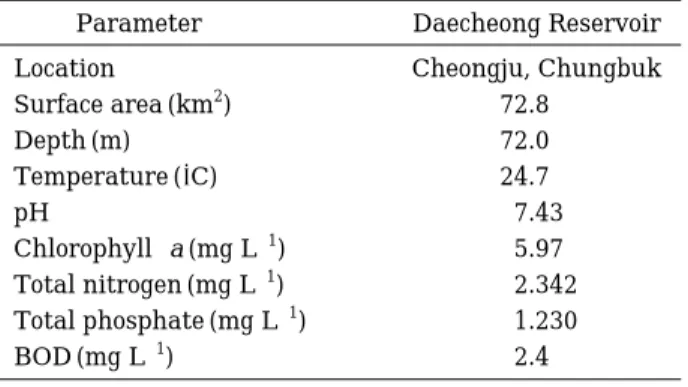
대청호로부터 시료 채취와 동시에 수온 및 pH를 현장 에서 측정하였으며, 그 외에 측정항목은 실험실로 운반하 여 분석한 결과를Table 3에 나타내었다.
대청호 시료에서 미생물 군집 구조의 양상을 알아보고 자 T-RFLP 분석법을 적용하였다(Marsh, 1999). T- RFLP 분석한 결과Fig. 1에서 보는 것과 같이 대청호 시 료 HaeIII T-RF profile에서 150~350 bp 범위에서 T- Table 2. One set of PCR primer for dhlA gene studied in this work.
Primer Sequence (5′-3′) A.T. (�C) Amplified sequence
562F GATTGCCCAGTACTCCCTGA 54 haloalkane dehaloganase gene
2171R GCAAATACCGACATCAAGCA 54 (dhlA full-covering region)
A.T., annealing temperature; primer sequences are originated from Xantobacter autotrophicus GJ10
RF band가 30여개 존재하는 것을 확인하였다. 그 중에 서161, 190, 192, 217, 219, 224, 235 bp 그리고256 bp 크 기의 T-RF band가 우점을 보였다. 특히, simulation 실 험을 통해 얻은 database를 바탕으로 HaeIII T-RF band 중에서 217 bp와 219 bp의 band는 β-proteobac- teria에 해당하며, 190 bp와 192 bp, 그리고 256 bp band 의 γ-proteobacteria에 해당하는, 224 bp band의 Cyano- bacteria해당되는 독특한 크기임을 확인하였다.
T-RFLP 방법으로 대청호의 미생물의 군집 구조를 분 석해 본 결과 미생물 군집 구조가 다양하지 않음을 확인 할 수 있었다. 이것은 시료 수집 기간이 수온이 상승하기
시작하는 7월초이었기 때문에 녹조 현상과 관련된 일부 Cyanobacteria가 우점한 것으로 보여지며, 또한 γ-pro- teobacteria 우점하였는데, 이는 Wagner et al. (2002)에 의하여 γ-proteobacteria은 유기물이 풍부한 곳에 선택 적으로 우점한다고 보고된 바 대청호 시료 안에 유기물 이 풍부함을 간접적으로 보여주는 결과였다.
2. 메타지놈 라이브러리 구축
UltraCleanTM kit (MoBio, USA)로 정제된 DNA를 EcoRI, BamHI, 그리고 SacII 등의 제한효소로 partial digestion하였고, pBACe3.6 vector도 같은 제한효소로 절 단하였다. 절단된 호수 시료 DNA와 벡터 DNA를 liga- tion시켜 E. coli DH10B에 열 충격(heat-shock)으로 형 질전환 시킨 결과1,250개의 클론을 얻었다. 그 클론들을 가지고 insert의 size를 확인하기 위해서 제한효소 처리 를 해본 결과 최소2 kb에서 최대 30 kb까지 다양한 size 의insert가 들어간 것을 확인할 수 있었고, 이들의 평균 insert size는 약 13~15 kb이었다. Fig. 2에서와 같이 insert size를 분석해 본 결과 최대 14 Mb 정도의 메타지 놈 라이브러리를 확보하였다.
3. dhlA유전자의 검색 및 dehalogenation의 활성
1, 2-DCE를 dehalogenation에 관여하는 dhlA유전자 를 메타지놈 라이브러리 클론들 중에서 분리하기 위하 Table 3. Environmental conditions of Daecheong Reser-
voir studied in this work.
Parameter Daecheong Reservoir
Location Cheongju, Chungbuk
Surface area (km2) 72.8
Depth (m) 72.0
Temperature (�C) 24.7
pH 7.43
Chlorophyll-a (mg L-1) 5.97 Total nitrogen (mg L-1) 2.342 Total phosphate (mg L-1) 1.230
BOD (mg L-1) 2.4
1 2 bp
307
252 233
202
219 bp: β-proteobacteria
224 bp: Actinobacteria, Cyanobacteria 256 bp: γ-proteobacteria
161 bp: Thermococci Nearest neighbors
190, 192 bp: γ-proteobacteria 217 bp: β-proteobacteria
235 bp: Actinobacteria, Oscillochoris
Fig. 1. Hae III T-RF profiles of 16S rDNA amplified from the lake samples. Lane: 1, Size marker; 2, Dae- cheong
0 100 200 300 400 500
Number of clones
0~2.0 2.1~4.0 4.1~6.0 6.1~8.0
8.1~10.0 10.1~20.0 ¤20.1 Size of insert (kb)
Fig. 2. Size distribution of the inserts included in the metagenomic DNA library.
여, 대청호 시료로부터 구축된 메타지놈 라이브러리의 클 론들을 TSA-Cm 고체배지에 picking하였고, 562F와
2171R primers로 증폭한 1.6 kb의 PCR 산물을 probe로 하여 colony hybridization을 실시하였다(Hanahan and Meselson, 1980). Colony hybridization을 수행한 결과 Fig. 3에서와 같이 구축된 메타지놈 라이브러리 pDC20 에서 positive 결과를 얻었다. 분리된pDC20을 가지고 1, 2-dichloroethane dehalogenation의 활성을 분석한 결과 Fig. 4를 보면, dhlA유전자를 가진 pDC20은 wild type 인 Xanthobater autotrophicus GJ10보다는 약간 낮지만, negative control인 E. coli DH10B와 비교하였을 때에는, 1, 2-DCE에 매우 높은 dehalogenation 활성을 나타냈었 다.
4. dhlA유전자 염기서열
대청호 시료로부터 구축된 메타지놈 라이브러리에서 분리한 pDC20에서 dhlA유전자를 염기서열 분석을 위 하여, 562F와 2171R primers를 수행하여 1.6 kb의 PCR product를 얻었다. 1.6 kb의 PCR product를 pGEM-T vector (Promega, USA)에 삽입하여 재조합 균주 pDH1 를 만들고 삽입된PCR 산물의 염기서열을 결정하였다.
Sequencing 결과, 562F와 2171R을 사용하여 증폭한 1.6 kb PCR product 내에는 dhlA유전자는 933 bp의 염 기와 310개의 아미노산으로 구성이 되어 있었고, GC composition은 54.5%, terminal codon은 TAG, ribosome 결합 부위는GAGG (-5~-8)였다.
재조합 균주 pDH1의 haloalkane dehalogenase 효소 는Table 4에서 보는 보와 같이, Xanthobacter autotroph- icus GJ10 (Janssen et al., 1989)와 Xanthobacter flavus UE15 (Song et al., 2004)의 haloalkane dehalogenase (dhlA)와 99%의 높은 유사성를 보였으나, Mycobacter- ium sp. GP1 (Poelarends et al., 1999)와 Pseudomonas pavonaceae (Poelarends et al., 2000), 그리고 Rhodococcus rhodochrous (Kulakova et al., 1997)의haloalkan dehalo- genase (dhaA)와 27%에서 29% 정도로 낮은 유사성을 보였다. 이는 haloalkane dehalogenase (dhlA) 효소와
cells including metagenomic clones
hybridized blots with dhlA probe pDC20
Fig. 3. Detection of dhlA gene including in the metage- nomic clones, pDC20.
DH10B
pDC20 GJ-10 1.2
Dechlorination of 1, 2-DCE (A453) 1.0
0.8
0.6
0.4
0.2
Incubation time (hr)
0.5 3 6 12 24
Buffer
±1, 2-DCE
Fig. 4. Dehalogenation of 1, 2-DCE to produce 2-chloro- ethane by the transformant E. coli cells, including the metagenomic clones, pDC20.
Table 4. Charateristics of dhlA gene from metagenomic clones and their identity with haloalkane dehalogenase genes.
No. of No. of Terminal G±C Source Identity (%) of sequence
Gene nucleotide (bp) amino acid codon (%) organism Nucleotide Amino acid
dhlA 933 310 TAG 54.5 Metagenomic clone (pDC20) 100 100
dhlA 933 310 TAG 54.5 Xanthobacter autotrophicus GJ10 99.9 99.9
dhlA 933 310 TAG 54.5 Xanthobacter flavus UE15 99.9 99.9
dhlA 924 307 TAG 59.6 Mycobacterium sp. GP1 49.4 28.6
dhlA 882 293 TAG 59.4 Rhodococcus rhodochrous 48.2 27.0
dhlA 882 293 TGA 59.4 Pseudomonas pavonaceae 48.6 27.0
haloalkan dehalogenase (dhaA)효소는 아미노산 서열상 에 유사성이 낮지만, haloalkane의 분해에 관여하는 ha- loalkane dehalogenase 중 hydrolytic haloalkane dehalo- genase으로써 전체적인 구조는 매우 유사하고 효소활성 부위에 보존적인 아미노산이 존재한다고 보고 되었다 (Newman et al., 1999).
적 요
전통적인 스크린 방법으로는 자연계에 존재하는 99%
이상의 미생물 자원을 확보하지 못했다. 자연생태계의 핵 산을 직접 클로닝하는 전략은 배양 가능한 미생물의 유 전적인 정보보다 더 광범위한 유전적인 정보를 전체의 미생물 메타지놈에서 확보하기 위한 계획을 세웠다. 그 결과 유용한 유전자를 탐색하는 한 방법으로 다양한 환 경에서 메타지놈 DNA 라이브러리를 구축하는 방법이었 다. 본 연구는 국내 중부권에 위치한 대청호로부터 시료 를 수집하였고, T-RFLP 방법을 사용하여 미생물 군집의 다양성을 분석하였다. 핵산의 추출은 SDS를 사용한 freeing-thawing 방법을 사용하였으며, 추출한 핵산은 UltraCleanTMkit (MoBio, USA)을 사용하여 정제하였다. 메타지놈 라이브러리는 제작은 정제한DNA와 pBACe3.6 vector를 EcoRI, BamHI, 그리고 SacII 등의 제한효소로 partial digestion하였고, 이들을 ligation한 다음 Escherichia coli DH10B에 형질전화 시켜 제작하였다. 메 타지놈 라이브러는14 Mb 정도 확보하였는데, 평균 insert size는 약13~15 kb이었다. Colony hybridization으로 메 타지놈 라이브러리로부터 1, 2-dichloroethane (1, 2- DCE) hydrolytic dehalogenation의 분해에 관련된 유전 자를 확인하였다. 1, 2-DCE dehalogenas효소는 기질에 대한 높은 활성을 나타내었다. 1, 2-dichloroethane deha- logenase 유전자의 클론을 만들었고, 염기서열을 분석하 였다. 이들 결과로 보아 대청호로부터 제작한 메타지놈에 서 dhlA유전자를 확인한 균주는 1, 2-DCE 분해에 탁월 한 능력을 나타내었다.
사 사
본 연구는21세기 프론티어연구개발사업인 미생물유전 체활용 기술개발사업단의 연구비지원(과제번호: M102KK010002-04K1101-00231)에 의하여 이루어졌 음. 또 과학기술부의 국제공동연구사업인 한-이태리 방
문연구(과제번호: M60407000003-04A0100-04510)에 따 라 본 논문 내용을 적극적으로 토의해 준 이태리Univer- sity of Firenze의Bazzicalupo 교수님께 감사드린다.
인 용 문 헌
Amann, R.I., W. Ludwig and K.-H. Schleifer. 1995.
Phylogenetic identification and in situ detection of indi- vidual microbial cells without cultivation. Microbiol.
Rev. 59: 143-169.
Bergman, J.G. and J. Sanik. 1957. Determination of trace amounts of chloride in naphtha. Anal. Chem. 29: 241- 243.
Bintrim S.B., T.J. Donohue, J. Handelsman, G.P. Roberts and R.M. Goodman. 1997. Molecular phylogeny of Archaea from soil. Proc. Nat. Acad. Sci. USA 94: 277- 282.
Ferguson, R.L., E.N. Buckley and A.V. Palumbo. 1984.
Response of marine bacteriolplankton to differential filtration and confinement. Appl. Environ. Microbiol.
47: 49-55.
Fetzner, S. and F. Lingens. 1994. Bacterial dehalogenase:
biochemistry, genetics, and biotechnological applica- tions. Microbiol. Rev. 58: 641-685.
Hanahan, D. and M. Meselson. 1980. Plasmid screening at high colony density. Gene 10: 63-67.
Janssen, D.B., A. Scheper, L. Dijkhuizen and B. Witholt.
1985. Degradation of halogenated aliphatic compounds by Xanthobacter autotrophicus GJ10. Appl. Environ.
Microbiol. 49: 673-677.
Janssen, D.B., F. Pries, J. Van Der Ploeg, B. Kazemier, P.
Terpstra and B. Witholt. 1989. Cloning of 1, 2-dichloro- ethane degradation genes of Xanthobacter autotro- phicus GJ10 and expression and sequencing of the dhlA gene. J. Bacteriol. 171: 6791-6799.
Janssen, D.B., J.E. Oppentocht and G.J. Poelarends. 2001.
Microbial dehalogenation. Curr. Opin. Biotechnol. 12:
254-258.
Jones, J.G. 1977. The effect of environmental factors on estimated viable and total populations of planktonic bacteria in lakes and experimental enclosures. Fresh- water Biol. 7: 67-91.
Kim, U.J., H. Shizuya, P.J. de Jong, B. Birren and M.I.
Simon. 1992. Stable propagation of cosmid sized hu- man DNA inserts in an F factor based vector. Nucleic Acids Res. 20: 1083-1085.
Kogure, K., U. Simidu and N. Taga. 1979. A tentative
direct microscopic method for counting living marine bacteria. Can. J. Microbiol. 25: 415-420.
Kogure, K., U. Simidu and N. Taga. 1980. Distribution of viable marine bacteria in neritic seawater around Japan. Can. J. Microbiol. 26: 318-323.
Kulakova, A.N., M.J. Larkin and L.A. Kulakov. 1997. The plasmid-located haloalkane dehalogenase gene from Rhodococcus rhodochrous NCIMB 13064. Microbiology 143: 109-115.
Lee, D.H., S.A. Noh and C.K. Kim. 2000. Development of molecular biological methods to analyze bacterial species diversity in freshwater and soil ecosystems. J.
Microbiol. 38: 11-17.
Lee, M.S. 2002. Molecular biological analysis of bacterial community and metagenome library construction from sunchon bay. M. S. thesis, Chungbuk National Univer- sity.
Marsh, T.L. 1999. Terminal Restriction Fragment Length Polymorphism (T-RFLP); an emerging method for characterizing diversity among homologous populations of amplification products. Curr. Opin. Microbiol. 2:
323-327.
Moon, M.S., D.H. Lee and C.K. Kim. 2004. Identification of the bphC gene for meta-cleavage of aromatic pollutants from a metagenomic library derived from lake waters.
Biotechnol. Bioprocess. Eng. 9: 393-399.
Newman, J., T.S. Peat, R. Richard, L. Kan, P.E. Swanson, J.A. Affholter, I.H. Holmes, J.F. Schindler, C.J.
Unkefer and T.C. Terwilliger. 1999. Haloalkane dehalo- genases: structure of a Rhodococcus enzyme. Biochem.
38: 16105-16114.
Pernthaler, J., F.O. Glockner, S. Unterholzner, A. Alfreider, R. Psenner and R. Amann. 1998. Seasonal community and population dynamics of pelagic bacteria and arc- haea in a high mountain lake. Appl. Environ. Micro- biol. 64: 4299-4306.
Poelarends, G.J., J.E. van Hylckama Vlieg, M.J.
Larkinand, L.M. Freitas Dos Santos and D.B. Janssen.
1999. Degradation of 1, 2-dibromoethane by Mycobac- terium sp. Strain GP1. J. Bacteriol. 181: 2050-8.
Poelarends, G.J., L.A. Kulakov, M.J. Larkin, J.E. van Hylckama Vlieg, and D.B. Janssen. 2000. Roles of horizontal gene transfer and gene integration in evolu- tion of 1,3-dichloropropene- and 1, 2-dibromoethane- degradative pathways. J. Bacteriol. 182: 2191-2199.
Rhocelle, P.A., J.C. Fry, R.J. Parkes and A.J. Weightman.
1992. DNA extraction for 16S rRNA gene analysis to determine genetic diversity in deep sediment communi- ties. FEMS. Microbiol. Lett. 79: 59-65.
Rondon, M.R., P.R. August, A.D. Bettermann, S.F. Brady, T.H. Grossman, M.R. Liles, K.A. Loiacono, B.A. Lynch, I.A. MacNeil, C. Minor, C.L. Tiong, M. Gilman, M.S.
Osburne, J. Clardy, J. Handelsman and R.M. Goodman.
2000. Cloning the soil metagenome: a strategy for accessing the genetic and functional diversity of uncul- tured microorganisms. Appl. Environ. Micobiol. 66:
2541-2547.
Sambrook, J., E. Fritsch and T. Maniatis. 1989. Molecular cloning: A Laboratory Manual. 2nd ed., Cold Spring Harbor Laboratory Press, Cold Spring Harbor, NY, USA.
Sanger, F., S. Nicklen and A.R. Coulson. 1977. DNA sequ- encing with chain-terminating inhibitors. Proc. Natl.
Acad. Sci. USA 74: 5463-5467.
Song, J.S., D.H. Lee, K. Lee and C.K. Kim. 2004. Genetic organization of the dhlA gene encoding 1, 2-dichloro- ethane dechlorinase from Xanthobacter flavus UE15. J.
Microiol. 42: 188-193.
Staley, J.T. and A. Konopka. 1985. Measurement of in situ activities of nonphotosynthetic microorganisms in aquatic and terrestrial habitats. Annu. Rev. Microbiol.
39: 321-346.
Thompson, J.D., D.G. Higgins and T.J. Gibson. 1994.
CLUSTAL W: improving the sensitivity of progressive multiple sequence alignment through sequence weight- ing, position-specific gap penalties and weight matrix choice. Nucl. Acids Res. 22:4673-4680.
Thompson, J.D., T.J. Gibson, F. Plewniak, F. Jeanmougin and D.G. Higgins. 1997. The Clustal X windows inter- face: flexible strategies for multiple sequence align- ment aided by quality analysis tools. Nucl. Acids Res.
24:4876-4882.
Tosvik, V., J. Goksoyr and F.L. Daae. 1990. High diversity of DNA of soil bacteria. Appl. Environ. Microbiol. 56:
782-787.
Wagner, M., R. Amann, H. Lemmer and K.H. Schleifer.
1993. Probing activated sludge with proteobacteria- specific oligonucleotides: inadequacy of culture-de- pendent methods for describing microbial community structure. Appl. Environ. Microbiol. 59: 1520-1525.
Wagner, M., R. Erhart, W. Manz, R. Amann, H. Lemmer, D. Wedi and K.H. Schleifer. 1994. Development of an rRNA-targeted oligonucleotide probe specific for the genus Acinetobacter and its application for in situ monitoring in activated sludge. Appl. Environ. Micro- biol. 60: 792-800.
Wagner, M. and A. Loy. 2002. Bacterial community com- position and function in sewage treatment systems.
Curr. Opin. Biotechnol. 13: 218-227.
Weisse, T. 1992. The microbial food web and its sensitivity to eutrophication and contaminant enrichment; a cross -system overview. Int. Rev. ges. Hydrobiol. 76: 327-
337.
(Manuscript received 3 January 2005, Revision accepted 18 May 2005)