417
Copyright © 2020 The Korean Society of Fisheries and Aquatic Science pISSN:0374-8111, eISSN:2287-8815
서 론
우리나라식품의기준과규격(식품공전)에의하면젓갈류를 젓갈, 양념젓갈, 액젓, 조미액젓으로분류하고있고, 2018년젓 갈류의생산현황은젓갈 16,259톤, 양념젓갈 23,304톤, 액젓 60,193톤, 조미액젓 36,377톤이었고, 생산액은젓갈 56,814백 만원, 양념젓갈 192,589백만원, 액젓 62,061백만원, 조미액젓 24,256백만원이었다(MFDS, 2019a). 최근천연조미료에대 한소비자관심이증대되면서, 액젓과조미액젓의생산량이최 근에증가하고있다. 이처럼액젓은우리나라의전통천연발효 조미료로사용되지만액젓은가공후에반드시발효잔사(이하 액젓잔사)가발생한다. 발생한액젓잔사는고염분및영양학적 요소가낮은특성때문에처리에어려움이있다. 그리고보관
중과도한지방산화에의하여발생하는알데히드류등불쾌한
산화취에 의하여조미소재개발에도한계가있다(Kim et al.,
2002). 이러한부산물은별도의용도가없어전량폐기되어악
취나토양오염, 해양오염등심각한환경문제를초래하고있다 (CNI, 2018; Kim et al., 2002). 액젓잔사발생량은정확히추 정이어렵지만, 충청남도의조사결과에따르면, 까나리및멸 치액젓을생산하는업체에서배출되는액젓잔사발생량은일 반적으로액젓절임량대비약 30%가발생하는것으로추정하 였다(CNI, 2018). 따라서 2018년액젓잔사량은액젓생산량의
30%인 18천톤이발생하고매년발생된부산물은누적되고있
는것으로추정된다. 최근액젓잔사는사업장폐기물로분류되 어일반수산부산물처럼생활쓰레기로처리가곤란해전문업체 에의한처리가요구되지만높은처리비용으로업체들의기피
멸치액젓잔사 추출물을 이용한 조미소재 개발
심길보*·정연겸1·이헌숙1·장미순1
부경대학교 식품공학과, 1국립수산과학원 식품위생가공과
Development of a Seasoning Sauce Using Hot Water Extracts from Anchovy Engraulis japonica Fish Sauce Processing By-products
Kil Bo SHIM*, Yeon Gyeom JEONG1, Heon Suk LEE1 and Mi Soon JANG1
Department of Food Science and Technology, Pukyong National University, Busan 48513, Korea
1Food Safety and Processing Research Division, National Institute Fisheries Science, Busan 46083, Korea
We developed a seasoning sauce using hot water extracts from anchovy Engraulis japonica fish sauce processing by- products. A temperature of 121°C was maintained for 120 min and the resulting amino acid content, salinity, and pH were 183.6 mg/100 g, 6.86, and 17.4 g/100 g, respectively. Radish juice, sea tangle Saccharina japonica extract, and mushroom Lentinula edodes were added to improve the flavor. The glutamic acid content of the extract mixed with 10% sea tangle extract was 88.87 mg/100 g and the 5'-GMP (guanine 5'-monophosphate) content of the extract mixed with 10% mushroom extract was 9.67 mg/ g. This study was conducted to determine optimal processing conditions for seasoned products using response surface methodology (RSM). The optimal conditions for X1 (sea tangle extract concentration) and X2 (mushroom extract concentration) were 15.0% and 5.0%, respectively, and the predicted values of the multiple response optimal conditions were Y1 (5'-GMP: 17.36 mg/100 g) and Y2 (glutamic acid: 157.35 mg/100 g). Under the optimal conditions, the experimental values of Y1 and Y2 were 17.32 mg/g and 155.36 mg/100 g, re- spectively, which are similar to the predicted values. We confirmed the feasibility of developing a seasoning sauce using hot water extract from anchovy fish sauce processing by-products and additives.
Keywords: Anchovy fish sauce by-product, Glutamic acid, 5'-GMP, Hot water extract
*Corresponding author: Tel: +82. 51. 629. 5834 Fax: +82. 51. 629. 5824 E-mail address: [email protected]
This is an Open Access article distributed under the terms of the Creative Commons Attribution Non-Commercial Licens (http://creativecommons.org/licenses/by-nc/3.0/) which permits unrestricted non-commercial use, distribution, and reproduction in any medium, provided the original work is properly cited.
Received 29 April 2020; Revised 25 May 2020; Accepted 16 June 2020
저자 직위: 심길보(교수), 정연겸(석사 후 연구원), 이헌숙(연구원), 장미순 (연구사)
https://doi.org/10.5657/KFAS.2020.0417 Korean J Fish Aquat Sci 53(3), 417-422, June 2020
현상으로그대로방치되고있다. 그리고 2016년이후폐기물외 해투기도전면적으로금지되어수산부산물처리는대내외적인 압박이심화되고있고, 육상매립및소각과같은처리비용상 승등처리환경도악화되고있어관련대책마련이시급한실 정이다(CNI, 2018).
그리고액젓은생선비린내에기인하는특유의냄새와짙은 색상으로용도제한의단점이있어풍부한정미성분을함유하 고있음에도불구하고범용적조미료로서의기능을하지못하 고있는실정이다(Jang et al., 2004; Jeong et al., 2013). 이러 한단점을극복하고다양한용도의천연액상조미료로액젓을 사용하고자젖산, 초산및구연산등의유기산과당, 주정등으 로냄새를저감시켜품질을개선하고자하였다(Lee and Rhee, 1982; Oh, 1996; Park and Kim, 2005; Jang et al., 2012). 그러 나멸치액젓잔사이용과관련된연구는액젓잔사, 증류수, 간장 박등을혼합하여최적제조조건을연구한바는있으나(Kim et al., 2002), 액젓잔사추출물에대한연구는전무한실정이다.
따라서연구에서는멸치액젓잔사를활용하기위한방안을모 색하기위하여액젓잔사추출물을제조하여다양한첨가물을 활용한조미소재개발을위한최적가공조건을확립하고자하 였다.
재료 및 방법 시료
부산시기장군장안읍소재멸치액젓가공공장에서 1, 2차발 효과정을거쳐멸치액젓으로가공하고남은액젓잔사를실험실 로운반하여시료로사용하였다. 그리고조미소재개발을위하 여사용한다시마추출액(ES-0739, Brix 53o), 표고버섯엑기스 (SP-4900, Brix 70o), 무즙농축액(SP-5336)은 (주)MSC (Yang- san, Korea)로부터확보하여사용하였다.
멸치액젓잔사 추출물 제조
멸치액젓잔사 추출물은 멸균기(LAC-5080SD, Daihan Labtech Co. Ltd., Namyangju, Korea)에서 121°C에서 30분, 60분, 90분, 120분간열처리한후, 냉각및여과하여시료로사 용하였으며, 대조구는시료인액젓잔사를바로여과한액을사 용하였다.
아미노질소 및 식염함량, pH
아미노질소(amino nitrogen, AN) 함량은 formol법, pH는 pH meter (Orion 3-star series, Thermo Fisher Scientific Inc., Waltham, MA, USA)를이용하였다. 식염함량은 AgNO3를이 용한 Mohr법으로분석하였다(MFDS, 2019b).
Glutamic acid 함량
시료를약 3-5 g씩칭량하여냉장상태의 5% trichloroacetic acid 15 mL를가하고 3-5분간균질화시킨후, 상온에서 30분
간방치하였다. 이용액을원심분리(8,000 g, 15분)하여 0.2 M lithium citrate buffer (pH 2.2)용액 25 mL로정용하였으며, 이 용액을 0.45 μm membrane filter (Whatman, Maidstone, Eng- land)로 여과하여 아미노산 자동분석기(Sykam DE/S-433D, Sykam, Eresing, Germany)로분석하였다.
핵산관련 물질 함량
핵산관련물질분석은 Hu et al. (2013) 방법에준하여분석하 였다. 시료 1 g에냉장상태의 5% perchloric acid 10 mL를첨 가하고 1M potassium hydroxide을이용하여 pH 2.0-3.5로조 정한후, 50 mL에정용하였다. 이용액을 0.45 μm membrane filter (Whatman Inc., Maidstone, UK)에여과하였으며, 여과 액 4 mL에 0.1M phosphate 1 mL를첨가한후 pH 7.5로조정 하여시료로사용하여 HPLC (Surveyor Plus HPLC system, Thermo, Waltham, MA, USA)로 분석하였다. 분석시 사용 된칼럼은 Shodex Asahipak GS-320 HQ (7.5 mm I.D.×300 mm, Showa Denko K.K., Tokyo, Japan), 이동상은 150 mM Sodium phosphate buffer (pH 2.5)을사용하였다. 이때, flow rate (0.6 mL/min), PDA detector (260 nm), injection volume (10 μL), 칼럼온도는 35°C로분석하였다.
반응표면분석법 중심합성계획
멸치액젓잔사를이용한조미소재개발을위한최적제조공정 을확립할목적으로주원료와 부원료중맛에기여되는다시 마추출물과 표고버섯추출물의첨가량을 반응표면분석법으로 최적화하고자하였다. 이들부재료의첨가량은중심합성계획 (central composite design)에따라 Table 3에제시한바와같 이범위를설정하였고, 5단계로부호화하여각각 11구의시료 를무작위적으로제조한다음, 이를시료로하여실험을진행하 였다. 이때위에서언급한 2개의독립변수범위와 center point
value들은예비실험의결과를토대로선정하였다.
회귀분석 및 최적화
멸치액젓잔사를이용한조미소재의제조를위한독립변수에 대한종속변수는첨가물의농도에따른맛성분의변화를확인 하기위하여 glutamic acid와 5'-GMP 함량으로 하였고, 이들 의데이터는회귀분석을위한자료로활용하였다. 한편, 멸치 액젓잔사를활용한조미소재의개발을위한원료첨가량에대 한최적점의예측및확인은 Kim et al. (2010)이언급한방법에 따라 MINITAB 통계프로그램(MINITAB Ver. 18, MINITAB, Pennsylvania, PA, USA)을이용하였다.
결과 및 고찰
멸치액젓잔사 추출물의 아미노질소, pH, 식염 함량 멸치액젓잔사는뼈, 소금등고형분으로인하여직접이용하 는것은어려움이있으므로, 액젓잔사를여과한액인대조구와
가열처리후추출물에대한아미노질소함량, pH, 식염함량은
Table 1과같다. 멸치액젓잔사로부터얻어진대조구의아미노
산질소함량은 169.9±1.7 mg/100 g이며, pH 7.09, 식염함량 은 16.0±0.2 g/100 g이었다.
멸치액젓잔사를 100°C이하의온도에서가열하여정미성분의 추출은가능하였으나정미성분함량이낮으며, 특히여과액을 동결건조하면대부분식염이었으며특유의불쾌취가남아서다 른식품원료로이용은한계가있었다(데이터미제시). 이러한 문제를해결하기위하여 Kim et al. (2002)은간장박을활용하 여액젓잔사의불쾌취와맛을보완하였다. 반면, 본연구에서는 멸치액젓잔사의불쾌취를제거하고정미성분을추출하기위하 여 121°C에서 30분, 60분, 90분, 120분열처리하였다. 각열처 리조건별추출물의아미노질소함량은 118.3-183.6 mg/100 g 이었으며, 이들조건에서의 pH은열처리시간이길어질수록낮 아져서 120분간열처리한시료의 pH는 6.86이었으며, 식염함 량은 17.4 g/100 g으로높아졌다(Table 1). 열처리시간의증가 에따른 pH감소와식염함량의증가는열처리에의한당, 유기 산이파괴되고수분증발로인한농축에의한것으로판단된다.
참치, 문어, 굴자숙액의엑스분함량은 625.1-1788.8 mg/100
g이며, 높은엑스분질소함량에의하여맛이강하다고보고하
였다(Oh et al., 2007a). 본연구에서는이들결과와는상당한차 이가있으나멸치액젓잔사추출물은열처리로불쾌취가제거 될뿐만아니라, 121°C, 120분이상열처리한후균질화시키면 뼈등이완전히마쇄되었다(Table 1). Kim et al. (2002)이멸치 액젓발효잔사에대한총질소함량은 1,929.24 mg/100 g, 염도
는 13.11%로보고하였으나본연구에서사용된멸치액젓발효
잔사는재추출을실시하여폐기하기위하여보관중인것을시 료로사용하였으며, 이들시료로부터열처리하여추출물을제 조하였기때문에아미노질소함량은낮았으나식염함량은유 사하였다.
멸치액젓잔사 추출물의 정미성분 함량
열처리한 멸치액젓잔사는불쾌취는제거되었지만조미소재 로 사용하기에는 정미성분이 낮았다. 따라서 이를 보완하기 위하여멸치액젓잔사추출물에 다시마추출액(ES-0739, Brix 53o), 표고버섯엑기스(SP-4900, Brix 70o), 무즙농축액(SP-
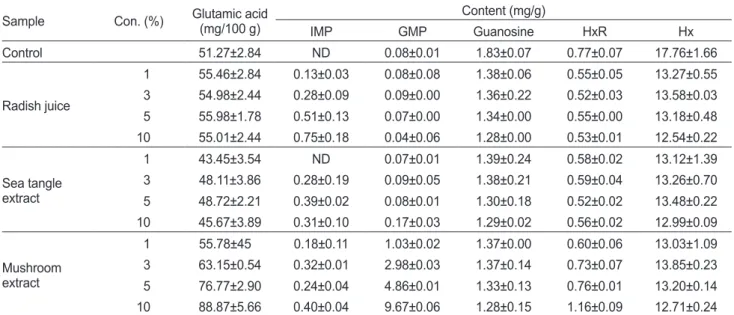
5336)을 1%, 3%, 5%, 10% 첨가하여 glutamic acid와핵산관 련물질함량을조사하였다. 멸치액젓잔사를열처리한추출물 의 glutamic acid 함량은 51.27 mg/100 g이었으며, 액젓잔사 추출물에 10% 무즙농축액과표고버섯엑기스첨가시 glutamic acid 함량은각각 55.01 mg/100 g, 45.67 mg/100 g이었다. 반 면, 10% 다시마추출물을첨가시 glutamic acid 함량은 88.87
mg/100 g으로상승하였으며, 농도가높아질수록함량도높아
졌다(Table 2). 그리고이들첨가물을 1%, 3%, 5%, 10% 농도로 첨가하여 핵산관련물질인 IMP (inosine 5'-monophosphate), inosine, guanine, 5'-GMP (guanine 5'-monophosphate), hypo- xanthine을측정하였다. 멸치액젓잔사추출물은 hypoxanthine 함량이 17.61 mg/g으로가장높았으며, guanosine 함량이 1.83 mg/g, 5'-GMP 및 inosine 함량이각각 0.08 및 0.77 mg/g이었 다. 대조구에무즙, 다시마추출물을농도별로첨가하면핵산관 련물질함량은대조구와유사하여차이가없었다. 반면, 표고 버섯엑기스를농도별로첨가하면 5'-GMP 함량은표고버섯엑 기스의농도가높아질수록증가하여 10% 첨가시 9.67 mg/g이 었으며, 기타핵산관련물질은큰변화가없었다(Table 2). 느티 리버섯, 양송이버섯, 팽이버섯을동결건조하고열수추출및효 소처리시핵산관련물질은 IMP와 guanosine 함량이각각 1.03- 1.87 mg/g, 1.75-3.99 mg/g이었으며, 이러한핵산관련물질은 생리적인기능뿐만아니라버섯의주요맛성분으로알려져있 어, 본연구에서맛의변화는표고버섯엑기스농도에의하여핵 산관련물질의상승때문이다(Kim and Kim, 2010).
최적 제조조건 확립
멸치액젓잔사를 121°C, 120분동안열처리하여얻어진추출 물에 다시마추출물, 표고버섯엑기스, 무즙농축액을첨가하여 조미소재로개발하기위한최적배합비확립하고자하였다. 이 를위하여앞서이들첨가물을첨가시정미성분이나타나지않 은무즙농축액은제외하고조미소재개발을위한다시마엑기 스, 표고버섯엑기스최적첨가조건을반응표면식을이용하여 확립하고자하였다(Table 3). 반응표면분석법의중심합성계획 에따라독립변수는다사마추출물농도(X1) 및표고버섯엑기 스농도(X2)로하고, 11개의실험구로설정하여시료(factorial design, 4개실험구; star point, 4개실험구; central point, 3개실
Table 1. Amino-N (AN) content, pH and salinity of hot water extracts from anchovy Engraulis japonica fish sauce processing by-products as affected by heating time at 121°C
Item Control Heating processing
121°C, 30 min 121°C, 60 min 121°C, 90 min 121°C, 120 min
AN (mg/100g) 169.9±1.7 118.3±3.2 118.9±2.1 168.6±2.2 183.6±2.3
pH 7.09 7.01 6.98 6.90 6.86
Salinity 16.0±0.2 15.4±0.0 16.8±0.1 17.1±0.0 17.4±0.0
Appearance** ++ ++ + + -
*++, remain the bones; +, mostly removes the bones but remain powder form; -, No bone left.
험구)를제조한다음종속변수인 glutamic acid 함량(mg/100 g) 과 5’-GMP 함량(mg/g)에대해 Table 3에나타내었다.
혼합물의 결과에 glutamic acid와 GMP 함량에 대하여 MINITAB software로 RSREG (response surface analysis by least-squares regression)를실시한후, 1차항(linear; X1, X2), 이
차항(quadratic; X12, X22) 및교차항(cross-product; X1X2)과같 은회귀방정식의계수들과이들의유의성은 5% 수준에서유의 성이인정되어, 이를정리하여반응모형방정식은아래와같다. Y1= 13.1300+4.0201X1-0.2342X2-0.0200X12+0.1875X22
+0.1225X1X2
Table 3. Central composite design, responses of the dependent variables and response surface plots for processing optimization of the sea- sonings product containing sea tangle Saccharina japonica extract and mushroom Lentinula edodes extract
Run no.
Coded levels of variable
Response
Coded Uncoded
X1 X2 X1 (%) X2 (%) Y1 Y2 Coefficients assessed by
1 -1 -1 6.5 6.5 9.45 74.77
Fractional factorial design (4points)
2 1 -1 13.5 6.5 17.38 107.91
3 -1 1 6.5 13.5 8.77 119.28
4 1 1 13.5 13.5 17.19 96.49
5 -1.414 0 5.0 10.0 7.60 90.78
Star points (4points)
6 1.414 0 15.0 10.0 18.78 78.75
7 0 -1.414 10.0 5.0 13.96 113.20
8 0 1.414 10.0 15.0 13.25 94.15
9 0 0 10.0 10.0 13.13 62.18
Central points (3points)
10 0 0 10.0 10.0 13.13 62.18
11 0 0 10.0 10.0 13.13 62.18
Predicted value 15.0 5.0 17.36 157.35
Experimental value 15.0 5.0 17.32±2.25 155.36±2.63
X1, sea tangle extract content (%, w/w); X2, mushroom extract (%, v/w); Y1, 5'-GMP (mg/g); Y2, glutamic acid (mg/100 g).
Table 2. Glutamic acid and nucleic acids (nucleosides and mono-nucleotides) of hot water extracts from anchovy Engraulis japonica sauce processing by-products heated for 120 min in a retort as affected by additives kinds (radish juice, sea tangle Saccharina japonica extract and mushroom Lentinula edodes extract) and various concentrations
Sample Con. (%) Glutamic acid
(mg/100 g) Content (mg/g)
IMP GMP Guanosine HxR Hx
Control 51.27±2.84 ND 0.08±0.01 1.83±0.07 0.77±0.07 17.76±1.66
Radish juice
1 55.46±2.84 0.13±0.03 0.08±0.08 1.38±0.06 0.55±0.05 13.27±0.55
3 54.98±2.44 0.28±0.09 0.09±0.00 1.36±0.22 0.52±0.03 13.58±0.03
5 55.98±1.78 0.51±0.13 0.07±0.00 1.34±0.00 0.55±0.00 13.18±0.48
10 55.01±2.44 0.75±0.18 0.04±0.06 1.28±0.00 0.53±0.01 12.54±0.22
Sea tangle extract
1 43.45±3.54 ND 0.07±0.01 1.39±0.24 0.58±0.02 13.12±1.39
3 48.11±3.86 0.28±0.19 0.09±0.05 1.38±0.21 0.59±0.04 13.26±0.70
5 48.72±2.21 0.39±0.02 0.08±0.01 1.30±0.18 0.52±0.02 13.48±0.22
10 45.67±3.89 0.31±0.10 0.17±0.03 1.29±0.02 0.56±0.02 12.99±0.09
Mushroom extract
1 55.78±45 0.18±0.11 1.03±0.02 1.37±0.00 0.60±0.06 13.03±1.09
3 63.15±0.54 0.32±0.01 2.98±0.03 1.37±0.14 0.73±0.07 13.85±0.23
5 76.77±2.90 0.24±0.04 4.86±0.01 1.33±0.13 0.76±0.01 13.20±0.14
10 88.87±5.66 0.40±0.04 9.67±0.06 1.28±0.15 1.16±0.09 12.71±0.24
IMP, Inosine 5`-monophosphate; GMP, guanosine 5`-monophosphate; HxR, inosine; Hx, hypoxanthine.
Y2= 62.1800-0.8329X1+0.7689X2+12.6406X12+22.0956X22 -13.9825X1X2
멸치액젓잔사의 5’-GMP 함량(Y1) 및 glutamic acid (Y2)의적 합결여검증(lack of fit test)은 P value가 0.05보다낮아설계 된모형이완전하지않았으나, 결정계수(R2)가각각 0.999 및 0.863로서 1에가까우며 model 값이각각 0.000 및 0.033로 0.05보다낮아조미소재제조를위하여설계된 5’-GMP 함량 (Y1) 및 glutamic acid (Y2) 대한반응모형이적합한것으로나 타났다(데이터미제시). 따라서다시마추출물과표고버섯엑기 스의함량에따라서 glutamic acid와 5’-GMP 함량이상당한차 이를나타내었는데, 이들함량이높을수록정미성분이높았다 (Fig. 1).
멸치액젓잔사 추출물을 이용한 조미소재의 정미성분인 5'- GMP 및 glutamic acid에대한목표값을 고려한다시마추출 물과표고버섯엑기스의첨가량에대한최적값은부호값(code value)이각각 1.4142 및 -1.4142이었고, 이를실제값(uncoded value)으로환산하는경우각각 15% 및 5%이었으며, 이들조건 에서제조된제품의예측치는각각 17.36 mg/g, 157.35 mg/100 g이었다. 따라서멸치액젓잔사추출물을이용한조미소스로제 조하기위한다시마추출물과표고버섯엑기스를첨가한제품의 실제측정값은 5'-GMP 및 glutamic acid 값이각각 17.32 mg/g 와 155.36 mg/100 g으로예측치와실측치간의유의적인차이 는없었다(Table 3).
참치자숙액가수분해물을이용하여제조한소스의유리아미 노산총함량은 1,905 mg/100 g이었으며, 감칠맛과단맛에관 여하는 glutamic acid 함량은 59.2 mg/100 g, 시판소스는 82.6 mg/100 g으로보고하였다(Oh et al., 2007b). 멸치액젓잔사추 출물의맛을내는정미성분함량은수산물의가수분해물과비 교해서는매우낮다. 그러나활용방안이없는멸치액젓잔사를
열처리하여추출물에다양한첨가물을활용하면시판조미소재 의 glutamic acid 함량과유사하거나높일수있으므로조미소 재로서의활용이가능하다고판단된다.
사 사
이 논문은 2020년 국립수산과학원 수산과학연구사업
(R202054)의지원으로수행된연구이며, 연구비지원에감사 드립니다.
References
CNI (Chungnam Institute). 2018. Utilization of fishery by- products in Chungcheonnam-do, Issue report.CNI, Gongju, Korea, 1-29.
Hu Y, Zhang J. Ebitani K and Konno K. 2013. Development of simplified method for extracting ATP-related compounds from fish meat. Nippon Suisan Gakk 79, 219-225. https://
doi.org/10.2331/suisan.79.219.
Jang MR, Kim IY, Hong MS, Shin JM and Han KY. 2004.
Quality evaluation of commercial salted and fermented fish sauces. Korean J Food Sci Technol 36, 423-431.
Jang MS, Park HY and Nam KH. 2012. Desalting processing and quality characteristics of salt-fermented anchovy sauce using a spirit. Korean J Food Preserv 19, 893-900. https://
doi.org/10.11002/kjfp.2012.19.6.893.
Jeong MH, Jeong WJ, Gyu OH, Jeong SW, Park HK, Cho YJ and Shim KB. 2013. Optimization of processing process for functional anchovy fish sauce in addition with raw sea tangle. J Kor Soc Fish Mar Edu 25, 1408-1418. https://doi.
org/10.13000/JFMSE.2013.25.6.1408.
Kim H, Lee JS and Cha YJ. 2002. Processing of functional Fig. 1. 3D plot for preparation of seasonings product containing sea tangle Saccharina japonica extract and mushroom Lentinula edodes extract for 5'-GMP (A) and glutamic acid (B). X1, sea tangle extract content (%, w/w); X2, mushroom extract (%, v/w); Y1, 5'-GMP (mg/g);
Y2, glutamic acid (mg/100 g).
(A) (B)
enzyme-hydrolyzed sauce from anchovy sauce and soy sauce processing by products 1. Optimization of hydroly- sis conditions by response surface methodology. J Korean Soc Food Sci Nutr 31, 653-657. https://doi.org/10. 3746/
jkfn.2002.31.4.653.
Kim MS and Kim GH. 2010. Contents of nucleic acids (Nucleo- sides and mono-nucleotides) in extracts of Pleurotus ostrea- tus, Agaricus bisporus and Flammulina velutipes. Korean J Food Nutr 23, 376-380.
Kim HJ, Yoon MS, Park KH, Shin JH, Heu MS and Kim JS.
2010. Processing optimization of gelatin from rockfish skin based on yield. Korean J Fish Aqua Sci 13, 1-11. https://doi.
org/10.5657/fas.2010.13.1.001.
Lee YE and Rhee HS. 1982. Effect of organic acids on suppres- sion of fishy odor in salted clam pickle. Korean J Food Sci Technol 14, 6-10.
MFDS (Ministry of Food and Drug Safety). 2019a. The pro- duction in food industry in Korea 2018. Chungju, Korea.
Retrieved from https://www.mfds.go.kr/brd/m_374/view.do
?seq=30198&srchFr=&srchTo=&srchWord=&srchTp=&i tm_seq_1=0&itm_seq_2=0&multi_itm_seq=0&company_
cd=&company_nm=&page=1 on Apr 20, 2020.
MFDS (Ministry of Food and Drug Safety). 2019b. Korean food standards codex. Retrieved from http://www.foodsafe- tykorea.go.kr/foodcode/01_03.jsp?idx=46 on Apr 20, 2020.
Oh HS, Kang KT, Kim HS, Lee JH, Jee SJ, Ha JH, Kim JS and Heu MS. 2007a. Food component characteristics of seafood cooking drips. J Korean Soc Food Sci Nutr 39, 595-602.
https://doi.org/10.3746/jkfn.2007.36.5.595.
Oh HS, Kim JS and Heu MS. 2007b. Preparation of functional seasoning sauce using enzymatic hydrolysates from skip- jack tuna cooking drip. J Korean Soc Food Sci Nutr 36, 766- 772. https://doi.org/10.3746/jkfn.2007.36.6.766.
Oh KS. 1996. Studies on the processing of sterilized salt-fer- mented anchovy sauce. Korean J Food Sci Technol 28, 1038-1044.
Park JH and Kim SM. 2005. Quality changes of low-salt anchovy sauce treated by heating during storage. Korean J Fish Aquat Sci 38, 89-93. https://doi.org/10.5657/kfas.2005.38.2.089.