- 91 -
상어 껍질과 육으로부터 산 및 Pepsin 가용성 콜라겐의 추출과 탈색조건
김재원․김도균․김미정1․김순동†
대구가톨릭대학교 외식식품산업학부 식품가공학전공, 1신성대학교 호텔조리제빵계열
Extraction and Bleaching of Acid- and Pepsin-Soluble Collagens from Shark Skin and Muscle
Jae-Won Kim, Do-Kyun Kim, Mee-Jung Kim1 and Soon-Dong Kim†
Faculty of Food Science and Industrial Technology, Catholic University of Daegu, Gyeongsan 712-702, Korea
1Devision of Hotel Culinary Arts and Bakery, Shinsung University, Dangjin 343-861, Korea
Abstract
Extraction and bleaching of citric acid- and pepsin-soluble collagens (ASC and PSC, respectively) from shark (Isurus oxyrinchus) skin and muscle were investigated. The optimal sodium hydroxide concentration for extraction was 0.3 M and the optimal treatment time for removal of foreign material was 9 h. The optimal sodium hypochlorite level for bleaching of shark skin was 0.48% (w/v), and sodium hypochlorite was a better bleaching agent than acetone, hydrogen peroxide (10%, v/v), sodium sulfite (0.48%, w/v), sodium thiosulfate (0.48%, w/v), or sodium metabisulfite (0.48%, w/v). Optimal citric acid concentration and extraction time for ASC were 0.3 M and 72 h, respectively, whereas optimal conditions for extraction of PSC were treatment with 0.1 M citric acid containing 0.1% (w/v) pepsin for 24 h. Protein contents in ASSC (acid-soluble shark skin collagen), ASMC (acid-soluble shark meat collagen), PSSC (pepsin-soluble shark skin collagen), and PSMC (pepsin-soluble shark meat collagen) were 88.66%, 83.09%, 90.33%, and 84.81% (on a dry weight basis), respectively, similar to that of commercial marine collagen (88.86%). Net collagen contents of ASSC, ASMC, PSSC, and PSMC, calculated from hydroxyproline levels, were 70.31%, 25.70%, 83.09%, and 32.94%, respectively. The yields of freeze-dried ASSC, ASMC, PSSC,and PSMC were 57.22%, 53.85%, 23.28%, and 20.61%.
Key words:shark, collagen, extraction, bleaching, acid soluble collagen, pepsin soluble collagen.
서 론
1)
콜라겐은 동물성 기원의 풍부한 섬유상의 구조단백질로 생체 단백질의 30%를 차지하며 세포와 세포를 연결하는 중요한 기능을 지닌다. 콜라겐 단백질은 3개의 chain이 homo-. hetero triple helix를 구성하는 3중나선구조를 이루 며 여러 가지 형태로 신체 각 부위에 존재한다(1). 콜라겐을 이루는 기본단위는 tropocollagen으로 분자 내 또는 분자 간 공유결합성 가교결합을 이룸으로서 물리적 또는 생물학 적으로 비교적 안정성을 가지며(2), 콜라겐을 이루는 아미 노산의 조성은 그 type에 따라 다소 차이가 있으나 보통
†Corresponding author. E-mail:[email protected], Phone:82-53-850-3216, Fax:82-53-850-3216
glycine이 전체의 1/3정도이며, proline이 1/4, hydroxyproline 이 1/7 정도를 차지하고 있다(3). 콜라겐을 구성하는 아미노 산 hydroxyproline은 hydroxylysine과 함께 일정비(12.5~
14%)를 이룸으로써 콜라겐을 정량하는 지표성분으로 활용 되고 있으며(4), 콜라겐의 구성 비율은 생물의 종류와 연령 에 따라 차이가 있는 것으로 알려져 있다(5). 콜라겐은 세포 가 다수 집합되어있는 피부, 뼈, 연골, 힘줄, 인대, 혈액, 혈관, 치아 및 각막에 많이 존재하고 척추동물에는 모든 장기에 널리 분포하며(6), 연골세포, 근섬유세포, 피부섬유 아세포, 골세포 등 특수한 세포에서만 생합성 되어 세포의 증식과 기능 활성화를 촉진하는 작용을 한다(7).
콜라겐에 관한 연구는 의약품, 화장품 및 식품분야에서 다양하게 이루어져 왔으며(8), 최근에는 항 피부노화(9) 및 피부 탄력개선(10), 관절염 예방(11), 항고혈압(12) 및 항암
작용(13) 등으로 확대되고 있다. 식품 및 의약품용의 콜라겐 소재들이 대부분 소나 돼지 등의 육상동물로부터 얻어졌으 나 원인불명의 광우병(14) 또는 구제역(15)의 전이와 관련 된 문제점이 야기되면서 해양자원 유래의 콜라겐 연구가 크게 확대되고 있다.
콜라겐은 용해성에 따라 중성염가용성, 산가용성 및 불 용성으로 나누며 구조적 단백질로서의 특이성 때문에 일반 적으로 추출이 어려우며, 추출방법으로는 산성조건에서 저 이온세기로 추출하는 방법(16), 약이온 세기에서 중성용액 을 사용하여 추출하는 방법이 있으나 수율이 낮은 단점이 있다(17). 콜라겐 분자는 helical domain과 N- 및 C-말단에 non-helical domain으로 구성되어 있는데 non-helical 부분과 helical domain이 공유결합으로 가교되어 섬유소를 이룬다.
이 섬유소는 산성용액에서 용해되지 못하고 콜로이드 형상 을 나타낸다. 따라서 효소로 가교결합을 제거함으로써 콜 라겐분자를 용해 상태로 전환시키는 방법이 제시되어 왔다 (18). 불용성 콜라겐의 함량이 높은 무척추동물(19)의 경우 는 펩신과 같은 산성에서 활성이 높은 효소를 이용하여 추출하며(20), 효소 처리시 콜라겐 분자는 helical domain이 특정 조건에서 효소반응에 대한 저항성을 가져 이때 활성화 된 효소가 non-helical domain을 분해하여 콜라겐 분자 사이 의 공유결합을 절단함으로써 콜라겐의 용해도를 높이는 작용을 한다(21).
상어는 콜라겐을 비롯하여 chondroitin sulfate, squalene 및 DHA (docosahexaenoic acid)와 같은 기능성 성분들이 함유되어 있으나(22, 23) 이들 기능성 성분들이 많이 함유된 간, 연골, 지느러미 등을 제외한 대부분은 대부분의 나라에 서 가공폐기물로 버려지고 있다. 우리나라에서는 일부 지 역에서 껍질을 제거시킨 육질부분을 돔배기로 가공되고 있으나 상품성이 낮은 상당량의 페기물이 발생하고 있어 폐자원의 활용측면에서도 의의를 찾을 수 있다. 본 연구에 서는 상어 가공시에 폐기물로 얻어지고 있는 껍질과 육 조직에 함유된 콜라겐의 이용성을 검토하고자 산가용성 콜라겐과 펩신가용성 콜라겐의 추출조건 및 탈색조건을 검토하였다.
재료 및 방법
재 료
본 실험에 사용한 상어는 모노상어 (Isurus oxyrinchus)로 그 껍질과 육은 영천 전통돔배기 영농조합 법인에서 제공 받았으며 -70℃ deep freezer (NF-400SF3, Nihon freezer Ltd, Japan)에 저장하면서 실험재료로 사용하였다. 대조구로 사 용한 콜라겐 표품은 Marine Collagen (Dermalab Co., Ltd, Gangwondo, Korea)을 사용하였다.
콜라겐의 추출
콜라겐의 추출은 Fig. 1과 같이 상어 껍질과 육 조직으로
구분하고 다시 산가용성 (ASSC: citric acid soluble shark skin collagen, ASMC: citric acid soluble shark muscle collagen)과 펩신가용성 (PSSC: pepsin and citric acid soluble shark skin collagen, PSMC: pepsin and citric acid soluble shark muscle collagen)으로 구분하여 추출하였다. 즉, 상어 껍질과 육은 5℃의 냉수로 핏물과 비린내를 수세하여 제거 한 후 1 x 3 mm로 세절하였다. 다음에 시료의 10배량의 0.3 N NaOH 용액을 가한 후 Ace Homogenizer (AM-10, Mihonseiki Kaisha Ltd, Japan)를 이용하여 균질화한 뒤 magnetic bar를 넣어 10℃, 250rpm에서 9시간동안 교반 한 다음 여과하여 알칼리 가용성의 비 콜라겐성 단백질의 제거 와 효소의 불활성화를 실시하고 잔존하는 알칼리는 증류수 로 세척하여 제거하였다. 다음에 10배량의 0.48% sodium hypochlorite 용액을 가하여 10℃, 250 rpm으로 60분 동안 교반하여 탈색시킨 후 3겹의 cheese cloth로 여과하여 탈색 된 잔류물을 얻었으며 증류수로 염소이온이 검출되지 않을 때까지 3회 반복 세척하였다. 산가용성 콜라겐 (ASC)은 탈색, 세척한 시료에 10배량의 0.3 M citric acid 용액을 가하
Washing of shark skin & muscle Removal of non-protein fraction by washing with alkali
(10 volumes of 0.3N NaOH solution) Alkali removal by washing with distilled
water until neutralization Bleaching with NaClO (0.48%, 250 rpm, 60 min)
Washing with distilled water (3 times)
Collagen extracted with 0.3M
citric acid (ASC) Collagen extracted with 0.1M citric acid containing 0.1% (w/v) pepsin (PSC)
Filtration with 3 layers of cheese cloth Centrifugation(3,000 x g, 10 min)
Freeze drying of supernatant Crude collagen powder
Fig. 1. Procedure for extraction and preparation of shark skin and muscle collagens.
여 10℃에서 3일동안 교반추출한 후 3,000 x g(4℃)에서 20분간 원심분리 하였다. 펩신가용성 콜라겐 (PSC)은 탈색, 세척한 시료에 10배량의 0.1%(w/v) 펩신을 함유하는 0.1 M citric acid 용액을 가하여 열변성을 최소화 하기위해 10℃
이내에서 1일 동안 교반, 추출한 후 3,000 x g (4℃)에서 20분간 원심분리하였다. 이렇게 하여 얻은 ASC와 PSC는 동결건조한 후 5℃에 저장하면서 실험에 사용하였다.
단백질 함량
단백질 함량은 Lowry 법(24)으로 측정하였으며 BSA (bovine serum albumin, Sigma-Aldrich Co.)를 표준품으로 한 표준곡선에 의하여 함량을 산출하였다.
알칼리 가용성 고형물 함량
상어껍질과 육조직에 10배(v/w)량의 농도별 NaOH 용액 을 가한 후 10℃에서 250 rpm으로 1~50시간 교반, 추출한 후, 여과지 (Whatman No. 1)로 여과하여 얻은 여액을 105℃
에서 건조시킨 후 남은 고형분량을 구하여 총 고형물량 (mg/g)으로 하였다.
탈 색
실험에 사용한 대조구로서의 탈색제 및 그 처리는 문헌 (25)에 따라 acetone, hydrogen peroxide (10%, 30%), 0.48%
sodium sulfite, 0.48% sodium thiosulfate 및 0.48% sodium metabisulfite을 사용하였으며 비 콜라겐 단백질을 제거한 시료에 10배량(v/w)으로 가하여 10℃, 250rpm으로 12시간 처리하였다. Sodium hypochlorite의 처리는 0.16~0.64% 범 위로 상기와 동일하게 0~240분 동안 처리하면서 탈색정도 를 대조구와 비교하였다.
색 상
표준색판으로 보정된 Chromameter (CR-200, Minolta Co, Japan)를 사용하여 L* (lightness), a* (redness-greenness), b*
(yellowness-blueness) 값을 측정하였으며 색차(∆E)는 다 음의 계산식에 의하여 구하였다.
∆ E=
콜라겐 함량 및 수율
Bergman 등(26)의 방법을 다소 수정하여 측정하였다. 즉, Fig. 1에서와 같이 알칼리 세척, 수세, 탈색, 추출하여 동결 건조한 crude collagen 300 mg에 증류수 1.5 mL, 12 N-HCl 1.5 mL을 가한 후 발생하는 가스를 흔들어 제거한 다음, 110℃에서 24시간 가수분해 한 후 50 mL로 정용하여 측정 용 시액으로 하였다. 이 시액 0.3 mL에 0.6 mL의 isopropanol 을 가한 후 7% chloramine T 용액과 0.25M sodium acetate, 0.13M trisodium citrate, 0.03M citric acid 및 0.3%
isopropanol 혼액을 1:4(v/v)의 비율로 혼합한 액 0.3 mL을 가하여 상온에서 4분 동안 산화시켰다. 여기에 Ehrlich 시약 (0.67%ρ-dimethylaminobenzaldehyde와 60% perchloric acid 혼액)과 isopropanol을 3:13(v/v)의 비율로 혼합한 액 4 mL 가하여 60℃의 water bath에서 25분간 반응시킨 후 558 nm 에서 흡광도를 측정하였다. Hydroxyproline 함량은 hydroxyproline (cis-4-Hydroxy-L-proline, Sigma Co.)을 표 준품으로 한 표준곡선에 의하여 함량을 산출하였고 총단백 질 함량에 대한 collagen 함량은 계산식 collagen in protein(%) = (hydroxyproline mg × 9.75 / protein mg) × 100에 의해 계산하였다. 수율은 원료의 건물에 대한 ASSC, ASMC, PSSC 및 PSMC 동결건조물의 상대 비율 (%)로 하였다.
일반성분 분석
수분함량은 적외선수분측정기 (HG53 Halogen Moisture Analyzer, Mettler-Toledo International Inc, Zurich, Switzerland) 로 측정하였으며, 일반성분 분석은 AOAC법(27)에 따라 분석하였다.
통계처리
모든 실험은 3회 반복으로 행하여 평균치와 표준편차로 나타내었고, 유의성 검증은 version 12의 SPSS (Statistical Package for Social Sciences, SPSS Inc., Chicago, IL, USA) software package program을 이용하여 Duncan's multiple range test를 행하였다.
결과 및 고찰
알칼리 처리 적정농도와 시간
Fig. 2는 상어껍질과 육 조직으로 부터 콜라겐의 추출시 비 콜라겐성의 단백질을 세척, 제거하기 위하여 농도별 (0.05~0.5 N) NaOH 용액을 시료에 대하여 10배량으로 가하 여 24시간동안 처리하였을 때 시료 내 잔존하는 단백질함 량 (Fig. 2의 좌측)과 세척되는 알칼리 가용성 고형물의 함 량(Fig. 2의 우측)을 조사한 결과이다. NaOH 용액의 농도가 증가함에 따라 껍질에 잔존하는 단백질 함량은 29.50 mg/g 에서 101.16 mg/g으로 증가한 반면 육에서는 69.50 mg/g에 서 110.78 mg/g 증가하였으며, 껍질과 육 모두 0.3~0.5N NaOH용액에서는 다소 감소하는 경향을 보였다. NaOH 용 액으로 세척하였을 때 용출되어 나온 총고형물의 양 (Fig.
2의 우측)은 NaOH의 농도증가와 비례하여 증가하였으며 껍질보다 육에서 높은 경향을 나타내었다. 이상의 결과 NaOH 세척시 0.3 N 이상의 농도에서 껍질과 육에 잔존하는 단백질 함량이 감소하는 현상은 알칼리 농도가 0.3 N 이상 으로 높은 농도에서는 비콜라겐 단백질뿐만 아니라 콜라겐
0 30 60 90 120 150
0.05 0.1 0.15 0.2 0.25 0.3 0.35 0.4 0.45 0.5
Normality of NaOH
Protein content (mg/g) ..
Skin Muscle
0 60 120 180 240 300
0.05 0.1 0.15 0.2 0.25 0.3 0.35 0.4 0.45 0.5
Normality of NaOH
Alkali soluble material(mg/g)
Skin Muscle
Fig. 2. Changes in the content of protein and alkali soluble materials of shark skin and muscle treated with different alkali concentration.
Values are mean of triplicate determinations
의 경우도 용출되어 소실됨을 나타내는 것으로 세척시의 적정농도가 0.3 N 임을 나타낸다.
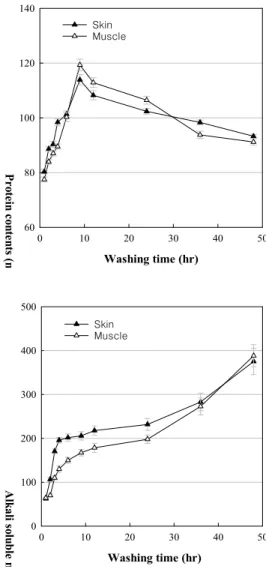
Fig. 3은 NaOH의 농도를 0.3 N로 고정하여 세척시간별에 따른 시료내 잔존하는 단백질 함량 (Fig. 3의 좌측)과 세척 되는 알칼리 가용성 총 고형물의 함량 (Fig. 3의 우측)을 조사한 결과이다. 세척시간이 증가함에 따라 껍질에 잔존 하는 단백질 함량은 80.31 mg/g에서 113.91 mg/ g으로 증가 하였으며, 육에서는 77.47 mg/g에서 119.34 mg/g으로 증가 하였으나 9시간 경과 후부터는 껍질과 육 모두 감소하는 경향을 보였다. 따라서 상어육과 껍질로 부터의 비콜라겐 성 단백질을 제거하기 위한 NaOH의 적정농도는 0.3 N로 판단되며, 적정시간은 9시간 정도인 것으로 생각된다. Woo 등(28)은 황다랑어 비늘 콜라겐의 추출 최적조건은 NaOH 농도 0.32 N, 처리시간 16.38 시간이라 하였으며, 상어 콜 라겐의 경우와 비교할 때 농도는 유사하나 처리시간에서 차이가 있었다.
Washing time (hr)
0 10 20 30 40 50
Protein contents (mg/g)
60 80 100 120 140
Skin Muscle
Washing time (hr)
0 10 20 30 40 50
Alkali soluble material (mg/g)
0 100 200 300 400 500
Skin Muscle
Fig. 3. Changes in the content of protein and alkali soluble materials of shark skin and muscle during washing with 0.3N-sodium hydroxide.
Values are mean of triplicate determinations.
탈색조건
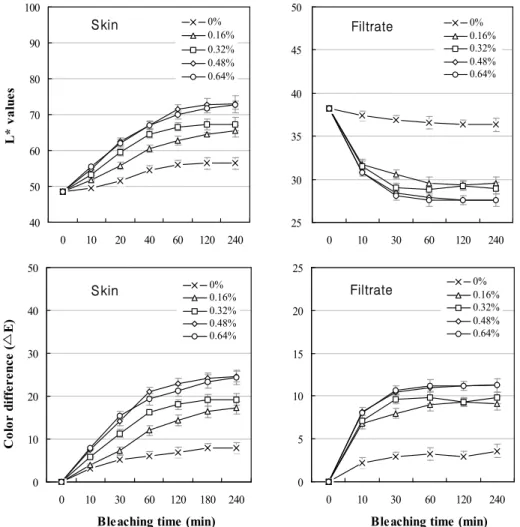
비 콜라겐 단백질이 제거된 시료의 탈색조건을 검토하기 위하여 sodium hypochlorite의 농도별 및 처리시간별에 따 른 색상변화를 관찰한 결과는 Fig. 4와 같다. 본 실험에서는 원료무게에 대하여 10배량 (v/w)의 0.16%, 0.32%, 0.48%
및 0.64%의 sodium hypochlorite를 가하여 처리시간에 따른 색상변화를 관찰한 결과 0.48%의 처리는 이보다 낮은 농도 보다 높은 탈색효과를 보인 반면 0.64%처리와 유사한 값을 나타내어 0.48%가 적정농도로 확인되었으며 처리시간은 60분에서 밝기 (L*)값이 240분까지 처리하였을 때의 값과 대등하여 적정 처리시간으로 확인되었다. 탈색제 처리 후 여과한 액에서는 탈색한 껍질의 색상과 반대의 결과를 나타 내었다. 탈색제 sodium hypochlorite의 농도별 처리시간별 색차를 산출한 값에서도 껍질의 색차는 0.48%와 0.64%가 유의적인 차이를 보이지 않는 것으로 나타나 L*값의 측정
Skin
40 50 60 70 80 90 100
0 10 20 40 60 120 240
L* values
0%
0.16%
0.32%
0.48%
0.64%
Filtrate
25 30 35 40 45 50
0 10 30 60 120 240
0%
0.16%
0.32%
0.48%
0.64%
Skin
0 10 20 30 40 50
0 10 30 60 120 180 240 Bleaching time (min)
Color difference (△E) .
0%
0.16%
0.32%
0.48%
0.64%
Filtrate
0 5 10 15 20 25
0 10 30 60 120 240
Bleaching time (min)
0%
0.16%
0.32%
0.48%
0.64%
Fig. 4. Changes in color L* values and color difference of shark skin and its filtrate during bleaching with different concentration of sodium hypochlorite.
Values are mean of triplicate determinations.
결과와 일치하였으며 탈색여액의 색차에서도 껍질의 색차 와 동일한 양상을 나타내었다.
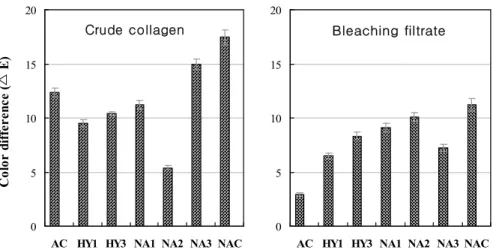
최적농도로 확인된 0.48%의 sodium hypochlorite의 60분 처리와 기존의 여타 탈색제와의 탈색효과를 비교하기 위하 여 식품탈색제(29)로 사용되는 acetone, hydrogen peroxide (10%), sodium sulfite (0.48%), sodium thiosulfite (0.48%) 및 sodium metabisulfite (0.48%)를 각각 12시간동안 처리한 경우와의 색차를 비교하였다 (Fig. 5). 그 결과 0.48%의 sodium hypochlorite를 60분간 처리한 경우가 타 탈색제를 처리한 경우에 비하여 높은 탈색효과를 나타내었다.
Sodium hypochlorite는 활성산소의 작용으로 소독 및 살균 효과(30)가 있으며 세균(31), 바이러스(32), 곰팡이 포자 (33), 원생동물(34) 및 기생충(35) 등을 사멸시키는 효과를 나타낼 뿐만 아니라 우수한 탈색효과를 냄(36)으로서 상어 껍질의 바람직한 탈색제로 판단된다.
콜라겐 추출조건
상어 껍질과 육으로부터 산 (citric acid) 또는 산 (citric acid)과 pepsin (0.1%)혼합액을 이용하여 ASSC (citric acid soluble shark skin collagen), ASMC (citric acid soluble shark muscle collagen), PSSC (pepsin and citric acid soluble shark skin collagen) 및 PSMC (pepsin and citric acid soluble shark muscle collagen)의 추출시 산의 농도별, 추출시간별에 따른 콜라겐의 함량변화를 조사한 결과는 Fig. 6과 같다. 산 가용 성 콜라겐인 ASSC 및 ASMC의 추출시 산의 농도를 0.1~0.3M로 변화시켰을 때의 순 콜라겐의 함량은 0.3M에 서 다소 높은 경향을 나타내었다. 추출시간을 24시간에서 72시간으로 변화하였을 때는 ASSC의 경우는 9.61%에서 70.31%로 증가하였으며 ASMC의 경우는 8.51%에서 25.70%로 증가하였다. 이에 반하여 pepsin 가용성의 PSSC 와 PSMC의 추출최적 산 농도는 0.1M citric acid로 나타났으 며 PSSC의 경우 24시간 추출하였을 때의 순 콜라겐 함량은 83.09%를 나타내었으나 72시간 추출하였을 때는 19.41%로
Crude collagen
0 5 10 15 20
AC HY1 HY3 NA1 NA2 NA3 NAC Color difference (△ E) .
Bleaching filtrate
0 5 10 15 20
AC HY1 HY3 NA1 NA2 NA3 NAC Fig. 5. Color difference of crude collagen extracted from shark skin treated with different bleaching agents.
Values are mean of triplicate determinations. Abbreviations: AC, acetone; HY1, 10% hydrogen peroxide; HY3, 30% hydrogen peroxide; NA1, 0.48% sodium sulfite; NA2, 0.48%
sodium thiosulfate; NA3, 0.48% sodium metabisulfite; NAC, 0.48% sodium hypochlorite.
0.1 M
0 20 40 60 80 100
24 36 48 60 72
Collagen content (g/100g protein) . 0.2 M 0
20 40 60 80 100
24 36 48 60 72
Extraction time (hr) ASSC
PSSC ASM C PSM C
0.3 M
0 20 40 60 80 100
24 36 48 60 72
Fig. 6. Changes in net collagen content of ASSC, ASMC, PSSC and PSMC extracted at various extraction times with different citric acid concentration(0.1~0.3 M).
Abbreviations: ASSC, citric acid soluble shark skin collagen; PSSC, pepsin and citric acid soluble shark skin collagen; ASMC, citric acid soluble shark muscle collagen; PSMC, pepsin and citric acid soluble shark muscle collagen.
감소하였으며, PSMC의 경우는 32.94%에서 4.04%로 감소 하였다. 이와 같이 pepsin 가용성 콜라겐의 추출시에는 추출 시간이 길어질수록 순 콜라겐 함량이 낮아지는 현상을 나타 내었는데 이는 pepsin의 활성에 의한 분해작용으로 인해 나타나는 현상으로 사료된다.
이상의 결과 상어껍질과 육의 산가용성 콜라겐의 추출 시 적정농도와 시간은 각각 0.3 M 및 72시간으로 판단되며, pepsin 가용성 콜라겐의 추출시 산의 농도와 처리시간은 각각 0.1 M 및 24시간으로 확인되었다.
콜라겐 함량과 수율 및 일반성분 함량
상어껍질과 육으로부터 ASSC와 ASMC는 0.3M citric acid로 72시간 추출하고, pepsin 가용성 콜라겐인 PSSC 및 PSMC는 0.1% pepsin을 함유하는 0.1M citric acid로 24시간
추출하여 얻은 동결건조분말을 시료로 하여 단백질과 순 콜라겐 함량 및 동결건조수율을 조사한 결과는 Table 1과 같다. 산가용성 콜라겐의 총 단백질 함량은 83.09~88.66%
이었으나 pepsin 가용성콜라겐에서는 84.81~90.33%로 pepsin 가용성 콜라겐에서 다소 높았다. 이 같은 현상은 콜라겐의 추출시의 효소처리가 콜라겐과 결합하고 있는 non-helical domain (telopeptide)을 분해함으로써 콜라겐 분 자 사이의 공유결합을 절단시켜 콜라겐의 용해도를 높이는 작용을 하는 것과 관련이 있는 것으로 사료되며(21) non-helical domain의 분해는 콜라겐의 항원성을 감소시킴 으로서 면역반응 또한 감소시킬 수 있다(37). 콜라겐 분자는 helical domain과 N- 및 C-말단에 비나선 구조인 non-helical domain (telopeptide)가 있으며, 이 telopeptide의 배열순서는 각각의 종마다 다르므로 면역반응을 일으키는 주된 원인이
Table 1. Contents of acid and pepsin soluble collagens prepared from shark skin and muscle at optimal conditions
Measurements ASMC1) ASSC2) PSMC3) PSSC4) STMC5)
Total protein(mg/g-dry weight) 886.60±2.15c,7) 830.90±0.60d, 903.32±0.51a 848.12±1.01e 888.61±0.97b Hydroxyproline(mg/g-dry weight) 26.36±0.82d 72.12±0.50b 33.78±0.64c 85.22±0.63a 85.82±0.48a Net collagen(mg/g-dry weight) 256.97±5.96e 703.13±7.84c 329.40±6.24d 830.90±8.27b 858.23±6.69a Yields of freeze dried powder(g/SS6)-100 g) 53.85±0.93b 57.22±1.97a 23.28±1.06c 20.81±1.02d -
1-4)Abbreviations: See Fig. 6,5)STMC; standard marine collagen. 6)SS: shark muscle and skin(dry basis).
7)Values are mean ± standard deviations of triplicate determinations. Different superscripts within a row(a-d) indicate significantly different atp<0.05.
된다(38).
Hydroxyproline의 함량으로부터 산출한 순 콜라겐 함량 은 산가용성 콜라겐에서는 25.70~70.31%, pepsin가용성콜 라겐에서는 32.94~83.09%로 표준콜라겐의 85.82%보다 낮 았으며 산가용성과 pepsin가용성콜라겐 모두 육 조직에서 보다 껍질에서 높은 함량을 나타내었다. 상어육과 껍질(dry basis) 100 g으로부터 얻을 수 있는 동결건조한 콜라겐분말 의 수율은 산가용성 콜라겐은 53.85~57.22%이었으나 pepsin가용성콜라겐의 경우는 20.81~23.28%이었다. 이는 산추출시와 효소추출시의 산 농도 (0.1~0.3 M)의 차이에 따라 제품에 함유된 citric acid 함량차이에 따른 결과로 사 료된다.
최적의 조건으로 껍질과 육에서 추출한 산가용성 및 pepsin 가용성 콜라겐의 동결건조 분말인 ASSC, ASMC, PSSC 및 PSMC와 표준품으로 사용한 시판 marine collagen (STMC)의 일반성분을 비교한 결과는 Table 2와 같다. 수분, 단백질, 지질, 탄수화물, 회분함량은 시료간의 유의적인 차 이를 나타내었다. 상어껍질 (SS)의 경우는 수분 73.61%, 조단백질 21.16%, 조지방 1.21%, 탄수화물 0.98%, 회분 3.04%이었으나 상어 육 (SM)에서는 수분 70.54%, 조단백 질 27.05%, 조지방 1.23%, 탄수화물 0.35%, 회분 0.83%로 조단백질 함량은 육에서 높으며 수분, 탄수화물, 회분은 껍질에서 다소 높았다. 콜라겐의 단백질 함량은 PSMC는 90.33%, STMC 88.86%, ASMC 88.66%, PSSC 84.81%, ASSC 83.09%이었다.
Table 2. Proximate composition of shark skin, muscle and crude collagen
Samples1) Proximate composition (%)
Moisture Protein Lipid Carbohydrate Ash
SS 73.61±1.37a,2) 21.16±2.18d 1.21±0.02a 0.98±0.19a 3.04±0.09e
SM 70.54±1.23b 27.05±0.57c 1.23±0.01a 0.35±0.06cd 0.83±0.23f
ASSC 4.04±0.18c 83.09±0.95b 0.35±0.03c 0.49±0.06bc 12.03±0.71b
ASMC 1.75±0.20d 88.66±1.30a 0.32±0.06c 0.35±0.13cd 8.92±0.60c
PSSC 1.03±0.06de 84.81±0.61b 0.05±0.02d 0.59±0.08b 13.52±0.50a
PSMC 0.70±0.11e 90.33±1.10a 0.11±0.04d 0.12±0.02e 8.74±0.21c
STMC 3.04±0.37c 88.86±0.45a 0.45±0.01b 0.24±0.05de 7.41±0.43d
1)Abbreviations: SS, shark skin; SM, shark muscle; others, See Fig. 6.
2)Values are mean ± SD of triplicate determinations. Different superscripts within a column(a-f) indicate significant differences(p<0.05).
이상의 결과 상어로 얻을 수 있는 콜라겐의 함량은 껍질 이 육질에 비하여 높으며, 산추출에 비하여 효소추출이 추 출시간 및 콜라겐 수율면에서 경제적인 것으로 사료된다.
요 약
상어의 껍질과 육 조직으로부터 산 (citric acid) 가용성 콜라겐 (ASC)과 pepsin 가용성 콜라겐 (PSC)의 추출 및 탈색조건을 조사하였다. 비 콜라겐 단백질을 제거하기 위 한 적정 NaOH 농도는 0.3 N이었으며 처리시간은 9시간이 었다. 상어껍질의 탈색은 생 원료에 대하여 10배량의 0.48%
sodium hypochlorite로 60분간 처리하는 것이 적절하였다.
ASC 및 PSC의 추출시 산의 적정농도는 각각 0.3 M 및 0.1 M이었고, 추출시간은 각각 72시간 및 24시간 이었다.
산가용성 콜라겐인 ASSC (citric acid soluble shark skin collagen)와 ASMC (citric acid soluble shark muscle collagen), pepsin 가용성 콜라겐인 PSSC(pepsin and citric soluble shark skin collagen)와 PSMC (pepsin soluble shark muscle collagen)에 함유된 총 단백질 함량은 각각 88.66, 83.09, 90.33 및 84.81% (dry basis)이었으며 시판 표준 콜라 겐의 88.86%와 대등하였다. Hydroxyproline의 함량으로부 터 산출한 순 콜라겐 함량은 ASC에서는 25.70~70.31%, PSC에서는 32.94~83.09%이었다. 상어육과 껍질 (dry basis)
100 g으로부터 얻을 수 있는 콜라겐의 수율은 ASC는 53.85
~57.22%, PSC는 20.81~23.28%이었다.
참고문헌
1. Rich, A. and Crick, F.H. (1991) The molar structure of collagen. J. Mol. Biol., 3, 483-506
2. Kim, S.K. and Kwak, D.C. (1991) The enzymatic modification and functionalities of filefish skin collagen.
J. Kor. Agic. Chem. Soc., 34, 265-272
3. Bailey, A.J. and Light, N.D. (1989) Connective tissue in meat and meat products. Elsevier Science Publishers LTD, NY.
4. Weiss, J.B. and Ayad, S. (1982) An introduction to collagen. In: Collagen in health and disease. Weiss JB, Jayson MIV. (eds.), Ch 1, Churchill Livingstone, NY, pp. 1-17
5. McCormick, R.J. (1994) Structure and properties of tissues. In: Muscle foods, meat poultry and seafood technology. Kinsman DM, Kotula AW, Breidenstein BC.
(eds.), Chapman and Hall, NY, pp. 25-62
6. Senaratne, L.S., Park, P. and Kim, S. (2006) Isolation and characterization of collagen from brown backed toadfish (Lagocephalus gloveri) skin. Bioresource Technol., 97, 191-197
7. Jerome, S.P., Gabrielle, L. and Raul, F. (1998) Identification of collagen fibris in Scleroderma skin. J. Invest.
Dermatol., 90, 48-54
8. Ashley, W., Masahiro, O., Ralph, JP., Mark, S., Mark, S. and Jack, NL. (2008) Biochemical properties of alligator(Aligator mississippiensis) bone collagen.
Comparative Biochem. Physiol (Part B)., 151, 246-249 9. Kwon, M.C., Qadir, S.A., Kim, H.S. and Ahn, J.H. (2008) UV protection and whitening effects of collagen isolated from outer layer of the squid Todarodes pacificus. J. Kor.
Fish. Soc., 41, 7-12
10. Kwon, M.C., Kim, C.H., Kim, H.S., Syed, A.Q., Hwang, B.Y. and Lee, H.Y. (2007) Anti-wrinkle activity of low molecular weight peptides derived from collagen isolated from Asterias amurensis. Kor. J. Food Sci. Technol., 39, 625-629
11. Hu, Y., Zhao, W., Qian, X. and Zhang, L. (2003) Effects of oral administration of type II collagen on adjuvant arthritis in rats and its mechanisms. Chi. Med. J., 116, 284-287
12. Tonnesen, MG., Feng, X. and Clark, R.A. (2000)
Angiogenesis in wound healing. J. Invest. Dermatol.
Symp. Proc., 5, 40-46
13. Rehn, M., Veikkola, T., Kukk-valdre, E., Makamura, H., IImonen, M., Lombardo, C., Pihlajaniemi, T., Alitalo, K. and Vuori, K. (2001) Interaction of endostatin with intefrins implicated in angiogeneses. Proc. Natl. Acad.
Sci., 98, 1024-1029
14. Li, H., Liu, B.L., Gao, L.Z. and Chen, H.L. (2004) Studies on bullfrog skin collagen. Food Chem., 84, 65-69 15. Salt, J.S., Barnett, P.V., Dani, P. and Williams, L. (1998)
Emergency vaccination of pigs against foot-and-mouth disease: protection against disease and reduction in contact transmission. Vaccine, 16, 746-754
16. Steffen, G., Edward, J. and Miller. (1979) Characterization of lens capsule collagen: Evidence for the presence of two unique chains in molecules derived from major basement membrane structures. Arch. Biochem.
Biophys., 198, 370-378
17. Fessler, J.H. (1959) Some properties of neutral-salt-soluble collagen. Biochem. J., 76, 452-463
18. Richard, M., Judy G.Z. (1980) Type Ⅳ collagen from chicken muscular tissues. Isolation and characterization of the pepsin-resistant fragments. Biochmistry, 19, 4065-4072
19. Tanzer, M.L. (1973) Cross-linking of collagen. Science, 180, 561-566
20. Yamaguchi, K., Lavety, J. and Love, R.M. (1976) The connective tissues of fishⅧ. Comparative studies on hake, cod and catfish collagen. J. Food Technol., 11, 389-399 21. ChandraRajan, J. (1978) Separation of typeⅢ collagen from type Ⅰ collagen and pepsin by differential denaturation and renaturation. Biochem. Biophys. Res. Comm., 83, 180-186
22. Sato, K., Yoshinaka, R., Sato, M. and Shimizu, Y. (1986) Collagen content in the muscle of fishes in association with their swimming movement and meat texture. Nippon Suisan Gakk., 52, 1595-1600
23. Murphy, M.G., Wright, V., Ackman, R.G. and Horackova, M. (1997) Diets enriched in menhaden fish oil, seal oil, or shark liver oil have distinct effects on the lipid and fatty acid composition of guinea pig heart. Molecular Cell. Biochem., 177, 257-269
24. Lowry, O.H., Rosebrough, N.J., Farr, A.L. and Randall, R.L. (1951) Protein measurement folin phenol reagent.
J. Biol. Chem., 193, 265-275
25. Ahn, C,W., Nam, H,S., Lee, H,J. and Shin, Y,C. (1994) Decolorization of shrimp chitin using sodium
hypochlorite. Korean J. Food Sci., 26, 787-790 26. Bergaman, I. and Loxley, R. (1963) Tow improved and
simplified methods for the spectrophotometric determination of hydroxyproline. Anal. Chem., 35, 1961-1963 27. A.O.A.C. (2000) Official Methods of Analysis of the
AOAC INTERNATIONAL. 17th edition. William Horwitz, ed. Association of Official Analytical Chemists, U.S.A.
28. Woo, J.W., Yu, S.J., Cho, S.M., Lee, Y.B. and Kim, S.B. (2008) Extraction optimization and properties of collagen from yellowfin tuna(Thunnus albacares) dorsal skin. Food Hydrocolloids, 22, 879-887
29. Taylor, S,L., Higley, N,C. and Bush, R,K. (1986) Sulfites in foods: uses, analytical methods, residues, fate, exposure assessment, metabolism, toxicity, and hypersensitivity.
Adv. Food Res., pp. 2-39
30. Yang, J.H., Lee, Y.C. and Lee, K.H. (2007) Comparison of sanitization process for long-term storage of fresh red pepper. Korean J. Food Sci. Technol., 39, 419~424 31. Raphael, D., Wong, T.A., Hoodnik, R. and Borden, B.G.
(1981) The effect of temperature on the bactericidal efficiency of sodium hypochlorite. J. Endocrinol., 7, 330-334
32. Brown, T.T. (1981) Laborotory evaluation of selected disinfectants as virucidal agents against porcine pavovirus, pseudorabies virus, and transmissible gastroenteritis virus. Am. J. Vet. Res. 42, 1033-1036
33. Cochrane, C.G. (1991) Cellular injury by oxidants. Am.
J. Med., 97, 23-30
34. Ronald, F. (1995) Effect of sodium hypochlorite exposure on infectivity of cryptosporidium parvum oocysts for neonatal BALB/c Mice. Appl. Environ. Microbiol., 61, 844-846
35. Rutala, W.A. and Weber, D.J. (1997) Uses of inorganic hypochlorite (bleach) in health-care facilities. Chinese Microbiol. Rev., 10, 597-610
36. Ahn, C.W., Nam, H.S, Lee, H.J. and Shin, Y.C. (1994) Decolorization of shrimp chitin using sodium hypochlorite. Korean J. Food Sci. Technol., 6, 787-790 37. Knapp, T.R., Luck, E. and Daniels, J.R. (1977) Behaviour of solubilised collagen as a bioimplant. J. Surg. Res., 23, 96-105
38. Davison, P.F., Levine, L., Drake, M.P., Ruvin, A.L. and Bump, S. (1967) The serological specificity of tropocollagen telopeptides. J. Exp. Med., 126, 331-345 (접수 2009년 9월 3일, 채택 2009년 12월 31일)