DOI: 10.5532/KJAFM.2012.14.2.063
ⓒ Author(s) 2012. CC Attribution 3.0 License.
온도 증가에 따른 일본잎갈나무와 거제수나무 유묘의 초기 생장과 생리 특성의 변화
한심희1
*
·김두현1·김길남1·이재천1·윤충원21국립산림과학원산림유전자원부
,
2국립공주대학교산림자원학과(2011
년11
월24
일접수; 2012
년3
월21
일수정; 2012
년6
월1
일수락)
Changes on Initial Growth and Physiological Characteristics of Larix kaempferi and Betula costata Seedlings under
Elevated Temperature
Sim-Hee Han
1* , Du-Hyun Kim1, Gil Nam Kim
1, Jae-Cheon Lee
1 and Chung-Weon Yun
2
1
Department of Forest Genetic Resources, Korea Forest Research Institute, Suwon 441-847, Korea
2
Department of Forest Resource, Kongju National University, Yesan 340-702, Korea (Received November 24, 2011; Revised March 21, 2012; Accepted June 1, 2012)
ABSTRACT
Larix kaempferi and Betula costata seedlings were grown under an elevated temperature (27
oC) for four weeks to understand initial changes on physiological characteristics caused by temperature rising in connection with global warming. At the end of the treatment, growth performance, leaf pigment content, antioxidative enzyme activities and malondialdehyde (MDA) content were measured and analyzed. Relative growth rates of the height of two tree species grown under elevated temperature (27
oC) were lower than those of control (24
oC) and dry weights of leaves, stems and roots were also reduced at higher temperature. Particularly, the root growth reduction of two tree species increased markedly at 27
oC over the study period, which increased the ratio of shoot to root. Under higher temperature, leaf pigment contents decreased, whereas anti-oxidative enzyme activities such as ascorbate peroxidase (APX) and catalase (CAT) increased as compared with the control. But MDA content was not affected by elevated temperature. In conclusion, the elevated temperature leads to root growth reduction, restriction of nutrient uptake from soil and the reduction of leaf pigment contents, which can inhibit the aboveground growth. In addition, higher temperature might act as a stress factor that causes growth reduction through the increase of energy consumption during a growth period.
Key words : Larix kaempferi, Betula costata , Growth, Relative growth rate, Leaf pigment, Antioxidative enzyme
I. 서 론
지구의 대기 중
CO
2 농도는2100
년까지 현재 대기 농도의 두배에 도달하고
,
지구 평균 기온은1.4~5.8
oC
증가할것으로예측하고있다(IPCC, 2007).
우리 나라는
1990
년이후 대기 중CO
2함량이증가하여
2008
년에는370.7~391.4ppm
이었으며, 1912
년부터
2009
년사이에연평균온도는1.7
oC
씩증가하였* Corresponding Author : Sim-Hee Han
([email protected])
64 Korean Journal of Agricultural and Forest Meteorology, Vol. 14, No. 2
다
.
이것은세계평균인0.75
oC
의두배에 달하는수 치이다(Korea Meteorological Administration, 2011;
Ministry of Environment, 2011).
온도는광량
,
강우량과더불어식물의생장과발달,
지리적분포와생존 등을결정하는요인중의하나이 며
,
대부분의식물체는생장과발달에필요한최적온도범위를가지고
,
한계온도에가까워지면,
생장이감 소할 수 있고,
그 한계를 넘어서면 고사하게 된다(Kratsch and Wise, 2000).
지구 평균온도의증가는산림 환경을변화시키며
,
토양뿐만아니라침·활엽수림의여러가지생리적인 과정에 영향을 준다
.
특히,
한대와 아한대에 위치한 산림은온도 변화에매우 민감하게반응하며,
나무의생장과 생존에 직접적인 영향을 준다
(Matala et al .,
2006; Scholze et al ., 2006).
일반적으로,
온도 증가는 수목의생장기간을연장시키고
,
질소의무기물화 를 증가시켜,
수목의생장을촉진하는 것으로알려져 있으며(Ceulemans and Mousseau, 1994; Hättenschwiler et al ., 1997; Kellomäki et al ., 1997; Peltola et al ., 2002; Kilpeläinen et al . 2004),
광합성 속도는 증가하고
(Geissler et al ., 2009),
기공전도도는 감소한다(Leakey et al ., 2009).
또한,
증산속도가감소하여 수분이용효율이증가하게된다
(Kanemoto et al ., 2009).
위와같이많은연구에서지구의평균기온상승에 따른수목의생장반응에대한결과들을제시해왔고
,
이러한결과들은지역에따라
,
수종에따라큰차이가 있음을 보고하였다. Matala et al .(2006)
은토양 조건 이 다른 지역에서 자라는 수목을 대상으로 온도와CO
2증가에대한수목의생장반응을조사하였고,
온도 변화에 따른 수목의반응은 지역간
,
수종간크게 차이가 있다고보고하였다.
또한Reich and Oleksyn
(2008)
은 유럽에 광범위하게 분포하는Scots pine
283
집단을대상으로기후온난화영향을조사하였다.
이 연구에서 지구 온난화에 따른
Scots pine
의 생존과생장반응은집단간큰차이가있음을보고하였다
.
이와같이 수목의생장에직접적인영향을주는온도 에 대한 수목의생장 반응은수종간 큰차이가있을 뿐만 아니라 수목의 생육 환경에 따라 전혀 다르게 나타난다
.
일반적으로수목의 생장 반응은 환경 변화에대한 생리적반응의최종적인 결과로알려져있다
.
그러나 대부분의성숙목들은장기적으로변화된환경에쉽게적응하여 살아갈 수 있기 때문에
,
환경 변화에 따른 생리적 변화를 정확히 이해하기 힘들다.
일반적으로생장 기간이 긴 나무는 초기 생장이 후기의 생장에 영향을주기때문에
,
초기생리적반응으로수목의후기 생장 특성을 예측할 수 있다
(McGee and Loftis,
1986; Ryu et al ., 2004).
따라서본연구는최근전지구적으로문제시되고 있는지구온난화현상과관련하여
,
평균온도상승에 따른 수목의초기 생장 및생리적 반응 조사를통하 여,
후기 생장 변화를예측하고자하였다.
이를 위해 서과거우리나라의전역에식재하였던주요조림수 종인일본잎갈나무와아고산지역에널리분포하고있 는거제수나무를대상으로온도 증가에따른생장및 생리적특성변화를조사하였다.
II. 재료 및 방법
2.1. 공시재료및온도처리
공시 재료는 우리나라 주요 조림수종 중 하나로
1970
년대부터산림녹화를위해전국에널리심었으며,
용재수로많이 이용되고 있으나
,
높은 온도에서유묘 생장이 부진한 것으로 알려진 일본잎갈나무( Larix
kaempferi )
와 우리나라의 평균 기온 상승 시 영향을받을 수 있는 대표적인 아고산 수종인 거제수나무
( Betula costata )
를 대상으로 하였다.
일본잎갈나무의 종자는 국립산림품종관리센터의 채종원에서 채취된2009
년종자를이용하였고,
거제수나무종자는덕유산에서
2009
년에 채취된종자를이용하였다.
두수종의종자는
2010
년2
월27
일에온실에서파종하여발아시켜
, 3
개월 동안 온실에서 키운 후6
월5
일에 크기가일정한묘목
20
본을선정하여화분(
직경16cm
× 높이20cm)
에옮겨심었다.
화분에옮겨심은묘목은활착을위하여
1
개월간유리온실에서키웠다. 1
개월이경과한 후
,
일본잎갈나무의 묘목의 평균 수고는5.4
±1.9cm
이었으며,
거제수나무묘목의평균 수고는3.14
±
0.5cm
였으며,
온도 처리별로10
본씩 환경제어실로옮긴 후실험을실시하였다
.
온도 제어는국립산림과 학원 산림유전자원부(
경기도수원시권선구오목천동44-3)
의환경제어실인공광챔버를이용하였으며,
처리온도는일반대기 온도인
24
oC
와50
년후지구 평균예상온도인
27
oC
로구분하였다(IPCC, 2007).
실험기 간동안 인공광챔버 내광량은400
µmol
·m
−2·s
−1,
상대습도
(RH)
는68
±10%
였다.
실험기간동안1
주일 에한번씩관수를실시하였다.
2.2.생장특성
수종별온도처리에따른초기생장의변화를알아 보기 위하여
,
온도처리가시작된후1
주일 간격으로 처리별로10
개체의수고를측정하고,
그 결과를이용 하여 상대생장율(relative growth rate)
을[Ln(x
2)- Ln(x
1)]/(t
2-t
1)
의 식에 의해 계산하였다(Beadle, 1993).
여기서
x
2와x
1은생장 종료 후(t
2)
와 이식 초기(t
1)
의 수고를나타낸다.
또한 실험이종료된4
주후에10
개 체를 수확하여,
잎,
줄기,
뿌리로 구분하여 세척하여70
oC
에서48
시간 동안 건조시킨 후건중량을 측정하였으며
,
이를이용하여 수목의지상부와지하부의 비(S/R)
를구하였다.
2.3. 광색소함량측정
엽내광색소함량은온도처리가종료된
4
주후에 수확하기 직전에잎을채취하고, dimethyl sulphoxide (DMSO)
를이용하여 추출하는Hiscox and Israelastam
(1979)
의 방법을사용하여 측정하였다.
두종의 생엽0.1g
에DMSO 10mL
를 첨가하고, 70
oC
의 항온 수조 에서2
시간동안유지하여색소를추출하였다.
추출액의 흡광도는
470, 645, 663nm
에서 측정하였다.
광색 소함량은5
반복으로측정후평균값을이용하였다.
2.4. 항산화효소활성및 MDA 함량측정
온도 처리가 종료된
4
주 후에 항산화효소의 활성측정을 위하여
,
신선한 잎0.1g
의 시료를 채취하여50mM phosphate buffer(pH 7.0), 10mM ascorbic acid(AsA)
와1.0%(w/v) polyvinypyrrolidone(PVP)
혼합액
1.5mL
을넣고균질화시킨후, 20,000
×g
에서30
분 동안원심분리한후상등액을효소활성분석에사용 하였다.
항산화효소인superoxide dismutase(SOD), ascorbate peroxidase(APX), glutathione reductase(GR)
및
catalase(CAT)
활성 분석은Han
et al.(2007)
과Kim
et al
.(2008)
의방법을따랐다.
스트레스에의한조직의손상정도를알아보기위한
malondialdehyde(MDA)
함량은Heath and Parker (1968)
의 방법을 따랐다.
신선한 잎0.1g
에62.5mM phosphate buffer(pH 7.8)
를 넣고 균질화시킨 후, 12,000
×g
에서20
분간 원심분리를실시하였다.
추출액1mL
와0.5% 2-thiobarbituric acid 1mL
를 첨가하여15
분간 가열한 후 빠르게 냉각시켰다.
흡광도는532nm
와600nm
에서 측정하여MDA
함량을 결정하였다
.
항산화효소활성과MDA
함량은5
반복으로측정후평균치를이용하였다
.
III. 결과 및 고찰
3.1.생장특성
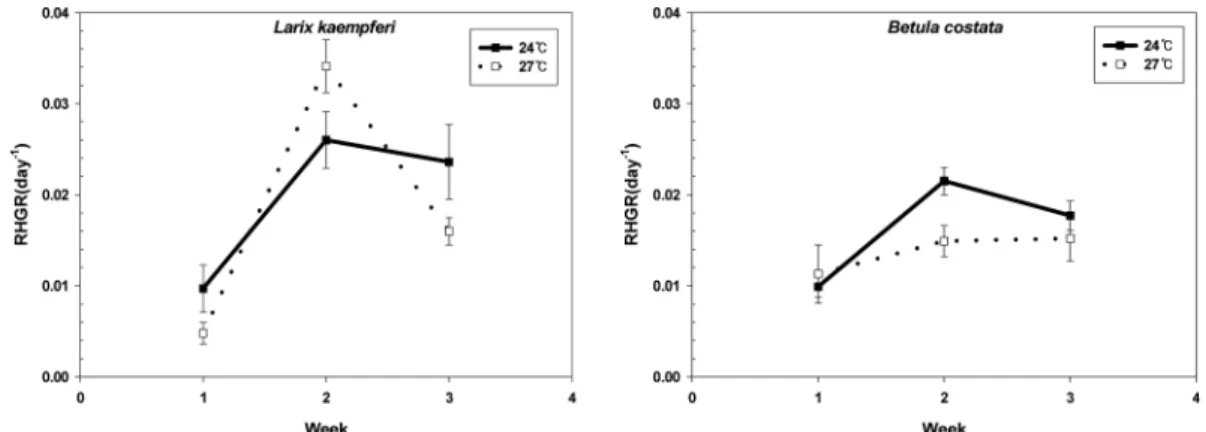
온도증가가수목의초기생장에미치는영향을알 아보기위해일주일간격으로수고생장을측정한결 과
,
일본잎갈나무의상대생장률은 처리1
주 후, 24
oC
가
27
oC
보다 높았다(Fig. 1).
그러나처리2
주후에는24
oC
가27
oC
보다 낮은 생장률을 보였으며,
처리3
주 후에는27
oC
의생장률이크게감소하면서,
다시24
oC
가
27
oC
보다높은값을 나타냈다.
거제수나무는처리1
주 후, 24
oC
가27
oC
보다 낮은 상대생장률을 보였으 나,
처리2
주와3
주 후에는24
oC
가27
oC
보다 높게나타났다
(Fig. 1).
위와 같이온도 증가에따른두수Fig. 1.
Changes on relative height growth rate (RHGR) of two tree species under elevated temperature.
66 Korean Journal of Agricultural and Forest Meteorology, Vol. 14, No. 2
종의 단기 수고 생장 특성은 매우 다르게 나타났다
.
즉
,
두 수종의 생장 증가는 생장 기간 동안 일정한양을 보이지 않으며
,
수종간 변화량은 전혀 달랐다.
즉
,
일본잎갈나무는 생장초기에온도 증가에민감한반응을보여
,
상대생장율이 감소한후일정한수준을 유지하였지만,
거제수나무는생장초기에는온도증가 에영향을나타내지않았던반면,
시간이지남에따라 상대생장율이감소하는경향을나타냈다.
수고 생장과함께 잎
,
줄기,
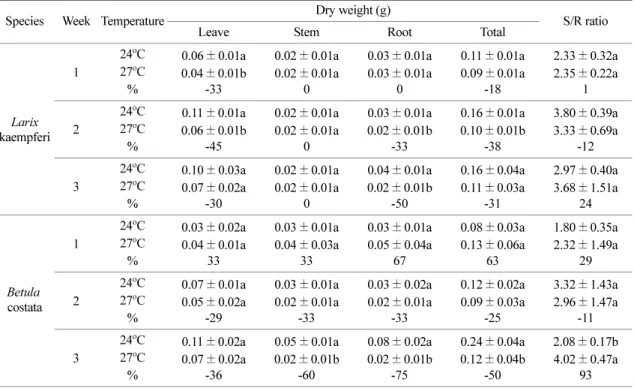
뿌리 각각의 건중량과 총 건중량을분석한결과,
일본잎갈나무의 총건중량 은 처리1~3
주 모두24
oC
가27
oC
보다 높았다.
거제수나무의 경우
,
총건중량은처리1
주 후, 27
oC
가높 았으나,
처리2~3
주는24
oC
에서의건중량이 더높았다
(Table 1).
이것은 거제수나무의 수고 상대생장률변화와같은경향이었다
.
지상부와지하부의비(S/R)
는 일본잎갈나무의경우, 24
oC
에서처리2
주까지증가하다 가 처리3
주 후에는크게 감소하였지만, 27
oC
에서는 꾸준히증가하였다.
거제수나무역시24
oC
에서처리2
주까지는 증가하다가
3
주 후에는 크게 감소하였지만, 27
oC
에서는꾸준히증가하는결과를보였다(Table 1).
많은연구에서
,
식물의생장량은온도가증가에따 라증가한다는결과를보여주고있지만(Morison and Lawlor, 1999; Lilley
et al., 2001),
반대의 결과도 제시되고 있다(Rehfeldt
et al. 2004; Wilmking
etal
. 2004).
Ghannoum
et al.(2010)
은대기 온도보다4
oC
높은 온도에서 유칼리투스(Eucalyptus)
의 건중량 생산이37%~52%
까지증가하였다고보고하였으며,
유사한온도에노출된독일가문비나무의경우
, 57%
까지생체량이 증가한 것으로 보고된 바 있다
(Saxe
et al.,
2001).
그러나높은온도에서생체량증가와는반대로상대생장률
(RGR)
은 감소하기도 한다(Loveys
et al.,
2002).
이것은단위잎면적당건중량증가를나타내는동화 속도
(net assimilation rate, NAR)
가 낮았기 때 문이며,
또한,
온도증가로호흡이증가하였기때문이 다(Loveys
et al., 2002).
우리의연구 결과에서
, 27
oC
에서생육한두수종의 생장량이24
oC
보다낮게나타난것은온도증가에따른생육 조건의변화때문인것으로보인다
. Table 1
에서보여 주는것처럼
, 27
oC
에서 두수종의뿌리생Table 1.
Changes on the dry weight and the ratio of shoot to root (S/R) of two tree species under elevated temperature
Species Week Temperature Leave Stem Dry weight (g) Root Total S/R ratio
Larix
kaempferi
1 24
oC 0.06
±0.01a 0.02
±0.01a 0.03
±0.01a 0.11
±0.01a 2.33
±0.32a 27
oC 0.04
±0.01b 0.02
±0.01a 0.03
±0.01a 0.09
±0.01a 2.35
±0.22a
% -33 0 0 -18 1
2 24
oC 0.11
±0.01a 0.02
±0.01a 0.03
±0.01a 0.16
±0.01a 3.80
±0.39a 27
oC 0.06
±0.01b 0.02
±0.01a 0.02
±0.01b 0.10
±0.01b 3.33
±0.69a
% -45 0 -33 -38 -12
3 24
oC 0.10
±0.03a 0.02
±0.01a 0.04
±0.01a 0.16
±0.04a 2.97
±0.40a 27
oC 0.07
±0.02a 0.02
±0.01a 0.02
±0.01b 0.11
±0.03a 3.68
±1.51a
% -30 0 -50 -31 24
Betula
costata
1 24
oC 0.03
±0.02a 0.03
±0.01a 0.03
±0.01a 0.08
±0.03a 1.80
±0.35a 27
oC 0.04
±0.01a 0.04
±0.03a 0.05
±0.04a 0.13
±0.06a 2.32
±1.49a
% 33 33 67 63 29
2 24
oC 0.07
±0.01a 0.03
±0.01a 0.03
±0.02a 0.12
±0.02a 3.32
±1.43a 27
oC 0.05
±0.02a 0.02
±0.01a 0.02
±0.01a 0.09
±0.03a 2.96
±1.47a
% -29 -33 -33 -25 -11
3 24
oC 0.11
±0.02a 0.05
±0.01a 0.08
±0.02a 0.24
±0.04a 2.08
±0.17b 27
oC 0.07
±0.02a 0.02
±0.01b 0.02
±0.01b 0.12
±0.04b 4.02
±0.47a
% -36 -60 -75 -50 93
All the values are means of ten replicates
±SD; Values with the different letter indicate significant differences between
two treatments (p
≤0.05).
장량은 시간이 지나면서 지속적으로 감소하였다
.
즉,
온도증가에의한뿌리의생장감소가지상부생장을 저해하는 주요인이되었을것으로추정된다
.
이러한 현상은S/R
율에서 잘 보여 주고 있다.
두 수종의S/
R
율은3
주 후에24
oC
보다27
oC
에서 높은 값을 보 였다.
이것은시간이지나면서24
oC
에서는지상부생 장과 함께 지하부 생장이 증가한 반면, 27
oC
에서는 시간이지나면서지하부의생장이감소한결과이다.
온도증가와식물의뿌리생산량에대한연구는매 우 다양한 결과를 보여준다
. Wan
et al.(2004)
은 온 도가 증가하면,
단풍나무유묘의뿌리 생산량이증가한다고 하였지만
, Johnson
et al.(2006)
은Douglas-fir
의세근생산량은온도증가의영향을받지 않았다고 보고하였다
.
한편,
온도가증가하면,
수목의뿌리분해 가 장기적으로 촉진될 수 있다(Chen
et al., 2008).
위의 연구 결과와 비교해 볼 때
,
본 연구 결과에서,
두 수종의 뿌리 생산량이 감소한 것은 온도 증가로 인한뿌리의탈락및분해가촉진된결과로판단된다
.
3.2. 광색소함량
일본잎갈나무와 거제수나무의 광색소 함량 변화는
Table 2
에 나타냈다.
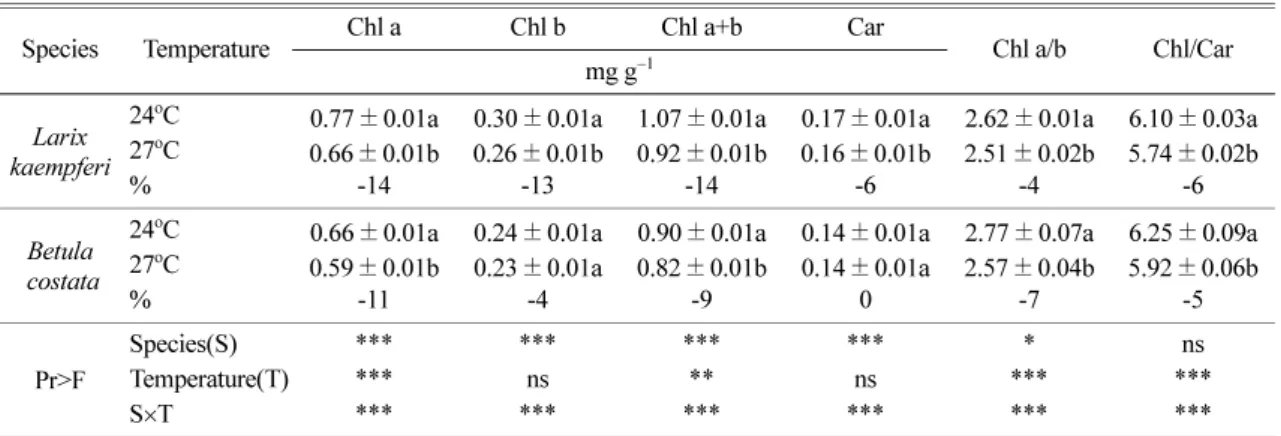
엽록소a
함량은 수종간,
처리간차이를보였으며
,
수종과처리간상호작용도존재하였 다.
두수종 모두27
oC
에서 뚜렷한감소를보였으며,
일본잎갈나무의감소율은
-14%,
거제수나무의감소율 은-11%
를나타냈다.
엽록소
b
함량은수종간차이가뚜렷하였다.
일본잎 갈나무 잎의 엽록소b
함량은27
oC
에서-13%
의 감소율을보였으나
,
거제수나무잎의엽록소b
함량은온 도간차이가없었다.
총엽록소함량은수종간,
처리간차이를보였으며
,
수종과처리간상호작용도존재 하였다.
두수종 모두총엽록소함량은엽록소a
함량과같이
27
oC
에서 뚜렷한감소를보였다.
카로테노 이드함량은수종간뚜렷한차이있었으며,
수종과처 리간상호작용도존재하였다.
광색소함량은스트레스를받으면감소하는특징을 가지고 있어
(Iglesias
et al., 2006; Han
et al., 2007),
스트레스평가 지표로널리 이용되고있으며
,
현재에 도많이 이용되는데,
수종간반응 차이도매우 크게나타나는 인자이다
(Han
et al., 2009; Kim
et al.,
2008).
본 연구에서는 높은 온도에서 엽록소 함량이뚜렷한감소를보여주어
,
온도증가가스트레스로작 용했을가능성을보였다.
엽록소
a
와b
함량의 비는 두 수종 모두27
oC
에서 감소하였는데,
이것은 온도 증가 시,
엽록소a
함량 감소가엽록소b
함량감소보다컸기때문이다.
한편,
총엽록소와카로테노이드함량과의비에서도두수종 모두온도간뚜렷한차이를보였고
,
온도증가에의해비율이감소하는 것으로나타났다
.
총 엽록소와카로 테노이드 함량 비의 감소율은 일본잎갈나무-6%,
거제수나무
-5%
를나타냈다.
총엽록소와카로테노이드 함량의비가감소한것은27
oC
에서총엽록소함량의 감소가카로테노이드함량의감소보다더컸기때문이 다.
즉,
온도증가는엽록소b
함량보다는엽록소a
함 량에더큰영향을주며,
카로테노이드함량보다는엽 록소함량에더큰영향을주는것으로판단된다.
Table 2.
Changes on photosynthetic pigment contents of two tree species under elevated temperature
Species Temperature Chl a Chl b Chl a+b Car Chl a/b Chl/Car
mg g
−1Larix
kaempferi
24
oC 0.77
±0.01a 0.30
±0.01a 1.07
±0.01a 0.17
±0.01a 2.62
±0.01a 6.10
±0.03a 27
oC 0.66
±0.01b 0.26
±0.01b 0.92
±0.01b 0.16
±0.01b 2.51
±0.02b 5.74
±0.02b
% -14 -13 -14 -6 -4 -6
Betula costata
24
oC 0.66
±0.01a 0.24
±0.01a 0.90
±0.01a 0.14
±0.01a 2.77
±0.07a 6.25
±0.09a 27
oC 0.59
±0.01b 0.23
±0.01a 0.82
±0.01b 0.14
±0.01a 2.57
±0.04b 5.92
±0.06b
% -11 -4 -9 0 -7 -5
Pr>F Species(S) *** *** *** *** * ns
Temperature(T) *** ns ** ns *** ***
S
×T *** *** *** *** *** ***
All the values are means of five replicates
±SD; Values with the different letter indicate significant differences
between two treatments (p
≤0.05). ** p
≤00.01, *** p
≤00.001; and ns indicates non-significance.
68 Korean Journal of Agricultural and Forest Meteorology, Vol. 14, No. 2
온도와
CO
2농도 증가가엽록소함량을감소시켰다는 결과는많은연구에서 찾아 볼수있다
(Hamid
etal
., 2009; Kim and You, 2010).
우리의 연구 결과에서처럼
,
온도증가로인한잎의엽록소함량감소는 잎의 질소함량감소와관계가 깊다.
즉,
온도증가로 뿌리의생산량이감소하면서,
질소흡수가감소하였고,
이로인해잎의엽록소함량이감소한것으로판단된다
.
3.3.항산화효소활성및 MDA 함량
식물은대기오염물질
,
저온,
고온,
건조 등의환경스트레스에 의해 체내에 활성산소가 생성되고
,
그로 인해산화스트레스가일어나는것으로보고되고있다(Gabara
et al., 2003; Velikova
et al., 2000).
그러 나식물은활성산소를효과적으로해독하기위한생화 학적 방어기구를가지고있는데, SOD
등의 항산화효소들이 관여되어 있는 것으로 알려져 있다
(Elstner,
1982).
온도증가가일본잎갈나무와거제수나무의스트레스 요인으로 작용하는지를 확인하기위하여
,
항산화효소활성을측정한결과는
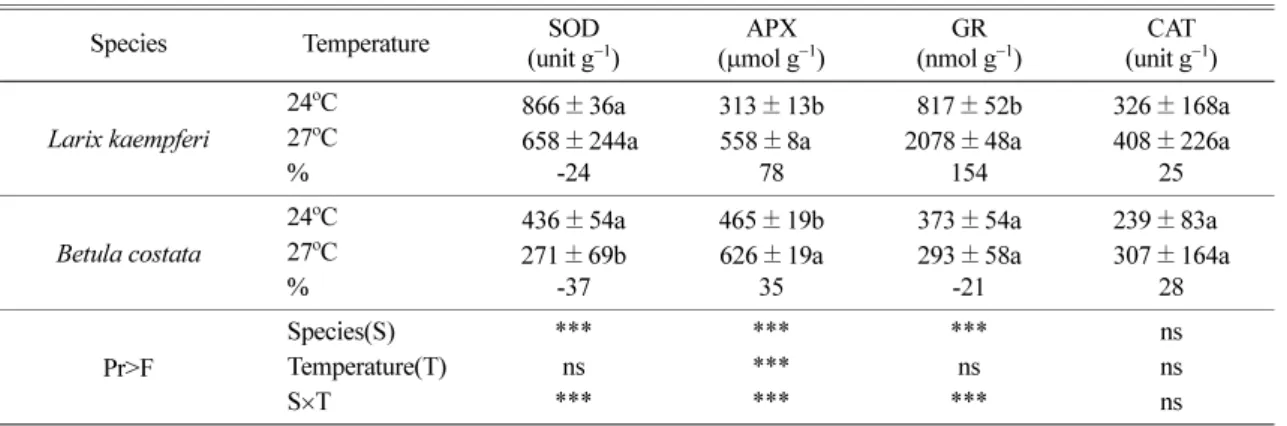
Table 3
에나타냈다. SOD
활성은두수종모두
27
oC
에서감소하는경향을나타냈는 데,
그감소율은일본잎갈나무가-24%,
거제수나무가-37%
였다. APX
활성은수종간,
처리간 뚜렷한차이를 보였으며
,
수종과처리간 상호작용도 존재하였다. APX
활성은 두 수종 모두27
oC
에서 증가하였으며,
그증가율은일본잎갈나무가
78%,
거제수나무가35%
였다
. GR
활성은 일본잎갈나무의 경우, 27
oC
에서154%
의 뚜렷한 증가율을 보였으나,
거제수나무는2
7
oC
에서-21%
의감소율을보이며서로반대의경향을나타냈다
. CAT
활성은 두수종 모두27
oC
에서 증가하였으나
,
뚜렷한차이는없었다.
일반적으로 항산화효소의 활성은 각종 스트레스에 의해유도되거나또는증가하는것으로보고되고있다
(Anderson
et al., 1995; Hodges
et al., 1997).
그 러나이러한식물의반응은스트레스의강도나기간뿐 만이 아니라식물 종에 따라 매우 다양한반응을나 타낸다(Rao
et al., 1996; Han
et al., 2007; Kim
et al
., 2008).
본 연구에서도 일본잎갈나무의 경우,
SOD
활성을 제외한 나머지 효소 활성이27
oC
에서증가되었으며
,
거제수나무의경우, APX
활성과CAT
활 성이27
oC
에서높은값을나타냈다.
MDA
함량은스트레스후증가하여생리적피해를Table 3.
Changes on antioxidative enzyme activities of two tree species under elevated temperature
Species Temperature SOD
(unit g
−1) APX
(
µmol g
−1) GR
(nmol g
−1) CAT
(unit g
−1)
Larix kaempferi 24
oC 866
±36a 313
±13b 817
±52b 326
±168a
27
oC 0658
±244a 558
±8a0 2078
±48a0 408
±226a
% -24 78 154 25
Betula costata 24
oC 436
±54a 465
±19b 373
±54a 239
±83a0
27
oC 271
±69b 626
±19a 293
±58a 307
±164a
% -37 35 -21 28
Pr>F Species(S) *** *** *** ns
Temperature(T) ns *** ns ns
S
×T *** *** *** ns
All the values are means of five replicates
±SD; Values with the different letter indicate significant differences between two treatments (p
≤0.05). **p
≤0.01, ***p
≤0.001; and ns indicastes non-significance.
Fig. 2.
Changes on malondialdehyde (MDA) content of two tree species under elevated temperature. All the values are means of five replicates
±SD; Values with the different letter indicate significant differences between two treatments (p
≤
0.05).
측정하는간접적인인자로이용되고있는데
(Iglesias
et al., 2006),
본연구에서는두 수종모두27
oC
에서 오히려 감소하는 경향을 보였다
(Fig. 2).
기존의 많은연구결과에서 수목에 인위적인 스트레스 처리 후
MDA
함량이증가하는결과를보여주었지만,
그반대 의 결과도 제시되었다(Kim
et al., 2008).
본 연구에 서는일본잎갈나무에서MDA
함량이처리별뚜렷한 경향을보여주고 있으나,
생장 및생리적인자들과의 연관성을 고려했을때,
생리평가 지표로서적당하지 않은것으로판단된다.
적 요
지구온난화현상과관련하여온도상승에따른수목 의초기생리반응변화를이해하기위하여
,
일본잎갈나무와거제수나무 유묘를
24
oC
와27
oC
에서4
주간키운 후,
이들의 생장,
광색소 함량,
항산화효소 활성 및MDA
함량을조사·분석하였다.
높은온도(27
oC)
에서생 장한두수종의수고상대생장률은대조구에비해낮았 으며,
잎,
줄기,
뿌리의건중량도모두낮았다.
특히뿌리의생장감소는시간이지나면서뚜렷하게증가하였으 며
,
이로인해지상부와지하부의 비는높은온도에서증가하였다
.
광색소함량은두수종모두온도증가로 감소하였으며,
항산화효소인APX
와CAT
의활성은높 은온도에서증가하였다.
그러나MDA
함량은온도변 화에영향을받지않았다.
결론적으로,
수목의생육온 도 증가는생육 초기에뿌리의 생장을감소시켜 양료 흡수를제한하며,
엽록소함량감소와지상부의생장을 방해할 수 있다.
또한 온도 증가는수목의 생장 기간동안스트레스요인으로작용하여에너지의소모를증가 시켜생장감소를초래할수있다
.
REFERENCES
Anderson, M. D., T. K. Prasad, and C. R. Stewart, 1995:
Changes in isozyme profiles of catalase, peroxidase, and glutathione reductase during acclimation to chilling in mesocotyls of maize seedlings. Plant physiology
109, 1247-1257.
Beadle, C. L., 1993: Growth analysis. Photosynthesis and production in a changing environment, a filed and laboratory manual. D. O. Hall, J. M. O. Scurlock, H. R.
Bolhar-Nordenkampf, R. C. Leegood, and S. P. Long (Eds.), Chapman Hall, London, 36-46.
Ceulemans, R. and Mousseau, M., 1994. Effects of elevated atmospheric CO
2on woody plants: a review. New Phytologist
127, 425-446.
Chen, H., P. T. Rygiewicz, M. G. Johnson, M. E. Harmon, H. Tian, and J. W. Tang, 2008: Chemistry and long-term decomposition of roots of Douglas-Fir grown under elevated atmospheric carbon dioxide and warming conditions.
Journal of Environmental Quality
37, 1327-1336.
Elstner, E. F., 1982. Oxygen activation and oxygen toxicity.
Annual Review of Plant Physiology
33, 73-96.
Gabara, B., M. Sklodowska, A. Wyrwicka, S. Glinska, and M.
Gapinska, 2003: Changes in the ultrastructure of chloroplasts and mitochondria and antioxidant enzyme activity in Lycopersicon esculentum Mill. Leaves sprayed with acid rain. Plant Science
164, 507-516.
Geissler, N., S. Hussin, and H. W. Koyro, 2009: Interactive effects of NaCl salinity and elevated atmospheric CO
2concentration on growth, photosynthesis, water relations and chemical composition of the potential cash crop halophyte Aster tripolium L. Environmental and Experimental Botany
65, 220-231.
Ghannoum, O., N. G. Phillips, J. P. Conroy, R. A. Smith, R.
D. Attard, R. Woodfield, B. A. Logan, J. D. Lewis, and D. T. Tissue, 2010: Exposure to preindustrial, current and future atmospheric CO
2and temperature differentially affects growth and photosynthesis in Eucalyptus. Global Change Biology
16, 303-319.
Hamid, N., F. Jawaid, and D. Amin, 2009. Effect of short- term exposure to two different carbon dioxide concentrations on growth and some biochemical parameters of edible beans ( Vigna radiate and Vigna unguiculata ). Pakistan Journal of Botany
41, 1831-1836.
Han, S. H., D. H. Kim, J. C. Lee, and P. G. Kim, 2009:
Effects of fertilization on physiological parameters in American sycamore ( Platanus occidentalis ) during ozone stress and recovery phase. Journal of Ecology and Field Biology
32, 149-158.
Han, S. H., D. H. Kim, K. Y. Lee, J. J. Ku, and P. G. Kim, 2007: Physiological damages and biochemical alleviation to ozone toxicity in five species of genus Acer . Journal of Korean Forest Society
96, 551-560.
Hättenschwiler, S., F. Miglietta, A. Rasch, and S. Körner, 1997: Thirty years of in situ tree growth under elevated CO
2: a model for future responses? Global Change Biology
3, 463-471.
Heath, R. L., and L. Parker, 1968: Photoperoxidation in isolated chloroplasts. I. Kinetics and stoichiometry of fatty acid peroxidation. Archives of Biochemistry and Biophysics
125, 189-198.
Hiscox, J. D., and G. F. Israelstam, 1979: A method for the extraction of chlorophyll from leaf tissue without maceration.
Canadian Journal of Botany
57, 1332-1334.
Hodges, D. M., C. J. Andrews, D. A. Johnson, and R.I.
Hamilton, 1997: Antioxidant enzymes responses to chilling
70 Korean Journal of Agricultural and Forest Meteorology, Vol. 14, No. 2
stress in differentially sensitive inbred maize lines.
Journal of Experimental Botany
48, 1105-1113.
Iglesias, J. D., A. Calatayud, E. Barreno, E. Primo-Millo, and M. Talon, 2006: Responses of citurs plants to ozone:
Leaf biochemistry, antioxidant mechanisms and lipid peroxidation. Plant Physiology and Biochemistry
44, 125-131.
IPCC. 2007. Climate change 2007: Mitigation of climate change. Contribution of working group III to the fourth assessment report of the intergovernmental panel on climate change. Cambridge University Press, Cambridge.
Johnson, M. G., P. T. Rygiewicz, D. T. Tingey, and D. L.
Phillips, 2006: Elevated CO
2and elevated temperature have no effect on Douglas-fir fine-root dynamics in nitrogen-poor soil. New Phytologist
170, 345-356.
Kanemoto, K., Y. Yamashita, T. Ozawa, N. Imanishi, N. T.
Nguyen, R. Suwa, P. K. Mohapatra, S. Kanai, R. E.
Moghaieb, J. Ito, H. Elshemy, and K. Fujita, 2009:
Photosynthetic acclimation to elevated CO
2is dependent on N partitioning and transpiration in soybean. Plant Science
177, 398-403.
Kellomäki, S., T. Karjalainen, and H. Väisänen, 1997: More timber from boreal forests under changing climate?
Forest Ecology and Management
94, 195-208.
Kilpeläinen, A., H. Peltola, A. Ryyppö, K. Sauvala, K.
Laitinen, and S. Kellomäki, 2004: Wood properties of Scots pine ( Pinus sylvestris ) grown at elevated temperature and carbon dioxide concentration. Tree Physiology
23, 889-897.
Kim, D. H., S. H. Han, J. J. Ku, K. Y. Lee, and P. G. Kim, 2008: Physiological and biochemical responses to ozone toxicity in five species of genus Quercus seedlings.
Korean Journal of Agricultural and Forest Meteorology
10, 47-57.
Kim, H. R., and Y. H. You, 2010: Effects of elevated CO
2concentration and increased temperature on leaf related- physiological responses of Phytolacca insularis (native species) and Phytolacca Americana (invasive species).
Journal of Ecology and Field Biology
33, 195-204.
Korea Meteorological Administration (KMA), 2011: Summary of Korea Global Atmosphere Watch 2010 Report. KMA, 8pp.
Kratsch, H. A., and R. R. Wise, 2000: The ultrastructure of chilling stress. Plant, Cell and Environment
23, 337-350.
Leakey, A. D. B., E. A., Ainsworth, C. J. Bernacchi, A.
Rogers, S. P. Long, and D. R. Ort, 2009: Elevated CO
2effects on plant carbon, nitrogen, and water relations: six important lessons from FACE. Journal of Experimental Botany
60, 2859-2876.
Lilley, J. M., T. P. Bolger, and R. M. Gifford, 2001: Productivity of Trifolium subterraneum and Phalaris aquatic under warmer, high CO
2conditions. New Phytologist
150, 371-383.
Loveys, B. R., I. Scheurwater, T. L. Pons, A. H. Fitter, and O. K. Atkin, 2002: Growth temperature influences the underlying components of relative growth rate: an
investigation using inherently fast and slow-growing plant species. Plant, Cell and Environment
25, 975-987.
McGee, C. E., and D. L. Loftis, 1986: Planted oak perform poorly in North Carolina and Tennessee. Northern Journal of Applied Forestry
3, 114-116.
Matala, J., R. Ojansuu, H. Peltola, H. Raitio, and S. Kellomäki, 2006: Modelling the response of tree growth to temperature and CO
2elevation as related to the fertility and current temperature sum of a site. Ecological Modelling
199, 39-52.
Ministry of Environment, 2011: Korea climate change evaluation report 2011, 635pp.
Morison, J. I. L., and D. W. Lawlor, 1999: Interactions between increasing CO
2concentration and temperature on plant growth. Plant, Cell and Environment
22, 659-682.
Peltola, H., A. Kilpeläinen, and S. Kellomäki, 2002: Diameter growth of Scots pine ( Pinus sylvestris ) trees grown at elevated temperature and carbon dioxide concentration under boreal conditions. Tree Physiology
22, 963-972.
Rao, M. V., G. Paliyath, and D. P. Ormrod, 1996: Ultraviolet-B and ozone-induced biochemical changes in antioxidant enzymes of Arabidopsis thaliana . Plant Physiology
110, 125-136.
Rehfeldt, G. E., N. M. Tchebakova, and E. I. Parfenova, 2004:
Genetic responses to climate and climate-change in conifers of the temperate and boreal forests. Recent Research Developments in Genetics and Breeding
1, 113-130.
Reich, P. B., and J. Oleksyn, 2008: Climate warming will reduce growth and survival of Scots pine except in the far north. Ecology Letters
11, 588-597.
Ryu, K. O., O. W Kwon, J. H. Song, and I. S. Kim, 2004:
The variation of growth performance, timing of leaf burst, and leaf form among 23 provenances of Quercus rubra L. in Korea. Journal of Korean Forest Society
93, 235-241. (In Korean with English abstract)
Saxe, H., M. G. R. Cannell, B. Johnsen, M. G. Ryan, and G.
Vourlitis, 2001: Tree and forest functioning in response to global warming. New Phytologist
149, 369-399.
Scholze, M., W. Knorr, N. W. Arnell, and I. C. Prentice, 2006: A climate-change risk analysis for world ecosystems.
Proceedings of the National Academy of Science U.S.A.,
103