a)성균관대학교 정보통신공학부 디지털미디어 연구실
Digital Media Lab., School of Information and Communication Engineering, Sungkyunkwan University
‡교신저자 : 전병우 ([email protected])
※이 논문은 2010년도 정부(교육과학기술부)의 재원으로 한국연구재단 의 지원을 받아 수행된 기초연구사업 연구임(No. 20100008030).
․접수일(2011년3월4일),수정일(2011년3월22일),게재확정일(2011년3월22일)
움직임 특성을 이용한 적응적 교차 움직임 벡터 부-복호화
원 광 현a), 양 정 엽a), 박 대 윤a), 전 병 우a)‡
Adaptive Interleaved Motion Vector Coding using Motion Characteristics
Kwanghyun Wona), Jungyoup Yanga), Daeyun Parka), and Byeungwoo Jeona)‡
요 약
본 논문은 영상의 움직임 특성을 참조하여 움직임 벡터 수평-수직 성분중 하나를 최적의 예측 움직임 벡터 성분으로 선택하여 사용 할 수 있는 개선된 교차 움직임벡터 부호화 방법을 제시한다. 제안방법은 부-복호화를 수행할 움직임 벡터 성분의 순서를 복호화기에 알리는 신호비트를 별도로 보낼 필요 없이, 시공간적 움직임필드의 특성을 참조하여 적절한 움직임벡터 성분 예측치를 적응적으로 사 용할 수 있다. 기존 H.264/AVC 방법과 비교한 실험 결과, 평균적으로 전체 비트량을 약 1.99% (최대 8.71%) 감소시킬 수 있음을 보 여준다.
Abstract
This paper proposes an improved design of an interleaved motion vector coding scheme with flexibility in predictive motion vector component by exploiting motion characteristics. It can use component-wise adaptive motion vector predictor based on the utility of spatial and temporal motion field without any signaling bit for indicating decoder of the selected predictive motion vector component. Experiment with test video data shows about 1.99% (max 8.71%) bit rate reduction compared to the conventional H.264/AVC method.
Keyword : H.264/AVC, interleaved motion vector coding, motion vector component, compression, motion characteristics
Ⅰ. Introduction
The H.264/AVC video coding standard has achieved substantially high compression performance compared to its predecessors thanks to variety of tools such as 1/4-pel
motion compensated inter prediction, directional intra pre- diction, variable block sizes, multiple reference pictures, context adaptive entropy coding, in-loop deblocking filter- ing, and so on[1][2][3]. All those coding tools contribute to improving coded video quality with spending minimum coded data for mode, motion, and textural information.
Especially, superior coding gain is brought by the motion compensated inter-picture prediction with 1/4-pel motion accuracy in variable block sizes. The data for textural in- formation are effectively reduced by exploiting temporal 일반논문-11-16-2-16
correlation using multiple reference pictures. However, the 1/4-pel accuracy in representing motion displacement leads to increasing motion information whose amount can reach up to 40% of the total bit-rate[4].
After the completion of H.264/AVC standardization, the ITU-T video coding experts group (VCEG) challenges the coding tools of the H.264/AVC for even higher compression, and various coding tools have been proposed and some of them are included in the key technical area (KTA) soft- ware[5][6]. Most coding tools proposed for better compressing motion vector (MV) require using additional signaling over- head bits which set some limit in the coding gain.
The Joint Collaborative Team on Video Coding (JCT-VC) of ITU-T VCEG and ISO/IEC MPEG has re- cently launched a standardization activity known as the high efficiency video coding (HEVC) with a goal of ach- ieving at least 50% of compression gain against the exist- ing H.264/AVC at equivalent quality[7]. In order to fulfill the goal, more precise and effective MV coding is neces- sary due to non-trivial bit portion of compressed MV data.
This paper presents a new way of MV coding in which one selected motion vector component is predicted first by the conventional median predictive motion vector while the other component is predicted by a corresponding compo- nent of a neighboring motion vector which is nearest to the current motion vector in its first selected component. The component selection is flexibly determined by measuring motion property of objects in picture. A criterion determin- ing which motion vector component is predicted by median predictor is designed, and its implementation on KTA soft- ware is tested for evaluation of its performance gain against H.264/AVC.
The remainder of this paper is organized as follows.
Prior works on MV coding relevant to the proposed meth- od are presented in Section II. The proposed method of the flexible MV coding is described in Section III. Finally, Section IV presents simulation results using KTA software
and discussion. Section V makes concluding remarks.
Ⅱ. Related Works 1. MV Coding
The MV coding has been one of the main areas of re- search in the video coding, thus lots of idea already have been addressed much in the literature[8][9][10][11][12][13]
. However, almost all those methods have exploited the ba- sic concept of predictive coding as following:
(1)
where denotes motion vector of a current block,
denotes its predictive MV (PMV), and de- notes differential MV (DMV) between MV of a current block and its PMV. Hence, selection of a proper PMV most similar to MV of a current block is the key to MV coding.
The H.264/AVC uses, as the PMV, the median of MVs of three spatial neighboring blocks - left (A0), upper (B0), and upper-right (C) blocks shown in Fig. 1. In case of us- ing the median as the PMV, the encoder does not need to transmit any signaling bits to inform decoder of the se- lected PMV since the decoder can generate the PMV for itself. However, the median may give ineffective coding ef- ficiency of MV when the other PMV is more similar to the current MV.
In this context, a MV coding scheme based on competi- tion has been researched to choose the optimal PMV[14]. The competition scheme selects a PMV which produces the minimum bit-rate among several MVs located in spatially and temporally neighboring blocks. The scheme is effective to reduce motion information because a PMV giving the minimum bit-rate is always used in Eq.(1). However, it comes with increment of overhead bits in order to notify
그림. 2. 교차 움직임 벡터 부-복호화 방법의 부호화 과정[16]
Fig. 2. Encoding in interleaved MV coding[16]
그림. 3. 교차 움직임 벡터 부-복호화 방법의 복호화 과정[16]
Fig. 3. Decoding in interleaved MV coding[16]
그림. 1. 현재 블록과 공간적으로 이웃한 블록들(A0, A1, …, B0, B1, …, C, D and E)과 시간적으로 이웃한 동일위치 블록(Co)
Fig. 1. Current and spatially neighboring blocks (A0, A1, …, B0, B1,
…, C, D and E), and temporally co-located block (Co)
a decoder of the selected PMV. Furthermore, if the number of candidate PMVs is increased, the amount of signaling bits also goes up.
There has been also research on MV coding which does not require such indicating overhead[15]. The method choo- ses a PMV which can be predicted at the decoder by matching the reconstructed pixel data of current and refer- ence blocks as indicated by the recovered motion vector.
In this scheme, however, since the decoder may not identi- fy the same PMV chosen at the encoder all the time, the encoder transmits signaling information to let the decoder
differentiate the case in which the decoder cannot identify the same PMV of encoder’s choice.
2. Interleaved MV Coding
Of being closely relevant to the proposed design, there has been a report on interleaved MV coding which also does not require any signaling bit for the selected PMV[16]. As shown in Fig. 2, the scheme compresses a horizontal MV component using a predictor determined after finishing coding the vertical component first. The vertical PMV component of a current block is selected by using Eq.(2) as the vertical component of the median calculated in the same way as the MV coding of the H.264/AVC.
(2)
where denotes the vertical direction, denotes a vertical component of PMV, · denotes a median function,
,
, and
denote vertical com- ponents of corresponding MVs in spatially neighboring blocks as described in Fig. 1. After finishing coding the vertical component first, the horizontal component of PMV is chosen as that of a neighboring MV which minimizes absolute difference between the vertical MV components of current block and its spatially neighboring blocks of left (A0), upper (B0) and upper-right (C) blocks shown in
그림. 4. 제안한 움직임 벡터 부-복호화 방법의 부호화 과정 Fig. 4. Encoding in the proposed MV coding design
그림. 5. 제안한 움직임 벡터 부-복호화 방법의 복호화 과정 Fig. 5. Decoding in the proposed MV coding design
Fig.1. The selection is made by Eq.(3).
arg ∈ (3)
where denotes the horizontal direction, de- notes a horizontal component of PMV, denotes a vertical MV component of the current block, denotes a candidate set for vertical components of MVs in left (A0), upper (B0) and upper-right (C) blocks, arg·
finds a vertical MV component among CS which mini- mizes the absolute difference, and the function · iden- tifies the horizontal component of a motion vector corre- sponding to the selected vertical MV component by arg·. The horizontal component is coded using the identified .
Its decoding process is almost identical to the encoding process as illustrated in Fig. 3. When DMV of a current block is parsed, the vertical MV component is first decoded using median PMV in Eq.(2). Following, the other PMV
component is found using Eq.(3). Although this interleaved MV coding scheme is effective, its coding of vertical com- ponent always using median predictor regardless of the di- rection of object motion or camera panning may reduce coding efficiency when the motion characteristic does not match with the fixed scheme.
Ⅲ. Proposed Motion Vector Coding
The proposed flexible interleaved MV coding approach seeks to enhance MV coding gain by adaptively coding each MV component using appropriate predictor. It allows one MV component better interleaved with the other MV component. Furthermore, it requires no signaling bit for in- dicating selected MV predictor. The flexibility according to sequence characteristics helps to improve coding efficiency. The design concept is particularly useful for supporting various directions of camera panning, object ac- tion, and zooming motion.
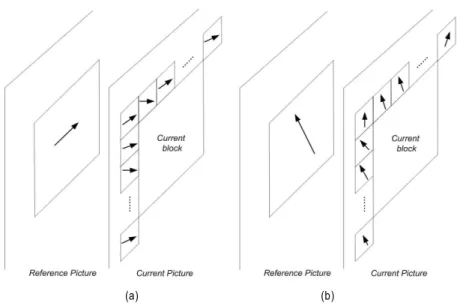
(a) (b) 그림. 6. 수평 움직임(a) 또는 수직 움직임(b)을 나타내는 주변 블록들
Fig. 6. Neighboring blocks with (a) horizontal or (b) vertical motion displacement
1. Coding Procedure
As described in Fig. 4, there are two ways of selecting a predictor for each MV component. The first encoded component is predicted by the same component of the me- dian PMV of the H.264/AVC.
(4)
Using Eq.(5), the predictor of the other MV component of a current block is decided based on SAD between the first component of motion vector of a current block in Eq.(4) and those neighboring blocks spatially and tempo- rally located in Fig. 1.
arg P r ∈ Pr (5)
where PropCS denotes a candidate set for the first MV component of left blocks (A0, A1,…), upper blocks (B0, B1,…), diagonal blocks (C, D, E), and temporally co-lo-
cated block (Co) in Fig. 1. The function · identifies the second component of a motion vector corresponding to the selected first MV component by arg·. The first MV component can be selected either horizontal or vertical component depending on the motion char- acteristics. Its decoding process is almost identical to the proposed encoding process as illustrated in Fig. 5. If the horizontal MV component is firstly decoded, Eq.(4) and Eq.(5) can be utilized as the above-mentioned method.
Otherwise, Eq.(2) and Eq.(3) can be employed in the iden- tical manner as explained in Section II-2.
2. Predictor Decision of MV Components
For making component-wise decision on motion vector predictor, motion vector disparity of a current block with respect to the spatio-temporally neighboring blocks is measured. The measurement is carried out using the recov- ered motion field so that the decoder can do the exactly same procedure. Thus the encoder does not need to code any overhead signaling bit. The motion vector disparity is
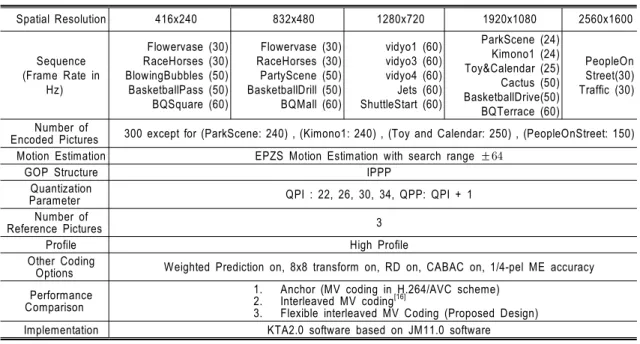
표 1. 실험 조건
Table 1. SIMULATION CONDITION
Spatial Resolution 416x240 832x480 1280x720 1920x1080 2560x1600
Sequence (Frame Rate in
Hz)
Flowervase (30) RaceHorses (30) BlowingBubbles (50) BasketballPass (50) BQSquare (60)
Flowervase (30) RaceHorses (30) PartyScene (50) BasketballDrill (50) BQMall (60)
vidyo1 (60) vidyo3 (60) vidyo4 (60) Jets (60) ShuttleStart (60)
ParkScene (24) Kimono1 (24) Toy&Calendar (25) Cactus (50) BasketballDrive(50) BQTerrace (60)
PeopleOn Street(30) Traffic (30)
Number of
Encoded Pictures 300 except for (ParkScene: 240) , (Kimono1: 240) , (Toy and Calendar: 250) , (PeopleOnStreet: 150) Motion Estimation EPZS Motion Estimation with search range ±
GOP Structure IPPP
Quantization
Parameter QPI : 22, 26, 30, 34, QPP: QPI + 1
Number of
Reference Pictures 3
Profile High Profile
Other Coding
Options Weighted Prediction on, 8x8 transform on, RD on, CABAC on, 1/4-pel ME accuracy Performance
Comparison
1.
2.
3.
Anchor (MV coding in H.264/AVC scheme) Interleaved MV coding[16]
Flexible interleaved MV Coding (Proposed Design)
Implementation KTA2.0 software based on JM11.0 software
∈Pr
i f
i f
i f
(6) computed as the difference between vertical and horizontal components of motion vectors in the identical blocks given by Eq. (6).
where PropBlk denotes a subset of neighboring blocks in the candidate set indicated by PropCS in Eq.(5). In Eq.(5), non-existing motion vector of a neighboring block (for example, due to being intra block or out of the picture boundary) is set to (0,0). A non-negative value of
means that the object action or camera panning is more in the horizontal direction than in the vertical direc- tion as illustrated in Fig. 6-(a). Consequently a range of vertical motion displacement is expected to be smaller than a range of horizontal one. Thus a possibility that variance
of vertical motion displacement is decreased highly rises.
Hence, it should be effective to firstly code vertical motion vector using median predictor. On the contrary, its negative value means that the activity is mainly in the vertical direc- tion as shown in Fig. 6-(b), thus coding the horizontal one in advance using the median predictor can achieve more coding efficiency.
Ⅳ. Simulation and Results 1. Simulation Condition
In order to evaluate the performance of the proposed method, it is implemented in the KTA reference software version 2.0[5], and then applied to all possible macroblock modes (SKIP, P16x16, P16x8, P8x16, P8x8, and all sub-macroblocks). The experiment is simulated under the test condition recommended by the JCT-VC for evaluating
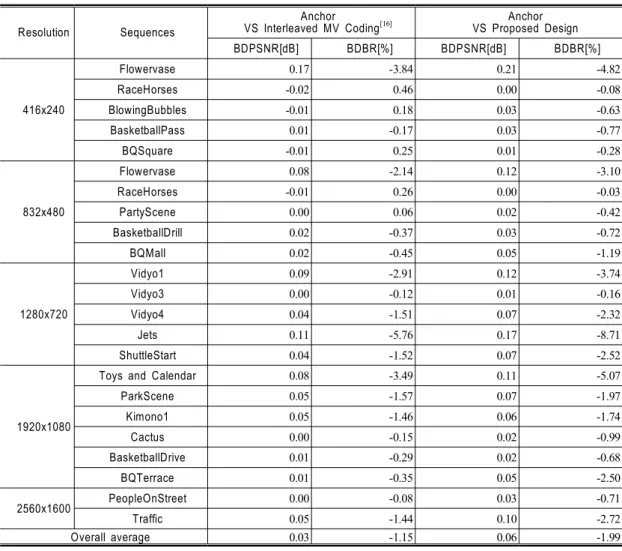
표. 2. 부호화 성능 비교
Table. 2. Coding performance comparison against H.264/AVC
Resolution Sequences
Anchor
VS Interleaved MV Coding[16]
Anchor VS Proposed Design
BDPSNR[dB] BDBR[%] BDPSNR[dB] BDBR[%]
416x240
Flowervase 0.17 -3.84 0.21 -4.82
RaceHorses -0.02 0.46 0.00 -0.08
BlowingBubbles -0.01 0.18 0.03 -0.63
BasketballPass 0.01 -0.17 0.03 -0.77
BQSquare -0.01 0.25 0.01 -0.28
832x480
Flowervase 0.08 -2.14 0.12 -3.10
RaceHorses -0.01 0.26 0.00 -0.03
PartyScene 0.00 0.06 0.02 -0.42
BasketballDrill 0.02 -0.37 0.03 -0.72
BQMall 0.02 -0.45 0.05 -1.19
1280x720
Vidyo1 0.09 -2.91 0.12 -3.74
Vidyo3 0.00 -0.12 0.01 -0.16
Vidyo4 0.04 -1.51 0.07 -2.32
Jets 0.11 -5.76 0.17 -8.71
ShuttleStart 0.04 -1.52 0.07 -2.52
1920x1080
Toys and Calendar 0.08 -3.49 0.11 -5.07
ParkScene 0.05 -1.57 0.07 -1.97
Kimono1 0.05 -1.46 0.06 -1.74
Cactus 0.00 -0.15 0.02 -0.99
BasketballDrive 0.01 -0.29 0.02 -0.68
BQTerrace 0.01 -0.35 0.05 -2.50
2560x1600 PeopleOnStreet 0.00 -0.08 0.03 -0.71
Traffic 0.05 -1.44 0.10 -2.72
Overall average 0.03 -1.15 0.06 -1.99
HEVC standardization as depicted in Table 1. The pro- posed flexible interleaved MV coding is compared against the MV coding in the H.264/AVC standard (as an anchor) and the interleaved MV coding scheme[16] in terms of Bjøntegaard Delta Bit Rate (BDBR)[17]. Since MV coding is lossless, no comparison is made in PSNR.
2. Analysis of Experimental Results
Table 2 summarizes experimental results of the proposed method and its comparison to existing methods. Its verti
cal-axis indicates percentage bit-saving. Table 2 shows that the existing interleaved MV coding[16] achieves high coding gain compared to the anchor because of its capability of appropriately matching vertical MV components of current and its neighboring blocks. It also shows that the proposed flexible interleaved MV coding gives better coding per- formance in all test sequences than the fixed interleaved method[16] because of properly exploiting the spatial and the temporal motion fields with no consumption of signal- ing bits. The results show that the proposed one and the fixed interleaved one[16] respectively achieve BDBR gain
ParkScene , 1920x1080
Bit-Rate (kbits/s)
1000 2000 3000 4000 5000 6000 7000 8000 9000 10000 11000 12000
PSNR (dB)
32 34 36 38 40
Anchor
Interleaved MV Coding [16]
Flexible Interleaved MV Coding (proposed)
Kimono1 , 1920x1080
Bit-Rate (kbits/s)
1500 3000 4500 6000 7500
PSNR (dB)
35.0 35.5 36.0 36.5 37.0 37.5 38.0 38.5 39.0 39.5 40.0 40.5 41.0 41.5
Anchor
Interleaved MV Coding [16]
Flexible Interleaved MV Coding (proposed)
Vidyo1 , 1280x720
Bit-Rate (kbits/s)
250 500 750 1000 1250 1500 1750 2000 2250 2500 2750 3000
PSNR (dB)
36 37 38 39 40 41 42 43
Anchor
Interleaved MV Coding [16]
Flexible Interleaved MV Coding (proposed)
BQMall , 832x480
Bit-Rate (kbits/s)
1000 2000 3000 4000 5000 6000 7000
PSNR (dB)
32 33 34 35 36 37 38 39 40
Anchor
Interleaved MV Coding [16]
Flexible Interleaved MV Coding (proposed)
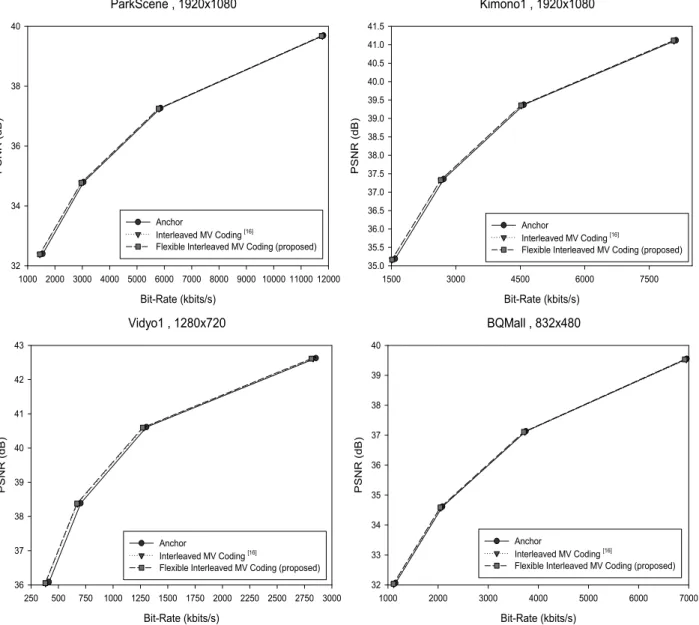
그림. 7. 율-왜곡 그래프 (수평방향의 움직임이 발생하는 영상) Fig. 7. R-D curve for sequences having mainly horizontal motions
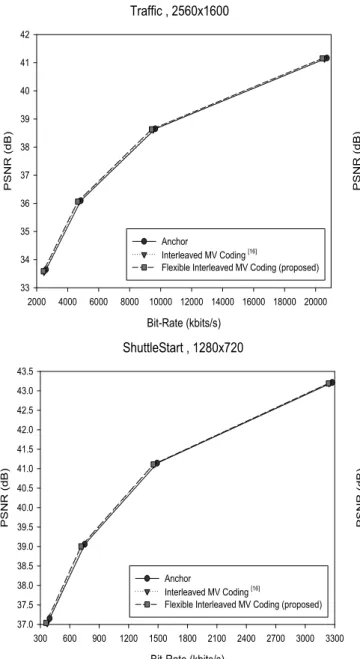
of 1.99% and 1.15% on average compared to the H.264/AVC standard. Especially, in the Jets sequence of 1280x720, the proposed one performs very well by attain- ing bit-saving of 8.71% against the anchor. For sequence- shaving mainly horizontal motions such as ParkScene, Kimono1, Vidyo1, and BQMall, the performance of the proposed and the interleaved ones hardly makes any differ-
ence even though both methods obtain quite good co- dinggain compared to anchor as represented in Fig. 7.
However, for sequences with diverse directional motions such as Traffic, Jets, ShuttleStart, Flowervase, the proposed one overwhelmingly gains more coding efficiency com- pared to the other methods as illustrated in Fig. 8.
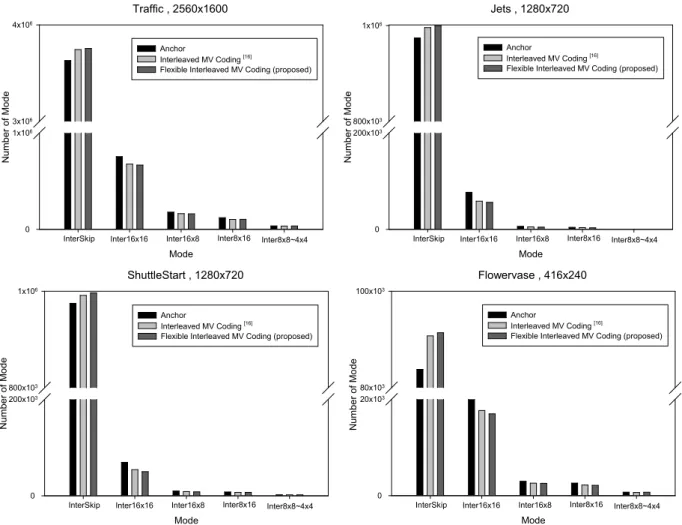
Fig. 9 shows number of selected coding modes. It shows
Traffic , 2560x1600
Bit-Rate (kbits/s)
2000 4000 6000 8000 10000 12000 14000 16000 18000 20000
PSNR (dB)
33 34 35 36 37 38 39 40 41 42
Anchor
Interleaved MV Coding [16]
Flexible Interleaved MV Coding (proposed)
Jets , 1280x720
Bit-Rate (kbits/s)
250 500 750 1000 1250 1500 1750 2000 2250 2500 2750 3000 3250
PSNR (dB)
36 37 38 39 40 41 42
Anchor
Interleaved MV Coding [16]
Flexible Interleaved MV Coding (proposed)
ShuttleStart , 1280x720
Bit-Rate (kbits/s)
300 600 900 1200 1500 1800 2100 2400 2700 3000 3300
PSNR (dB)
37.0 37.5 38.0 38.5 39.0 39.5 40.0 40.5 41.0 41.5 42.0 42.5 43.0 43.5
Anchor
Interleaved MV Coding [16]
Flexible Interleaved MV Coding (proposed)
Flowervase , 416x240
Bit-Rate (kbits/s)
40 80 120 160 200 240 280 320 360 400
PSNR (dB)
33 34 35 36 37 38 39 40 41 42
Anchor
Interleaved MV Coding [16]
Flexible Interleaved MV Coding (proposed)
그림. 8. 율-왜곡 그래프 (다양한 움직임이 발생하는 영상)
Fig. 8. R-D curve for sequences having diverse directional motions
that the proposed method generates more SKIP modes than the anchor and the interleaved method[16] because the pro- posed one selects the proper PMV which is considerably close to a current MV so that it produces more zero DMV which is one condition of being a skip mode. This can ex-
plain why the proposed one attains highly effective compression. Moreover, its adaptive usage of compo- nent-wise predictor operated without any signaling bit also contributes to coding gain.
Traffic , 2560x1600
Mode
Number of Mode
0 1x10⁶ 3x10⁶ 4x10⁶
Anchor
Interleaved MV Coding [16]
Flexible Interleaved MV Coding (proposed)
InterSkip Inter16x16 Inter16x8 Inter8x16 Inter8x8~4x4
Jets , 1280x720
Mode
Number of Mode
0 200x103 800x103 1x10⁶
Anchor
Interleaved MV Coding [16]
Flexible Interleaved MV Coding (proposed)
InterSkip Inter16x16 Inter16x8 Inter8x16 Inter8x8~4x4
ShuttleStart , 1280x720
Mode
Number of Mode
0 200x103 800x103 1x10⁶
Anchor
Interleaved MV Coding [16]
Flexible Interleaved MV Coding (proposed)
InterSkip Inter16x16 Inter16x8 Inter8x16 Inter8x8~4x4
Flowervase , 416x240
Mode
Number of Mode
0 20x103 80x103 100x103
Anchor
Interleaved MV Coding [16]
Flexible Interleaved MV Coding (proposed)
InterSkip Inter16x16 Inter16x8 Inter8x16 Inter8x8~4x4
그림. 9. 모드 결정 과정에서 결정된 블록 모드의 개수 (다양한 움직임이 발생하는 영상)
Fig. 9. Coding modes used for each block in sequences having diverse directional motions
Ⅴ. Conclusion
In this paper, a new MV coding with flexible usage of predictive motion vector components is proposed to im- prove the coding efficiency of motion vector. To reduce motion information data, this design allows each MV com- ponent to be flexibly interleaved with the other. Indeed, the proposed design promotes many zero DMVs and the ap- proach with the flexibility according to sequence character- istics is effective to enhance coding gain. Compared to the anchor and the previous interleaving-based method[16], the
proposed one provides improvement in coding efficiency by allowing flexibility in choosing a coding procedure.
참 고 문 헌
[1] JVT of ISO/IEC MPEG and ITU-T VCEG, Draft ITU-T Recommendation and Final Draft International Standard of Joint Video Specification, ITU-T Rec. H.264, ISO/IEC 14496-10 AVC, 2003.
[2] T. Wiegand, G. J. Sullivan, G. Bjøntegaard, and A. Luthra, “Overview of the H.264/AVC Video Coding Standard,” IEEE Trans. on Circuits and Syst. for Video Tech., vol.13, no.7, pp.560-576, Jul. 2003.
[3] J. Ostermann, J. Bormans, P. List, D. Marpe, M. Narroschke, F.
Pereira, T. Stockhammer, and T. Wedi, “Video coding with
H.264/AVC: tools, performance, and complexity,” IEEE Circuits Syst.
Mag., vol. 4, no. 1, pp. 7–28, 1Q, 2004.
[4] G. Laroche, J. Jung, and B. Pesquet-Popescu, "A spatio-temporal com- peting scheme for the rate-distortion optimized selection and coding of motion vectors," Proc. 14th European Signal Processing Conf., Italy, 2006.
[5] Key Technology Area Reference Software, Version 2.0(KTA2.0).
[Online]. Available: http://www.tnt.uni-hannover.de/~vatis/kta/.
[6] T. Wedi, “1/8-pel Motion Vector Resolution for H.26L,” ITU-T VCEG, Proposal Q15-K-21, Aug. 2000.
[7] “Joint Call for Proposals on Video Compression Technology,”
ISO/IEC MPEG/ITU-T SG16 VCGE Doc. N11113/VCEG-AM91, Jan. 2010.
[8] L. A. Da Silva Cruz, and J. W. Woods, “Adaptive motion vector quanti- zation for video coding,” in Proc. IEEE ICIP, Oct. 2000, vol. 2, pp. 867 –870.
[9] A. Deever and S. S. Hemami, “Dense motion field reduction for motion estimation,” Signals, Syst. Comput., vol. 2, pp. 944–948, Nov. 1998.
[10] M. H. Chan, Y. B. Yu, and A. G. Constantinides, “Variable size block matching motion compensation with applications to video coding,”
Proc. Inst. Elect. Eng., vol. 137, pp. 205–212, Aug. 1990.
[11] J. Yeh, M. Vetterli, and M. Khansari, “Motion compensation of motion vectors,” Proc. IEEE Inter. Conf. Image Processing (ICIP), Oct. 1995, vol. 1, pp. 574–577.
[12] M. C. Chen and A. N. Willson, “A spatial and temporal motion vector coding algorithm for low-bit-rate video coding,” Proc. IEEE Inter.
Conf. Image Processing (ICIP), Oct. 1997, vol. 2, pp. 791–794.
[13] S. D. Kim and J. B. Ra, “An efficient motion vector coding scheme based on minimum bit rate prediction,” IEEE Trans. Image Process., vol. 8, no. 8, pp. 1117–1120, 1999.
[14] G. Laroche, J. Jung, and B. Pesquet-Popescu, “RD Optimized Coding for Motion Vector Predictor Selection,” IEEE Trans. on Circuits and Syst. for Video Tech., vol.18, no.12, pp.1681-1691, Dec. 2008.
[15] J. Yang, K. Won, and B. Jeon, “Motion vector coding with selection of an optimal predictive motion vector” SPIE Opt. Eng., vol. 48, no.1, pp.010501, Jan. 2009.
[16] JCT-VC, “Description of video coding technology proposal by Fraunhofer HHI”, Joint Collaborative Team on Video Coding (JCT-VC) of ITU-T SG16 WP3 and ISO/IEC JTC1/SC29/WG11, document JCTVC-A116, Dresden, DE, 15-23 April, 2010.
[17] G. Bjøntegaard, "Calculation of average PSNR differences between RD-curves," ITU-T SG16/Q6 Doc. VCEG-M13, April 2001.
저 자 소 개
원 광 현
- 2007년 : 광운대학교 컴퓨터공학부 학사 졸업 - 2009년 : 성균관대학교 휴대폰학과 석사 졸업 - 2009년 ~ 현재 : 성균관대학교 휴대폰학과 박사 과정 - 주관심분야 : 멀티미디어 영상압축
양 정 엽
- 2004년 : 성균관대학교 정보통신공학부 학사 졸업 - 2006년 : 성균관대학교 전자전기공학과 석사 졸업 - 2006년 ~ 현재 : 성균관대학교 전자전기공학과 박사 과정 - 주관심분야 : 멀티미디어 영상압축
저 자 소 개
박 대 윤
- 2010년 : 성균관대학교 전자전기공학과 학사 졸업 - 2011년 ~ 현재 : 성균관대학교 휴대폰학과 석사 과정 - 주관심분야 : 비디오 영상압축
전 병 우
- 1985년 : 서울대학교 전자공학과 학사 졸업 - 1987년 : 서울대학교 전자공학과 석사 졸업
- 1992년 : Purdue Univ, School of Elec. 공학박사 졸업 - 1993년 ~ 1997년 : 삼성전자 신호처리연구소 선임/수석연구원 - 1997년 ~ 현재 : 성균관대학교 정보통신공학부 교수 - 주관심분야 : 멀티미디어 영상압축, 영상인식, 신호처리
![Fig. 2. Encoding in interleaved MV coding [16]](https://thumb-ap.123doks.com/thumbv2/123dokinfo/4808378.522687/3.892.90.401.180.438/fig-encoding-interleaved-mv-coding.webp)