논문 2015-52-7-13
모순 검증을 통한 다중 움직임 벡터 해상도 시그널링 방법
( Signaling Method of Multiple Motion Vector Resolutions Using Contradiction Testing )
원 광 현*, 박 영 현*, 전 병 우***
( Kwanghyun Won, Younghyeon Park, and Byeungwoo Jeon
ⓒ)
요 약
대부분의 비디오 압축 표준들이 1/4 부화소 정밀도와 같은 고정 움직임 벡터 해상도를 사용하고 있는 데 반해, 다중 움직임 벡터 해상도를 지원하는 형태의 구조는 비디오 콘텐츠의 성질에 따라 필요로 하는 만큼의 움직임 벡터 정밀도를 효율적으로 사용할 수 있고, 더 정확한 움직임 예측자 생성이 가능해지므로, 부호화 효율을 향상할 수 있다는 장점이 있다. 그러나 다중 움직임 벡터 해상도 구조는 각각 움직임 벡터에 대해 선택된 움직임 벡터 해상도를 추가로 시그널링 해야 한다는 문제점이 있 다. 본 논문에서는 움직임 벡터 해상도의 모순 검증 기반 시그널링 구조를 제안한다. 제안 방법은 여러 개의 후보 중, 각 움직 임 벡터에 대해 최소크기의 부호화율을 갖는 움직임 벡터 해상도를 선택한다. 또한, 움직임 벡터 해상도의 시그널링에 따른 오 버헤드를 줄이기 위해, 부호화기 및 복호화기 양쪽에서 미리 정의된 기준을 통한 모순 검증 과정을 수행하여 시그널링 할 필 요가 없는 후보 움직임 벡터 해상도를 판별하는 과정을 수행한다. 실험 결과, 제안 구조가 고정 움직임 벡터 해상도 기반의 구 조와 비교하여 Bjøntegaard delta bit rate (BDBR)에서 평균 약 4.01%의 이득(최대 15.17%)을 달성함으로써 부호화되는 움직 임 정보의 양을 줄이는 데 효과적이라는 것을 검증하였다.
Abstract
Although most current video coding standards set a fixed motion vector resolution like quarter-pel accuracy, a scheme supporting multiple motion vector resolutions can improve the coding efficiency of video since it can allow to use just required motion vector accuracy depending on the video content and at the same time to generate more accurate motion predictor. However, the selected motion vector resolution for each motion vector is a signaling overhead. This paper proposes a contradiction testing-based signaling scheme of the motion vector resolution. The proposed method selects a best resolution for each motion vector among multiple candidates in such a way to produce the minimum amount of coded bits for the motion vector. The signaling overhead is reduced by contradiction testing that operates under a predefined criterion at both encoder and decoder with a purpose of pruning irrelevant candidate motion vector resolutions from signaling responsibility. Experimental results verified that the proposed scheme is effective in reducing coded motion information by achieving its Bjøntegaard delta bit rate (BDBR) gain of about 4.01% on average (and up to 15.17%) compared to the conventional scheme with a fixed motion vector resolution.
Keywords : motion vector coding, motion vector resolution, motion vector accuracy, contradiction testing, motion compensation
* 학생회원, ** 정회원, 성균관대학교 정보통신대학
(Sungkyunkwan University, College of Information & Communication Engineering)
ⓒ Corresponding Author(E-mail: [email protected])
※ 이 논문은 2011년도 정부(미래창조과학부)의 재원으로 한국연구재단의 지원을 받아 수행된 연구임 (No. 2011-001-7578).
Received ; June 5, 2015 Revised ; June 18, 2015 Accepted ; July 4, 2015
Ⅰ. Introduction
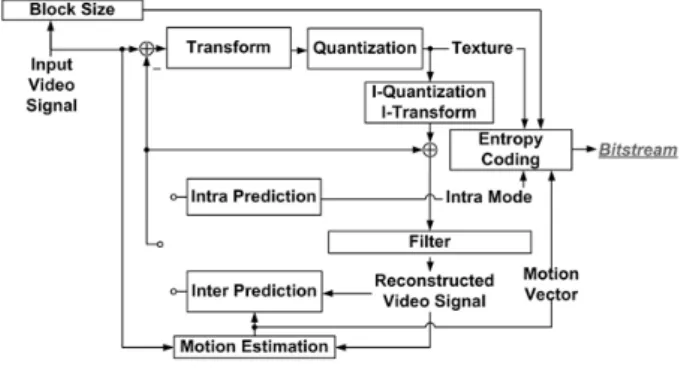
International video coding standards such as H.264[1] or HEVC[2] divide input pictures into blocks, each of which is compensated and converted into transform coefficients like discrete cosine transform (DCT) coefficients as illustrated in Fig. 1. Pixels in a block to be coded are subtracted by a predictor composed of reconstructed pixels located at either spatial (called, intra prediction) or temporal (called, inter prediction) neighbors. The subtracted pixels, namely, residual pixels are transformed and quantized. At last, through entropy coding, the quantized transform coefficients are written into a compressed bitstream which is transmitted to a decoder or stored. In order to achieve high coding efficiency, it is important to select a predictor as similar to a block to be coded as possible. In the inter prediction, motion vector (MV) indicates a location of the predictor in reference picture. In the very early video standard of H.261 (also known as px64)[3], the predictor for the motion compensation was only composed of integer pixels and its MV was only integer-pel accurate. Afterwards, the concept[4]
of allowing fractional-pel accurate MV emerged where a motion-predictor at sub-pel positions was generated from integer pixels through interpolation methods[5], including an adaptive scheme[6]. The fractional-pel accuracy can be classified into 1/2[1, 7], 1/4[2], 1/8-pel[11], etc., according to a selected MV
그림 1. 일반적인 움직임 보상 변환 부호화 구조 Fig. 1. General motion-compensated transform coding.
resolution which indicates the minimum fraction between integer pixels represented by encoder.
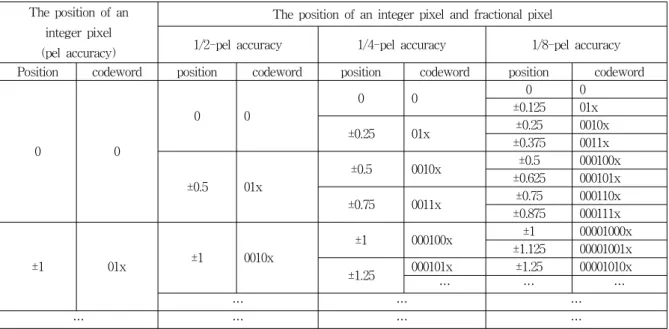
MPEG-1 and -2 use a fixed half-pel accurate motion vectors[7]. Certainly a technique with a higher MV accuracy can improve texture coding efficiency much by providing better motion-prediction made using finer fractional pixels. However, at the same time, it requires more bits to represent the subdivided positions of an MV as shown in Table 1. Various MV resolutions are being used: 1/2-pel accuracy in MPEG-2[7], 1/4-pel accuracy in H.264/AVC[1] and
HEVC[2, 8∼10] and 1/8-pel accuracy in KTA
software[11]. Note that all of them set a fixed motion vector resolution to avoid additional signaling overhead of selected motion vector resolution.
However, a fixed resolution can be inefficient since it may be too coarse when finer motion vector resolution can give more accurate predictor, or non-necessarily fine to represent the estimated motion vector. To be more coding-efficient than the current fixed resolution schemes, the amount of potential improvement obtainable by using adaptive motion vector resolution for each motion vector should be large enough to compensate its signaling overhead[12]. In order to develop such a method, various methods have been investigated, for example, block-level adaptive motion vector accuracy[13] or a similar scheme but with implicit signaling scheme[14]. Two recent methods[15, 22] select an MV resolution among multiple candidate accuracies in an R-D optimal sense. However, the conventional scheme of a fixed resolution sometimes turns out to be better than the adaptive schemes since the overhead is not overwhelmed by the bit-savings coming from the improved texture coding facilitated by more accurate motion predictor.
The motivation of this paper is that if the overhead can be more efficiently represented by an improved encoding method, the schemes using multiple MV resolutions can outperform the conventional fixed resolution scheme. In this context,
The position of an integer pixel (pel accuracy)
The position of an integer pixel and fractional pixel
1/2-pel accuracy 1/4-pel accuracy 1/8-pel accuracy Position codeword position codeword position codeword position codeword
0 0
0 0
0 0 0 0
±0.125 01x
±0.25 01x ±0.25 0010x
±0.375 0011x
±0.5 01x
±0.5 0010x ±0.5 000100x
±0.625 000101x
±0.75 0011x ±0.75 000110x
±0.875 000111x
±1 01x ±1 0010x
±1 000100x ±1 00001000x
±1.125 00001001x
±1.25 000101x ±1.25 00001010x
… … …
… … …
… … … …
x=0 for positive position; x=1 for negative position 표 1. MV 해상도에 따른 위치 및 엔트로피 부호화된 코드의 표현
Table 1. Illustration of the position and its entropy-coded representation according to MV resolution.
this paper proposes an improved encoding method which lets an encoder select an MV resolution optimal in minimum rate sense but informs a decoder of its selected resolution only if necessary, thus minimizing the afore-mentioned overhead problem. In many cases, a decoder can identify for itself some MV resolution(s) which its encoder is expected to never select. By mimicking this decoder action in the same way, the encoder can prune those resolutions out from the candidate list of MV resolutions in order to reduce its signaling overhead. If the pruning process reveals that there is just one single resolution left, the encoder even does not send any signals since the decoder for itself can find out the exact MV resolution unambiguously.
The remaining part of this paper is organized as follows: state-of-the-art techniques for MV coding and multiple MV resolutions are reviewed in Section
Ⅱ. The basic concept of the contradiction testing and the proposed method based on it are described in Section Ⅲ. Section Ⅳ presents simulation conditions and test results. Finally, concluding remarks are given in Section Ⅴ.
Ⅱ. MV Coding and Multiple MV Resolutions
1. Basic Concept of MV Coding
The MV coding has been one of the main research problems in video coding, and it has generated many interesting ideas, like quantization of motion vector[17], motion-compensation of motion vectors[18], RD-based multiple motion vector predictor competition[19], and motion vector coding with optimal selection of motion vector predictor[20] to name a few. Most methods for compressing MVs have exploited the concept of predictive coding as shown:
(1)
where denotes a motion vector of a current block, denotes its predictive MV (PMV), and denotes a differential MV (DMV) between MV and its PMV. There are two factors important in reducing predictive-coded motion information. The first one is to select a PMV which is as similar as possible to MV of a current block, and the second is to use an MV resolution being as coarse as possible. The
그림 2. 1/8부화소와 1/4부화소 정밀도(anchor) 간 BDBR 비교[21]
Fig. 2. BDBR comparing 1/8-pel vs. 1/4-pel accuracy (anchor)[21].
sub-pel resolution is also related to interpolation[5∼6]. Note that a coarse MV resolution may lower texture coding efficiency due to less accurate motion predictors, however, an unnecessarily finer MV resolution will increase motion information due to too finely subdivided MV. Hence, an appropriate MV resolution which well-balances between coding efficiency of texture and MV accuracy should be selected. Especially, this is a key issue in MV coding with multiple resolutions.
2. MV Resolution
Table 1 shows a simple illustration of the MV positions and their entropy-coded representations under multiple MV resolutions. A finer resolution needs longer entropy-coded representations due to increased number of fractional DMVs. The encoder does not need to inform decoder of motion accuracy if the encoder and decoder both pre-define a unique fixed MV accuracy. It is seen that a fixed MV resolution may not always give the best coding efficiency as in Fig. 2[21]. For example, in some sequences, a method with 1/8-pel accuracy gives a better coding efficiency since it can generate more
accurate predictor than otherwise. In other sequences, the opposite happens when the 1/8-pel accurate MV cannot justify the increased data amounts for such finer MVs. To overcome the limitations, a selection of a proper MV resolution has been investigated under some optimality criterion. For example, the selection methods[15],[22] choose an MV resolution for each block using the following criterion:
arg
∈
(2)
where denotes a set of candidate MV resolutions, which encoder and decoder share together (hereafter it is referred by a candidate set (CS)), denotes an MV resolution in CS, denotes a total number of candidate MV resolutions, denotes a selected MV resolution to represent , and respectively denote MV and PMV in an accuracy indicated by . The function indicates a selection criterion which is a cost function outputting a number of coded bits to represent input argument
. The encoder signals decoder of the selected resolution . Table 2 shows a simple encoding example using Eq. (2). As shown in Table 2, assume MV = (1, 1), PMV = (1, 0.375), and CS = {1/4-pel accuracy, 1/8-pel accuracy}. In 1/4-pel resolution, the PMV of (1, 0.375) is represented by (1, 0.25) through truncation since the location corresponding to 0.375 (=
1/8) cannot be expressed in 1/4-pel accuracy. DMV which is the difference between MV and the truncated PMV becomes (0, 0.75). In 1/8-pel resolution, the PMV need not be truncated, and DMV is (0, 0.625). The 1/4-pel accuracy is chosen as
as illustrated in Table 2 because the entropy-coded bit length of (0, 00110) corresponding to DMV = (0, 0.75) in 1/4-pel accuracy is less than that of (0, 0001010) corresponding to DMV = (0, 0.625) in 1/8-pel accuracy. Although Eq. (2) is always capable of selecting a resolution optimal in
Assume MV = (1, 1), PMV = (1, 0.375), CS = {acc1(=1/4), acc2(=1/8)}
Candidate Accuracy
MV & PMV represented in a given accuracy
DMV = MV-PMV its codeword
Number of bits to represent DMV
Accuracy selected by encoder acc1
(1/4-pel)
MV: (1,1) PMV: (1, 0.25)
DMV=(0, 0.75)
0: '0' & 0.75: '00110' 1+5 = 6 Selected acc2
(1/8-pel)
MV: (1,1) PMV: (1, 0.375)
DMV=(0, 0.625)
0: '0' & 0.625: '0001010' 1+7 = 8
In this example, the proposed encoder selects acc1 (1/4-pel), and sends the codeword of (0, 00110) for the DMV as shown in Table 1.
표 2. 부호화기의 최적 MV 정밀도 선택에 대한 표현
Table 2. Illustration of an encoder in the selection an optimal MV accuracy.
terms of minimum bitrate of MV information (e.g., DMV), the additional signaling overhead of resolution can limit its overall compression efficiency. When the signaling bits are coded using a fixed-length code, their length is given as Eq. (3).
⌈log⌉
(3)
III. Proposed Contradiction-Based MV Resolution Signaling
1. Basic Concept of the contradiction testing applied to video coding
The basic concept of the contradiction testing[16] is to bring a truth of a certain statement into question to see whether the statement is mathematically contradictory to a known fact as following equation:
(4)
where denotes a statement under testing, ∙
denotes a testing function which puts the statement given as input argument into question, denotes a reference point (that is, a known fact) used to decide whether the statement under test is acceptable or not. The ∙∙ function outputs 1 when the statement and reference point are inconsistent.
Otherwise, the function outputs 0. If a result of Eq.
(4) is 1, the statement which is put to test is rejected since the statement cannot be true, otherwise, it is accepted. In a field of video coding, the concept can be applied to reduce (or sometimes,
even to remove) coded information (such as a signaling index) of a certain selected syntax element(s) as follows. Suppose a candidate set (CS), a set listing all candidate values which the given syntax element can take. If there is no a priori information available both to encoder and decoder related to signaling a particular value in CS, the encoder should spend sufficient number of bits to represent all values in CS. However, if some values in CS are known a priori not possible for the syntax element in certain situation, less number of bits would be sufficient to represent the choice. Therefore, for each value in CS, the encoder performs the contradiction testing[16] to see whether there is indeed some possibility that the given syntax element actually chooses the selected value. This decision can be made by checking whether selecting a specific value for the syntax element makes any contradiction to a known fact which both encoder and decoder share. Subsequently, impossible value is pruned off the candidate set so that less number of bits can be used to represent the surviving values from the contradiction testing. Especially, if a single candidate is left, the signaling bit can be even removed. Note that the signaling bits are never increased even though all candidates are acceptable afterwards.
Thus, there is no potential harm in using the proposed method in the compression view point. The decoder can do the contradiction testing in the exactly same manner as encoder based on the known fact shared also with the decoder, and it can decode
the compressed data using the reduced candidate set.
This technique is already shown workable for video coding when applied to PMV coding by showing successful reduction of MV information[23]. Unlike the work[23] which reduces signaling bits of indicating PMV index, this paper reduces signaling bits of informing MV resolution.
2. Proposed signaling method of multiple MV resolutions
The proposed contradiction-based method of MV resolution coding selects an MV resolution giving the minimum bitrate and represents the selected resolution only by spending the smallest necessary number of bits through pruning out impossible candidate resolutions from signaling requirement.
According to the proposed method, an encoder performs the contradiction-testing of the candidate resolutions one by one using Eq. (2). That is, each MV resolution is contradiction-tested to see whether there is indeed possibility that the tested MV resolution (as a statement in eq. (4)) can end up with being selected under a known fact of the selection condition in Eq. (2) (as a in eq. (4)). If there is zero possibility, the candidate is pruned out.
At times, different candidate MV resolutions can have a tie in the cost of in Eq. (2) since non-identical DMVs may produce entropy-coded representations of the same length as shown in Table 1 and Fig. 3. Although either choice of resolutions giving the tie does not affect the rate performance, a pre-fixed simple tie-breaking rule can further reduce the candidate set because the deselected tie-making resolution can be additionally removed from the CS.
In the proposed method of multiple resolutions coding, a simple tie-breaking rule is pre-agreed between encoder and decoder that the coarsest resolution is selected in such a tie case. After the encoder selects a proper resolution, it prunes untenable candidates out of CS in order to reduce signaling bits to notify a decoder.
그림 3. H.264/AVC에서 엔트로피 부호화된 DMV의 동일 률에 대한 등고선도
Fig. 3. Contour plot of equal rate of entropy-coded DMV in H.264/AVC.
Exactly the same procedure of the proposed contradiction testing is performed by decoder as well.
When a decoder reconstructs DMV, in many cases, it can identify some MV resolutions in CS which cannot be the selected ones in any cases. The procedure is as follows. First, the decoder put a candidate resolution in CS to the contradiction testing. That is, it computes its corresponding (temporarily) reconstructed MV by MV = PMV + DMV where the entropy-decoded symbol data for DMV is interpreted under an assumption of the MV resolution under the test. Subsequently, the temporarily reconstructed MV is subjected to the same MV encoding process of the encoder under the known common fact, in eq.(4) which is the minimum rate criterion with the tie-breaking rule. In this process, it is tested whether the encoder chooses the same MV resolution again for the temporarily reconstructed MV. If the answer is negative, the resolution is deleted from CS since the decoder is now certain that it should have been also excluded from the set of signaling candidates by the encoder.
By doing this contradiction testing one by one for all MV resolutions in CS, a reduced set of CS (hereafter denoted by CS’), which consists of only those
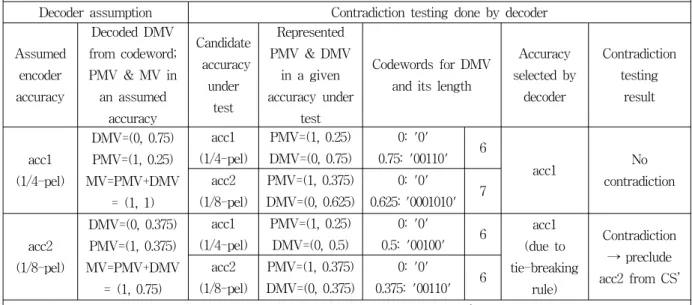
Decoder receives a codeword for (0,00110) corresponding to a DMV. Following shows how decoding of the selected motion accuracy is performed. Note that in Table 2, MV=(1, 1), PMV=(1, 0.375), CS = {acc1(=1/4), acc2(=1/8)}; encoder selects an accuracy=acc1 and sends a codeword for (0, 00110) corresponding to DMV = (0,0.75) with 1/4-pel accuracy to the decoder as shown in Table 1 and Table 2.
Decoder assumption Contradiction testing done by decoder
Assumed encoder accuracy
Decoded DMV from codeword;
PMV & MV in an assumed
accuracy
Candidate accuracy
under test
Represented PMV & DMV
in a given accuracy under
test
Codewords for DMV and its length
Accuracy selected by decoder
Contradiction testing
result
acc1 (1/4-pel)
DMV=(0, 0.75) PMV=(1, 0.25) MV=PMV+DMV
= (1, 1)
acc1 (1/4-pel)
PMV=(1, 0.25) DMV=(0, 0.75)
0: '0'
0.75: '00110' 6
acc1 No
contradiction acc2
(1/8-pel)
PMV=(1, 0.375) DMV=(0, 0.625)
0: '0'
0.625: '0001010' 7
acc2 (1/8-pel)
DMV=(0, 0.375) PMV=(1, 0.375) MV=PMV+DMV
= (1, 0.75)
acc1 (1/4-pel)
PMV=(1, 0.25) DMV=(0, 0.5)
0: '0'
0.5: '00100' 6 acc1
(due to tie-breaking
rule)
Contradiction
→ preclude acc2 from CS’
acc2 (1/8-pel)
PMV=(1, 0.375) DMV=(0, 0.375)
0: '0'
0.375: '00110' 6
Note that in this example, no signalling bit is necessary since CS’ has only one member.
표 3. 제안하는 복호화기에서의 시그널링 된 MV 정밀도의 복호화 표현 Table 3. Illustration of the proposed decoder in decoding the signaled MV accuracy.
possible signaling candidates for a given block, can be defined. The signaling index bits for the optimal resolution received by the decoder are now guaranteed to identify a member only inside CS’. In some blocks, CS’ may even be dwindled to have only one member, and, in this case, the encoder does not send any bits, which saves lots of bits. The decoder can properly handle this case as well owing to exactly the same pruning process working at the encoder.
Table 3 illustrates a simple example of the proposed method. All notations (MV, PMV, CS, and the selected resolution) in Table 3 are inherited from Table 2. Suppose a decoder receives entropy-coded representation of DMV = (0, 00110). The decoder first supposes that the resolution chosen by the encoder be 1/4-pel accuracy, and interpret the symbol (0, 00110) as (0, 0.75) by referring to Table 1. Then the decoder temporarily recovers an MV from the given DMV and the PMV according to the 1/4-pel accuracy. The decoder mimics the encoder's
selection of an MV resolution using the criterion Eq.(2) for the recovered MV following the procedures in Table 2. The decoder tests the 1/4-pel accuracy again as the signaled resolution, which does not contradict the starting assumption of 1/4-pel accuracy for the given DMV symbol interpretation.
Hence, the 1/4-pel accuracy is maintained in CS.
Next, the decoder tests the 1/8-pel accuracy, and interpret (0, 00110) in 1/8-pel accuracy as (0, 0.375) as shown in Table 1. In the same way as before, the decoder temporally recovers its MV on the basis of which it finds out its optimal resolution according to Eq.(2). As shown in Table 3, the decoder selects the 1/4-pel accuracy as the optimal one by applying the tie-breaking rule. In this case, the different decision (thus, contradiction) manifests that the supposition of the 1/8-pel accuracy being the signaled resolution by encoder is not acceptable. Therefore, the 1/8-pel accuracy is removed from CS. In this example, after pruning untenable candidates, CS’ has only 1/4-pel accuracy, so the encoder does not need to send any
Test Sequence
Class B (1920x1080)
Class C (832x480)
Class D (416x240)
Class E (1280x720)
CIF (352x288)
QCIF (176x144) 1. Kimono1
2. ParkScene 3. Cactus 4. BasketballDrive 5. BQTerrace
6. BasketballDrill 7. BQMall 8. PartyScene 9. RaceHorses
10. BasketballPass 11. BQSquare 12. BlowingBubbles 13. RaceHorses
14. Night 15. Jets 16. Vidyo4 17. Vidyo3 18. Vidyo1
19. Table 20. Container 21. Hall_monitor 22. Paris
23. News 24. Table 25. Foreman 26. Container
GOP IPPP
QP 22, 27, 32, 37
ME EPZ search (±128)
References 4
Profile High
Software KTA-based software released for CfP(Call for Proposal) of HEVC[22]
Comparison
1. Anchor (A fixed MV resolution of 1/4-pel accuracy )
2. Adaptive MV resolution[22] (Adaptive MV resolution bet. 1/4- & 1/8-pel accuracy ) 3. Proposed contradiction-testing-based MV resolution
표 4. 실험 조건
Table 4. Experimental conditions.
signaling bits. The proposed method always not only guarantees selecting an optimal resolution in the sense of the minimum rate of MV information in Eq.(2), but also reduces the transmitted signaling bits to inform decoder of selected optimal resolution for further enhancing coding efficiency.
Ⅳ. Experiment Results
1. Experimental conditions
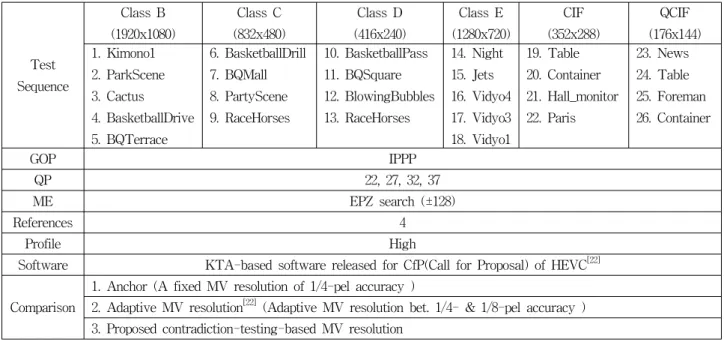
In order to evaluate the performance of the proposed method, simulation tests are executed and their results are compared in terms of Bjøntegaard delta bit rate (BDBR)[24] and Bjøntegaard delta peak signal to noise ratio (BDPSNR)[24] among an existing method of using a fixed 1/4-pel resolution (denoted by Anchor), an adaptive resolution switching method[22] between 1/4 and 1/8-pel resolutions (denoted by Conventional method), and the proposed method (denoted by Proposed method) of using 1/4 and 1/8-pel resolutions. The conventional method selects one resolution between 1/4 and 1/8-pel accuracies for each MV and signals the selected resolution by 1 bit to decoder. The proposed method
is different from it only in the way of signaling the selected resolution - owing to the proposed pruning process based on the contradiction testing, the resolution selection information may not be signaled to decoder. The comparative simulation test is done using a same software[22] by changing only the way of dealing with the multiple resolutions according to the three methods under testing. As multiple resolutions, 1/4-pel and 1/8-pel accuracy are considered. For the anchor case simulation, 1/4 pel accuracy is made to be used all the time without resolution signaling. A negative value (“-” sign) of BDBR indicates actual bit rate reduction of the proposed method compared to the anchor. A positive value (“+” sign) of BDPSNR represents improvement of objective quality of the proposed method compared to the anchor.
2. Experimental results
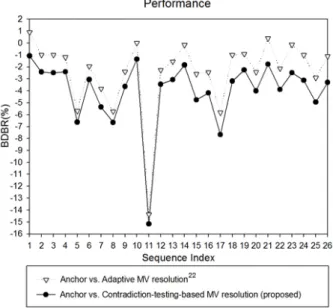
Fig. 4 and Table 5 summarize experimental results of the proposed method and its comparison to the anchor and the conventional method. In Fig. 1, the y-axis indicates a percent bit-saving, and the x-axis indicates sequences whose indices are in Table 4. It
그림 4. Anchor(고정 1/4부화소 정밀도)와 제안 방법 간 부호화 성능 비교
Fig. 4. Coding performance of the proposed method compared to the anchor (with a fixed 1/4-pel accuracy).
Sequence Size
Anchor vs.
Adaptive MV resolution[22]
Anchor vs. Proposed Contradiction-testing based MV resolution BDBR
[%]
BDPSNR [dB]
BDBR [%]
BDPSNR [dB]
Class B
(1920x1080) -1.59 0.03 -3.01 0.07
Class C
(832x480) -3.48 0.15 -4.68 0.20
Class D
(416x240) -4.54 0.19 -5.76 0.25
Class E
(1280x720) -2.41 0.07 -4.34 0.13
CIF
(352x288) -1.27 0.06 -2.98 0.12
QCIF
(176x144) -1.29 0.06 -3.46 0.18
표 5. 영상 해상도별 제안 방법과 anchor(고정 1/4부 화소 정밀도) 간 평균 부호화 성능 비교 Table 5. Coding performance of the proposed method
compared to the anchor (with a fixed 1/4-pel accuracy) on average for each sequence resolution.
shows that the conventional method achieves high coding gain of BDBR 2.40% on average compared to the anchor because of its capability of appropriately
selecting an optimal resolution according to characteristic of sequences. However, its BDBR performance is degraded for some sequences with its index 1 (kimono1 with class B), 10 (BasketballPass with class D), and 21 (hall_monitor with CIF). The overhead to signal a selected MV resolution explains the degradation. On the other hand, the proposed method shows better coding performance of 4.01%
BDBR on average which even reaches up to 15.17%
BDBR in some test sequence because of successfully reducing or removing the number of signaling bits by the contradiction testing. Table 5 reorganizes the average results shown in Fig. 4 from the view point of sequence size. In the table, the conventional method shows that sequence sizes giving the highest and the lowest coding gain are respectively class D (-4.54% BDBR on average) and CIF (-1.27% BDBR on average). The proposed method also agrees with this: the highest gain for class D (-5.76% BDBR on average) and the lowest gain for CIF (-2.98% BDBR on average). However, the difference of 2.78% BDBR in the proposed method between the highest and the lowest gains is lower than that of the conventional one (3.27% BDBR). RD curves in Fig. 5 supports coding performances shown in Fig. 4 and Table 5. In Fig. 5, the proposed method is seen effective at all quantization parameters (QP). Especially, it is observed that the proposed method tends to achieve higher coding efficiency than the anchor and the conventional one especially in high bitrate (low QP).
Therefore, it demonstrates the utility of the proposed idea of contradiction testing associated with MV resolution signaling. It deems to be pointed out that the proposed idea of examining whether each MV resolution candidate contradicts or not by recovering its corresponding M inevitably leads to increased decoding complexity, however, this issue is expected to be solved more and more easily due to ever-increasing hardware performance.
(a) (b)
(c) (d)
(e) (f)
그림 5. 영상 별 율-왜곡 그래프 (a) News (b) Hallmonitor (c) Vidyo1 (d) RaceHorse (e) BQMall (f) Kimono1 Fig. 5. R-D Curves for sequences (a) News (b) Hallmonitor (c) Vidyo1 (d) RaceHorse (e) BQMall (f) Kimono1.
Ⅴ. Conclusion
In this paper, a signaling method of MV resolution under contradiction testing concept is proposed to improve the coding efficiency of MV coding with multiple resolutions. It selects an MV resolution among multiple possibilities under a given optimality criterion, and a signaling information notifying decoder of the selected one is parsimoniously encoded by executing a proposed pruning process of candidate resolutions using the contradiction testing technique.
Experimental results showed that the proposed method achieved a coding gain of 4.01% in BDBR compared to the anchor operating with a fixed MV accuracy. Particularly, some test sequences even achieved a bit saving of 15.17%. Compared to the existing method of using a fixed resolution, the proposed one not only provides improvement in coding efficiency by reducing signaling overhead of MV resolution, but also it provides a stable coding gain by selecting an optimal resolution with the minimum rate owing to the proposed tie-breaking rule.
REFERENCES
[1] T. Wiegand, G. J. Sullivan, G. Bjøntegaard, and A. Luthra, “Overview of the H.264/AVC Video Coding Standard,” IEEE Trans. on Circuits and
Syst. for Video Tech., Vol. 13, no.7, pp. 560-576,
Jul. 2003.[2] ITU-T and ISO/IEC JTC 1, “High Efficiency Video Coding,” ITU-T Rec. H.265 and ISO/IEC
23008-2, Apr. 2013.
[3] ITU-T, “Video Codec for Audiovisual Services at px64 kbit/s,” ITU-T Recommendation H.261, 1993.
[4] B. Girod, “Motion-compensating prediction with fractional-pel accuracy,” IEEE Trans. Commun., Vol. 41, no. 4, pp. 604–612, Apr. 1993.
[5] T. Wedi, “Adaptive interpolation filter for motion compensated prediction,” in Proc. 2002 IEEE
Int. Conf. Image Process(Volume: 2),
pp.II509-512, New York, USA, Sept. 2002.
[6] Y. Vatis and J. Ostermann, “Adaptive interpolation filter for H.264/AVC,” IEEE Trans.
Circuits Syst. Video Technol., Vol. 19, no. 2, pp.
179-192, Jan. 2009.
[7] ITU-T and ISO/IEC JTC 1, “Generic coding of moving pictures and associated audio information – Part 2: Video,“ ITU-T Recommendation
H.262
– ISO/IEC 13818-2 (MPEG-2), 1994.[8] J.-H. Nam, H.-H. Jo, D.-G. Sim, S.-Y. Lee,
“Selective Interpolation filter for video coding,”
Journal of the Institute of Electronics and Information Engineers, Vol. 49, no. 1, pp. 58-66, Jan. 2012.
[9] T. Hwang, Y. Ahn, J. Ryu, D. Sim, “Optimized implementation of interpolation filters for HEVC encoder,” Journal of the Institute of Electronics and Information Engineers, Vol. 50, no. 10, pp.
2651-2655, Oct. 2013.
[10] W.-J. Han, “Fast non-integer motion estimation for HEVC encoder,” Journal of the Institute of Electronics and Information Engineers, Vol. 51, no. 12, pp. 2786-2795, Dec. 2014.
[11] JMKTA Software [Online]. Available:
http://iphome.hhi.de/suehring/tml/download/KTA.
[12] J. Ribas-Corbera and D. L. Neuhoff, “Optimizing motion-vector accuracy in block-based video coding,” IEEE Trans. Circuits Syst. Video
Technol., Vol. 11, no. 4, pp. 497-511, Apr. 2001.
[13] X. Ji, D. Zhao, and W. Gao, “Block-wise adaptive motion accuracy based b-picture coding with low-complexity motion compensation,”
IEEE Trans. Circuits Syst. Video Technol., Vol.
17, no. 8, pp. 1085–1090, Aug. 2007.
[14] L. Guo, P. Yin, Y. Zheng, X. Lu, Q. Xu, and J.
Sole, “Adaptive motion vector resolution with implicit signaling,” in Proc. IEEE International
Conf. on Image Processing 2010, pp. 2057-2060,
Hong Kong, Sept. 2010.[15] M. Karczewicz, P. Chen, R. Joshi, X. Wang, W.
-J. Chien, R. Panchal, Y. Reznik, M. Coban, and I. S. Chong, “A Hybrid Video Coder Based on Extended Macroblock Sizes, Improved Interpolation, and Flexible Motion Representation,” IEEE Trans. Circuits Syst.
Video Technol., Vol. 20, no. 12, pp. 1698-1708,
Nov. 2010.[16] W. Byers, “How Mathematicians Think: Using Ambiguity, Contradiction, and Paradox to Create Mathematics,” Princeton University Press, NJ, 2007.
저 자 소 개 원 광 현(학생회원)
2007년 광운대학교 컴퓨터공학부 학사 졸업.
2009년 성균관대학교 휴대폰학과 석사 졸업.
2014년 성균관대학교 휴대폰학과 박사 졸업.
<주관심분야 : 멀티미디어 영상압축>
박 영 현(학생회원)
2011년 성균관대학교 전자전기 공학부 학사 졸업.
2011년∼현재 성균관대학교 전자 전기컴퓨터공학과
석박통합과정.
<주관심분야 : 영상압축, 압축센싱>
전 병 우(정회원)
1985년 서울대학교 전자공학과 학사 졸업.
1987년 서울대학교 전자공학과 석사 졸업.
1992년 Purdue Univ. School of Elec. 박사 졸업.
1993년∼1997년 삼성전자 신호처리연구소 선임/
수석연구원.
1997년∼현재 성균관대학교 정보통신공학부 교수.
<주관심분야 : 멀티미디어 영상압축, 영상인식, 신호처리>
[17] L. A. Da Silva Cruz and J. W. Woods,
“Adaptive motion vector quantization for video coding,” in Proc. IEEE International Conf. on
Image Processing 2000 (Volume: 2), pp. 867–
870, Vancouver, Canada, Sept. 2000.
[18] J. Yeh, M. Vetterli, and M. Khansari, “Motion compensation of motion vectors,” in Proc. IEEE
International Conf. on Image Processing 1995(Volume: 1),
pp. 574–577, Washington, USA, Sept. 1995.[19] G. Laroche, J. Jung, and B. Pesquet-Popescu,
“RD Optimized Coding for Motion Vector Predictor Selection,” IEEE Trans. Circuits Syst.
Video Technol., Vol. 18, no. 12, pp. 1681-1691,
Oct. 2008.[20] J. Yang, K. Won, and B. Jeon, “Motion vector coding with selection of an optimal predictive motion vector,” Opt. Eng., Vol. 48, no. 1, pp.
010501, Jan. 2009.
[21] T. K. Tan and C. S. Boon, “Simulation results using JM11.0KTA1.2 software,” ITU-T SG16/Q6
Doc. VCEG-AE018, 2007.
[22] M. Karczewicz, P. Chen, R. Joshi, X. Wang, W.-J. Chien, and R. Panchal, “Video coding technology proposal by Qualcomm”,
JCTVC-A121, 2010.
[23] K. Won, J. Yang, and B. Jeon, “Motion vector coding with contradiction testing,” Opt. Eng., Vol. 50, no. 4, pp. 040502, Apr. 2011.
[24] G. Bjøntegaard, “Calculation of average PSNR differences between RD-curves,”
![그림 2. 1/8부화소와 1/4부화소 정밀도(anchor) 간 BDBR 비교 [21]](https://thumb-ap.123doks.com/thumbv2/123dokinfo/5070247.559246/4.892.87.425.167.466/그림-부화소와-부화소-정밀도-anchor-간-bdbr-비교.webp)