http://dx.doi.org/10.7236/JIIBC.2013.13.3.119
JIIBC 2013-3-16
적응 산술 부호화를 이용한 고화질 영상 암호화 전략
Enhanced Image Encryption Scheme using Context Adaptive Variable Length Coding
심갑용, 이말례
*Gab-yong Shim, Malrey Lee
요 약 실시간 부호 매김과 비디오데이터 부호화 변환을 위한 비디오 부호화 방법은 비디오 압축 과정을 가진 통합 부호화 기법을 사용한다
.
본 연구에서는 접근이 허용되지 않은 비디오 데이터를 가진 사람이 접근을 하지 못하도록 비디오 데이터 부호화 기법에 대해서 연구 하였다. H.264
엔트로피 코딩에 대한 연구와H.264 CAVLC
부호화 방법 을 이용하여 진보된 비디오 부호화 알고리즘에 대한 연구이다.
특히 보다 더 강한 보안 부호화 프레임을 만들기 위하 여 혼합 알고리즘을 제안하였다.
제안한 방법은 비디오 데이터 암호화 기능과 압축률이 호전됨을 실험을 통하여 알 수 있었다.
Abstract o achieve real-time encryption and video data transcoding, current video encryption methods usually integrate encryption algorithm with video compression course. This paper is devoted to discussing the video encryption technology, by encrypting to avoid unauthorized person getting video data. This paper studied the H.264 entropy coding and proposed of CAVLC video encryption scheme which is combined with the process of entropy coding of H.264 CAVLC encryption scheme. Three encryption levels are proposed. In addition, a scrambling method is also proposed which makes the encrypted frames more robust in anti crack. This method showed more robust video data encryption function and compressive rate .
Key word : Digital Video Encryption, Surveillance, Security, Encryption
*정회원, 전북대학교 영상정보신기술연구센터 (교신저자) 접수일자 2013년 5월 16일, 수정완료 2013년 6월 12일 게재확정일자 2013년 6월 14일
Received: 16 May 2013 / Revised: 12 June 2013 / Accepted: 14 June 2013
*Corresponding Author: [email protected]
Center for Advanced Image and Information Technology, Chonbuk National University, Korea
I. Introduction
With range enlarging of digital video application, the demand of video data safety is getting more and more.
Likewise, video data safety is also needed in human detection system.
Video data encryption algorithms roughly fall into four kinds: full encryption, selective encryption, DCT
permutation encryption and entropy encryption. Full
encryption algorithm treats video data as common bit
stream. This algorithm provides the highest Security,
but it is time-consuming for mass data, so it cannot
meet requirement of a real-time system such as human
detection system. Selective encryption is also called
partial encryption. In the process of video encoding,
sectional data is encrypted. Compared with full
encryption, selective encryption processes less data, and provides better real-time, but the format information of video data is changed so that the video data no longer has operability. In DCT permutation encryption, DCT coefficients make up a binary code stream and XOR with secret key.
It provides fast encryption speed but low security. In the process of entropy encoding, both coding and encryption are achieved.
Video data is huge, and importance of every part is different. For meet request of security and real-time, it is necessary to design algorithm on the basis of video data features. H.264 lays emphasis on high performance data compression and high reliability of data transmission, while error code-handling capacity is enhanced. Therefore high security and real-time is achieved.
II. H.264 Encoding Standard
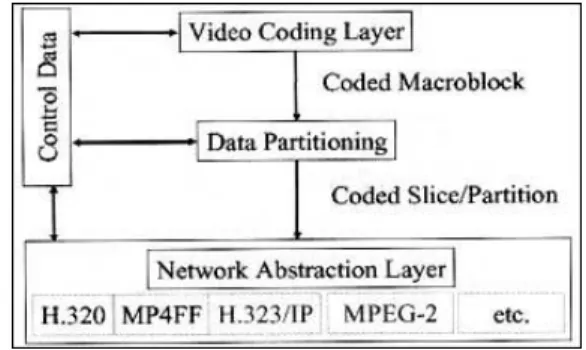
H.264/MPEG-4 AVC is a block-oriented motion- compensation-based codec standard developed by the ITU-T Video Coding Experts Group (VCEG) together with the ISO/IEC Moving Picture Experts Group (MPEG).The intent of the H.264/AVC project was to create a standard capable of providing good video quality at substantially lower bit rates than previous standards, without increasing the complexity of design so much that it would be impractical or excessively expensive to implement. There are 2 parts in H.264 encoding system, one is Video Coding Layer (VCL), and the other is Network Abstraction Layer (NAL)
[1]. VCL is used to describe and define Video Content.
It includes Motion Compensation, transform and quantization and entropy coding. NAL is in charge of data encapsulation, frame format, logical channel control, and stop bit definition. A typical NAL packet consists of packet header information, segment structure information and VCL data load information.
NAL gets encoded video data from access layer port,
and packs VCL data under requirement of external network. NAL supports Circuit Switching (CS) and Internetwork Packet Exchange (IPX). Data header and data message can be mapped to most network protocols accurately. Encoding and channel are split by NAL, which enhanced flexibility of complex channels.
By the layered structural design, compression, encapsulation and priority control of the video data are strengthened.
그림 1. H.264 계층구조
Fig. 1. H.264 Layered Structure
H.264 standard divided into three profiles: baseline profile, main profile and extended profile.
Baseline profile is mainly used in Interactive Application Communication, its technical features are:
only operating I slice and P slice; using Intra- Prediction and interframe prediction to build pictures;
using loop filter to reduce blocking effects;
Context-Adaptive Variable-Length Coding (CAVLC) is used in entropy coding part; Slice is independent of each other and can be transmitted to decoder in random order; redundant slices is transmitted to recover in data error.
III. Encryption Scheme Based on CAVLC
In this chapter, an encryption based on CAVLC is
proposed, and Figure 2 shows the flow of the scheme.
그림 2. 부호결합흐름도
Fig. 2. Encryption Combining with Coding Flow Chart
1. CAVLC Encoding Process 1.1 Process Description 1) Number of nonzero coefficient
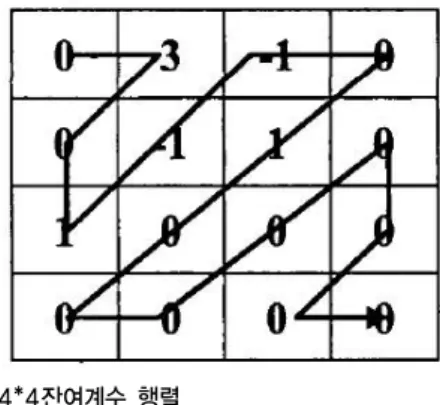
Most of the coefficients turned to 0 by residual transforms, only a few nonzero coefficients left. Then residual coefficients are scanned in Zigzag, nonzero coefficients are on the left, and 0 are on the right. The last several nonzero coefficients are often ±1. ±1 are which continuously emerge from right to left in order (there could be several 0 but no nonzero coefficients).
Number of ±1 never exceeds 3; if not extra ±1 will be treated as common nonzero coefficients. If last nonzero coefficient is not ±1, the number of ±1 is 0. The number of nonzero coefficients and ±1 become to a syntax element coeff_token.
2) Sign of ±1
Trailing ±1 are coded in 1 bit, +1 is coded into 0, -1 is coded into 1 from right to left.
3) Coding other nonzero coefficients
Except trailing ±1, other nonzero coefficients are coded from right to left. The code words consist of prefix and suffix. Suffix length means absolute value of the coded coefficient. If number of nonzero coefficient is more than 10 and number of trailing ±1 is less than
3, then suffix _length will be initialized into 1.
Otherwise, suffix _length will be initialized into 0.
4) Coding number of 0 on the left of last nonzero coefficient Relevant code word is in code table of H.264 standard
[13].
5) Coding every number of 0 before nonzero coefficients
Zero_left means number of 0 on the left of nonzero coefficient. Run_before means number of 0 between the nonzero coefficients and the next.
1.2. Coding Sample
From the above explanation, a specific example is showed
[6]그림 3. 4*4잔여계수 행렬
Fig. 3. 4*4 Residual Coefficient Matrix
In figure 3, by Zigzag scanning, the sequence is:
0,3,0,1,-1,-1,0,1,0,0,0,0,0,0,0,0 By the coding step:
(1) Number of nonzero coefficients is 5, number of trailing ±1 is 3(1,-1,-1). In the H.264 standard code table, corresponding code word is
“0000100”.
(2) The three trailing ±1 are coded from right to left.
The coded bit is “011”
(3) Two nonzero coefficients are 1 and 3, suffix_
length is initialized into 0. From right to left, 1
is coded first, and calculates prefix to get 0
without suffix, then prefix is used to get code word “1” in code table, so 1 is coded into “1” and suffix_length is change to 1. 3 is coded to calculate prefix 2 and suffix 0, then prefix is used to get code word “001” in code table, suffix joints 001 to get the coded bit “0010”
(4) The last nonzero coefficient is “1”, there are three 0 on its left, the code word is “111” in the code table
(5) On the left of the first nonzero coefficient, there are three 0, there is one 0 between it and the next nonzero coefficient, so code word is “10” in the code table. Similarly, other code words of nonzero coefficients are “1”, “1” and “01”. The last nonzero coefficient-3 need not to be coded.
표 1. 코드화 단계 Table 1. Code Step
Step Code element Code word
(1) (5,3) 0000100
(2)
1 0
-1 1
-1 1
(3) 1 : prefix=0, suffix_length=0 1 3 : prefix=2, suffix_length=1, suffix=0 0010 (4) Three 0 are on the left of last nonzero
coefficient 111
(5)
1 : zero_left=3, run_before=1 (3,1) 10 -1 : zero_left=2, run_before=0 (2,0) 1 -1 : zero_left=2, run_before=0 (2,0) 1 1 : zero_left=2, run_before=1 (2,1) 01 3 : zero_left=1, run_before=1(1,1) no code So this 4*4 block coded bit stream is:
000010001110010111101101.
2. CAVLC Encryption Scheme 2.1 Scheme Description
By analyzing the process of CAVLC entropy coding, it is known that the number of trailing ±1 and nonzero coefficient can be abstracted. So in step (2) there is no need to encrypt syntactic element, otherwise the coefficient of the block cannot be decoded. Similarly, in step (4), the number of 0, which are on the left of last nonzero coefficient, cannot be encrypted. Consequently, encryption objects can only be sign of trailing ±1,
nonzero coefficients and number of 0 before nonzero coefficient. Meanwhile, the coded motion vector will be encrypted on order to get higher security. According to this route, a video encryption scheme is presented.
Level 1 : encryption of trailing ±1.
There are three trailing ±1 in a 4*4 block at most, and 1 bit means a sign of trailing ±1. So the signs can be encrypted by a certain algorithm:
x means the sign, SEA means encryption function, y means cipher text. Trailing ±1, which is high-frequency component of coefficient transformation, is on right of the Zigzag scanning sequence. So this encryption level can only scramble the video.
Level 2 : Besides level 1, encrypt suffix and run_before in step (3).
The last bit of suffix relates to plus-minus property of the nonzero coefficient. If the bit is 0, the nonzero coefficient is plus; if the bit is 1, the nonzero coefficient is minus. By encrypting suffix, plus-minus property of the nonzero coefficient is changed; meanwhile its absolute value is also changed. The encryption method of suffix and run_before is:
, run_before
Encrypt is encryption function, y is cipher text. The bit of secret key is suffix_length. Encryption of run_before will change the coefficient position in sequence, thus inverse transform generate more deviation.
Level 3 : besides level 2, encrypt motion vector
difference (MVD)
Exp-Golomb Coding is used for coding MVD. Prefix is M zero and 1, suffix is M bit INFO:
Y is cipher text. Because H.264 used intraframe and interframe prediction technology, in case motion prediction of one block makes mistakes, then it causes avalanche effect, and there will be more confusion in the subsequence images. So MVD encryption makes further improvement of security.
Encryption functions can be neatly configured to achieve faster encryption speed and higher security.
2.2 Encryption Sample
This section gives encryption operation on level 2 for the block in 3.1.2. Stream cipher is used for encryption function. In sign encryption SEA, it combines 1 bit secret key and trailing ±1 by using XOR operator, so is the suffix. Run_before minus 1 bit secret key, if run_before is changed then zero_left need to be update.
Set secret key sequence as: 0, 0, 1, 1, 1, 0, 0, 1…
The first three bits are used to encrypt signs of trailing ±1 (011), the encrypted code stream is 010; and then one bit is used to encrypt the second suffix and gets 0011; the last four bits are sued to encrypt run_before. The encrypted bit stream is:
“0000100010100111111111101”
표 2. 레벨2 부호화 예
Table 2. Sample of Leve2 Encryption
Step Original code Secret key Encrypted code (1) 0000100 No encrypt 0000100
(2)
0 0 0(0⊕0)
1 0 1(1⊕0)
1 1 0(1⊕1)
(3) 1 No encrypt 1
0010 1 0011(1⊕suffix)
(4) 111 No encrypt 111
(5)
10(3,1) 1 11(3,0)
1(2,0) 0 11(3,0)
1(2,0) 0 10(3,1)
01 (2,1) 1 1(2,0)
No code No encrypt
IV. Simulation Analysis and Experiment
1. Experimental Result
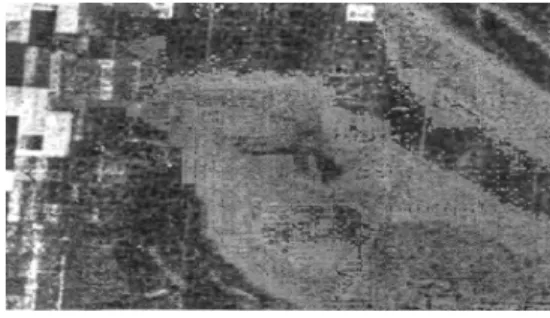
From Figure 4 to Figure 7 are the frames of foreman_qcif in three levels encryption; The frame encrypted in level 1 can be recognized; in l level 2, the frame is difficult to distinguish; in level 3 the frame is beyond recognition. So are the scrambled frames.
그림 4. 표준 프레임
Fig. 4. Foreman_qcif Standard Frame
그림 5. 레벨 1 부호화
Fig. 5. Foreman_qcif Level 1 Encryption
그림 6. 레벨2 부호화
Fig. 6. Foreman_qcif Level 2 Encryption
그림 7. 레벨 3 부호화
Fig. 7. Foreman_qcif Level 3 Encryption
2. Signal-to-Noise
The SNR of the encrypted frame luminance component is less than 15. Commonly, when SNR is less than 23 people feel obvious distortion. In table 3 SNR of the frames is showed.
표 3. 레벨 2 부호화 예
Table 3. Sample of Leve2 Encryption SNR(Y) SNR(U) SNR(V) Foreman_qcif 10.75 19.60 29.13 Carphone_qcif 9.62 21.57 28.04