OFDM시스템에서 블록코딩을 이용한 PAR감소에 대한 연구
PAR reduction using Adaptive Block Coding in the OFDM system
Tae-Han Kim* Young-Soo Kim Tel : +82-02-6110-5359 Fax :+82-02-6110-5369
[email protected] Seoulmetro
ABSTRACT
In this paper, we propose a Peak to Average power Ratio(PAR) reduction algorithm by using the Adaptive Block Coding(ABC). The problem of a PAR due to each sub-carrier overlap phenomenon in the OFDM (Orthogonal Frequency Division Multiplexing) system causes the an increasing in the complexity of the A/D converter in the transmitter and a reduction in the efficiency of the amplifier. The proposed ABC algorithm selects the block coding which provides the lowest PAR value based on the various check bit position. It is shown that a PAR of the ABC algorithm can be reduced from 8.35dB to 6.02dB in 16 sub-carriers compared to theconventional block coding scheme. We also extended the ABC algorithm to a larger number of sub-carriers and estimated their PAR values.
1. Introduction
The basic principle of OFDM is to split a high-rate data stream into a number of lower rate streams that are transmitted simultaneously over a number of sub-carriers [4]. In OFDM, the modulation is performed with an Inverse Fast Fourier Transform (IFFT) and the demodulation with a Fast Fourier Transform(FFT). The advantage of such schemesis that unlimited transmission rates are theoretically possible in highly timed dispersive channels, without the need for equalization [1],[2]. Even though there are many well-known advantages of OFDM signaling, there are some limitations and complications in practice when using its transmission systems. The main problem is that OFDM transmit signal exhibits a very high PAR [1],[2]. OFDM signal consists of independently modulated sub-carriers, which can give a large PAR when added up coherently; When N signals are added with the same phase, they produce a peak power that is N times the average power. A large PAR input into the transmitter power amplifier may cause nonlinear amplification of the input signal. The nonlinear characteristic of the power amplifier is very sensitive to variation in signal amplitude. Unfortunately, the variation of OFDM signal amplitudes is very wide with large PAR, which is known to be Rayleigh-distributed. For this reason, OFDM system with the power amplifier suffers from significant performance degradation [5].
To reduce the PAR, several techniques have been proposed such as clipping, peak windowing, and coding [1]. The simplest way to reduce the PAR is to clip the signal, such that the peak amplitude becomes limited to some desired maximum level. Although clipping is definitely the simplest solution, there are a few problems associated with it. First, by distorting the OFDM signal amplitude, a kind of self-interference is introduced that degrades the BER. Second, the nonlinear distortion of OFDM signal significantly increases the level of the out-of-band radiation. The latter effect can be understood easily by viewing the clipping operation as a multiplication of the OFDM signal by a rectangular windowing function that is 1 if the OFDM
clipped OFDM signal is found as the input OFDM spectrum convolved with the spectrum of the window function. The out-of-band spectral properties are mainly determined by the wider spectrum of the two, which is the spectrum of the rectangular window function. This spectrum has a very slow rolloff that is inversely proportional to the frequency [1]. To remedy the out-of-band problem of clipping, a different approach is to multiply large signal peaks with a certain nonrectangular window. A Gaussian shaped window is proposed for this, but in fact any window can be used, provided it has good spectral properties. To minimize the out-of-band interference, ideally the window should be as narrowband as possible. On the other hand, the window should not be too long in the time domain, because that implies that many signal samples are affected, which increases the BER. Examples of suitable window functions are the Cosine, Kaiser, and Hamming windowing [1]. Clipping and peak windowing are the simplest techniques, but they cause serious out-of-band radiation. Coding seems attractive because it does not create any out-of band radiation and provides the error correcting ability with additional bits, but to date no good coding solutions are known which can maintain a reasonable coding rate for an arbitrary numbers of sub-carriers [1]-[5].
In this paper, we focus on block coding in various coding methods. It has studied on thePAR reduction by using the odd parity check bit. First, block coding schemes used in 4 sub-carriers and then extended for using in 16 sub-carriers [2],[3]. In this conventional block coding, length of information sequence for one frame can be chosen as 12 and all data information sequence with length 12 bits is divided into 4 sub-block and each sub-block is encoded with 1 odd parity check bit, 3/4 coding rate. The odd parity check bit always located right handed or left handed in each sub-block. The PAR can be 8.35dB value by using this conventional block coding method with the error correcting ability in 16 sub-carriers [4], [5]. In this paper, we propose a new ABC scheme, which provides error correction capability and also achieves the minimum PAR for the OFDM system using 16 sub-carriers and the ABC technique by choosing optimized redundant bit position. It is shown that a PAR of the ABC algorithm can be reduced from 8.35dB to 6.02dB in 16 sub-carriers with cost of look-up table compared to the conventional block coding scheme. We also extended an ABC algorithm to thelarger number of sub-carriers and estimate its PAR values. This paper is organized as follows, in section 2 we introduce the PAR coefficient of OFDM and its statistical characteristic. Thepropose algorithm is described in section 3. Simulation results cover the performance in section 4. The paper closes with some conclusions in section 5.
2. PAR in OFDM System
In OFDM system, consider a multi-carrier transmitter consisting of a data source and serial to parallel converter providing N streams of data, which are modulated onto Nsubcarriers with uniform orthogonal
frequency spacing equal to the symbol rate on the individual subcarriers. If the outputs of these modulators are combined, the composite signal can be written as (1);
( )
∑
= + = N n t f j ne n d t s 1 2 ) ( π φ (0≤t≤T) (1)where N is the number of subcarriers, d is the data applied to the nth subcarrier, n f is the frequency offset n of the nth subcarrier frequency from the center frequency,
φ
is the initial phase of the nth sub-carrier, andInput data Block coding Serial to Parallel OFDM signal Linear amplifier dn s(t) ) 2 ( f1t j
e
π ) 2 ( f2t je
π . . . . . 1.Fig. 1 The block diagram of OFDM system
The peak power ppeak defined as the maximum power of the transmitted signals, is given as equation
(2) * ) ( ) ( ) (t s t s t ppeak = (2)
where
(⋅
)
*denotes complex conjugate. If the power in the individual carriers is normalized to 1W then themaximum peak envelope power (PEP) and the average power of
s
(t
)
can be written as :[ ] (W) } ) ( max{ 2 , 0 2 N t s PPEAK = t∈ T = (3) and =
∫
T AVG T s t dt P 0 2 ) ( 1 (4) With (3) and (4), the PAPR can be defined as:⎭⎬ ⎫ ⎩ ⎨ ⎧ = AVG PEAK P P PAPR 10log10 (dB) . (5)
3. The proposed ABC algorithm
In this paper, we focus on block coding schemes in various coding methods. The block coding scheme has an advantage of reducing PAR easily and monotonous coding operation. Hence, it has studied on the PAR reduction by using the odd parity check bit. A block coding schemes used in 4 sub-carriers and then extended for using in 16 sub-carriers. In this conventional block coding, length of information sequence for one frame can be chosen as 12 and all data information sequence with length 12 bits is divided into 4 sub-blocks and each sub-block is encoded with 1 odd parity check bit, 3/4 coding rate. Odd parity check bit always located right handed or left handed in each sub-block. The conventional block coding scheme used for reducing PAR is given by table 1. The PAR by using this each conventional block coding method is
The form of the conventional block coding in 16 sub-carriers Method
∆
×
×
×
×
×
×
∆
×
×
×
∆
×
×
×
∆
Method 1×
×
×
∆
∆
×
×
×
∆
×
×
×
∆
×
×
×
Method 2Input data Right handed check bit Left handed check bit Waveform
Binary Decimal Binary Decimal
000 0001 1 1000 8 Same 001 0010 2 0001 1 Different 010 0100 4 0010 2 Same 011 0111 7 1011 11 Different 100 1000 8 0100 4 Different 101 1011 11 1101 13 Same 110 1101 13 1110 14 Different 111 1110 14 0111 7 Same
Table 1 The check bit position by the conventional block coding in 16 sub-carriers
×
: data bit,∆
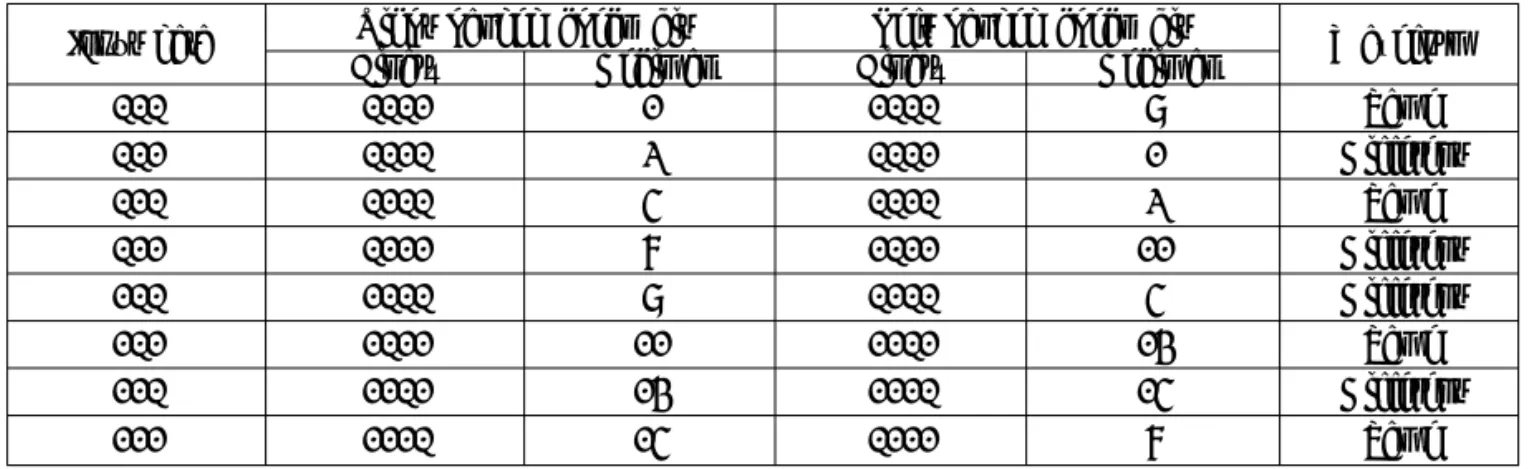
: check bitIn this paper, we propose a PAR reduction by using theABC algorithm which provides error correction capability and also achieves the minimum PAR for the OFDM system using 16 sub-carriers. Compared with conventional block coding scheme which consider the check bit only in right or left side, we consider the both check bit information and analyses the both waveforms by right handed check bit and left-handed check bit location, whether the both waveform provides the same form or not. If thetwo waveforms are different, we can expect other results for waveforms of the summed all sub-carriers. And we can choose better waveform between two waveforms for PAR reduction.
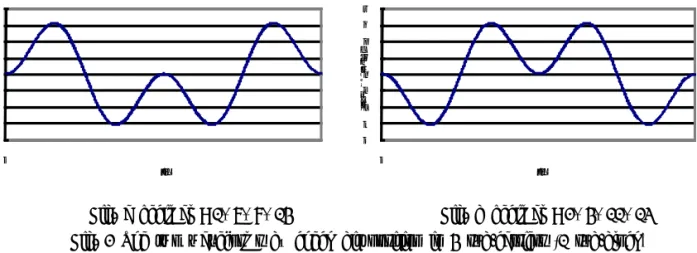
Table 2 provides the overall 4 sub-carriers with right and left handed check bit. Figure 2 depicts a simulated two waveforms of all possible input data in 1 sub-block. These two waveforms have same peak power value of 7.07W. But when these two waveforms are summed with other 3 sub-blocks, each waveform results in different value of PAR in 16 sub-carriers. Based on the table 2 and figure 2, we can get that the input data with 001, 011, 100, 110, has different waveform by check bit position in 1 sub-block ,but the input data with 000, 010, 101, 111 has same waveform. When this different waveform by check bit position is summed by the waveform of the other 3 sub-blocks, we can expect PAR reduction by choosing better waveform between two waveforms.
The form of the ABC in 16 sub-carriers considerable caseThe number of Binary form
∆
×
×
×
×
×
×
∆
×
×
×
∆
×
×
×
∆
case1 0000∆
×
×
×
×
×
×
∆
×
×
×
∆
∆
×
×
×
case2 0001∆
×
×
×
×
×
×
∆
∆
×
×
×
×
×
×
∆
case3 0010∆
×
×
×
×
×
×
∆
∆
×
×
×
∆
×
×
×
case4 0011∆
×
×
×
∆
×
×
×
×
×
×
∆
×
×
×
∆
case5 0100∆
×
×
×
∆
×
×
×
×
×
×
∆
∆
×
×
×
case6 0101∆
×
×
×
∆
×
×
×
∆
×
×
×
×
×
×
∆
case7 0110∆
×
×
×
∆
×
×
×
∆
×
×
×
∆
×
×
×
case8 0111×
×
×
∆
×
×
×
∆
×
×
×
∆
×
×
×
∆
case9 1000×
×
×
∆
×
×
×
∆
×
×
×
∆
∆
×
×
×
case10 1001×
×
×
∆
×
×
×
∆
∆
×
×
×
×
×
×
∆
case11 1010×
×
×
∆
×
×
×
∆
∆
×
×
×
∆
×
×
×
case12 1011×
×
×
∆
∆
×
×
×
×
×
×
∆
×
×
×
∆
case13 1100×
×
×
∆
∆
×
×
×
×
×
×
∆
∆
×
×
×
case14 1101×
×
×
∆
∆
×
×
×
∆
×
×
×
×
×
×
∆
case15 1110×
×
×
∆
∆
×
×
×
∆
×
×
×
∆
×
×
×
case16 1111 0 1 2 3 4 5 6 7 8 0 p e a k p o w e r( W ) t/T 0 1 2 3 4 5 6 7 8 0 p e a k p o w e r( W ) t/TFig. a decimal : 1, 7, 8, 14 Fig. b decimal : 2, 4, 11, 13 Fig. 2 The two waveforms by check bit position in 4 sub-carriers (1 sub-block)
Table 3 provides the overall combination of check bit in right or left hand location position where the sub-carrier size is chosen as N=16. The length of information sequence for one frame can be chosen as 12 and all data information sequence with length 12 bits is divided into 4 sub-block and each sub-block is encoded with 1 odd parity check bit like as conventional block coding schemes. In each sub-block, we put '0' when the check bit position is right handed, i.e.,×××∆, and '1'when left handed, i.e., ∆×××. Thus the binary form of the table 3 gives the information of the check bit position. To reduce the PAR, we choose the one of the block coding case of 16 cases with the lowest PAR value in the table.
Table 3 Check bit position by 16 ABC cases in 16 sub-carriers
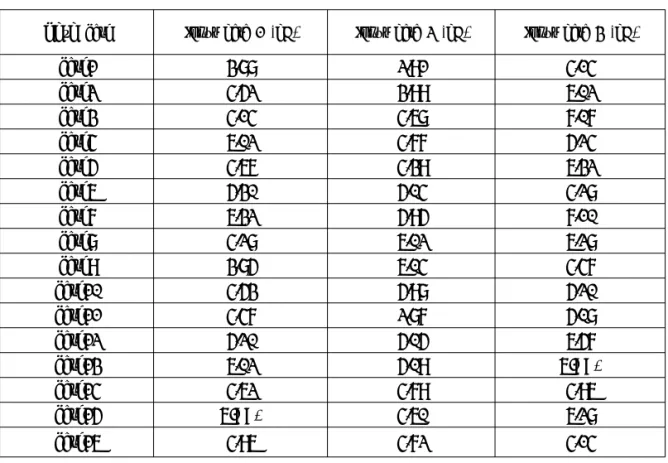
data case Input data 1 (dB) Input data 2 (dB) Input data 3 (dB) case1 3.88 2.91 4.14 case2 4.52 3.99 6.02 case3 4.14 4.68 7.07 case4 6.02 4.77 5.24 case5 4.67 4.39 6.32 case6 5.30 5.04 4.28 case7 6.32 5.95 7.10 case8 4.28 6.02 6.28 case9 3.85 6.04 4.47 case10 4.53 5.98 5.20 case11 4.47 2.87* 5.08 case12 5.20 5.05 6.57 case13 6.02 5.09 3.77* case14 4.62 4.79 4.96 case15 3.77* 4.60 6.28 case16 4.96 4.72 4.14
4. Simulations
We consider that the ABC algorithm applies to the several random inputdata in 16 sub-carriers. It can be seen from table 4, i.e., PAR of the three random input data by the ABC algorithm. Each random input data has different PAR value in different block coding case. Input data 1 has minimum PAR value in case15, input data 2 in case11 and input data3 in case13, respectively. Hence we can reduce PAR by choosing the block coding case which provides the lowest PAR value based on the number of 16 check bit position.
Table 4 The PAR of the random input data by ABC algorithm Input data 1 : 000 000 001 111
Input data 2 : 100 010 110 000 Input data 3 : 111 111 111 000
* : The lowest PAR value
Figure 3 shows the PAR value when all possible input data (from 000 000 000 000 to 111 111 111 111) transmitted, i.e., N=12. The PAR can be decreased as the number of considerable cases of the input data increases. Since the ABC method selects the block coding which provides the lowest PAR value based on thenumber of 16 check bit position, the PAR of the ABC algorithm can be reduced from 8.35dB to 6.02dB in 16 sub-carriers compared to the conventional block coding scheme.
The ABC algorithm
The number of
uncoded data bits PAR The number of
Information data bits
The number of Odd parity check bits
The number of Total transmitted bits
12 4 16 4 6.02
15 5 20 5 6.98
18 6 24 6 7.78
21 7 28 7 8.45
24 8 32 8 9.03
Fig. a PAR performance followed by Fig. bPAR performance followed by considerable 1-block code case considerable 16-block code cases (Using conventional block coding method) (Usingproposed block coding method)
Fig. 3 PAR performance by the number of considerable block code cases
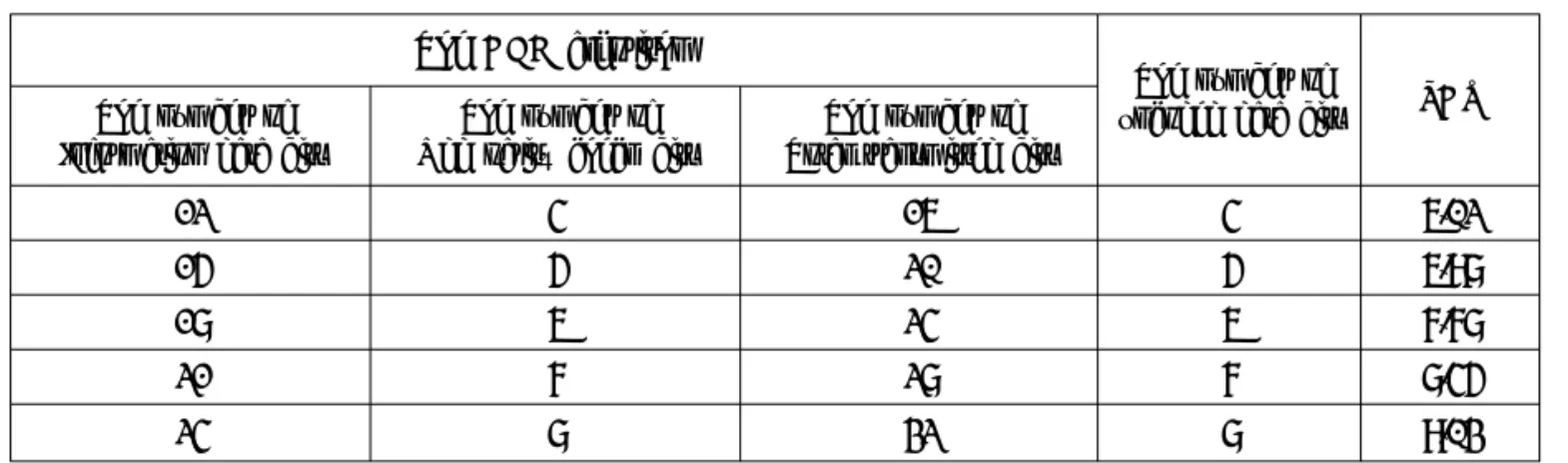
Table 5 shows the extension of adaptive block coding applying to larger the number of sub-carriers. We can transmit 4 data bits by using uncoded case in 6.02dB of PAR value, but we can transmit 12 data bits except 4 odd parity check bits by using adaptive block coding in 6.02dB of PAR value. The ABC algorithm achieves efficiency of three timesdata bit rate compared of uncoded data in sama PAR value, and can approximate the PAR value of ABC in larger the number of sub-carrier by equalize PAR values of uncoded and adaptive block coding. Hence, we can approximate the PAR value of adaptive block coding by calculate the PAR of uncoded data in larger the number of sub-carrier environment.
We can apply ABC algorithm to a larger number of sub-carriers by using calculation of uncoded case.
Table 5 Extension of the number of sub-carrier with the ABC algorithm
Table 6 shows the comparison of the performance about each method for PAR reduction. In this table, we consider the OFDM system with 16 sub-carriers environment. In the uncoded case, we can transmit 16 information data bit and need not the redundant bit. Conventional block coding scheme has 12 information data bits and 4 odd parity check bits. The proposed ABC algorithm has 12 information data bits, 4 odd parity check bits and 4 side information bits. In 16 sub-carriers environment, we know that the proposed ABC algorithm has the lowest bandwidth efficiency, but has the highest PAR performance compared with the other methods.
Uncoded Block codingConventional ABC algorithm The number of Information
data bits
N
4 3 × N 4 3 × N The number ofOdd parity check bits 0 4
1 × N 4 1 × N The number of
Side information bits 0 0 log2N
The number of
Total transmitted bits
N
N
N+log2NBandwidth efficiency NN N N 4 3 × N N N 2 log 4 3 + × PAR (dB) 12.04 8.35 6.02
Table 6 The comparison of each method for PAR reduction (
N
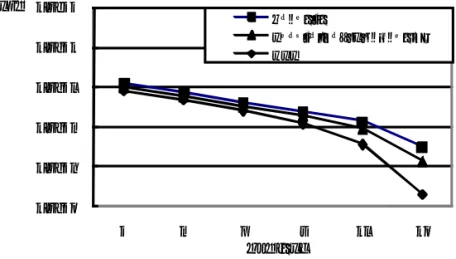
=16 : the number of sub-carrier)In figure 4, we can obtain the BER performance of the uncoded, conventional and the proposed method for PAR reduction with the fixed PAR value. Each method uses the number of 16 sub-carriers. If the PAR is higher than 6.02dB(the PAR value by using ABC algorithm), itspower waveform is clipped for each method. Simply, the amount of large power has been clipped in the uncoded case and conventional block with less clipping than the uncoded case. However note that the threshold is based on the ABC, we do not need to clip for all possible input data waveforms. As expected due to the clipping, we can obtain the best BER performance in ABC algorithm compared with the uncoded case and conventional block coding
1.E-05 1.E-04 1.E-03 1.E-02 1.E-01 1.E+00 0 3 6 9 12 15 BER SNR(dB) Uncoded
Conventional Block coding ABC
5. Conclusions
In this paper, we proposed theABC algorithm that selects the block coding which provides the lowest PAR
value based on thevarious check bit position. The conventional block coding algorithm achieves PAR reduction by using just one case of the16 in proposed the ABC algorithm. But the ABC has various PAR values by using different check bit position in all possible input data bit. It is shown that the PAR of the ABC algorithm can be reduced from 8.35dB to 6.02dB in 16 sub-carriers. All possible input data achieves efficient PAR reduction as considerable cases increase. The ABC algorithm achieves efficiency of three times data bit rate compared of uncoded data, and can approximate the PAR value of the ABC algorithm to the larger number of sub-carriers. The cost for this algorithm is the database memory for optimizing block coding of all possible input data in transmitter and receiver and the side information for the position of the check bit.
6. Reference
[1] R. van Nee, A. de Wild, "Reducing the peak-to-average power ratio of OFDM," in IEEE 48th
Vehicular Technology Conference (VTC' 98), vol. 3, pp. 2072-2076, 1998.
[2] A. E. Jones, T. A. Wilkinson, and S. K. Barton, "Block coding scheme for reduction of peak to
mean envelope power ratio of multicarrier transmission schemes", Electronics Letters, vol. 30, no. 25,
pp. 2098-2099, Dec. 8. 1994.
[3] D. Wulich, "Reduction of peak to mean ratio of multicarrier modulation using cyclic coding,"
Electronics Letters, vol. 32, no. 5, pp. 432-433, Feb. 29, 1996.
[4] S. Fragicomo, C. Matrakidis, and J. J. O'Reilly, "Multicarrier transmission peak-to-average power
reduction using simple block code," Electronics Letters, vol. 34, no. 10, pp. 953-954, May 14, 1998.
[5] Y. Zhang, A. Yongacoglu, J. Y. Chouinard, and L. Zhang, "OFDM peak power reduction by
sub-block-coding and its extended versions," in IEEE 49th Vehicular Technology Conference (VTC'99),
Houston, USA, May 16-20, vol. 1, pp. 695-699, 1999
[6] Y. Zhang, A. Yongacoglu, and J. Y. Chouinard "Reducing Multicarrier Transmission Peak Power
With A Modified Simple Block Code," Communication Technology Proceedings, WCC - ICCT 2000.
International Conference on, vol. 1, pp. 578-580, 2000.
[7] H. Saeedi, M. Sharif, and F. Marvasti "Clipping noise cancellation in OFDM systems using
oversampled signal reconstruction," in IEEE Communications Letters , vol. 6, pp. 73 75, Feb. 2002
[8] C. Tellambura, "Comment: Multicarrier transmission peak-to-average power reduction using simple block
Letters, vol. 33, no. 15, pp. 1300-1301, July 17, 1997.
[10] J. A. David and J. Jedwab, "Peak-to-mean power control in OFDM, Golay complementary sequences,
and Reed-Muller codes," IEEE Transactions on Information Theory, vol. 45, no. 7, pp. 2397-2417,
November 1999.
[11] H. Ochiai and H. Imai, "Block coding scheme based on complementary sequences for multicarrier
signals," IEICE Trans. Fundamentals, pp.2136-2143, 1997
[12] S. L. Miller and R. J. O'Dea, "Peak power and bandwidth efficient linear modulation," IEEE Trans.
Commun., vol. 46, pp. 1639-1648, Dec. 1998.
[13] J. A. David and J. Jedwab, "Peak-to-mean power control and error correction for OFDM
transmission using Golay sequences and Reed-Muller codes," Electron. Lett., vol. 33, no. 4, pp.
267-268, Feb. 1977
[14] Tarokh, V. and Jafarkhaui, H., "On the computation and reduction of Peak-to-Average Power Ratio
in multicarrier communications," IEEE Transactions on Communications, vol. 48, no. 1, p.37-44, Jan.