• 검색 결과가 없습니다.

Prediction of Indoor Radon Concentration through the Exhalation from Korean Yellow Residual Soil, Hwangtoh as a Building Material

N/A
N/A
Protected

Academic year: 2021

Share "Prediction of Indoor Radon Concentration through the Exhalation from Korean Yellow Residual Soil, Hwangtoh as a Building Material"

Copied!
12
0
0

로드 중.... (전체 텍스트 보기)

전체 글

(1)

Prediction of Indoor Radon Concentration through the Exhalation from Korean Yellow Residual Soil,

Hwangtoh as a Building Material 1

Ju Yong LEE 2 ⋅Seog Goo KANG 3,†

ABSTRACT

1)

The radon gas from nature mainly considers a cause of radon problems, and it is closely affect human life cycle.

Korean yellow residual soil, Hwangtoh, widely used as a building material, is considered to be one of major sources of indoor radon. However, there have, as yet, been no studies about radon from Hwangtoh in mass market brands.

Here, we investigated the indoor radon concentrations and exhalation rates in four Hwangtohs from different brand names and regional features. The Closed Chamber Method (CCM) conducted by a Continuous Radon Monitor (CRM) has been used for the rates of radon exhalation. Based on equations of previous references, the indoor radon concentrations were deducted. As a result, the radon surface exhalation rates resulted in the 1.4208 to 3.0293 Bq·m 2 ·h -1 range. Significant differences were found among Hwangtohs according to production regions. Materials with higher radon concentration required a longer time to reach a quasi-steady state in a given environment, in other words, the number of half-life cycles increased from a set starting point. The experimentally identified Hwangtohs demonstrated its safety for construction purposes. There exists, so far, a possibility to exert influence radon emanation due to unidentified factors. Therefore, it is necessary to corroborate with more research by increasing the number of Hwangtohs, considering the other references reported high radon exhalation rates. In addition, it is highly recommended that the radon exhalation rates should be measured for all building materials for preventing human health before the material usage.

Keywords: closed chamber method (ccm), indoor radon, exhalation rate, hwangtoh, yellow residual soils, building materials

1. INTRODUCTION

Modern people are exposed to indoor pollutants as the indoor living time increases (Lee, et al., 2014).

Indoor air pollutants include building materials, vola-

tile organic compounds (VOCs) such as formaldehyde, and naturally occurring gases like radon, and there has been an increasing interest in eco-friendly building materials that do not release volatile organic com- pounds (Han, et al., 2019; Jang, et al., 2017; Jang,

1 Date Received October 5, 2020, Date Accepted February 3, 2021

2 Department of Civil and Environmental Engineering, College of Engineering, KAIST, Daejeon 34141, South Korea

3 Department of Department of Biobased Materials, College of Agriculture & Life Science, Chungnam National University, Daejeon 34134, South Korea

† Corresponding author: Seog Goo KANG (e-mail: [email protected], ORCID: 0000-0002-2440-7070)

Original Article

(2)

et al., 2017; Choi, et al., 2020; Park, et al., 2020).

Radon, as an indoor air pollutant, is unintentionally exposed because it is difficult to determine the degree of contamination (Kim, 2018).

Radon ( 222 Rn) is one of the carcinogenic, invisible, and odorless gases usually found in environments on earth. Radon with no stable isotopes has been dis- covered in about 40 isotopes with different atomic masses between 193 and 231 (Neidherr et al., 2009).

222 Rn, the most stable isotope having 3.82 days half- life, is produced by decaying radium ( 226 Ra) and ura- nium ( 238 U) (Elliot et al., 2014; Singh et al., 2005).

This gas spreads easily from sources such as the ground to air in the room (Faheem and Matiullah, 2008, Parajuli et al., 2015), and dissolves quickly into ground water. People are easily exposed to the radon gas and lead serious consequences such as lung cancer.

Previous studies noted that exposure to indoor radon gas is causative of critical health influence such as lung cancer (Lubin et al., 1995). Since the International Agency for Research on Cancer (IARC) declared ex- posing radon consisted of about 14% is one of major contributors of lung cancer (IARC, 1988). The rela- tionship between radon and lung cancer has been heightened that radon is considered as the first hazard factor for non-smokers (EPA, 2012). However, the in- fluence of radon has not yet been fully understood.

According to case studies by the WHO handbook in 2009, the possibility of having lung cancer grows up to 16% per 100 Bq/m 3 with exposure of the average concentration during a long period (Zeeb et al., 2009).

The proportional correlation, as an example, is de- noted between exposure to radon and lung cancer. The increase in time of exposure and of radon concen- tration augment the development of cancer (Lubin and Boice, 1997; Webb, 1992). These examples show that indoor radon presence is harmful and threatens the health of residents.

While the importance of the health impact of radon has

emerged, the International Commission for Radiological Protection (ICRP) defined a terminology of radon prone areas where radon concentration in building is higher than national average to inform of the danger and to save people from high perpetual exposure, where 1 % or higher of buildings in the United States occupy higher indoor radon concentration, which is 10 times higher than the average (ICRP, 1993). Similarly, sci- entists reported the harmful effects of radon since 1976, radon issue has been started in the spotlight from last couple years in Republic of Korea. In 2018, the Korean broadcast reported a large quantity of ra- don was detected in beds, mattresses, pillows, and even sanitary pads. Knowing the relationship between radon and cancer made an influence people’s safeties and behaviors, and it led people to raise awareness about radon. Building materials are closely connected with radon concentration in households because radon exhalation occurred from every building material peo- ple use. Building materials, such as soil and rocks, are considered one of the major contributors of radon.

The yellowish-reddish brown residual soil, called

Hwangtoh in Korea, produced by the weathering of

parent rocks not only have been used as a major build-

ing material for the Korean traditional houses since

ancient times, but also have been widely used for all

sorts of applications. Hwangtoh is used as cosmetics,

beds, red tide reduction (Seok and Jun, 2009), animal

feeding (Hwang et al., 2002), foods, naturally dyed

clothing (Rhie and Choi, 2005), natural pigment (Mun

et al., 2019), accumulation of heavy metals (Jeong and

Kim, 1990; Shin et al., 2011) as well as various

health-products today. Hwangtoh is also used as an

interior building material for Korean-style decorations

of the wall, ceiling and floor of modern apartments

(Kim et al., 2010). Hwangtoh is comprised of diverse

clay minerals such as illite, micas/vermiculite, and

kaolinite (Hwang and Lee, 2010). Due to soil proper-

ties, the particle size is distinction among their color,

(3)

density, mineral, chemical compositions, and even dif- ferences of microorganism communities. For example, the increase of iron oxide in the soil, Hwangtoh, be- come more reddish color and higher density as the particle size decreased. Soil colors are also changeable to different color such as gray when it turns anaerobic because of the different microorganisms’ growths.

Hwangtoh has many advantages as a building mate- rial, such as excellent insulation properties, regulation of temperature and humidity (Kim et al., 2010), good acoustic environment, air permeability, durability, re- cyclability, versatility, and deodorization (Kim et al., 2000) . It has been known for many years about sig- nificant health benefits because it prevented mould growth in the home. All of these create a superior in- ternal air quality which is closely related to human health. In spite of these advantages, radon found in several products has attracted public attention today . Researchers reported a warning about the ra- don from soil, and maintained the soil is one of main sources of high radon emission (Parajuli et al., 2015;

Seo et al., 2018; UNSCEAR, 2000; Yoo et al., 2019).

Korean traditional residual soil, Hwangtoh, has been seriously influenced by these even though the in- formation is not directly mentioned about Hwangtoh.

It is no longer available to use rare earth elements and yellow residual soil as bedding such as mattresses and pillows for the intention of health improvement until a reliable media announces its safety. So far, the Korea Institute of Nuclear Safety (KINS) has organized the assessment of radon concentration levels within vari- ous houses in South Korea. The radon concentration in structures built by ochre, wood, concrete, and pre- fabricated materials are 74.1 Bq·m -3 , 54.9 Bq·m -3 , 53.1 Bq·m -3 , and 36.6 Bq·m -3 , respectively. The hazard in- dexes of Hwangtoh and Hwangtoh brick represent 0.83 and 0.74, respectively, which ranked the third and fourth highest among 12 building materials (Kim et

al, 2002). However, they analyzed only one Hwangtoh sample, and it is unable to produce statistically sig- nificant and reliable results in this case.

Radon exhalation from soil depends on various fac- tors such as its radium content, permeability, mineral- ogy, water content, water filled pore space, and par- ticle size through parent rock and soil (Gundersen and Schumann, 1996; UNSCEAR, 2000). Building materi- als based on soil are often considered as one of the major sources of indoor radon because radon is shaped predominantly in the soil and rock. Given these emerging issues, there have, as yet, been no studies about radon exhalation from Hwangtoh in mass mar- ket brands. Therefore, it is of interest to the Korean public to evaluate Hwangtoh's radon contribution, and it is commonly available in Korean markets, and to verify whether Hwangtoh used in building materials at Korean homes have any difference in radon ema- nation properties. Herein, this research aims to address this public safety issue about radon from Hwangtoh, to assess indoor radon levels in the contribution of Hwangtoh in accordance with the different production areas in Korean Hwangtoh markets, to rectify the mis- understanding about Hwangtoh, and specifically to es- timate indoor radon concentration from the radon ex- halation rate of Hwangtoh samples by the Closed Chamber Method (CCM).

2. MATERIALS and METHODS

2.1. Hwangtoh samples

Radon exhalations of four different brands of re-

sidual yellow soils (Hwangtoh), commonly known as

red clay or ocher, were measured in this study. The

soils were easily accessible and inexpensive, and they

were purchased at Korean markets under different soil

brand names based on different regional features of

raw materials. The soils were selected from the four

(4)

provinces in South Korea. After samples were dried in oven at 105 ℃ for 24 h to evaporate all moisture contents, the samples were cooled at room temperature for 24 h to get moisture contents in air. After cooling, 2 kg of each sample was placed in plastic vessels with a sample surface area of 0.28 m × 0.2 m, 0.056 m 2 as shown in Fig. 1(a) and 1(b).

2.2. Experimental process

The general experimental process followed by CCM. Without this method, it is difficult to know what exact percent of gas is in air. To measure accu- rate radon exhalations of samples, the CCM required because gathering a specific gas in a blocked space is easier for calculating accurate gas concentration (Petropoulos et al., 2001). This procedure is described

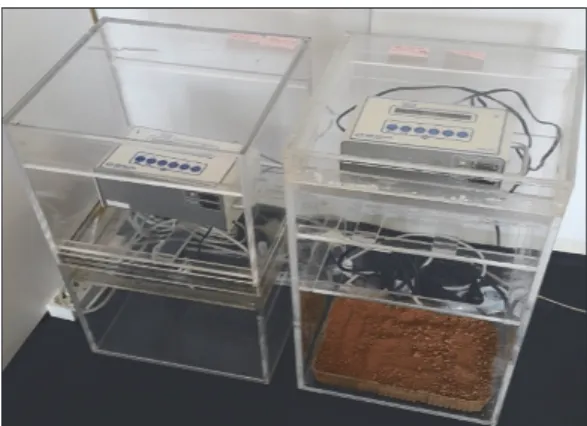
well in a previous paper (Lee et al., 2018). Briefly, self-designed acryl chambers (width: 300mm, length:

300mm, height: 600mm, volume: 0.054m 2 ) were cre- ated and hermetically sealed. Two continuous radon monitors, Sun Nuclear Model 1028, were used for the whole experiment. High resolution data of the radon concentration can be achieved to the CRM, Model 1028 (Sun Nuclear Co., USA), over time. As shown in Fig. 1(a) and 1(b), a sample, Hwangtoh, was laid on the floor, and the machine was installed over the sample, which was 30 cm away from the radon monitor. Radon gas was detected continuously over 12 points a day for 20 days after the points reached a sta- ble level within fifth half-lives. Temperature and hu- midity were indicated to 26 ± 2℃ and RH 55 ± 3%, respectively. For the blank, a chamber without samples was prepared and measured with the same procedure to figure out where radon emission was actually coming from and to get rid of the background effect.

2.3. Calculation of radon emanation

According to the Petropoulos article, enclosed sample method is the most general technique to measure the ex- halation rate of a typical building material (Petropoulos et al., 2001). A sample is in a closed container, and the increasing amount of the radon concentration in the air volume is described by the following equation:

(1)

where:

C = sample’s radon concentration (Bqm -3 ) in a container at growth time t (h)

E = exhalation rate of radon (Bqh -1 ) λ = decay constant of radon (h -1 )

C o = initial concentration of radon (Bqh -1 ) in a container at the initial time t o

t = time in measurement

From the equation (1), the conversion of radon ex- Fig. 1(a). Self-designed closed chambers.

Fig. 1(b). Scheme of the experiment in the CCM.

(5)

halation from the measured data was calculated, and it could be directly transformed to equation (2) by Chen (Chen et al., 2010).

(2)

where:

A = surface area of sample (m 2 )

V = enclosing volume of the chamber (m 3 )

When applying equation (2), the surface exhalation rate in the air tighten container should be similar to the free surface exhalation in accordance with the ac- tual room condition.

(3)

where:

(s -1 ), which consists of decay constant, back-diffusion coefficient and chamber leakage coefficient, respectively.

For equation (3) by Awhida (Awhida et al., 2016), the measurement can be compared with the standard accumulation method with the same geometry and its free surface. Equation (3) is combined to the concept of measurement time. When applying Equation (2), it is necessary to minimize the background term, C o , es- pecially for materials of low radon exhalation rates.

Chen reported that the contribution from the term in Equation (2) could be neglected in the case of the radon concentration in the laboratory where all testing was performed was under 15±10 Bqm -3 . Therefore, the Equation (2) can be transformed to the Equation (4) if the both values, the compensating and neglecting expressions, , are negligible.

(4)

Where:

E M = mass exhalation rate (Bq/kg·h) E A = areal exhalation rate (Bq/m 2 h) M = mass of sample (kg)

Based on the all four calculations, the verification measurement values can be confirmed and transferred to the meaningful values of radon emanation.

2.4. Prediction of indoor radon concentration

Indoor radon concentration was estimated from the radon exhalation rate of Hwangtoh samples calculated by Equation (4). The contribution of indoor radon con- centration from the exhalation rate of Hwangtoh sam- ples can be calculated with the following Equation (5) (Lee et al., 2018; Mahur et al., 2009; Nazaroff and Nero, 1988).

(5)

Where:

C Rn =concentration of indoor radon emanation from building materials (Bq/m 3 )

E x = exhalation rate of radon (Bq·m -2 ·h -1 ) V r = Volume of the room (m 3 )

λ v = air-exchange rate (ach) S r = Surface area (m 2 )

2.5. Exhalation rate analysis

The results are demonstrated from the measured

values of Hwangtoh as a building material from the

continuous radon monitor to verify the characteristics

of radon concentration. The recorded data and the

curves of the results were processed using statistical

analysis, which were operated by IBM SPSS version

22 because the tendency cannot be proved with only

the result curves. The properties of Hwangtoh in dif-

ferent production regions over the half-life can be de-

termined by measuring 230 radon counts.

(6)

3. RESULTS and DISCUSSION 3.1. Radon exhalation rate over Korean

residual soil, Hwangtoh

The concentrations of exhalation of all the tested Hwangtohs were measured to be distributed across the range between 5.3 and 11.3 pCi/L in a chamber as shown in Table 1. The mass exhalation rates of all the samples were calculated, which ranged from 0.0398 to 0.0848 Bq·kg -1 ·h -1 . Moreover, the surface ex- halation rates resulted in the 1.4208-3.0293 Bq·m 2 ·h -1 range. The result shows that the surface and mass ex- halation rates are significant over the production areas.

Although D Province Hwangtoh is the highest value among the samples, it is still below the world average, 57.6 Bq·m -2 ·h -1 in Table 2 (UNSCEAR, 2000).

The correcting backgrounds by a control were not

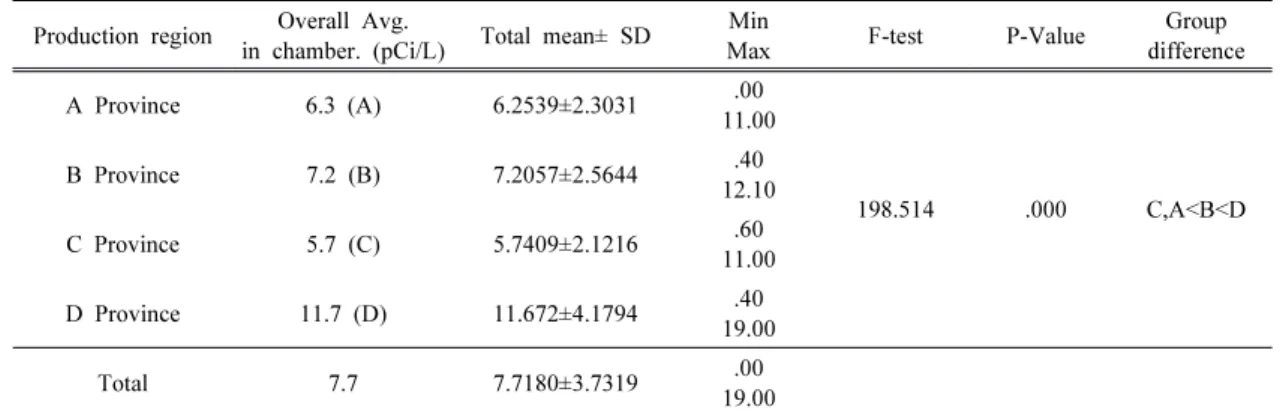
performed, well described in a previous paper (Lee et al., 2018). In brief, the correcting values were not ef- fective to process every single counts, 230 counts, of samples and a blank. Because of this treatment, the stat- istical significance test for group differences for radon exhalations from Hwangtohs along with production re- gions was conducted without the corrected background effect as shown in Table 3. Because the control correc- tions of empty chambers had shown a similar aspect, the distribution for the statistical significance tests in- dicates the same result whether each exhalation rate of Hwangtoh is corrected or not by the blanks.

As a result of the statistical data, four Hwangtoh ma- terials were divided into three groups: C and A < B <

D. Significant differences were found among Hwangtoh materials according to the production regions. The region- al differences are probably caused by physicochemical differences and climate-controlled differences in soil

Production area Overall Avg. in chamber (pCi/L) Empty chamber

(pCi/L) Concentration of

emanation (pCi/L) Surface exhalation

rate (Bq·m -2 ·h -1 ) Mass exhalation rate (Bq·kg -1 ·h -1 )

A Province 6.3 0.4 5.9 1.5817 0.0443

B Province 7.2 0.4 6.8 1.8230 0.0510

C Province 5.7 0.4 5.3 1.4208 0.0398

D Province 11.7 0.4 11.3 3.0293 0.0848

Table 1. Radon Concentration, Surface Exhalation Rate and Mass Exhalation Rate for Hwangtohs

Material Radon exhalation

per unit area (Bq·m -2 ·h -1 ) Radon exhalation

per unit weight (Bq·kg·h -1 ) Countries

origin Reference

Soil - 0.0777 U.S.A. (CA,MD) (Ingersoll, 1983)

Soil 57.6 - World average (UNSCEAR, 1969)

Soil 0.375±0.147 - Pakistan(Punjab) (Faheem and Matiullah, 2008)

Soil 72-7560 - Syria (Shweikani and Hushari, 2005)

Soil 0.246-1.100 - India (Singh et al., 2005)

Soil - 0.0391-0.0912 India (Bala et al., 2017)

Soil 0.003-0.145 - Morocco (Oufni, 2003)

Soil 0.4368-2.7913 0.00219-0.01403 Nepal (Parajuli et al., 2015)

Soil 161.28-174.96 - South Korea (Seo et al., 2018)

Hwangtoh 1.421-3.029 0.040-0.085 South Korea Present study

Table 2. Radon Exhalation Rates of Soils from Various References

(7)

weathering and parent rocks (UNSCEAR, 1969). Hence it is concluded that these Hwangtoh materials in this study are available to use for construction purposes until due to low exhalation of radon, which is lower than both the Korean radon recommendation level, 200 Bq/m 3 and WHO´s action level, 100 Bq/m 3 .

3.2. Conversion to indoor radon concentration

Every country has different acceptable indoor radon levels. A common action level, 100 Bq/m 3 or 2.7 pCi/L, was established by the WHO (Zeeb et al., 2009). In the United States, the Environmental Protection Agency noted that the action level of 148 Bq/m 3 (4 pCi/L) is the standard (EPA, 2012). In South Korea, the Ministry of Environment drew up guidelines for the radon stand- ard level, 148 Bq/m 3 for multi-use facilities and 200 Bq/m 3 for new apartment houses since 2018, two times higher than that of the WHO (KME, 2016).

On the basis of the findings, one can estimate the contribution of the radon emanating from the Hwangtoh materials used in a typical Korean house to its indoor radon levels. From Equation (5), the results of the ra- don concentrations in the closed chambers can be ap- plied and predicted to a hypothetical space as a general building. For example, there is a Korean traditional wood-frame Hwangtoh building (9 x 18 x 2.4 m 3 ,

width x length x height), Ondol (Korean floor heating system) floor, 9 x 18 m 2 of Hwangtoh ceiling, three Hwangtoh walls (because the size of windows and doors were assumed to be the size of one-side wall), and air-exchange rates of 0.5 and 0.1 air changes per hour (ach). According to all surface exhalation rates of Hwangtohs in Table 1, the contribution of the Hwangtoh to indoor levels would be between 1.97 and 4.20 Bq·m -3 as shown in Table 4. The values are significantly less than the concentrations of 74.1 Bq·m -3 observed in structures built from ochre materials (Kim et al, 2002). To compare our results of the radon emanation rates from Hwangtoh materials with those of other references in Table 2, Korean Hwangtohs tested in this study belonged to the lowest group of the radon emanation among the various world soils. The radon exhalations of the samples have been found to be well below the world average value of 57.6 Bq·m -2 ·h -1 (0.016 Bq·m -2 ·s -1 ).

Supposing an air exchange rate of 0.1 ach, the re- sulting indoor concentration would be between 9.86 and 21.02 Bq·m -3 . Hence it is concluded that these Hwangtoh materials in this study are available to use for construction purposes until due to low exhalation of radon, which is lower than the Korean radon recom- mendation level, 200 Bq/m 3 . Another example can be found in the previous paper (Seo et al., 2018).

Production region Overall Avg.

in chamber. (pCi/L) Total mean± SD Min

Max F-test P-Value Group

difference

A Province 6.3 (A) 6.2539±2.3031 .00

11.00

198.514 .000 C,A<B<D

B Province 7.2 (B) 7.2057±2.5644 .40

12.10

C Province 5.7 (C) 5.7409±2.1216 .60

11.00

D Province 11.7 (D) 11.672±4.1794 .40

19.00

Total 7.7 7.7180±3.7319 .00

19.00

Table 3. Group Differences of Radon Exhalations from Hwangtohs along with Production Regions

(8)

In this case, soil radon exhalation per unit area is 174.96 Bq·m -2 ·h -1 , which is the highest among their samples, and the resulting indoor concentration would be 1214.2 Bq·m -3 , which is 6 times larger than the Korean radon recommendation level as mentioned earlier. Therefore, it is necessary to make up with more research by increasing the number of Hwangtoh sam- ples considering the references mentioned above. It is also recommended that the radon exhalation rate should be measured for all building materials and a standard code for indicating radon level placed on all products.

3.3. Half-lives of radon in Hwangtohs

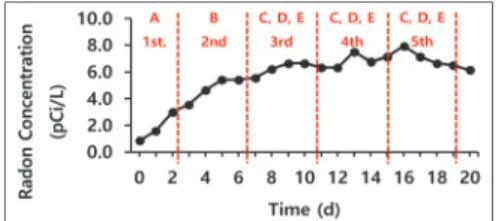
Radon concentration increments in a closed contain- er attain a quasi-steady state, in which the radon emis- sion from Hwangtohs and the transformation by half- lives are practically equal. (Lee et al., 2018). Fig. 4 shows a relatively high radon emission from a Hwangtoh board produced by a company from N city in South Korea. The graph also shows the increasing range of radon concentration decreases as the half-life continues, and it maintains at an appropriate level. It is easy to identify what the tendency of radon concen- tration is about according to the number of half-life cycles. As a result of the board, the steady state was reached at the 5 th half-life among 9 half-lives. In case of Hwangtoh sample from C Province, its steady state was reached at the third half-life. In short, the board with higher radon concentration evidently required the longer time to reach the quasi-steady state in the test

environment, in other words, the number of half-life it cycled through increased from the set starting point.

As mentioned earlier, the results of Fig. 2 and Fig. 3 depict radon concentrations for Hwangtoh materials in the chamber without reflecting the control’s background.

Production area Surface exhalation rate (Bq·m -2 ·h -1 )

Converts in Indoor Concentration (Bq·m -3 ), 0.5 ach

Converts in Indoor Concentration (Bq·m -3 ), 0.1 ach

A Province 1.5817 2.20 10.98

B Province 1.8230 2.53 12.65

C Province 1.4208 1.97 9.86

D Province 3.0293 4.20 21.02

Table 4. Indoor Radon Concentration

Fig. 2. Radon concentration of C province Hwangtoh in chamber.

Fig. 3. Daily averages of the concentration of C province Hwangtoh in chamber.

Fig. 4. Averages of sequential half-lives of commercial

Hwangtoh board and group difference by Scheffe test.

(9)

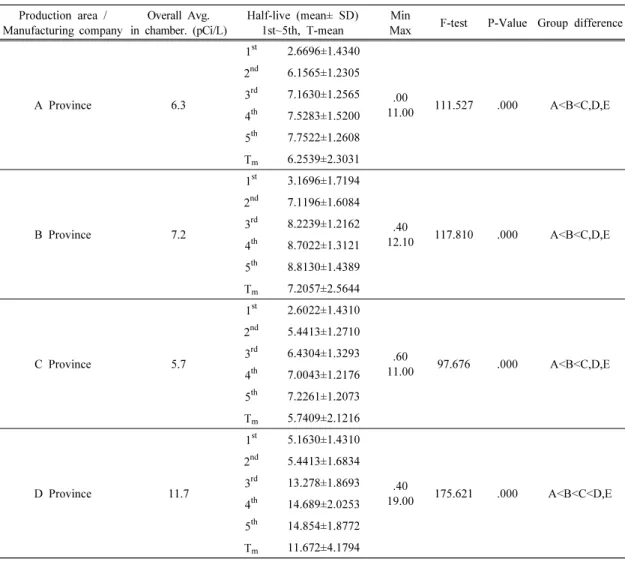
The radon concentrations of Hwangtoh materials were compared up to the fifth half-life by the CCM.

The results of Table 4 were shown only for five se- quential half-lives because more measurements were not necessary since the average peaks of the concen- trations were attained at the forth half-life. The meas- urements were taken to 20 days, unlike previous pa- pers (Lee et al., 2015; Najam et al., 2014), which not- ed that two or three months were needed. The stat- istical significance test for group difference between the number of half-lives indicated the same results

whether the values were calibrated or not because there were no differences between the corrected aver- ages and original non-corrected averages (Lee et al., 2018). As a result of the statistical processing data, all Hwangtoh materials were confirmed in the same group of the 3 rd , 4 th and 5 th half-lives by the Scheffe test, and one last Hwangtoh material was positioned in the different group of 4 th and 5 th half-lives. Therefore, the experiment was proceeded until the fifth half-life period as shown in Table 5.

Production area /

Manufacturing company Overall Avg.

in chamber. (pCi/L) Half-live (mean± SD)

1st~5th, T-mean Min

Max F-test P-Value Group difference

A Province 6.3

1 st 2.6696±1.4340

11.00 .00 111.527 .000 A<B<C,D,E 2 nd 6.1565±1.2305

3 rd 7.1630±1.2565 4 th 7.5283±1.5200 5 th 7.7522±1.2608 T m 6.2539±2.3031

B Province 7.2

1 st 3.1696±1.7194

12.10 .40 117.810 .000 A<B<C,D,E 2 nd 7.1196±1.6084

3 rd 8.2239±1.2162 4 th 8.7022±1.3121 5 th 8.8130±1.4389 T m 7.2057±2.5644

C Province 5.7

1 st 2.6022±1.4310

11.00 .60 97.676 .000 A<B<C,D,E 2 nd 5.4413±1.2710

3 rd 6.4304±1.3293 4 th 7.0043±1.2176 5 th 7.2261±1.2073 T m 5.7409±2.1216

D Province 11.7

1 st 5.1630±1.4310

19.00 .40 175.621 .000 A<B<C<D,E 2 nd 5.4413±1.6834

3 rd 13.278±1.8693 4 th 14.689±2.0253 5 th 14.854±1.8772 T m 11.672±4.1794

Table 5. Group Differences among Half-lives of Radon Exhalation from Hwangtohs

(10)

4. CONCLUSION

The CCM conducted by a CRM has been used to determine radon exhalation rates from building materials. In this study, four different Hwangtohs of mass market brands were selected considering accessi- bility, convenience, and locations, and were compared for radon exhalation rates based on four different re- gional features of raw materials in South Korea. The radon mass exhalation rates of all the samples were distributed from 0.0398 to 0.0848 Bq·kg -1 ·h -1 , and the surface exhalation rates resulted in the 1.4208 to 3.0293 Bq·m 2 ·h -1 range. Even though significant dif- ferences were found among Hwangtoh materials ac- cording to the production region of raw materials, the Korean Hwangtoh materials are satisfied to use for the construction purposes due to both low radon ex- halations below the Korean radon recommendation level 200 Bq·m -3 and the WHO´s action level, 100 Bq/m 3 . To reach a quasi-steady state in case of an en- vironment with high radon concentration, the number of half-life cycles increases from a set starting point.

The more study of the relationship between radon and Hwangtoh is still necessary to corroborate with more research by increasing the number of Hwangtoh sam- ples, considering the other references reported high ra- don exhalation rates. In addition, it is highly recom- mended that the radon exhalation rates should be measured for all building materials for human health before the materials were used.

REFERENCES

Awhida, A., Ujic, P., Vukanac, I., Durasevic, M., Kandic, A., Celikovic, I., Loncar, B., Kolarz, P.

2016. Novel method of measurement of radon exhalation from building materials. Journal of Environmental Radioactivity 164: 337-343.

Bala, P., Kumar, V., Mehra, R. 2017. Measurement

of radon exhalation rate in various building materials and soil samples. Journal of Earth System Science 126(31): 1-8.

Chen, J., Rahman, N.M., Abu Atiya, I. 2010. Radon exhalation from building materials for decorative use. Journal of Environmental Radioactivity 101(4):

317-22.

Choi, W.S., Yang, S.O., Lee, J.H., Choi, E.J., Kim, Y.H., Yang, J.Y., Park, M.J. 2020. Profiling patterns of volatile organic compounds in intact, senescent, and litter red pine. Jouranl of the Korean Wood Science and Technology 48(5): 591-607.

Elliot, T., Bonotto, D.M., Andrews, J.N. 2014.

Dissolved uranium, radium and radon evolution in the continental intercalaire aquifer, algeria and tunisia. Journal of Environmental Radioactivity 137: 150-162.

Environmental Protection Agency (EPA) 2012. A citizen’s guide to radon. The guide to protecting yourself and your family from radon. pp. 1-16.

Faheem, M., Matiullah 2008. Radon exhalation and its dependence on moisture content from samples of soil and building materials. Radiation Measurements 43(8): 1458-1462.

Gundersen, L.C.S., Schumann, R.R. 1996. Mapping the radon potential of the united states: Examples from the appalachians. Montreal, Canada, Proceedings of the 1995 6th International Symposium on the Natural Radiation Environment, NRE, 22(1): 829-837.

Han, H.J., Lee, S.E., Yang, S.M., Chio, C., Kang, S.G.

2019. Evaluation of formaldehyde emission from wood-based panels using accelerated collection method. Journal of the Korean Wood Science and Technology 47(2): 129-144.

Hwang, J., Lee, H. 2010. The applications and mineral compositions of residual soils distributed in south korea(asian clay special paper). Clay Science 14(6):

253-262.

Hwang, J., Park, H., Yang, K., Lee, H. 2002. Mineralogy

(11)

and chemical properties according to particle size separation of hwangto (reddish residual soil) used in feeding of cattle. Journal of the Mineralogical Society of Korea 15(1): 33-43.

International Agency for Research on Cancer (IARC) 1988. Man-made mineral fibres and radon. IARC monographs on the evaluation of carcinogenic risks to humans, 43.

International Commision on Radiological Protection (ICRP) 1993. Protection against radon-222 at home and at work. ICRP Publication 65. Ann. ICRP, 23(2): 1-45.

Ingersoll, J.G. 1983. A survey of radionuclide contents and radon emanation rates in building materials used in the u.S. Health Physics 45(2): 363-368.

Jang, J.H., Lee, M., Lee, S.M., Park, S.B. 2017.

Formaldehyde emission of building materials and effection of carbonized board on their reduction.

Journal of the Korean Wood Science and Technology 45(3): 327-334.

Jang, J.H., Lee, M., Kang, E.C., Lee, S.M. 2017.

Characteristics of low density fiberboards bonded with different adhesives for thermal insulation(II).

Journal of Korean Wood Science and Technology 45(5): 580-587.

Jeong, G., Kim, S. 1990. Iron oxide minerals in the sancheong kaolin deposits. Journal of The Mineralogical Society of Korea 3(2): 79-88.

Kim, I., Seo, S., Kang, C. 2000. General properties and ferric oxide content of hwangtoh (yellow ochre). Journal of Korean Pharmaceutical Sciences 30(3): 219-222.

Kim, J.S. 2018. Indoor radon levels and effective dose estimation in learning and common living space of university. J. Korean Soc. Radiol. 12(3): 329-333.

Kim, K., Kim, S., Park, M., Kim, H., Park, J. 2010.

Characteristics of a reddish residual soil (hwangtoh) finishing material with water-soluble adhesive for residential building. Construction and Building

Materials 24(8): 1542-1546.

Kim, C., Noh, J., Park, S., Park, S., Park, H., Lee, D., Lee, J., Lee, H., Jang, B., Jin, H., Choi, S., Kim, O., Park, S., Lee, M., Lee, S., Cho, E., Choi, S., Choi, Y., Choi, J., Han, H. 2002. Assessment of radiation risk for korean population and nationwide indoor radon survey in korea: Nationwide survey of indoor radon level in korea, Korea Institute of Nuclear Safety (KINS), 3(1): 100-151.

Korean Ministry of Environment (KME) 2016. Indoor air quality control in public-use facilities, etc. Act.

2003. No. 6911.

Lee, C., Jung, S., Lee, D., Kim, Y., Lee, D., Cho, Y., Jin, Y. 2015. Investigation of radon emanation of domestic building materials. Journal of Odor and Indoor Environment 14(1): 50-56.

Lee, J., Choi, G., Kang, S. 2018. Radon exhalation from five wood species. Journal of the Korean Wood Science and Technology 46(6): 735-747.

Lee, M., Park, S.B., Lee, S.M., Lee, H.Y., Kil, D.H.

2014. Emisson characteristics of volatile organic compounds by humidifer with using hinoki cypress extracts. Journal of the Korean Wood Science and Technology 42(6): 747-757.

Lubin, J.H., Boice, J.D., Jr. 1997. Lung cancer risk from residential radon: Meta-analysis of eight epidemiologic studies. Journal of the National Cancer Institute 89(1): 49-57.

Lubin, J.H., Boice, J.D., Jr., Edling, C., Hornung, R.

W., Howe, G.R., Kunz, E., Kusiak, R.A., Morrison, H.I., Radford, E.P., Samet, J.M., et al. 1995. Lung cancer in radon-exposed miners and estimation of risk from indoor exposure. Journal of the National Cancer Institute 87(11): 817-827.

Mahur, A.K., Kumar, R., Sengupta, D., Prasad, R. 2009.

Radon exhalation rate in chhatrapur beach sand

samples of high background radiation area and

estimation of its radiological implications. Indian

Journal of Physics 83(7): 1011-1018.

(12)

Mun, S.W., Kang, Y.S., Park, J.H., Han, M.S., Jeong, H.Y. 2019. A study on the making properties of natural pigments based on substance characteristics for hwangto in korea. Journal of Conservation Science 35(6): 600-611.

Najam, L., Tawfiq, N., Mahmood, R. 2014. Radon concentration in some building materials in iraq using cr-39 track detector. International Journal of Physics 1(3): 73-76.

Nazaroff, W.W., Nero, A.V. 1988. Radon and its decay products in indoor air. New York, NY (US); John Wiley and Sons, Incorporated, United States.

Neidherr, D., Audi, G., Beck, D., Blaum, K., Bohm, C., Breitenfeldt, M., Cakirli, R.B., Casten, R.F., George, S., Herfurth, F., Herlert, A., Kellerbauer, A., Kowalska, M., Lunney, D., Minaya-Ramirez, E., Naimi, S., Noah, E., Penescu, L., Rosenbusch, M., Schwarz, S., Schweikhard, L., Stora, T. 2009. Discovery of 229rn and the structure of the heaviest rn and ra isotopes from penning-trap mass measurements.

Physical Review Letters 102(11): 1-5.

Oufni, L. 2003. Determination of the radon diffusion coefficient and radon exhalation rate in moroccan quaternary samples using the ssntd technique.

Journal of Radioanalytical and Nuclear Chemistry 256(3): 581-586.

Parajuli, P., Thapa, D., Shah, B. 2015. Study of radon exhalation rate in soil samples of kathmandu valley using passive detector lr115. International Journal of Chemical and Physical Sciences 4(4): 30-39.

Park, H.J., Jo, S.E. 2020. Evaluation of physical, mechanical properties and pollutant emissions of wood-magnesium laminated board(WML Board) for interior finishing materials. Journal of the Korean Wood Science and Technology 48(1): 86-94.

Petropoulos, N.P., Anagnostakis, M.J., Simopoulos, S.E. 2001. Building materials radon exhalation rate:

Erricca intercomparison exercise results. Science of the Total Environment 272(1-3): 109-118.

Rhie, J., Choi, K. 2005. Coloration of synthetic fiber fabrics with loess(i). Korean Journal of Human Ecology 8(1): 19-24.

Seo, J., Nirwono, M.M., Park, S.J., Lee, S.H. 2018.

Standard measurement procedure for soil radon exhalation rate and its uncertainty. Journal of Radiation Protection and Research 43(1): 29-38.

Seok, J., Jun, S. 2009. Control of redtide microbes with hydrogen peroxide and yellow loess. Journal of Korean Society of Water and Wastewater 23(4): 491-497.

Shin, G., Choo, Y., Kim, K., Ryu, H., Lee, S. 2011.

Evaluation of lanthanum(iii): loess compositeas an adsorbent for phosphate removal. Journal of Korean Society of Environmental Engineers 33(2): 143-148.

Shweikani, R., Hushari, M. 2005. The correlations between radon in soil gas and its exhalation and concentration in air in the southern part of syria.

Radiation Measurements 40(2-6): 699-703.

Singh, S., Kumar, M., Mahajan, R.K. 2005. The study of indoor radon in dwellings of bathinda district, punjab, india and its correlation with uranium and radon exhalation rate in soil. Radiation Measurements 39(5): 535-542.

United Nations Scientific Committee on the Effects of Atomic Radiation (UNSCEAR) 1969. Report of the united nations scientific committee on the effects of atomic radiation.

United Nations Scientific Committee on the Effects of Atomic Radiation (UNSCEAR) 2000. Source, effects and risk of ionizing radiation.

Webb, G.A.M. 1992. Exposure to radon. Radiation Protection Dosimetry 42(3): 191-195.

Yoo, J., Lee, K., Seo, S., Kim, S., Lee, J. 2019.

Comparison of indoor radon concentrations in areas of jeollabuk-do province. Journal of Environmental Health Sciences 45(6): 658-667.

World Health Organization (WHO) 2009. WHO handbook on indoor radon: A public health perspective. 1(1.1):

7-13.

수치

Fig.  1(b).  Scheme  of  the  experiment  in  the  CCM.
Table  1.  Radon  Concentration,  Surface  Exhalation  Rate  and  Mass  Exhalation  Rate  for  Hwangtohs
Table  3.  Group  Differences  of  Radon  Exhalations  from  Hwangtohs  along  with  Production  Regions
Fig.  4.  Averages  of  sequential  half-lives  of  commercial Hwangtoh  board  and  group  difference  by  Scheffe  test.
+2

참조

관련 문서

Radon remediation in homes with levels ≥ 21.6 pCi/L $6,100

This study aims to assess the impacts of the foundation and management of the Innopolis start-ups in terms of expansion of entrepreneurship

This study examined the sensibility about the fundamental value of ‘safety’ of police officer who are responsible for the public security to establish

Second, as a result of the IPA analysis of the sub-factors of audience perception, the factors of entry route were located in the first quadrant, the

In the efficiency review of the Trombe wall system through the experiment, if the Trombe wall was applied in the building structure, the Trombe wall had the

The concerned study is now believed to make a contribution to protecting the seniors in Korea from committing a suicide and to reduce the suicidal

In this thesis, this method choosing the node having reliable RSSI values based on the reliability of the signal is proposed for the... more accurate

As the importance of education through play in modern children's education is emphasized, this study aims to propose an art education program through play