• 검색 결과가 없습니다.

Demand Analysis for the Development of Basic-Level TRIZ Curriculum

N/A
N/A
Protected

Academic year: 2021

Share "Demand Analysis for the Development of Basic-Level TRIZ Curriculum"

Copied!
8
0
0

로드 중.... (전체 텍스트 보기)

전체 글

(1)

Demand Analysis for the Development of Basic-Level TRIZ Curriculum

Jiyoung Han

*

․ Seung-Hyun Yoo

**,†

**

Daejin University, Innovation Center for Engineering Education

**

Ajou University, Department of Mechanical Engineering

ABSTRACT

This study was conducted for the purpose of developing a basic-level TRIZ curriculum to improve students’ creativity and problem- solving abilities. Towards this end, literature review, field application study, and a survey on the demand for such curriculum were conducted, as the research methodologies. Specifically, literature review was performed on the TRIZ-related research trends and education trends, and the researchers, who had experience running a TRIZ education program for a few years, ran a basic-level TRIZ for 40 hours as part of the extra-curriculum of A University. An actual survey was also conducted to determine the demand for the development of a basic-level TRIZ curriculum. Of the total of 40 students who were subjected to the curriculum, 31 responded sincerely ŀto the survey.

Based on the survey analysis results on the students’ recognition of the TRIZ curriculum and of the TRIZ task performance, and on the contents and educational effects of TRIZ, basic guidelines for the development of a basic-level TRIZ curriculum were formulated.

Reflecting the results of the survey on the demand for a basic-level TRIZ curriculum, such a curriculum was proposed based on 16-week-long, 3-credit lectures considering the curricula of other subjects in the university.

Keywords: TRIZ, creativity, curriculum development, demand analysis

I. Introduction 1)

Although South Korea has achieved drastically fast industrialization yet unparalleled in history, the nation is now contemplating what it has to do to be upgraded to a fast mover from a fast follower. This can be seen in the nation's search for its current tasks from the activation of a creative economy. The major concerns in many industrial fields and of many educational institutions are focused on the improvement of the workers' and students' creativity and problem-solving abilities, and how they can visualize their performances. In this process, with the introduction of the engineering education accreditation system to the engineering colleges of universities in the 2000s, the interest in engineering education has largely increased, and each engineering college is promoting innovation of its education program to raise high-quality engineers with the ability

Received 14 July, 2014; Revised 14 July, 2014 Accepted 30 July, 2014

† Corresponding Author: [email protected]

to solve the problems that will confront them.

Many universities started to think of how they would educate their students with the end in view of improving their creativity and problem-solving abilities, which were their education keywords. For this, they aimed to actively utilize the engineering design subjects. They also started to think of how they would organize such subjects' contents.

In a related move, companies have conducted job training targeted at all employees or intensive training for researchers by operating TRIZ in-house or through separate TRIZ- specialized organizations. This is because TRIZ has contributed to solving problems in various industrial fields since its introduction into Korean companies in 1996.

TRIZ is what enables a comprehensive survey of the theory developed by Dr. Altshuller from Russia solve the problems in a creative and systematic way by extracting common problem-solving principles from millions of patents (Yoo, 2013).

As the effectiveness of TRIZ has been demonstrated,

many universities have operated TRIZ training courses as

(2)

a non-curriculum course or a regular curriculum course.

However, in many cases, one course is operated regardless of level, which is not based on systematic educational research, or professional part-time lecturers are the ones who handle training.

This study is designed to lay the groundwork for the development of educational courses by conducting a survey on demands of students who underwent TRIZ training in the process of developing a TRIZ training course organized by level. This development is aimed at nurturing creative and innovative talents to meet the social needs and educational requirements in the field. In this regard, this study attempts to conduct a survey on the demand for the purpose of developing entry-level TRIZ training courses as a first step.

II. Literature Review

1. Basic concept and research trends of TRIZ

TRIZ is a creative problem-solving technique developed by Genrich Saulovich Altshuller(1926-1988) et al. and their pupils in the old USSR for over 50 years, from 1946.

The theory was established from the extraction of common problem-solving principles found from the analyses of over 3 million patents.

Altshuller found that a problem-solving technique generated from a certain area(e.g., chemistry) could be applied to other areas(e.g., mechanical engineering, electric science, etc.) in the same way, from the patent analysis process. As he applied the existing knowledge in another technological area to other current technological areas, he made technological innovation possible.

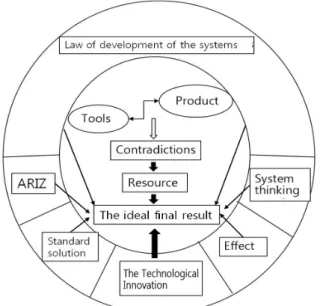
TRIZ employs ideality, contradictions, and system approach as its basic concepts. It is a systematic approach that analyzes problems, checks the contradictions in the system, and then pursues ideality using capable resources as its bases.

The association among the basic concepts and various other problem-solving tools included in TRIZ is modeled as follows(Rantanen & Domb, 2007; co-trans. Kim & Park, 2012);

Fig. 1 Concept and Instrument in TRIZ

2. Education trends of TIRZ

Rantanen & Domb(2007) delivered TRIZ education focused mainly on 40 invention principles, law of development of the system, and the use of a scientific-effect database to engineers, technology managers, development teams, manufacturing teams, inventors, and planning department staffs. As a result, she proposed the use of a program with simplified steps, progress based on steps, and a task performance practice subject as conditions for successful lectures. Further, as TRIZ education precautions, she suggested giving short feedback for success, short lecture hours, and the use of familiar terminologies and cases, there being many new terminologies in TRIZ.

Clapp(1998) of NC State University promoted a complex design education program based on TRIZ consisting of 4-credit classes spanning over two semesters, and concluded that it is effective for attempting to perform impossible tasks or solving unsolved problems in companies. In particular, the TRIZ curriculum is useful for breaking psychological inertia. In this process, it was found that ideality, the contradiction theory, the substance field, resources, and ARIZ tools were useful, in that order.

In South Korea, POSCO Group opened POSCO TRIZ Internal

University to develop creative human resources equipped

with creative minds and capacities beyond the existing

(3)

thoughts and paradigms, and offers a mandatory TRIZ education subject to all the executives and employees of the company (POSCO Newspaper, 2010).

As TRIZ education is expanded among large corporations, and as the number of TRIZ-utilizing cases increases from elementary school education to university education as well as from the engineering to the service areas, various relevant studies, including those on the TRIZ utilization methods (Jung et al., 2003; Moon, 2006), the development of TRIZ application models(Kim, 2013; Kim, 2007), and the analysis of the effect of TRIZ application(Lee & Song, 2011; Jung, 2012), have been conducted.

III. Study Method

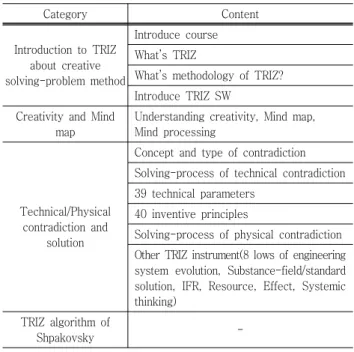
In this study, literature review, field application study through extra-curriculum operation, and a survey on the demand for the development of a basic-level TRIZ curriculum were carried out. Specifically, literature review on the trends in the study of TRIZ and TRIZ education was first executed, then an extra-curriculum consisting of theory and task practice was organized as planned by this study's joint researchers, who had several years' TRIZ education experience, after which TRIZ education was delivered to the students in A University for 40 hours. The theory part consisted of new-product development through TRIZ, creativity and mind maps, and technological/physical contradictions and solutions, which are creative problem-solving techniques.

For the task practice part, the program asked the students to solve problems by group using Shpakovsky's TRIZ algorithm. The detailed education program is shown in

<Table 1>.

Further, a questionnaire was developed consisting of five questions regarding the respondents' personal background, 34 questions evaluating the students' reactions to the detailed TRIZ curriculum(5-point scale), 20 questions about the students' task performance, and 6 discussion questions about the detailed programs of the theoretical classes and task performances as well as their educational effects, and a survey was conducted on them. Among the total of 40 students who were subjected to the TRIZ education, 31 answered the questions sincerely(77.5% of the response

Table 1 Education program of TRIZ

Category Content

Introduction to TRIZ about creative solving-problem method

Introduce course What’s TRIZ

What’s methodology of TRIZ?

Introduce TRIZ SW Creativity and Mind

map

Understanding creativity, Mind map, Mind processing

Technical/Physical contradiction and

solution

Concept and type of contradiction Solving-process of technical contradiction 39 technical parameters

40 inventive principles

Solving-process of physical contradiction Other TRIZ instrument(8 lows of engineering system evolution, Substance-field/standard solution, IFR, Resource, Effect, Systemic thinking)

TRIZ algorithm of

Shpakovsky -

ratio). The distribution of the students’ majors was as follows: engineering, 22(71%); business administration, 8 (25.8%); and law, 1(3.2%). As for the subjects’ gender distribution, there were 24 male students(approximately 77%) and 7 female students(approximately 23%). For the year level distribution, there were 19 third year students (63.3%), 10 fourth year students(33.3%), and 1 second year student(3.3%). Among the students, 16(51.6%) already knew about TRIZ education, and the other half did not know what TRIZ was when they started their education.

The SPSS ver.18 program for Windows was applied for analysis purposes, and statistical techniques were used to find the frequencies, percentages, averages, and standard deviations.

IV. Result

1. Results on the students' recognition of TRIZ education

It was found that students usually easily accepted and

understood the TRIZ outline, and that the contents that

are most helpful for task performance were the application

cases from companies(3.84) and from various academic

areas(3.77). Regarding the more detailed responses of

(4)

Table 2 The result on the students’ recognition of education of problem-solving instrument in TRIZ

Category Frequency

Difficulty Understanding Assistance of perform task

Average Standard

deviation Average Standard

deviation Average Standard deviation

Concept of contradiction 31 2.97 1.22 3.90 .75 4.42 .67

Concept of Administrative, Technical,

Physical contradiction 31 3.29 1.19 3.87 .76 4.29 .69

Solving principle of Technical contradiction 31 3.29 1.04 3.77 .76 4.35 .61

39 Technical parameters 31 2.94 1.21 3.71 .90 4.13 .96

40 Inventive principles 31 2.87 1.23 3.84 .93 4.19 1.01

Contradiction Matrix 31 2.65 1.08 3.81 .98 3.97 .98

Solving process of Technical contradiction 31 3.10 1.17 3.58 .92 3.97 .84

Function analysis 31 3.45 .96 3.45 .85 3.58 .96

Resource analysis 31 3.35 1.05 3.32 .87 3.77 .85

Substance-field analysis 31 3.74 1.00 3.03 1.02 3.35 .99

IFR 31 2.87 1.20 3.81 1.01 3.94 .89

9 windows analysis 31 3.32 .98 2.94 .89 3.10 1.04

Physical solving process 31 3.29 .94 3.29 .69 3.55 .81

Separated by time 31 2.77 1.18 3.81 .87 3.94 .81

Separated by space 31 2.84 1.19 3.61 .80 3.94 .81

Separated by system criterion 31 3.26 .97 3.23 1.18 3.68 .98

Separated by condition 31 3.23 1.09 3.45 .93 3.65 .99

The law of engineering system evolution 31 3.16 1.19 3.26 1.00 3.29 1.07

76 standard solutions 31 3.35 1.02 2.90 .98 3.19 1.22

Necessity and solving-problem of Science effect 31 3.16 1.07 3.35 .95 3.77 1.48

the students about the TRIZ outline, they indicated that the history of TRIZ was the easiest content(1.94) and was the most easily understood. It was found, however, that it was not helpful for task performance(3.13).

Regarding the students' recognition of the creativity and mind map education, the students' responses indicated that the students did not think that such education content was difficult, and that they had no problem understanding it. It did not, however, directly help them perform their tasks in the end. Nevertheless, the students recognized that they could have more realistic help if concrete materials like a mind map drawing manual(3.48) will be offered.

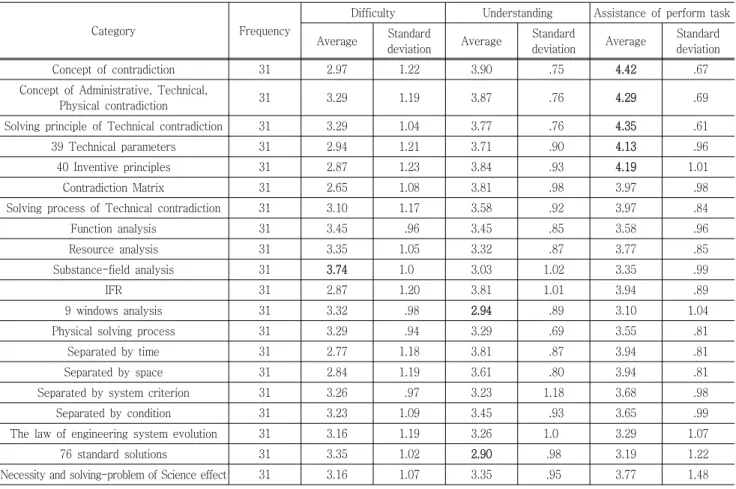
As shown in <Table 2>, the students did not recognize the various TRIZ tools for solving various problems as difficult, and had no problem understanding them. They thought that these were largely helpful in the process of solving problems and in the performance of actual tasks.

Considering the detailed TRIZ education contents, the students recognized “substance field analysis” as the

most difficult content(3.74), and windows analysis as the most difficult to understand(2.94). When solving problems by performing actual tasks and classifications(4.29), “principle for solving technological contradictions,” “technological parameters,” and “principles of invention” were found to be the most helpful, obtaining over 4 out of 5 points.

In the survey on the students' recognition of the problem- solving algorithm curriculum developed by Shpakovsky, the students responded that it was more difficult than the other curriculum contents even though it was not very difficult to understand. They indicated, however, that it helped them perform their tasks well because they solved the problems that they encountered while performing their tasks using Shpakovsky’s algorithm.

Specifically, it was revealed that the students slightly

negatively regarded the curriculum contents related to

Shpakovsky's algorithm compared to the previous educational

contents. It was shown that the students recognized the

level of difficulty as 3.42, which was higher than that of

(5)

Table 3 Result on the students' recognition of TRIZ task performance

Category Frequency Average Standard deviation

Recognition level of TRIZ 31 4.26 .68

Contradiction recognition of set problem 31 4.16 .74

Solving-problem by methodical process 31 3.81 .70

Significance recognition of surrounding resource analysis 31 4.42 .89

Understanding for super system 31 3.97 .88

Significance recognition of breaking psychological inertia 31 4.26 1.0

Problem analysis of Function 31 3.77 .88

Confidence for creative solving-problem 31 4.19 .70

Changing viewpoint of recognition of surrounding object 31 4.23 .85

Problem recognition of various viewpoint 31 4.32 .79

Assistance of TRIZ for Clear setting problem 31 4.42 .67

Assistance of TRIZ for general solving-problem 31 4.32 .70

Processing class of methodical way 31 3.35 1.17

Interesting about TRIZ 31 4.35 .71

Teamwork for processing perform task 31 4.61 .56

Equality solving between beginnings and endings 31 3.71 .97

Satisfaction of final solution 31 4.13 .76

Using TRIZ hereafter for Solving-problem 31 4.52 .72

Recommending education of TRIZ for friend 31 4.52 .63

the other contents, while their level of understanding of such content was only 3.99, which was lower than that of the other contents. Their evaluation of the level of its usefulness to their task performance was also 3.90, the lowest among the four relevant questions.

2. Students' recognition of TRIZ task performance

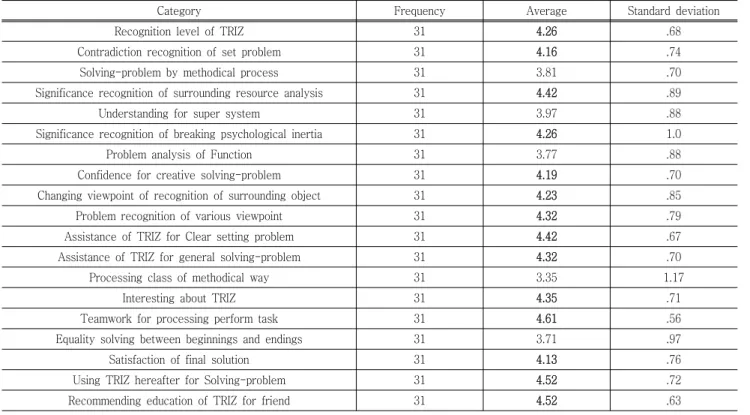
It can be seen in Table 3 that the levels of the students' recognition of TRIZ, of their understanding of it, and of their confidence in creative problem-solving generally became higher as they solved their problems utilizing Shpakovsky's TRIZ algorithm. Specifically, the students' willingness to solve future problems using the TRIZ algorithm and to recommend the TRIZ curriculum to their friends got a score of 4.52. Further, the students' interest in TRIZ became higher(4.35), they recognized that the TRIZ algorithm is helpful in solving problems(4.32), and they recognized that the analysis of the surrounding resources is very important in solving problems(4.42). Likewise, the students could be equipped with abilities to systematically solve problems in various aspects through TRIZ education.

3. Proposal to develop a basic-level TRIZ curriculum

a. Implications of the results of the survey on the demand for the development of a TRIZ curriculum

Below are the major considerations for the development of a TRIZ curriculum that were found through the survey.

First, it is basically considered that the organization of the program combining theoretical and practical classes for task performance is necessary for the in-depth understanding of the conceptual theory of TRIZ through practice.

Second, securing actual application cases of TRIZ in corporate or academic areas and introducing those to the students during the theory classes to explain the TRIZ outline can largely help the students understand TRIZ. Further, escaping from the explanation of TRIZ and of intellectual property rights by introducing the origin of TRIZ, and introducing cases where TRIZ was applied to the intellectual property rights area after the development of the TRIZ methodology for education, will help the students understand TRIZ to a large extent.

Third, the creativity and mind map areas are actually

considered subsidiary rather than direct areas of TRIZ.

(6)

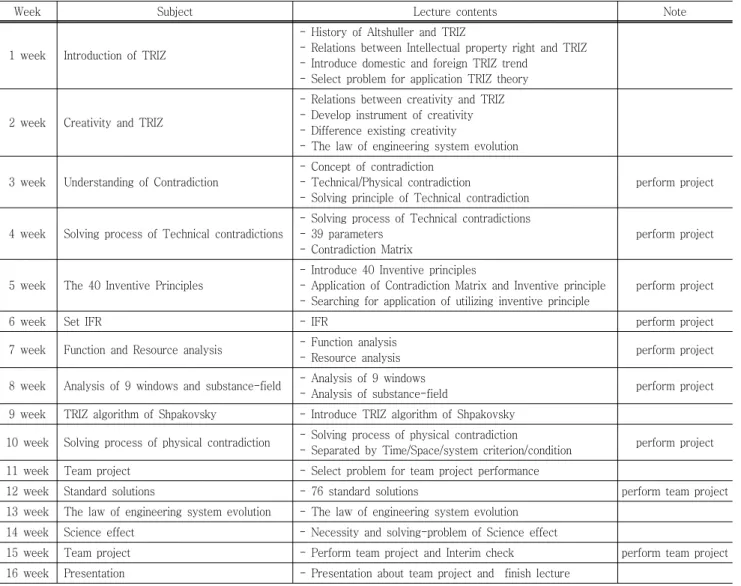
Table 4 Proposal to develop a TRIZ curriculum

Week Subject Lecture contents Note

1 week Introduction of TRIZ

- History of Altshuller and TRIZ

- Relations between Intellectual property right and TRIZ - Introduce domestic and foreign TRIZ trend

- Select problem for application TRIZ theory

2 week Creativity and TRIZ

- Relations between creativity and TRIZ - Develop instrument of creativity - Difference existing creativity

- The law of engineering system evolution

3 week Understanding of Contradiction

- Concept of contradiction - Technical/Physical contradiction

- Solving principle of Technical contradiction

perform project

4 week Solving process of Technical contradictions

- Solving process of Technical contradictions - 39 parameters

- Contradiction Matrix

perform project

5 week The 40 Inventive Principles

- Introduce 40 Inventive principles

- Application of Contradiction Matrix and Inventive principle - Searching for application of utilizing inventive principle

perform project

6 week Set IFR - IFR perform project

7 week Function and Resource analysis - Function analysis

- Resource analysis perform project

8 week Analysis of 9 windows and substance-field - Analysis of 9 windows

- Analysis of substance-field perform project

9 week TRIZ algorithm of Shpakovsky - Introduce TRIZ algorithm of Shpakovsky

10 week Solving process of physical contradiction - Solving process of physical contradiction

- Separated by Time/Space/system criterion/condition perform project 11 week Team project - Select problem for team project performance

12 week Standard solutions - 76 standard solutions perform team project

13 week The law of engineering system evolution - The law of engineering system evolution 14 week Science effect - Necessity and solving-problem of Science effect

15 week Team project - Perform team project and Interim check perform team project

16 week Presentation - Presentation about team project and finish lecture

Thus, if the curriculum is organized to suggest the relationship between creativity and TRIZ when the usefulness of TRIZ is dealt with, the students will accept creativity and TRIZ together, with a more consistent view. Also, when introducing the mind map in the curriculum, the students will more easily recognize it if various creativity-generating tools will be introduced, and if their differences from the existing creativity generation tools will be explained.

Fourth, when dealing with various TRIZ problem-solving tools, it is necessary to more systematically simplify the curriculum. In particular, when developing the basic-level curriculum, it is necessary to enhance the level of understanding of the practical application cases by providing various actual cases for each content. Besides cases, it is also necessary

to develop and provide guidelines and to set standards for decision-making when the application of the TRIZ principles in the application process is vague.

Fifth, many students indicated that they experienced the greatest difficulty in the problem analysis step. This could be due to the fact that the students had not accurately understood the various terminologies appearing in each problem analysis step. As such, this should be added to the program. Also, the problem analysis steps should be presented more systematically and in greater detail, and an effort should be made to help the students understand them by presenting various examples.

Sixth, as half of the students who took the course did

not have previous knowledge about TRIZ, it could have

(7)

been better had the focus been placed on the students' understanding of the concept of TRIZ rather than on holding classes with invited foreign TRIZ masters when running the basic-level TRIZ curriculum. It is considered that the lectures by invited experts would be more effective in the higher-level curriculum.

Seventh, the students can learn more effectively from actively participating in classes through discussions and other activities rather than through one-way lectures to students. Thus, it is proposed that theoretical and practical classes be better mixed and that the students be made to perform higher standard tasks to improve their creativity and problem-solving abilities in the latter part, rather than organizing theoretical classes in the first part and practical classes in the latter part.

b. Proposal to develop a TRIZ curriculum

The proposed TRIZ curriculum based on the above- mentioned implications of the results of the survey on the demand for the development of a TRIZ curriculum on the development of such a curriculum is as follows. This study suggests a 3-credit regular curriculum considering the university's credit system. This TRIZ curriculum will provide theories as well as apply small tasks set in the beginning of the class to enhance the students' understanding in each class. Also, as each team selects and solves a certain problem from its surroundings as well as performs the set small tasks, this curriculum tried to more systematically organize the theoretical and practical components of the program by assigning practice tasks and tasks for the teams to develop creativity.

To address the problem of TRIZ and the creativity part being slightly separated in the existing TRIZ curriculum, this curriculum organized the educational contents in such a way as to make the students realize how useful TRIZ is and to endeavor to develop their creativity by themselves.

The curriculum was also systematically set, with the contents arranged from easy to hard, and with concrete details for the abstract contents.

To effectively run such program, it is necessary to develop and provide guidelines for the available TRIZ tools to solve tasks.

V. Conclusion and Recommendation

In this work, a fundamental study was undertaken to develop a basic-level TRIZ curriculum to raise creative and innovative human resources among engineering students.

Towards this end, a survey was conducted on the demand for the development of a more systematic basic-level curriculum for the students who have completed the existing TRIZ education program.

Based on the results of the aforementioned survey, this study analyzed the curriculum contents that the students found difficult or difficult to understand, those that were helpful in their performance of actual tasks, and the educational effects of their completion of the entire TRIZ curriculum. Based on the results of the analysis of the survey results, the problems were analyzed, implications were drawn, the development directions of the TRIZ curriculum were set, and a TRIZ curriculum based on these was formulated.

To properly run the proposed curriculum, additional studies will be necessary. For this, this study further suggests the following:

(1) that many cases about the conceptually abstract terminologies be developed;

(2) that more studies be undertaken to more systematically organize the related know-how and the learning to be gained from experiences for the application of TRIZ to actual problems as a problem-solving process, and to reflect these to the curriculum;

(3) that more studies be conducted on how to maximize student participation, and for the consistent operation of the program, one instructor should be responsible for the curriculum, or if it is a team-teaching program, there should be more preparation on the part of the instructors;

(4) that for the performance of small tasks and team projects, a classroom suitable for discussions rather than lectures be assigned; and

(5) that studies on the connection of the curriculum to

design education be conducted, for the application of the

curriculum to the basic design education process, by

simplifying the curriculum, which will enhance its adaptability

to the field in the engineering colleges.

(8)

Acknowledgements

- This research was supported by Basic Science Research Program through the National Research Foundation of Korea(NRF) funded by the Ministry of Education, Science and Technology(2013R1A1A3010623).

- The second author is grateful for the support of HUA(Happy Undergraduate at Ajou University) project in ACE from Korean Ministry of Education to Ajou University

Reference

1. Jung, J.(2012), The Application Effect of TRIZ Technique in Practical Arts Idea Plan Activity by University Students of Education, Journal of Korean practical arts education, Vol. 25 NO. 3, Korea Practical Arts Education.

2. Jung, Y., Seo, Y., Koo, K., & Hyun, C.(2003), TRIZ Application for Inventive Thinking in the Design Phase VE, Journal of Korea Contents Association, Vol. 19 No. 8, The Korea Contents Society.

3. Kim, H.(2013), Instructional Design Model Development for Continuous Creativity-Personality Education based on NFTM-TRIZ, Journal of Korea Contents Association, Vol.

13 NO.8, The Korea Contents Society,.

4. Kim, G.(2007), Development and Verification of the Invention Education Model Applied with TRIZ Techniques, Journal of Korean practical arts education, Vol. 20 NO. 1, Korea Practical Arts Education.

5. Lee, S. & Song G.(2011), A Study on the Effects of the Essay-Writing Class Based on TRIZ on the Development of Creative Thinking, Digital library, Vol. 63 No.-, The Korea Digital library Forum.

6. Mann D.(2007). Hands of systematic innovation. IFR Consultants Ltd.

7. Moon, D.(2006), Exploring Strategies for Applying TRIZ to Technology Education, Journal of Korean Instiute of Industrial Educators. Vol. 31 NO. 2, The Korean Instiute of Industrial Educators.

8. Rantanen, K. & Domb, E.(2005). Simplified TRIZ. Kim, B., Park, S. co-translation. Inter vision.

9. Raviv, D.(2000). Teaching inventive thinking. TRIZ Journal.

10. Yoo, S. H.(2013). Sustainable Design by Systematic Innovation Tools(TRIZ, CAI, SI, and Biomimetics), Handbook of Sustainable Engineering, (Ed. J. Kauffman and K. Lee), Springer.

11. POSCO Newspaper. http://www.posco.co.kr/homepage/docs/

kor3/jsp/news/posco/s91fnews003v.jsp?idx=195775.

Han, Jiyoung

1993: BS, Inha University, Textile Engineering 2000, 2004:

MA, Ph.D. Seoul National University, Vocational Education (Technology Education)

2007: Post-Doc.University of Minnesota, Engineering Education supported by NRF Currently, Assistant Professor, Innovation Center for Engineering Education at Daejin University

Research area : Engineering education, ABEEK, Creative engineering design, TRIZ Phone: 031-539-2356

Fax: 031-539-2359 E-mail: [email protected]

Yoo, Seung-Hyun

1977, 1981: BS, MS, Seoul National University, Mechanical Engineering,

1986: Ph.D., Stanford University, Mechanical Engineering, Senior Researcher at The University of Michigan & KIMM(Korea Institute of Machinery and Materials) Currently, Professor of Mechanical Engineering, Biomedical Engineering at Ajou University Research area: Structural mechanics, Creative engineering design, Biomechanics, CAI, TRIZ

Phone: 031-219-2345

FAX: 031-219-1611

E-mail: [email protected]

수치

Fig.  1  Concept  and  Instrument  in  TRIZ
Table  1  Education  program  of  TRIZ
Table  2  The  result  on  the  students’  recognition  of  education  of  problem-solving  instrument  in  TRIZ
Table  3  Result  on  the  students'  recognition  of  TRIZ  task  performance
+2

참조

관련 문서

Therefore, the purpose of this study is to study on the special education teachers’ state of first aid education completion, knowledge level and abilities

The purpose of this study to investigate the background of revision, educational objectives, organization, contents of the high school earth science curriculum

The purpose of this study was to analyze the cultural contents of English textbooks (Grade 7) according to the 2009 revised middle school curriculum and

The purpose of this research is to the development and effect of the anthroposophy group art therapy program for improvement of creativity and reduction

The purpose of this study was to examine the parents' perceptions on the current status, effects and satisfaction of personal assistant service for students

The purpose of this study was to identify the frequency and related factors of advanced airway management for patients with cardiac arrest by the

To understand the current status of education, this study compared the 2015 Curriculum to the 2009 Curriculum whose teaching methods and evaluation standards

The purpose of this study was to investigate the Science Social Emotional Learning elements on the 2015 revised science curriculum and the achievement