INTRODUCTION
Every living thing on this planet moves by using ground reaction force (GRF) in each of their movements (Glaister, Orendurff, Schoen, Bernatz, & Klute, 2008). If GRF is not utilized properly, people cannot move safely and purposely. When a beginner ballerina pirouettes, they simply spin their bodies without efficiently (Prisk & O'Loughilin, 2008) using vertical force in order to spin, but when an expert pirouettes, they push off of the ground vertically in order to keep themselves spinning for longer (Lee & Oh, 2012; Orendurff, Schoen, Bernatz, Klute, & Glaister, 2008) rather than solely spinning on the balls of their feet. This is an example of utilizing ground reaction force.
In golf, there are seven phases to a golf swing that focus only on upper extremities; however, just like a ballerina, a player must also focus on using ground reaction force during their swing. With that said, if a golf player utilizes ground reaction force properly, they might perform well. On the other hand, beginners usually fail to use ground reaction force properly while swinging (Stuart, 2009).
There are three elements in golf. One is power, the second is accuracy, and the third is repeatability (Whang, 1993). If someone can use ground reaction force properly, they can satisfy these three elements of golf (Willams, Jones, & Snow, 1998). Golf instructors usually focus on the
angling of joints and speed rather than ground reaction force. Even if one angles their joints properly, they may still fail to have a good swing if they do not utilize ground reaction force effectively. In order to increase their swing velocity, golfers must also utilize GRF (Keller et al., 1996; Kulig, Fietzer, & Popovich, 2011).
Some of the reasons why people cannot use ground reaction force are: a narrow base of support at their feet; ankle, knee, and hip insta- bility (Jeffrey Mann, 2016), wearing shoes that do not produce proper friction; uneven medial gluteus; lack of knowledge regarding utilizing downward force while swinging etc. Such predisposing factors can cause varying, reoccurring cycles of fatigue, discomfort, pain, and injury.
These days, more people are using elastic bands to improve their physical fitness in areas such as muscular strength (Treiber, Lott, Duncan, Slavens, & Davis, 1998) and endurance, flexibility, power, and coord- ination simultaneously (Wallace, Winchester, & McGuigan, 2006). Elastic bands can not only increase elasticity in muscles, but also in tendons (Burge & Brown, 1990) and ligaments (Treiber, Lott, Duncan, Slavens, &
Davis, 1998; Burge & Brown, 1990). These are the proprioceptive system.
In addition, elastic bands can create closed-loop kinetic chain exercises.
These closed-loop kinetic chain exercises can help to recruit more core muscles (Carpes, Reinehr, & Mota, 2008), and to stimulate proprioceptive system for the good control and balance of the center of pressure and
KJSB
http://e-kjsb.org eISSN 2093-9752ORIGINAL
The Immediate Effects of Ankle Restriction Using an Elastic Band on Ground Reaction Force during a Golf Swing
Kyungock Yi1, OkJa Kim2
1Division of Kinesiology and Sports Studies, College of Science and Industry Convergence, Ewha Womans University, Seoul, South Korea
2Division of Beautiful and Science, College of Health Science, Shinhan University, Gyeonggi-do, South Korea
Received : 24 June 2016 Revised : 09 July 2016 Accepted : 10 July 2016
Corresponding Author Kyungock Yi
Division of Kinesiology and Sports Studies, College of Science and Industry Convergence, Ewha Womans University, Seoul, 03760, South Korea Tel : +82-2-3277-2547
Fax : +82-2-3277-2846 Email : [email protected]
Purpose: The purpose of this study was to analyze the immediate effects of ankle restriction with an elastic band on ground reaction force during a golf swing.
Method: There were five subjects who were teaching pros with an average golf score of 75. A force platform (9281B, Switzerland) was used. The independent variable was the presence of an elastic band. The dependent variables were three-dimensional ground reaction forces to analyze the transfer of momentum with the timing, control and coordination of the three forces. A paired t-test within subject repeated measure design was used via an SPSS 20.0.
Results: Wearing an elastic band around one's ankles significantly makes shorter time differences between the moment of cross anterior / posterior forces and vertical force and median value of anterior / posterior forces during the backswing, between medial and lateral maximum and anterior / posterior force from the top of the back swing to the mid down swing, and creates an anterior / posterior maximum force.
Conclusion: Wearing an elastic band around one’s ankles affects control and coordination between three dimensional forces, and anterior force power according to each phase of the golf swing.
Keywords: Ankle restriction, Elastic band, Force platform, Medial / lateral, Anterior / posterior, Vertical force
maximum power. If one recruits more of these core muscles, one can have even more power and accuracy during exercise. Furthermore, should one wear an elastic band around one's ankles, they may exert balanced downward and outward forces between their right and left legs (Dayakidis & Boudolos, 2006). Especially, an elastic band around the ankles may increase gluteus medius muscle development and stability (Van Deun et al., 2007). Exerting a balanced force between the right and left legs may maintain their central alignment. Additionally, this may help to keep joints in areas such as the ankles, knees, and hips stable, resulting in the avoidance of excessive eversion force at the ankle joints and valgus of knees in order to produce a proper neuro- muscular response (Bullock-Saxton, 1994; Fukagawa, Brown, Sinacore, &
Host, 1995).
The purpose of this study was to analyze the immediate effects of restricting one's ankles with an elastic band on three directional ground reaction force (GRF) during a golf swing.
METHODS
1. SubjectsThere were five subjects who were teaching pros in Korea and had been playing for over nine years at the time of the study. Their average golf score was 75. They all were right-handed golf swingers. Their aver- age height and weight were 175±3.7 (cm) and 69±3.5 (kg) respectively.
2. Equipment
A force platform (9281B, Switzerland) was used to measure three- directional ground reaction force during the golf swing with and with- out an elastic band around their ankles. Golfers stood with their right foot on the force platform during their swings. The sampling rate was
10,000 Hz for the vertical force and 5,000 Hz for the medial/lateral and anterior/posterior.
3. Variables
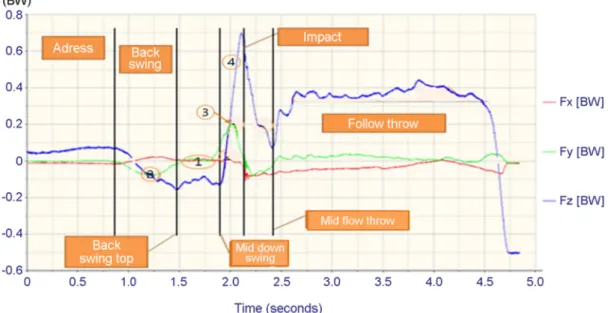
The independent variable was the presence of the elastic band around their ankles. The dependent variables were three-dimensional ground reaction forces such as ① differences between medial/lateral and anterior/posterior force values from the back-swing top to the mid- down swing (to analyze neutralizing between medial/lateral and anterior /posterior force) (Figure 1); ② time difference Intersections between maximum posterior value and vertical directional Forces during the back swing (to analyze the transfer of momentum and coordination between forces) (Figure 1); ③ maximum anterior force from mid-down swing to impact (Figure 1); ④ time difference between a medial/lateral maxi- mum force and an anterior/posterior maximum force and as well as the point of intersection with vertical force from mid-down swing to impact (to analyze the timing to understand transfer of momentum and coordination) (Figure 1); ⑤ vertical minimum force value, anterior/
posterior maximum and minimum force value, and medial/lateral maxi- mum and minimum force value (to analyze the power).
4. Procedure
There were ten trials with an elastic band and ten without one (twenty trials in total) with randomly selected subjects and band usage during 5 days. Only the ground reaction forces of the subjects' right feet were measured when the subjects swung with their golf club. For this study, only seven iron golf clubs were used. There are seven phases to a golf swing: address, mid-back swing, back-swing top, mid-down swing, impact, mid-follow through, and follow through based on the previous researched (Stuart, 2009; Williams, Jones, & Snow, 1988; YI & So, 2004;
Figure 1. X, Y, and Z directional GRF according to the phases
Mann, 2016). Analysis of three dimensional ground reaction force values and timings were conducted according to each of these phases.
5. Statistics
A paired t-test within the subject repeated measure design was used to analyze the differences between ground reaction force with and without an elastic band (Table 1) via an SPSS 20.0.
6. Result
1) Differences between medial/lateral and anterior/posterior values from the back-swing top to the mid-down swing
Medial and lateral and anterior/posterior values from the back-swing
top to the mid-down swing with a band were significantly lower than without a band (p<.05), (Table 1). If there were no differences between medial/lateral and anterior/posterior values from the back swing top to the mid-down swing, it would have meant that there were no fluctua- tions, i.e. there was stability between medial/lateral and anterior/posterior.
Therefore, this result shows that only vertical force existed. Medial/
lateral and anterior/posterior forces remaining neutral might have a correctable and coordinated impact.
2) Time difference Intersections between maximum posterior value and vertical directional forces during the back swing
During the back swing, if the vertical force line can meet the maxi- mum value of the posterior force, the transfer of momentum and coordination will be better. The time difference between the maximum Table 1. GRF variables according to band usage
GRF variables Independent
variables N M ± SD t p
1 From back swing top to mid down swing, time difference between X max and Y max (sec)
Band 10 0.00±0.00
-2.546 0.03*
No band 10 0.01±0.01
2 Time diff. between the moment of cross Y and Z during backswing (sec)
Band 10 0.11±0.08
-2.509 0.03*
No band 10 0.22±0.19
3 Anterior/Posterior maximum value (BW) Band 10 0.21±0.06
2.213 0.05*
No band 10 0.18±0.04
4
Before impact, time difference (X value) (sec) Band 10 0.08±0.03
0.607 0.56
No band 10 0.08±0.03
Before impact, time difference (Y value) (sec) Band 10 0.02±0.01
-1.668 0.13
No band 10 0.03±0.02
5 Diff. between vertical maximum value – minimum value at follow through (BW)
Band 10 0.19±0.06
-1.910 0.09
No band 10 0.24±0.07
6 Vertical max value at mid follow (BW) Band 10 0.39±0.16
-0.735 0.48
No band 10 0.43±0.12
7 Vertical maximum value (BW) Band 10 0.67±0.10
-.018 0.99
No band 10 0.67±0.11
8 Vertical minimum value (BW) Band 10 -0.33±0.07
1.583 0.15
No band 10 -0.36±0.10
9 Anterior/posterior minimum value (BW) Band 10 -0.09±0.04
1.574 0.15
No band 10 -0.11±0.03
10 Medial/lateral maximum value (BW) Band 10 0.06±0.04
-1.910 0.09
No band 10 0.08±0.06
11 Medial/lateral minimum force value (BW) Band 10 -0.10±0.05
-.596 0.57
Nno band 10 -0.09±0.04
*p<.05
posterior value and the vertical force line with a band was significantly lower than without a band (p<.05), (Table 1).
3) Maximum anterior force from mid-down swing to impact
From mid-down swing to impact, the maximum anterior force was significantly higher with a band than without a band (p<.05), (Table 1). This means that before impact, the anterior forwarding force was exerted instead of the lateral force.
4) Time difference between a medial/lateral maximum force and an anterior/posterior maximum force and as well as the point of intersection with vertical force from mid-down swing to impact
For analysis of the transfer of momentum from mid-down swing to impact, the time difference between medial/lateral maximum force and the point of intersection with vertical force, and the time difference between anterior/posterior maximum force and the point of intersection with vertical force, were analyzed (Table 1). Because all subjects were certified teaching professionals, there were no significant differences.
For future studies, an amateur golfer's swing will be analyzed to cross- reference the data.
5) Other variables
The other variables such as vertical maximum and minimum force value, anterior/posterior minimum force value, and medial/lateral maxi- mum and minimum force value were not significantly different, except the above mentioned (Table 1).
But, in the case of band restriction around the ankle, there was a lower tendency of the ground reaction forces with a band than without one.
DISCUSSION
Coordination means spatiotemporal ordering between component parts (Jantzen, Oullier, & Kelso, 2008), which requires movements in- volving changes in muscle length and muscle recruitment time (Mauk
& Buomonano, 2004). Therefore, there is a strong relationship between coordination and timing. Functional performance also involves the close interaction of sensory processing. The number of peripheral sources such as vision, muscles, tendons, ligaments, joints, and the vestibular system providing feedback to the central nervous system during action execution.
In this study, time differences and sequences between three direc- tional ground reaction forces used during golf swings. In particular, the elastic band restriction around the right and left ankles were utilized for the peripheral sources to control timing in motor control and coord- ination (Turvey, 1990; Davids, Handford, & Williams, 1994). Thus, the ankle restriction with the elastic band offered a system-environment interaction with a sensory-motor coupling.
During the golf swing with the ankle restriction elastic band, coord-
ination may be described as the coupled movements with a specific force execution time lag (Hume, Keogh, & Reid, 2005) between three directional forces. Therefore, coordination involves variables that specify the spatiotemporal ordering (Jantzen, Oullier, & Kelso, 2008) between three dimensional forces.
During the back swing, there were two kinds of Y directional forces which were the symmetrical anterior and posterior forces. At the moment of the mid-back swing, if the vertical force line can meet the maximum value of the posterior force, the transfer of momentum and coordination between posterior and vertical forces will be at its best (Leyland, 2013). The time difference between the maximum anterior/
posterior value and the vertical force line with a band was significantly lower. With a band, it was possible to have coupled restraint anterior/
posterior and vertical forces within and without segments, which made for better control and coordination. Optimal sports skill performances, such as the golf swing entails complex sequential movements. Spanning multiple effectors such as limbs, muscles and joints rely on carefully coordinated movements timed using milliseconds (Medina, Carey, &
Lisberger, 2005; Buanmono & Laje, 2010).
Medial/lateral and anterior/posterior force values from the top of the backswing to the mid-down swing with a band were significantly lower. There was stability between medial/lateral and anterior/posterior forces with a band because there were no differences between medial/
lateral and anterior/posterior force values from the top of the back- swing to the mid-down swing that means there were no fluctuations.
Therefore, this result showed that only a vertical force existed and medial/lateral and anterior/posterior forces remained neutral which might had a correctable impact.
From the mid-down swing to right before the pre-impact of the ball, maximum anterior force was significantly higher with a band. This means that before impact, an anterior force was exerted instead of a lateral force.
A high degree of coordination, both within and between segments was required for fast, accurate, and energy-efficient movement execution.
The force execution timing accuracy of the movements between and within segments seemed to be crucial for performing a golf swing (Schmidt & Wrisberg, 2004). These factors had a significant impact on both the quality relating to the spatiotemporal properties and the outcome of the movement pertaining to the accuracy of the golf swing.
CONCLUSIONS AND SUGGESTIONS
Wearing an ankle restriction elastic band affects the control and neutralization of the medial/lateral directional force from the top of the back swing to the mid-down swing, from the mid downswing to right before the impact of the ball, as well as anterior/posterior directional force from the back swing to the early mid-down swing.
In addition, an elastic band may affect the coordination between the three directional forces. Furthermore, an elastic band can increase anterior force from the mid-downswing to right before the impact of the ball. Even though there was an increased anterior force, the vertical directional force did not increase significantly. As a result, study for the relationship between medial/lateral and vertical forces will be analyzed
for future studies.
If two force platforms had been used, it would have been possible to analyze the forces within and between two extremities.
Lastly, ankle restriction with an elastic band might help control one's muscles. Muscle activation with an elastic band during a golf swing needs to be analyzed in future studies.
REFERENCES
Bullock-Saxton, J. E. (1994). Local sensation changes and altered hip muscle function following severe ankle sprain. Physical Therapy, 74(1), 17-28.
Buonomano, D. V. & Laje, R. (2010). Population clocks: motor timing with neural dynamics. Trends in Cognitive Sciences, 14, 521-527.
Burge, P. D. & Brown, M. (1990). Elastic band mobilization after flexor tendon repair; splint design and risk of flexion contracture. Journal of Hand Surgery (British and European Volume), 15(4), 443-448.
Carpes, F. P., Reinehr, F. B. & Mota, C. B. (2008). Effects of a program for trunk strength and stability on pain, low back and pelvis kine- matics, and body balance: a pilot study. Journal of Bodywork and Movement Therapies, 12(1), 22-30.
Davids, K., Handford, C. & Williams, A. M. (1994). The natural physical alternative to cognitive theories of motor behavior: An invitation for interdisciplinary research in sports science? Journal of Sports Sciences, 12, 492-528.
Dayakidis, M. K. & Boudolos, K. (2006). Ground reaction force data in functional ankle instability during two cutting movements. Clinical Biomechanic, 21(4), pp.405-411.
Fukagawa, N. K., Brown, M., Sinacore, D. R, & Host, H. H. (1995). The relationship of strength to function in the older adult. The Journals of Gerontology Series A: Biological Sciences and Medical Sciences, 50(Special Issue), 55-59.
Hume, P. A., Koegh, J. & Reid, D. (2005). The role of biomechanics in maximizing distance and accuracy of golf shots. Sports Medicine, 35, 429449.
Jantzen, K. J., Oullier, O. & Kelso, J. A. S. (2008). Neuroimaging coord- ination dynamics in the sport sciences. Methods, 45, 325-335.
Keller, T. S., Weisberger, A. M., Ray, J. L., Hasan, S. S., Shiavi, R. G. &
Spengler, D. M. (1996). Relationship between vertical ground re- action force and speed during walking, slow jogging, and running.
Clinical Biomechanics, 11(5), 253-259.
Kulig, K., Fietzer, A. L. & Popovich Jr, J. M. (2011). Ground reaction forces and knee mechanics in the weight acceptance phase of a dance leap take-off and landing. Journal of Sports Sciences, 29(2), 125-131.
Lee, J. & Oh, C. H. (2012). A biomechanical analysis of lower extremity
segment during the fouette en dehors performed by ballet dancers.
Korean Journal of Sport Biomechanics, 22(1), 43-53.
Leyland, T. (2013). Coaching Tennis. Retrieved from http://www.sfu.ca/
~leyland/Kin201 Files/Tennis Biomechanics.pdf
Mauk, M. D. & Buonomano, D. V. (2004). The neural basis of temporal processing. Annual Review of Neuroscience, 27, 307-340.
Mann, J. (2016). Jack Nicklaus & Mike Souchak - Gary Player & Arnold Palmer Slow Motion, retrieved from https://youtu.be/StKkT9sTTtQ, 2008. 5. 1.Sky View Angle
Medina, J., Carey, S. & Lisberger, S. (2005). The representation of time for motor learning. Neuron, 45, 157-167.
Orendurff, M. S., Schoen, J. A. Bernatz, G. C., Klute, G. K. & Glaister, B.
C. (2008). Ground reaction forces and impulses during a transient turning maneuver. Journal of Biomechanics, 41(14), pp.3090-3093.
Prisk, V. R. & O’Loughilin, P. F. (2008). Foot and ankle injuries in dance.
Clinics in Sports Medicine, 27(2), 305-320.
Stuart, S. (2009). Ground Reaction Force Analysis of Golf Swings using Force Plate Data (Doctoral dissertation, School Of Health And Natural Social Sciences, University Of Sunderland).
Schmidt, R. & Wrisberg, C. (2004). Motor Learning and Performance. A Problem-based Learning Approach. (4th ed.). Champaign, IL: Human Kinetics.
Thegolfevolution.com. (2015.2.23). How Much Speed is Generated Without Using the Ground (GRF)? retrieved from https://youtu.be/
hRPMH49AC5g?t=7.
Treiber, F. A., Lott, J., Duncan, J., Slavens, G. & Davis, H. (1998). Effects of thera-band and lightweight dumbbell training on shoulder rotation torque and serve performance in college tennis players.
The American Journal of Sports Medicine, 26(4), 510-515.
Turvey, M.T. (1990). Coordination. American Psychologist, 45, 938-953.
Van Deun, S., Staes, F. F., Stappaerts, K. H., Janssens, L., Levin, O. & Peers, K. K. (2007). Relationship of chronic ankle instability to muscle activation patterns during the transition from double-leg to single- leg stance. The American Journal of Sports Medicine, 35(2), 274- 281.
Wallace, B. J., Winchester, J. B. & McGuigan, M. R. (2006). Effects of elastic bands on force and power characteristics during the back squat exercise. The Journal of Strength & Conditioning Research, 20(2), 268-272.
Whang, I. S. (1993). Mechanic Golf. Seoul : Yonsei University Press.
Williams, K. R., Jones, J. & Snow, B. (1988). Ground reaction forces during the golf swing in relation to hitting performance. Journal of Biomechanics, 21(10), 869.
Yi, K. O. & So, J. M. (2004), The Ground Reaction Force Relationship Between Two Feet During Golf Swing. Journal of Korean Physical Education Association for Girls and Women, 18(1), 86-97.