Antioxidant Activity and Biological Activity of Specialty Barley ( Hordeum vulgare L.) Extracts
Na Young Lee*, Yang-Kil Kim*, Induck Choi*, Sang-Kyun Cho*, Hun-Jung Kweon**, Kwang-Won Lee*, Jong-Nae Hyun*, Jae-Seong Choi*, Ki-Hun Park***, Kee-Jong Kim*, and Mi-Ja Lee*
†*National Institute of Crop Science, Rural Development Administration, Iksan, 570-080, Republic of Korea
**Apple experiment station, National Institute of Horticultural & Herbal Science, Rural Development Administration, Gunwi 716-810, Republic of Korea
***Research and Coordination Division, Rural Development Administration, Suwon, 441-707, Republic of Korea
159
†
Corresponding author: +82-63-840-2257
(E-mail) [email protected] < Received June 4, 2010 >
ABSTRACT Specialty barley extracts were prepared and investigated for its antioxidant activity and biological activity.
Hunter L
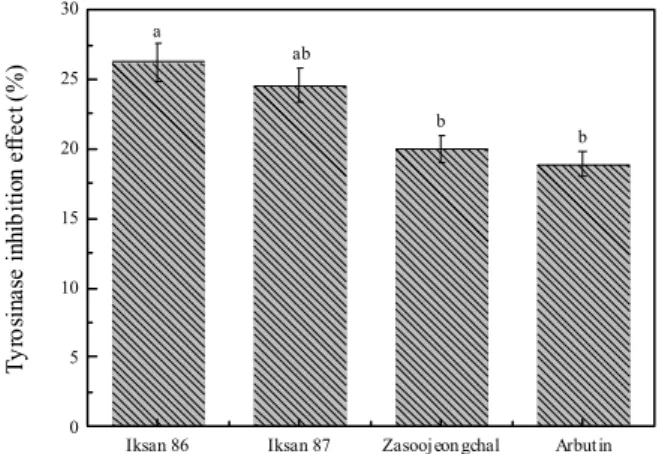
*values of the Iksan 86 extracts had higher than that of the Iksan 87 and Zasoojeongchal extracts. The extrac- tion yields of Iksan 86, Iksan 87, and Zasoojeongchal was 8.08, 6.62, and 7.30%, respectively. The contents of total phenolic compounds of the Iksan 86, Iksan 87, and Zasoo- jeongchal extracts were 16.24, 15.51, and 13.95 GAE mg/g of sample, respectively. The DPPH radical scavenging activity of Iksan 86, Iksan 87, and Zasoojeongchal extracts were 50.00, 33.27, and 7.56% at a 500 ppm, respectively. The samples showed an inhibition of xanthin oxidase. ACE inhibition effect of specialty barley extracts, Iksan 86, Iksan 87, and Zasoojeongchal, was 39.81, 41.06, and 27.78%, respectively. Tyrosinase inhibition rates (%) of Iksan 86, Iksan 87, and Zasoojeongchal extracts were 26.21, 24.57, and 20.00%, respectively. Results indicated that specialty barley extracts possesses various biological activities inclu- ding antioxidative capacity, xanthin oxidase inhibition activity, angiotensin converting enzyme inhibition activity, and tyrosi- nase inhibition activity.
Keywords : specialty barley extracts, antioxidant activity, biological activity
Cereal grains contribute significant amounts of energy, protein, selected micronutrients to the human diet and contain a large variety of biologically active substances. Also dietary intake of whole grain foods is associated with a decreased risk of chronic diseases such as diabetes, obesity and heart disease (Hill & Path, 1998; Bondia-Pons et al., 2009).
Barley (Hordeum vulgare L.) is a well-known cereal grain, cultivated throughout the world and a widely consumed
cereal among the most ancient cereal crops. Almost 80-90
% of barley production is for malt and animal feeds, but now barley is gaining renewed interest as an ingredient of production of functional foods due to their concentration of bioactive compounds such as β-glucan, arabinoxylan, and tocols (Jadhav et al., 1998; Peterson, 1994). In resent years, specialty barley such as colored, high lysine, high β-glucan has been developed. Also, barley is rich in a wide range of biological compounds such as phenolic acid derivatives, proanthocyanidins, quinones, and flavonoids (Bonoli et al., 2004; Kim et al., 2007). There have been some studies on the phytochemical, arabinoxylans, tocol, β-glucan, phenolic content, and antioxidant activity of barley (Zhao et al., 2008; Panfili et al., 2008; Madhujith & Shahidi, 2006;
Höije et al., 2005; Andersson et al., 2008).
In recent years, the demand for natural, functional, and healthy foods has tended to increase. Phytochemical rich plants have played a significant role in diet based therapies to prevent and cure various ailments (Bonoli et al., 2004).
The whole grain contains a large variety of substances, especially those that are biologically active and demonstrate antioxidant properties, which include free radical scavenger, reducing agents, potential complexes of prooxidant metals, and quenchers of the formation of singlet oxygen (Zieliński, 2002). Rice bran extracts showed antioxidant capability in inhibition linoleic acid peroxidation (57%), scavenging DPPH radicals (93%), reducing power (78%), and Fe
2+chelating activity (up to 1300 μg EDTA equivalent/g) (Lai et al., 2009).
Biological composition such as phenolics can vary in plants
from organ to organ, but other factors, such as cultivar and
geographical conditions, can also participate in their varia-
bility in plants (Oliveira et al., 2007).
The objective of this study was to investigate the anti- oxidant activity and biological activities of specialty hull- less whole barley (Hordeum vulgare L.) extracts.
MATERIALS AND METHODS
Sample preparation
Specialty barley cv. Iksan 86, Iksan 87, and Zasoojeong- chal, waxy type hull-less barley, were supplied from Depart- ment of Rice and Winter cereal Crop, National Institute of Crop Science, Korea. Barley was propagated during the 2008-2009 season at Iksan region in Chonbuk province, Korea. The whole barley was grinding using a rotor mill (ZM 100; Retsch GmbH, Haan, Germany) equipped with a 0.5 mm screen and then barley flour were put into plastic bags and stored at -20°C until used. Extraction was perfor- med by using a 70% ethanol solution for 24 hr at room temperature. The ratio of sample and solvent was 1:10 (w/v).
After extraction, the ethanol extracts were filtered through a 110 mm filter paper (No 2, Advantec, Japan) twice using 70% ethanol and transferred to a 2-L round-bottom container.
The solvent of the extracts were removed by an evaporator (EYELA new Rotary Vacuum Evaporator; Rikakikai Co., Ltd, Tokyo, Japan) immediately and then lyophilized using a lyophilizer (EYELA FD1; Rikakikai Co., Tokyo, Japan).
The freeze dried sample was weighed and the yield was calculated. The samples were stored at -20°C for a further investigation.
Color measurement
Color of the extract solutions was measured by a color difference meter (Color JS 55; Color Technology System Co., Japan). The color was measured 3 times for each samples and then averaged. The numerical value of the color was expressed by Hunter L*, a* and b* values. Hunter L*
value indicates the lightness of the samples, a* value indicates the +red/-green, and b* value indicates the +yellow/-blue.
Total phenolic contents
Total phenolic contents were measured using the Folin- Ciocalteau colorimetric method (Yu et al., 2004). The extract (1%, 0.1 mL) was mixed with 0.2 mL of Folin-Ciocalteau
reagent (Sigma Chemical Co., St. Louis, MO, USA). Then 3 mL of 5% Na
2CO
3was added. The absorbance of the mixture at 765 nm was recorded by a spectrophotometer (HP1B; Hewlett-Packard Co., Germany) for the mixtures after 2 hr of incubation at 23°C. The total phenolic content was expressed as gallic acid equivalents.
Antioxidant activity
Antioxidnat activity was estimated with DPPH and ABT radical scavenging activity. DPPH radical scavenging capacity was estimated according to the method of Blois (1958) with some modification. The sample dissolved in 70% ethanol (500 ppm, 1 mL) was added into the 0.2 mM DPPH radical solution (1 mL) and vortexed. The mixture was reacted for 30 min at room temperature and the absorbance was measured at 517 nm with a spectrophotometer. The scavenging activity of the DPPH radicals in percentage points was calculated by the following equation: Scavenging activity (%) = (1-A1/A0) × 100, where A0 is the absorbance of the blank and A1 is the absorbance of the sample.
ABTS (2,2`-azinobis (3-ethylbenzothiazoline-6-sulfonic acid) diammonium salts) radical cation was measured using the method of Zhao et al. (2006) with some modification. ABTS was dissolved in water to a 7 mM concentration. ABTS radical cation was produced by reacting ABTS stock solution with 2.45 mM potassium persulfate (final concentration) and allowing the mixture to stand in the dark at room temperature for 12-16 hr before use. ABTS + solution was diluted with ethanol to an absorbance of 0.70 (±0.02) at 734 nm and equilibrated at 30°C. The extract (500 ppm, 0.1 mL) was mixed with 2.9 mL of diluted ABTS + solution.
After reaction at 30°C for 20 min, the absorbance at 734 nm was measured.
Xanthine oxidase (XOase) inhibition effect
Xanthine oxidase (XOase) inhibition effect was determined
spectrophotometically by measuring uric acid formation at
292 nm (Jeon et al., 2002; Nam et al., 2005). The reaction
mixture, containing 1 mL substrate (2 mM xanthine, Sigma)
in a 0.1 M potassium phosphate buffer (pH 7.4), 0.1 mL
(0.4 unit/mL, Sigma) of enzyme solution and 0.1 mL of
extract solution (250 ppm), was reacted at 37°C for 20
min. The control solution was prepared by adding 0.1 mL
Table 1. Changes in hunter color values of specialty barley cultivar extracts
1).
Samples L* a* b*
Iksan 86 90.75±0.02
a-4.21±0.01
c17.09±0.02
aIksan 87 67.52±0.09
c-0.30±0.01
b13.67±0.11
bZasoojeongchal 70.36±0.05
b-0.27±0.01
a11.01±0.05
c1)a-c
Different letters within the same column differ significantly (p<0.05).
distilled water instead of extracts. The reaction was stopped by adding 1 mL of 20% trichloroacetic acid. The formation of uric acid by reaction was measured at 292 nm using a spectrophotometer (UV 1600PC; Shimadzu, Tokyo, Japan).
Angiotensin converting enzyme (ACE) inhibition activity Angiotensin converting enzyme (ACE) inhibition activity was assayed by the method of Cushman & Cheung (1971) with some modification. ACE solution was extracted with rabbit lung acetone powder (1g) in 0.1M sodium borate buffer (pH 8.3) containing 0.3 M NaCl (10 mL) at 4°C for 24 hr and then extracted ACE solution was centrifuged at 4,000×g for 20 min. A sample solution (250 ppm, 50 μL) with 50 μL of ACE solution was preincubated at 37°C for 5 min and then incubated with 50 μL of substrate (hippuryl- histidyl-leucine, Sigma) at 37°C for 30 min. The reaction was stopped by the addition of 250 μL of 1 N HCl. The resulting hippuric acid was extracted with 1 mL of ethyl acetate. After the solution was centrifuged, the 1 mL upper layer was transferred into a test tube and evaporated at 120°C for 30 min. The hippuric acid was dissolved in 3 mL of distilled water. The ACE inhibition effect (%) was calculated by observing the spectrophotometric reading at 228 nm.
Tyrosinase inhibition effect
Tyrosinase inhibition effect was performed as previously described by Jo et al. (2003). A sample (250 ppm, 0.2 mL) was added to a reaction mixture containing 10 mM L-3, 4-dihydroxyphenyl-alanine (L-DOPA; Sigma) solution, 1/15 M sodium phosphate buffer (pH 6.8) and mushroom tyrosi- nase (100 unit/mL, Sigma). The reaction mixture was incu- bated at 25°C for 15 min. The amount of dopachrome produced in the reaction mixture was determined at 475 nm by a spectrophotometer (model UV 1600PC; Shimadzu,
Tokyo, Japan).
Statistical analysis
This experiment was designed as randomized block design with 3 replications. One-way analyses of variance were perfor- med using SAS software (version 7.0; SAS Institute, Cary, NC, USA) along with Duncan’s post hoc tests to compare differences among mean values. Each data entry represents the mean of three different experiments with three measure- ments in each experiment. Mean values and standard deviation were reported and the significance was defined at p<0.05.
RESULTS AND DISCUSSION
Color changes and extraction yield
The extraction yields of Iksan 86, Iksan 87, and Zasoo- jeongchal was 8.08, 6.62, and 7.30%, respectively (data not shown). The Hunter color value changes of the specialty barley extract solutions are shown in Table 1. The Hunter color L* values of Iksan 86 extract solutions was bright compared with Iksan 87 and Zasoojeongchal extracts. Color a* and b* values of the samples was showed similar results with L* values of the samples. Color is an important charac- teristic and selection criterion for food choice (Hallagan et al., 1995). Also, food coloring agents such as anthocyanins have also been observed to possess potent antioxidant proper- ties (Duangmal et al., 2008).
Total phenolic compounds
Phenolic compounds were considered as a major group of compounds that contributed to the antioxidant activity of cereal (Zieliński et al., 2000). Total phenolic contents of Iksan 86, Iksan 87, and Zasoojeongchal extracts were 16.24, 15.51, and 13.95 mg/g, respectively (Table 2). Cook &
Samman (2006) reported that phenolic compounds are anti-
Table 2. Total phenolic compounds (mg/g samples) and free radical scavenging activity of specialty barley cultivar extracts
1).
Samples Total phenolics (mg/g) DPPH radical scavenging capacity (%)
ABT radical scavenging capacity (µmol TE/g)
Iksan 86 16.24±0.682
a50.00±2.259
a19.68±1.920
Iksan 87 15.51±1.686
ab33.27±6.718
b19.86±0.606
Zasoojeongchal 13.95±1.949
b7.56±7.762
c18.84±4.458
1)a-b
Different letters within the same column differ significantly (p<0.05).
Table 3. Xanthin oxidase and angiotensin converting enzyme inhibition activity of specialty barley cultivar extracts
1). Samples
2)Xanthin oxidase inhibition activity (%) ACE inhibition activity (%)
Iksan 86 10.31±1.48 39.81±0.904
bIksan 87 12.05±1.80 41.06±4.631
aZasoojeongchal 13.78±1.59 27.78±2.495
c1)a-c
Different letters within the same column differ significantly (p<0.05).
oxidants and natural antioxidants may exhibit one or more of the following roles; free radical scavenger, reducing agent, potential producer. Phenolic compounds in cereals are either in free or bound forms. Generally, the free phenolic compounds are proanthocyanidins of flavonoids, whereas the bound phenolic compounds are ester-linked to cell wall polymers and consist mainly of ferulic acid and its oxida- tively coupled dimmers (Bonoli et al., 2004). Most of the free phenolics are flavanols and tocopherols whereas the bound phenolics are mainly phenolic acids (ferulic acid and p-coumaric acid) in the barley (Holtekjølen et al., 2006).
Kim et al. (2007) reported that antioxidant capacity of barley is related to the concentration of phenolic compounds such as chlorogenic acid, 3,4-dimethoxybenzoic acid, homogentisic acid, protocatechuin acid, and rutin.
Antioxidant activity of specialty barley extracts DPPH radical scavenging capacity (%) of Iksan 86, Iksan 87, and Zasoojeongchal extracts were 50.00, 33.27, and 7.56% at a 500 ppm, respectively (Table 2). DPPH radical scavenging activity of the Iksan 86 extracts was higher than that of Iksan 87 and Zasoojeongchal extracts. ABT radical scavenging activity of Iksan 86, Iksan 87, and Zasoo- jeongchal extracts were 19.68, 19.86, and 1.84 μmol TE/g, respectively, at a 500 ppm level. Zhao et al. (2008) reported that the values of DPPH radical scavenging activity for 14 barley samples raged from 9.33 to 11.78 μmol TE/g db. The
DPPH radical scavenging activities of the colored barley varied from 46.4 to 86.3% and average radical scavenging activity in the hulless barley groups (66.5%) was higher than that of hulled barley (63.5%) (Kim et al., 2007). Liu
& Yao (2007) reported that whole barley extract has the strong scavenging activity, which showed similar scavenging activity to BHT at the amount of 200 µg. Qingming et al.
(2010) reported that malt barley extract prevented the de- crease of antioxidant enzyme activities, decreased liver and brain malondialodehyde levels and carbonyl content, and improved total antioxidant capability in D-galactose treated mice.
Xanthin oxidase and angiotensin converting enzyme inhibition activity
Table 3 shows the xanthin oxidase (XOase) and angiotensin converting enzyme (ACE) inhibition activity of the specialty barley extracts. The order of xanthin oxidase inhibition effect for the samples was as follows: Zasoojeongchal extracts >
Ikdan 87 extracts > Iksan 86 extracts. However, there was
no difference between the samples (p>0.05). Xanthine oxidase
catalyzed the metabolism of hypoxanthine and xanthine to
uric acid (Kong et al., 2000). Increase of the uric acid and
its accumulation in blood and bone result in gout and acc-
umulation in the kidney, occasionally causing kidney trouble
(Stroch & Ferber, 1988). Nam et al. (2006) reported that
xanthin oxidase (XOD) inhibition assay suggest that the
superoxide scavenging by rice cultivars extracts might be
Iksan 86 Iksan 87 Zasoojeon gchal Arbutin 0
5 10 15 20 25 30
b b ab
a
Tyrosinase inhibition effect (%)
Fig. 1. Tyrosinase inhibition effect of specialty barley extracts
1).
1)a-b