296
가든 세이지(Salvia officinalis L.) 추출물의 생리활성 탐색
조영제*·주인식·윤동혁·천성숙1·안봉전2·김정환3·김명욱4 경북대학교 식품공학과, 1영남대학교 식품가공학과, 2대구한의대학교 화장품약리학과,
3엔아이피바이오텍, 4경북해양바이오산업연구원
Biological Activity of Extracts from Garden Sage ( Salvia officinalis L.)
Young-Je Cho*, In-Sik Ju, Dong-hyuck Yun, Sung-Sook Chun
1, Bong-Jeun An
2, Jeung-Hoan Kim
3, and Myung-Uk Kim
4Department of Food Engineering, Kyungpook National University, Sangju 742-711, Korea
1Department of Food Science & Technology, Yeungnam University, Gyeongsan 712-749, Korea
2Department of Cosmeceutical Science, Daegu Hanny University, Gyeongsan, 712-715, Korea
3NIP Biotech. Munkyung 745-706, Korea
4Gyungbuk Institute for Marine Bio-Industry, Uljin 767-801, Korea Received June 26, 2007; Accepted December 10, 2008
The extracts from
Salvia officinaliswere studied for antioxidative activities and inhibitory activities against angiotensin converting enzyme(ACE) and xanthine oxidase (XOase). Total phenolic com- pounds were found as 22.28, 26.3, 24.63, and 28.22 mg/g in the water, 60% ethanol, 60% methanol and 60% acetone extracts, respectively. The antioxidant activities of
Salvia officinalisextracts were measured as 64.4±1.5% at 200
µg/m
lon EDA, inhibition rate on ABTS of 96.9±0.2%, antioxidant protection factor of 2.30±0.16 PF and TBARS was 0.62±0.05 (×100
µM) in the control and 0.28±0.02 (×100
µM) in 60% ethanol extracts. Inhibitory activities was the ACE of 75.50% and XOase 100% in 60% ethanol extracts. The 60% ethanol extracts from
Salvia officinalisexhibited antimicrobial activities against
Helicobacter pylorisuch as 13 mm of clear zone and inhibition rate of 63.4% with 200
µg/m
lof phenolics content. Rosemarinic acid was the most abundant phenolic compounds as analyzed by HPLC. The results suggest that the 60% ethanol extracts from
Salviaofficinalis
L. will be useful as natural antioxidants and functional foods.
Key words: Salvia officinalis, angiotensin converting enzyme, xanthine oxidase, antimicrobial activity, antioxi- dant activity, Helicobacter pylori
서 론
최근건강에대한관심이높아지면서식품의약리기능성물 질탐색에 관한연구가 활발히진행되고있으며특정성분이나 천연물이가지는 2차대사산물인 생리활성물질에대한관심이
증대되고있다. 생리활성물질은매우적은양으로현저한활성 을나타내는고부가가치의물질로서현재수많은 종류가유용 하게이용되고있으며, 또한새로운물질들이연구개발되고있 다. 생리활성을나타내는물질 중식품의기능강화를위해주 로활용되고있는것은방향성및 항산화활성관련물질과식 품의부패와변질을유발하는미생물에대하여항균활성을나
타내는물질등이있다.1)특히허브를포함한다양한유용식물
을이용하여전세계적으로식물자원에서항암, 항알레르기, 항 비만, 항산화 및 항균등에 효과가 있는 기능성 물질을 다량
함유하는 자원을선발하여 이들유용한물질들을약으로, 식품 첨가제로또는화장품의원료로개발하려는연구가 다양한각 도에서진행되고있으며2,3)그와함께 고령화사회로인한 노인 과관련된만성퇴행성질환의예방이시급한과제로떠오르고 있다.4)
지금까지보고된대부분의천연 항산화제등의생리활성물 질은 식물유래로서주로 폴리페놀화합물인것으로알려져있 는데,5) 이들 페놀성 화합물인 flavonoid, tannin, anthocyanin, carotenoid류, glutathione 등의 천연항산화제는생체내에서 노 화를 억제시키거나, 동맥경화증, 염증, 퇴행성질환및암을예 방하는데아주효과적인것으로보고되었다.3,6)가든세이지(Salvia officnalls L.)는 약용 살비야 또는 Common Sage라고도 하며
흔히 Salvia라는이름으로도 불리며, 약용으로잎을삶아서 인
*Corresponding author
Phone: 82-54-530-1265; Fax: 82-54-530-1269 E-mail: [email protected]
doi:10.3839/jabc.2008.046
후염및 위장염에사용한다. 방부, 향균, 항염등7)살균, 소독 작용이 있으며 염증의 소염제로도 이용하기도하고, 중풍이나
심한운동뒤의피로도씻어준다. 또한 Lamiaceae family에속 하는허브로향신료로많이이용되었으나세이지 추출물이우 수한항산화력을갖는다는것이보고되면서,8)가든세이지에함 유되어 있는 항산화 물질들을 밝혀내려는 연구들이 계속되고 있다. 이미밝혀진항산화성분으로는 carnosic acid, rosemarinic acid와,9) sagecoumarin, sagericin acid, caffeic acid, luteolin-7- O-glucoside, apigenin, hispidulin, carnosol, rosemanol과 같은 다양한종류의 terpenes, flavonoids, phenolic acid 등이있으나10),
다양한생리적효능에대한연구가아직많이이루어지지않은 상태이다.
따라서본연구에서는가든세이지의추출조건별 phenol성분
용출량의최적조건과그에따른생리활성을규명하는작업의 일환으로써각각다른종류의용매를이용하여 추출하였고, 또
한생리활성능을살펴봄으로써 기능성식품소재개발을하고 자하였다.
재료 및 방법
시료의 선정. 본실험에 사용한가든세이지는경북 구미시 에 소재하는 Herb 농원에서구입하여 5oC의 dry oven에서건
조한후 40 mesh로분쇄하여시료로사용하였다.
추출조건. 시료추출의최적조건을알아보기위해추출용매 를달리하여각각물(열수) 추출물과 60%의 ethanol, methanol,
acetone 등으로 추출하여 최적조건의 추출용매를 정하였으며,
추출용매로 ethanol을 0~100%의농도로사용하고추출하여최 적조건의농도를 정하고, 30시간동안 6시간 간격으로 phenol
성물질의 용출량을측정하여시간별용출량의변화를 측정하 였다.
추출물의 제조. 시료추출은 각추출용매 100 ml에 가든세 이지 시료 1 g을 가하여 24시간동안상온진탕 추출하였으며,
추출액은 whatman No.1 filter paper로여과한후 필요에따라
rotary vacuum evaporator(Eyela NE, Japan)에서농축하여시료 로사용하였다.
Phenol 화합물 정량. 총페놀화합물은 Folin-Denis 방법11)으 로 측정하였으며, 시료 1 ml에 95% ethanol 1 ml와 증류수 5 ml를 첨가하고 1 N Folin-ciocalteu reagent 0.5 ml를 넣어 잘 섞어주고, 5분간 방치한 후, Na2CO3 1 ml를 가한 후, 흡광도 725 nm에서 1시간이내에 측정하여 gallic acid를 이용한 표준 곡선으로부터양을환산하였다.
HPLC 분석. 가든세이지 추출물에 sample phenolic 물질의 존재와그함량을알아보기위하여시료를 0.2µm filter로 2 ml 를 여과하고그 중 5µl를주입하여분석하였다. 분석조건은, column은 Xterra(Waters, RP-18, 250×4.6 mm)를 30oC로 유지 하였고, 검출기는 Waters 2487 UV detector를 사용하여 306 nm에서측정하였다. 이동상은 acetonitile과 formic acid(pH 3.0)
이며기울기용리조건은 5분동안 acetonitrile 10%, 그후 30
분간 50%로증가시키고, 다시 5분간 10%로감소시켜총 45
분간용매를이동시켰다. 이때흐름속도는 0.5 ml/min이었다.
DPPH 라디칼 소거능 측정. DPPH radical에대한 소거활성 은 Blois의12)방법을변형하여측정하였다. 각시료 1 ml에 60
µM DPPH 3 ml를 넣고 vortex한 후 15분 동안 방치한 다음
517 nm에서 흡광도를 측정하였다. DPPH 라디칼 소거능은 다
음 식으로나타내었다. DPPH 라디칼소거능(%)=
대조구의흡광도−반응구의흡광도 ×100 대조구의흡광도
ABTS radical cation decolorization의 측정. ABTS[2,2- azinobis(3-ethylbenzothiazoline-6-sulfonic acid)] radical cation decolorization의 측정은 Pellegrin 등13)의 방법에의해측정하였 다. 즉, 7 mM ABTS 5 ml와 140 mM K2S2O8 88µl를 섞어어
두운 곳에 14~16시간방치시킨후, 이를 absolute ethanol과약
1:88 비율로섞어 734 nm에서대조구의흡광도값이 0.7±0.002
가 되도록 조절한 ABTS solution을 사용하였다. 시료용액 50
µl와 ABTS solution 1 ml를 혼합하여 30초간진탕한 후 2.5분
간반응시키고 734 nm에서흡광도를측정하여아래의식에의
해 ABTS 라디칼저해율을계산하였다.
ABTS radical 저해율(%)=( 1− 반응구의흡광도 )×100 대조구의흡광도
Antioxidant Protection Factor(PF) 측정.PF는 Andarwulan
과 Shetty14)의 방법으로 측정하였다. 10 mg의 β-carotene을 50 ml의 chloroform에 녹인 용액 1 ml를 evaporator 수기에 넣고
40oC water bath에서 chloroform을 증류시킨 후 20µl linoleic acid, 184µl Tween 40과 50 ml H2O2를 가하여 emulsion을 만 들고, 5 ml의 emulsion용액에 시료용액 100µl를 혼합하여 vortex로잘섞어준뒤 50oC에서 30분간반응시켜냉각시킨다
음, 470 nm에서흡광도를 측정하여다음의 식으로 PF값을 계
산하였다.
PF=( 1−반응구의흡광도 )×100 대조구의흡광도
Thiobarbituric acid reactive substances(TBARS) 측정.
TBARS는 Burge와 Aust15)의 방법에 따라 측정하였다. 1%
linoleic acid와 1% Tween 40으로 emulsion을 만들고 emulsion 0.8 ml와시료 0.2 ml를섞은후 50oC water bath에서 10시간반 응시켰다. 반응 후 반응액 1 ml에 TBA reagent 2 ml를 가하고 15분간중탕한다음 10분간냉각시킨후 15분간 1,000 rpm으로 원심분리 하였다. 원심분리 한액을 실온에서 10분간방치한
후상징액을취해 532 nm에서흡광도를측정하였으며, TBARS
값은 (흡광도수치×0.0154)로 1 ml반응혼합물에대해서생성된
1,1,3,3 tetraethoxypropane(TEP)의 µM로표시하였다.
Xanthine oxidase 저해 활성 측정. Xanthine oxidase 활성저 해측정법은 Stirpe와 Corte16)의방법에준하여측정하였다. 0.1 M potassium phosphate buffer(pH 7.5)에 xanthine 2 mM을 녹 인 기질액 3 ml에 효소액 0.1 ml와 추출용액 0.3 ml를 넣고대
조구에는 추출용액 대신 증류수를 0.3 ml 첨가하여 37oC에서
30분간반응시키고 20% trichloroacetic acid(TCA) 1 ml를가하
여반응을 종료시킨다음 3,500 rpm에서 15분간원심분리하여 단백질을제거한후, 반응액중에생성된 uric acid를 292 nm에
서흡광도를측정하여구한뒤, 표준곡선에서양을환산하여다 음식으로저해율을계산하였다.
저해율(%)=( 1− 반응구의 uric acid 생성량 )×100 대조구의 uric acid 생성량
Angiotensin converting Enzyme(ACE) 저해 활성 측정. ACE저해 활성 측정17)은 0.3 M NaCl을 함유하는 0.1 M potassium phosphate buffer(pH 8.3)에 2.5 mM hippuryl- histidyl-leucine을 녹인 기질액 0.15 ml에 ACE(0.125 U/ml) 0.1 ml와 시료액 0.1 ml를 가하고, 대조구에는시료액 대신증류수
0.1 ml를 첨가하여 37oC에서 30분간 반응시켰다. 1 N-HCl 0.35 ml를가하여 반응을종료시킨뒤, ethyl acetate 3 ml를가 하고 ethyl acetate층만을 취하여 evaporating한 뒤 그 잔사에
증류수 2 ml를 가하여효소에 의해기질로부터분리되어추출
된 hippuric acid를 녹여 280 nm에서 흡광도를측정하여 구한
뒤 표준곡선에서양을 환산하여아래의 식에 의해 저해율(%)
을계산하였다.
저해율(%)=( 1− 반응구의 hippuric acid 생성량 )×100 대조구의 hippuric acid 생성량
Pancreatin α-amylase 저해 활성 측정. Pancreatin α- amylase 저해활성측정은 agar diffusion method18)를이용하여
측정하였다. Plate는 1%의 agar와 1%의 soluble starch를 증류 수에 녹여 끓인 후, 121oC로 15분간 멸균하고 15 ml씩 petri dish에붓고 굳혀서 plate를제작하였다. 시료액 0.8µl와효소액
0.2µl(1000 U/ml)를 섞어 plate위에놓인 disc paper 위에각각
분주하고대조구에는 시료액 대신증류수를 넣어 37oC에서 3
일간 배양한 후 I2/KI(5 mM I2 in 3% KI) 5 ml를 가하여 15
분간발색시킨후 다음의식으로저해율을계산하였다.
저해율(%)=( 대조구의면적−반응구의면적 )×100 대조구의면적
Helicobacter pylori항균활성측정. 실험에사용한균주는위,
십이지장 궤양 원인균인 H. pylori로서 표준균주인 ATCC 43504를 사용하였다. 균의 배양에는 최적배지(special peptone 0.5 g, agar 0.75 g, NaCl 0.25 g, yeast extract 0.25 g, beef extract 0.2 g 및 pyruvic acid 0.025 g)를사용하였으며미호기성
조건을 유지시켜주기 위해서 10% CO2 incubator에서 습도는
95% 이상으로유지하며배양하였으며, agar plate상에서배양은 37oC로 48~72시간동안실시하였다. 또한항균활성측정은 H.
pylori최적배지 plate에 균분산액 100µl를분주하여 멸균유리 봉으로 도말한 다음, 멸균된 disc paper(ϕ 8 mm)를 올리고
0.45µm membrane filter로 제균한 각 추출물을 vacuum
evaporator로 농축한 후 멸균수로 희석하여 phenol 함량이
50~200µg/100µl가되도록조절한후각 추출물 100µl를 disc paper에흡수시키고, 대조구로는멸균수를흡수시킨후 37oC의
미호기성조건에서 48시간동안 incubation한다음, disc 주위 의 clear zone 생성유무를 확인하였다.19)
결과 및 고찰
가든 세이지추출물의 추출조건및페놀화합물 함량. 페놀성
화합물은다양한구조와분자량을가지며, phenolic hydroxyl기 를 가지기때문에단백질및기타거대분자들과결합하는성 질을 가지며, 항산화효과 등의생리활성기능을 가지는 것으로 알려져 있어,20) 추출물에함유된페놀성 화합물의함량을조사 하였다. 먼저시료추출의최적조건을알아보고자추출용매를
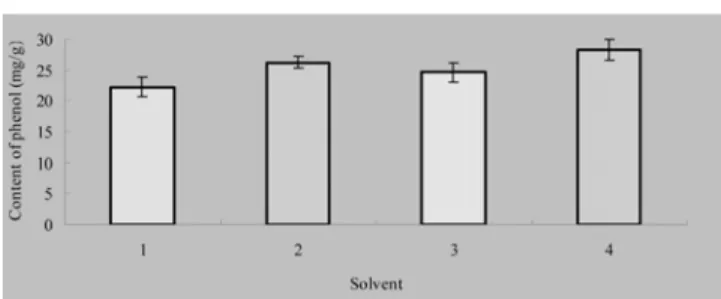
달리하여 가든 세이지 추출물의 phenol 함량을 비교한 결과,
Fig. 1과 같이 물(열수)추출물에서 22.28 mg/g, 60% ethanol, 60% methanol, 60% acetone 추출물에서 각각 26.3, 24.63,
28.22 mg/g으로 나타나 물보다 유기용매로 추출한 실험구에서
높은 phenol 함량을나타내었다. 그리고추출물을식품에적용
하고자 신체에유해하지않으며 phenol성물질의 용해도가높
은 ethanol을 다양한농도(0~100%까지, 11단계)로 제조하고이 를 추출용매로하여 추출한결과 Fig. 2와 같이총 phenol 함 량이 60% ethanol 농도에서 26.3 mg/g으로가장높게 나타났으 며, 물(열수)추출물에서도 20.2 mg/g으로 나타나 10~30%
ethanol 추출물보다높은 phenol 함량을볼수 있었다. 물 추출 물제조 시열수추출한결과높은온도(100oC)에의해 용출된
phenol 성분의 함량이 ethanol 용매를 10~30% 섞은 용매에서
의 phenol 용출함량보다높게 나타난이유라 사료된다. 최적
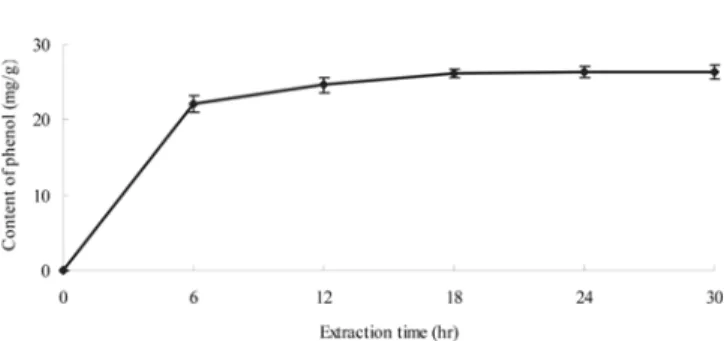
추출시간을정하기위하여 60% ethanol을 이용하여 30시간동
안 6시간간격으로 phenol성 물질의 용출량을측정하였다. 그 결과 Fig. 3과같이 6시간에서 24시간까지용출량이서서히증
가하다가 24시간이후에는용출량의변화가 거의나타나지않 았다. 따라서용출최적조건은 60% ethanol로 24시간교반 추출 Fig. 1. Effect of different solvents on extraction of phenol from
Salvia officinalis L. 1: water extracts. 2: 60% ethanol extracts. 3: 60%
methanol extracts. 4: 60% acetone extracts. Each value represents the mean±SD (n=3).
Fig. 2. Effect of ethanol concentration on extraction of phenol from
Salvia officinalis L. Each value represents the mean±SD (n=3).
하였을 때가 최적 조건이었다. Clark 등21)은 식물체에 함유된 페놀성 물질이 항균활성을 나타낸다고 보고하였는데 60%
ethanol을추출용매로하여 24시간교반시킨추출물에서비교적
높은페놀성 물질의 함량이 나타나 천연 항균제 및 생리활성 물질로의기능을 추측할수있었다.
HPLC 분석. Shetty22) 및 Chun19)등은 simple phenol성 물질
중 protocatecuic acid, caffeic acid, chlorogenic acid, courmaric acid, rosemarinic acid 등이항산화및항균활성이높다고보고 하였으며, 본 실험에서도가든세이지(Salvia officnalis L.) 추출
물 중에서이러한 simple phenol 물질의존재유무를 알아보기
위해 HPLC 상에서표준물질의 chromatogram과 retention time
을 비교하여 정량분석을 한 결과 Table 1과 같이 rosemarinic acid가 21.3±1.3 mg/g으로검출되었다. Zheng 등23)은 sage 신선
물의 rosemarinic acid가 다른항산화 물질보다많이함유되어 있다고 보고 하였으며, Cuvelier 등24)도 rosemarinic acid, caffeic acid dimer 등이항산화활성을 갖는다고보고하였는데,
가든 세이지에서 rosemarinic acid가 21.3 mg/g의 함량을 나타
내어비교적높은항산화활성을나타낼것이라추측되었다.
가든세이지추출물의항산화효과. 항산화활성중 DPPH 라 디칼소거능은안정한유리기로 cysteine, glutathione과같은함 유황 아미노산과 ascorbic acid, aromatic amine 등에 의해환 원되어탈색되므로항산화 물질의항산화능측정에편리한방
법이다. 이러한물질들이 free radical을환원시키거나상쇄시키 는 능력이 크면높은항산화 활성및 활성산소를 비롯한 다 른 라디칼에대한소거활성을기대할수있으며인체내에서
free radical에의한노화를억제하는척도로도이용할수있다.25)
따라서 가든세이지 추출물의 DPPH 라디칼 소거능을알아본
결과, Table 2와 같이 60% ethanol 추출물(200µg/ml)에서 64.4%의 DPPH 라디칼소거능을나타내었다. 가든세이지의친
수성 및 lipophilic 물질의 항산화력을 측정하기 위해 ABTS
radical cation decolorization을 측정한 결과, Table 2와 같이
60% ethanol 추출물(200µg/ml)에서 96.9%로높은저해율을나 타내어항산화력이매우우수함을 알수있었다. 지용성물질에 대한항산화력을측정하기위하여 β-carotene을첨가한 linoleic
acid emulsion을 이용하여가든 세이지 추출물의지용성 물질
에 대한항산화력으로 antioxidant protection factor(PF)를측정 한 결과, Table 2와 같이 60% ethanol 추출물(200µg/ml)에서
2.30 PF로높은항산화력을나타내었다. PF의 경우일반적으로
1.2 PF를 기준으로그이상의 경우항산화력이 높다고판단할
수있는데, 이결과로보아가든 세이지 60% ethanol 추출물의 지용성물질에 대한항산화력은 우수하다고 판단할 수 있었다.
또한 가든세이지추출물에의한지질과산화억제효과를측정
하는지표로서 TBARs 생성의감소정도를측정한결과 Table
2와 같이 60% ethanol 추출물(200µg/ml)에서 0.28×10² µM을 나타내어대조구의 0.62×10² µM에 비해낮은 TBARs값을나
타내어항산화효과가우수한 것으로나타났다. 따라서 Kim 등
26)은총 polyphenol의 양과추출물의항산화활성과의 관련성을 비교한결과, 대부분의 polyphenol의함량이높을수록항산화활
성이높아서함량의 상관관계를나타내었다고 한것을토대로
, 총페놀함량이높은가든 세이지 60% ethanol 추출물이높은
항산화 효과를나타내는것으로 판단되었다.
Xanthine oxidase(XOase) 저해활성. XOase는 생채 내 purine 대사에관여하는효소로 xanthine 혹은 hypoxanthine으로 부터 urate를 형성하여혈장내 urate가 증가되면낮은용해성
으로인하여골격에축적되어심한통증을유발하는통풍(gout)
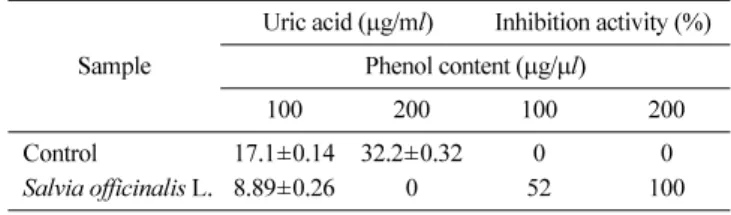
을일으킨다. 그리하여 XOase에대한추출물의저해활성을살
펴본 결과, Table 3에서와같이가든 세이지 60% ethanol 추출 물(200µg/ml)은 100%의 저해효과를 나타내었다. 이러한결과 는 Stirpe 와 Della Corte16)의 XOase 저해실험에서폴리페놀류
가 저해효과가높다는연구보고에서와같이가든세이지의페
놀함량이 매우높아 gout(통풍)의예방또는생약치료제로 개
발 및이용이가능할것으로 사료된다.
Angiotensin converting enzyme(ACE) 저해활성. ACE는 renin에 의하여생성된 decapeptide인 angiotensin I으로부터 C- Fig. 3. Effect of extraction time on content of phenol from Salvia
officinalis L. Each value represents the mean±SD (n=3).
Table 1. Phenol profiles of Salvia officinalis L. extracts
phenol Content (mg/g)
Protocatecuic acid ND
Caffeic acid 2.0±0.2
Chlorogenic acid 2.5±0.5
Courmeric acid 0.3±0.8
Rosemarinic acid 21.3±1.3
*Each value represents the mean±SD (n=3).
*ND: Not detected.
Table 2. Antioxidant activities of 60% ethanol extracts from Salvia officinalis L.
Antioxidant
DPPH (%) ABTS+ (%) Antioxidant proection factor (PF) TBARS (×102µm) Phenol content (µg/µl)
100 200 100 200 100 200 100 200
Control - - - 0.32±0.02 0.62±0.05
60% Ethanol extracts 34.2±1.2 64.4±1.5 50.3±0.4 96.9±0.2 1.17±0.9 2.30±1.6 0.24±0.05 0.28±0.02
*Each value represent the mean±SD (n=3).
말단의 de-peptide를가수분해시킴으로서 혈관수축작용을갖는
octapeptide인 angiotensin II를 합성하는마지막 단계에 관여하 는 효소이다. angiotensin II는 A-II 수용체와결합하여 동맥과 소동맥을수축시키고부신피질을 흥분시켜알도스테론의 유리 를촉진시켜결과적으로혈압의증가를가져온다. 따라서 ACE
저해물질은 ACE의활성을 억제함으로써고혈압을직접적으로
억제할수 있으며,27-29) ACE 억제제들이 고혈압치료제로서의
개발가능성이제시된후식물에서분리한 ACE 저해활성을가
진 phenol성 물질 및 peptide류 들을검색하는 연구가 다양하
게 이루어지고있다.30,31) 가든세이지의 ACE저해활성을 측정 한 결과, Table 4에서와 같이 대조구가 9.4µg/ml의 hippuric acid를 생성한 것에 대하여 60% ethanol 추출물(200 µg/ml)에 서 2.3µg/ml의 hippuric acid를생성하여 75.5%의 저해율을나 타내었다. 팥의 ethanol 추출물에서 51.8%의 저해율을보였으 며32)복분자의 ethanol 추출물에서 78.0%의저해율을나타내는
것33)과 비교해보다더 높거나비슷한저해효과를 볼수있었
다. 이는가든세이지의총페놀함량중 ACE 저해활성이있
는페놀성물질이많을것으로판단되었으며, 높은저해율을나 타내는것으로 보아고혈압예방에 활용할수있는좋은기능 성 소재라판단되었다.
가든 세이지 추출물의 Helicobacter pylori 항균활성. Disc
method에의하여가든 세이지추출물들의 H. pylori에대한 항
균활성을 측정한 결과, Fig. 4와 같이 200µg/ml 농도의 60%
ethanol 추출물에서 13±1.6 mm의 clear zone이나타나가든세 이지 추출물은위장 내에서 위궤양을일으키는원인 균인 H.
pylori균의억제효과가비교적우수한것으로판단되었다. Diker
와 Hascelik34)는 차 추출물로부터 15 mm 내외의 clear zone을 얻은 것으로 보고하였으며, Sage35)의 60% ethanol 추출물에서
약 12 mm 내외의 clear zone을얻은것으로보고한것과비교 하여볼때, 본연구에 사용된가든세이지도 H. pylori에대
한 항균제로서산업화에활용이 가능하다고사료되었다.
초 록
가든세이지추출물의추출최적 조건을알아보고자각각추 출 용매별, 농도별, 시간별로비교하였다. 가든세이지는 60%
ethanol에서 24시간추출하는것이최적추출조건으로가장효
율적이라 판단되었다. 한편 생리활성효과는 추출물의 phenol
농도를 200µg/ml로 조절하여실험하였다. DPPH에대한전자
공여능은 60% ethanol 추출물에서 64.4%로나타났으며, ABTS radical decolorlization은 60% ethanol 추출물에서 96.9%, antioxidant protection factor는 60% ethanol 추출물에서 2.30 PF로나타났으며, PF와같이지용성물질의항산화력을나타내
는 TBARS값은 control의 0.62×10² µM에 비해 60% ethanol
추출물에서 0.28×10² µM의낮은 TBARS값을나타내어항산화
효과가우수한것으로나타났다. Xanthine oxidase 활성억제효 과는 100%의저해율을나타냈고, ACE 활성억제효과는 75.5%
의 저해율을나타내었으며, Helicobacter pylori균에 대한항균 활성도 200 µg/ml 농도의액체배지에서 63.4%의저해율을나 타내어 생리활성효과도우수한 것으로나타났다.
Key words: Salvia officinalis, angiotensin converting enzyme, xanthine oxidase, antimicrobial activity, antioxidant activity,
Helicobacter pylori
감사의 글
이 논문은 경북대학교 2007년도 학술연구지원금에 의해 연 구되었으며, 이에감사드립니다.
참고문헌
1. Tabance, N., Kirimer, N., Demirci, B., Demirci, F. and Baser, K. H. C. (2001) Composition and antimicrobial activity of the essential oils of Micromeria cristata subsp. Phrygia and Table 3. Effect of inhibition on xanthine oxidase by 60% ethanol
extracts from Salvia officinalis L.
Sample
Uric acid (µg/ml) Inhibition activity (%) Phenol content (µg/µl)
100 200 100 200
Control 17.1±0.14 32.2±0.32 0 0
Salvia officinalis L. 8.89±0.26 0 52 100
*Each value represents the mean±SD (n=3).
Table 4. Effect of inhibition on angiotensin converting enzyme by 60% ethanol extracts from Salvia officinalis L.
Sample
Hippuric acid (µg/ml) Inhibition activity (%) Phenol content (µg/µl)
100 200 100 200
Control 9.4±0.01 9.4±0.01 0 0
Salvia officinalis L. 3.9±0.12 2.3±0.06 41.5 75.5
*Each value represents the mean±SD (n=3).
Fig. 4. Antioxidant activity of Salvia officinalis L. 60% ethanol extracts against Helicobacter pylori by disc method. A: 50 µg/ml of phenol content. B: 100 µg/ml of phenol content. C: Control. D: 150
µg/ml of phenol content. E: 200 µg/ml of phenol content.
enantiomeric distribution of borneol. J. Agric. Food Chem.49, 4300-4303.
2. Kim, H. J., Ahn, M. S., Kim, G. H. and Kang, M. H. (2006) Antioxidant and antimicrobial activity of Pleurotus eryngii extracts prepared from different aerial part. Korean J. Food Sci.
Technol. 38, 779-804.
3. Ali, K. A., Abdelhak, M., George, B. and Panagiotis, K. (2005) Tea and herbal infusions: Their antioxidant activity and phenolic propolis. Food Chem.89, 27-36.
4. Jung, S. W. and Kim, M. K. (2003) Effect of dried powders of chamomile, sage and green tea on antioxidative capacity in 15- month-old rats. The Korean Nut. Soc.34, 699-710.
5. Huang, M. T., Ho, C. T. and Lee, C. (1992) Phenolic Compounds in Food and their Effects on Health (II), Antioxidants and Cancer Prevention. ACS Symp. Series 507, American Chemical Society, Washington, DC, USA. pp. 54-71.
6. Elzaawely, A. A., Xuan, T. D. and Tawata, S. (2005) Antioxidant and antibacterial activities of Rumex japonicus Houtt. aerial parts. Biol. Pharm. Bull. 28, 2225-2230.
7. Doosan World Encyclopedia. 14, 480.
8. Farag, R. S., Badei, A. Z. M. A., Hawedi, F. M. and Elbaroty, G. S. A. (1989) Antioxidant activity of some spice essential oils on linoleic acid oxidation on aqueous media. JAOCS66, 9. Cuvelier, M. E., Richard, H. and Berset, C. (1996)792.
Antioxidative activity and phenolic composition of pilot-plant and commercial extracts of sage and rosemary. J. Am Oil Chem. Soc 73, 645-652.
10. Areias, F., Valentao, P., Andrade, P. B., Ferreres, F. and Seabra, R. M. (2000) Flavonoids and Phenolic Acids of Sage:
Influence of some Agricultural Factors. Agric Food Chem48, 6081-6084.
11. Kim, K. S., Shim, S. H., Jeon,g G. H. and Cheong, C. S.
(1998) Antidiabetic activity of constituents of Lycii fructus. The Journal of applied pharmacology 6, 378-382.
12. Blois, M. S. (1958) Antioxidant determination by the use of stable free radical. Nature,26, 1198-1199.
13. Pellegrin, N., Re, R., Yang, M. and Rice-Evans, C. (1998) Screening of dietary carotenoids and carotenoid-rich fruit extracts for antioxidant activites applying 2,2'-azinobis(3- ethylbenzothiazoline-6-sulfonic acid) radical cation decolorization assay. Method Enzymol.299, 379-389.
14. Andarwulan, N. and Shetty, K. (1999) Phenolic content in differentiated tissue cultures of untransformed and agrobacteriumtransformed roots of anise (Pimpinella anisum L.). J. Agric. Food Chem. 47, 1776-1780.
15. Buege, J. A. and Aust, S. D. (1978) Microsomal lipid peroxidation. Method Enzymol. 105, 302-310.
16. Stirpe, F., Della Corte, E. (1969) The regluation of rat liver xanthine oxidase. J. Biol Chem.244, 3855-3863.
17. Cushman, D. W. and Ondetti, M. A. (1980) Inhibitors of angiotensin converting enzyme for treatment of hypertension.
Biochem Pharmacol.29, 1871-1877.
18. Cavidson, P. H. and Parish, M. E. (1989) Methods of testing the efficacy of food antimicrobials. Food Technol.43, 148-150.
19. Chun, S. S., Vattem, D. A., Lin, Y. T. and Shetty, K. (2005) Phenolic antioxidants from clonal oregano (Origanum vulgare) with antimicrobial activity against Helicobacter pylori. Process Biochemistry,40, 809-816.
20. Kuhnau, J. (1976) The flavonoids a class of semiessential food components; their role in human nutrition. World Rev. Nutr.
Diet.24, 117-200.
21. Clark, A. M. and El-Feraly F. S. (1981) Antimicrobial activity of phenolic constituents of Magnolia grandiflora L. J Pharm Sci70, 951-952.
22. Shetty, K. (2001) Biosynthesis and medical application of Rosemarinic acid. J. Herbs, Spices Med. Plant8, 161-181.
23. Zheng, W. and Wang, S. Y. (2001) Antioxidant activity and phenolic compound in selected Herbs. J. Agric. Food Chem.
49, 5165-5170.
24. Cuvelier, M. E., Richahard, H. and Berset, C. (1998) Antioxidative activity of phenolic composition of pilot plant and commercial extracts of sage and rosemary. J. Am. Oil Chem. Soc. 73, 645-652.
25. Torel, J., Gillard, J. and Gillard, P. (1986) Antioxidant activity of flavonoids and reactivity with peroxy radical.
Phytochemistry25, 383-385.
26. Kim, E. Y., Baik, I. H., Kim, J. H., Kim, S. R. and Rhyu M.
R. (2004) Screening of the antioxidant activity of some medicinal plants. Kor. J. Food Sci. Tech. 36, 333-338.
27. Ma, S. J. (2000) Inhibitory effect of onion seasoning on angiotensin converting enzyme. J. Korean Soc. Food Sci. Nutr.
29, 395-400.
28. Vermeirssena, V., Campb, J. V. and Verstraetea, W. (2002) Optimization and validation of an angiotensin converting enzyme inhibition assay for the screening of bioactive peptides.
J. Biochem. Biophys. Methods51, 75-87.
29. Erdos, E. G. and Skidgel, R. A. (1987) The angiotensin I converting enzyme. Lab. Invest.56, 345-348.
30. Ariyoshi, Y. (1993) Angiotensin converting enzyme inhibitors derived from food proteins. Trends Food Sci. Technol. 4, 139- 31. Petrillo, E. W. and Ondetti, M. A. (1982) Angiotensin144.
converting enzyme inhibitors: Medicinal chemistry and biological actions. Med. Chem. and Biol. Act. Med. Res. Rev.2, 32. Kwon, Y. S., Lee, H. G., Shin, H. K. and Yang, C. B. (2000)1-6.
Purification and identification of angiotensin converting enzyme inhibitory peptide from small red bean protein hydrolyzate.
Food Sci. Biotechnol.9, 292-296.
33. Cho, Y. S., Chun, S. S., Kwon, H. J., Kim, J. H., Yoon, S. J.
and Lee, K. H. (2005) Comparison of physiological activities between hot-water and ethanol extracts of bokbunja (Rubus coreanum F.). J Korean Soc Food Sci Nutr 34, 790-796.
34. Paek, N. S. and Kim, Y. M. (1998) α-Glucosidase inhibition by culture broth of Streptomyces sp. NS-15. Korean J. Food Nutr.
11, 640-646.
35. Diker, K. S. and Hascelik, G. (1994) The bactericidal activity of tea against Helicobacter pylori. Letters in Appl. Microbiol. 19, 299-300.