Kor. J. Hort. Sci. Technol. 31(3):380-387, 2013 DOI http://dx.doi.org/10.7235/hort.2013.13013
건천마와 발효천마 추출물의 항노화 활성과 신경성장인자 유도 효과 비교
최재홍1ㆍ김정환2ㆍ정재윤1ㆍ서상곤1*
1영남대학교 원예생명과학과, 2경북대학교 식품공학부
Comparison of Nerve Growth Factor Induction and Anti-aging Activity Using Dried Gastrodia and Fermented Gastrodia Extracts
Jae-Hong Choi1, Jeung-Hoan Kim2, Jae-Youn Jung1, and Sang-Gon Suh1*
1Department of Horicuture and Life Science, Yeungnam University, Gyeongsan 712-749, Korea
2School of Food Science, Kyungpook National University, Sangju 742-711, Korea
Abstract. This study was performed to examine the increasing biological activities of both nerve growth factor induction and anti-aging activity of gastrodia (Gastrodia elata) with fermentation process. Antioxidant activities, taken in the fermenting, were investigated to verify utility value of gastrodia for functional food and cosmetics. Fermented gastrodia extracts showed higher antioxidant activities than dried gastrodia extracts.
During the routine check of all the practical use potential as functional food, inhibition effect of angiotensin converting enzyme (ACE) and xanthine oxidase (XOase) was tested among water extracted dried gastrodia (WEDG), water extracted fermented gastrodia (WEFG), 70% ethanol extracted dried gastrodia (EEDG) and 70% ethanol extracted fermented gastrodia (EEFG). DPPH was shown as WEDG = 64.14 ± 0.89%, WEFG
= 66.21 ± 1.03%, EEDG = 82.25 ± 0.52%, and EEFG = 82.36 ± 2.37%. ABTS was shown as WEDG
= 54.15 ± 1.37%, WEFG = 60.24 ± 2.25%, EEDG = 59.18 ± 1.86%, and EEFG = 77.17 ± 4.23%. Therefore, ACE activity was dramatically inhibited by EERG while there was no difference of XOase inhibition between EEFG and EERG. Nerve growth factor (NGF) activity was measured and indicated about 40% increased neurite growth effect. To conclude, biologically active compounds of gastrodia were increased by fermentation process. It seems to be that ferment gastrodia enhance the use ranges from functional food to fuctional cosmetics, and to all processing industry.
Additional key words: angiotensin converting enzyme, antioxidant protection factor, antioxidative activity, xanthine oxidase
*Corresponding author: [email protected]
※ Received 19 January 2013; Revised 25 February 2013; Accepted 25 February 2013. This work was supported by the 2010 Yeungnam university research grant.
서 언
하루가 다르게 발전하는 현대에는 발전과 함께 환경오염 과 같은 여러 가지 부정적 요인이 따른다. 그 결과 사회가 발전하고 인간의 의식이 변화하면서 환경오염 및 부작용에 관한 부정적 요인을 해결하려는 LOHAS(life styles of heath and sustainability) 노력이 활발해졌다. 우리가 먹고 바르고 사용하는 모든 제품의 안전성에 대한 높은 인식은 최근 식 품 및 화장품 산업에서의 천연원료 이용은 물론이고 발효라 는 생물공정을 적용하여 친환경 제품의 연구개발을 이끌었 다. 현대 산업사회의 발달로 경제적인 여유와 문화적인 혜
택을 누리는 현대인들의 질병과 고령화 사회에 따른 삶의 질에 대한 인식의 변화(Kim et al., 2004)가 그 배경이다. 최 근에는 천연물과 한방에서 식이가 가능하고 효능이 검증된 약용식물자원 유래의 생리활성이 우수한 기능성 물질에 대 해 선진각국에서 많은 연구가 이루어지고 있으며, 약용식물 이나 한약재의 약용부위의 물질을 탐색하여 식품이나 식품 부재료로 개발하는 것은 자원의 효율적인 이용 측면에서나 새로운 식품자원 개발에 기여할 수 있다는 측면에서도 매우 의미 있는 일이라 할 수 있다(Kinsella et al., 1993).
한약재인 천마(天麻)는 난초과(Orchidavege)에 속한 다년 생의 초본성 기생식물인 천마(Gastrodia elata Blume) 및 동
속 근연식물의 근경을 건조한 것으로 예로부터 간질 치료제 등으로 사용하여 왔다. 신농본초경(神農本草經)에는 상품 (上品)의 생약으로 분류되고 있고, 그 명칭은 적근(赤根), 귀 독우(鬼督郵), 난모(難母), 신초(神草), 정풍초(定風草) 등으 로 불리우기도 한다. 엽록소가 없어서 탄소동화 작용을 이 용한 영양 물질의 광합성이 불가능하고, 뿌리가 없는 관계 로 뽕나무버섯(Armillaria mellea)과 편리공생을 하여 영양 을 공급받아 생장한다(Choi, 2003). 현재까지 천마에 대한 연구결과로는 고지방 식이와 병행 섭취한 천마 분말이 쥐의 혈정 및 간 조직 지질에 미치는 영향에 관한 연구(Choi, 2008)와 천마 분획물이 고지방 식이를 급여한 쥐의 혈청 지 질농도에 미치는 영향(Hong et al., 2005), 천마 성분의 일반 약리작용(Kim et al., 2001), pentylenetetrazole 투여 쥐의 천 마의 항경련 작용기전에 관한 연구(Huh et al., 1998), 천마 의 GABA-benzodiazepine 수용체 복합체에 대한 조절작용 (Ha et al., 1997), 천마의 4-vessel occlusion으로 유발된 쥐 의 전뇌허혈에 대한 신경보호 효과(Kim and Ahn, 1999), 고 지방 사료로 유발된 비만백서에서 트레드밀 운동과 천마의 항비만효과에 관한 연구(Kim et al., 2007), 천마 추출물의 항산화 및 항암활성 효과(Heo et al., 2006), 천마추출물의 성분분석 및 in vitro 생물활성에 관한 연구(Kang et al., 2002), 천마분말의 화학적 성분분석에 관한 연구(Kim et al., 2000)와 반응표면분석법을 이용한 천마의 열수 추출조건설 정에 관한 연구(Kang, 2007), 천마추출물을 이용한 음료의 품질특성 및 천마 유효 성분의 에탄올 추출조건 최적화 연 구(Kim, 2006) 등이 있다. 이와 같은 연구에도 불구하고 여 러 가지 약리 효과가 높은 천마는 독특한 맛과 냄새로 인하 여 기호성이 낮아 농축액, 분말, 환, 술 등으로 가공제품 개 발이 한정되어 있으며 주로 생천마로 유통되고 있는 실정이 다. 식물 또는 약용작물의 발효를 통하여 제품의 기능을 향 상시킨 것은 후 발효차 중의 하나인 보이차이다. 차잎에 미 생물을 번식시켜 이 미생물이 분비하는 효소에 의해 발효가 진행되는데, 후발효차는 보존 중에 가용성분이 증가함에 따 라 감칠맛이 증가하는 특성을 이용한 것이다. 또한 해조류 의 저장기간을 늘리기 위한 방법으로 발효공법이 적용되어 해조류가 가지는 생체 활성 물질의 변질 및 파괴 등을 수반 하는 결과를 초래하거나 효과적으로 해조류의 성분을 추출 해 내지 못하는 단점을 개선하기도 한다(Kim et al., 2011).
이와 같이 한약재의 발효는 약효성분의 체내 흡수율과 생체 이용률이 모두 극대화가 가능하여 한약의 새로운 수요를 창 출하고 고부가가치의 새로운 한약제품을 개발할 수 있다는 데 그 의의를 두고 있다(Kim et al., 2011). 이 연구에서는 발효한 천마의 항산화력과 NGF 활성 등을 탐색하여 발효천
마의 장점을 알리고자 한다.
재료 및 방법
발효천마와 시약
실험재료인 천마(Gastrodia elata Blume)는 농업과학기술 원에서 1995년 개발한 천마균1호 중 5cm 이상의 굵고 병해 충 피해가 없는 것을 선별하여 종마로 사용하였다. 천마를 식재할 원목은 15cm 이내의 참나무를 사용하였으며, 2010 년 4월에 식재한 후 이듬해인 2011년 10월에 수확한 것을 육안으로 관찰해 건전한 개체만 발효천마 재료로 선발하였 다. 발효천마는 Phelinus linteus(상황버섯균)을 접종하여 발 효시킨 후 80-100mesh의 입자로 분쇄한 것을 사용하였다.
2,2’-azino-bis(3-ethylbenzothiazoline-6-sulfonic acid)(ABTS), yeast extract, beef extract, pyruvic acid, β-carotene, α,α-diphenyl- β-picrylhydrazyl(DPPH), ρ-nitrophenol-α-D-gluco pyranoside(α- PNPG), 12-O-tetradecanoylphorbol-13-acetate(TPA), hydrocortisone (HC) 등은 Sigma(USA)사의 시약을 사용하였다.
추출물의 제조
시료 추출은 물 추출물의 경우 건조 천마 1g에 증류수 200mL를 가하고 액이 100mL가 될 때까지 가열한 후 냉각 하고 교반 추출하였으며, ethanol 추출물은 시료에 100mL 에 각 농도별 ethanol을 가하여 24시간 동안 상온 교반하였 다. 추출액은 여과지(Whatman No. 1)로 여과한 후 필요에 따라 회전감압농축기(Eyela NE, Japan)에서 농축하여 시료 로 사용하였다.
전자공여능 활성 측정
DPPH radical에 대한 소거활성은 Blois(1958)의 방법에 준하여 측정하였다. 각 시료 0.5mL에 60μM DPPH 3mL를 넣고 vortex한 후 15분 동안 방치한 다음 517nm에서 흡광도 를 측정하였다. 전자공여능은 다음의 식으로 나타내었다.
Electro donation ability (%) = × 100 (A: absorbance of sample, B: absorbance of control)
ABTS Radical Cation Decolorization 활성 측정
ABTS radical cation decolorization의 측정은 Pellegrin et al.(1998) 방법으로 측정하였다. 즉, 7mM ABTS 용액 5mL 와 140mM K2S2O8 88μL를 섞은 용액 1mL와 ethanol 88mL 를 혼합한 ABTS용액 1mL와 시료용액 50μL를 혼합하여 30
초간 진탕한 후 2분 30초간 배양하고, 734nm에서 흡광도 를 측정하였다. ABTS radical cation decolorization 효과는 percentage inhibition(%)으로 나타내었다.
Inhibition rate (%) =
× 100(A: absorbance of sample, B: absorbance of control)
Antioxidant Protection Factor(APF) 활성 측정
APF는 Andarwulan and Shetty(1999)의 방법으로 측정하 였다. 10mg의 β-carotene과 50mL chloroform 용액 1mL를 evaporator용 수기에 넣고 40℃ water bath에서 chloroform 을 증류시킨 후, 20μL linoleic acid, 184μL Tween 40과 50mL H2O2를 가하여 emulsion을 만들고, 5mL의 emulsion 을 시료용액 100μL에 혼합하여 잘 섞어준 뒤 50℃에서 30 분간 반응시켜 냉각시킨 다음, 470nm에서 흡광도를 측정하 였고 APF는 다음의 식으로 계산하였다.
Antioxidant protection factor =
(A: absorbance of sample, B: absorbance of control)
Thiobarbituric Acid Reactive Substances(TBARS) 활성 측정 TBARS는 Buege and Aust(1978)의 방법에 따라 측정하 였다. 1% linoleic acid와 1% Tween 40으로 emulsion을 만 들고 emulsion 0.8mL와 시료 0.2mL를 섞은 후 50℃ water bath에서 10시간 반응시켰다. 반응 후 반응액 1mL에 TBA/TCA 시약 2mL를 가하고 15분간 boiling한 다음 10분간 냉각시 킨 후 15분간 1000rpm으로 원심분리하여 실온에서 10분간 방치 후 상징액을 532nm에서 흡광도를 측정하였다. 이때 TBARS 값은 1mL 반응혼합물에 대해서 생성된 1,1,3,3-tetraethoxy propane(TEP)의 μg으로 표시하였다.
Angiotensin Converting Enzyme(ACE) 활성 측정 ACE 저해효과 측정은 Cushman and Cheung(1971)의 방 법으로 행하였다. 즉, 반응구는 0.3M NaCl을 함유하는 0.1M potassium phosphate buffer(pH 8.3)에 기질인 hippuryl-L- histidyl-L-leucine(HHL, Sigma, USA) 2.5mM을 녹인 액 0.15mL, ACE(0.25unit・mL-1, Sigma, USA) 0.1mL와 각 추 출시료 용액 0.1mL를 혼합하였으며, 대조구는 추출시료 대신 증류수 0.1mL를 첨가하여 37℃에서 30분간 반응시켰다. 1N HCl 0.25mL 첨가로 반응을 중지시킨 뒤 3mL의 ethylacetate
를 첨가하였다. Ethylacetate 층으로부터 용매를 증류시키고 남은 침전물에 2mL의 증류수를 첨가하여 추출된 hippuric acid를 spectrophotometer를 사용하여 흡광도 280nm에서 측 정한 후 다음 식에 따라 저해율(%)을 구하였다.
Inhibition rate (%) =
× 100(A: Hippuric acid concentration of control, B: Hippuric acid concentration of sample)
Xanthine Oxidase(XOase) 활성 측정
XOase 활성저해 측정법은 Stirpe and Corte(1969)의 방법 에 준하여 측정하였다. 즉, 반응구는 0.1M potassium phosphate buffer(pH 7.5)에 xanthine 2mM을 녹인 기질액 3mL에 효소 액 0.1mL와 추출용액 0.3mL를 넣고, 대조구에는 추출용액 대신 증류수 0.3mL을 첨가하여 37℃에서 30분간 반응시켰 다. 저해율은 반응액에 TCA(trichloroacetic acid) 1mL를 가 하여 반응을 종료시킨 다음 원심분리하여 단백질을 제거한 후 반응액 중에 생성된 uric acid를 흡광도 292nm에서 측정 하여 다음 식으로 구하였다.
Inhibition rate (%) =
× 100(A: Uric acid concentration of control, B: Uric acid con- centration of sample)
PC12 Cell에서 Nerve Growth Factor(NGF) 활성 측정 NGF 활성에 대한 조사는 PC12 세포의 신경돌기 성장 정 도를 측정하여 나타내었다. Rat pheochromocytoma cell line 이라 하여 크롬친화성 세포종으로 epinephrine과 norepinephrine 등 신경전달물질의 분비가 활발하여 신경계 연구에 많이 사 용되고 있다(Martin and Grishanin, 2003). PC12 세포는 37℃ 및 5% CO2 조건의 배양기에서 마 혈청(horse serum 10%, v/v), 우태아 혈청(fetal bovine serum 5%, v/v) 그리고 1% penicilln-streptomycin이 포함된 RPMI(Roswell Park Memorial Institute) 1640 배지에서 배양하였다. 미분화된 PC12세포에서 시료의 신경돌기 성장에 미치는 영향을 알아 보기 위하여, PC12 세포를 poly-D-lysine으로 코팅한 6 well 플레이트에 2% 마 혈청, 1% 페니실린 streptomycin 배지 조건으로 well당 5 × 10⁴개로 분주하여, 24시간 후 에탄올 10μL・mL-1 천마 추출물 각각 10μL・mL-1와 NGF 50ng・mL-1 을 각각 처리하였다. 신경돌기(neurite)의 길이는 시료 처리
Table 1. Effect of solvent on electronic donation ability, ABTS radical cation decolorization, antioxidant protection factor of Gastordiae elata Blume extracts.
Sample DW 70% EtOH
DPPH (%) ABTS (%) APF DPPH (%) ABTS (%) APF
DGP 64.14 ± 0.89 54.15 ± 1.37 1.12 ± 0.02 82.25 ± 0.52 59.18 ± 1.86 1.21 ± 0.02 FGP 66.21 ± 1.03 60.24 ± 2.25 1.12 ± 0.03 82.36 ± 2.37 77.17 ± 4.23 1.29 ± 0.02 DW, distilled water extracts; 70% EtOH, 70% ethanol extracts; DPPH, electronic donation ability; ABTS, radical cation decolorization;
APF, antioxidant protection factor; DGP, dried Gastrodiae elata Blume powder; FGP, fermented Gastrodiae elata Blume powder.
The data were expressed as the mean ± SD (n = 3). Results are representatives of more than three independent experiments.
후 48시간 후에 도립 상대비 현미경(CK-2, Olympus, USA) 을 이용하여 측정하였다. 신경돌기 성장은 세포 몸체의 직 경에 대한 신경돌기 길이의 비로 환산하였다.
결과 및 고찰
전자공여능
천마의 추출물들의 전자 공여능을 측정한 결과 천마의 물 과 70% ethanol 추출물은 각각 64.1%와 82.2%, 그리고 발 효천마 추출물은 각각 66.2%, 82.3%이었다(Table 1). 전자 소거활성 측정에 사용된 DPPH는 자신의 고유 흡수 스펙트럼 을 보이나, phenolic compounds와 같이 수소에 전자를 제공 해 주는 전자공여체와 반응하게 되면 전자 hydrogen radical 을 받아 phenoxy radical을 생성하게 되며, 흡수 band도 사 라지게 되고 안정한 분자가 된다. 또한 공여된 전자는 비가 역적으로 결합하여 그 수에 비례하여 진보라색의 DPPH의 색이 점점 옅어지게 된다(Blois, 1958). 전자공여능은 70%
ethanol 추출물이 물을 이용한 추출물보다 상대적으로 높게 나타났으며, 모든 추출물이 60-80%의 항산화력을 나타내어 비교적 우수한 항산화력을 나타냄을 알 수 있다(Table 1).
또한 발효와 건천마 추출물의 항산화력의 차이는 거의 없는 것으로 나타났다. 이러한 결과는 Eom et al.(2010)과 Bae and Kim(2010)의 다시마 추출액 미생물 발효에 의한 DPPH 라디칼 소거능이 증가한다는 연구 결과와 다소 차이가 있는 것으로 나타났다. 그 이유는 발효전 재료의 구성성분에 차 이가 있기 때문으로 여겨진다.
ABTS Radical Cation Decolorization
발효천마 추출물은 건천마 추출물보다 친수성 및 lipophilic 물질에 대한 항산화력이 우수한 것을 알 수 있었다(Table 1). ABTS 항산화 활성율 측정은 표준물질의 사용으로 추출 물의 상대 비교가 가능하도록 potassium persulfate와의 반 응에 의해 생성된 ABTS+ free radical이 추출물 속의 항산화 물질에 의해 제거되어 radical 특유의 색인 청록색이 탈색되
는 것을 이용한다(Pellegrin et al., 1998). Song et al.(2011) 이 보고한 발효 톳의 hydroxyl radical 소거활성이 발효하지 않은 톳 추출물의 hydroxyl radical 소거활성보다 2배 이상 의 활성이 나타났다는 결과와 유사한 것을 알 수 있었다. 이 는 미생물 발효에 의한 시료의 대사산물 등의 차이에 기인 하는 것으로 생각되지만 현재 이에 대한 연구는 진행되지 않아 향후 연구가 필요한 것으로 판단된다.
Antioxidant Protection Factor(APF)
APF의 경우 일반적으로 1.2APF를 기준으로 그 이상의 경우 지용성 물질에 대한 항산화력이 높다고 판단할 수 있 는데, 천마와 발효천마의 APF를 측정한 결과 건천마의 물 및 70% ethanol 추출물에서는 모두 1.12APF와 1.21APF를 나타내었으며, 발효천마 추출물에서는 1.21와 1.29APF를 나타내어 발효천마 추출물이 상대적으로 높은 APF 값을 나 타내었다(Table 1). 발효천마의 APF 값은 Jeun(2011)은 골 담초 잎과 꽃 추출물 모두 70% ethanol로 추출하였을 때 1.2 이상의 APF 값을, Kim(2006)의 연구에서는 오디 추출물의 지용성 물질에 대한 항산화력은 60% ethanol 추출물에서 1.25PF를 완두콩에 함유된 phenol 화합물은 1.3APF라는 연 구 결과와 유사한 APF 값을 나타내었다. 이상의 결과로 보 아 천마를 발효하게 되면 지용성물질에 대한 항산화력은 비 교적 높아진다는 것을 알 수 있었다. Jeong et al.(2009)은 국내에 시판되는 녹차, 보이차, 우롱차의 항산화 활성을 비 교한 결과 ABTS 항산화 활성은 녹차가 가장 높고 보이차, 우롱차, 홍차 순이었다고 하였으며, 이는 차의 phenolic 화 합물의 함량이 높은 시료에서 높은 라디칼 소거능을 나타내 었다고 보고하였다. 이 실험에서도 건천마보다 발효천마의 ABTS 항산화 활성이 높은 것으로 보아 phenolic 화합물의 함량에 따른 것으로 생각된다.
Thiobarbituric Acid Reactive Substances(TBARS) 지질과산화물인 malondialdehyde의 함량으로 TBARS를 측정한 결과 대조구(0.54μM)보다 건천마와 발효천마 추출
Fig. 1. Effect of solvent on thiobarbituric acid reactive substances of Gastrodiae elata Blume extracts. DGP: dried Gastrodiae elata Blume powder. FGP, fermented Gastrodiae elata Blume powder; DW, distilled water extracts; 70% EtOH, 70% ethanol extracts. Bars represent the mean ± SD (n = 3). Results are representatives of more than three independent experiments.
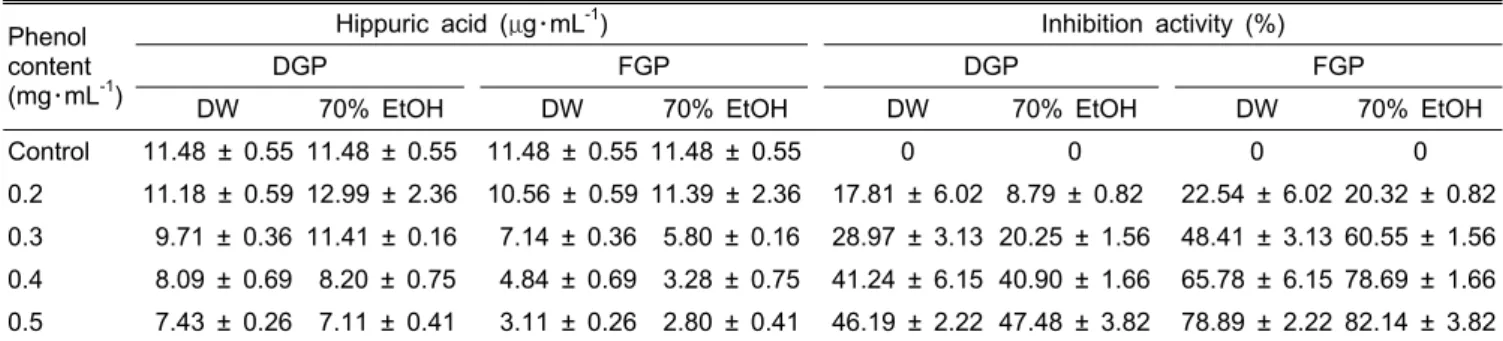
Table 2. Inhibition effect of dried or fermented Gastrodiae elata Blume extracts on angiotensin converting enzyme.
Phenol content (mg・mL-1)
Hippuric acid (μg・mL-1) Inhibition activity (%)
DGP FGP DGP FGP
DW 70% EtOH DW 70% EtOH DW 70% EtOH DW 70% EtOH
Control 11.48 ± 0.55 11.48 ± 0.55 11.48 ± 0.55 11.48 ± 0.55 0 0 0 0
0.2 11.18 ± 0.59 12.99 ± 2.36 10.56 ± 0.59 11.39 ± 2.36 17.81 ± 6.02 8.79 ± 0.82 22.54 ± 6.02 20.32 ± 0.82 0.3 9.71 ± 0.36 11.41 ± 0.16 7.14 ± 0.36 5.80 ± 0.16 28.97 ± 3.13 20.25 ± 1.56 48.41 ± 3.13 60.55 ± 1.56 0.4 8.09 ± 0.69 8.20 ± 0.75 4.84 ± 0.69 3.28 ± 0.75 41.24 ± 6.15 40.90 ± 1.66 65.78 ± 6.15 78.69 ± 1.66 0.5 7.43 ± 0.26 7.11 ± 0.41 3.11 ± 0.26 2.80 ± 0.41 46.19 ± 2.22 47.48 ± 3.82 78.89 ± 2.22 82.14 ± 3.82 DW, distilled water extracts; 70% EtOH, 70% ethanol extracts; DGP, dried Gastrodiae elata Blume powder; FGP, fermented Gastrodiae elata Blume powder. The data were expressed as the mean ± SD (n = 3). Results are representatives of more than three independent experiments.
물 모두 낮은 함량을 나타내었다(Fig. 1). 발효천마 추출물 의 경우 건천마 추출물보다 낮은 malondialdehyde 함량을 나타내어 상대적으로 높은 항산화력을 나타낸 것을 알 수 있었다. 이 결과 역시 발효과정 중 일어난 천마 분말의 화학 적 변화에 의한 것이라 생각되며 DPPH, APF, ABTS 항산 화 활성 결과와 유사한 경향을 나타내었다.
Angiotensin Converting Enzyme(ACE)
고혈압 완화에 도움이 된다고 알려진 천마를 이용하여 발효 및 건천마의 ACE 저해활성을 측정하여 비교하였다.
그 결과 발효천마 추출물이 건천마 추출물에 비해 높은 저 해 활성을 나타내고 있는 것을 알 수 있으며, 첨가 농도에 따라 농도가 의존적으로 높아짐을 알 수 있었다(Table 2). 고 혈압은 우리 몸의 angiotensin I converting enzyme이라는 효소가 관여하는데 우리나라에서 암 다음으로 많이 발생되 는 대표적인 질환의 하나이다. 생체 중에 존재하는 불활성 형의 angiotensin I은 ACE에 의해 dipeptide가 떨어져 나감 으로써 혈관벽 수축작용이 있고 angiotensin II로 전환된다.
이 물질은 강력한 혈관수축작용을 가지고 aldosterone의 분
비를 촉진함으로써 물과 sodium의 배설을 억제하며, 또한 혈관이완작용을 갖는 bradykinin을 불활성화시켜 혈압을 상 승시키는 역할을 한다(Cushman and Cheung, 1971). Kang et al.(2002)은 0.2-1mg・mL-1 천마 추출물 농도 범위에서 ACE 저해율은 63-89%로 농도가 높아짐에 따라 ACE 저해 활성도 증가하나, 0.6mg・mL-1 이상의 고농도일 때 저해능 의 유의성이 없는 것으로 보고하여, 이 연구에서의 시료 농 도의 범위에 따른 유의성을 판단할 수 있었다. 일반적으로 phenol 유래의 화합물과 단백질과의 결합은 단백질의 아미 드 결합과 페놀성 수산기간의 수소결합에 의한 반응으로 단 백질과 복합체의 침전물을 형성한다. 이런 현상은 pH, 이온 농도, 단백질 및 phenol 농도에 의한 상호작용으로 비경쟁적 효소를 저해함으로써 효소의 용해성 및 안정성을 저하시키 고, 효소 불활성화를 일으키는 것으로 보고되어 있다(Kim, 2006), 천마를 발효하여 활용하면 위와 같은 유익한 화학적 변화를 가져와 천마의 활용도를 높일 수 있을 것으로 생각 된다.
Xanthin Oxidase(XOase)
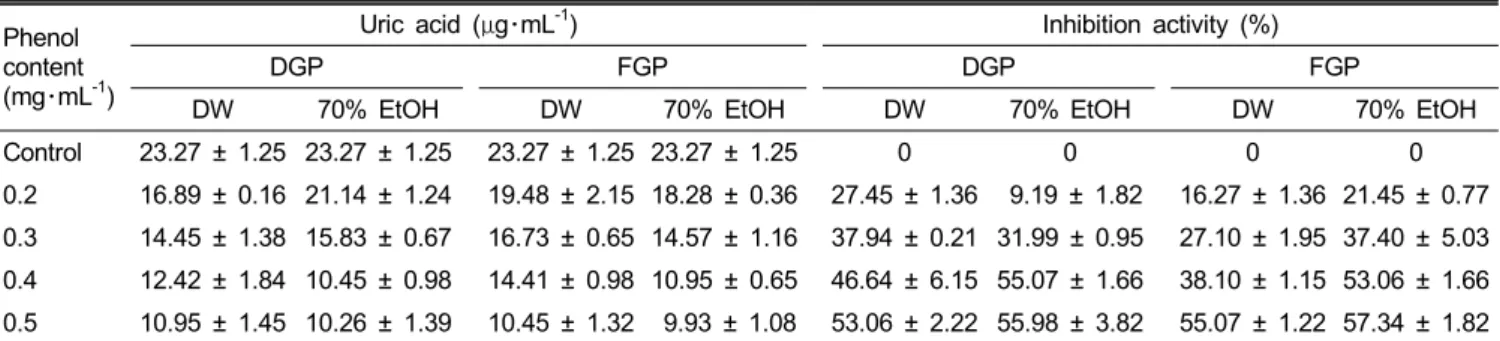
천마와 발효천마 추출물의 xanthin oxidase(XOase) 저해 활성을 측정한 결과 발효와 건천마 간의 차이는 거의 없는 것으로 나타났으며, 천마 추출물 0.4mg・mL-1의 농도를 처 리하면 모든 추출물에서 40% 이상의 XOase 저해 활성을 나타내는 것으로 나타났다(Table 3). XOase에 대한 천마 추 출물의 저해 활성은 발효에 의한 상승효과를 기대할 수 없 는 것으로 나타났다. XOase는 분자상의 산소를 수소 수용체 로 이용하여 xanthine을 uric acid형으로 산화하는 반응을 촉 매작용을 하므로 XOase의 저해 효과는 유리 라디칼의 생성 억제와 더불어 생물학적으로 중요한 의의를 가진다고 할 수 있다. XOase는 purine 대사에 관여하는 효소로서 xanthine 또는 hypoxanthine으로부터 urate를 형성하여 urate가 혈장 내에 증가되면 골절에 축적되어 심한 통증을 유발하는 통풍
Table 3. Inhibition effect of dried or fermented Gastrodiae elata Blume extracts on xanthine oxidase.
Phenol content (mg・mL-1)
Uric acid (μg・mL-1) Inhibition activity (%)
DGP FGP DGP FGP
DW 70% EtOH DW 70% EtOH DW 70% EtOH DW 70% EtOH
Control 23.27 ± 1.25 23.27 ± 1.25 23.27 ± 1.25 23.27 ± 1.25 0 0 0 0
0.2 16.89 ± 0.16 21.14 ± 1.24 19.48 ± 2.15 18.28 ± 0.36 27.45 ± 1.36 9.19 ± 1.82 16.27 ± 1.36 21.45 ± 0.77 0.3 14.45 ± 1.38 15.83 ± 0.67 16.73 ± 0.65 14.57 ± 1.16 37.94 ± 0.21 31.99 ± 0.95 27.10 ± 1.95 37.40 ± 5.03 0.4 12.42 ± 1.84 10.45 ± 0.98 14.41 ± 0.98 10.95 ± 0.65 46.64 ± 6.15 55.07 ± 1.66 38.10 ± 1.15 53.06 ± 1.66 0.5 10.95 ± 1.45 10.26 ± 1.39 10.45 ± 1.32 9.93 ± 1.08 53.06 ± 2.22 55.98 ± 3.82 55.07 ± 1.22 57.34 ± 1.82 DW, distilled water extracts; 70% EtOH, 70% ethanol extracts; DGP, dried Gastrodiae elata Blume powder; FGP, fermented Gastrodiae elata Blume powder. The data were expressed as the mean ± SD (n = 3). Results are representatives of more than three independent experiments.
Fig. 2. Effect of Gastrodiae elata Blume extracts on the neurite outgrowth from PC12 Cells. CONT, control sample with EtOH;
NGF, nerve growth factor; DGP, dried Gastrodiae elata Blume powder; FGP, fermented Gastrodiae elata Blume powder. Bars represent the mean ± SD (n = 3). Results are representatives of more than three independent experiments.
과 신장에 침착되어 신장질환을 일으키는 효소로 알려져 왔 다(Stripe and Corte, 1969).
PC12 Cell에서 Nerve Growth Factor(NGF)
향신경성인자(neurotrophic factor, NF)는 신경세포의 성 장, 분화 및 사멸을 조절하는 신경조절인자로서, 중추신경계 (central nervous system, CNS)와 말초신경계(peripheral nervous system, PNS)에서 뉴런(neuron)의 성장, 분화 및 생존에 영 향을 미치는 단백질을 총칭한다. 미분화된 PC12 세포에서 시 료의 신경돌기 성장에 미치는 영향을 알아보기 위하여 PC12 세포에 건천마와 발효천마 추출물을 각각 투여한 후 신경돌 기의 성장 길이를 측정하여 신경돌기 성장효과를 평가하였 다. NGF의 신경돌기 성장효과를 100%라고 하였을 때 건천 마 물과 에탄올 추출물에서 37.5% 이상의 신경돌기 성장효 과를 발효천마 물과 에탄올 추출물에서는 40.6%의 신경돌 기 성장효과를 나타내었다(Fig. 2). 향신경성인자 뇌유래 신 경성인자(brain-derived neurotrophic factor, BDNF)와 신경 성인자(neurotrophin, NT)인 NT-3, NT-4, 그리고 NT-5등이 있다(Maness et al., 1994). 이러한 신경성장인자들은 그 종 류에 따라 분화, 발현되는 합성 양상이 다르고 표적 장소가 다르다. 향신경성인자는 신경세포의 사멸을 억제하며, 향신 경성인자의 결핍은 이들의 단백질 합성(cell death related genes)에 의존하는 세포사멸을 발생시킨다. 향신경성인자 중 신경성장인자(NGF)는 뉴런퇴화 사멸을 억제함으로써 뉴 런의 감소를 방지하며, 중추신경계에서 신경세포의 손상을 보호하는 작용을 하고, 성숙한 신경원 유지에 중요한 역할 을 한다(Hefti, 1986). 신경계의 정상적인 발생과정 중 발생 중인 뉴런의 약 50%는 세포사멸에 의해 제거되며, 표적 세 포에 의해 분비되는 신경성장인자들이 뉴런의 생존을 결정 한다고 알려져 있다. 신경세포가 정상상태에서 생존, 성장, 분화하기 위해서는 신경성장인자와 같은 성장촉진인자들이
필수적으로 요구된다고 할 수 있다. 향신경성 인자 중 하나 인 NGF는 생체 내에서 생성되는 단백질로서 PC12 세포를 분화시키는 것으로 알려져 있다(Levi-Montalcini and Booker, 1960).
초 록
건천마와 발효천마의 추출물을 이용하여 항노화 활성과 신경성장인자 유도효과를 비교하였다. 항산화 활성을 비교 하여 측정한 결과 모든 추출물에서 비교적 높은 항산화력 을 나타내었으며, 발효하지 않은 건천마 추출물보다 발효 과정을 거친 발효천마 추출물에서 다소 높은 항산화력을 나타내었다. Angiotensin converting enzyme(ACE)와 xanthine oxidase(XOase) 저해 활성을 측정한 결과 DW 추출에서 DPPH가 건천마 64.14 ± 0.89%, 발효천마 66.21 ± 1.03%으 로 나타났고, ABTS가 건천마 54.15 ± 1.37%, 발효천마 60.24
± 2.25%로 나타났다. 70% EtOH추출에서도 유사한 결과를 보여 발효천마 추출물이 ACE에 대해 높은 저해활성을 나타 내었으나, XOase에 대하여 발효 및 건천마 추출물의 차이는 크지 않다는 것을 알 수 있다. 그리고 nerve growth factor (NGF) 활성 측정 결과 모든 추출물에서 40%의 신경돌기 성장효과를 나타내었다. 이와 같이 건천마와 발효천마의 추 출물을 상대로 천마의 항노화 활성과 신경성장인자 유도효 과에 대한 기능성을 탐색한 결과 발효천마가 건천마보다 우수한 생리기능성을 가지는 것을 알 수 있어, 발효과정을 통하면 천마의 활용도를 높일 수 있다는 것을 증명할 수 있었다.
추가 주요어 : 엔지오텐신전환효소, 항산화효과, 항산화력, 크산틴산화효소
인용문헌
Andarwulan, N. and K. Shetty. 1999. Phenolic content in differentiated tissue cultures of untransformed and Agrobacterium-transformed roots of anise (Pimpinella anisum L.). J. Agric. Food Chem.
47:1776-1780.
Bae, N.H. and Y.M. Kim. 2010. Improvement of the functional qualities of sea tangle extracts through fermentation by Aspergillus oryzae. Korean J. Fish Aquat Sci. 13:12-17.
Blois, M.S. 1958. Antioxidant determinations by the use of a stable free radical. Nature 26:1199-1200.
Buege, J.A. and S.D. Aust. 1978. Microsomal lipid peroxidation.
Method in Enzymol. 105:302-306.
Choi, D.G. 2003. Quality characteristics and preference as beverage of Gastrodia elata Blume. Master’s Degree Thesis. Sangju Univ., Sangju, Korea.
Choi, J.H. 2008. The studies of fermentation of Gastrodia elata Blume powder. Master’s Degree Thesis. Yeungnam Univ., Gyeongsan, Korea
Choi, S.R, C.S. Kim, and D.H. You. 2011. Changes of components and quality in Gastrodia rhizoma by different dry methods.
Korea J. Medicinal Crop Sci. 19:354-361.
Cushman, D.W. and H.S. Cheung. 1971. Spectro-photometic assay and properties of the angiotensine-converting enzyme of rabbit lung. Biochem. Pharmacol. 20:1637-1648.
Eom S.H., B.J. Bae, and Y.M. Kim. 2010. Effect of yeast fermentation on the antioxidant and anti-inflammatory activity of sea tangle water extract. Korean J. Fish Aqua. Sci. 43:117-124.
Ha, J.H., D.U. Lee, and K. Huh. 1997. Modulation of ligand binding to the GABA-benzodiazepine receptor complex by Gastrodia elata Bleme. J. Appl. Pharmacol. 5:325-330.
Hefti, F. 1986. Nerve growth factor promotes survival of septal cholinergic neurons after fimbrial transections. J. Neurosci.
6:2155-2162.
Heo, J.C., J.Y. Park, S.M. An, J.M. Lee, C.Y. Yun, H.M. Shin, T.K. Kwon, and S.H. Lee. 2006. Anti-oxidant and anti-tumor activities of crude extracts by Gastrodia elata Blume. Korean
J. Food Preserv. 13:83-87.
Hong, H.S., Y.C. Kim, I.K. Keum, S.S. Kim, K.I. Kim, and C.K.
Han. 2005. Effect of Gastrodia rhizoma fractions on serum lipid concentrations in rats fed with high fat diet. J. Korean Soc. Appl. Biol. Chem. 48:370-374.
Huh, K., J.S. Kim, T.H. Kwon, J.A. Kim, C.S. Youg, J.H. Ha, and D.U. Lee. 1998. The mechanism of anticonvulsive effect of the Rhizoma of Gastrodia elata in pentylenetetrazole treated rats. Yakhak Hoeji 42:330-335.
Jeong, C.H., S.T. Kang, O.S. Joo, S.C. Lee, Y.H. Shin, K.H. Shim, S.H. Cho, S.G. Choi, and H.J. Heo. 2009. Phenolic content, antioxidant effect and acetylcholine esterase inhibitory activity of Korean commercial green, puer, oolong, and black teas.
Korean J. Food Preserv. 16:230-237.
Jeun, Y.S. 2011. The screening of biological activity from Caragana chamlagu extracts and application to functional foods and cosmetics. M.S. thesis. Kyungpook Univ., Sangju, Korea.
Kang, C.S. 2007. Qualitative characteristics of sponge cakes with addition of Gastrodia rhizoma powder. Korean J. Culinary Res. 13:211-219.
Kang S.T., Y.J. Kong, H.J. Kwon, B.K. Choi, J.G. Hong, and U.K. Park, 2002. A studies on the chemical composition and in vitro biological activities of a hot water extracts of Gastrodia elata. Kor. J. Mycol. 30:136-141.
Kim, E.J., Y.E. Kim, and G.Y. Kim. 2007. The anti-obesity effects of treadmill exercise and Gastrodia elata on the obesity rats induced high-fat diet. Korean J. Exercise Nutr. 11:61-68.
Kim, H.C. and D.K. Ahn, 1999. Neuroprotective effect of Gastrodia rhizoma on global ischemia induced by 4-vessel occlusion in rats. Kor. J. Hernology 14:121-129.
Kim, H.J., S.K. Chung, and K.D. Moon. 2000. Chemical components of Gastrodia elata Blume powder. Korean J. Postharvest Sci.
Technol. 7:278-284.
Kim, J.A., D.G. Jin, S.H. Park, J.H. Ha, Y.S. Lee, C.S. Youg, D.U. Lee, and K. Huh. 2001. General pharmacology of 4- hydroxybenzaldehyde, 4-hydroxy-3-methoxybenzyl alcohol and their synthetic derivatives from Gastrodia eleta Blume. J.
Resource Dev. 20:32-37.
Kim, J.H. 2006. Biological activities of phenolic compound from herb and oriental medicinal resource. Master’s Degree Thesis.
Sangju Univ., Sangju, Korea.
Kim, M.J., J.Y. Kim, S.W. Choi, J.T. Hong, and K.S. Yoon. 2004.
Anti-wrinkle effect of safflower (Cathamus tinctotius) seed extract. J. Soc. Cosmet. Sci. Korea 30:15-22.
Kim, M.R., J.H. Hwang, J.K. Yun, K.H. Han, E.J. Do, J.S. Lee, E.J. Lee, and J.B. Kim. 2011. Antioxidation and antiaging effect of mixed extract from Korean medicinal herbs. Kor.
J. Herbology 26:111-117.
Kinsella, J.E., E. Frankel, B. German, and J. Kanner. 1993.
Possible mechanism for the protective role of antioxidants in wine and plant foods. Food Technol. 478:85-92.
Levi-Montalcini, R. and B. Booker. 1960. Destruction of the sympathetic ganglia in mammals by an antiserum to a nerve- growth protein. Proc. Natl. Acad. Sci. USA 46:384-391.
Maness, L.M., A.J. Kastin, J.T. Weber, W.A. Banks, B.S. Beckman, and J.E. Zadina. 1994. The neurotrophins and their receptors:
structure, function, and neuropathology. Neurosci. Biobehav.
Rev. 18:143-59.
Martin, T.F. and R.N. Grishanin. 2003. PC12 cell as a model for studies of regulated secretion in neuronal and endocrine cells. Methods Cell Biol. 71:267-286.
Pellegrin, N., R. Roberta, Y. Min, and R.E. Catherine. 1998.
Screening of dietary carotenoids and carotenoid-rich fruit extracts for antioxidant activities applying 2,2'-azinobis (3- ethylenebenzothiazoline-6-sulfonic acid) radical cation decolori-
zation assay. Method in Enzymol. 299:379-389.
Song, H.S., H.K. Kim, H.O. Min, J.D. Choi, and Y.M. Kim. 2011.
Changes in physicochemical and sensory properties of Hizikia fusiforme water extract by fermentation of lactic acid bacteria.
Kor. J. Fish Aqua. Sci. 44:104-110.
Stirpe, F. and E.D. Corte. 1969. The regulation of rat liver xanthine oxidase. J. Biol. Chem. 244:3855-3862.