• 검색 결과가 없습니다.

First Report of Gray Mold Disease of Sponge Gourd (Luffa cylindrica) Caused by Botrytis cinerea in Korea

N/A
N/A
Protected

Academic year: 2021

Share "First Report of Gray Mold Disease of Sponge Gourd (Luffa cylindrica) Caused by Botrytis cinerea in Korea"

Copied!
4
0
0

로드 중.... (전체 텍스트 보기)

전체 글

(1)

Sponge gourd (Luffa cylindrica L.) is a tropical and subtropi- cal vegetable belongs to the family Cucurbitaceae. Luffa gourds are grown primarily for their fibrous tissue skeleton, which is commonly used as scrubbers, cleaning pads or bath sponges, but green immature fruits were cooked as vegetable and eaten as squash or substituted for cucumber in salads (Oboh and Aluyor, 2009). Botrytis cinerea (teleomorph Botryo­

tinia fuckeliana) is an air borne, ubiquitous filamentous fungal pathogen and may cause gray mold on a variety of dicotyle- donous plants, including many vegetables, fruits, ornamental flowers, and greenhouse plants (Elad, 1997; Jarvis, 1977). The pathogen is a necrotroph, inducing host cell death resulting in serious damage to plant tissues culminating in rot of the plant (Govrin and Levine, 2000; Staats et al., 2005). Botrytis infections are favored by a cool weather, rainy spring season and summer temperatures of approximately 15

o

C (60

o

F). Gray

mold can be particularly damaging when rainy and/or damp weather occurs over several days. Since 2014, gray mold of sponge gourd caused by B. cinerea has been found at differ- ent locations in Korea. The aim of the present study was to identify the causal agent associated with gray mold observed on sponge gourd in Korea, based on culture characteristics, molecular phylogenetics, and pathogenicity.

Isolation of the fungi and pathogenicity test. In October 2014, several young fruits exhibiting symptoms with gray mold were observed in Sachunmun, Gangneung, Gangwon Province, Korea. Symptoms included abundant mycelia growth with gray conidia on young fruits and finally rotting the fruits (Fig. 1A). Diseased fruit tissue was excised and sur- face sterilized by immersion in 0.1% sodium hypochlorite (Na- OCl) for 1 minute, rinsed three times with sterilized distilled water, placed on potato dextrose agar (PDA; Difco, Detroit, MI, USA) plates, and incubated at 20

o

C±2

o

C.

To conduct the pathogenicity test, inoculum was prepared

©The Korean Society of Plant Pathology

cc

This is an open access article distributed under the terms of the Creative Commons Attribution Non-Commercial License (http://creativecommons.org/

licenses/by-nc/4.0/), which permits unrestricted non-commercial use, distribution, and reproduction in any medium, provided the original work is properly cited.

Open Access

Res. Plant Dis. 22(2): 107-110 (2016)

http://dx.doi.org/10.5423/RPD.2016.22.2.107

First Report of Gray Mold Disease of Sponge Gourd ( Luffa cylindrica ) Caused by Botrytis cinerea in Korea

*Corresponding author Tel: +82-33-640-2353 Fax: +82-33-640-2909 E-mail: [email protected]

Md. Aktaruzzaman 1,2 , Tania Afroz 1 , Byung-Sup Kim 1 *, and Hyeon-Dong Shin 3

1

Department of Plant Science, Gangneung­Wonju National University, Gangneung 25457, Korea

2

National Institute of Crop Science, Highland Agriculture Research Institute, Pyeongchang 25342, Korea

3

Division of Environmental Science and Ecological Engineering, College of Life Sciences and Biotechnology, Korea University, Seoul 02841, Korea

Received April 19, 2016 Revised June 8, 2016 Accepted June 10, 2016

In October 2014, an occurrence of gray mold was observed on young fruits of sponge gourd (Luffa cylindrica) in Sachunmun, Gangneung, South Korea. Symptoms included abundant mycelia growth with gray conidia on young fruits and finally rotting the fruits. The fungus was isolated from symptomatic fruits and its pathogenicity was confirmed. Based on the morphological features and sequence analysis of ITS-5.8S rDNA, G3PDH, HSP60, and RPB2 genes, the pathogen was identified as Botrytis cinerea Pers. This is the first report of gray mold caused by B. cinerea on L. cylindrica in Korea.

Keywords: Botrytis cinerea, Gray mold, Luffa cylindrica, Sponge gourd

Research in Plant Disease pISSN 1598-2262, eISSN 2233-9191 www.online-rpd.org

식물병연구

Note

107

(2)

by harvesting conidia from 2-week-old cultures on PDA. A conidial suspension (2×10

6

conidia/ml) was sprayed onto 3 young fruits that were wounded by piercing with a steril- ized needle. Another 3 wounded fruits were sprayed with sterilized water, serving as controls. Inoculated all fruits were sealed in a plastic bags that had been sprayed with water on the inside to maintain high humidity and incubated in growth chamber at 20

o

C±2

o

C. After 7 days, blackish gray mycelia with abundance conidia were developed on inoculated fruits (Fig.

1B); whereas control fruits remained symptomless. The patho- genicity test was carried out twice with similar results. The pathogen was successfully re-isolated from inoculated fruits, fulfilling Koch’s postulates. The results showed that B. cinerea was the causal agent of the disease.

DNA extraction, polymerase chain reaction (PCR) ampli- fication, and sequence analysis. Genomic DNA of isolated fungus was extracted using DNeasy Plant Mini Kit (Qiagen Inc., Valencia, CA, USA) following the manufacturer’s instructions.

DNA sequence of the internal transcribed spacers (ITS) and 5.8S ribosomal DNA (ITS-5.8S rDNA) ITS4 (White et al., 1990) and three nuclear protein-coding genes: glyceraldehyde- 3-phosphate dehydrogenase gene (G3PDH), heat-shock pro- tein 60 gene (hsp60) and DNA-dependent RNA polymerase

subunit II gene (RPB2) were amplified using primer pairs ITS1 (5′-TCCGTAGGTGAACCTGCGG- 3′)/ITS4 (5′-TCCTCCGCTTATT- GATATGC-3′) (White et al., 1990), G3PDH-F (5′-ATTGACATC- GTCGCTGTCAACGA-3′)/G3PDH-R (5′-ACCCCACTCGTTGT CG- TACCA-3′), HSP60-F (5′-CAACAATTGAGATTTGCCCACAAG-3′)/

HSP60-R (5′-GATGGATCCAGTGGTACCGAGCAT-3′), and RPB2-F (5′-GATGATCGTGATCATTTCGG-3′)/RPB2-R (5′-CCCATAGCTT- GCTTACCCAT- 3′) (Staats et al., 2005), respectively. The PCR was performed in a 25 μl reaction mixture containing 0.5 μl of each primer, 0.5 μl of TaqDNA polymerase (Bioneer, Daejeon, Korea), 0.5 μl of each dNTP, 2.5 μl of 10× PCR reaction buffer, 18.5 μl of distilled water, and 2.0 μl of template DNA. The re- action was performed in Mastercycler Gradient (Eppendorf, Hamburg, Germany). The following thermo cycling pattern was used to amplify ITS region: an initial preheat at 94

o

C for 4 minutes, followed by 35 cycles of denaturation at 94

o

C for 35 seconds, annealing at 52

o

C for 55 seconds, and extension at 72

o

C for 1 minute, terminating with a final extension at 72

o

C for 10 minutes. The PCR cycle conditions were 94

o

C for 5 min- utes, followed by 35 cycles of 94

o

C for 30 seconds, 55

o

C for 30 seconds, 72

o

C for 90 seconds and a final elongation step at 72

o

C for 10 minutes for HSP60 and RPB2 gene segments. The same program with an annealing temperature of 64

o

C was applied to G3PDH gene fragments. The obtained nucleotide sequences were searched by using BLASTn available from the GenBank database (http://www.ncbi.nlm.nih.gov/BLAST/).

Phylogenetic analysis was performed by using the MEGA5 program (Tamura et al., 2011) with the neighbor-joining method (Saitou and Nei, 1987).

Identification and characterization of B. cinerea . A total of 4 morphologically similar isolates were obtained from 2 diseased tissue samples and isolate SGGM003 was examined for identification. Fungal colonies on PDA at 20

o

C were initially white and turned grey to dark grey after 5 days (Fig. 1C). Conidia (n=50) were single-celled, ellipsoidal or ovoid, 5.8–7.9×5.8–9.5 μm on naturally infected fruits and 5.8–10.2×4.8–7.2 μm on PDA (Fig. 1D). Conidiophores arose singly or in groups, straight or flexuous, septate, with an inflated basal cell and brown to light brown, and measured 11.2–25.5×112.3–415.7 μm. After three weeks, the fungus formed several black sclerotia ranging from 1.0–4.3×1.2–3.5 Research in Plant Disease Vol. 22 No. 2

108 A

B

C D E F

Fig. 1. Gray mold caused by Botrytis cinerea on sponge gourd

(Luffa cylindrica). (A) Young fruit damaged by gray mold. (B) Gray

mold developed 7 days after artificial inoculation. (C) Two-week-

old colony of B. cinerea on potato on potato dextrose agar. (D)

Conidia. (E, F) Conidiophore and conidia of B. cinerea (scanning

electron microscopy).

(3)

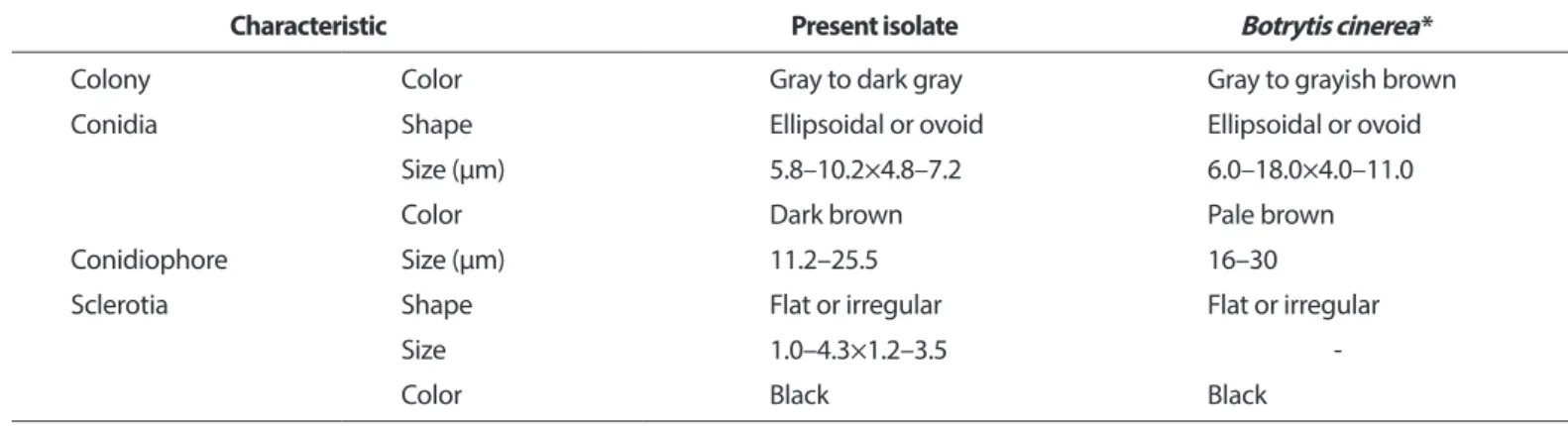
mm (n=20) near the edge of the Petri dish. The morphologi- cal characteristics of the identified species are summarized in Table 1.

BLAST analysis of the resulting approximately 527-bp ITS- 5.8S rDNA sequence, 883-bp G3PDH sequence, 976-bp HSP60 sequence and 1,093-bp RPB2 sequence were obtained.

The ITS-5.8S rDNA, G3PDH, HSP60 and RPB2 nucleotide se- quences for the re-isolated fungus were also obtained, and were 100% identical to the sequences of original isolates. The sequences for the representative isolate SGGM003 have been deposited in the NCBI database (GenBank accession Nos.

KT728905 for ITS-5.8S rDNA, KT728906 for G3PDH, KT728907 for HSP60, and KT728908 for RPB2). Blast analysis confirmed the identity of the fungus, showing 100% similarity to the ITS- 5.8S rDNA sequence of published B. cinerea isolate Bau42_3 (GenBank accession No. KP903573.1), 100% identity to the G3PDH sequence of isolate GRGM-3 of B. cinerea (KT025631.1), 100% identity to the HSP60 sequence of isolate SD1 of B. ci­

nerea (KM016534.1), and 100% identity to the RPB2 sequence of isolate B326 of B. cinerea (KF857477.1). In the phylogenetic tree based on combined G3PDH, HSP60, RPB2 nucleotide se- quences, the representative isolate was placed within a clade comprising reference isolates of B. cinerea (Fig. 2).

Based on symptoms, mycological characteristics, molecu- lar data and pathogenicity, this fungus was identified as B.

cinerea Pers. (Barnett and Hunter, 1972; Ellis and Waller, 1974;

Zhang, 2006). Gray mold disease of L. cylindrica caused by B. cinerea has been recorded in Taiwan (Ko et al., 2007). To our knowledge, this is the first occurrence of gray mold on sponge gourd in Korea.

Conflicts of Interest

No potential conflict of interest relevant to this article was reported.

References

Barnett, H. L. and Hunter, B. B. 1972. Illustrated Genera of Imper- fect Fungi. 3rd ed. Burgess Publishing, Minneapolis, MN, USA.

Elad, Y. 1997. Effect of filtration of solar light on the production of conidia by field isolates of Botrytis cinerea and on several dis- eases of greenhouse-grown vegetables. Crop Prot. 16: 635-642.

Ellis, M. B. and Waller, J. M. 1974. Sclerotinia fuckeliana (conidial

Research in Plant Disease Vol. 22 No. 2 109

Table 1. Morphological characteristics of the gray mold fungus isolated from sponge gourd

Characteristic Present isolate Botrytis cinerea*

Colony Color Gray to dark gray Gray to grayish brown

Conidia Shape Ellipsoidal or ovoid Ellipsoidal or ovoid

Size (μm) 5.8–10.2×4.8–7.2 6.0–18.0×4.0–11.0

Color Dark brown Pale brown

Conidiophore Size (μm) 11.2–25.5 16–30

Sclerotia Shape Flat or irregular Flat or irregular

Size 1.0–4.3×1.2–3.5 -

Color Black Black

*Described by Ellis and Waller (1974) (CMI Descr. Pathog. Fungi Bact. 431).

Fig. 2. Phylogenetic analysis of Botrytis cinerea isolate SGGM003, constructed by using the neighbor-joining method based on combined G3PDH, HSP60, and RPB2 gene sequence data. Mon­

ilinia fructigena was used as the out group. The numbers at the nodes indicate bootstrap values from a test of 1,000 replicates.

The scale bar indicates the number of nucleotide substitutions.

(4)

state: Botrytis cinerea). CMI Descr. Pathog. Fungi Bact. 431.

Govrin, E. M. and Levine, A. 2000. The hypersensitive response fa- cilitates plant infection by the necrotrophic pathogen Botrytis cinerea. Curr. Biol. 10: 751-757.

Jarvis, W. R. 1977. Botryotinia and Botrytis Species: Taxonomy, Physiology and Pathogenicity. A Guide to the Literature. Re- search Branch, Canada Department of Agriculture, Ottawa, ON, Canada. 195 pp.

Ko, Y., Yao, K. S., Chen, C. Y. and Lin, C. H. 2007. First report of gray mold disease of sponge gourd (Luffa cylindrica) caused by Botrytis cinerea in Taiwan. Plant Dis. 91: 1199.

Oboh, I. O. and Aluyor, E. O. 2009. Luffa cylindrica: an emerging cash crop. Afr. J. Agric. Res. 4: 684-688.

Saitou, N. and Nei, M. 1987. The neighbor-joining method: a new method for reconstructing phylogenetic trees. Mol. Biol. Evol. 4:

406-425.

Staats, M., van Baarlen, P. and van Kan, J. A. L. 2005. Molecular phylogeny of the plant pathogenic genus Botrytis and the evo- lution of host specificity. Mol. Biol. Evol. 22: 333-346.

Tamura, K., Peterson, D., Peterson, N., Stecher, G., Nei, M. and Ku- mar, S. 2011. MEGA5: molecular evolutionary genetics analysis using maximum likelihood, evolutionarydistance, and maxi- mum parsimony methods. Mol. Biol. Evol. 28: 2731-2739.

White, T. J., Bruns, T., Lee, S. and Taylor, J. 1990. Amplification and direct sequencing of fungal ribosomal RNA genes for phyloge- netics. In: PCR Protocols: A Guide to Methods and Applications, eds. by M. A. Innis, D. H. Gelfand, J. J. Sninsky and T. J. White, pp.

315-322. Academic Press Inc., New York, NY, USA.

Zhang, Z. 2006. Flora Fungorum Sinicorum. Vol. 26. ‘Botrytis’, ‘Ram­

ularia’. Science Press, Beijing, China.

Research in Plant Disease Vol. 22 No. 2

110

수치

Fig. 1. Gray mold caused by Botrytis cinerea on sponge gourd  (Luffa cylindrica). (A) Young fruit damaged by gray mold
Fig. 2. Phylogenetic analysis of Botrytis cinerea isolate SGGM003,  constructed by using the neighbor-joining method based on  combined G3PDH, HSP60, and RPB2 gene sequence data

참조

관련 문서

• 이명의 치료에 대한 매커니즘과 디지털 음향 기술에 대한 상업적으로의 급속한 발전으로 인해 치료 옵션은 증가했 지만, 선택 가이드 라인은 거의 없음.. •

The proposal of the cell theory as the birth of contemporary cell biology Microscopic studies of plant tissues by Schleiden and of animal tissues by Microscopic studies of

 As a affiliated company of Green Cross in the field of genome analysis, we provide disease diagnosis services, such as prenatal genetic test, oncogenomic analysis and

It considers the energy use of the different components that are involved in the distribution and viewing of video content: data centres and content delivery networks

After first field tests, we expect electric passenger drones or eVTOL aircraft (short for electric vertical take-off and landing) to start providing commercial mobility

1 John Owen, Justification by Faith Alone, in The Works of John Owen, ed. John Bolt, trans. Scott Clark, "Do This and Live: Christ's Active Obedience as the

On his part, CEO of Express Roads Authority, Saud Al-Naqqi said that the heavy rains of the previous day led to clogging parts of the express

Kuwait will celebrate on Sunday the fourth anniversary of the UN honoring and proclamation of His Highness the Amir, Sheikh Sabah Al-Ahmad Al-Jaber Al-Sabah as