≫ 연구논문 ≪
연속 감압-간접열 방식의 벨트형 건조장치를 이용한 건조효율 연구
하상안 · 김동균 · 왕제필*
신라대학교 환경공학과,
*국립부경대학교 금속공학과
A Study on the Conditions of Drying Efficiency for Conveyor-Belt-Type Dryers Employing Continuous Decompression Indirect Heating Method
Sang-An Ha, Dong-Kyun Kim and Jei-Pil Wang*
Silla University, Department of Environmental Engineering, Busan 617-736, Korea
*Pukyong National University, Department of Metallurgical Engineering, Busan 608-739, Korea
요 약
본 연구의 목표는 1 ton/day용량의 연속 감압식 간접열 방식의 벨트형 건조장치를 개발하여 건조효율을 70% 이상 향상시키며 기 존 건조기 장치에 비하여 약 50% 이상의 건조기 크기를 축소시켜 장치의 소형, 경량화를 이루고 그로 인한 설치비 및 운전비 절 감효과를 20%이상 향상시키는 것이다. 현재는 기존의 간접열 건조장치를 분석하여 구조적인 개선점을 도출하였으며 기초실험을 통 하여 우수한 건조성능을 확인하였다. 또한 감압조건에서의 실험을 수행하여 열전달 및 건조특성이 향상되는 것을 확인하였다.
주제어 : 함수율, 열풍건조, 컨베이어, 열전달계수
Abstract
The objective of this study is to develop a belt-type dryer with a capacity of 1 ton/day, thereby improving drying efficiency by more than 70% and reducing the size of dryers by more than 50%, and thus making dryers smaller and lighter to reduce the installation and operation costs by more than 20%. We identified structural improvements by analyzing existing dryers employ- ing indirect heating and verified the superior drying performance of the proposed method through some basic experiments. Fur- thermore, we verified the improvements in the heat transfer and drying characteristics as we conducted the experiments at reduced pressure.
Key words : moisture content, hot-air drying, conveyer, heat transfer coefficient
1. Introduction
The heat and mass transfer in the heat source of dryer systems is basically controlled by moisture and temperature gradient. This process involves complex
phenomena such as diffusion of vapor because of the change in water vapor pressure; changes in thermal conductivity, diffusion coefficient and specific heat of the materials to be dried depending on moisture content;
energy loss attributed to the heat of vaporization and
· Received : October 26, 2015 · Revised : November 26, 2015 · Accepted : December 4, 2015 Corresponding Author : Jei-Pil Wang (E-mail : [email protected])
Department of Metallurgical Engineering, Pukyong National University, 365 Sinseon-ro, Nam-gu, Busan, 48547 Korea
ⓒThe Korean Institute of Resources Recycling. All rights reserved. This is an open-access article distributed under the terms
of the Creative Commons Attribution Non-Commercial License (http://creativecommons.org/licenses/by-nc/3.0/), which permits
unrestricted non-commercial use, distribution and reproduction in any medium, provided the original work is properly cited.
evaporation rate of moisture during contact with air and mass transfer into air because of diffusion and convection of moisture from the materials to be dried. Several types of studies on such drying phenomena and heat and mass transfer have been conducted.1-3)
Conventional drying processes used to generate air pollution and odor during cementation, incineration, and carbonization. Therefore, most studies on drying have only focused on the size of the device, heating, operability, and type of the dryer according to the characteristics of the materials to be dried through analysis of drying. Only few studies have been conducted on device development or technologies for waste heat recovery in terms of energy efficiency.4)
This study proposes a drying technology based on a high-efficiency heat source; through this technology, the materials to be dried are recycled effectively and moisture content is reduced considerably because drying is carried out as soon as moisture forms. Thus, it does away with the storage and transport processes necessary in the existing methods. Furthermore, no primary or secondary air pollutants are generated because materials are dried at temperatures below 180°C. Finally, we aimed to study on the characteristics of materials to be dried are recycled effectively.
2. Experimental Apparatus and Procedure
Table 1 lists the basic design specifications of the pilot-scale experiment device used in this study. The main types of materials to be dried were sewage sludge and organic and inorganic sludge, and the treatment
capacity was 1 ton/day. A belt-type conveyor system was designed to have a maximum speed of 60 RPM.
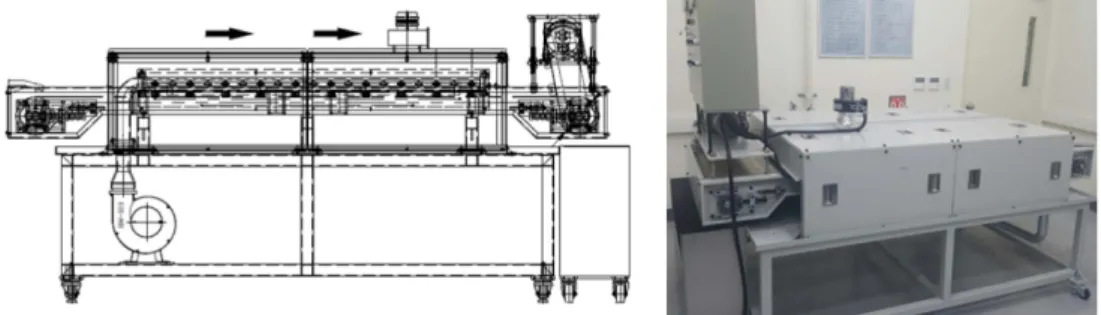
Ten heaters were used as the heat source, and the power consumption per heater was 750 W. The materials to be dried were introduced into the device at 100°C, and they were dried at 180oC via the heat transfer process before they were discharged. The temperature of the dried materials, which are discharged at the exit after the final drying, ranged around 70-90oC. Fig. 1 shows the schematic diagram of the pilot-scale experimental device of the belt-type hot-air drying system unit. It shows the pictures of the pilot prototypes manufactured and the overall appearance of the belt-type heat source dryer, which mainly comprises the main body of the dryer, sample supply unit, and exhaust unit. The vapor generated during drying was designed to be circulated to facilitate heat supply for materials inside the drying room. In addition, a conveyor belt was connected up to the final discharge port to maintain a constant degree of vacuum for the dried samples.
The temperature was maintained by means of the circulating fan, and a timer was installed and configured
Table 1. Basic design specifications of the pilot-scale
experiment device
No. Actions Operating conditions
1 Device Type Belt Conveyor
2 Application Scope Sewage sludge, etc.
3 Processing Capacity ~ 1 Ton
4 Control Power AC 380 V × 60 Hz × 3-phase 4-wire
5 Device speed 5–60 RPM
Fig. 1. A schematic diagram of the belt-type hot-air drying system unit.
to close and open the dryer for a certain time of interval, thereby minimizing the degree of vacuum while discharging the samples. Fig. 2 shows the detailed configuration of the device in which a blower fan for circulating air was mounted to minimize the fall in temperature due to the evaporation of moisture from the materials to be dried. To check whether the heat generated in the interior of the heater is supplied normally, a heat sensor was installed and control equipment was manufactured to adjust the conveyor-moving rate automatically.
3. Results and Discussion
To conduct accurate experiments, experiments to determine compensation were conducted for the conveyor that supplied materials to be dried and for the temperature sensor. Fig. 3 shows the compensation result of the conveyor; the sample’s discharge rate was measured with the speed of the conveyer belt. The sample’s discharge rate increased linearly with the increase in the speed.
In addition, we conducted experiments to compare the normal and reduced pressures with changes in the discharge rate by changing the flow rate at the discharge port of dry samples when running a blower pump.
Through the experiments, we can calculate the accurate number of calories to be used in the dryer by measuring the supply from the heat source on the heat transfer area, and this can be used to derive important results to calculate the dry efficiency and performance of the
Fig. 2. The detailed structure of the hot air drying system.
Fig. 3. Discharge rate calibration of the sample.
dryer.5-6)
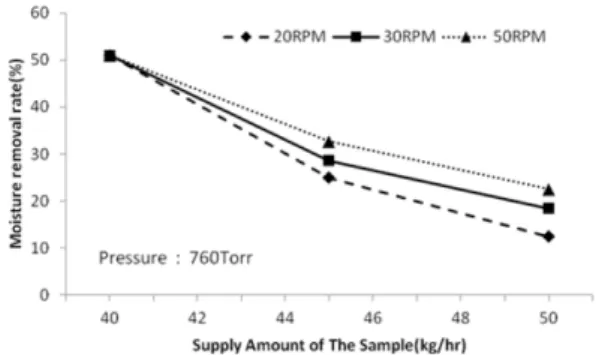
To evaluate the performance of the pilot prototype, we measured and calculated the moisture content of the materials to be dried and determined the heat transfer coefficient with sample input amount, RPM control, and heater operation at atmospheric pressure, though this is not related to specifically raising or reducing pressure.
Fig. 4 shows changes in moisture contents when the speed of the conveyor belt was increased from 20 to 50 RPM and sample’s input was varied between 40 and 50 kg/h at atmospheric pressure. As the sample’s input increased when heat was supplied, the moisture content of materials tended to be reduced. As the dryer’s speed was reduced, heat transfer was facilitated further when the heat source supplied more calories, resulting in better moisture evaporation and thus reducing the
moisture content of materials to be dried.7)
To calculate the heat transfer coefficient, which is the most important factor for the drying of materials in the dryer, equations (1) and (2) give the relationship among input calories during drying, heat transfer coefficient, temperature change, and heat transfer area when the supply rate of materials to be dried was 40 kg/h and inlet temperature of the heat source supply dryer was 177.5oC. The calculated total heat transfer coefficient was 78 kcal/m2·h·oC, which was smaller than the theoretical design value of 100 kcal/m2·h·oC. Table 2 lists the theoretical calculation values of the heat transfer coefficient. The calculation of the heat transfer coefficient in the dryer for the dryer for the materials to be dried can be a vital indicator to predict the volume of the dryer.8)
Q = UA× A ×Δ7 (1)
(2)
Ud : Overall Heat Transfer Coefficient (kcal/m2·h·oC), Q : Total heat transfer amount (kcal/h)
A : Mean heat transfer area (m2),
ΔT : Logarithmic mean temperature difference (oC)
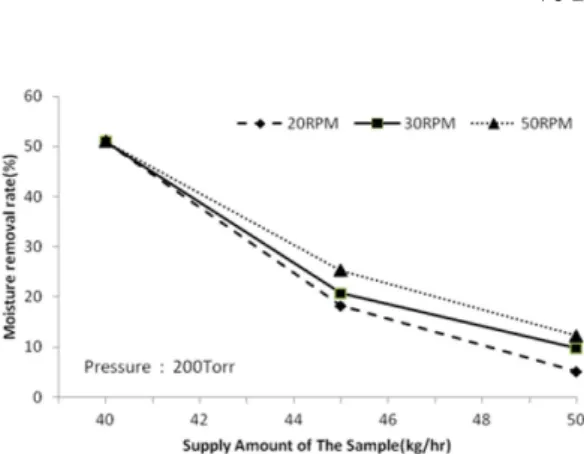
Figure 5 shows changes in the moisture content of materials to be dried with the sample’s input and rotation speed of the rotating axis in the dryer under reduced
Ud Q
A ΔT× ---
=
Fig. 4. Changes in the moisture content of the dried
product with the speed of the input and the conveyor belt of a sample at atmospheric pressure.
Table 2. Theoretical calculation values with regard to the heat transfer coefficient during drying at atomospheric pressure
No. Mark Explanation Results
1 Q Input quantity of heat 22,604 kcal/h
2 A Heat transfer area 2.5 m
23 ΔT The average temperature difference of the drying equipment 115.7°C ΔT = Hot-air dryer inlet temperature 177.5°C, Hot-air dryer outflow temperature 161.4°C, Sample outflow temperature 81°C, Sample
inlet temperature 24°C
T1 = 177.5 - 81 = 96.5, T2 = 161.4 − 24 = 137.4
∴ U
d= ΔT T 2 – T1
In T 2 T1 ---
⎝ ⎠
⎛ ⎞
--- 137.4 96.5 – In 137.4
--- 96.5
⎝ ⎠
⎛ ⎞
--- 115.7 C
o= = =
22604 2.5 115.7 ×
--- 78.1 kcal/m 2 h C ⋅
o⋅
[ ]
=
pressure (below 200 torr). The sample’s input rate varied between 40 and 50 kg/h, and the conveyor speed changed between 20 and 50 RPM in the experiments. The experiment result showed that as the sample input rate increased, the moisture contents of the samples tended to decrease under the same condition; when the dryer’s speed was maintained above 25 RPM, the moisture content of the samples tended to decrease, but when the speed exceeded a certain value, the moisture content after drying increased. The reason for this decrease was that the moisture content of the materials to be dried on the conveyor belt slipped below a certain level since the outer surfaces of the materials were dried first, and this prevented the materials from achieving sufficient heat transfer, thereby increasing the moisture content.
We also verified that no significant changes in moisture content were found because the moisture evaporated during the drying was absorbed again into the sample when the RPM decreased. Such a relationship between the threshold moisture content and dryer speed can be compensated sufficiently by increasing the number of operating heaters.
With an input of 50 kg/h, the moisture content of material to be dried was 12.4% under the dryer operation at 20 RPM, which satisfies the following: the operation condition of the initial design value, 50 kg/h of input rate, and below 30% of moisture content of the materials to be dried. Eq. (2) was used to estimate the heat transfer coefficient during drying under reduced pressure. To calculate the heat transfer coefficient, Table 3 lists theoretical calculation values of the relationship between the input calories during drying, heat transfer coefficient, temperature change, and heat transfer area when the supply rate of materials to be dried was 40 kg/h and inlet temperature of the heat source supply dryer was 153.6°C.
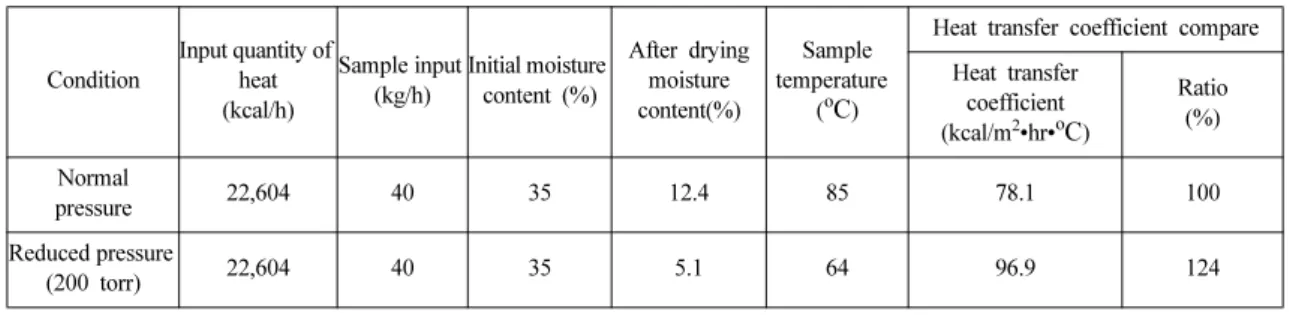
Figure 6 shows the values measured by conducting experiments with regard to changes in moisture contents of materials to be dried after inputting samples under normal and reduced pressures (200 torr). The moisture content was measured as 12.4% and 5.1% at normal and reduced pressure, respectively, after drying, indicating that moisture content after drying under reduced pressure were considerably lower than that under normal pressure.
Table 4 lists the total thermal conductivity (Ud) calculated
Fig. 5. Changes in the moisture content of the dried
product with the speed of the input and the conveyor belt of the sample at reduced pressure (200 torr).
Table 3. Theoretical calculation values with regard to the heat transfer coefficient during drying at reduced pressure
No. Mark Explanation Results
1 Q Input quantity of heat 22,604 kcal/h
2 A Heat transfer area 2.5 m
23 ΔT The average temperature difference of the drying equipment 93.3°C
ΔT = Hot-air dryer inlet temperature 153.6°C, Hot-air dryer outflow temperature 125.4°C, Sample outflow temperature 68°C, Sample inlet temperature 24°C
T1 = 153.6 - 68 = 85.6, T2 = 125.4 - 24 = 101.4
∴ U
d= ΔT T 2 – T1
In T 2 T1 ---
⎝ ⎠
⎛ ⎞
--- 101.4 –
85.6In
101.4---
85.6⎝ ⎠
⎛ ⎞
---
93.3oC
= = =
22604 2.5 ×
93.3--- =
96.9[ kcal/m
2⋅ h C ⋅
o]
based on the above result. As shown in Table 4, the total thermal conductivity (Ud) of the dryer for similar input calories improved to 124% when pressure was reduced up to 200 torr from normal pressure, which was not specifically raised or decreased. This result implies that when the same number of calories was supplied, the volume of dryer could be reduced by up to 20%. However, if the volume and number of calories were reduced below values, their ratio did not proportionally reduce normally owing to the indirect heating characteristics of the dryer. Thus, the dryer volume cannot be reduced by more than 20% in reality or the dryer will not work properly.
4. Conclusion
This study aimed to develop a dryer in which a continuous decompression indirect heating method is employed. This method helps overcome the numerous drawbacks of the existing direct heat drying methods.
Thus, in this study, a conveyor-belt-type dryer was fabricated, and it employed the continuous indirect heating method and had a capacity of 1 ton/day. The following conclusions were derived:
1. As the sample’s input increased under the given conditions, the moisture content of the materials to be dried tended to increase as well. As the dryer’s speed was decreased, heat transfer was facilitated further when the number of heat source supply heaters was increased, resulting in better moisture evaporation, and thus, reducing the moisture content of the materials to be dried.
2. The moisture content of the materials to be dried was 12.4% and 5.1% at normal and reduced pressure,
respectively, after drying. This indicated that the moisture content of the materials to be dried at reduced pressure was considerably lower than that at normal pressure.
3. If the volume and the number of calories were reduced below a certain ratio, this ratio did not proportionally reduce normally owing to the indirect heat dryer characteristics. Thus, a dryer’s volume cannot be reduced by more than 20% in reality or the dryer will not work properly.
4. In this study, the superiority of the developed equipment that applied the indirect heating method was verified, and the improvement of drying performance at reduced pressures was confirmed.
Acknowledgement
This study was supported by the R&D Center for Valuable Recycling (Global-Top Environmental Technology Development Program) funded by the Ministry of Environment (Project No.: GT-11-C-01-060-0).
Fig. 6. Changes in atmospheric pressure and the water content of the dried product corresponding to the sample input in vacuum.
Table 4. Experiment conditions and heat transfer coefficient at normal pressure and reduced pressure
Condition
Input quantity of heat (kcal/h)
Sample input (kg/h)
Initial moisture content (%)
After drying moisture content(%)
Sample temperature
(
oC)
Heat transfer coefficient compare Heat transfer
coefficient (kcal/m
2•hr•
oC)
Ratio (%)
Normal
pressure 22,604 40 35 12.4 85 78.1 100
Reduced pressure
(200 torr) 22,604 40 35 5.1 64 96.9 124
References
1. T. J. stubbing, 1993 : Airless Drying Its Invention, Method and Applications, Trans IChemE, VOL. 71, Part A, pp. 488-495.
2. A. Strawinski, 1991 : Analysis of Paper Dryers Heat Consumption, Drying, 91, pp. 567-590.
3. Sang-An Ha, 2014 : Effect of Effect of Microwave and High-temperature Heating Methods on Contaminates Removal from Oil-contaminated Soil by Heat Treatment, J. of Korean Inst. of Resources Recycling, 23(2), pp. 1-7.
4. A. S. Mujumdar, 1987 : Handbook of Industrial Drying, Marcel Dekker, Inc.
5. Young-Sub Moon, 1997 : Drying Characteristics of a Small-Scale Swirl-Flow Dryer, Graduate School of Kon- Kuk University.
6. Hiechan Kang, Hyun-sik Oh, 2011 : Air side Pressure Drop, Heat Transfer and Drain Performance Enhance- ment of Louver Fin Heat Exchanger by Using Dimple,
Korea Automobile Engineering Society of Partial com- prehensive academic tournament, pp. 2093-2097.
7. Jung-In Kim, 1994 : Application de la methode des ele- ments Finis a l'Etude Previsionnelle des Cycles Ther- miques en Relation avec des parametred technologiques et metallurgiques du procede TiG, Universite de Nantes, Ph.D. Thesis.
8. Fischer J, 2011 : Comparison of trilateral cycles and organic Rankine cycles, Energy, 36, pp. 6208-6219.
김 동 균
• 신라대학교 환경공학과 석/박사
• 현재 신라대학교 조교수
하 상 안
• 독일 Particle학회 정회원
• 현재 신라대학교 교수(공학교육혁신 센터장, 토양분석센터장)
왕 제 필