충청남도 해안지역의 비브리오 패혈증균 분포 및 분리주의 특성 분석
이현아 , 고영은 , 최지혜 , 이다연 , 여성순 , 박종진 , 이미영 , 최진하 , 박준혁*
충청남도보건환경연구원
Distribution and Characterization of Vibrio vulnificus Isolated in Coastal Areas of Chungcheongnam-do Province
Hyunah Lee, Young-Eun Ko, Jihye Choi, Dayeon Lee, Seoungsoon Yeo, Jongjin Park, Miyoung Lee, Jinha Choi, and Junhyuk Park*
Chungcheongnam-do Institute of Health and Environment Research ABSTRACT
ABSTRACT
Background: Vibrio vulnificus has been frequently detected in seawater, fish, and shellfish mainly in the coastal areas of Chungcheongnam-do Province.
Objectives: This study was conducted to investigate the analyzed biochemical properties, genetic characteristics, and distribution of Vibrio vulnificus isolated from environmental sources in coastal areas of Chungcheongnam-do Province from 2019 to 2020.
Methods: A total of 1,510 samples were obtained from six different sites in Chungcheongnam-do Province.
Isolated strains from the samples were identified by a VITEK 2 system and MALDI-TOF. Antibiotic susceptibility testing for 85 isolates was done by microdilution minimum inhibitory concentration methods, and 11 isolates were analyzed for 16s rRNA sequences in multiple alignments.
Results: Among the 1,510 samples taken during the investigation period, 306 strains were isolated and the detection rate of V. vulnificus was 20.3%. One hundred eighty-eight strains (24.6%) from seawater and 118 strains (15.8%) from mud flats were isolated. It was mainly detected in July (17.3%), August (36.5%), and September (28.8%), and the proportion was 82.0%. Based on the CLSI-recommended breakpoints, V.
vulnificus isolates were all susceptible to amoxicillin/clavulanic acid, amikacin, gentamicin, ciprofloxacin and trimethoprim/sulfamethoxazole. However, nonsusceptible isolates to ampicillin, ampicillin/sulbactam, cefazolin, cefoxitin, imipenem, tetracycline and chloramphenicol were identified. In the analysis of the nucleotide sequences for 16s rRNA of V. vulnificus isolates, it was confirmed that mutations frequently occurred between nucleotide number 922 and 952, and 98.2% to 100% nucleotide identities between isolates was verified.
Conclusions: The results of this study can be used as a basic data for infection control and prevention of Vibrio vulnificus infection by describing the distribution and characteristics of Vibrio vulnificus strains isolated in coastal areas of Chungcheongnam-do Province.
Key words: 16s rRNA sequence, antibiotic susceptibility, Chungcheongnam-do coastal areas, Vibrio vulnificus
Received September 16, 2021 Revised October 18, 2021 Accepted October 19, 2021
Highlights:
ㆍ Vibrio vulnificus can cause a serious and fatal infection that is the leading cause of death.
ㆍ Vibrio vulnificus was isolated and detected from seawater and mud flats mainly in summer season.
ㆍ The isolates showed high susceptibility to antimicrobial agent including β- lactam and aminoglycoside antibiotics.
ㆍ This study is meaningful in providing basic data for the management and prevention of Vibrio vulnificus infection.
*Corresponding author:
Chungcheongnam-do Institute of Health and Environment Research, 8, Hongyegongwon-ro, Hongbuk-eup, Hongseong 32254, Republic of Korea Tel: +82-41-635-6911
Fax: +82-41-635-7942 E-mail: [email protected]
Original Article
Copyright Ⓒ Korean Society of Environmental Health.
This is an open-access article distributed under the terms of the Creative Commons Attribution Non-Commercial License (http://creativecommons.org/licenses/by-nc/4.0/), which permits unrestricted non-commercial use, distribution, and reproduction in any medium, provided the original work is properly cited.
I. 서 론
최근 지구 온난화 등 기후 변화에 따라 해수 온도가 상승하 여 비브리오균에 대한 주의가 요구되고 있다. 특히 해안지역을 중심으로 해수와 어패류 등에서 자주 검출되며, 어패류를 생식 으로 즐기는 우리나라는 더욱 문제가 되고 있다. 병원성을 나타 내는 대표적인 비브리오균은 Vibrio parahaemolyticus, Vibrio cholerae 그리고 Vibrio vulnificus이다. V. parahaemolyticus 는 제4급 감염병으로 표본감시가 필요한 장관감염증이고, V.
cholerae의 경우, 제2급 감염병으로 발생 또는 유행 시 24시간 이내 신고 및 격리해야 하며, V. vulnificus는 제3급 감염병으로 발생 또는 유행 시 24시간 이내에 신고해야 한다. 이 세 가지 모 두 법정 감염병으로서 국가에서 관리하고 있다.1)
비브리오균은 Vibrionaceae과, Vibrio 속으로 분류되고 알려 진 77종 중 12종이 사람에게 병원성을 보이며 임상에서 분리 되고 있다. 이 중 병원성이 상대적으로 높은 V. cholerae O1, V.
cholerae O139, V. vulnificus가 중요하게 여겨진다.2) 패혈증의 원인인 V. vulnificus는 해양환경 어디서나 존재하여 상처 있는 사람이 오염된 해수에 노출되었을 때 감염될 수 있고, 덜 익은 어패류나 비가열 채소류 등의 음식과도 연관되어 있다.2-5) 국내 에서는 해마다 약 50여명이 V. vulnificus에 감염되어 증상이 발현되며, 여름철에 간 질환자나 알콜중독자와 같은 고위험군 환자들에게 주로 발생한다. 일반적으로 상처 감염증, 패혈증 등 이 유발되며 오한, 발열, 설사, 복통, 하지 통증 등의 다양한 증 상을 일으키며 심할 경우 사망할 수 있다.6) 비브리오 패혈증은 다른 식중독과 비교하여 발생 건수가 많지 않지만 발생시 치명 률이 높아 감염예방 및 감염 관리를 위한 지속적인 모니터링이 필요하다.
연중 비브리오 패혈증 감염 첫 환자는 일반적으로 5월경에 처음 발생하는데, 2020년에는 1월에도 환자가 발생했으며 겨
울철에도 V. vulnificus가 꾸준히 분리되어 계절과 상관없는 비 브리오 감염예방이 필요하다.7) 비브리오 패혈증은 진행 속도가 매우 빨라 관련 항생제로 적용함에도 전신증상 후 평균 4.2일 이면 사망률이 62~79%에 이르는 치명적 질환이다.8) V. vulni- ficus 감염증의 치료에서 신속한 항생제 투여가 환자의 생존과 예후에 매우 중요하다.6) 현재 V. vulnificus를 포함하는 일반적 인 Vibrio 속의 세균은 대부분의 항생제에 감수성이 있지만, 어 류 양식 생산에서 감염을 통제하기 위한 항생제의 오용으로 인 해 다제 내성균의 출현 가능성이 높아짐에 따라 항생제 내성 관련 연구가 필요하다.9)
충청남도는 15개 시군 중 6개가 지리적으로 해안에 위치하 여 타지역에 비해 비브리오균에 노출될 수 있는 기회가 많아 병 원성 V. vulnificus에 대한 상시 감시와 지속적인 연구가 요구된 다. 본 연구에서는 2019년부터 2020년까지 충청남도 해안 12 개 지점을 선정하여 4월~11월 사이 매주 1회씩 해수와 갯벌을 채취하여, 분리된 V. vulnificus의 항생제 내성과 유전학적 특성 을 분석하였다.
II. 재료 및 방법
1. 검체 채취
검체 채취는 2019년부터 2020년까지 2년 동안 해수 온도 가 올라가는 4월부터 11월까지 8개월간 매주 1회씩 실시하였 다. 채취장소는 해안을 포함하고 있는 충청남도 시군 중 보령, 서산, 당진, 서천, 홍성, 태안지역을 대상으로 각기 다른 2곳 총 12지점을 선정하였다(Fig. 1, Table 1). 해수는 내륙에 인접한 위치의 수심 1 m 이내 표층에서 1 L를 채취하였고, 갯벌은 외 부 오염을 방지한 상태로 약 50 g을 무균병에 채취하였다.
Fig. 1. Sampling sites for the monitoring of Vibrio vulnificus in Chungcheongnam-do coastal area
2. V. vulnificus의 분리 동정
2.1. 증균배양
해수를 0.45 μM nitrocellulose 여과지(Whatman, Japan) 를 사용하여 여과하고, 여과된 여과지를 20 mL의 2% NaCl 이 포함된 Alkaline Peptone Water (APW, OXOID, UK)에 넣어 37°C에서 24시간 배양하고, 갯벌은 5 g 정도를 취해 9배 양의 2% NaCl 포함된 APW (OXOID, UK)에 넣어 해수와 동일한 방 법으로 배양하였다.10)
2.2. 분리배양
2%의 NaCl이 포함된 APW (OXOID, UK)에서 증균된 배양 액을 CHROMagarTMVibrio (CHROMagar, France) 배지에 옮 겨 3단 도말하여 37°C에서 24시간 1차 배양을 하고, 의심되 는 단일집락을 선택하여 Matrix-Assisted Laser Desorption Ionization-Time of Flight (MALDI-ToF, Bruker, Germany)로 분석하여 MBT Compass RUO Library version 9.0과 비교하 여 선택 감별하여 배양하였다. 선택배지에서 확인된 특이 순 수 집락을 기본 영양배지인 Tryptic Soy Agar (TSA, Becton Dickinson, USA)에 2% NaCl을 첨가한 배지에 계대배양 한 후 확인 검사를 실시하였다.10)
2.3. 확인시험
활성화된 균주를 GNI card에 0.5 McFarland로 희석하여 분 주한 뒤 VITEK 2 system (bioMérieux Vitek, France)에서 신뢰 도 90% 이상일 경우에 최종 균주로 판정하였다. 추가적으로 Real-time PCR을 실시하여 유전자 특성을 확인하고자 DNA 추출을 위해 전형적인 집락을 취하여 멸균증류수 200 μL에 현 탁 한 후 10분간 끓여 8,000 RPM으로 1분간 원심분리 후, 상 층액을 주형으로 사용하였다. PowerCheckTMVibrio Multiplex Real-time PCR Kit (Kogene biotech, Korea)에 추출 DNA 5 μL 를 첨가하여 ABI 7500 Fast real-time PCR (Thermo Fisher Scientific, USA)에 장착하고 95°C에서 10분 초기반응 후, 95°C 15초와 55°C 30초를 40회 반복하여 V. vulnificus에 대한 유 전자 증폭을 확인하였다. 증폭된 유전자가 지수 로그그래프로
표시되고, 35 threshold cycle 이하 일 때, 양성으로 판단하였다.
3. 항생제 감수성 시험
항생제 감수성 시험은 VITEK 2 (bioMérieux Vitek, France) 의 AST-N169 패널을 사용하여 액체배지 미량희석법으로 시 행하였으며, 각 항생제의 감수성 및 내성결과는 Clinical and Laboratory Standards Institute (CLSI)의 기준에 따라 결과를 판 정하였다.11) V. vulnificus로 동정된 균주를 영양배지에 24시 간 배양한 후 0.45% NaCl 3 mL에 부유시켜 최종 탁도를 0.6 McFarland barium sulfate turbidity standard에 맞추고 진탕한 후, 현탁액 145 μL를 패널에 로딩하여 분석하였다. 대상 항생제 는 ampicillin, amoxicillin/clavulanic acid, ampicillin/sulbactam, cefazolin, cefotetan, cefoxitin, ceftriaxone, imipenem, amikacin, gentamycin, nalidixic acid, ciprofloxacin, tetracycline, chloram- phenicol, trimethoprim/sulfamethoxazole의 15종을 사용하였다.
4. 염기서열 분석 및 계통분석
채취 지점에 따라 대표적인 V. vulnificus 11 분리 균주를 대 상으로 16s rRNA의 conventional PCR을 실시한 후 염기서열 을 결정하여 계통분석을 실시하였다. 추출된 DNA를 Access RT-PCR system (Promega, USA)에 5 μL씩 각 키트에 추가하 고, 27F (5'-AGA GTT TGA TCC TGG CTC AG-3'), 1492R (5'-ACG GTT ACC TTG TTA CGA CTT-3') 프라이머를 포 함시켜 Proflex-PCR system (Thermo-Fisher, USA)에서 96°C 3분 초기 변성 후 96°C 20초, 58°C 20초, 72°C 3분 조건 으로 35회 반복 후 72°C 7분간 추가 반응하였다. QIAxcel (QIAgen, Germany)을 이용하여 전기영동한 후 PCR에 의해 증 폭된 1,465 bp의 밴드를 확인하였다. 염기서열 결정은 Bioneer (Korea)에 의뢰하여 분석하였고, 분석된 각 염기서열은 Editseq (DNASTAR, USA)에서 편집하였다. 이들은 보고되어 있는 국외 참조주들을 포함하여 Clustal-X (European Molecular Biology Laboratory, Germany)를 이용하여 다중정렬을 수행한 후, 정렬된 자료는 Megalign (DNASTAR, USA)을 이용하여 계 통분석을 실시하였다.12,13)
Table 1. Sampling sites for the isolation of Vibrio vulnificus in Chungcheongnam-do coastal area
District Site-1 Site-2
Boryeong Muchangpo beach, Ungcheon-eup Jukdo Island, Nampo-myeon
Seosan Ganwoldo Island, Buseok-myeon B-dike, Buseok-myeon
Dangjin Sapgyo dike, Sinpyeong-myeon Hanjin port, Songak-eup
Seocheon Janghang lighters wharf, Janghang-eup Hongwon harbor, Seo-myeon
Hongseong Namdang harbor, Seobu-myeon Gungni port, Seobu-myeon
Taean Cheongpodae beach, Nam-myeon Dangam port, Nam-myeon
5. 자료 통계분석
월별, 지역별 등 비브리오 검출 통계 분석은 R Studio 3.5.1 for Windows를 사용하여 카이제곱 검정을 통해 p 값이 0.05 미만인 경우를 유의한 것으로 판단하였다.
III. 결과 및 고찰
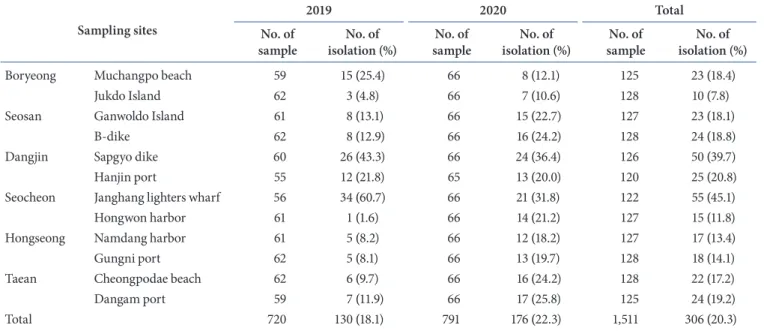
2019년부터 2020년까지 충남지역에서 채취된 해수와 갯벌 검체 중 V. vulnificus 균의 분포를 조사한 결과, 총 1,510건 중 306건 분리되어 전체적으로 20.3%의 분리율을 보였다. 검체 별로는 해수에서 188주(24.6%), 갯벌에서 118주(15.8%)가 분 리되었다(Table 2). 연도별로는 2019년은 130주(18.1%)가 검 출되었고 2020년도는 176주(22.2%)로 분리율이 약 4.1% 정 도 높아진 것으로 확인되었다(Table 2). 해수의 경우 2019년에 23.8%에서 2020년 25.3%의 분리율을 보여 약 1.5%가 증가되 었고, 갯벌의 경우 2019년 12.0%에서 2020년 19.2%로 분리 율이 약 7.2% 증가되었다. V. vulnificus균은 채취장소에 따라 해수와 갯벌의 분리율에 차이가 있으나 일관된 양상을 보이지
않았다. 2019년에 비해 2020년에 V. vulnificus의 검출이 현저 하게 증가한 것은 충청남도 지역 평균 강수량이 2019년 913.2 mL에서 2020년 1,573 mL로 증가하였고, 이런 영향이 해수의 염도와 V. vulnificus의 생육에 영향을 주었을 것으로 추정된다.
V. vulnificus의 생육은 온도, 염도, 탁도 그리고 pH 등 다양한 외부환경에 영향을 받는다고 보고되어 있다.2,14-16) 또한 2020 년에 충청남도 보건환경연구원에 도입된 MALDI-ToF (Bruker, Germany)의 활용으로 보다 많은 후보 균주를 스크리닝함으로 써 결과적으로 많은 V. vulnificus 분리를 유도했을 가능성도 있다.
검체채취 장소 중 분리율이 가장 높은 곳은 서천군 장항읍 물양장이며, 122건 검사에 55건 검출되어 분리율이 45.1%
이었고, 가장 낮은 분리율을 보인 장소는 보령시 죽도로 128 건 검사에 10건 검출되어 7.81%의 분리율을 보여 유의미 한 차이를 보였다(χ2=41.55, p<0.001) (Table 3). 나머지는 11.81~20.83%의 분리율을 나타내고 있었다. 그러나 이런 결 과들은 검체 채취 장소의 지엽적인 특성에 따라 분리율의 차이 가 나타날 수 있으므로 이를 일반화하여 특정 시군에서 V. vul- nificus의 검출이 높다고 판단하는 것은 무리가 있을 것으로 생
Table 2. Distribution of Vibrio vulnificus according to sample types from 2019 to 2020 Sample
type
2019 2020 Total
No. of sample No. of
isolation (%) No. of sample No. of
isolation(%) No. of sample No. of
isolation(%)
Sea water 369 88 (23.8) 396 100 (25.3) 765 188 (24.6)
Mud flat 351 42 (12.0) 395 76 (19.2) 746 118 (15.8)
Total 720 130 (18.1) 791 176 (22.2) 1,511 306 (20.3)
Table 3. Distribution of Vibrio vulnificus according to sampling sites Sampling sites
2019 2020 Total
No. of
sample No. of
isolation (%) No. of
sample No. of
isolation (%) No. of
sample No. of
isolation (%)
Boryeong Muchangpo beach 59 15 (25.4) 66 8 (12.1) 125 23 (18.4)
Jukdo Island 62 3 (4.8) 66 7 (10.6) 128 10 (7.8)
Seosan Ganwoldo Island 61 8 (13.1) 66 15 (22.7) 127 23 (18.1)
B-dike 62 8 (12.9) 66 16 (24.2) 128 24 (18.8)
Dangjin Sapgyo dike 60 26 (43.3) 66 24 (36.4) 126 50 (39.7)
Hanjin port 55 12 (21.8) 65 13 (20.0) 120 25 (20.8)
Seocheon Janghang lighters wharf 56 34 (60.7) 66 21 (31.8) 122 55 (45.1)
Hongwon harbor 61 1 (1.6) 66 14 (21.2) 127 15 (11.8)
Hongseong Namdang harbor 61 5 (8.2) 66 12 (18.2) 127 17 (13.4)
Gungni port 62 5 (8.1) 66 13 (19.7) 128 18 (14.1)
Taean Cheongpodae beach 62 6 (9.7) 66 16 (24.2) 128 22 (17.2)
Dangam port 59 7 (11.9) 66 17 (25.8) 125 24 (19.2)
Total 720 130 (18.1) 791 176 (22.3) 1,511 306 (20.3)
각된다. 그럼에도 불구하고 갯벌이 발달한 서해안은 우리나라 어패류의 중요 공급지이고, 국민소득이 증가함에 따라 해산물 의 소비가 급증함에 따라 수산물의 안전한 관리가 무엇보다도 중요하다. 또한 비브리오 패혈증은 해수 및 갯벌의 노출로 인한 피부창상으로도 감염되므로, 관광지가 밀집되어 있는 해안가 나 갯벌체험장 등 계절에 상관없는 상시 모니터링 체계 확립으 로 예방 및 홍보가 필요한 상황이다.
V. vulnificus의 월별 분포를 보면 7월에서 10월 사이에 주로 검출되었는데, 8월에 정점을 보였다(Fig. 2). 2019년은 전체 검 출의 31.2%, 2020년은 전체 검출의 40.5%가 8월에 집중되었 다. 2년 전체를 보았을 때, 7월이 17.3%, 8월이 36.5%, 9월이 28.2%로 3개월 동안 차지하는 비중이 전체의 82.0%로 해수 온도가 높을수록 균의 활성도가 증가하기 때문으로 생각된다.
V. vulnificus 분리주 중 재배양 된 85주를 선택하여 β-lactam 계열과 aminoglycoside 계열 등의 항생제에 대한 감수성 시험
을 하였다. CLSI 판정 기준에 따르면 모든 균주가 amoxicillin/
clavulanic acid, amikacin, gentamicin, ciprofloxacin, trime- thoprim-sulfamethoxazole에 대해 감수성을 보였으나 ampicil- lin, ampicillin/sulbactam, cefazolin, cefoxitin, imipenem, tet- racycline, chloramphenicol에 대해서는 내성인 균주가 발견되 었다(Table 4). Ampicillin에 대하여 분리균 85주 중 3주가 내 성을, 3주가 중간내성을 보였다. 가장 많은 균주가 내성을 보인 항생제는 cefoxitin, cefazolin, ampicillin 순으로 각각 균주의 85.5%, 6.0%, 3.5%가 내성이었다. 미국, 중국 그리고 이탈리아 등에서 분리된 균주의 ampicillin 내성에 대한 보고가 다수 존 재하고, cefazolin 내성균주도 중국에서 보고되어 있다.9,17) 최근 미국에서 발표된 자료에서 약 5% 정도의 내성을 보인다고 보고 되어 있다.17) 본 연구에서는 cefoxitin에서 상대적으로 높은 내 성을 보이는 것이 특징이었다. 이는 2014년에서 2015년 전남 지역 해수 및 갯벌에서 분리된 V. vulnificus 균주에 대한 항생 제 내성 실험결과의 cefoxitin에 85.7% 내성을 나타내었다는 보 고와 유사한 결과이다.18) 두 가지 이상의 항생제에 내성을 보인 다제내성 균주는 4 균주(4.7%)이었고, 세부적으로는 ampicil- lin과 cefoxitin의 내성 3균주, cefoxitin과 cefazolin의 내성이 1 균주 이었다(data not shown). V. vulnificus에 효과적인 항생제 는 3세대 cephalosporin (cefotaxime, ceftriaxone, ceftazidime), β-lactam combination (piperacillin-tazobactam), carbapenems (imipenem), tetracycline (minocycline, doxycycline), aminogly- coside (gentamicin, amikacin), fluoroquinolone (ciprofloxacin, moxifloxacin, levofloxacin)과 trimethoprim-sulfamethoxazole 과 chloramphenicol 등이 있다.6,9) 3세대 cephalosporin과 tetra- cycline의 병합요법이 사망률을 감소시키고, cefotaxime과 cip- rofloxacin의 병합요법이 생체외 감수성 검사에서 상승효과를
보인다.19,20) 본 연구의 환경 분리균주에서 Aminoglycosides 계
Table 4. Antimicrobial susceptibility of isolated Vibrio vulnificus strains
Antimicrobial agent class Antimicrobial agents No. (%) of isolates with the following results
Susceptible Intermediate Resistant
Penicillin Ampicillin 79 (92.9) 3 (3.5) 3 (3.5)
β-lactam combination Amoxicillin/clavulanic acid 85 (100) 0 (0.0) 0 (0.0)
Ampicillin/sulbactam 84 (98.8) 1 (1.2) 0 (0.0)
Cephems Cefazolin 68 (81.9) 10 (12.1) 5 (6.0)
Cefoxitin 7 (8.4) 5 (6.0) 71 (85.5)
Carbapenem Imipenem 84 (98.8) 1 (1.2) 0 (0.0)
Aminoglycoside Amikacin 85 (100) 0 (0.0) 0 (0.0)
Gentamicin 85 (100) 0 (0.0) 0 (0.0)
Quinolone Ciprofloxacin 85 (100) 0 (0.0) 0 (0.0)
Tetracycline Tetracycline 84 (98.8) 0 (0.0) 1 (1.2)
Phenicol Chloramphenicol 83 (97.7) 1 (1.2) 1 (1.2)
Folate pathway antagonist Trimethoprim/sulfamethoxazole 85 (100) 0 (0.0) 0 (0.0)
Fig. 2. Number of detections of Vibrio vulnificus per month
열 항생제와 Tetracycline (98.82%) 등에서 높은 감수성을 보 였고, V. vulnificus 감염증에 대한 권장 사용되는 항생제의 유 효성을 확인하였다. 항생제 사용의 증가는 수생환경 중에 있는 세균의 내성에 영향을 주고 있으며, 이로 인해 인체에도 영향을 미칠 수 있다는 우려가 제기되고 있어, 환자들의 임상 역학 자 료 조사 및 항생제 내성 획득에 기여하는 위험요인에 대한 규명 연구가 필요 할 것으로 사료된다.
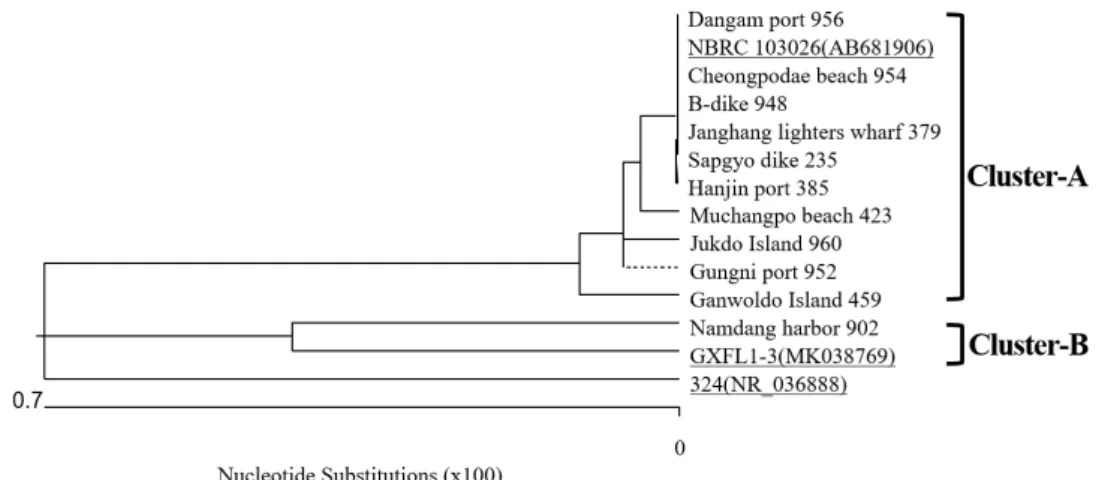
분리된 V. vulnificus 11 균주의 16s rRNA에 대한 1,465 bp 의 염기서열을 결정하였다. 분석된 염기서열 중 922번부터 952 번 사이에서 돌연변이가 다중으로 발생하고 있는 것으로 확 인하였고, 나머지 부분은 산발적으로 돌연변이가 발생하였다 (Fig. 3). 결정된 염기서열 정보와 보고되어 있는 외국의 V. vul- nificus 균 3개 주를 포함하여 다중정렬 후 계통분석을 실시한 결과, NBRC 103026 참조주와 당암포구 분리주 등 6개 균주 와 염기서열이 동일한 것으로 확인되었고, 특별하게 남당항에 서 분리된 분리균주는 다른 분리주에 달리 다른 클러스터에 포 함되어 있었다(Fig. 3). 클러스터-A는 내부적으로 99.7~100%
의 상동성을 보였고, 클러스터-A와 B 사이에는 98.2~99.2%의
상동성을 나타내었다(Fig. 4).
IV. 결 론
2019년부터 2020년까지 충청남도 지역 해수와 갯벌 검체 총 1,510건 채취하여 분리된 306건의 V. vulnificus 균주에 대하 여 분포 조사 및 항생제 감수성 시험과 16s rRNA 염기서열을 분석하였다. 조사기간 중 V. vulnificus의 분리율은 20.3%이었 고, 해수 188주(24.6%)와 갯벌 118주(15.8%)가 분리되었다.
V. vulnificus의 2019년 첫 분리는 5월 13일 당진 삽교방조제, 2020년은 5월 27일 서천 물양장이었으며, 이때의 수온은 각각 19.7°C, 21.1°C였다. 2년 동안 가장 높은 분리율을 보인 곳은 서천군 물양장이었고, 122건 검사에 55회 검출되어 45.1%이 었다. 시기에 따라 7월 17.3%, 8월 36.5%, 9월 28.8%에 주로 이루어졌고, 그 비중은 82.0%이었다.
V. vulnificus 85주에 대한 항생제 감수성 시험에서 amoxi- cillin/clavulanic acid, amikacin, gentamicin, ciprofloxacin, trimethoprim-sulfamethoxazole에 대해서는 모든 균주가 감
Fig. 3. Multiple alignment of nucleotide sequences with reference strains and Vibrio vulnificus isolates in this study. The mutation region is shown in the blue box. Name of reference strains was underlined.
Fig. 4. Phylogenetic analysis of reference strains and Vibrio vulnificus isolates in this study. Name of reference strains were underlined.
수성을 보였으며, ampicillin, ampicillin/sulbactam, cefazolin, cefoxitin, imipenem, tetracycline, chloramphenicol에 대해서 는 비감수성인 균주가 발견되었다. 가장 많은 균주가 내성을 보 인 항생제는 cefoxitin (85.5%)였고, cefazolin (6.0%), ampicillin (3.5%) 순 이었다. 두 가지 이상의 항생제에 내성을 보인 다제 내성 균주는 4균주(4.7%)이었다. 분리된 V. vulnificus 균주의 16s rRNA에 대한 1,465 bp의 염기서열을 분석한 결과 922번 부터 952번 사이에서 돌연변이가 빈번하게 발생하는 것을 확 인하였고, 분리주들 사이에는 98.2~100%의 상동성을 나타내 며 두 개의 클러스터로 구분되었다.
본 연구 결과는 충청남도 해안지역의 V. vulnificus의 분포와 분리주의 특성을 기술함으로써 비브리오 패혈증의 감염 관리 및 예방을 위한 기초 자료로 활용될 수 있을 것이다.
감사의 글
이 논문은 보건환경 연구 및 시책추진 지원의 유전자 분석 비용을 활용하였고, 2021년 충남도청 지식동아리 「4차 보건 혁명」 회원들이 “도정 발전 및 정책 아이디어 발굴에 기여할 수 있는 과제”의 일환으로 수행되었습니다.
Conflict of Interest
No potential conflict of interest relevant to this article was reported.
References
1. Kim YH, Kwon D, Lee DH. Reorganization of national notifiable infectious diseases classification system. Public Health Wkly Rep.
2020; 13(1): 2-7.
2. Hwang KW, Gong YW, Oh BY, Lee JM, Go JM, Kim YH. Distribu- tion and characteristic of growth of Vibrio spp. in Incheon coastal area. J Environ Sanit Eng. 2008; 23(3): 31-38.
3. Jeong YI, Myung GE, Choi EJ, Soh SM, Park GJ, Son TJ. Distribu- tion of pathogenic vibrios in the aquatic environment adjacent to coastal areas of South Korea and analysis of the environmental fac- tors affecting their occurrence. J Environ Health Sci. 2018; 44(2): 133-142.
4. Blake PA, Merson MH, Weaver RE, Hollis DG, Heublein PC. Dis- ease caused by a marine Vibrio. Clinical characteristics and epide- miology. N Engl J Med. 1979; 300(1): 1-5.
5. Shapiro RL, Altekruse S, Hutwagner L, Bishop R, Hammond R, Wilson S, et al. The role of Gulf Coast oysters harvested in warmer months in Vibrio vulnificus infections in the United States, 1988- 1996. Vibrio Working Group. J Infect Dis. 1998; 178(3): 752-759.
6. Kim DM, Hong SJ. Vibrio vulnificus sepsis. Korean J Med. 2012;
82(6): 671-679.
7. Ministry of Food and Drug Safety. Prediction System of Vibrio Vulnificus. Available: http://vibrio.foodsafetykorea.go.kr/main [ac- cessed 15 March 2021].
8. Yang SJ, Shin JH, Cho D, Kee SJ, Shin MG, Suh SP, et al. Identifica- tion of Vibrio vulnificus by the Microscan and the Vitek II sys- tems. Korean J Lab Med. 2005; 25(1): 33-38.
9. Elmahdi S, DaSilva LV, Parveen S. Antibiotic resistance of Vibrio parahaemolyticus and Vibrio vulnificus in various countries: a re- view. Food Microbiol. 2016; 57: 128-134.
10. Lee JM, Lee WJ, Kim MJ, Cho YS, Lee JS, Lee HJ, et al. Compara- tive evaluation of the VITEK 2 system and species-specific PCR methods for the detection of Vibrio species isolated from shrimp. J Food Hyg Saf. 2015; 30(3): 281-288.
11. Clinical and Laboratory Standards Institute. Performance Stan- dards for Antimicrobial Susceptibility Testing, 30th ed. Wayne:
CLSI supplement M100; 2020.
12. Thompson FL, Gevers D, Thompson CC, Dawyndt P, Naser S, Hoste B, et al. Phylogeny and molecular identification of vibrios on the basis of multilocus sequence analysis. Appl Environ Microbiol.
2005; 71(9): 5107-5115.
13. Saitou N, Nei M. The neighbor-joining method: a new method for reconstructing phylogenetic trees. Mol Biol Evol. 1987; 4(4): 406-425.
14. Song JW, Jeong IH, Park SH, Yun SJ, Hur ES, Kim YS. Character- ization of Vibrio vulnificus isolated from the west coastal area of Gyeonggi-do. Korean J Microbiol. 2021; 57(3): 197-203.
15. Randa MA, Polz MF, Lim E. Effects of temperature and salinity on Vibrio vulnificus population dynamics as assessed by quantitative PCR. Appl Environ Microbiol. 2004; 70(9): 5469-5476.
16. Inoue Y, Miyasaka J, Ono T, Ihn H. The growth of Vibrio vulnificus and the habitat of infected patients in Kumamoto. Biosci Trends.
2007; 1(3): 134-139.
17. Shaw KS, Rosenberg Goldstein RE, He X, Jacobs JM, Crump BC, Sapkota AR. Antimicrobial susceptibility of Vibrio vulnificus and Vibrio parahaemolyticus recovered from recreational and com- mercial areas of Chesapeake Bay and Maryland Coastal Bays. PLoS One. 2014; 9(2): e89616.
18. Yoon YH, Park S, Kim JY, Lee YJ, Jeon DY, Choi GC, et al. Preva- lence of toxin genes and profiles of antibitoc resistance in Vibrio vulnificus isolates from fish, fish tanks, and patients. J Food Hyg Saf. 2020; 35(1): 6-12.
19. Jung YS, Jung SI, Kang SJ, Jun CH, Park KH, Shin JH, et al. Clinical manifestations and prognostic factors in Vibrio vulnificus septice- mia. Korean J Med. 2008; 74(3): 288-295.
20. Liu JW, Lee IK, Tang HJ, Ko WC, Lee HC, Liu YC, et al. Prognostic factors and antibiotics in Vibrio vulnificus septicemia. Arch Intern Med. 2006; 166(19): 2117-2123.
<저자정보>
이현아(연구사), 고영은(연구사), 최지혜(연구사), 이다연(연구사), 여성순(연구사), 박종진(팀장), 이미영(부장), 최진하(원장), 박준혁(연구사)