| Abstract |
Purpose: The purpose of this study was to investigate the effect of open and closed kinetic chain exercises with a sling on neck flexor thickness during chin-in movement in office workers with forward head posture.
Methods: Thirty-one selected subjects randomly performed chin-in movement in open kinetic chain and closed kinetic chain exercises using a sling. All subjects were measured for their neck flexor thickness using ultrasound measurement equipment during the performance of chin-in movement in open and closed kinetic chain exercised. A paired t-test was used to compare the thickness of the total neck flexor, superficial, and deep neck flexor, respectively, between open and closed kinetic chain exercises with chin-in movement.
Results: The thickness of the superficial neck flexor diminished in size more greatly during the chin-in movement with the closed kinetic chain than the open kinetic chain, but this was not a statistically significant difference (p > 0.05). On the other hand, the thickness of the total neck flexor and deep neck flexor had more greatly increased during the chin-in movement with the closed kinetic chain than the open kinetic chain, and this was a statistically significant differences (p < 0.05).
Conclusion: This study suggested that chin-in movement with a closed kinetic chain is more effective in activating the deep neck flexor than the open kinetic chain. Thus, we believe that the closed kinetic chain exercise using a sling is an effective intervention to correct the postural alignment of individuals with forward head posture.
Key Words: Open-closed kinetic chain, Thickness of neck flexor, Sling, Forward head posture
†Corresponding Author : Jin-Tae Han ([email protected])
Original Article Open Access
슬링을 이용한 열린사슬운동과 닫힌 사슬 운동의 턱당기기 동작 시 목굽힘근 두께 비교
이주훈⋅한진태1†1)
경성대학교 일반대학원 물리치료학과, 1경성대학교 물리치료학과
Comparison of the Thickness of the Neck Flexor Between Open and Closed Kinetic Chain Exercises During Chin- in Movement
Ju-Hun Lee, P.T., M.S.⋅Jin-Tae Han, P.T., Ph.D.1†
Department of Physical Therapy, Graduate School, Kyungsung University
1Department of Physical Therapy and Institute for Rehabilitation Science, Kyungsung University Received: June 16, 2020 / Revised: June 30, 2020 / Accepted: June 30, 2020
ⓒ 2020 Journal of Korea Proprioceptive Neuromuscular Facilitation Association
This is an Open Access article distributed under the terms of the Creative Commons Attribution Non-Commercial License (http://creativecommons.org/licenses/by-nc/3.0) which permits unrestricted non-commercial use, distribution, and reproduction in any medium, provided the original work is properly cited.
Ⅰ. 서 론
현대 사무직 종사자들은 장시간 컴퓨터 사용이나 책상에 앉아서 작업을 해야 하는 일의 특성으로 인해 다른 직업군에 비해서 전방머리자세가 발생하기 쉽다 (Kim et al., 2014). 전방머리자세는 해부학적 중심선에 대해 머리가 앞으로 돌출되어 몸통보다 앞에 위치한 상태이며(Lee & Bae, 2015), 책상에 앉아서 장시간 일 을 하게 되면 윗몸통이 경직된 상태에서 동일한 근육 에 반복적으로 부하를 많이 받게 되고 그 결과 특정 근육과 인대의 과도한 긴장으로 해부학적 정렬의 변 화가 일어나게 된다(Khayatzadeh et al., 2017; Kocur et al., 2019). 특히 목빗근과 목갈비근은 과사용되고 긴목근과 긴머리근은 근력저하 및 기능 부재가 나타 난다고 하였다(Falla et al., 2003; Kisner & Colby, 2017).
전방머리자세가 있는 사람들은 목 주위 근육들의 불균형과 기능 부재로 인해 목의 불안정성과 부정렬 이 나타났으며 목 주위의 통증을 호소한다(Harman et al., 2005). 그리고 중간등세모근, 아래등세모근, 긴머 리근, 긴목근의 약화와 위등세모근, 어깨올림근, 목빗 근, 뒤통수밑근육의 과긴장되는 특징이 나타나며, 특 히 깊은목굽힘근은 약화되고 근육동원 시간이 지연되 는 반면 얕은목굽힘근육의 과활성화가 나타난다(Falla et al., 2004). 이러한 전방머리자세의 부정렬을 개선하 기 위해 실시한 목 안정화 운동에 관한 선행연구에서 턱 당기기 운동은 깊은목굽힘근을 활성화시키고 목 통증 감소에 효과적이며(Jull et al., 2009; Yoo & Lee, 2016) 턱 당기기 운동 시 얕은목굽힘근의 두께는 감소 하고 깊은목굽힘근의 두께가 증가하였다(Yoon &
Kim, 2013).
최근 관절의 안정화를 위해 실시하는 운동 중 닫힌 사슬운동이 열린사슬운동보다 더 많은 근육이 동원되 었으며(Kwon & Lee, 2005) 근력강화에도 더 효과적이 었다(Kwon et al., 2012). 또한 닫힌사슬운동이 열린사 슬운동보다 고유수용성감각과 동적, 정적 균형능력을 더 향상시켰고(Park & Lee, 2018), 닫힌사슬운동이 열 린사슬운동보다 배가로근과 뭇갈래근의 두께를 더 증
가시켰다(Bae et al., 2013). 또한 슬링(sling) 운동은 다 양한 탄력 밴드를 이용하여 목적에 따라 보조 또는 저항의 역할을 할 수 있어 대상자에게 열린사슬운동 이나 닫힌사슬운동을 적용할 수 있는 운동이다(Kim et al., 2004).
열린사슬운동은 팔다리의 먼쪽에서 자유롭게 움직 이고 몸쪽에서는 고정된 상태로 운동하는 방법이며 주로 관절운동범위가 제한된 환자의 근력강화를 위해 사용한다(Kim & Park, 2008). 반면, 닫힌사슬운동은 팔다리의 먼쪽이 고정되어 몸쪽과 먼쪽에서 저항을 동시에 적용하는 운동이다(Prentice et al., 2005). 따라 서 동적인 근육의 안정성을 위한 동시수축으로 원심 성 수축이 우세하며, 관절 압박력으로 전단력을 감소 시켜 관절의 안정성을 주고, 기계적 수용기는 관절낭 의 압력 변화에 민감하게 반응하여 고유수용성 감각 을 촉진한다(Moon et al., 2013).
슬링은 중재자가 대상자에게 운동을 적용할 때 보 조 또는 저항을 효율적으로 할 수 있게 해주며 슬링 운동 시 관절이나 주변 근육에 중력과 마찰을 최소화 하여 초기의 관절운동성과 약화된 근육 회복에 효과 적이었다(Kim et al., 2003). 슬링 운동의 장점은 대상자 스스로 운동에 능동적으로 참여하게 하고, 운동방법 에 따라 중력을 제거한 상태에서 시행 할 수 있다.
지금까지 전방머리자세의 개선을 위해 실시한 선 행연구들은 목 주위 근육의 강화 또는 목의 안정화운 동에 대한 효과를 검증하는 연구가 주로 이루어졌고 슬링을 이용한 목의 열린사슬운동과 닫힌사슬운동이 전방머리자세에 미치는 효과를 비교하는 연구는 미흡 한 상황이며 또한 목 굽힘근의 두께 변화를 알아본 연구는 부족한 실정이다. 따라서 본 연구에서는 전방 머리자세를 대상으로 슬링을 이용한 열린사슬운동과 닫힌사슬운동에서의 턱 당기기 운동 시 목굽힘근의 두께에 미치는 영향을 알아보고, 임상에서 전방머리 자세를 개선하기 위한 효과적인 운동방법을 제시하고 자 한다.
Ⅱ. 연구 방법 1. 연구 대상
본 연구는 전방머리자세가 있는 20-30대 사무직 종 사자 31명을 대상으로 하였다. 본 연구의 대상자 선정 기준은 머리-목뼈각(craniovertebral angle, CVA)이 50 도 이하인 자(Kim et al., 2011), 3년 이상의 경력자로 하루 5시간 이상 사무직 종사자, 신체질량지수 범위가 18.5∼24.9㎏/㎡인 자로 하였다. 제외기준은 목이나 어 깨수술 이력이 있는 자, 고혈압 및 당뇨와 같은 만성질 환이 있는 자, 누운자세에서 턱당기기 동작 시 통증을 호소하는 자로 하였다. 본 연구는 K대학교 생명연구 윤리위원회의 승인을 받은 후 진행하였으며(KSU- 18-12-001), 실험 전 대상자들에게 실험에 대한 내용에 대한 설명을 충분히 설명한 후 연구 참여에 자발적인 동의를 받았다.
2. 측정방법 및 도구 1) 목 굽힘근 두께 측정
목굽힘근 두께는 턱 당기기 동안 초음파 측정기 (Prosound 2, Hitachi Aloka Medical, Japan)를 이용하여 얕은목굽힘근인 목빗근과 깊은목굽힘근인 긴목근과 긴머리근 두께를 측정하였다. 진단용 초음파 측정기 의 7.5MHz linear 도자(probe)를 오른쪽 목에 세로방향 으로 적용하였다. 얖은목구힘근인 목빗근의 측정은 목의 중앙에서 5㎝ 가쪽에 세로로 도자를 위치하여 측정하였고 깊은목굽힘근인 긴목근과 긴머리근의 측 정 위치는 방패연골에서 오른쪽으로 5㎝ 떨어진 곳에 서 측정하였다(Jesus et al., 2011). 똑같은 압력을 적용 하기 위해 스프링이 있는 초음파 측정 보조 도구를 사용함으로써 각 측정 시 초음파 도자 압력을 일정하 게 하였다(Fig. 1A). 또한 대상자는 열린사슬운동과 닫힌사슬운동에서의 턱당기기 동작 시 26mmHg의 압 력으로 힘을 준 상태를 10초간 유지하도록 하였으며 이때 각 근육의 근두께를 측정하였다. 대상자는 턱당
기기 운동 시 누르는 압력을 일정하게 유지하기 위하 여 압력바이오피드백기구(Stabilizer, chattanooga, USA)를 이용하여 충분히 연습을 하도록 하였다(10회 씩 3세트).
2) 초음파 이미지 분석
근육의 측정 위치는 목뿔뼈와 방패연골 사이 지점 을 기준으로 얕은목굽힘근과 깊은목굽힘근의 두께를 측정하였다(Kwon et al., 2011). 초음파를 이용하여 측 정한 영상이미지는 아래 사진과 같으며 목빗근, 목동 맥 그리고 긴머리근과 긴목근의 순서이다(Jeon et al., 2011)(Fig. 1B).
Fig. 1. Measurement method (A) and ultrasound imaging (B) of neck muscles.
3. 실험 절차 1) 운동방법
운동방법은 바로 누운자세로 어깨가 치료테이블 끝에 위치하도록 하고 슬링이 뒤통수 부위에 오도록 한다. 검사자는 연구대상자에게 바깥귀길과 어깨봉우 리를 일치시켜서 목의 중립자세를 만든 후 연구대상 자가 목뼈 중앙부를 뒤쪽으로 천천히 누르게 하여 목 뼈 앞굽음을 감소시키도록 하였다. 이때 이 자세를 최소한 10초 유지하라고 지시하였다(Yun & Kim, 2013). 열린사슬운동과 닫힌사슬운동에서의 턱당기
기 운동을 5회 연습하여 충분히 동작을 익히도록 하였 고 열린사슬운동과 닫힌사슬운동 시 목굽힘근의 두께 를 총 3번 측정하여 그 평균값을 사용하였다.
2) 열린-닫힌사슬운동(open-closed kinetic chain)
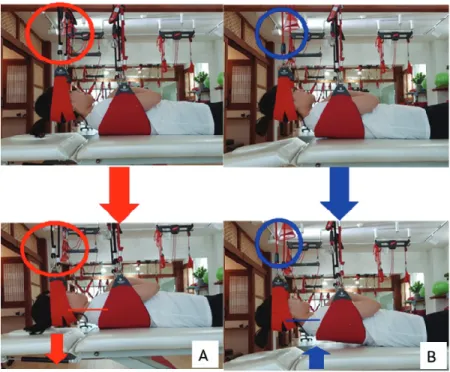
열린사슬운동은 바로 누운자세에서 머리의 움직임 을 허용하는 탄력고무밴드에 띠를 설치하였고, 등뼈 부분에도 역시 탄력고무밴드를 설치하였다. 열린사슬 운동은 머리에 있는 띠를 이용하여 턱당기기 운동을 수행하였으며 머리가 아래로 움직이기 때문에 가슴띠 를 이용하여 턱 당기기 동안 머리가 충분히 머리띠를 누를 수 있도록 저항역할을 하게하였다(Fig. 2A).
닫힌사슬운동은 바로 누운자세에서 머리를 지지할 수 있는 비탄력밴드에 띠를 설치하고, 등뼈부분에는 탄력고무밴드를 설치하였다. 운동하는 방법은 열린사 슬운동과 동일하며, 뒤통수 부분으로 띠를 누르면서 턱 당기기 운동을 실시하였다. 닫힌사슬운동은 몸통 이 움직이기 때문에 가슴띠를 이용하여 턱 당기기 동
안 적당히 머리띠를 누를 수 있게 보조역할을 하게 하였다(Fig. 2B).
4. 자료 분석
턱 당기기 동안 슬링을 이용한 열린사슬운동과 닫 힌사슬운동 시 목굽힘근의 차이를 비교하기 위하여 대응비교(paired t-test)를 이용하였고 목굽힘근 두께를 기술통계량으로 제시하였다. 자료 분석을 위해 SPSS version 25.0을 사용하였으며, 통계적 유의수준은 0.05 로 하였다.
Ⅲ. 연구 결과 1. 연구 대상자의 일반적인 특성
본 연구에 참여한 대상자는 남자 16명 여자 15명으 로 총 31명이었으며 대상자들의 신체적 특성은 Table
Fig. 2. Open kinetic chain (A) and closed kinetic chain (B).
1과 같았다.
Characteristics Subject (N=31)
Age (years) 29.25±8.86
Height (㎝) 167.65±10.24
Weight (㎏) 63.45±8.63
BMI (㎏/㎡) 22.54±1.26
BMI: body mass index
Table 1. General characteristics of subjects
2. 총 목굽힘근 두께 비교
턱 당기기 동안 슬링을 이용한 열린사슬운동과 닫 힌사슬운동 시 총 목굽힘근의 평균 두께는 열린사슬 운동에서 26.49±6.10㎜이었고 닫힌사슬운동에서 28.11±6.23㎜로 나타났다. 총 목굽힘근 두께는 열린사 슬운동보다 닫힌사슬운동에서 증가하였고 통계학적 으로 유의한 차이가 있었다(p<0.05)(Table 2).
3. 얕은목굽힘근 두께 비교
턱 당기기 동안 슬링을 이용한 열린사슬운동과 닫 힌사슬운동 시 얕은목굽힘근인 목빗근의 평균 두께는 열린사슬운동에서 10.63±3.12㎜이었고 닫힌사슬운동 에서 10.77±3.12㎜로 나타났다. 얕은목굽힘근의 두께 는 열린사슬운동이 닫힌사슬운동보다 다소 감소하였 으나 통계학적으로 유의한 차이가 없었다(p>0.05) (Table 3).
4. 깊은목굽힘근 두께 비교
턱 당기기 동안 슬링을 이용한 열린사슬운동과 닫 힌사슬운동 시 깊은목굽힘근인 긴목근과 긴머리근의 평균 두께는 15.85±3.81㎜이었고 닫힌사슬운동에서 17.33±4.15㎜로 나타났다. 깊은목굽힘근의 두께는 열 린사슬운동보다 닫힌사슬운동에서 증가하였으며 통 계학적으로 유의한 차이가 있었다(p<0.05)(Table 3).
Variable Open kinetic chain Closed kinetic chain t P
Thickness of TNF 26.49±6.10 28.11±6.23 -4.55 0.00*
Mean ±SD, *p<0.05, TNF: total neck flexor
Table 2. Comparison of thickness of total neck flexor between open and closed kinetic chain during chin-in movement (N=31, Unit: mm)
Variable Open kinetic chain Closed kinetic chain t p
Thickness of SNF 10.63±3.12 10.77±3.12 -0.55 0.58
Mean ±SD, SNF: superficial neck flexor
Table 3. Comparison of thickness of superficial neck flexor between open and closed kinetic chain during chin-in movement (N=3 1, Unit: mm)
Variable Open kinetic chain Closed kinetic chain t p
Thickness of DNF 15.85±3.81 17.33±4.15 -5.57 0.00*
Mean ±SD, *p<0.05, DNF: deep neck flexor
Table 4. Comparison of thickness of deep neck flexor between open and closed kinetic chain during chin-in exercise movement (N=31, Unit: mm)
Ⅳ. 고 찰
본 연구는 턱 당기기 동안 슬링을 이용한 열린사슬 운동과 닫힌사슬운동이 목 굽힘근 두께 변화에 어떤 영향을 미치는지를 알아보기 위해서 실시하였다. 총 목굽힘근 두께는 열린사슬운동보다 닫힌사슬운동 시 증가하였고 통계적으로 유의한 차이가 있었다. 얕은 목굽힘근인 목빗근 두께는 열린사슬운동과 닫힌사슬 운동이 유사하였고 통계학적으로 유의한 차이는 나타 나지 않았다. 하지만 깊은목굽힘근인 긴목근과 긴머 리근은 열린사슬운동보다 닫힌사슬운동 시 근두께가 증가하였고 통계학적으로 유의한 차이가 있었다. 이 는 닫힌사슬운동 시 목굽힘의 작용근, 협력근, 대항근 이 협력 수축하여 목관절의 안정성을 제공한 상태가 되었기 때문에 깊은목굽힘근이 목을 안정화시키는 역 할을 수행하기 위해 근두께가 열린사슬운동에 비해 더욱 증가하였을 것으로 생각된다.
Yun과 Kim 등(2004)은 머리목굽힘운동이 목빗근과 깊은목굽힘근 두께를 측정한 결과, 머리목굽힘근운동 이 얕은목굽힘근인 목빗근의 두께는 감소시키고 깊은 목굽힘근의 근두께는 증가시켰다고 하였으며, 이를 깊은목굽힘근의 선택적 수축 현상이라고 보고하였다.
턱 당기기 운동은 역동적움직임 보다는 지속적인 자 세 유지와 관련이 많다(Cho, 2011). 열린사슬운동보다 닫힌사슬운동에서 깊은목굽힘근의 두께가 증가한 것 은 깊은목굽힘근이 자세 유지에 많은 기여를 한다는 것을 증명하는 것이라고 생각한다. 또한 깊은목굽힘 근은 해부학적 부착부위가 얕은목굽힘근보다 몸속 깊 이 목뼈와 위등뼈에 붙어있어 닫힌사슬운동이 열린사 슬운동에 비해 관절수용기를 자극시키기에 적합하다 고 생각한다. 따라서 이러한 해부학적 특징으로 인해 서 직접적으로 척추뼈와 맞닿아 있는 깊은목굽힘근의 근두께가 닫힌사슬운동에서 열린사슬운동보다 더욱 증가한 것으로 사료된다. Uçar 등(2014)은 닫힌사슬운 동이 열린사슬운동보다 관절 기능을 개선하는데 더 효과적이라고 보고하였고 Yoon 등(2013)은 턱 당기기 운동 시 얕은목굽힘근인 목빗근의 근두께는 감소하였
고, 깊은목굽힘근인 긴목근과 긴머리근육의 근두께는 증가하였다고 보고하였다. 또한 Park 등(2016)은 턱당 기기 운동이 목통증 환자의 깊은목굽힘근의 수축두께 를 증가시켰다고 보고하였다. 이와 같은 연구결과는 본 연구의 결과와 유사하였으며 이는 턱 당기기 동작 이 얕은목굽힘근의 과활성을 감소시키고 깊은목굽힘 근을 활성화시키는데 더 효과적인 운동이라는 것을 의미한다. Kim과 Kim (2006)은 닫힌사슬운동은 작용 근, 대항근, 협력근이 동시 수축하여 각 관절의 안정화 운동에 적합하다고 보고하였으며 이는 닫힌사슬운동 이 열린사슬운동 보다 안정화근육을 활성화 시키기에 효율적이며 본 연구의 결과와 유사함을 보여준다.
슬링을 이용한 턱 당기기 운동 시 열린사슬운동보 다 닫힌사슬운동 시 총 목굽힘근의 두께가 증가하였 다. 닫힌사슬운동이 열린사슬운동과 비교해 총 목굽 힘 두께가 증가한 것은 얕은목굽힘근은 감소하고 깊 은목굽힘근은 증가하였기 때문이다. 이는 닫힌사슬운 동이 목의 안정화를 위해 선택적 근육 수축을 일으키 는데 효과적이라는 것을 보여준다. 닫힌사슬운동이 열 린사슬운동에 비해 목의 과도한 굽힘을 막아주고 안정 성을 증가시켜 머리-목을 지지해주는 역할을 하는 깊 은목굽힘근의 두께가 더 증가하였다고 생각한다. 따 라서 궁극적으로 닫힌사슬운동이 전방머리자세가 있 는 사람들을 위한 효율적인 운동이라고 사료된다.
본 연구의 제한점은 대상자 수가 적어서 연구결과 를 일반화하기 어려운 점이 있다. 또한 턱 당기기 운동 시 누르는 압력을 정량화하기 위하여 압력바이오피드 백기구를 사용하여 대상자에게 턱 당기기 운동을 충 분히 사전교육 하였지만 슬링운동의 특성상 턱 당기 기 운동 시 누르는 압력의 정량화를 완벽하게 통제하 지는 못하였다. 그리고 턱 당기기 동안 목 주위 관절의 움직임과 협력근의 작용을 모두 통제하지 못하여 열 린사슬운동과 닫힌사슬운동의 효과를 충분히 설명하 지 못하였다. 향후 목뼈의 움직임 동안 등뼈나 허리뼈 의 움직임 상관성 연구나 깊은목굽힘근과 몸통 안정 화 근육 들과의 연관성을 알아보는 연구가 필요할 것 으로 생각된다.
Ⅴ. 결 론
본 연구는 전방머리자세가 있는 사무직 종사자를 대상으로 턱 당기기 동안 슬링을 이용한 열린사슬운 동과 닫힌사슬운동이 목굽힘근 두께 변화에 미치는 영향을 알아보고자 하였다. 턱 당기기 동안 슬링을 이용한 열린사슬운동보다 닫힌사슬운동이 얕은목굽 힘근의 근두께를 감소시키고고 깊은목근두께는 증가 시켰다. 따라서 닫힌사슬운동 자세에서 턱 당기기 운 동은 전방머리자세로 인한 얕은목굽힘근의 과활성화 와 깊은목굽힘근의 저활성화를 개선하기 위한 효율적 인 운동 방법이라고 사료된다.
Acknowledgments
본 논문은 제1저자 이주훈의 2019년도 석사학위논 문에서 일부를 발췌하여 정리하였음.
References
Bae WS, Kim JH. The effect of closed kinetic and open kinetic exercise on thickness of low back stabilization exercise using an ultrasonography imaging. Journal of The Korean Society Integrative Medicine. 2013;1(2):
67-80.
Cho HY. Effects of cervical stabilization exercise type on muscle strength and endurance, cross sectional area of cervical in patients with chronic cervical pain.
Korean University. Dissertation of Doctorate Degree.
2011.
Falla D, Jull G, Paul D, et al. An electromyographic analysis of the deep cervical flexor muscles in performance of craniocervical flexor. Physical Therapy. 2003;
83(10):899–906.
Falla D, Jull G, Hodges P. Patients with neck pain demonstrate
reduced electromyographic activity of the deep cervical flexor muscles during performance of the craniocervical flexion test. Spine. 2004;29 (19):
2108-2114.
Harman K, Hubley-Kozey CL, Burtler H. Effectiveness of an exercise program to improve forward head posture in normal adults: a randomized, controlled 10-week trial. Journal of Manual & Manipulative Therapy.
2005;3(3):163-176.
Jeon DH, Fell DW, Kim K. The suggestion of proper pressure level in cranio-cervical flexion exercise for deep cervical flexor by ultrasonographic measurement.
Journal of the Korean Society of Physical Medicine.
2011;6(4):497-504.
Jesus MFR, Ferreira, PH, Pereira LSM, et al. Ultrasonographic analysis of the neck flexor muscles in patients with chronic neck pain and changes after cervical spine mobilization. Journal of Manipulative and Physiological Therapeutics. 201134(8):514-524 Jull G, Falla D, Hodges P. The effect of therapeutic exercise
on activation of the deep cervical flexor muscles in people with chronic neck pain. Manual Therapy.
2009;14(6):696-701.
Khayatzadeh S, Kalmanson OA, Schuit D, et al. Cervical spine muscle-tendon unit length difference between neutral and forward head posture: biomechanical study using human cadaveric specimens. Physical Therapy.
2017;97(7):756-766.
Ki SH, Song YK. Correlations of forward head posture to heart rate variability and standing posture balance factors. Journal of Korean Medicine Rehabilitation.
2014;24(4):163-170.
Kim BG, Seo HK, Jung YW. The effect of sling exercise on lumbar stabilization and muscle strength. The Journal of Korean Society of Physical Therapy.
2004;16(4):603-612.
Kim EJ, Kim JW, Park BR. Effects of sling exercise program
on muscle activity and cervical spine curvature of forward head posture. Journal of the Korea Contents Association. 2011;11(11):213-220.
Kim SY, Cho HH. First and second Korean working conditions survey: a comparison between south Korea and EU countries. Korean Journal of Occupational Health Nursing. 2014;23(4):277-286.
Kim SY, Kim TY, Park SJ. A clinical with the principle of hanging point in the sling exercise therapy. The Journal of Korean Academy of Orthopedic Manual Physical Therapy. 2003;9(2):25-45.
Kim TY, Kim SY. Theoretical basis and application of the Neurac technique which uses the sling exercise therapy. The Journal of Korean Academy of Orthopedic Manual Physical Therapy. 2006;12(2):
52-65.
Kim YJ, Park RJ. The effects of closed kinetic chain exercises of unstable floor on the stability of the knee joints of patients with anterior cruciate ligament reconstruction. Journal of the Korean Society of Physical Medicine. 2008;3(1):11-20.
Kisner C, Colby LA. Therapeutic exercise therapy foundation, 5th ed. Philadelphia. F.A. Davis Co. 2007.
Kocur P, Wilski M, Goliwas M, et al. Influence of forward head posture on myotonometric measurements of superficial neck muscle tone, elasticity, and stiffness in asymptomatic individuals with sedentary jobs.
Journal of Manipulative and Physiological Therapeutics.
2019;42(3):195-202.
Kwon MS, Jeon HR, Lee HJ. Comparing persons with neck pain experience to persons without neck pain experience in deep neck muscle size using ultrasonography images and neck muscle endurance time. Journal of the Korea Contents Association.
2011;11(12):326-334.
Kwon SB, Lee HO. Effect of closed and open kinetic chain exercise after cruciate ligament reconstruction. The
Journal of Korean Society of Physical Therapy.
2005;17(3):297-310.
Kwon YJ, Park SJ, Kim K. The effect of open and closed chain exercise on lower extremity muscle activity in adults. Journal of the Korean Society of Physical Medicine. 2012;7(2):173-182.
Lee GC, Bae WS. The effect of shoulder exercise program for improving forward head posture. Journal of The Korean Society of Integrative Medicine.2015;
3(3):1-8.
Moon SJ, Kim TH, Roh JS. A comparison of the serratus anterior muscle activity according to the shoulder flexion angles in a closed kinetic chain exercise and an open kinetic chain exercise. Journal of the Korean Society of Physical Medicine. 2013;8(3):369-378.
Park JM, Lee SH. The effect of knee joint position sense through close and open kinetic chain exercise on the proprioception and balance ability of elderly people. Journal of Korean Society for Neurotherapy.
2018;22(2):27-32.
Park ES, Choi HS, Shin WS. Effect of craniocervical flexion exercise with masticatory contraction on deep cervical muscle thickness and neck disability index in patient with neck pain. Journal of the Korean Society of Physical Medicine. 2016;11(4):139-146.
Prentice WE, Voight ML. Techniques in musculoskeletal rehabilitation. McGraw-Hill. 2005.
Uçar M, Koca I, Eroglu M, et al. Evaluation of open and closed kinetic chain exercises in rehabilitation following anterior cruciate ligament reconstruction.
Journal of Physical Therapy Science. 2014;26(12):
1875-1878.
Yoo KT, Lee HS. Effects of therapeutic exercise on posture, pain and asymmetric muscle activity in a patient with forward head posture: case report. Journal of the Korean Society of Physical Medicine. 2016;11 (4):93-103.
Yoon KH, Kim K. Effect of craniocervical flexion exercise using sling on thickness of sternocleidomastoid muscle and deep flexor muscle. Journal of the Korean Society of Physical Medicine. 2013;8(2):253-261.
Yun KH, Kim K. Effect of craniocervical flexion exercise using sling on thickness of sternocleidomastoid muscle and deep cervical flexor muscle. Journal of the Korean Society of Physical Medicine. 2013;8(2):253-261.