• 검색 결과가 없습니다.

Laparoscopic total extraperitoneal hernia repair of fallopian tube indirect inguinal hernia in reproductive aged woman: a case report

N/A
N/A
Protected

Academic year: 2022

Share "Laparoscopic total extraperitoneal hernia repair of fallopian tube indirect inguinal hernia in reproductive aged woman: a case report"

Copied!
4
0
0

로드 중.... (전체 텍스트 보기)

전체 글

(1)

www.ogscience.org 608

Case Report

Obstet Gynecol Sci 2017;60(6):608-611 https://doi.org/10.5468/ogs.2017.60.6.608 pISSN 2287-8572 · eISSN 2287-8580

Introduction

An indirect inguinal hernia is a protrusion of abdominal cavity components through the inguinal ring, particularly lateral to the inferior epigastric vessels. Indirect inguinal hernias occur in ≤5% of women [1]. Hernias containing genital organs (e.g., the fallopian tube, ovary or uterus) in the hernia sac account for approximately 2.9% of all hernia cases [2]. Moreover, an indirect inguinal hernia containing only the fallopian tube is extremely rare. Most reported cases of indirect inguinal her- nias involving genital organs in infants are accompanied by other genital tract anomalies.

We report an uncommon case of a 22-year-old woman who had an indirect inguinal hernia containing only the fallopian tube without any genital anomalies, in which the hernia was successfully reduced using a laparoscopic total extraperitoneal (TEP) method and repaired with a polypropylene mesh.

Case report

A 22-year-old nulliparous patient with a left groin lump and left lower quadrant pain visited our emergency room. She reported a recurrent palpable mass in the left groin that was

present since several months. A lump had appeared 10 days previously and had not disappeared. Two days before her visit, left lower quadrant pain occurred and became aggravated.

The patient had no surgical or medical history but was diag- nosed with polycystic ovaries 1 year ago. Physical examination revealed a 6×5 cm soft mass in the left groin, but there was

Laparoscopic total extraperitoneal hernia repair of fallopian tube indirect inguinal hernia in reproductive aged woman: a case report

Yong Hee Park 1 , Eun Jung Jung 1 , Jung Mi Byun 1,2 , Min Sung An 2,3 , Young Nam Kim 1,2 , Kyung Bok Lee 1 , Moon Su Sung, 1,2 , Ki Tae Kim 1,2 , Eun Taeg Kim 4 , Chul Hoi Jeong 5 , Dae Hoon Jeong 1,2

1
Department of Obstetrics and Gynecology,

2

Paik Institute for Clinical Research,

3

Department of General Surgery, Paik Institute for Clinical Research, Inje University Busan Paik Hospital; Department of Obstetrics and Gynecology,

4

Kosin University Gospel Hospital,

5

Haeundae Paik Hospital, Busan, Korea

An indirect inguinal hernia containing the fallopian tube alone is extremely rare in reproductive-aged women without any genital tract anomalies. Despite this rarity, early diagnosis and adequate management is important to prevent strangulation and recurrence. We present a case of an indirect inguinal hernia containing only the fallopian tube in the hernia sac, which was successfully reduced by using a laparoscopic total extraperitoneal approach and repaired with a polypropylene mesh.

Keywords: Hernia, inguinal; Fallopian tubes; Laparoscopy

Articles published in Obstet Gynecol Sci are open-access, distributed under the terms of the Creative Commons Attribution Non-Commercial License (http://creativecommons.

org/licenses/by-nc/3.0/) which permits unrestricted non-commercial use, distribution, and reproduction in any medium, provided the original work is properly cited.

Copyright © 2017 Korean Society of Obstetrics and Gynecology

Received: 2017.04.13. Revised: 2017.05.25. Accepted: 2017.06.08.

Corresponding author: Dae Hoon Jeong

Department of Obstetrics and Gynecology, Inje University Busan Paik Hospital, Inje University College of Medicine, 75 Bokji-ro, Busanjin-gu, Busan 47392, Korea

E-mail: [email protected] https://orcid.org/0000-0001-9354-5496 Chul Hoi Jeong

Department of Obstetrics and Gynecology, Inje University Haeundae Paik Hospital, Inje University College of Medicine, 875, Haeun-daero, Haeundae-gu, Busan 48108, Korea

E-mail: [email protected]

https://orcid.org/0000-0002-3033-9908

(2)

www.ogscience.org 609 Yong Hee Park, et al. Fallopian tube indirect inguinal hernia

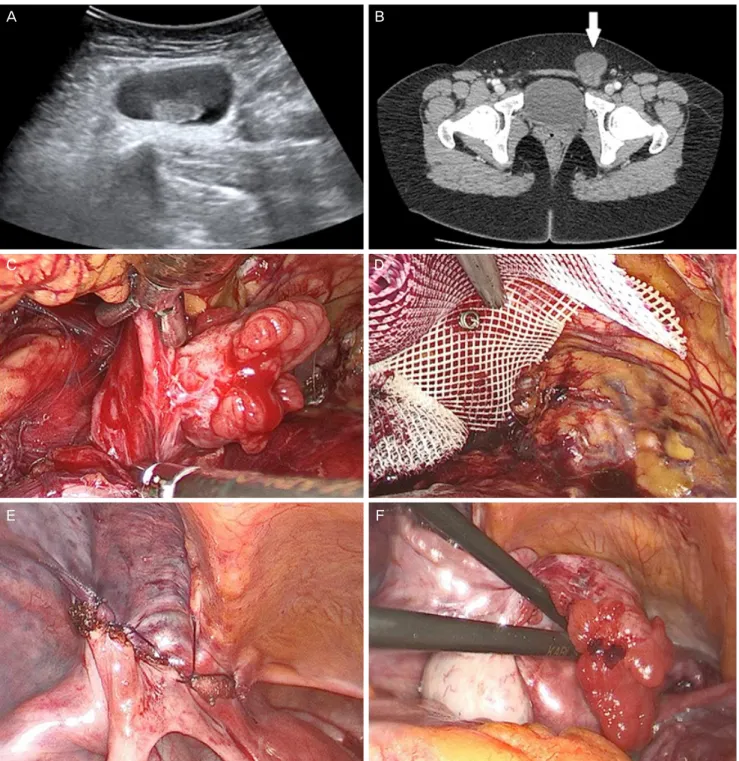
no genital anomaly. Ultrasonography showed a normal uterus and both polycystic ovaries. The left fallopian tube was found in the hernia sac as hydrosalpinx (Fig. 1A). It demonstrated a

6×4 cm cystic structure was observed by computed tomogra- phy in the left inguinal area (Fig. 1B), which was a hernia sac containing the left fallopian tube.

Fig. 1. (A) Ultrasonographic image showing the left hydrosalpinx in the hernia sac. (B) Computed tomography image of the pelvis show- ing a 6×4 cm cystic structure in the inguinal area (white arrow). (C) Laparoscopic view of herniation of the left fallopian tube in the inguinal canal. (D) Laparoscopic view of the polypropylene mesh used to repair the hernia using the total extraperitoneal hernia repair method. (E) Laparoscopic view of the repaired partial defect of peritoneum in the inguinal internal ring area. (F) Laparoscopic view of the left fallopian tube after reduction. Operative findings showed no ischemic changes and no anatomical abnormalities.

A B

C D

E F

(3)

www.ogscience.org 610

Vol. 60, No. 6, 2017

Laparoscopic hernia repair was performed using the TEP method. Edematous left fallopian tube and part of the round ligament were found in hernia sac (Fig. 1C). The left fallopian tube was incarcerated with the round ligament. Part of the left round ligament was cut, and reduction of the left fallo- pian tube into the peritoneal cavity was performed. A poly- propylene mesh was used to repair the hernia (Fig. 1D). After treatment of the hernia using the TEP method, we performed laparoscopic intra-abdominal exploration. Both ovaries showed polycystic feature but did not have other abnormal finding. The uterus, right fallopian tube, and right round liga- ment appeared normal. Laparoscopic suture was performed to repair the peritoneum and anchor the round ligament (Fig.

1E). Tubal patency test results were normal (Fig. 1F).

The patient had an uneventful post-operative course and was discharged on postoperative day 2. Follow-up ultraso- nography was performed 1 week after the operation. The diameter of left salpinx had decreased and edema was im- proved.

Discussion

The incidence of inguinal hernia containing genital organs (e.g., the fallopian tube, ovary or uterus) is infrequent. In a retrospective review article of inguinal hernias in 2006, Gurer et al. [2] reported that among 1,950 cases, ovaries and fal- lopian tubes accounted for 2.9% of the unusual contents of hernia sacs and only 0.41% of patients showed a hernia sac containing only the fallopian tube [3]. In adult women, ingui- nal hernia containing genital organs is generally accompanied by other genital abnormalities [4]. Only 2 cases of fallopian tube and ovary indirect inguinal hernia in reproductive-aged women without genial anomalies have been reported to the Obstetrics and Gynecology Science [5,6]. This is the first case of indirect inguinal hernia containing only the fallopian tube, without the ovary, in a woman of reproductive age without any genital organ anomaly. Kim et al. [5] reported a case of indirect inguinal hernia containing left ovary, left fallopian tube and endometriosis in Korea. In that case report, hernia sac size was 4×5 cm. Compare to Kim et al.’s case report [5], the patient of our case showed larger hernia sac but con- tained only the left fallopian tube without ovary or any other organ. In addition, the patient was younger and had no his- tory of pregnancy which means the patient had lower risk of

abdominal wall or ligamental weakness.

The mechanism of inguinal hernias of genital organs in re- productive-aged women without any genital organ anomalies is unclear. Ozkan et al. [3] suggested that weakness of the broad ligament and ovarian suspensory ligament may cause this kind of herniation. This can also be aggravated when abdominal pressure is increased. But Ozkan et al.’s hypothesis [3] cannot explain why recurrent indirect hernias containing the fallopian tube, ovary or uterus occur in reproductive aged woman because weakness of the ligaments increases with age.

Because of the rarity and unclear pathogenesis, it is difficult to predict or diagnose genital organ herniation. However, early diagnosis and timely management is essential to reduce the risk of adnexal damage and preserve fertility.

Most cases of inguinal hernia of the fallopian tube and ova- ry or hernia of the fallopian tube alone are treated by excision of the hernia sac and its components [3,5,7]. Kim et al. [5]

used a laparoscopic approach to perform left salpingo- oophorectomy because the patient of that case has been had plan of hysterectomy because the patient already had carcinoma in situ of cervix as underlying disease.

Song et al. [6] reported a high ligation method for a left fal- lopian tube hernia that saved the left salpinx, but this was an open method. Our case, the patient was young and had no history of delivery, so we performed laparoscopic reduction of the fallopian tube into the peritoneal cavity with TEP hernia repair using polypropylene mesh to preserve future fertility, prevent recurrence and achieve better cosmetic out- comes. Using a laparoscopic approach, patients recover faster, experience less pain during the first day, face fewer complica- tions (e.g., infection or bleeding), have a lower risk of chronic pain and have better cosmetic outcomes than open hernia repair [8].

In conclusion, we reported a case of inguinal hernia of only

the fallopian tube in a woman of reproductive age without

any genital anomalies. A laparoscopic approach with using

the TEP method was successful, with good cosmetic out-

comes and less pain after surgery, and the fallopian tube was

preserved. Therefore, before determination of resection of a

hernia sac or herniated fallopian tube, we suggest consider-

ing a laparoscopic approach to reduce herniated adnexae and

prevent recurrence.

(4)

www.ogscience.org 611 Yong Hee Park, et al. Fallopian tube indirect inguinal hernia

Conflict of interest

No potential conflict of interest relevant to this article was reported.

References

1. Graul A, Ko E. Indirect inguinal hernia containing a fal- lopian tube and ovary in a reproductive aged woman.

Case Rep Obstet Gynecol 2014;2014:437340.

2. Gurer A, Ozdogan M, Ozlem N, Yildirim A, Kulacoglu H, Aydin R. Uncommon content in groin hernia sac. Hernia 2006;10:152-5.

3. Ozkan OV, Semerci E, Aslan E, Ozkan S, Dolapcioglu K, Besirov E. A right sliding indirect inguinal hernia contain- ing paraovarian cyst, fallopian tube, and ovary: a case

report. Arch Gynecol Obstet 2009;279:897-9.

4. Manjunath BG, Shenoy VG, Raj P. Persistent müllerian duct syndrome: how to deal with the müllerian duct remnants - a review. Indian J Surg 2010;72:16-9.

5. Kim JH, Chong GO, Lee JY, Lee YH, Hong DG, Park SY, et al. Laparoscopic repair of indirect inguinal hernia con- taining endometriosis, ovary, and fallopian tube in adult woman without genital anomalies. Obstet Gynecol Sci 2014;57:557-9.

6. Song EJ, Hong SN, Woo YJ, Ji BJ, Park KD. Inguinal her- nia of ovary and fallopian tube in adult woman. Korean J Obstet Gynecol 2006;49:2018-22.

7. Golash V, Cummins RS. Ovulating ovary in an inguinal hemia. Surgeon 2005;3:48.

8. National Institute for Clinical Excellence (GB). Laparo-

scopic surgery for inguinal hernia repair. London: Na-

tional Institute for Clinical Excellence; 2005.

수치

Fig. 1. (A) Ultrasonographic image showing the left hydrosalpinx in the hernia sac. (B) Computed tomography image of the pelvis show- show-ing a 6×4 cm cystic structure in the show-inguinal area (white arrow)

참조

관련 문서