• 검색 결과가 없습니다.

Single-Port Laparoscopic Total Extraperitoneal Inguinal Hernia Repair without Fixation of the Mesh

N/A
N/A
Protected

Academic year: 2021

Share "Single-Port Laparoscopic Total Extraperitoneal Inguinal Hernia Repair without Fixation of the Mesh"

Copied!
7
0
0

로드 중.... (전체 텍스트 보기)

전체 글

(1)

Single-Port Laparoscopic Total Extraperitoneal Inguinal Hernia Repair without Fixation of the Mesh

Sung Uk Bae, M.D.

1

, Byung Soh Min, M.D.

2

, Seung Hyuk Baik, M.D.

2

, Nam Kyu Kim, M.D.

2

, Hyuk Hur, M.D.

2

Division of Colorectal Surgery, Department of Surgery,

1

School of Medicine, Keimyung University and Dongsan Medical Center, Daegu,

2

Colorectal Cancer Clinic, Severance Hospital, Yonsei University College of Medicine, Seoul, Korea

Purpose: Single-port laparoscopic surgery has been used increasingly in treatment of a variety of conditions, and one recently introduced technique is single-port laparoscopic total extraperitoneal (SPLTEP) hernia repair. The aim of this study was to evaluate the safety and technical feasibility of SPLTEP hernia repair without fixation of the mesh.

Methods: From June 2010 to October 2012, 112 consecutive patients underwent SPLTEP hernia repair.

Results: We performed 129 inguinal hernia repairs in 112 patients, 17 were bilateral and 95 unilateral.

There were 107 indirect hernias (83.0%), 20 direct hernias, and 2 hernias had both of types. Successful SPLTEP hernia repair was performed in 110 patients, with two conversions to an open surgical approach. Median operative times for unilateral and bilateral hernias were 70 minutes (40~145 minutes) and 90 minutes (67~135 minutes), respectively, and the hospital stay was 1 day (1~5 days).

Postoperative complications included 10 patients with wound seromas or hematomas, 2 with urinary retention, 4 with groin pain, and 1 with bleeding from the incision site. There were 3 early recurrences (2.4%) during a median follow-up period of 42 months (range, 6~55).

Conclusion: SPLTEP inguinal hernia repair without fixation of the mesh is both safe and technically feasible, and provides acceptable operative outcomes. Conduct of a prospective randomized study with long-term follow-up is needed to confirm the benefit of this technique in patients with inguinal hernia.

Keywords: Hernia, Inguinal herniorrhaphy, Laparoscopy

Received October 2, 2015 Revised 1st November 25, 2015

2nd December 14, 2015 Accepted December 29, 2015

Corresponding author Hyuk Hur

Division of Colorectal Surgery, Department of Surgery, Colorectal Cancer Clinic, Severance Hospital, Yonsei University College of Medicine, 50 Yonsei-ro, Seodaemun-gu, Seoul 41931, Korea Tel: +82-2-2228-2139

Fax: +82-2-313-8289 E-mail: [email protected]

This is an Open Access article distributed under the terms of the Creative Commons Attribution Non-Commercial License (http://

creativecommons.org/licenses/by-nc/4.0/) which permits unrestricted non-commercial use, distribution, and reproduction in any medium, provided the original work is properly cited.

Copyright © 2016 The Journal of Minimally Invasive Surgery. All rights reserved.

Journal of Minimally Invasive Surgery
J Minim Invasive Surg 2016;19(1):25-31

InTRODUCTIOn

Laparoscopic inguinal hernia repair was first introduced in 1990, and the technique has since become increasingly popular worldwide.

1

Compared with open repairs, laparo- scopic inguinal hernia repair is associated with less postop- erative pain, shorter recovery times, and improved cosmetic results.

2

Although laparoscopic hernia repair was somewhat controversial due to its high recurrence rates and rare but

dangerous complications, such as bowel or vascular injuries

in early studies, recent studies have reported no difference in

the recurrence rates of laparoscopic hernia repair and open

tension-free repair for experienced surgeon.

3,4

With minimally

invasive surgery becoming increasingly common, questions

of how to minimize surgical trauma and improve cosmetic

outcomes have evolved as important topics of discussion. Each

laparoscopic incision for trocar insertion presents risks for

incisional hernias, bowel or vascular injuries, and unsatisfac-

(2)

tory cosmetic outcomes. As a result, single-port laparoscopic surgery (SPLS) has been developed for treatment of a variety of conditions.

SPLS was first described in 1998 for laparoscopic appen- dectomy

5

and cholecystectomy,

6

the SPLS technique has been incorporated into a variety of laparoscopic procedures. Since the first report of single-port laparoscopic total extraperito- neal (SPLTEP) hernia repair,

7

there have been several studies in the published literature.

8-11

The aim of this study was to evaluate the safety and technical feasibility of SPLTEP hernia repair without fixation of the mesh.

MATERIALS AnD METHODS

Between June 2010 and October 2012, 112 consecutive pa- tients underwent elective inguinal hernia repair by a single surgeon (H.H) at Severance Hospital, Yonsei University Col- lege of Medicine. All inguinal hernia repairs was planned to be performed by single-port laparoscopic approach. Pro- spectively collected data included age, gender, body mass index, hernia characteristics, gender, operative time, length of hospital stay, and perioperative complications. Postoperative wound pain was measured using the visual analog scale (VAS) pain score system with endpoints labeled as ‘‘no pain’’ (0-mm) and ‘‘worst possible pain’’ (100-mm) on postoperative day 1.

For the subgroup analysis, the patients were separated into 2 groups, unilateral and bilateral hernia repairs.

Surgical technique of SPLTEP hernia repair without fixation

All patients were given prophylactic antibiotics, and surgical procedures were carried out under general anesthesia with the patient in the supine position. A single 2.5-cm vertical inci- sion was made through the umbilical skin. The subcutaneous tissue was dissected to expose the linea alba. The linea alba was then incised vertically and the peritoneum was preserved.

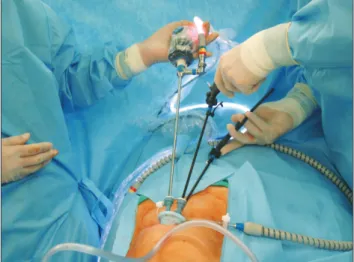
Fig. 1. Single-port with the camera inserted into the 5-mm port along with laparoscopic instruments.

A B

C D

Fig. 2. Intraoperative views during a

SPLTEP inguinal hernia repair. (A) Identifica-

tion of the inferior epigastric vessels, sym-

physis pubis, femoral vessels, and hernia

sac. (B) Isolation of the hernia sac from

the spermatic cord. (C) Ligation of hernia

sac just beyond the internal ring with a

endoloop. (D) Placement of polyester mesh

without fixation suturing.

(3)

Extraperitoneal space was carefully generated by blunt finger dissection. A disposable SILS

TM

Multiple Instrument Ac- cess Port (Covidien, Mansfield, MA, USA) was placed in the preperitoneal space through the umbilical incision, and three 5-mm channels were inserted into each hole of the single- port. After CO

2

insufflation via the insufflation channel of the single-port, an endoscopic camera 5-mm in diameter and 45- cm in length along with graspers and monopolar diathermy were used to generate preperitoneal space (Fig. 1). Lateral space was dissected toward the anterior superior iliac spine and continued medially until the inferior epigastric vessels, symphysis pubis, and cord structures were identified (Fig. 2A).

If a direct hernia was present, the hernia sac was reduced us- ing gentle traction on the sac. In cases of indirect hernias, the hernia sac was carefully isolated, freed from the spermatic cord, and reduced from the internal ring by gentle traction and dissection (Fig. 2B). Indirect hernia sacs were routinely ligated just beyond the internal ring with a Vicryl Endoloop (Ethicon, Somerville, NJ, USA) and divided using endoshears (Fig. 2C).

One 5-mm access channel was then removed and a 12-mm access channel was subsequently inserted. Parietex Anatomi- cal mesh (Covidien, Dublin, Ireland) 9-cm×13-cm in size was

introduced through the 12-mm access channel, unfolded, and placed around the spermatic cord from the pubic symphysis to the anterior iliac spine laterally without fixation suturing or fibrin sealant (Fig. 2D). After the operation was completed, the space was deflated under direct visualization without drain- age.

Statistical analyses

The statistical analyses were performed with IBM SPSS 20.0 software (SPSS Inc., Chicago, IL, USA). Clinical characteris- tics and variables were compared between bilateral and uni- lateral groups by an independent-sample t-test for continuous data or a chi-square test for categorical data. A p value <0.05 was considered to be statistically significant.

RESULTS

Patient characteristics

We performed 129 inguinal hernia repairs in 112 patients, 17 of which were bilateral and 95 unilateral. There were no femoral or scrotal hernias. Patient demographics and hernia characteristics are summarized in Table 1. The median age of the patients was 58 years (range, 19~85 years), with 10 women and 102 men and the body mass index was 22.7 kg/m

2

(16.8~36.7 kg/m

2

). There were 107 indirect henias (83.0%), 20 Table 1. Patient and inguinal hernia characteristics

Patient number 112

Sex, n (%)

Male 102 (91)

Female 10 (9)

Age (yr), median (range) 58 (19~85) BMI (kg/m

2

), median (range) 22.7 (16.8~ 36.7) ASA classification, n (%)

1 85 (76)

2 23 (21)

3 4 (4)

4 0

Site of hernia, n (%)

Right inguinal 59 (53)

Left inguinal 36 (32)

Bilateral 17 (15)

Type of hernia, n (%)

Indirect hernia 107 (83.0)

Direct hernia 20 (15.5)

Indirect and direct hernia 2 (1.5)

ASA = American Society of Anesthesiologists; BMI = body mass index.

Table 2. Operative outcomes and morbidity after SPLTEP inguinal hernia repair

Operation time (min), median (range)

Unilateral 70 (40~145)

Bilateral 90 (67~135)

VAS score on POD 1, median (range) 2 (1~7) Hospital days (days), median (range) 1 (1~5)

Conversion, n (%) 2 (1.8)

Postoperative complications, n (%) 17 (15.3)

Wound hematoma 4 (3.6)

Wound seroma 6 (5.4)

Urinary retention 2 (1.8)

Groin pain 4 (3.6)

Wound bleeding 1 (0.9)

Mortality, n (%) 0 (0)

Recurrence, n (%) 3 (2.4%)

SPLTEP = single-port laparoscopic totally extraperitoneal; VAS = visual

analog scale;.POD = postoperative day.

(4)

direct hernias, and 2 hernias had both of types.

Perioperative clinical outcomes

Successful SPLTEP hernia repair was performed in 110 patients, with 2 conversions to an open surgical approach (Table 2). Both conversions were due to peritoneal tears that occurred as the surgeon created preperitoneal space. Median operative times for unilateral and bilateral hernias were 70 minutes (40~145 minutes) and 90 minutes (67~135 minutes),

respectively. The median postoperative hospital stay was 1 day (1~5 days) and the median pain score (VAS score) on postoperative day 1 was 2 (1~7). Cosmetic results were excel- lent, with the 2.5-cm single-incision being inside the natural fold of the umbilicus (Fig. 3). All procedures were completed without major intraoperative complications, though postopera- tive complications included 10 patients with wound seromas or hematomas, 2 with urinary retention, 4 with groin pain, and 1 with bleeding from the incision site. All complications were managed with conservative treatment. There were 3 early recurrences (2.4%) during a median follow-up period of 42 months (range, 6~55).

Subgroup analysis of unilateral versus bilateral inguinal hernia repair

Demographic characteristics were similar between the two groups for age, gender, and ASA classification (Table 3). The mean operative time was significantly longer in the bilateral group (95.5±21.6 minutes) than in the unilateral group (73.5

±18.4 minutes; p<0.001). Pain scores for the incision site on postoperative day 1 showed no significant differences be- tween the two groups (bilateral: 2.2±1.2; unilateral: 2.2±

0.9; p=0.894). Morbidity within 30 days after surgery and the length of hospital stay were comparable between the two groups.

DISCUSSIOn

The present study demonstrates that, SPLTEP repairs can be

Table 3. Subgroup analysis of unilateral versus bilateral inguinal hernia repair

Variables Unilateral group (n=17) Bilateral group (n=95) p value

Age (yr), mean±SD 54.0±18.43 59.4±16.6 0.258

Sex (%) 0.656

Male 87 (91.6) 15 (88.2)

Female 8 (8.4) 2 (11.8)

ASA classification, (%) 0.393

1 70 (73.7) 15 (88.2)

2 21 (22.1) 2 (11.8)

3 4 (4.2) 0 (0)

Operation time (min), median (range) 73.5±18.4 95.5±21.6 <0.001

VAS score on POD 1, mean±SD 2.2±0.9 2.2±1.2 0.894

Postoperative complications, n (%) 13 (13.7) 3 (17.6) 0.667

Hospital days (days), median (range) 1.2±0.7 1.1±0.3 0.537

SD = standard deviation; ASA = American Society of Anesthesiologists; VAS = visual analog scale; POD = postoperative day.

Fig. 3. Operativescar on postoperative day 7 after SPLTEP inguinal hernia

repair.

(5)

performed with safety, feasibility, and good technical efficien- cy for patients with inguinal hernia. The surgical outcomes of the present case series are consistent with our hypothesis that by using the single-port for TEP repair without fixation of the mesh, high postoperative pain can be prevented for inguinal hernia repair surgery, especially for patients with both ingui- nal hernias. In a literature review of the most recent data from SPLTEP inguinal hernia repairs, Minh Do et al.

12

reported operative times ranging from 30 to 100 minutes for unilateral hernia repair and 26 to 120 minutes for bilateral hernia repair.

Our results showed comparable median operating times of 70 minutes for unilateral and 90 minutes for bilateral hernia repair, with only two conversions to tension-free Lichtenstein repair.

Laparoscopic inguinal hernia repair was first used in the 1990s by Ger et al.

1

At that time, this technique was con- troversial due to its relative technical difficultly compared with open hernia repair. Additionally, some studies reported postsurgical recurrence rates that were as high as 25%.

13,14

However, after more than a decade of experience with laparo- scopic hernia repair, recurrence rates have decreased and this technique has become the treatment of choice at many insti- tutions. The main advantages of laparoscopic inguinal hernia repair are less postoperative pain, shorter recovery times, and improved cosmetic results. This method has been well estab- lished because of its safety, efficacy, and patient satisfaction.

There are two well-described approaches to laparoscopic in- guinal hernia repair including the total extraperitoneal (TEP) and the transabdominal preperitoneal (TAPP) methods. TEP repair is preferred to TAPP repair by some surgeons because it does not require entry into the peritoneal cavity, and thus avoids the risk of mesh coming into contact with intra-ab- dominal structures.

15

As minimally invasive surgery becomes more common, questions of how to minimize surgical trauma and improve cosmetic outcomes have evolved as important topics of discus- sion. For this reason, SPLS is being increasingly used to treat a variety of conditions. Since SPLS was first described in 1998 for laparoscopic appendectomy

5

and cholecystectomy,

6

the feasibility of SPLS has been reported for a number of surgical procedures including,

12

colectomy,

16

adrenalectomy,

17

nephrec- tomy,

18

and splenectomy.

19

The potential advantages of this approach are improved cosmetic outcomes, less postoperative incisional pain, fewer wound complications, and reduction of the number of trocars used. Since the first (SPLTEP) hernia repair was reported by Filipovic-Cugura et al.,

7

and there have been few related reports in the literature.

8-10

In this study, median VAS score on postoperative day 1 was 2 this result was comparable to previous studies of SPLTEP with tack placement or suturing

20-22

Although we did not com-

pare the pain score of SPLTEP without fixation with that of SPLTEP with tack placement, the present study demonstrated that SPLTEP repair without fixation suturing of the mesh did not seem to be related to high levels of postoperative pain. We unfolded the mesh without fixation suturing before the pre- peritoneal space was deflated under direct visualization. In the laparoscopic approach, various techniques of mesh attachment have been described as being in favor of fixation of the mesh used in SPLTEP hernia repairs.

9,23

However, Belyansky et al.

4

demonstrated that bilateral inguinal hernia repairs were as- sociated with higher pain levels during the early postoperative time period when compared to unilateral repairs and that the use of more than 10 tacks on each side in bilateral repairs was associated with a higher frequency of symptomatic patients.

In our study, to investigate whether bilateral SPLTEP repair results in higher pain levels, we compared the outcomes of the bilateral and unilateral inguinal hernia groups. Pain scores for incision site on postoperative day 1 showed no significant differences between two groups. These results suggest that SPLTEP repair without fixation suturing of the mesh is not be related to high levels of postoperative pain. Messaris et al.

24

have also suggested that mesh in the preperitoneal space does not need to be anchored and is instead held in place by the intra-abdominal pressure generated by the abdominal cavity viscera. There may be benefits of non-fixation with respect to shorter operative times, cost reduction, less postoperative pain, and fewer complications related to the introduction of foreign material. Due to concerns for nerve entrapment or potential tissue injury by tacks or suturing, we suggest an alternative means of securing the mesh: non-fixation of the mesh.

In the present study, there were 3 recurrences (2.4%) during a median follow-up period of 42 months (range, 6~55). These recurrences occurred within first 10 cases during the learning curve period and were associated with inappropriate placement of mesh. Schwab et al.

25

reported that there were 2 recurrences (2.3%) in the fibrin sealant group and 5 recurrences (5.7%) in the stapled group in patients who underwent laparoscopic TEP repair for inguinal hernia. Topart et al.

26

demonstrated that 3 recurrences (2.9%) in tack staples group and 1 recurrence (1.5%) in fibrin glue group occurred in 66 patients. These results sug- gest that SPLTEP repair without fixation suturing of the mesh in our study is not related to high recurrence rate.

SPLS has its own unique challenges including the relative

loss of triangulation, inline vision, clashing of instruments,

and a steep learning curve for mastering the procedure. To

overcome these technical challenges, OnderSurgit

23

recom-

mended the “crossed instrument technique,” and Argawalet al.

8

used articulated laparoscopic instruments. In addition, Hanh

Tran

27

suggested two maneuvers including “inline” dissection

in which one dissecting instrument is pushing away while the

(6)

other is pulling outward, and “vertical” dissection in which the instruments move vertically in opposite directions on either side of the laparoscope. Also, significant coordination between the camera assistant and the operator surgeon is important to avoid clashing of the instruments and the laparoscope during the operation. In this study, we used an 30

o

endoscopic camera 5-mm in diameter and 45-cm in length to minimize the col- lision between camera and instruments.

In recent years, the focus in hernia repair has begun to shift from minimizing the recurrence rate to quality of life, includ- ing postoperative pain and cosmetic results, which are two goals of minimally invasive surgery. However, the cosmetic result after hernia repair is generally ignored by many sur- geons. The cosmetic result of the single incision after SPLTEP repair hidden in the normal groove of the umbilicus seems to be excellent. However, a prospective study including an assessment of cosmetic appearance and body image using a questionnaire is needed in the future.

Our study has several limitations, including its retrospective nature and its lack of both a control group and registration of a scar assessment questionnaire. From the limited information from a single center, we can suggest the following advantages of single incision laparoscopic total extraperitoneal inguinal hernia repair without fixation of the mesh:

1. Allows safe and feasible repair of inguinal hernia

2. Presents excellent cosmetic outcomes with nearly scarless incision

3. Results in less postoperative pain than the mesh anchor- ing technique

In conclusion, SPLTEP inguinal hernia repair without fixa- tion of the mesh is both safe and technically feasible, and provides acceptable operative outcomes. A prospective ran- domized study with long-term follow-up is needed to confirm the benefit of this technique in patients with inguinal hernia.

REfEREnCES

1) Ger R, Monroe K, Duvivier R, Mishrick A. Management of in- direct inguinal hernias by laparoscopic closure of the neck of the sac. Am J Surg 1990;159:370-373.

2) Memon MA, Cooper NJ, Memon B, Memon MI, Abrams KR.

Meta-analysis of randomized clinical trials comparing open and laparoscopic inguinal hernia repair. Br J Surg 2003;90:1479-1492.

3) Langeveld HR, van't Riet M, Weidema WF, et al. Total extra- peritoneal inguinal hernia repair compared with Lichtenstein (the LEVEL-Trial): a randomized controlled trial. Ann Surg 2010;251:

819-824.

4) Belyansky I, Tsirline VB, Klima DA, Walters AL, Lincourt AE, Heniford TB. Prospective, comparative study of postoperative quality of life in TEP, TAPP, and modified Lichtenstein repairs.

Ann Surg 2011;254:709-714; discussion 714-705.

5) Esposito C. One-trocar appendectomy in pediatric surgery. Surg Endosc 1998;12:177-178.

6) Piskun G, Rajpal S. Transumbilical laparoscopic cholecystectomy utilizes no incisions outside the umbilicus. J Laparoendosc Adv Surg Tech A 1999;9:361-364.

7) Filipovic-Cugura J, Kirac I, Kulis T, Jankovic J, Bekavac-Beslin M. Single-incision laparoscopic surgery (SILS) for totally extra- peritoneal (TEP) inguinal hernia repair: first case. Surg Endosc 2009;23:920-921.

8) Agrawal S, Shaw A, Soon Y. Single-port laparoscopic totally ex- traperitoneal inguinal hernia repair with the TriPort system: initial experience. Surg Endosc 2010;24:952-956.

9) Chung SD, Huang CY, Wang SM, et al. Laparoendoscopic single- site totally extraperitoneal adult inguinal hernia repair: initial 100 patients. Surg Endosc 2011;25:3579-3583.

10) Kim JH, Park SM, Kim JJ, Lee YS. Initial experience of single port laparoscopic totally extraperitoneal hernia repair: nearly- scarless inguinal hernia repair. J Korean Surg Soc 2011;81:339- 343.

11) Tsai YC, Ho CH, Tai HC, Chung SD, Chueh SC. Laparoendo- scopic single-site versus conventional laparoscopic total extraperi- toneal hernia repair: a prospective randomized clinical trial. Surg Endosc 2013;27:4684-4692.

12) Do M, Liatsikos E, Beatty J, et al. Laparoendoscopic single-site extraperitoneal inguinal hernia repair: initial experience in 10 pa- tients. J Endourol 2011;25:963-968.

13) Fitzgibbons RJ Jr, Camps J, Cornet DA, et al. Laparoscopic in- guinal herniorrhaphy. Results of a multicenter trial. Ann Surg 1995;221:3-13.

14) Vogt DM, Curet MJ, Pitcher DE, Martin DT, Zucker KA. Preliminary results of a prospective randomized trial of laparoscopic onlay versus conventional inguinal herniorrhaphy. Am J Surg 1995;169:84-89;

discussion 89-90.

15) Wake BL, McCormack K, Fraser C, Vale L, Perez J, Grant AM.

Transabdominal pre-peritoneal (TAPP) vs totally extraperitoneal (TEP) laparoscopic techniques for inguinal hernia repair. Cochrane Database Syst Rev 2005:CD004703.

16) Ramos-Valadez DI, Patel CB, Ragupathi M, Bartley Pickron T, Haas EM. Single-incision laparoscopic right hemicolectomy:

safety and feasibility in a series of consecutive cases. Surg Endosc 2010;24:2613-2616.

17) Chung SD, Huang CY, Wang SM, Tai HC, Tsai YC, Chueh SC.

Laparoendoscopic single-site (LESS) retroperitoneal adrenal- ectomy using a homemade single-access platform and standard laparoscopic instruments. Surg Endosc 2011;25:1251-1256.

18) Raman JD, Bagrodia A, Cadeddu JA. Single-incision, umbilical

laparoscopic versus conventional laparoscopic nephrectomy: a

comparison of perioperative outcomes and short-term measures

of convalescence. Eur Urol 2009;55:1198-1204.

(7)

19) Targarona EM, Pallares JL, Balague C, et al. Single incision ap- proach for splenic diseases: a preliminary report on a series of 8 cases. Surg Endosc 2010;24:2236-2240.

20) Kim JH, An CH, Lee YS, Kim HY, Lee JI. Single incision laparo- scopic totally extraperitoneal hernioplasty (SIL-TEP): experience of 512 procedures. Hernia 2015;19:417-422.

21) Tran H, Turingan I, Tran K, Zajkowska M, Lam V, Hawthorne W.

Potential benefits of single-port compared to multiport laparo- scopic inguinal herniorraphy: a prospective randomized controlled study. Hernia 2014;18:731-744.

22) Kim JH, Lee YS, Kim JJ, Park SM. Single port laparoscopic totally extraperitoneal hernioplasty: a comparative study of short-term outcome with conventional laparoscopic totally extraperitoneal hernioplasty. World J Surg 2013;37:746-751.

23) Surgit O. Single-incision Laparoscopic surgery for total extra-

peritoneal repair of inguinal hernias in 23 patients. Surg Laparosc Endosc Percutan Tech 2010;20:114-118.

24) Messaris E, Nicastri G, Dudrick SJ. Total extraperitoneal laparo- scopic inguinal hernia repair without mesh fixation: prospective study with 1-year follow-up results. Arch Surg 2010;145:334-338.

25) Schwab R, Willms A, Kroger A, Becker HP. Less chronic pain following mesh fixation using a fibrin sealant in TEP inguinal hernia repair. Hernia 2006;10:272-277.

26) Topart P, Vandenbroucke F, Lozac'h P. Tisseel versus tack staples as mesh fixation in totally extraperitoneal laparoscopic repair of groin hernias: a retrospective analysis. Surg Endosc 2005;19:724- 727.

27) Tran H. Safety and efficacy of single incision laparoscopic surgery

for total extraperitoneal inguinal hernia repair. JSLS 2011;15:47-

52.

수치

Fig. 1. Single-port with the camera inserted into the 5-mm port along  with laparoscopic instruments
Table 2. Operative outcomes and morbidity after SPLTEP inguinal hernia  repair
Fig. 3. Operativescar on postoperative day 7 after SPLTEP inguinal hernia  repair.

참조

관련 문서

Average of the indexed values of the following data: (1) Total value of the indexed score for disability-adjusted life years (the number of years lost due to illness,

In the years following 1965, President Johnson began send- ing large numbers of American troops to fight alongside the South Vietnamese.. The United States sent troops to

(1.1 points) According to the passage, which of the following is NOT mentioned as the nature of pain.. ① Pain is not tied to any referent in

The “Asset Allocation” portfolio assumes the following weights: 25% in the S&amp;P 500, 10% in the Russell 2000, 15% in the MSCI EAFE, 5% in the MSCI EME, 25% in the

1 John Owen, Justification by Faith Alone, in The Works of John Owen, ed. John Bolt, trans. Scott Clark, &#34;Do This and Live: Christ's Active Obedience as the

Therefore depending on the size of the fracture in the veneering porcelain, intraoral repair methods using surface treatment and composite resins may

The orifice inserted inside the mold increases the shear rate, extension rate inside the channel, which has been shown to improve the angle in the direction

Interest in sustainability and improving the quality of living has brought changes in the measurement and judgement for the quality of living.