APPROXIMATE MLE FOR THE SCALE PARAMETER OF THE DOUBLE EXPONENTIAL DISTRIBUTION
BASED ON TYPE-II CENSORED SAMPLES SUK-BoK
KANG*1. Introduction
Consider the double exponential distribution with probability den- sity function (pdf)
(1.1) Let (1.2)
f(x;O')
=_e- 1 1xl/ u,
-00< x <
00.20'
be the available Type-I1 censored sample from the double exponential distribution with pdf (1.1), where the smallest r and the largest s observations are censored.
Bain and Engelhardt (1973) discussed the usefulness of the double exponential distribution as a model for statistical studies, and obtained the confidence intervals based on the maximum likelihood estimators for the location and scale parameters of the double exponential dis- tribution. Govindarajulu (1966) gave coefficients of the best linear unbiased estimators for the location and scale parameters in the dou- ble exponential distribution from complete and symmetric censored samples.
Raoet al.(1991) obtained the first two moments and product
Received October 18, 1994.
1991 AMS Subject Classification: 62F10, 62F12.
Key words: approximate MLE, double exponential distribution, Type-II cen- sored sample, relative efficient, mean square error, best linear unbiased, optimum unbiased absolute estimator.
*This research was partially supported by KOSEF 1993-1994.
moments of absolute values of order statistics for the double expo- nential and the double Weibull distributions. They also obtained the optimum unbiased absolute estimator (OUAE) of the scale parameter in (1.1) by absolute values of the order statistics and showed that this new 0 UAE is generally more efficient than the best linear unbiased estimator (BLUE) of the scale parameter by order statistics.
The approximate maximum likelihood estimation method was first developed by
~alakrishnan(1989 a, b) for the purpose of providing the explicit estimators of the scale parameter in the Rayleigh distribution and the mean and standard deviation in the normal distribution with censoring. For the extreme value distribution with censoring and the half-logistic distribution with Type-II right censoring, Balakrishnan and Varadan (1991) and Balakrishnan and Wong (1991) provided a method of deriving explicit estimators by approximating the likelihood equationi-respectively;--'I'heyalso studied the hiases andvariancesof the proposed estimators and showed that these estimators are almost as efficient as the maximum likelihood estimators and just as efficient as the BLUEs. Some historical remarks and a good summary of the approximate maximum likelihood estimation may be found in Balakr- ishnan and Cohen (1991).
In this paper, we derive an explicit estimator of
afor complete and censored samples by appropriately approximating the likelihood function. We obtain the asymptotic variance and simulate the values of the biases and the variances of the proposed approximate maximum likelihood estimator (AMLE). We compare the AMLE with the BLUE and the OUAE of the scale parameter a in the sense of the mean square error (MSE). We show that this proposed AMLE is generally more efficient than the BLUE and the OUAE of the scale parameter for complete and censored samples.
2. Approximate maximum likelihood estimator
We shall derive the AMLE of a based on the Type-I! censored sam- ple in (1.2).
The likelihood function based -on the Type-II censored sample in
(1.2) is given by (2.1)
1 [
f(Zr+l:n) f(Zn-s:n)
- - A + rZr+l:n F(Z ) - sZn-s:n 1 _ F(Z )
u r+l:n n-s:n
n-s ]
- L IZi:nl
=O.
i=r+l
(2.3)
where A
=n - r - s is the size of the censored sample in (1.2), Zi:n
=Xi:n/u, and fez) and F(z) are the pdf and the distribution function of the standard double exponential distribution, respectively.
By realizing that f'(z)/ fez) = -lzl/z, z
=1=0, we can obtain the follow- ing the likelihood equation for u.
(2.2)
---a;;- dlnL
=Equation (2.2) does not admit an explicit solution for u unless r
=0 and s
=O. But we can expand the functions f(Zr+l:n)/ F(Zr+l:n) and f(Zn-s:n)/{l - F(Zn-s:n)} in Taylor series around the points F-l(Pr+d
=In(2pr+d ifpr+l < 0.5,
=-In{2(1-Pr+l)} ifpr+l
~0.5, and F-l(Pn_s) = In(2Pn-s) if Pn-s < 0.5, = -In{2(1 - Pn-s)} if
Pn-s
~0.5, respectively.
(1) Case 1 : Zr+l:n
~0
Since F(Zn-s:n)
=1 - f(Zn-s:n), the expansion of the function f(Zr+l:n)/F(Zr+l:n) is required. We can approximate it by
f(Zr+l:n)
F(Z )
~ a -/3Zr+l:n, r+l:n
where
Pi
=ij(n + 1), (2.4)
(2.5)
Now making use of the approximate expression in (2.3), we obtain the approximate likelihood equation of (2.2) as
(2.6)
dlnL dlnL*
- - " ' - - - du - du
= - ~ [A + raZr+l:n - sZn-s:n - .I: IZi:nl- r/3Z;+l:n] = o.
I=r+l
Upon solving equation (2.6) for u, we derive the AMLE of u as (2.7)
where
n-s
Bi·=sX;;::::-;;";;+LI:Xi~~t;..;,;r~:Xr+I:n:;
i=r+l
Cl
=r/3X;'+l:n'
Equation (2.6) is quadratic in
uwhich has two roots; however, one of them drops out because Cl
~o.
Case 2 : Zr+l < 0 < Zn-s:n
Since F(Zr+l) = !(Zr+l) and F(Zn-s)
= 1-!(Zn-s) in this case, we can obtain the likelihood equation as follow;
(2.8) dlnL 1 [ n-s ]
- d -
= -- A + rZr+l:n - sZn-s:n - L IZi:n! = o.
u u
i=r+lHence, in this case, we can obtain the exact maximum likelihood esti- mator (MLE) of u as follow;
n-s
(2.9)
Er={sXn- s:n - rX
r+
l :n + L IXi:nl}/A,
i=r+l
Case 3 : Zn-s:n ::; 0
Since F(Zr+l:n)
=!(Zr+l:n), the expansion of the function
!(Zn-s:n)/{l- F(Zn-s:n)} is required. We can approximate it by
(2.10) where
(2.11)
(2.12)
Now making use of the approximate expression in (2.10), we can obtain the approximate likelihood equation.of (2.2) as
(2.13)
dlnL dlnL*
--"'-~-
dO' . - dO'
= - ~ [A + rZr+l:n - s-yZn-s:n - .I: IZi:nl- Sc5Z;_s:n] = o.
s=r+l
Upon solving equation (2.13) for
0',we derive the AMLE of
(7as (2.14)
where
n-s
B
2= s"'YXn-s:n + L IXi:nl-
rX r+
1:n,
i=r+l
Equation (2.13) is quadratic in
(7which has two roots; however, one of them drops out because C
2 ~o.
Note that in complete case (r
=s
=0), the AMLE becomes the
minimum variance unbiased estimator,
E~=lIXi:nl/nof
(7.3. Asymptotic Properties
Since the AMLEs
iTin (2.7) and (2.14) are the solutions of the ap- proximate maximum likelihood equations (2.6) and (2.13), respectively, and the MLE
iTin (2.9) is the solution of the maximum likelihood equa- tion (2.8), it immediately follows that
iTis asymptotically normally dis- tributed with mean a and variance 1/E{-d?-lnL*/da
2J (See Kendall and Stuart (1973)). Now, from equations (2.6), (2.8), and (2.13) we can obtain
(3.1)
where
Zr+l:n 20
Zr+l:n < 0 < Zn-s:n Zn-s:n :::; 0
- L n-s E(lZi:n)!J - A, i=r+l
n-s
D2 =
2{sE(Zn-s:n) + L E(IZi:nl) - rE(Zr+l:nn -
A,i=r+l
D
3 =3sc5E(Z;_s:n) - 2{rE(Zr+t:n) -
S7E (Zn-s:n)
- L n-s E(\Zi:nln - A.
i=r+l
From the equation (3.1), we can compute the asymptotic variance of
the AMLE
iTby using the following results (Govindarajulu (1966) and
Rao et al.(1991)).
E(lZ;,.1) ~2-n {t, (~)S1(i -
j,n -j) + ~ (~)S1(j -; +l,j) }
E(Zf,n) ~Tn {t,(;) [5,(i -
j,n -j) + ~(i -
j,n -j)l
+ ~ e)lS,(j -
i+ 1,j) + ~(j - ; + 1,j))},
i = r
+ 1, ... , n - s, where
n
Sk(i,n)=
L
1jlk,l=n-i+l
k
=1,2.
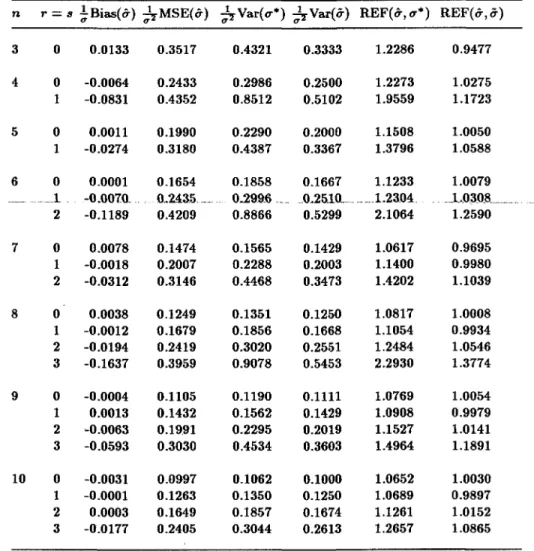
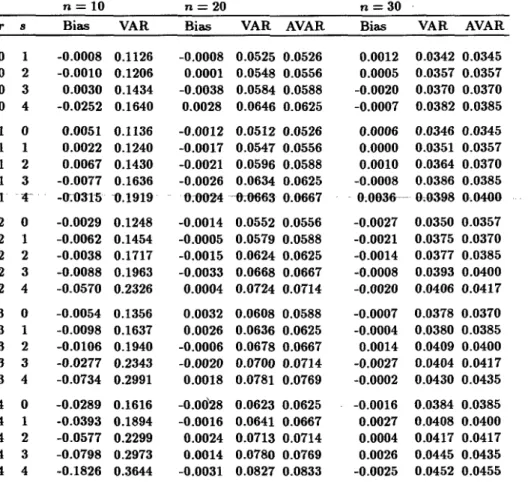
From the formulae derived in section 2, we simulate the values of the biases, variances and the mean square errors of AMLE
(J(based on 10000 Monte Carlo runs) for n
=3(1)10, 20, 30 and over various choices of censoring. These values are presented in Table 1, 2 and 3 with the variances of the BLUE u* and the QUAE u. The values of the relative efficiency of the AMLE
(Jto the BLUE u*, REF( u, u*)
=Var(u*)jMSE(u), and the relative efficiency of the AMLE u to the
QUAE
u, REF(u,u) =Var(u)jMSE(u) are also presented in Table 1
and 2. From Table 1 and 2, the AMLE is generally more efficient than
the BLUE and QUAE of the double exponential scale parameter u for
complete, symmetrically censored samples and right censored samples.
Table
1.The Biases and MSE's of the AMLE u, and the Variances of the BLUE
(7*and QUAE
(jof the Double Exponential Scale Parameter from Complete and Symmetrically Censored Samples.
n r
=
8 ~Bias(u) ~MSE(u) ~Var(u*) ~Var(u)t7 t7 REF(u,u*) REF(u,u)3 0 0.0133 0.3517 0.4321 0.3333 1.2286 0.9477
4 0 -0.0064 0.2433 0.2986 0.2500 1.2273 1.0275
1 -0.0831 0.4352 0.8512 0.5102 1.9559 1.1723
5 0 0.0011 0.1990 0.2290 0.2000 1.1508 1.0050
1 -0.0274 0.3180 0.4387 0.3367 1.3796 1.0588
6 0 0.0001 0.1654 0.1858 0.1667 1.1233 1.0079
... _..1. -0.007.0.. 0..24.35 .... 0..299-6 .0.25.10_ ...1.2304 .1..030.8 ...
2 -0.1189 0.4209 0.8866 0.5299 2.1064 1.2590
7 0 0.0078 0.1474 0.1565 0.1429 1.0617 0.9695
1 -0.0018 0.2007 0.2288 0.2003 1.1400 0.9980 2 -0.0312 0.3146 0.4468 0.3473 1.4202 1.1039
8 0 0.0038 0.1249 0.1351 0.1250 1.0817 1.0008
1 -0.0012 0.1679 0.1856 0.1668 1.1054 0.9934 2 -0.0194 0.2419 0.3020 0.2551 1.2484 1.0546 3 -0.1637 0.3959 0.9078 0.5453 2.2930 1.3774
9 0 -0.0004 0.1105 0.1190 0.1111 1.0769 1.0054
1 0.0013 0.1432 0.1562 0.1429 1.0908 0.9979
2 -0.0063 0.19.91 0.2295 0.2019 1.1527 1.0141 3 -0.0593 0.3030 0.4534 0.3603 1.4964 1.1891
10 0 -0.0031 0.0997 0.1062 0.1000 1.0652 1.0030
1 -0.0001 0.1263 0.1350 0.1250 1.0689 0.9897
2 0.0003 0.1649 0.1857 0.1674 1.1261 1.0152
3 -0.0177 0.2405 0.3044 0.2613 1.2657 1.0865
Table 2. The Biases and MSE's of the AMLE u, and the Variances of
the BLUE
(7*and QUAE
(jof the Double Exponential Scale Parameter
from Right Censored Samples.
n s
*
Bias(u) ~ MSE(u) ~Var(u*) ~Var(u) REF(u,u*) REF(u, u)3 1 -0.1159 0.4272 0.8422 0.5290 1.9714 1.2383
4 1 -0.0290 0.3146 0.4414 0.3391 1.4031 1.0779
2 0.0693 0.5508 0.7343 0.5484 1.3332 0.9956
5 1 -0.0041 0.2440 0.3008 0.2514 1.2328 1.0303
2 -0.0916 0.3098 0.4483 0.3657 1.4471 1.1804
3 0.0638 0.4867 0.5800 0.4935 1.1917 1.0140
6 1 -0.0001 0.2051 0.2294 0.2004 1.1185 0.9771
2 -0.0229 0.2363 0.3063 0.2612 1.2962 1.1054
3 0.0573 0.3551 0.4245 0.3775 1.1954 1.0631
4 0.0466 0.4163 0.4668 0.4274 1.1213 1.0267
7 1 -0.0114 0.1614 0.1858 0.1668 1.1512 1.0335
2 -0.0094 0.1970 0.2316 0.2039 1.1756 1.0350
3 -0.0712 0.2346 0.3075 0.2791 1.3107 1.1897
4 0.0405 0.3185 0.3802 0.3537 1.1937 1.1105
5 0.0357 0.3752 0.3897 0.3714 1.0386 0.9899
8 1 -0.0017 0.1238 0.1564 0.1429 1.2633 1.1543
2 -0.0027 0.1667 0.1867 0.1681 1.1200 1.0084
3 -0.0339 0.1942 0.2343 0.2132 1.2065 1.0978
4 0.0337 0.2527 0.2982 0.2868 1.1801 1.1349
5 0.0399 0.3011 0.3345 0.3185 1.1109 1.0578
6 0.0279 0.3277 0.3354 0.3268 1.0235 0.9973
9 1 -0.0082 0.1221 0.1351 0.1250 1.1065 1.0238
2 -0.0004 0.1383 0.1567 0.1434 1.1330 1.0369
3 -0.0084 0.1645 0.1883 0.1723 1.1447 1.0474
4 -0.0658 0.1863 0.2345 0.2254 1.2587 1.2099
5 0.0346 0.2415 0.2798 0.2750 1.1586 1.1387
6 0.0341 0.2751 0.2952 0.2856 1.0731 1.0382
7 0.0288 0.2934 0.2954 0.2914 1.0068 0.9932
10 1 -0.0039 0.1097 0.1189 0.1111 1.0839 1.0128
2 0.0053 0.1269 0.1352 0.1252 1.0654 0.9866
3 -0.0052 0.1427 0.1575 0.1453 1.1037 1.0182
4 -0.0367 0.1559 0.1897 0.1802 1.2168 1.1559
5 0.0299 0.2003 0.2298 0.2307 1.1473 1.1518
6 0.0264 0.2331 0.2576 0.2541 1.1051 1.0901
7 0.0087 0.2425 0.2632 0.2576 1.0854 1.0623
8 0.0236 0.2709 0.2649 0.2630 0.9779 0.9708
Table 3. The Biases, Variances and the Asymptotic Variances of the AMLE a- of the Double Exponential Scale Parameter from Type-11 Censored Samples.
n = 10 n=20 n =30
r s Bias VAR Bias VAR AVAR Bias VAR AVAR
0 1 -0.0008 0.1126 -0.0008 0.0525 0.0526 0.0012 0.0342 0.0345 0 2 -0.0010 0.1206 0.0001 0.0548 0.0556 0.0005 0.0357 0.0357 0 3 0.0030 0.1434 -0.0038 0.0584 0.0588 -0.0020 0.0370 0.0370 0 4 -0.0252 0.1640 0.0028 0.0646 0.0625 -0.0007 0.0382 0.0385 1 0 0.0051 0.1136 -0.0012 0.0512 0.0526 0.0006 0.0346 0.0345 1 1 0.0022 0.1240 -0.0017 0.0547 0.0556 0.0000 0.0351 0.0357 1 2 0.0067 0.1430 -0.0021 0.0596 0.0588 0.0010 0.0364 0.0370 1 3 -0.0077 0.1636 -0.0026 0.0634 0.0625 -0.0008 0.0386 0.0385 1 4- -0:0315 0.1919 0;0024 tt;0663 0.0667 . 0,0&36 0,0398 0.0400 2 0 -0.0029 0.1248 -0.0014 0.0552 0.0556 -0.0027 0.0350 0.0357 2 1 -0.0062 0.1454 -0.0005 0.0579 0.0588 -0.0021 0.0375 0.0370 2 2 -0.0038 0.1717 -0.0015 0.0624 0.0625 -0.0014 0.0377 0.0385 2 3 -0.0088 0.1963 -0.0033 0.0668 0.0667 -0.0008 0.0393 0.0400 2 4 -0.0570 0.2326 0.0004 0.0724 0.0714 -0.0020 0.0406 0.0417 3 0 -0.0054 0.1356 0.0032 0.0608 0.0588 -0.0007 0.0378 0.0370 3 1 -0.0098 0.1637 0.0026 0.0636 0.0625 -0.0004 0.0380 0.0385 3 2 -0.0106 0.1940 -0.0006 0.0678 0.0667 0.0014 0.0409 0.0400 3 3 -0.0277 0.2343 -0.0020 0.0700 0.0714 -0.0027 0.0404 0.0417 3 4 -0.0734 0.2991 0.0018 0.0781 0.0769 -0.0002 0.0430 0.0435 4 0 -0.0289 0.1616 -0.0028 0.0623 0.0625 -0.0016 0.0384 0.0385 4 1 -0.0393 0.1894 -0.0016 0.0641 0.0667 0.0027 0.0408 0.0400 4 2 -0.0577 0.2299 0.0024 0.0713 0.0714 0.0004 0.0417 0.0417 4 3 -0.0798 0.2973 0.0014 0.0780 0.0769 0.0026 0.0445 0.0435 4 4 -0.1826 0.3644 -0.0031 0.0827 0.0833 -0.0025 0.0452 0.0455
Bias:=E(u - u)/u, VAR:=Var(u)/u2, AVAR:=l/E(
-rP
InL*/d(2)/u2References
1. Bain, L. J. and Engelhardt, M., Interval estimation for the two-parameter dou- ble exponential distributions, Technometrics 15 (1973), 875-887.
2. Balakrishnan, N., Approximate MLE of the scale parameter 0/the Rayleigh distribution with censoring, IEEE Trans. on Reliab. 38 (1989 a), 355-357.
3. , Approximate maximum likelihood estimation of the mean and stan- dard deviation of the normal distribution based on 'I'ype-II censored samples, J. Statist. Comput. Simul. 32 (1989 b), 137-148.
4. Balakrishnan, N. and Cohen, A. C., Order Statistics and Inference, Academic Press, Inc., 1991.
5. Balakrishnan, N. and Varadan, J., Approximate MLEs for the location and scale parameters of the extreme value distribution with censoring, IEEE Trans.
on Reliab.40(2) (1991), 146-151.
6. Balakrishnan, N. and Wong,K. H. T., Approximate MLEs for the location and scale parameters of the half-logistic distribution with 'I'ype-II right-censoring, IEEE Trans. on Reliab.40(2) (1991), 146-145.
7. Govindarajulu, Z., Best linear estimates under symmetric censoring of the parameters of a double exponential population, J. Amer. Statist. Assoc. 61 (1966), 248-258.
8. Kendall, M. G. and Stuart, A., The Advanced Theory of Statistics Vol. 2, Charles Griffin and Co., London, 1973.
9. Rao, A. V., Dattatreya Rao, A. V., and Narasimham, V. L., Optimum linear unbiased estimation of the scale parameter by absolute values of order statis- tics in the double exponential and the double Weibull distributions, Commun.
Statist.-Simula.20(4) (1991), 1139-1158.