https://doi.org/10.20307/nps.2017.23.2.97
97
Acetylcholinesterase Inhibitors from Angelica polymorpha Stem
Yongsoo Kwon
1,*, Hyun Pyo Kim
1, Myong Jo Kim
2, and Wanjoo Chun
31
College of Pharmacy, Kangwon National University, Chuncheon 24341, Korea
2
College of Agriculture and Life science, Kangwon National University, Chuncheon 24341, Korea
3
School of Medicine, Kangwon National University, Chuncheon 24341, Korea
Abstract – Fourteen compounds were isolated from the stem of Angelica polymorpha. On the basis of spectral data, these compounds were identified as isoimperatorin (1), phellopterin (2), bergapten (3), xanthyletin (4), cnidilin (5), geijerine (6), (−)-3'-acetyl hamaudol (7), 7-demethylsuberosine (8), dehydrogeijerin (9), (–)-hamaudol (10), (+)-visamminol (11), divaricatol (12), scopoletin (13), and decursidate (14), respectively. Among them, compounds 4 - 6, 8, 9, 13, and 14 were isolated for the first time from A. polymorpha. Dehydrogeijerin (6) and geijerin (9) were isolated for the first time from genus Angelica. All isolates tested for inhibitory activity against acetylcholinesterae. Compounds 1 to 13 showed acetylcholinesterase inhibitory activity with IC
50values ranging from 1.4 to 37.5 µM.
Keywords – Angelica polymorpha, Coumarins, Chromones, Acetylcholinesterase inhibitory effect
Introduction
Angelica polymorpha is widely distributed in Korea, Japan and the Northeastern part of China.
1The roots of this plant have been used in China as a traditional medicine to treat the common cold, to act as an analgesic and to reduce inflammation.
2Up to now, over thirty compounds have been isolated from this plant,
3-10which mainly include coumarins and chromones.
To cholinergic hypothesis, one widely accepted expla- nation for onset Alzheimer’s disease,
11suggests the use of acetylcholinesterase inhibitors as useful therapeutic agents for treating Alzheimer’s disease.
12-14For this reason, many researchers have focused their study on finding acetylcho- linesterase inhibitors from plant sources. As part of ongoing study to find acetylcholinesterase inhibitors from plants, we found that MeOH extract of A. polymorpha stem showed inhibitory activity against acetylcholines- terase.
The present study focuses on isolation of constituents of A. polymorpha stem and their acetylcholinesterase inhibitory activities.
Experimental
General experimental procedures − UV/Vis determina- tions were carried out using a V-530 spectrophotometer (JASCO, Tokyo, Japan). The optical rotations were measured using DIP 1000 digital polarimeter (JASCO, Tokyo, Japan). The MS spectrum was measured using an API 3200 LC/MS/MS system (AB Sciex, Concord, Canada). NMR spectra were recorded on an AVANCE 600 (Bruker, Rheinstetten, Germany). The chemical shifts were represented as parts per million (ppm) referenced to the residual solvent signal. Column chromatography was carried out using a Kieselgel 60, 63 - 200 μm and 40 - 63 μm (Merck, Darmstadt, Germany) and YMC gel ODS-A, 150 μm (YMC, Kyoto, Japan). TLC was performed on a glass backed Kieselgel 60 F
254and RP F
254splates. All other chemicals and reagents used were of analytical grade. Electric eel acetylcholinesterase, acetylthiocholine iodide, and 5-5'-thiobis-2-nitrobenzoic acid (DTNB) were purchased from Sigma (Sigma-Aldrich Co., St. Louis, USA).
Plant material – A stem of an A. polymorpha was collected from Mt. Samyung (Gangwon Province, Korea) in August, 2014. A voucher specimen (KNUH-S-1408-2) was deposited in the Herbarium of the College of Pharmacy, Kangwon National University, Korea.
Extraction and isolation – The air dried stem of A.
polymorpha was cut into small pieces and extracted with hot MeOH (3.0 kg, 20 L × 2) for 4 hrs. All extracts were
*Author for correspondence
Yongsoo Kwon, College of Pharmacy, Kangwon National Univer- sity, Chuncheon 24341, Korea
Tel: +82-33-250-6921; E-mail: [email protected]
combined and concentrated in vacuo at 40 ºC. The MeOH extract (367 g) was suspended in water and the successively partitioned with n-hexane, CHCl
3, and n-BuOH, leaving a residual water soluble fraction. Each soluble fraction was evaporated in vacuo to yield residues of n-hexane fraction (fr.) (23.5 g), CHCl
3fr. (16.6 g), and n-BuOH fr. (24.5 g).
Among the solvent fractions, n-hexane fr. and CHCl
3fr.
showed inhibition rates of 58.8% and 57.0% against acetylcholinesterase at 100 μg/ml, respectively. To isolate active compounds from these two fractions, various column chromatography were performed. The n-hexane soluble fraction (20 g) was applied to silica gel column chromato- graphy (63 - 200 μm, 10 × 50 cm, 600 g) using isocratic elution with benzene : EtOAc (5 : 1, 100 mL each), in order to divide the fraction into seven fractions (Fr. 1 – Fr.
7). Fr. 2 (5.1 g) was applied to further chromatography (63 - 200 μm, 5 × 50 cm, 180 g) to yield four sub-fractions (Fr. 2-1 – Fr. 2-4). Fr. 2-2 (0.9 g) was applied to further chromatography on a flash column (Redisep
®ODS, 43 g) and silica gel (100 g, 63 - 200 μm, 3 × 50 cm) using isocratic elution with MeOH : H
2O (75 : 25; flow rate : 20 mL/min) and benzene : EtOAc (99 : 1, 50 mL each), to give compound 1 (65.4 mg). Fr. 2-3 (1.6 g) was applied to further chromatography on a flash column (Redisep
®ODS, 43 g) using isocratic elution with MeOH : H
2O (80 : 20; flow rate : 30 mL/min) to yield three sub-fractions (Fr.
2-3-1 – Fr. 2-3-3). Fr. 2-3-1 (0.7 g) was applied to further chromatography on a silica gel (40 - 63 μm, 2.5 × 30 cm, 30 g) and ODS (YMC gel, 150 μm, 3 × 50 cm, 70 g) using isocratic elution with n-hexane : EtOAc (4 : 1, 30 mL each) and MeOH : H
2O (70 : 30, 20 mL each) to give compound 3 (7.0 mg) and 4 (10.0 mg). Fr. 2-3-2 (0.5 g) was applied to further chromatography on a silica gel (40 - 63 μm, 2.5 × 50 cm, 30 g) using isocratic elution with n-hexane : EtOAc (5 : 1, 20 mL each) to give com- pound 2 (66.1 mg) and compound 5 (7.0 mg), respectively.
Fr. 2-4 (2.8 g) was applied to further chromatography on a flash column (Redisep
®ODS, 43g) using isocratic elution with MeOH : H
2O (70 : 30; flow rate : 20 mL/min) to give compound 9 (7.7 mg). Fr. 3 (4.5 g) was applied to further chromatography on a flash column (Redisep
®ODS, 130 g) using isocratic elution with MeOH : H
2O (70 : 30; flow rate : 30 mL/min) to yield seven sub- fractions (Fr. 2-3-1 – Fr. 2-3-7). Fr. 2-3-3 (0.3 g) was applied to further chromatography on a silica gel (40 - 63 μm, 2.5 × 30 cm, 30 g) isocratic elution with benzene : EtOAc (19 : 1, 20 mL each) to give compound 6 (70.0 mg). Fr. 2-3-4 (0.4 g) was re-chromatographed on a silica gel (40 - 63 μm, 2.5 × 30 cm, 30 g) isocratic elution with benzene : EtOAc (19 : 1, 20 mL each) to give compound
8 (29.6 mg). Fr. 2-3-5 (0.7 g) was re-chromatographed on a silica gel (40 - 63 μm, 2.5 × 30 cm, 30 g) isocratic elution with benzene : EtOAc (19 : 1, 20 mL each) to give com- pound 7 (118.1 mg). Fr. 6 (1.5 g) was applied to further chromatography on a silica gel (63 - 200 μm, 10 × 50 cm, 300 g) using isocratic elution with n-hexane : EtOAc (2 : 1, 100 mL each) to yield four sub-fractions (Fr.6-1 – Fr.
6-4). Fr. 6-3 (0.9 g) was re-chromatographed on a flash column (Redisep
®ODS, 43 g) using isocratic elution with MeOH : H
2O (70 : 30; flow rate : 20 mL/min) to give compound 10 (348.6 mg). The CHCl
3soluble fraction (16 g) was applied to silica gel medium pressure liquid chromatography (63 - 200 μm, Büchi, 5 × 40 cm, 400 g) using isocratic elution with benzene : EtOAc (2 : 1, 100 mL each), in order to divide the fraction into seven fractions (CFr. 1 – CFr. 7). CFr. 3 (0.9 g) was applied to further chromatography on a flash column (Redisep
®ODS, 43 g) using isocratic elution with MeOH : H
2O (60 : 30; flow rate : 20 mL/min) to yield five sub-fractions (CFr. 3-1 – CFr. 3-5). CFr. 3-4 (0.5 g) was re-chromato- graphed on a silica gel (40 - 63 μm, 2.5 × 50 cm, 100 g) isocratic elution with CHCl
3: MeOH (49 : 1, 50 mL each) to give compounds 11 (3.2 mg) and 12 (4.4 mg). CFr. 4 (1.1 g) was applied to further chromatography on a flash column (Redisep
®ODS, 130 g) using gradient elution with MeOH : H
2O (40 : 30; flow rate : 30 mL/min) → MeOH : H
2O (50 : 50; flow rate : 30 mL/min) to yield five sub-fractions (CFr. 4-1 – CFr. 4-5). CFr. 4-2 (0.3 g) and CFr. 4-3 (0.4 g) were applied to chromatography on a silica gel (40 - 63 μm, 2.5 × 30 cm, 40 g) isocratic elution with benzene : EtOAc (3 : 1, 20 mL each) to give com- pounds 13 (32.6 mg) and 14 (112.2 mg).
Compound 1 −
1H-NMR (600 MHz, CDCl
3) δ : 8.15 (1H, d, J = 9.8 Hz, H-4), 7.59 (1H, d, J = 2.3 Hz, H-2'), 7.14 (1H, s, H-8), 6.95 (1H, d, J = 2.3 Hz, H-3'), 6.26 (1H, d, J = 9.8 Hz, H-3), 5.54 (1H, t, J = 6.9 Hz, H-2"), 4.92 (2H, d, J = 6.9 Hz, H-1"), 1.80 and 1.70 [each 3H, s, (CH
3)
2];
13C-NMR (150 MHz, CDCl
3) δ : 161.29 (C-2), 158.13 (C-7), 152.66 (C-9), 148.97 (C-5), 144.89 (C-2'), 139.83 (C-3"), 139.58 (C-4), 119.10 (C-2"), 114.18 (C-6), 112.54 (C-10), 107.50 (C-3), 105.06 (C-3'), 94.20 (C-8), 69.74 (C-1"), 25.82 (CH
3), 18.22 (CH
3); ESI-MS m/z, 293 [M+Na]
+Compound 2 −
1H-NMR (600 MHz, CDCl
3) δ : 8.09
(1H, d, J = 9.8 Hz, H-4), 7.60 (1H, d, J = 2.2Hz, H-2'),
6.98 (1H, d, J = 2.2Hz, H-3'), 6.24 (1H, d, J = 9.8 Hz, H-
3), 5.58 (1H, t, J = 7.2Hz, H-2"), 4.83 (2H, d, J = 7.2 Hz,
H-1"), 4.16 (3H, s, -OCH
3), 1.72 and 1.68 [each 3H, s,
(CH
3)
2];
13C-NMR (150 MHz, CDCl
3) δ : 160.53 (C-2),
150.79 (C-7), 145.08 (C-2'), 144.38 (C-5), 144.32 (C-9),
139.59 (C-3"), 139.42 (C-4), 126.82 (C-8), 119.88 (C-2"), 114.49 (C-6), 112.69 (C-3), 107.49 (C-10), 105.10 (C-3'), 70.35 (C-1"), 60.74 (OCH
3), 25.80 (CH
3), 18.06 (CH
3);
ESI-MS m/z, 323 [M+H]
+Compound 3 −
1H-NMR (600 MHz, CDCl
3) δ : 8.15 (1H, d, J = 9.8Hz, H-4), 7.60 (1H, d, J = 2.5Hz, H-2'), 7.13 (1H, s, H-8), 7.02 (1H, d, J = 2.5 Hz, H-3'), 6.27 (1H, d, J = 9.8 Hz, H-3), 4.27 (3H, s, OCH
3);
13C-NMR (150 MHz, CDCl
3) δ : 161.23 (C-2), 158.39 (C-7), 152.72 (C-9), 149.59 (C-5), 144.79 (C-2'), 139.26 (C-4), 112.69 (C-6), 112.56 (C-3), 106.42 (C-10), 105.04 (C-3'), 93.85 (C-8), 60.10 (OCH
3); ESI-MS m/z, 217 [M+H]
+Compound 4 −
1H-NMR (600 MHz, CDCl
3) δ : 7.57 (1H, d, J = 9.4 Hz, H-4),7.04 (1H, s, H-5), 6.71 (1H, s, H- 8), 6.33 (1H, d, J = 9.9 Hz, H-3'), 6.21 (1H, d, J = 9.4 Hz, H-3), 5.68 (1H, J = 9.9 Hz, H-4'), 1.46 [6H, s, (CH
3)
2];
13
C-NMR (150 MHz, CDCl
3) δ : 161.19 (C-2), 156.84 (C-7), 155.44 (C-9), 144.35 (C-4), 131.23 (C-3'), 124.77 (C-5), 120.78 (C-4'), 118.52 (C-6), 113.02 (C-3), 112.78 (C-10), 104.39 (C-8), 77.73 (C-2'), 28.34 (CH
3× 2); ESI- MS m/z, 229 [M+H]
+Compound 5 −
1H-NMR (600 MHz, CDCl
3) δ : 8.12 (1H, d, J = 9.8 Hz, H-4), 7.63 (1H, d, J = 2.2 Hz,H-2'), 6.95 (1H, d, J = 2.2 Hz, H-3'), 6.29 (1H, d, J = 9.8 Hz, H- 3), 5.53 (1H, t, J = 7.1 Hz, H-2"), 4.79 (2H, d, J = 7.1 Hz, H-1"), 4.12 (3H, s, OCH
3), 1.79 and 1.66 [each 3H, s, (CH
3)
2];
13C-NMR (150 MHz, CDCl
3) δ : 160.55 (C-2), 149.69 (C-7), 145.21 (C-2'), 143.58 (C-5), 143.44 (C-9), 139.85 (C-3"), 139.75 (C-4), 128.61 (C-8), 119.22 (C-2"), 116.54 (C-6), 112.90 (C-3), 108.96 (C-10), 105.09 (C-3'), 70.55 (C-1"), 61.69 (OCH
3), 25.82 (CH
3), 18.16 (CH
3);
ESI-MS m/z, 323 [M+Na]
+Comound 6 −
1H-NMR (600 MHz, CDCl
3) δ : 7.73 (1H, s, H-5), 7.66 (1H, d, J = 9.5 Hz, H-4), 6.84 (1H, s, H-8), 6.60 (1H, br s, H-2'), 6.29 (1H, d, J = 9.5 Hz, H-3), 3.94 (3H, s, OCH
3), 2.23 and 1.98 [each 3H, s, (CH
3)
2];
13
C-NMR (150 MHz, CDCl
3) δ : 190.51 (C-1'), 160.77 (C-7), 160.49 9 (C-2), 157.35 (C-9), 156.70 (C-3'), 143.33 (C-4), 130.36 (C-5), 128.28 (C-6), 124.85 (C-2'), 113.96 (C-3), 112.20 (C-10), 99.65 (C-8), 56.29 (OCH
3), 28.12 (CH
3), 21.45 (CH
3); ESI-MS m/z, 259 [M+H]
+Compound 7 − [α]
D15−100.7º (c, 0.1 in MeOH);
1H- NMR (600 MHz, CDCl
3) δ : 6.33 (1H, s, H-8), 5.99 (1H, s, H-3), 5.11 (1H, dd, J = 5.2, 5.5 Hz, H-3'), 2.98 (1H, dd, J = 5.2, 17.5 Hz, H-4'a), 2.77 (1H, dd, J = 5.2, 17.5Hz, H- 4'b), 2.33 (3H, s, 2-CH
3), 2.07 (3H, s, 3'-COCH
3), 1.36 and 1.33[each 3H, s, 2'-(CH
3) × 2];
13C-NMR (150 MHz, CDCl
3) δ : 182.53 (C-4), 170.30 (3'-COCH
3), 166.79 (C- 2), 159.52 (C-5), 158.72 (C-7), 156.20 (C-9), 108.37 (C- 3), 104.42 (C-10), 102.38 (C-6), 94.79 (C-8), 69.74 (C-
3'), 24.67 (2'-CH
3), 23.01 (2'-CH
3), 22.60 (C-4'), 21.06 (3'-COCH
3), 20.55 (2-CH
3); ESI-MS m/z, 319 [M+H]
+Compound 8 −
1H-NMR (600 MHz, CDCl
3) δ : 7.67 (1H, d, J = 9.4 Hz, H-4), 7.20 (1H, s, H-5), 7.06 (1H, s, H-8), 6.23 (1H, d, J = 9.4 Hz, H-3), 5.32 (1H, t, J = 7.3 Hz, H-2'), 3.37 (2H, d, J = 7.3 Hz, H-1'), 1.78 and 1.73 [each 3H, s, (CH
3)
2];
13C-NMR (150 MHz, CDCl
3) δ : 162.75 (C-2), 158.72 (C-7), 154.04 (C-9), 144.58 (C-4), 134.68 (C-3'), 128.22 (C-5), 126.15 (C-6), 121.12 (C-2'), 112.18 (C-10), 111.98 (C-3), 103.12 (C-8), 28.24 (C-1'), 25.82 (CH
3), 17.87 (CH
3); ESI-MS m/z, 231 [M+H]
+Compound 9 −
1H-NMR (600 MHz, CDCl
3) δ : 7.86 (1H, s, H-5), 7.70 (1H, d, J = 9.4 Hz, H-4), 6.89 (1H, s, H-5), 6.33 (1H, d, J = 9.4 Hz, H-3), 4.00 (3H, s, OCH
3), 2.89 (2H, d, J = 6.8 Hz, H-2'), 2.24 (1H, m, H-3'), 0.96 [6H, d, J = 6.7 Hz, (CH
3)
2];
13C-NMR (150 MHz, CDCl
3) δ : 200.58 (C-1'), 161.26 (C-7), 160.32 (C-2), 157.77 (C- 9), 143.33 (C-4), 130.55 (C-5), 126.23 (C-6), 114.17 (C- 3), 112.30 (C-10), 99.72 (C-8), 56.21 (OCH
3), 52.71 (C- 2'), 24.99 (C-3'), 22.71[ (CH
3)
2]; ESI-MS m/z, 261 [M+H]
+Compound 10 − [α]
D15−75.3º (c, 0.1 in MeOH);
1H- NMR (600 MHz, CDCl
3) δ : 12.96 (1H, s, 5-OH), 6.29 (1H, s, H-8), 5.97 (1H, s, H-3), 3.86 (1H, br s, H-3'), 2.93 (1H, dd, J = 4.9, 17.1 Hz, H-4'), 2.75 (1H, dd, J = 4.9, 17.1 Hz, H-4'), 2.32 (3H, s, 2-CH
3), 1.39, 1.34 [each 3H, s, gem-(CH
3)
2];
13C-NMR (150 MHz, CDCl
3) δ : 182.50 (C-4), 166.81 (C-2), 159.66 (C-5), 158.98 (C-7), 156.18 (C-9), 108.29 (C-3), 104.31 (C-10), 102.93 (C-6), 94.79 (C-8), 78.48 (C-2'), 68.69 (C-3'), 25.35 (C-4'), 24.83 (gem-CH
3), 22.09 (gem-CH
3), 20.54 (2-CH
3); ESI-MS m/
z, 299 [M+H]
+Compound 11 − [α]
D15+112.6º (c, 0.1 in MeOH);
1H- NMR (600 MHz, CDCl
3) δ : 12.93 (1H, s, 5-OH), 6.30 (1H, s, H-8), 6.01 (1H, s, H-3), 4.76 (1H, dd, J = 9.4, 8.2 Hz, H-2'), 3.17 (1H, dd, J = 9.4, 15.7 Hz, H-3'), 3.09 (1H, dd, J = 8.2, 15.7 Hz, H-3'), 2.33 (3H, s, 2-CH
3), 1.34, 1.23 [each 3H, s, gem-(CH
3)
2];
13C-NMR (150 MHz, CDCl
3) δ : 182.64 (C-4), 166.54 (C-7), 165.80 (C-2), 158.34 (C-5), 156.68 (C-9), 108.86 (C-3), 108.64 (C-6), 105.49 (C-10), 91.73 (C-8), 88.85 (C-2'), 71.91 (C-1"), 26.78 (C-3"), 25.88 (C-2"), 23.88 (C-2-CH
3), 20.42 (C-3'); ESI-MS m/z, 277 [M+H]
+Compound 12 −
1H-NMR (600 MHz, CDCl
3) δ : 12.90
(1H, s, 5-OH), 6.34 (1H, s, H-8), 6.32 (1H, s, H-3), 5.11
(1H, dd, J = 5.1, 4.6 Hz, H-3'), 4.55 (2H, br s, 2-CH
2),
2.99 (1H, dd, J = 5.1, 17.7 Hz, H-4' β), 2.78 (1H, dd,
J = 4.6, 17.7 Hz, H-4'α), 2.07 (3H, s, 2"-CH
3COO), 1.37,
1.34 [each 3H, s, gem-(CH
3)
2];
13C-NMR (150 MHz,
CDCl
3) δ : 182.56 (C-4), 170.35 (COCH
3), 167.98 (C-2),
159.62 (C-5), 159.06 (C-9), 155.87 (C-7), 106.38 (C-3),
104.86 (C-10), 94.96 (C-8), 69.68 (C-3'), 61.42 (C-2- CH
2OH), 24.67 (C-3'-CH
3), 23.04 (C-3'-CH
3), 22.60 (C- 4'), 21.06 (COCH
3); ESI-MS m/z, 335 [M+H]
+Compound 13 −
1H-NMR (600 MHz, acetone-d
6) δ : 7.83 (1H, d, J = 9.7 Hz, H-4), 7.18 (1H, s, H-5), 6.78 (1H, s, H-8), 6.16 (1H, d, J = 9.7 Hz, H-3), 3.89 (3H, s, OCH
3);
13C-NMR (150 MHz, acetone-d
6) δ : 160.44 (C- 2), 150.93 (C-9), 150.23 (C-7), 145.06 (C-6), 143.77 (C- 4), 112.39 (C-3), 111.19 (C-10), 109.07 (C-5), 102.81 (C- 8), 55.82 (OCH
3); ESI-MS m/z, 193 [M+H]
+Compound 14 − [α]
D11−255.1º (c, 0.1 in MeOH);
1H- NMR (600 MHz, acetone-d
6) δ : 7.61 (1H, d, J = 15.9 Hz, H-7), 7.30 (1H, d, J = 1.9 Hz, H-2), 7.29 (2H, d, J = 8.4 Hz, H-2', H-6'), 7.11 (1H, dd, J = 1.9, 8.2 Hz, H-6), 6.87 (1H, d, J = 8.2 Hz, H-5), 6.83 (2H, d, J = 8.4 Hz, H-3', H- 5'), 6.38 (1H, d, J = 15.9 Hz, H-8), 4.92 (1H, m, H-7'), 4.22 (2H, m, H-8'), 3.90 (3H, s, OCH
3);
13C-NMR (150 MHz, acetone-d
6) δ : 166.72 (C-9), 156.91 (C-4'), 149.23 (C-4), 147.90 (C-3), 145.08 (C-7), 132.57 (C-1'), 127.54 (C-2', C-6'), 126.56 (C-1), 123.11 (C-6), 115.27 (C-5), 115.02 (C-3', C-5'), 114.86 (C-8), 110.45 (C-2), 71.20 (C- 7'), 69.14 (C-8'), 55.49 (OCH
3); ESI-MS m/z, 331 [M+H]
+Determination of acetylcholinesterase inhibitory activity − The acetylcholinesterase inhibition assay was
measured according to the method of Ellman et. al.
15with a slight modification. Tested compounds were dissolved in DMSO. The reaction mixture had a final volume of 1 mL, contained a sodium phosphate buffer (100 mM, pH 8.0), up to 10 μL of the tested sample solution, and 20 μL of acetylcholinesterase (5 U/mL), which were mixed and incubated for 10 min at 37 ºC. The reactions were started with the addition of 40 μL of 10 mM dithionitrobenzoic acid (DTNB) and 10 μL of 75 mM acetylthiocholine iodide (ATCI) as a substrate. The hydrolysis was monitored by following the formation of the yellow 5-thio-2-nitrobenzoate anion at 412 nm for 6 min using a spectrophotometer.
A control reaction was carried out using water instead of compounds.
Inhibition activity (%) = [1-( ΔA
sample/ ΔA
control)] × 100 ΔA
sampleis the absorbance of the tested compounds and ΔA
controlis the absorbance of the control.
Measurements were performed twice, and the concent- ration of each test sample giving 50% activity inhibition (IC
50) was estimated from the least-squares regression line of the logarithmic concentration plotted against the remaining activity. Galanthamine hydrobromide was used as a reference compound.
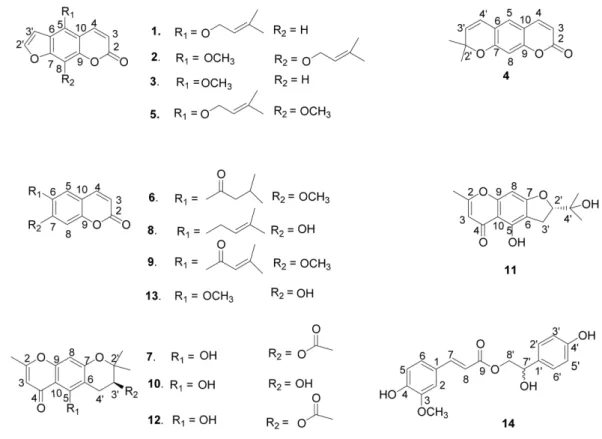
Fig. 1. Structures of 1 – 14.
Results and Discussion
Compounds 1 - 5, 7, 8, and 10 - 14 were identified as isoimperatorin,
16phellopterin,
16bergapten,
16xanthyletin,
17,18cnidilin,
19,20( −)-3'-acetylhamaudol,
217-demethylsuberosine,
22( −)-hamudol,
16(+)-visamminol,
23divaricatol,
24scopoletin,
25and decursidate,
26,27respectively, by comparing their physico-chemical and spectral data with those of literature values.
1H-NMR spectrum of 6 exhibited two doublets at δ 7.66 and 6.29 (each 1H, J = 9.4 Hz), and two singlet signals at δ 7.73 and 6.84 (each 1H). Furthermore,
1H- NMR spectrum of 6 exhibited two methyl signals at δ 2.23 and 1.98 (each 3H, s), and a broad singlet at δ 6.60, and a methoxyl signal at δ 3.94. These data showed 6 has a 6,7-disubstitued coumarin skeleton.
2813C-NMR spectrum of 6 exhibited characteristic signals assignable to a senecioyl moiety at δ 190.51 156.70, 124.85, 28.12 and 21.45. HMBC spectrum showed a correlation between the methoxyl group at δ
H3.94 and C-7 at δ
C160.77. This result showed that a methoxyl group attached at C-7 and a senecioyl group attached at C-6. On the basis of these data and on those previously reported in the literature,
29,30,316 was identified as dehydorgeijerin.
1H- and
13C-NMR spectra of 9 is similar to those of 6 with the exception those of senecioly moiety.
1H-NMR spectrum of 9 exhibited a doublet at 2.89 (2H, J = 6.8Hz), a multiplet (1H) at δ 2.24, and a doublet at 0.96 (6H, J = 6.7Hz), which showed that 9 has an isovaleryl moiety in the skeleton instead of senecioyl moiety.
13C-NMR spectrum of 9 exhibited signals at δ 200.58, 52.71, 24.99, and 22.71, which confirmed presence of an isovaleryl moiety in the skeleton of 9. Comparing these data with those of literature,
29,329 was identified as geijerin. Dehydrogeijerin (6) and geijerine (9) were isolated for the first time from genus Angelica. All isolates can divide five types of skeleton, simple coumarins (6, 8, 9, 13), furanocoumarins (1, 2, 3, 5), pyranocoumrins (4), chromones (7, 10, 11, 12) and a ferulate (14). To determine the inhibitory activity of each compound, all isolates were tested for their inhibitory activity against acetylcholinesterase (Table 1). Acetylcho- linesterase inhibition activities have been reported previously for tested compounds, isoimperatorin (1), xanthyletin (4), 7-demethylsuberosin (8), and scopoletin (13).
33-35As shown in Table 1, bergapten (3) exhibited a potent acetylcho- linesterase inhibition activity with an IC
50value of 1.4 μM.
Phellopterin (2) and cnidin (5) showed moderate acetyl- cholinesterase inhibition activity with IC
50values of 4.0 and 6.3 μM, respectively. Xanthyletin (4), dehydrogeijerin (6), demethylsuberosin (8), geijerin (9), (+)-visamminol (11) and divaricatol (12) showed mild acetylcholinesterase
inhibition activity with an IC
50values of 8.9, 9.7, 8.7, 10.4, 8.7, and 12.9 μM, respectively; whereas isoimpera- torin (1), ( −)-hamaudol (10) and scopeoletin (13) showed weak acetylcholinesterase inhibition activity with IC
50values of 28.5, 23.2, and 37.5 μM, respectively, in the present study. Kang et al.
35studied structure-activity relationship of some coumarins and suggested that pyrone moiety in the coumarin skeleton may plays an important role on the acetylcholinesterase inhibitory activity. We isolated one pyranocoumarin, four furanocoumarins, and four simple coumarins, which gave us information to discuss structure-activity relationships between furano- coumarins and simple coumarins. From this data, methoxyl moiety at the C-5 position of furanocourmarin was considered required to induce exhibition of acetyl- cholinesterase inhibitory activity. In the inhibitory activity of chromone derivatives against acetylcholinesterase, furan moiety of chromone skeleton may play an important role in the acetylcholinesterase inhibition, though the number of tested compounds was very small.
In conclusion, this data shows that A. polymorpha extracts have potent acetylcholinesterase inhibitory activity, suggesting that it may be a useful therapeutic agent for Alzheimer’s disease.
Table 1. Acetylcholinesterase inhibitory activity of compounds 1 - 14
Tested compounds IC
501)(µg/ml) IC
50(µM)
1 7.7 28.5
2 1.3 4.0
3 0.3 1.4
4 2.0 8.8
5 1.9 6.3
6 2.5 9.7
7 4.0 12.6
8 2.0 8.7
9 2.7 10.4
10 6.9 23.2
11 2.4 8.7
12 4.3 12.9
13 7.2 37.5
14 > 100 −
Galanthamine-hydrobromide
2)0.3 0.8
1)
The inhibitory activity dose that reduced 50% of aceylcho- lineseterase activity and expressed as mean of two different experiments.
2)