http://dx.doi.org/10.4014/kjmb.1105.05003 pISSN 1598-642X eISSN 2234-7305
백하수오 발효액의 모발성장 효과
박장순·이재숙*
광주여자대학교 미용과학과
Received : May 11, 2001 / Revised : September 1, 2011/ Accepted : September 22, 2011
The Promoting Effect of Pleuropterus cilinervis Extracts Fermented with Lactobacillus rhamnosus on Hair Growth. Park, Jang-Soon and Jae-Sug Lee*. Department of Beauty Science, Kwangju Women's Uni- versity, Kwangju 506-713, Korea − The bacterial growth and pH of Pleuropterus cilinervis extracts and animal milk, fermented with Lactobacillus rhamnosus during the fermentation process, were evaluated. The results indicated that the bacterial count after fermentation always remained higher than 6 log CFU/mL, with a con- stant pH of approximately 4. In order to evaluate the effects of Pleuropterus cilinervis extracts and animal milk, fermented with Lactobacillus rhamnosus, on hair growth promotion, C57BL/6 mice were chosen as experimental subjects. Six week old males with similar body weights were divided into four groups; a normal group (saline), a negative control group (essence base), a positive control group and an experimental group (Pleuropterus cilinervis extracts and animal milk, fermented with Lactobacillus rhamnosus, mixed with nega- tive control). The substances and test materials were applied topically on the back skin of the mice for 8 days.
Other external conditions and variables such as food intake were kept at the same as the four groups. At the end of the experiment it was noted that hair re-growth in the experimental group, using gross and histological examinations, was higher than that in the positive control group. This study therefore provides an empirical evidence that Pleuropterus cilinervis extracts and animal milk fermented with Lactobacillus rhamnosus pro- motes hair growth, and suggests that applications could be found in hair loss treatments.
Keywords: C57BL/6 Mouse, Pleuropterus cilinervis, Lactobacillus rhamnosus, hair growth
서 론
현대 사회로 가면서 탈모 환자가 급격히 증가하고 있으 며, 모발 관리 대상자 60%가 20-30대로 탈모의 연령대는 점 점 낮아지고 있고, 탈모증으로 고통 받고 있는 환자의 숫자 는 거의 천만 명에 이를 것으로 추산되고 있어 이에 따른 사 회 경제적 문제가 심각하게 대두되고 있다[9,14].
탈모가 심할수록 심리적으로 우울이나 불안 증상을 호소 하며, 스트레스 지각도가 높아지고, 인간관계나 이성 관계에 서 적응의 어려움을 겪으며, 가정 내 적응이 원만하지 못한 것으로 보고되고 있어 보건학적인 관심사가 되고 있다[2].
탈모의 원인은 아직까지 잘 알려져 있지 않으나 이에 대 한 가능성 있는 원인으로 유전적 요인, 호르몬적 이상, 그리 고 면역학적 이상에 의한 원인 등에 대한 보고가 있다[19].
현재 탈모 치료제로는 미국 Food and Drug Administra- tion(FDA)의 승인을 받은 경피도포용 미녹시딜(Minoxidil)과 경구투여용 finasteride가 많이 사용되고 있으나 수반되는 부
작용인 심혈관계 장애, 피부 자극, 성기능 감소 및 심각한 기형유발 등의 이유로 한계점을 드러내고 있다 [1, 8, 10, 13, 17].
한편 선행 연구에서 생약제제들을 이용한 탈모증 개선 효 과에 대해 보고하였으나, 그 결과는 미비한 수준이다[7, 12].
유산균 발효액은 항산화 효과, 설사 완화 효과, 비뇨생식 기의 감염 억제 효과, 위장염 억제 효과 등 다양한 인체내의 유익한 효과가 보고되었으나 아직까지 모발성장 효과에 대 한 보고는 없는 실정이다[3, 5, 15, 16, 18].
따라서 본 연구에서는 백하수오 추출물과 동물성 밀크를 유산균으로 발효한 발효액의 모발성장 효과를 분석하였다.
재료 및 방법 실험재료
동물성 밀크는 서울 우유(Korea)에서 구입하였으며, 유산 균 배양에 사용되는 Rogosa, and Sharpe(MRS)는 Gibco BRL(Grand Island, NY)에서 구입하여 사용하였다. 미녹시 딜(Minoxidil)은 Sigma사(Sigma, St. Louis, MO, USA) 제 품을 사용하였다.
*Corresponding author
Tel: +82-62-950-3656, Fax: +82-62-953-2218 E-mail: [email protected]
털의 제모시 실험동물은 염산케타민(isoflurane; 유한양행, Korea)과 럼푼(BayerKorea, Korea) 혼합액을 복강주사하여 마취시켰으며 제모 과정 동안의 마취 상태 유지를 위하여 염 산케타민을 이용하여 흡입마취하였다. Depilation시약은 rosin-wax 혼합물을 사용하였고, 흡입마취기는 anesthesia machine V70100(Surgivet, USA)을 사용하였다.
실험동물
생후 6주 된 수컷 C57BL/6 마우스를 (주)중앙실험동물로 부터 구입하여 1주간 동물 사육실 환경에 적응시킨 후 실험 에 사용하였다. 동물 사육실은 온도 23+/-3oC 상대습도 50+/
-10%, 12시간씩 밤낮을 유지하였다. 실험동물은 Clean rack 에서 사육하였고 실험동물용 사료를 자유로이 급여하고 cage 는 매 3일마다 교체하였다. 총 20 마리를 실험하였으며, 총 4개 군으로 나누어서 사육하였다.
백하수오 추출물 제조
UNIQ F&F Co., Ltd.(Seoul, Korea)로부터 구입한 백하수 오 1 kg을 2 L의 물과 혼합하여 1시간씩 2회 환류 냉각하 여 추출물을 제조하였다. 제조된 추출물은 여과지를 이용하 여 얻어진 여액을 감압농축(EYELA A-3S)을 사용하여 농축 하여 농축액 83.7 g을 얻었다.
백하수오추출물의 유산균 발효액 제조
비젼(Bision co., Seongnam-si, Korea)으로터 제공받은 Lactobacillus rhamnosus는 멸균된 MRS 배지 10 mL에 접 종하여 37oC에서 1일 배양 후 본 배양에 사용하였다.
본 배양은 동물성 밀크(Seoul milk, Seoul, Korea) 100 mL에 백하수오 추출물 1.5 g과 설탕 3 g, 종균 1 mL을 넣고 잘 섞이게 한 후 37oC에서 24시간 배양하여 발효액을 얻었다.
pH 측정 및 유산균 생장 측정
백하수오 유산균 발효액 제조 동안 6시간 간격으로 1일 동안 pH 측정기(model 420, Thermo Orion, USA)를 이용 하여 pH를 측정하였고, MRS 배지를 이용하여 6시간 간격 으로 1일 동안 유산균 개체수를 측정하였고 개체수는 콜로 니 형성 단위의 로고함수(log colony forming units per milliliter; CFU/mL)로 나타내었다.
에센스의 제조
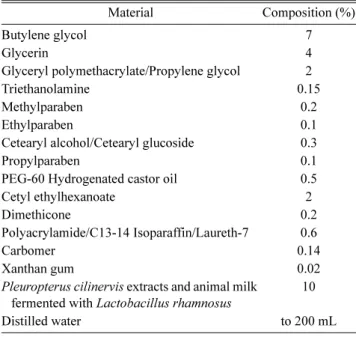
Table 1에 기재된 원료 및 조성 비율로 에센스를 제조하 여 본 실험에 사용하였다.
사료 섭취량 및 체중 측정
실험동물의 체중과 사료 섭취량은 은 2일 간격으로 전자 저울(CP224S, Sartorius, Germany)을 이용하여 무게를 측정 하였다.
C57BL/6 마우스를 통한 모발 성장 효과 실험
제조된 에센스를 이용하여 모발 생장 효과를 실험하였다.
발모 촉진 효능을 평가하기 위해, 등쪽 피부의 색이 pink color를 보이는 휴지기 체모의 6주령을 사용하였다. Animal clipper(Panasonic ER1431p, Japan)를 이용하여 조심스럽게 C57BL/6 마우스 등판의 털을 깎아내고, 제모크림 비트(veet, Reckitt Benckiser, France)로 나머지 털을 제거하였다. 상처 부위가 치유될 때까지 3일 안정화 후 8일 동안 붓을 사용하 여 5 µg/100 µL의 시료를 도포하였으며, 양성 대조군으로는 대표적인 발모 촉진용 약물인 미녹시딜을 동량 사용하였다.
실험 시작 후 털이 자란 상태를 육안으로 관찰하기 위해 실험기간 동안 주 1회 에테르로 가볍게 마취한 후 디지털 카메라로 사진 촬영하였다. 평가방법은 Hyung 등(2007)에 의해 보고된 방법에 의해 평가하였으며, 방법은 각 군의 모 발성장 효과는 scoring system에 의해 각 각의 동물을 육안 적으로 판정하여 평균치를 산정하였으며 판정기준은 발모 정도에 따라 0-19%(-), 20-39%(±), 40-59%(+), 60-79%
(++), 80-100% (+++)로 평가하였다[6].
조직학적 분석
피부조직의 조직학적 관찰을 위해 피부조직을 적출한 후 10% 중성포르말린에 고정한 다음 24시간 후 흐르는 물에 수세하고 alcohol, xylene, paraffin으로 탈수, 투명, 침투과 정을 거쳐 파라핀에 포매하였다. 포매된 조직을 4 µm의 박절편을 만들어 hematoxylin and eosin(H&E) 염색한 후 광학현미경으로 모낭 크기와 수 및 모근의 길이를 관찰하 였다.
Table 1. Formulation of essence with Pleuropterus cilinervis extracts and animal milk fermented with Lactobacillus rhamno- sus
Material Composition (%)
Butylene glycol 7
Glycerin 4
Glyceryl polymethacrylate/Propylene glycol 2
Triethanolamine 0.15
Methylparaben 0.2
Ethylparaben 0.1
Cetearyl alcohol/Cetearyl glucoside 0.3
Propylparaben 0.1
PEG-60 Hydrogenated castor oil 0.5
Cetyl ethylhexanoate 2
Dimethicone 0.2
Polyacrylamide/C13-14 Isoparaffin/Laureth-7 0.6
Carbomer 0.14
Xanthan gum 0.02
Pleuropterus cilinervis extracts and animal milk fermented with Lactobacillus rhamnosus
10
Distilled water to 200 mL
결과 및 고찰 백하수오 유산균 발효액의 pH
발효액의 초기 pH는 6.4였다. 1일 발효 동안 pH의 변화 는 4에서 6사이를 나타내었으며, 1일 발효 후에는 대조군의 pH는 4.6이였고, 실험군의 pH는 4.3를 나타내어 백하수오를 함유한 발효물이 더 낮은 pH를 나타냄을 알 수 있었다(Fig.
1). 1997년도 Dave와 Shah의 연구에 의하면 프로바이오틱 박테리아(Probiotic bacteria) 배양시 초기 pH는 6.55이고 배 양 완료 후에는 4.33에 이른다고 보고되었다[4]. 본 연구에 서 1일 동안 발효된 백하수오 유산균 발효액의 pH는 4.3으 로 백하수오 첨가에 관계없이 발효가 잘 완성되었다고 사료 된다.
백하수오 유산균 발효액의 유산균 생장
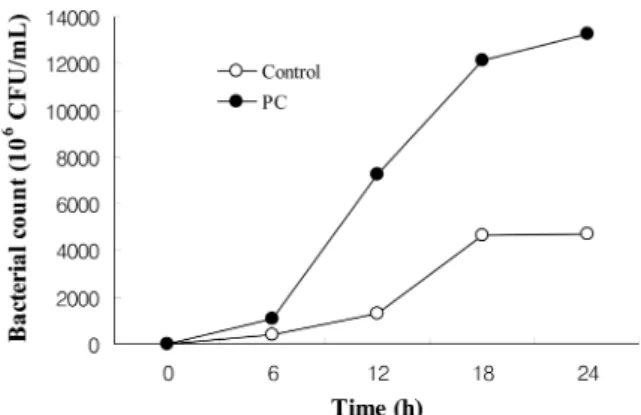
발효액의 제조 과정 동안 유산균의 개체수가 증가함을 알 수 있었다(Fig. 2). 발효 1일 후 백하수오 추출물을 함유하 는 유산균 발효물의 유산균 개체수가 대조군에 비해 약 3배 이상의 더 높은 개체수를 보이는 것을 확인하였다. 전의 연 구에 의하면 인체에 유익한 작용을 나타내기 위해서 유산균 발효 후의 개체수는 중요하며 일반적으로 발효 종료 후에 유 산균은 106~108개체수(CFU/mL)에 이르는 것이 바람직하 다고 연구결과를 보고하였다[11]. 그럼으로 본 연구결과에서 1일 배양 후 백하수오 추출물을 함유하는 유산균 발효물은 약 108개체수(CFU/mL)를 나타내어 인체에 유익한 성분들 이 발효과정 동안 생성되었다고 생각된다.
사료 섭취량 및 체중
사료섭취량과 체중은 백하수오 유산균 발효군 및 대조군
모두에서 시간의 경과에 따라 증가하는 경향을 보였다(Fig.
3 and 4). 따라서 실험기간 동안 4가지 그룹에 복용된 각 군 들의 사료섭취는 마우스의 성장에 아무런 영향을 주지 않았 음을 알 수 있었다.
C57BL/6 마우스를 통한 모발 성장 효과
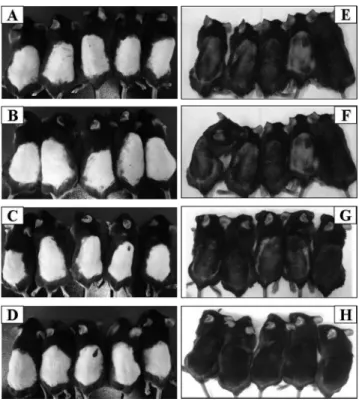
실험 시작 후 털이 자란 상태를 육안적으로 관찰한 결과 실험기간 동안 무처리군과 음성대조군에서 모발성장이 약하 게 관찰되었고, 양성대조군인 미녹시딜 처리군에서는 평균 62%의 모발성장이 관찰되었으며, 실험군인 백하수오 유산균 발효군에서는 평균 90% 이상의 모발성장이 관찰되었다 (Table 2 and Fig. 5). 이러한 결과는 C57BL/6 마우스 모델
Fig. 1. pH Changes during fermentation at 37oC. PC, Pleu- ropterus cilinervis extracts and animal milk fermented with Lacto- bacillus rhamnosus. Control, base group of animal milk fermented with Lactobacillus rhamnosus without Pleuropterus cilinervis extracts; Experimental (PC), Application group of Pleuropterus cilinervis extracts and animal milk fermented with Lactobacillus rhamnosus.
Fig. 2. Growth of bacteria during fermentation at 37oC. Con- trol, base group of animal milk fermented with Lactobacillus rhamnosus without Pleuropterus cilinervis extracts; Experimental (PC), Application group of Pleuropterus cilinervis extracts and animal milk fermented with Lactobacillus rhamnosus; CFU/mL, colony forming units per milliliter.
Fig. 3. Food intake in C57BL/6 mice applied test materials top- ically for 8 days. Normal, Saline application group; Negative con- trol, Essence base application group without Pleuropterus cilinervis extracts and animal milk fermented with Lactobacillus rhamnosus; Positive control, Minoxidil application group; Experi- mental (PC), Application group of Pleuropterus cilinervis extracts and animal milk fermented with Lactobacillus rhamnosus.
에서 복합 한약추출물이 모발성장 촉진효과가 있다는 전의 연구결과와 비슷한 결과를 나타내었다[6].
백하수오 발효액의 모발 성장에 대한 조직학적 변화 모발 성장에 대한 조직학적 변화를 관찰하기 위해 실험 8일에 피부조직을 H&E 염색하여 모근의 수와 길이를 광 학 현미경으로 관찰하였다. 그 결과 실험 종료일인 8일째 의 마우스의 무처리군과 음성 대조군은 모낭의 수 및 크기 가 작고 모근의 길이가 작았고, 양성대조군은 모낭의 수, 크기 및 모근의 길이가 무처리군과 음성대조군에 비해 약 간 신장한 것을 알 수 있었다. 백하수오 유산균 발효군인 실험군은 모낭의 수, 크기 및 모근의 길이가 다른 군에 비 해 크게 관찰되었다(Fig. 6). 이러한 결과는 전의 한 연구 결과인 당귀와 감초 복합 한약추출물이 모발성장을 촉진한
다는 연구결과의 조직학 분석 결과와 비슷한 결과를 나타 내었다[7].
Fig. 4. Body weight in C57BL/6 mice applied test materials topically for 8 days. Normal, Saline application group; Negative control, Essence base application group without Pleuropterus cilin- ervis extracts and animal milk fermented with Lactobacillus rham- nosus; Positive control, Minoxidil application group; Experimental (PC), Application group of Pleuropterus cilinervis extracts and animal milk fermented with Lactobacillus rhamnosus.
Table 2. Average score of hair growth in C57BL/6 mice applied with test compounds for 8 days
Days
Group
Normal Control
Negative control Positive control PC
1 - - - -
8 + + ++ +++
Normal: Saline application group
Negative control: Essence base application group without Pleu- ropterus cilinervis extracts and animal milk fermented with Lacto- bacillus rhamnosus
Positive control: Minoxidil application group
Experimental (PC): Application group of Pleuropterus cilinervis extracts and animal milk fermented with Lactobacillus rhamnosus.
Fig. 5. Effects of Pleuropterus cilinervis extracts fermented with Lactobacillus rhamnosus on morphological change in back skin of C57BL/6 mice. A, Normal at 1 day; B, negative control at 1 day; C, positive control at 1 day; D, Pleuropterus cilinervis and animal milk fermented with Lactobacillus rhamnosus at 1 day; E, Normal after 8 day; F, negative control after 8 day; G, positive control after 8 day; H, Pleuropterus cilinervis extracts and animal milk fermented with Lactobacillus rhamnosus after 8 day.
Fig. 6. Effect of Pleuropterus cilinervis extracts and animal milk fermented with Lactobacillus rhamnosus on histological change in back skin of C57BL/6 mice. The dorsal skins of C57BL/6 mice were harvested on day 8 after depilation. A, Nor- mal; B, negative control; C, positive control; D, Pleuropterus cilin- ervis and animal milk fermented with Lactobacillus rhamnosus.
요 약
백하수오와 동물성 밀크를 혼합하여 유산균인 Lacto- bacillus rhamnosus와 함께 1일 동안 배양 한 결과 pH 및 유산균 개체수에 있어서 이상적인 발효에 도달한 것을 알 수 있었다. 이러한 발효물을 생후 6주령 된 C57BL/6 마우스에 1일 1회, 8일 동안 붓을 사용하여 매 회 100 µL씩 경피 도 포하여 모발성장 촉진효과를 관찰한 실험에서 다음과 같은 결과를 얻었다. 실험기간 동안 모든 군에서 체중과 사료 섭 취량이 큰 차이를 나타내지 않았으며, 육안적 관찰에서 무 처리군과 음성대조군에서 모발성장이 약하게 관찰되었고, 양 성대조군인 미녹시딜 처리군에서는 평균 62%의 모발성장이 관찰되었으며, 실험군인 백하수오 유산균 발효군에서는 평 균 90% 이상의 정상적인 모발성장이 관찰되었다. 피부조직 의 H&E 염색 후 분석 결과 8일째 희생한 마우스의 무처리 군과 음성 대조군에서 모낭의 수 및 크기가 작고 모근의 길 이가 작았고, 양성대조군에서는 모낭의 수, 크기 및 모근의 길이가 무처리군과 음성대조군에 비해 약간 신장한 것을 알 수 있었으며, 백하수오 유산균 발효군인 실험군에서는 모낭 의 수, 크기 및 모근의 길이가 다른 군에 비해 크게 관찰되 었다.
이상의 실험결과를 통해 백하수오와 동물성 밀크를 유산 균인 Lactobacillus rhamnosus와 같이 발효하여 얻은 발효 액은 우수한 모발성장 촉진효과를 보였으며, 미녹시딜보다 더 높은 효과를 나타냄을 알 수 있었다.
REFERENCES
1. Arca, E., G. Açikgöz, H. B. Ta tan, O. Köse, and Z. Kurumlu.
2004. An open, randomized, comparative study of oral finasteride and 5% topical Minoxidil in male androgenetic alopecia. Dermatology 209: 117-125.
2. Bienová, M., R. Kucerová, M. Fiurásková, M. Hajdúch, and Z. Kolá´r. 2005. Androgenetic alopecia and current methods of treatment. Acta Dermatovenerol. Alp. Panonica Adria 14:
5-8.
3. Bousvaros, A., S. Guandalini, R. N. Baldassano, C. Botelho, J. Evans, G. D. Ferry, B. Goldin, L. Hartigan, S. Kugathasan, J. Levy, K. F. Murray, M. Oliva-Hemker, J. R. Rosh, V.
Tolia, A. Zholudev, J. A. Vanderhoof, and P. L. Hibberd.
2005. A randomized, double-blind trial of Lactobacillus GG versus placebo in addition to standard maintenance therapy for children with Crohn's disease. Inflamm. Bowel Dis. 11:
833-839.
4. Dave, R. I. and N. P. Shah. 1998. Ingredient supplementation effects on viability of probiotic bacteria in yogurt. J. Dairy Sci. 81: 2804-2816.
5. Kim, H. S. and J. S. Ham. 2003. Antioxidative Ability of lactic acid bacteria. Korean J. Food Sci. Ani. Resour. 23:
186-192.
6. Hyung, S. H., S. R. Gang, and Y. C. Kim. 2007. Effect of complex oriental medicine extract on hair growth promotion in an alopecia model of C57BL/6 mice. J. Kor. Soc. Cosm.
13: 1366-1375.
7. Kim, S. H., K. S. Jeong, S. Y. Ryu, and T. H. Kim. 1998.
Panax ginseng prevents apoptosis in hair follicles and accelerates recovery of hair medullary cells in irradiated mice. In Vivo 12: 219-222.
8. Lucky, A. W., D. J. Piacquadio, C. M. Ditre, F. Dunlap, I.
Kantor, A. G. Pandya, R. C. Savin, and M. D. Tharp. 2004.
A randomized, placebocontrolled trial of 5% and 2% topical Minoxidil solutions in the treatment of female pattern hair loss. J. Am. Acad. Dermatol. 50: 541-553.
9. Lee, J. S. and Y. C. Kim. 2010. The promoting effect of Angelica gigas nakai and Glycyrrhiza uralensis fischet oriental medicine complex extracts on hair growth. J.
Cosmetol. Sci. 6: 49-56.
10. Lee, Y. K., J. K. Kim, and H. G. Cho. 2004. The clinical study using oriental medicine extract on male pattern hair loss. J. Exp. Biomed. Sci. 10: 317-324.
11. Lourens-Hatting, A. and B. C. Viljeon. 2001. Yogurt as pro- biotic carrier food. Int. Dairy J. 11: 1-17.
12. Matsuda, H., M. Yamazaki, Y. Asanuma, and M. Kubo.
2003. Promotion of hair growth by ginseng radix on cultured mouse vibrissal hair follocles. Phytother. Res. 17: 797-800.
13. Olsen, E. A., M. Hordinsky, D. Whiting, D. Stough, S.
Hobbs, M. L. Ellis, T. Wilson, and R. S. Rittmaster. 2006.
The importance of dual 5α-reductase inhibition in the treat- ment of male pattern hair loss: Results of a randomized placebo-controlled study of dutasteride versus finasteride. J.
Am. Acad. Dermatol. 55: 1014-1023.
14. Paik, J. K., J. B. Yoon, W. Y. Sim, B. S. Kim, and N. I. Kim.
2001. The prevalence and types of androgenetic alopecia in Korean men and women. Br. J. Dermatol. 145: 95-99.
15. Reid, G. and J. A. Hammond. 2005. Probiotics. Some evidence of their effectiveness. Can. Fam. Physician 51:
1487-1493.
16. Sarker, S. A., S. Sultana, G. J. Fuchs, N. H. Alam, T. Azim, H. Brussow, and L. Hammarstrom, 2005. Lactobacillus paracasei strain ST11 has no effect on rotavirus but ameliorates the outcome of nonrotavirus diarrhea in children from Bangladesh. Pediatrics 116e: 221-228.
17. Sinclair, R., M. Wewerinke, and D. Jolley. 2005. Treatment of female pattern hair loss with oral antinadrogens. Br. J.
Dermatol. 152: 466-473.
18. Szymanski, H., J. Pejcz, M. Jawien, A. Chmielarczyk, M.
Strus, and P. B. Heczko. 2006. Treatment of acute infectious diarrhoea in infants and children with a mixture of three Lactobacillus rhamnosus strains−a randomized, doubleblind, placebo-controlled trial. Aliment. Pharmacol. Ther. 23: 247- 253.
19. Zong, Z. P., S. Matsui, A. L. Li, S. Katsuda, and N.
Yamaguchi. 2003. Autoimmune hair loss induced by allo- antigen in C57BL/6 mice. Cell Struct. Funct. 28: 97-104.