• 검색 결과가 없습니다.

밀폐형 자외선 광조사 임플란트의 공진 주파수 분석과 조기부하: 증례보고

N/A
N/A
Protected

Academic year: 2021

Share "밀폐형 자외선 광조사 임플란트의 공진 주파수 분석과 조기부하: 증례보고"

Copied!
18
0
0

로드 중.... (전체 텍스트 보기)

전체 글

(1)

Received: June 2, 2017 Revised: June 9, 2017 Accepted: June 9, 2017

Copyright © 2017. The Korean Academy of Oral &

Maxillofacial Implantology

This is an Open Access article distributed under the terms of the Creative Commons Attrib- ution Non-Commercial License (http://creative- commons.org/licenses/by-nc/4.0/) which permits unrestricted non-commercial use, distribution, and reproduction in any medium, provided the original work is properly cited.

pISSN : 1229-5418

Implantology 2017; 21(2): 110-127 https://doi.org/10.12972/implantology.20170009

eISSN : 0000-0000

OPEN ACCESS

밀폐형 자외선 광조사 임플란트의 공진 주파수 분석과 조기부하: 증례보고

설현우1, 박규화2*, 허정욱3, 손병섭4, 김승수5

1

중앙대학교병원 치과보철과

2

프라임치과

3

굿윌 치과병원

4

에스플란트 치과병원

5

미유치과

Resonance Frequency Analysis and Early Loading of Implants with Sealed UV Treatment System:

Case Reports

Hyon-Woo Seol

1

, Kyou-Hwa Park

2

*, Jeong-Uk Heo

3

, Byeong-Sup Sohn

4

, Seung-Soo Kim

5

1

Department of prosthodontics, Dental Center, Chung-Ang University Hospital, Seoul, Korea

2

Prime Dental Clinic, Seong-Nam, Korea

3

Good Will Dental Hospital, Pusan, Korea

4

S-plant Dental Hospital, Seoul, Korea

5
Mieux Dental Clinic, Seoul, Korea

*Corresponding author: Kyou-Hwa Park, [email protected]

Abstract

Ultraviolet (UV) irradiation enhances the biologic activity of titanium surface without the change of surface topography. UV treated titanium surface is very hydrophilic and chemically clean with low carbon composition on its surface. Also, surface charge of titanium surface is changed from negative to positive by UV treatment. Implants with sealed UV treatment system, were inserted in fresh extraction socket and maxillary molar area with simultaneous sinus elevation. The changes in implant stability quotient (ISQ) values were favorable, and early loading protocol was accepted. In other cases, UV treated implants were loaded one week after installation, and their ISQ values were recorded periodically. UV treated implants showed stable stability even after the loading.

Keywords: Early loading, Implant stability quotient, Resonance frequency analysis, Ultraviolet (UV) treatment

I. 서론

최근에 치과용 임플란트의 골유착 형성 능력을 향상시키기 위한 방법의 하나로 자외선

조사 처리법이 소개되었고, 실제 환자의 치료에 다양하게 이용되고 있다

1-4

. 자외선 처리는

(2)

임플란트 표면 형태나 거칠기는 변화시키지 않고 그대로 유지시키면서 임플란트의 생물학적인 반응 성을 매우 높여주는 효과가 있다

5

. Ogawa 등은 자외선 처리 후에 일어나는 물리 화학적 특성의 변화와 생물학적 반응성의 향상을 포함하는 타이타늄 표면성질 변형을 자외선 광 기능화(UV photofunctionali- zation) 라고 지칭하였다

6-9

. 동물실험을 통한 골접촉률(Bone to Implant Contact, BIC-%) 비교에서, 일 반 임플란트가 단지 55%의 골접촉률을 보인 반면 자외선이 조사된 임플란트는 거의 100%의 골접촉 률을 보이는 것으로 나타났고, 게다가 식립후 초기에 측정된 골유착의 강도 역시 일반 임플란트의 3배 가 되는 것으로 밝혀졌다

6

. 또다른 동물실험에서 밝혀진 사실들은 다음과 같다. 길이가 40% 짧은 임플 란트는 원래 길이의 임플란트보다 골유착 강도가 50% 정도 감소하는 것으로 나타났으나, 40% 짧은 임플란트에 자외선을 조사한 후에는 원래 길이의 임플란트에 비해 오히려 증가된 골유착 강도를 보였 다

10

. 임플란트를 피질골에 고정시키지 않은 상태에서 치유를 시켜본 결과, 자외선 조사된 임플란트는 임플란트 표면에서부터 골형성이 활발하게 시작되어 주변 골로 이어지는 양상을 보이는데 비해, 일반 임플란트는 주변의 피질골에서부터 더딘 골형성이 시작되어 임플란트로 접근하는 것으로 나타났다

11

. SLA 표면 처리된 임플란트에 자외선을 조사하여 개에서 실험한 논문에 의하면

12

, 자외선 처리를 한 임 플란트에서 식립 4주 후 비틀림 제거력이 50% 증가하고, 피질골과 해면골 모든 부위에서 bone-implant contact 이 통계적으로 유의한 수준으로 높게 관찰되었다. 특이한 것은 자외선 처리한 임플란트의 모든 실험값(비틀림 제거력, 조직형태학적 분석치)이 일반 임플란트의 실험값에 비해 변동계수(coefficient of variation) 가 매우 낮게 관찰되었다는 점이다. 일례로 비틀림 제거력 측정값의 변동계수가 자외선 처 리군에서 대략 3%에 불과하였으나 일반 임플란트군에서 대략 22%로 나타났는데, 이는 자외선 처리 된 임플란트가 일반 임플란트에 비해 보다 우수하면서도 동시에 일관성 있는 치료결과를 보여줄 수 있 음을 시사한다.

자외선 조사를 받은 타이타늄 표면은 일반적인 타이타늄 표면에 비해 친수성이 매우 증가하여, 접촉 각이 거의 0°에 가깝게 나타나는데 이를 초친수성(superhydrophilicity)이라 칭한다

5

. 일반적인 타이타 늄 표면에는 생산 후 어느 정도의 기간이 지났느냐에 따라 탄화수소에 의한 탄소성분이 표면 화학 조성 (chemical composition)의 60%에서 75%까지 증가하는 것으로 나타난다

13

. 그러나 자외선 조사를 한 후 의 타이타늄 표면에서는 탄소가 전체 표면 화학 조성에서 차지하는 비율이 20% 미만으로 줄어든다

6,14

. 일련의 연구에 의하면, 일반적인 타이타늄 표면은 정전기적으로 음전하를 띠게 되는데 비해, 자외선 처리후의 타이타늄 표면은 정전기적으로 양전하로 전환되어, 신체 내에서 음전하를 띠는 여러 부착 단 백질과 세포와의 결합이 직접적으로 일어나는 것으로 나타났다

7,9

. 이와 같은 세가지의 표면 변화가, 조 골세포로 하여금 임플란트 표면으로의 이동, 부착과 유지를 증가시키고, 이후 증식 및 골형성 기능 발 현을 현저히 촉진하는 것으로 밝혀졌다

6-8,11,15,16

.

임플란트는 식립 후 기존 골과의 마찰력에 의한 기계적인 유지력으로 고정이 된다(primary implant

(3)

stability). 이러한 기계적 고정력은 기존골의 흡수에 의해 줄어들게 되는데 비해

17

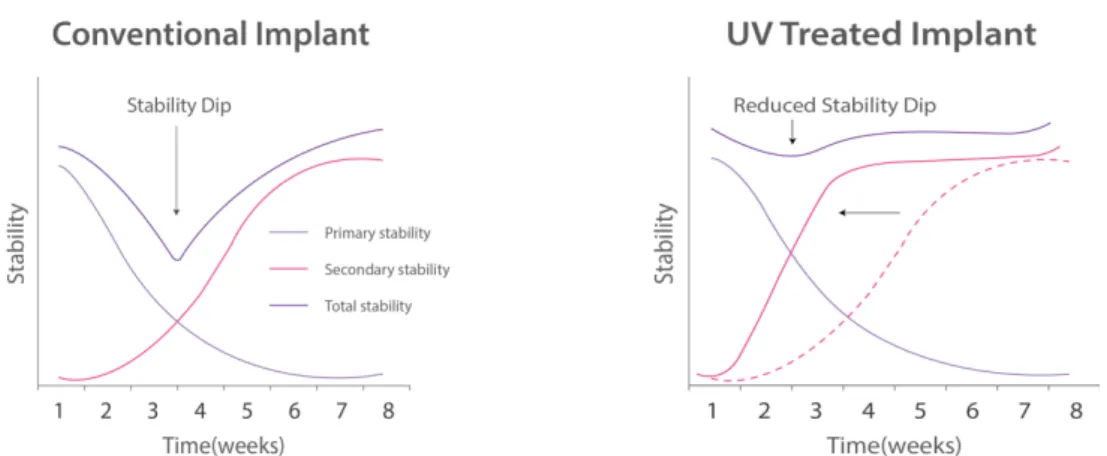
, 골이 리모델링되거 나 새로운 신생골이 임플란트 표면에 생성되고 성숙하여 임플란트를 지지(secondary implant stability) 하기까지는 상대적으로 긴 시간이 필요하므로, 그러한 시간적 차이에 의해 임플란트가 식립된 후 일시 적으로 안정성이 떨어지는 기간(implant stability dip)이 생기게 된다

18,19

. 이러한 stability dip이 있는 기간에는, 가급적 임플란트에 하중을 가하는 것을 피하도록 권고하고 있으며, 이것이 임상가로 하여금 임플란트 식립 후 조기부하나 즉시부하를 주저하게 하는 이유가 되고 있다. 임플란트의 안정성을 측정 하는 여러가지 방법가운데, 공진 주파수 분석법(Resonance Frequency Analysis, RFA)에 기반을 둔 ISQ(Implant Stability Quotient)값 측정이 비파괴적이면서 신뢰성과 유효성을 갖고 있는 방법으로 보 고되고 있다

20-26

. RFA 측정기는 초기엔 L자 모양의 트랜스듀서(transducer)가 연결된 전자식(Osstell ® ; Integration Diagnostics AB, Göteborg, Sweden) 이었으나, 현재는 마그네틱 리셉터인 SmartPeg ® (Integration Diagnostics AB) 을 이용한 비 접촉형 프로브(contact-free probe)가 있는 Osstell Mentor ® (Integration Diagnostics AB) 혹은 Osstell ISQ ® (Integration Diagnostics AB) 가 사용되고 있다. 측정 된 ISQ 값과 골유착과의 상관관계에 관하여서는 여러 논문에 따라 견해가 다르지만

27-31

, 임플란트를 식립한 후 일정한 간격으로 ISQ값을 측정하여 추적 관찰 하는 것은 각각의 임플란트에서 골유착이 성 공적으로 진행되고 있는지의 여부를 추정하는데 매우 유용한 판단 근거가 된다

32

.

본 증례보고에서는, 포장을 개봉하지 않은 상태로 전용의 UV generator (Point Implant Co., Seoul, Korea) 에서 48시간 자외선 조사를 시행한 임플란트(Point UV Active ® ; Point Implant Co.) 를 발치와 에, 혹은 상악동 골이식과 동시에 식립한 후 Osstell Mentor ® (Integration Diagnostics AB) 로 ISQ 값 을 일주일 혹은 이주일 간격으로 최소 4회 이상 측정하여 골유착이 일어나는 동안 임플란트 안정성의 변화를 알아보았다. 그리고, 하악 구치부 부분 무치악과 하악 임플란트 오버덴처 증례에 자외선 처리 임 플란트를 식립하여 1주일 후 조기부하를 가한 상황에서 ISQ 값의 추이가 어떠한 양상을 보이는지 추적 관찰 하였다.

II. 증례보고

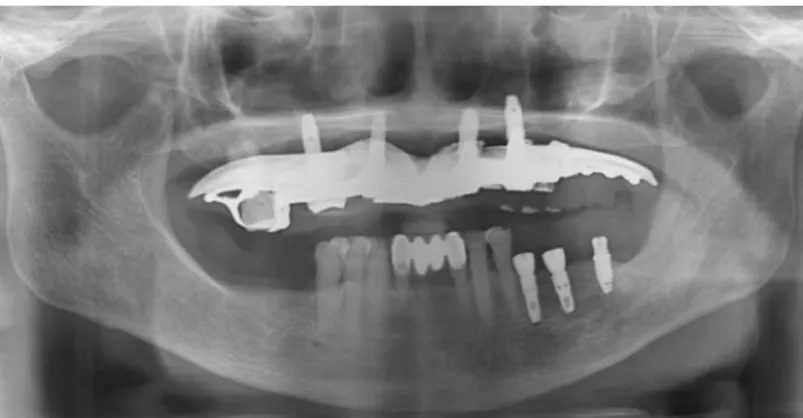
1. Case #1: 발치 후 발치와 즉시 식립 및 조기부하

위암 수술 경력이 있는 74세 남성 환자로서, 근관 치료후 금관 수복 되었던 치아(#36)가 치근단 병소

악화로 발거되었으며, #37은 이차 우식에 의해 치근만 남은 상태였다 (Fig. 1). 국소 마취 하에 절개 및

판막을 거상하고 #37 치근을 발거한 후에 #36, 37 위치에 두개의 임플란트(Point UV Active ® Ø5.0 ×

10 mm)를 식립하였다 (Fig. 2). 임플란트는 포장을 개봉하지 않은 상태에서 UV generator (Point

(4)

Implant Co.) 에서 미리 48시간 자외선 조사를 해 두었다. 두 부위 모두 골질은 type 2 였으며, 최종 식립 토크는 35 Ncm 이상 확보하였고 매식체와 발치와 사이 공간을 미리 준비해 둔 자가치아 골 이식재로 채운 후, 치유 지대주(Point Implant Co.)를 연결하고 봉합(Dafilon ® ; B. Braun, Germany)하였다.

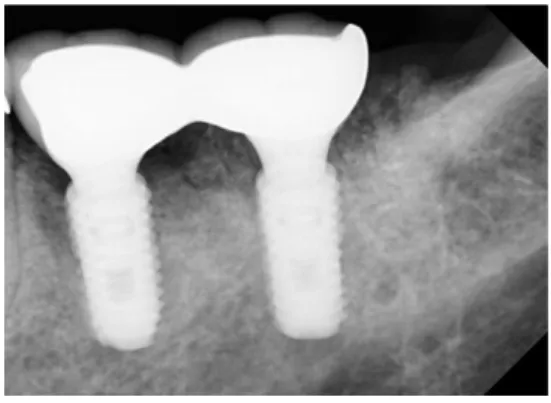
일주일 후에 봉합사를 제거하였고, Table 1 과 같이 ISQ 값을 측정하여 추이를 관찰하였다. Stability dip의 양상은 나타나지 않았고, 오히려 식립 2주차까지 측정치가 가파르게 상승하였으며(#36: 69 → 81,

#37: 74 → 81), 그 이후엔 수치가 거의 일정하게 유지되었다. 안정적인 골유착 형성이 판단되어 수술

Fig. 1. Case #1. Initial panoramic radiograph.

Hyon-Woo Seol et al. : Resonance Frequency Analysis and Early Loading of Implants with Sealed UV Treatment System: Case Reports.

Implantology 2017

(A) (B)

Fig. 2. Case #1. (A) Implants were installed at #36, 37 site. (B) Periapical radiograph on the day of loading (early loading: 4 weeks after installation).

Hyon-Woo Seol et al. : Resonance Frequency Analysis and Early Loading of Implants with Sealed UV Treatment System: Case Reports.

Implantology 2017

Table 1. ISQ value changes (Case #1) during one month after implant installation

1st. op. 1 week 2 week 3 week 4 week (loading)

#36 69 73 81 80 80

#37 74 75 81 81 80

Hyon-Woo Seol et al. : Resonance Frequency Analysis and Early Loading of Implants with Sealed UV Treatment System: Case Reports.

Implantology 2017

(5)

4 주차에 기성 지대주(Point Implant Co.)를 30 Ncm으로 연결 (Fig. 2) 한 후 아크릴릭 레진 임시치아로 조기 부하를 시작 하였다. 조기 부하를 시작한지 3주(식립후 7주)후에 30 Ncm으로 어버트먼트 스크루 를 반복체결하고, 지대주 수준에서 실리콘 인상(Delikit ® ; Happi Den, Seoul, Korea) 을 채득하였다. 금 속 소부 도재관으로 최종 보철물을 제작하여 치료를 마무리하였다. 임상적, 방사선학적 이상은 발견되 지 않았으며 안정된 치유 양상을 보이고 환자도 만족하였다 (Fig. 3, 4).

2. Case #2: 상악동 골이식과 동시 식립 후 조기부하

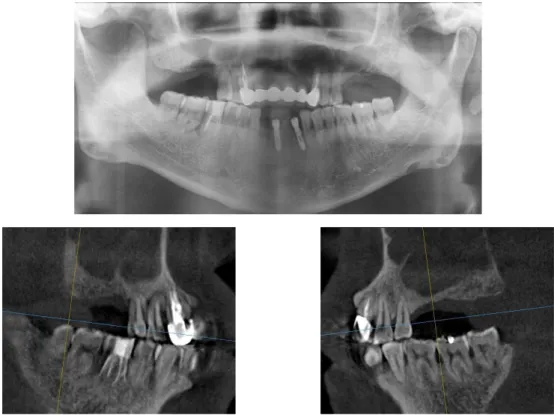
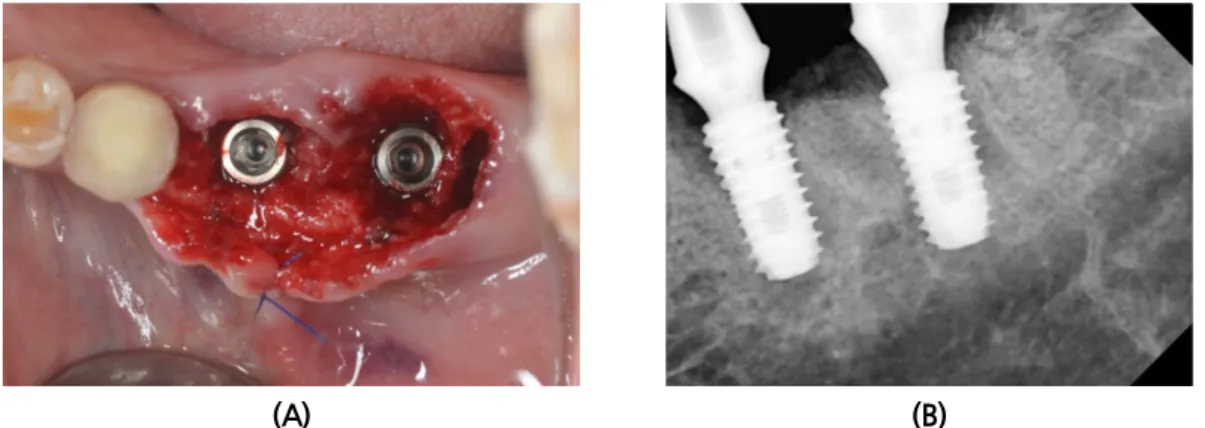
52세 남성 환자로서 상악 양측 대구치 부위에 상악동 골이식을 동반하여 임플란트 식립이 계획되었 다. 환자가 만성 상악동염을 오랫동안 앓아왔기 때문에 상악 치아를 발거하고 이비인후과에 상악동염 해결을 위한 전반적 처치를 의뢰하였다. 그러나 이비인후과 치료에도 불구하고 CT상에서 여전히 점막 의 비후가 관찰되었고(Fig. 5), piezo device (Piezosurgery ® ; Mectron, Italy)를 이용하여 골창(lateral bony window) 를 형성하고 상악동 내부를 육안으로 확인하면서 거상을 실시하였다. 염증에 의한 골이

Fig. 3. Case #1. Periapical radiograph on the day of final delivery.

Hyon-Woo Seol et al. : Resonance Frequency Analysis and Early Loading of Implants with Sealed UV Treatment System: Case Reports.

Implantology 2017

Fig. 4. Case #1. Two weeks after final restoration.

Hyon-Woo Seol et al. : Resonance Frequency Analysis and Early Loading of Implants with Sealed UV Treatment System: Case Reports.

Implantology 2017

(6)

식재의 감염이 우려되었기 때문에 자가혈을 채취, 원심분리(Medifuge TM ; Silfradent, Italy) 를 하여 CGF (Concentrated Growth Factor) gel 을 제조하였고 이를 상악동에 채운 상태에서 임플란트를 식립 한 뒤 골창을 재위치시킨 다음 봉합을 시행하였다. #16, 17 부위는 잔존골이 5내지 6 mm로 파악되었 으며 (Fig. 5) Point UV Active ® Ø5.0 × 11.5 mm 매식체 두 개를 식립하였다 (Fig. 6). #26, 27 부위는 잔존골이 3내지 4 mm로 파악되었고(Fig. 5) Point UV Active ® Ø5.0 × 10 mm 매식체를 각각 식립하

Fig. 5. Initial panoramic radiograph and CT scan. Haziness in both maxillary sinus (Case #2).

Hyon-Woo Seol et al. : Resonance Frequency Analysis and Early Loading of Implants with Sealed UV Treatment System: Case Reports.

Implantology 2017

Fig. 6. Two fixtures were installed in right maxillary molar area with sinus elevation (Case #2).

Hyon-Woo Seol et al. : Resonance Frequency Analysis and Early Loading of Implants with Sealed UV Treatment System: Case Reports.

Implantology 2017

(7)

였다 (Fig. 7). 골 삭제 시 확인된 양측의 골질은 모두 type 2에 해당하였고, 식립 토크는 모두 30 Ncm 이 상으로 확인되었다. 좌측 상악동 수술후 환자가 소량의 비출혈을 보고하였으나 별다른 이상 없이 치유 가 되었다.

#16 에 심겨진 매식체에서 10일 후 ISQ 값의 감소가 보였으나 일주일후 다시 회복되었고, #27은 초 기값을 거의 일정하게 유지하였으며 #17, 26은 지속적인 측정치의 증가를 보였다(Table 2, 3). #16, 17 매식체에는 식립 약 6주 후 맞춤 지대주를 하여(30 Ncm) 아크릴릭 레진으로 제작한 임시치아로 조기 부하를 시작하였고, 조기부하 4주 후에 최종 보철물을 금속 소부 도재관으로 제작하여 마무리 하였다.

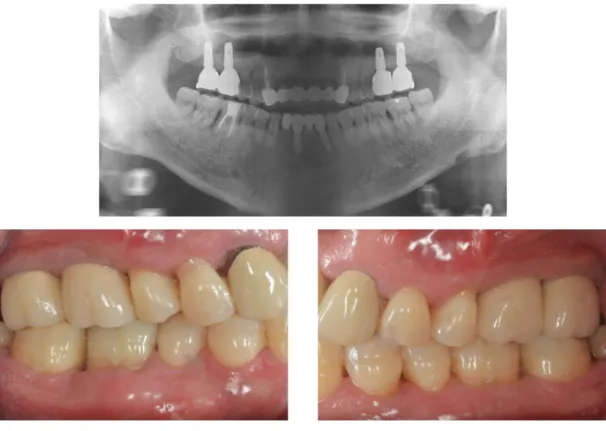
#26, 27 에서는 식립 2개월 후 마찬가지 방법으로 조기 부하를 실시하였고 조기부하 4주 후(식립 3개월 후) 최종 보철물을 연결하였다 (Fig. 8).

Fig. 7. After fixture installation in left maxillary molar area with sinus elevation (Case #2).

Hyon-Woo Seol et al. : Resonance Frequency Analysis and Early Loading of Implants with Sealed UV Treatment System: Case Reports.

Implantology 2017

Table 2. ISQ changes in implants installed in right maxillary molar area (Case #2)

1st. op. 10 days 17 days 24 days

#16 82 76 82 82

#17 76 77 79 80

Hyon-Woo Seol et al. : Resonance Frequency Analysis and Early Loading of Implants with Sealed UV Treatment System: Case Reports.

Implantology 2017

Table 3. ISQ changes in implants installed in left maxillary molar area (Case #2)

1st. op. 1 week 2 weeks 3 weeks 4 weeks 2 months

#26 75 75 78 78 77 80

#27 83 82 83 82 82 83

Hyon-Woo Seol et al. : Resonance Frequency Analysis and Early Loading of Implants with Sealed UV Treatment System: Case Reports.

Implantology 2017

(8)

3. Case #3: 하악 구치부 식립 1주 후 조기부하

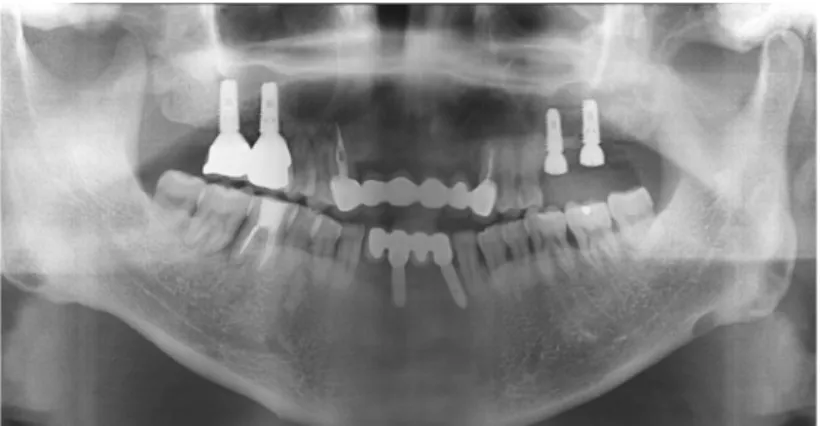
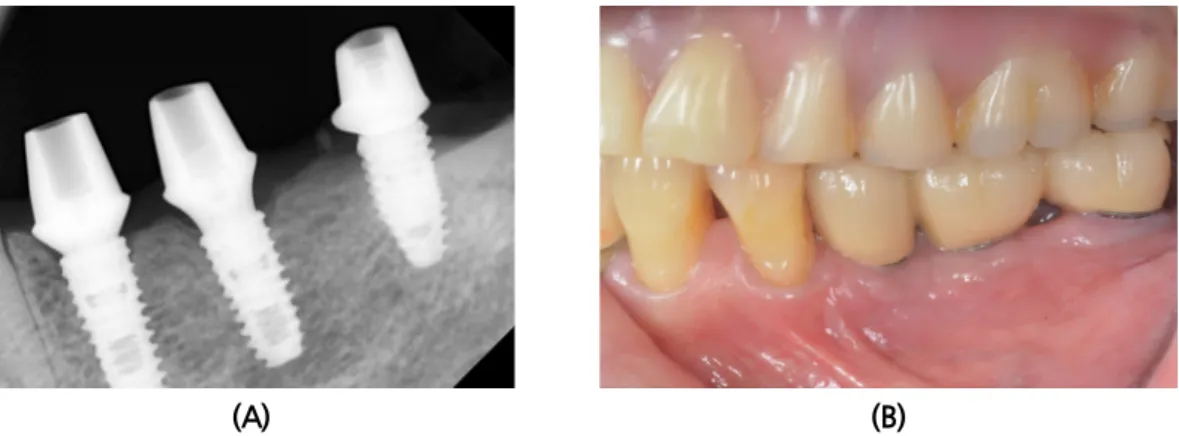
타 치과에서 상악에 임플란트 오버덴쳐 및 하악에 임플란트 치료를 받은 이력이 있는 83세 여자 환 자분으로, 불편한 임플란트 피개의치의 재제작 및 하악 임플란트 재치료를 주소로 내원하였다. 이전 치과에서 하악 우측에 두 개, 좌측에 세 개의 임플란트를 식립하였으나 우측은 하악 신경을 압박하여, 좌측 세 개 중 전방 두개의 픽스쳐는 식립 후 지속되는 불편감과 통증으로 제거된 상황이었다 (Fig. 9).

상악의 피개의치는 과연장된 의치상연에 의한 연조직 열상과 치은 열성비대가 관찰되었으며 의치상 연의 조정으로 새로운 의치 제작 없이 치료를 마무리하였다.

파노라마 방사선 및 CT검사 결과 하악 우측은 치조골정과 신경관 사이 공간이 부족하였기에, 먼저 좌측에 임플란트를 식립하여 구치부 교합을 형성하기로 하였다. 수직적 골 양은 적절하였으나 골폭이 다소 좁은 관계로 #35에는 Point UV Active ® Ø4.0 × 10 mm 를, #36에는 Point UV Active ® Ø4.0 × 8.5 mm 픽스쳐를 골이식을 피하기 위해 노출되는 부위 없이 약간 깊게 식립하였다 (Fig. 10). 드릴링 시 확 인된 골질은 #35부위는 type 2에 가까웠고 #36 부위는 이보다 약간 약했다. 최종 식립 토크는 #35픽스 쳐의 최종 식립 깊이에서 45 Ncm, #36 픽스쳐의 최종 식립 깊이에서 30 Ncm을 기록하였다. 별다른 골 이식 없이 치유 지대주(Point Implant Co.)를 연결하여 봉합을 하였고, 봉합 3일 후 트랜스퍼 인상을 채

Fig. 8. Final prosthesis (Case #2).

Hyon-Woo Seol et al. : Resonance Frequency Analysis and Early Loading of Implants with Sealed UV Treatment System: Case Reports.

Implantology 2017

(9)

득하였다. 수술 1주 후 봉합사를 제거하면서 임시 치아용 지대주(Point Implant Co.)와 아크릴릭 레진 으로 제작된 나사 유지형 임시치아로 조기 부하를 실시하였다 (Fig. 11). 임시치아는 새로이 식립된 두 개의 픽스쳐와 이전에 식립되었던 최후방 픽스쳐를 연결하여 연결고정 효과를 도모하였다.

Fig. 9. Initial panoramic radiograph.

Hyon-Woo Seol et al. : Resonance Frequency Analysis and Early Loading of Implants with Sealed UV Treatment System: Case Reports.

Implantology 2017

Fig. 10. After fixture placement.

Hyon-Woo Seol et al. : Resonance Frequency Analysis and Early Loading of Implants with Sealed UV Treatment System: Case Reports.

Implantology 2017

Fig. 11. Three weeks after early loading (4 weeks after fixture insertion).

Hyon-Woo Seol et al. : Resonance Frequency Analysis and Early Loading of Implants with Sealed UV Treatment System: Case Reports.

Implantology 2017

(10)

ISQ값은 식립 일주일 후에 두 개의 픽스쳐에서 모두 증가하였고 부하를 가하고 나서는 다소 감소하 는 양상을 보였다. 그러나 1주 혹은 2주 후에 다시 증가하는 추세를 보였다 (Table 4). 두 픽스쳐 모두 안 정적인 치유 양상을 보였으며, 식립 2개월 후(조기 부하 7주 후) 기성 어버트먼트(Point Implant Co.)를 30 Ncm으로 연결하고 (Fig. 12) 금속 소부 도재관으로 최종 보철물을 완성하였다.

4. Case #4: 식립 1주 후 하악 임플란트 오버덴처 조기부하

77 세 여자 환자분으로, 3년 전에 상하악 총의치를 제작하였으나 지속적으로 헐거운 하악 의치로 인 한 불편감을 호소하시며 내원하셨다. 구 의치를 검사해 본 결과, 상악 의치는 유지력이 양호하였으며, 상하악 의치 교합 관계도 안정적이었다. 단지 하악 총의치의 유지력 부재가 문제가 되는 상황이었으며, 하악에 두개의 임플란트를 식립하고 기존의 의치에 어태치먼트를 연결하여 사용하기로 결정하였다 (Fig. 13).

하악 양측 견치 위치에 임플란트를 식립하였다(#33: Point UV Active ® Ø4.0 × 10, #43: Point UV Active ® Ø4.0 × 11.5). 드릴링 시 골질은 type 2로 파악되었고 식립 토크는 양쪽 모두 최종 픽스쳐 깊이 에서 40 Ncm으로 기록되었다 (Fig. 14). 치유 지대주를 연결하고 봉합을 한 후, 치유 지대주가 위치하 는 부위만 의치 내면을 삭제하여 환자가 사용하도록 하였다. 1주 후 봉합사를 제거하고 로케이터 어태

Table 4. ISQ value change during early loading (Case #3)

1st. Op. 1 week (loading) 2 weeks 4 weeks 6 weeks 2 months

#35 79 85 81 79 80 82

#36 70 71 68 73 74 75

Hyon-Woo Seol et al. : Resonance Frequency Analysis and Early Loading of Implants with Sealed UV Treatment System: Case Reports.

Implantology 2017

(A) (B)

Fig. 12. Final prosthesis. (A) Abutment connection (2 months after fixture insertion). (B) Three months after fixture installation.

Hyon-Woo Seol et al. : Resonance Frequency Analysis and Early Loading of Implants with Sealed UV Treatment System: Case Reports.

Implantology 2017

(11)

치먼트(LOCATOR, Zest Anchors LLC, USA)를 임플란트에 20 Ncm으로 고정하고 의치 내면에 denture cap (Zest Anchors LLC) 과 black processing male (Zest Anchors LLC)을 연결하여 조기부하 를 시작하였다(Fig. 15). Table 5에서 보듯, 식립 1주 후 ISQ 수치의 상승이 매우 인상적이었고, 이후

Fig. 13. Initial panoramic radiographic (Case #4).

Hyon-Woo Seol et al. : Resonance Frequency Analysis and Early Loading of Implants with Sealed UV Treatment System: Case Reports.

Implantology 2017

Fig. 14. Two fixtures were installed in canine area of mandible (Case #4).

Hyon-Woo Seol et al. : Resonance Frequency Analysis and Early Loading of Implants with Sealed UV Treatment System: Case Reports.

Implantology 2017

(A) (B) (C)

Fig. 15. (A) Two LOCATOR attachments were connected to fixtures. Denture caps with black processing male were set on the Locator attachments. (B) Relief of denture base. (C) Denture caps were embedded in old denture with auto-polymerizing resin (Pattern Resin LS, GC, USA) in direct technique.

Hyon-Woo Seol et al. : Resonance Frequency Analysis and Early Loading of Implants with Sealed UV Treatment System: Case Reports.

Implantology 2017

(12)

조기부하 상황에서도 증가된 수치가 매우 안정적으로 유지되었다. 성공적인 골유착이 진행되는 것으 로 판단하여 식립 4주 후 로케이터 어태치먼트를 30 Ncm으로 조여주고 black processing male을 파란 색 LOCATOR male (Zest Anchors LLC)로 교체한 후 마무리 하였다.

III. 총괄 및 고찰

자외선 임플란트는 골삭제 후 식립될 때 표면이 혈액에 매우 잘 젖고 빠르게 혈병이 형성된다 (Fig.

16). 혈액은 다양한 혈구와 혈청 단백질, 섬유소원(fibrinogen)과 물의 혼합체이므로, 친수성이 좋은 임

플란트의 표면에는 혈액이 잘 묻어나게 된다. 하지만 임플란트 주위에 distance osteogenesis가 아닌, contact osteogenesis 가 일어나기 위해서는 임플란트 표면에 혈병이 안정적으로 형성되어 부착되어야 하는데

33

, 이는 fibrin matrix가 안정적으로 형성되어야 조골세포가 이 층을 통과하여 임플란트 표면에 도달하여 부착할 수 있고

33-35

, 동시에 혈병 내의 혈소판에서 다양한 cytokine과 growth factor가 분비 되어 골형성 과정에 도움을 주기 때문이다

33

. 그러므로 빠르고 안정적인 골유착의 형성을 위해서는 임 플란트의 친수성이 중요한 것이 아니라, 임플란트 표면을 혈액이 잘 적신 다음 혈액이 혈병으로 단단히

Table 5. ISQ value changes during early loading (Case #4)

1st. Op. 1 week (loading) 2 weeks 3 weeks 4 weeks

#33 72 80 85 85 86

#43 81 86 86 85 85

Hyon-Woo Seol et al. : Resonance Frequency Analysis and Early Loading of Implants with Sealed UV Treatment System: Case Reports.

Implantology 2017

(A) (B)

Fig. 16. Superhydrophilic surface of UV treated implant. (A) On contacting implant, blood is absorbed into the implant and spirals up through the thread (Case #3). (B) A fixture was retrieved for additional drilling (Case #4). The thread valleys were filled with blood without air void.

Hyon-Woo Seol et al. : Resonance Frequency Analysis and Early Loading of Implants with Sealed UV Treatment System: Case Reports.

Implantology 2017

(13)

표면에 형성되는 것이 중요하다고 하겠다. 실제 in vitro 실험에서 자외선 처리된 타이타늄 표면에 fibronectin 과 albumin과 같은 단백질의 부착이 일반 표면에 비해 월등히 높게 나타나는 것으로 나타났 는데

9,36

, 앞서 서론에서 밝힌 세가지 표면성질 변화가 복합적으로 작용하여 자외선 처리된 임플란트 표 면에 이처럼 혈병이 잘 형성되도록 하는 것으로 보여진다.

Ueno 등에 의하면, 식립된 임플란트가 피질골의 지지가 없는 상태에서 치유가 될 경우, 일반 임플란 트에서는 골유착의 강도가 60%의 감소를 보인데 반해, 자외선 처리된 임플란트는 피질골 지지를 얻은 상태에서 치유된 일반 임플란트와 유사한 골유착 정도를 보였고, 동시에 임플란트 표면에서 시작된 골 형성이 주변 골로 이어지는 contact osteogenesis의 양상을 보인다고 한다

11

. 실제 임상에서, 발치와에 임플란트를 식립하는 경우 임플란트의 일부가 피질골의 지지를 받지 못하게 된다 (Fig. 2). 본 증례에서 는 Case 1. 환자의 발치와(#37)에 심겨진 임플란트의 ISQ 값이 식립 시 74에서 4주 후 80으로 측정이 되었다. #36 부위에 심겨진 임플란트도 식립 시 ISQ값이 69에서 4주 후 80으로 증가한 바, 비교적 고령 의 환자(74세)임에도 불구하고 stability dip 없이 매우 인상적인 ISQ값의 증가를 보였다 (Table 1). 이 후의 ISQ값이 측정되지 않았으나, 방사선 사진과 임상적 관찰을 통해 지속적으로 안정적인 골유착 형 성이 진행되고 있음이 확인되었다.

상악동 골이식과 동시에 임플란트를 식립 할 때, 6개월 내지 9개월의 치유기간을 부여 하는 것을 권 장하고 있으며

37

, osteotome으로 상악동저를 거상하면서 임플란트를 식립한 경우에도 임플란트의 종 류에 관계 없이 6개월간의 치유기간이 필요하였다

38,39

. 마찬가지로 osteotome으로 상악동저를 거상하 면서 25개의 ITI 임플란트(SLA surface)를 식립하여 행한 선향적 연구에서는 3개월 내지 4개월의 치 유기간 후에 기능적 부하를 가할 수 있을 상태의 안정성이 확보되었다고 한다

40

. Kuchler 등은 109개의 ITI 임플란트(SLActive surface)를 상악동 골이식과 동시에 식립하고 8주의 치유기간을 부여하였는데, 식립시와 8주후 측정한 ISQ값은 각각 68.3 (표준편차 ± 9.8), 73.6 (표준편차 ± 6.4)으로 나타났다

41

. 본 증례의 Case #2에서는 초기 측정치가 75 (#26), 76 (#17), 82 (#16), 83 (#27)으로 모두 높게 나왔다.

이는 상악 대구치 위치임에도 불구하고 다소 골질이 단단하였고, bicortical fixation으로 매식체가 안

정적으로 고정되었기 때문인 것으로 보여진다. 문헌마다 사용한 ISQ측정기가 다르기 때문에 직접적

인 비교가 조심스러울 수 있으나

42-44

, 흔히 초기 ISQ 값이 60 보다 높으면 수치가 변하지 않거나 오히려

감소하는 경향이 있음에도 불구하고

45-47

, Case #2에서 초깃값이 75였던 임플란트는 2개월 후 80으로,

초깃값이 76이었던 임플란트는 24일 후 80으로 각각 증가하였다. 초깃값이 82,83으로 나타났던 임플

란트는 측정기간 내내 거의 일정한 값을 유지하는 양상을 보였다 (Table 2, 3). #16 임플란트에서 식립

10일 후 측정치의 감소가 관찰되었지만, 일주일 후 바로 원래의 수치로 회복되었다. 이러한 현상이 상

악동 골 이식과 동반하여 임플란트가 식립된 상황에서 일어났고, 또 비교적 이른 시기에 기능 부하를

가할 수 있었음은(우측: 식립 6주 후, 좌측: 식립 2개월 후) 매우 고무적인 결과이다.

(14)

2003 년 제 3차 ITI (International Team for Implantology) Consensus Conference 에서는 임플란트 식립 후 48시간 이후부터 3개월 이전의 기간에 기능 하중을 부여하는 것을 임플란트의 조기 부하 (early loading)로 제안하였다

48

. Berglundh 등이 개 실험에서 밝힌 바로는 SLA 표면을 가진 임플란트 를 식립한 지 4일 후 파골세포가 관찰되었고, 신생골의 출현은 1주 후에 처음 관찰되며, 2주경에는 나 사산 부위를 잡고있던-초기에 임플란트를 고정하던-골들이 흡수되고 새로운 골로 대체되는 과정이 진 행된다고 한다

49

. 이를 사람의 경우로 환산하여 추정하여 보면

18

, 식립 약 1주경에 파골세포가 출현하여 골흡수가 시작되고 식립 2-3주경이 가장 임플란트의 안정성이 떨어지게 되는 시기라고 볼 수 있다. 따 라서 임플란트 식립 48시간 이후부터 3개월 이전의 기간이 조기부하의 카테고리 안에 들어가지만, 식 립 1주, 4주, 6주, 8주 후의 임플란트와 주위 조직간의 상태는 조직학적으로 그 상황이 매우 판이하기 때문에 실제적으로는 1주 후에 행한 조기부하와 4주, 6주, 혹은 8주 후에 행한 조기부하를 모두 같은 카 테고리로 묶는 것은 무리가 있다고 보여진다. ITI conference의 제안에 따르면, 위의 네 개의 증례 모두 조기부하에 해당된다. 앞의 두 증례는 부하를 가하지 않은 상태에서 ISQ값의 추이를 살펴보면서 최소 4주에서 최대 2개월의 치유기간을 부여한 반면, 뒤의 두 증례는 식립 1주 후에 기능 부하를 시작하고 이후 ISQ값의 변화를 추적 관찰하였기 때문에, 비록 두 케이스에 지나지 않지만 stability dip이 우려되 는 시기에 기능 부하를 가하여 자외선 임플란트가 어떠한 반응을 보이는지 살펴볼 수 있었다. Case 3 (Table 4)의 경우 식립 1주 후 수치의 상승이 두 개의 매식체 모두에서 관찰되었으나, 조기 부하 후에는 다소 수치의 하락이 나타났다. 조기부하 1주 후 #36에서 초기 측정치(70)보다 다소 아래(68)로 내려 갔으나, 2주 동안 바로 수치가 회복되어 식립 4주 후에는 73을 나타냈다. #35에서는 조기부하 이후에 수치의 하락이 있었으나 그 값이 식립 당일의 ISQ값(79)을 유지하였고 이후에 상승하였다. Case 4

(Table 5) 의 경우에는 식립 1주 후 수치가 상승했음은 물론 조기부하 이후에도 수치가 하락하지 않고

오히려 증가(#33)하거나 유지(#43)하는 양상을 보였다. 두 환자 모두 비교적 고령이었음을 고려할 때, 이는 매우 인상적인 결과로 보인다.

개에서 행한 동물실험에 의하면 자외선 처리를 한 임플란트에서는 그 주변부는 물론 임플란트 표면

에서 광화(mineralization)현상이 관찰되는 반면, 일반 임플란트에서는 임플란트와 동떨어진 부위에서

광화가 일어났다. 그리고 초기 후기 골형성 반응 모두가 자외선 처리된 임플란트 주위에서 매우 활발하

게 일어났는데, 이는 자외선 조사된 임플란트쪽에서 조직형태학적 계측치가 모두 일반 임플란트에 비

해 높게 나오는 결과로 이어졌다

12

. 본 증례에서도 10개 매식체 중 1개를 제외하고 모두 일주일만에

ISQ 값이 상승했다. 다른 조건이 일정한데 수치가 증가했다는 것은 임플란트 주위에서 치유가 올바르

게 빠르게 진행되고 있음을 시사한다. 그리고 식립 당일 측정치가 75 이상으로 높게 나온 경우에도 이

후 측정치가 줄어들지 않고 오히려 상승하거나 유지하고 있었는데, 이는 골흡수에 의해 primrary

implant stability 가 감소하는 상황에서 동시에 임플란트 표면에 새로운 골형성이 활발하게 일어나

(15)

secondary implant stability가 신속히 회복되어 결국 stability dip의 양상을 줄여주는 결과로 나타나는 것으로 여겨진다 (Fig. 17).

밀폐형 자외선 임플란트는 포장을 벗기지 않은 상태에서 전용의 UV 발생기(generator)에 로딩 (loading) 을 하여 수술 이틀 전부터(48시간) 자외선 처리를 한다. 이후 실제 수술 시 임플란트 식립 직 전에 포장을 개봉하여 사용하고, 사용하지 않은 임플란트는 개봉되지 않은 상태이므로 다시 보관이 가 능하다. 술전 스터디를 통해 세심한 계획을 세운다 하여도 실제 수술을 하다보면 여러가지 이유에 의해 식립할 임플란트의 직경과 길이를 변경해야 하는 경우가 많다. 밀폐형 자외선 임플란트 시스템은 수술 전에 다양한 규격의 임플란트를 여러 개 자외선 처리하여 준비할 수 있으므로 수술 도중 이와 같은 돌 발적 상황에 쉽게 대처할 수 있게 하여, 술자의 부담을 줄여주는 것으로 평가할 수 있다.

IV. 결론

본 증례보고를 통해 자외선 임플란트가 발치와에 즉시 식립되거나, 상악동 골이식과 동시에 식립되 었을 경우 비교적 빠르게 임플란트의 안정성이 확보됨을 확인하였고 비교적 이른 시기에 기능 부하를 시작하였을때 별다른 이상 없이 치료를 마무리할 수 있음을 알 수 있었다. 골이식 없이 식립된 증례에 서 식립 1주만에 기능 부하를 가하고 ISQ값 측정을 통해 안정성 변화를 추적하여 본 결과, 기능 부하를 받는 상황에서도 임플란트의 안정성이 잘 유지되는 것으로 나타났다. 비교적 고령의 환자들에게서도 이와 같은 치료 결과를 얻을 수 있었으며, 앞으로 보다 다양한 임상 연구와 중장기적 추적 관찰이 필요 할 것으로 보인다.

Fig. 17. UV treated titanium surface enduce faster bone healing around the implant. Fast increase of secondary stability reduce stability dip during 2 to 4weeks after implant placement.

Hyon-Woo Seol et al. : Resonance Frequency Analysis and Early Loading of Implants with Sealed UV Treatment System: Case Reports.

Implantology 2017

(16)

References

1. Suzuki S, Kobayashi H, Ogawa T. Implant stability change and osseointegration speed of immediately loaded photofunctionalized implants. Implant Dentistry. 2013; 22: 481-490.

2. Funato A, Ogawa T. Photofunctionalized dental implants: a case series in compromised bone. Int J Oral Maxillofac Implants. 2013; 28: 1589-1601.

3. Hirota M, Ozawa T, Iwai T, et al. Implants stability development of photofunctionalized implants placed in regular and complex cases: a case-control study. Int J Oral Maxillofac Implants. 2016; 31:

676-686.

4. Kitajima H, Ogawa T. The use of photofunctionalized implants for low or extremely low primary stability cases. Int J Oral Maxillofac Implants. 2016; 31: 439-447.

5. Ogawa T. Ultraviolet photofunctionalization of titanium implants. Int J Oral Maxillofac Implants.

2014; 29: e95-e102.

6. Aita H, Hori N, Takeuchi M, et al. The effect of ultraviolet functionalization of titanium on integration with bone. Biomaterials. 2009; 30: 1015-1025.

7. Iwasa F, Hori N, Ueno T, et al. Enhancement of osteoblast adhesion to UV-photofunctionalized titanium via an electrostatic mechanism. Biomaterials. 2010; 31: 2717-2727.

8. Hori N, Ueno T, Minamikawa H, et al. Electrostatic control of protein adsorption on UV-photo- functionalized titanium. Acta Biomater. 2010; 6: 4175-4180.

9. Hori N, Ueno T, Suzuki T, et al. Ultraviolet light treatment for the restoration of age-related degradation of titanium bioactivity. Int J Oral Maxillofac Implants. 2010; 25: 49-62.

10. Ueno T, Yamada M, Hori N, et al. Effect of ultraviolet photoactivation of titanium on osseointegration in a rat model. Int J Oral Maxillofac Implants. 2010; 25: 287-294.

11. Ueno T, Yamada M, Suzuki T, et al. Enhancement of bone-titanium integration profile with UV- photofunctionalized titanium in a gap healing model. Biomaterials. 2010; 31: 1546-1557.

12. Pyo SW, Park YB, Moon HS, et al. Photofunctionalization enhances bone-implant contact, dynamics of interfacial osteogenesis, marginal bone seal, and removal torque value of implants: a dog jawbone study. Implant Dent. 2013; 22: 666-675.

13. Morra M, Cassinelli C, Bruzzone G, et al. Surface chemistry effects of topographic modification of titanium dental implant surfaces: 1. Surface analysis. Int J Oral Maxillofac Implants. 2003; 18: 40-45.

14. Att W, Hori N, Iwasa F, et al. The effect of UV-photofunctionalization on the time-related bioactivity of titanium and chromium-cobalt alloys. Biomaterials. 2009; 30: 4268-4276.

15. Yamada M, Miyauchi T, Yamamoto A, et al. Enhancement of adhesion strength and cellular stiffness of osteoblasts on mirror-polished titanium surface by UV-photofunctionalization. Acta Biomater.

2010; 6: 4578-4588.

16. Miyauchi T, Yamada M, Yamamoto A, et al. The enhanced characteristics of osteoblast adhesion to photofunctionalized nanoscale TiO2 layers on biomaterials surfaces. Biomaterials. 2010; 31: 3827-3839.

17. Terehyden H, Lang NP, Bierbaum S, et al. Osseointegration - communication of cells. Clin Oral Implants Res. 2012; 23: 1127-1135.

18. Raghavendra S, Wood MC, Taylor TD. Early wound healing around endosseous implants: a literature review. Int J Oral Maxillofac Implants. 2005; 20: 425-431.

19. Gomes JB, Campos FE, Marin C, et al. Implant biomechanical stability variation at early implantation

(17)

times in vivo: an experimental study in dogs. Int J Oral Maxillofac Implants. 2013; 28: e128-e134.

20. Han J, Lulic M, Lang NP. Factors influencing resonance frequency analysis assessed by Osstell mentor during implant tissue integration: II. Implant surface modifications and implant diameter. Clin Oral Implants Res. 2010; 21: 605-611.

21. Gupta RK, Padmanabhan TV. An evaluation of the resonance frequency analysis device: examiner reliability and repeatability of readings. J Oral Implantol. 2013; 39: 704-707.

22. Nedir R, Bischof M, Szmukler-Moncler S, et al. Predicting osseointegration by means of implant primary stability. Clin Oral Implants Res. 2004; 15: 520-528.

23. Meredith N, Alleyne D, Cawley P. Quantitative determination of the stability of the implant-tissue interface using resonance frequency analysis. Clin Oral Implants Res. 1996; 7: 261-267.

24. Huang HL, Tsai MT, Su KC, et al. Relation between initial implant stability quotient and bone-implant contact percentage: an in vitro model study. Oral Surg Oral Med Oral Pathol Oral Radiol. 2013; 116(5):

e356-361.

25. Park KJ, Kwon JY, Kim SK, et al. The relationship between implant stability quotient values and implant insertion variables: a clinical study. J Oral Rehabil. 2012; 39: 151-159.

26. Sennerby L, Meredith N. Implant stability measurements using resonance frequency analysis: biological and biomechanical aspects and clinical implications. Periodontol 2000. 2008; 47: 51-66.

27. Abdel-Haq J, Karabuda CZ, Arisan V, et al. Osseointegration and stability of a modified sand-blasted acid-etched implant: an experimental pilot study in sheep. Clin Oral Implants Res. 2011; 22: 265-274.

28. Blanco J, Alvarez E, Muñoz F, et al. Influence on early osseointegration of dental implants installed with two different drilling protocols: a histomorphometric study in rabbit. Clin Oral Implants Res.

2011; 22: 92-99.

29. Antunes AA, Oliveira Neto P, De Santis E, et al. Comparisons between Bio-oss

®

and Straumann

®

bone ceramic in immediate and staged implant placement in dogs mandible bone defects. Clin Oral Implants Res. 2013; 24: 135-142.

30. Jun SH, Chang BM, Weber HP, et al. Comparison of initial stability parameters and histomorphometric analysis of implants inserted into extraction sockets: human fresh cadaver study. Int J Oral Maxillofac Implants. 2010; 25: 985-990.

31. Park IP, Kim SK, Lee SJ, et al. The relationship between initial implant stability quotient values and bone-to-implant contact ratio in the rabbit tibia. J Adv Prosthodont. 2011; 3: 76-80.

32. van Eekeren P, Said C, Tahmaseb A, et al. Resonance frequency analysis of thermal acid-etched, hydrophilic implants during first 3 months of healing and osseointegration in an early-loading protocol.

Int J Oral Maxillofac Implants. 2015; 30; 843-850

33. Davies JE. Understanding peri-implant osseous healing. J Dent Educ. 2003; 67: 932-49.

34. Kim BS, Kim JS, Lee J. Improvements of osteoblast adhesion, proliferation, and differentiation in vitro via fibrin network formation in collagen sponge scaffold. Journal of Biomedical Materials Research Part A. 2013; 101: 2661-2666.

35. Rai B, Oest ME, Dupont KM, et al. Combination of platelet-rich plasma with polycaprolactone- tricalcium phosphate scaffolds for segmental bone defect repair. Journal of Biomedical Materials Research Part A. 2007; 81: 888-899.

36. Aita H, Att W, Ueno T, et al. Ultraviolet light-mediated photofunctionalization of titanium to promote human mesenchymal stem cell migration, attachment, proliferation and differentiation. Acta Biomater.

2009; 5: 3247-3257.

(18)

37. Jensen OT, Shulman LB, Block MS, et al. Report of the sinus consensus conference of 1996. Int J Oral Maxillofac Implants. 1998; 13(suppl): 11-32.

38. Lundgren S, Andersson S, Gualini F, et al. Bone reformation with sinus membrane elevation: a new surgical technique for maxillary sinus floor augmentation. Clin Implant Dent Relat Res. 2004; 6:

165-173.

39. Brägger U, Gerber C, Joss A, et al. Patterns of tissue remodelling after placement of ITIs dental implants using an osteotome technique: a longitudinal radiographic case cohort study. Clin Oral Implants Res. 2004; 15: 158-166.

40. Nedir R, Bischof M, Vazquez L, et al. Osteotome sinus floor elevation without grafting material: a 1-year prospective pilot study with ITI implants. Clin Oral Implants Res. 2006; 17: 679-686.

41. Kuchler U, Chappuis V, Bornstein MM, et al. Development of implant stability quotient values of implants placed with simultaneous sinus floor elevation - results of a prospective study with 109 implants. Clin Oral Implants Res. 2017; 28: 109-115.

42. Atsumi M, Park SH, Wang HL. Methods used to assess implant stability: current status. Int J Oral Maxillofac Implants. 2007; 22: 743-754.

43. Valderrama P, Oates TW, Jones AA, et al. Evaluation of two different resonance frequency devices to detect implant stability: a clinical trial. J Periodontol. 2007; 78: 262-272.

44. Cho IH, Lee YI, Kim YM. A comparative study on the accuracy of the devices for measuring the implant stability. J Adv Prosthodont. 2009; 1: 124-128.

45. Nedir R, Bischof M, Szmukler-Moncler S, et al. Predicting osseointegration by means of implant primary stability. Clin Oral Implants Res. 2004; 15: 520-528.

46. Makary C, Rebaudi A, Sammartino G, et al. Implant primary stability determined by resonance frequency analysis: correlation with insertion torque, histologic bone volume, and torsional stability at 6 weeks.

Implant Dent. 2012; 21: 474-480.

47. Sençimen M, Gülses A, Ozen J, et al. Early detection of alterations in the resonance frequency assessment of oral implant stability on various bone types: a clinical study. J Oral Implantol. 2011; 37:

411-419.

48. Proceedings of the Third ITI (International Team for Implantology) Consensus Conference. Gstaad, Switzerland, August 2003. Int Oral Maxillofac Implants. 2004; 19(suppl): 7-154.

49. Berglundh T, Abrahamsson I, Lang NP, et al. De novo alveolar bone formation adjacent to endosseous

implants. Clin Oral Implants Res. 2003; 14: 251-262.

수치

Fig. 2. Case #1. (A) Implants were installed at #36, 37 site. (B) Periapical radiograph on the day of  loading (early loading: 4 weeks after installation).
Fig. 3. Case #1. Periapical radiograph on the day of final delivery.
Fig. 5. Initial panoramic radiograph and CT scan. Haziness in both maxillary sinus (Case #2).
Fig. 7. After fixture installation in left maxillary molar area with sinus elevation (Case #2).
+7

참조

관련 문서

– Analyze unloading and cyclic loading behavior for both rheological models and for real materials, including cyclic stress-strain curves, irregular variation of strain with

Purpose:To evaluate stability and bone loss and histomorphometric bone reaction of dental implants in case of immediate nonfunctional loading(INFL) and

Odor removal efficiency and maximum elimination capacity by biofilters are examined against inlet loading of 4 types of sulfur compounds, ammonia, acetaldehyde and toluene..

Salama H, Rose LF, Salama M, Betts NJ : Immediate loading of bilaterally splinted titanium root-form implants in fixed prosthodontics.. A technique reexamined:

[18] performed a similar study on support material and observed that the high loading of Pt-Ru (80 wt%) alloy electrocatalyst sup- ported on acetylene black exhibited

1 John Owen, Justification by Faith Alone, in The Works of John Owen, ed. John Bolt, trans. Scott Clark, "Do This and Live: Christ's Active Obedience as the

In BCC and HCP crystal structure, mechanical twinning occurs at low temperatures, and at high rates of loading (shock loading), conditions under which the slip

– In an undamped mass-spring system, resonance occurs if the In an undamped mass spring system, resonance occurs if the frequency of the driving force equals the natural